
 100% FREE ACCESS
12th Standard CBSE Syllabus & Materials
12th Standard CBSE
CBSE 12th Economics Government Budget and the Economy Previous year Question Papers Study Material - QB365 Set A
NEW12th Standard CBSE
CBSE 12th Computer Science Interface Python with MySQL - New Previous year Question Papers Study Material - QB365 Set A
NEW12th Standard CBSE
CBSE 12th Computer Science Database Concept - New Previous year Question Papers Study Material - QB365 Set A
NEW12th Standard CBSE
CBSE 12th Computer Science Data Communication - New Previous year Question Papers Study Material - QB365 Set A
NEW12th Standard CBSE
CBSE 12th Computer Science Data Structures - New Previous year Question Papers Study Material - QB365 Set A
NEW12th Standard CBSE
CBSE 12th Computer Science Functions - New Previous year Question Papers Study Material - QB365 Set A

Published on: 29/12/2018
Class 12 Model Question
Download CBSE Class 12th Standard CBSE Maths question papers, sample papers, important questions, and previous year solved papers in PDF format. Get free study materials, NCERT solutions, and exam preparation resources for Class 12th Standard CBSE Maths
Questions + Answers key
Take MCQ Maths Test
1.
\(y={ tan }^{ -1 }\frac { 5x }{ 1-6{ x }^{ 2 } } \),\(-\frac { 1 }{ \sqrt { 6 } }
2.
Use differentials find the approximate value of \((127)^{1/3}\) .
3.
Let f and g be real function be \(f(x)=\sqrt { x+4 } ,x\ge 4\) find the function fg, \(\frac { f }{ g } \)
4.
Show that : \({ tan }^{ -1 }\left( \frac { 3a^{ 2 }x-{ x }^{ 3 } }{ { a }^{ 3 }-3a{ x }^{ 2 } } \right) =3tan^{ -1 }\left( \frac { x }{ a } \right) \)
5.
If \(A=\left| \begin{matrix} 2 & 3 & -1 \\ 4 & 1 & 0 \\ 3 & 3 & 2 \end{matrix} \right| \) , find \(M_{ 12 }\times M_{ 21 }+C_{ 21 }\times C_{ 12 }\) when Mjj called minor and Cjj called co-factors of A.
6.
Write the value of the area of the parallelogram determined by the vectors \(2\hat { i } \ and\ 3\hat { j } \)
7.
Evaluate the integral: \(\int {(1-x)\sqrt x\ dx}\)
8.
If \(A=\begin{bmatrix} cos\alpha - & sin\alpha \\ sin\alpha & cos\alpha \end{bmatrix}\), then for what value of \(\alpha \), A is an identify matrix?
9.
Show that the relation R:{1, 2, 3}\(\rightarrow\){1, 2, 3} given by R={(1, 1), (2, 2), (3, 3), (1, 2), (2, 3)} is reflexive but neither symmetric nor transitive.
10.
Let d1,d2,d3 be three mutually exclusive diseases. Let S = [S1, S2,...,S 6] be the set of observable symptoms of these diseases. For example, S1is the shortness of breath, S2 is the loss of weight, S3 3,500 with disease d2 and 3,300 with disease d2. Also, 3,100 patients with disease d1, 3,300 with disease d2 and 3,000 with disease d3 . Show the symptoms S. Knowing that the patient has symptoms S, the doctor wishes to determine the patient's illness. On the basis of this informations, what should the doctor conclude?
11.
The side of an equilateral triangle is increasing at the rate of 2 cm/s. At what rate is its area increasing when the side of the triangle is 20 cm?
12.
Solve the following differential equation: \(xy\quad log\left( \frac { y }{ x } \right) dx+\left( { y }^{ 2 }-{ x }^{ 2 }log\left( \frac { y }{ x } \right) \right) dy=0\)
13.
If \(y=log\left( x+\sqrt { { x }^{ 2 }+1 } \right) \)prove that \(\left( { x }^{ 2 }+1 \right) \frac { { d }^{ 2 }y }{ { dx }^{ 2 } } +x\frac { dy }{ dx } =0\)
14.
Evaluate:\(\int _{ 0 }^{ \pi /2 }{ \frac { \sin ^{ 4 }{ x } }{ \sin ^{ 4 }{ x } +\cos ^{ 4 }{ x } } } dx.\)
15.
If A,B are symmetric matrices of same order, then AB-BA is a:
(A) Skew-symmetric matrix
(B) Symmetric matrix
(C) Zero matrix
(D) Identity matrix.
16.
Show that \(\left| \overrightarrow { a } \right| \overrightarrow { b } +\left| \overrightarrow { b } \right| \overrightarrow { a } \) is perpendicular to \(\left| \overrightarrow { a } \right| \overrightarrow { b } -\left| \overrightarrow { b } \right| \overrightarrow { a } \) for any two non-zero vectors \(\overrightarrow { a } \ and\ \overrightarrow { b } \)
17.
A manufacturer considers that men and women workers are equally efficient and so he pays them at the same rate. He has 30 and 17 units of workers (male and female) and capital respectively, which he uses to produce two types of goods A and B. To produce one unit of A, 2 workers and 3 units of capital are required while 3 workers and 1 unit of capital is required to produce one unit of B. If A and B are priced at Rs. 100 and Rs. 120 per unit respectively, how should he use his resources to maximise the total revenue ? Form the above as an LPP and solve graphically. Do you agree with this view of the manufacturer that men and women workers are equally efficient and so should be paid at the same rate?
18.
Using integration find the area of the following region:
\(\left\{ \left( x,y \right) :\left| x-1 \right| \le y\le \sqrt { 5-{ x }^{ 2 } } \right\} \)
19.
Find the equation of the plane passing through the line of intersection of the planes x + y + z = 1 and 2x + 3y + 4z = 5 which is perpendicular to the plane x - y + z = 0. Also, find the distance of the plane obtained above from the origin.
20.
If a young man rides his motor-cycle at 25km per hour, he had to spend Rs. 2 per km on petrol with very little pollution in the air. If he rides it at a faster speed of 40km per hour, the petrol cost increases to Rs. 5 per km and rate of pollution also increases. He has Rs. 100 to spend on petrol and wishes to find what is the maximum distance he can travel within one hour. Express this problem as an LPP. Solve it graphically to find the distance to be covered with different speeds. What value is indicated in this question?
21.
Evaluate : \(\int _{ 1 }^{ 3 }{ \left( { 3x }^{ 2 }+1 \right) } dx\) by the method of limit of sums.
22.
Find the value of \(\frac{dy}{dx}\) at \(\theta=\frac{\pi}{4}\), if \(x=ae^{ \theta }(\sin\theta-\cos\theta)\) and \(y=ae^{ \theta }(\sin\theta+\cos\theta)\)
23.
Show that the differential equation
\(x\frac { dy }{ dx } \sin { \left( \frac { y }{ x } \right) } +x-y\sin { \left( \frac { y }{ x } \right) } =0\)is homogeneous. Find particular solution of this differential equation, given that x = 1 when y = \(\frac { \pi }{ 2 } \).
24.
Using properties of determinants, prove that:
\(\left| \begin{matrix} { (y+z) }^{ 2 } & xy & zx \\ xy & { (x+z) }^{ 2 } & yz \\ xz & yz & { (x+y) }^{ 2 } \end{matrix} \right| =2xyz{ (x+y+z) }^{ 3 }.\)
25.
Two farmers X and Y cultivate only three varieties of rice namely Basmati, Permal and Naura. The sale in rupees of these varieties of rice by both the farmers in the months of September and October are given by the following matrices A and B.
September Sales in rupees
\(A=\left[ \begin{matrix} \overset { Basmati }{ 10,000 } & \overset { Permal }{ 20,000 } & \overset { Naura }{ 30,000 } \\ 50,000 & 30,000 & 10,000 \end{matrix} \right] \begin{matrix} X \\ Y \end{matrix}\)
October Sales in rupees
\(A=\left[ \begin{matrix} \overset { Basmati }{ 5,000 } & \overset { Permal }{ 10,000 } & \overset { Naura }{ 6,000 } \\ 20,000 & 10,000 & 10,000 \end{matrix} \right] \begin{matrix} X \\ Y \end{matrix}\)
Find :
(i) What were the combined sales is September and October for each farmer in each variety?
(ii) If both farmers decided to donate 2% of the gross rupees sales in October, for the welfare of their workers, compute the total amount paid by each farmer for the welfare of the warkers.
(iii) Which values are depicted in this problem?
26.
If \(A=\left( \begin{matrix} 1 & 0 & 2 \\ 0 & 2 & 1 \\ 2 & 0 & 3 \end{matrix} \right) \) and A3 - 6A2 + 7A + kI3 = 0, find k.
27.
If \(\left[ \begin{matrix} 2x & 3 \end{matrix} \right] \left[ \begin{matrix} 1 & 2 \\ -3 & 0 \end{matrix} \right] \left[ \begin{matrix} x \\ 3 \end{matrix} \right] =0\), then find x.
1.
\(y={ tan }^{ -1 }\frac { 3x+2x }{ 1-3x2x } \)
= \({ tan }^{ -1 }3x+{ tan }^{ -1 }2x\)
\(\Rightarrow \frac { dy }{ dx } =\frac { 3 }{ 1+9{ x }^{ 3 } } +\frac { 2 }{ 1+4{ x }^{ 2 } } \)
2.
Let \(y=x^{1/3}\)
Let \(x=125 \ and \ x+\Delta x=127\)
\(\Rightarrow \Delta x=2\)
\(y=(125)^{1/3}\Rightarrow5\)
\(y=x^{1/3}\)
\(\frac{dy}{dx}=\frac{1}{3}(x)^{-2/3}\)
\(\Rightarrow \Delta y=\frac{x^{-2/3}}{3}\times \Delta x \)
\(=\frac{2}{3(5)^2}=\frac{2}{75}=0.0266 \)
\(\therefore\ y+\Delta y=5+0.0266\Rightarrow5.0266 \)
\( \Rightarrow 3\sqrt{127}=5.0266\)
3.
(i) f(g) = f(x)g(x)
\(fg=(\sqrt { x+4 } )(\sqrt { x-4 } )=\sqrt { x^{ 2 }-4 } \)
(ii) \(\frac { f }{ g } =\frac { f(x) }{ g(x) } =\frac { \sqrt { x+4 } }{ \sqrt { x-4 } } \)
\(=\frac { \sqrt { x+4 } }{ \sqrt { x-4 } } \times \frac { \sqrt { x-4 } }{ \sqrt { x-4 } } \)
\(=\frac { \sqrt { x^{ 2 }-16 } }{ x-4 } \)
4.
\(L.H.S.={ tan }^{ -1 }\left( \frac { 3{ a }^{ 2 }x-{ x }^{ 3 } }{ { a }^{ 3 }-3a{ x }^{ 2 } } \right) \)
\(Divide\quad by\quad a^{ 3 },\)
\(={ tan }^{ -1 }\left( \frac { 3\frac { x }{ a } -\frac { { x }^{ 3 } }{ { a }^{ 3 } } }{ 1-3\left( \frac { { x }^{ 2 } }{ { a }^{ 2 } } \right) } \right) \)
\(={ tan }^{ -1 }\left[ \frac { 3\left( \frac { x }{ a } \right) -{ \left( \frac { x }{ a } \right) }^{ 3 } }{ 1-3{ \left( \frac { x }{ a } \right) }^{ 2 } } \right] \)
\(Put,\frac { x }{ a } =tan\theta ,\quad \theta ={ tan }^{ -1 }\frac { x }{ a } \)
\(={ tan }^{ -1 }\left[ \frac { 3tan\theta -{ tan }^{ 3 }\theta }{ 1-3{ tan }^{ 2 }\theta } \right] \)
\(={ tan }^{ -1 }(tan\quad 3\theta )\)
\(3\theta =3{ tan }^{ -1 }\left( \frac { x }{ a } \right) =R.H.S.\)
5.
We have, \(A=\left| \begin{matrix} 2 & 3 & -1 \\ 4 & 1 & 0 \\ 3 & 3 & 2 \end{matrix} \right| \)
\(M_{ 12 }\left| \begin{matrix} 4 & 0 \\ 3 & 2 \end{matrix} \right| =8-0=8\)
\(M_{ 21 }\left| \begin{matrix} 3 & -1 \\ 3 & 2 \end{matrix} \right| =6+3=9\)
\(C_{ 21 }=-\left| \begin{matrix} 3 & -1 \\ 3 & 2 \end{matrix} \right| =-(6+3)=-9\)
\(C_{ 12 }=-\left| \begin{matrix} 4 & 0 \\ 3 & 2 \end{matrix} \right| =-(8-0)=-8\)
\( M_{ 12 }\times M_{ 21 }+C_{ 21 }\times C_{ 12 }\)
\( 8\times (9)+(-9)(-8)=72+72\)
\(=144\)
6.
6 sq.units
7.
\(={2\over3}x^{3/2}-{2\over5}x^{5/2}+c\)
8.
\(cos\alpha =1,sin\alpha =0\Rightarrow \alpha ={ 0 }^{ o }\)
9.
For reflexive : As (1, 1), (2, 2), (3, 3) ∈ R. Hence, reflexive
For Symmetric: (1, 2) ∈ R but (2, 1) ∉ R. Hence, not symmetric
For transitive: (1, 2) ∈ R and (2, 3) ∈ R but (1, 3) ∉ R.Hence, not transitive
Hence, R is not an equivalence relation
10.
2Let D1 denote the event that the patient has disease d1. The events D2 and D3 are defined similarly.
Then, \(P({ D }_{ 1 })=\frac { 3,200 }{ 10,000 } =0.32\)
\(P({ D }_{ 2 })=\frac { 3,500 }{ 10,000 } =0.35\)
and \(P({ D }_{ 3 })=\frac { 3,300 }{ 10,000 } =0.33\)
Let S be the event that the patient shows the symptoms S,
Then, \(P(S/{ D }_{ 1 })=\frac { P(S\cap D)) }{ P({ D }_{ 1 }) } =\frac { 3,100 }{ 3,200 } \)
= 0.97 (approx.)
\(P(S/{ D }_{ 3 })=\frac { 3,000 }{ 3,500 } =0.94\quad (approx.)\quad \)
\(P(S/{ D }_{ 3 })=\frac { 3,000 }{ 3,300 } =0.91\quad (approx.)\)
Using Bayes' theorem, we get
P(D1/S) = The probability that the patient has disease d1 knowing that he/she has symtoms S1, S2 ,....,S6
P(D1/S)
\(=\frac { P({ D }_{ 1 })|P(S/{ D }_{ 1 }) }{ P({ D }_{ 1 })P(S/{ D }_{ 1 })+P({ D }_{ 2 })P(S/{ D }_{ 2 })+P({ D }_{ 3 })P(S/{ D }_{ 3 }) } \)
\(=\frac { 0.32\times 0.97 }{ 0.32\times 0.97+0.35\times 0.94+0.33\times 0.91 } \)
\(=\frac { 0.3104 }{ 0.3104+0.329+0.3003 } \)
\(=\frac { 0.3104 }{ 0.9397 } =0.33\quad approx\)
Similarly,
\(P({ D }_{ 2 }/S)=\frac { 0.329 }{ 0.9397 } =0.35\quad approx\)
and \(P({ D }_{ 3 }/S)=\frac { 0.3003 }{ 0.9397 } =0.32\quad approx\)
Thus, knowing that the patient has symtoms S1,S2, ..., S3, the probability that he has disease d1 is 0.33, the probability that he has disease d2 is 0.35, the probability that he has disease d3 is 0·32. Therefore, the doctor should conclude that the patient is most likely to have disease d2.
11.
\(\therefore \ \frac{dx}{dt}=2\ cm/s\)
Area (A)=\(\frac{\sqrt3}{4}x^2\)
\(\Rightarrow \frac{dA}{dt}=\frac{\sqrt3}{2}x\frac{dx}{dt}\)
\(\Rightarrow \frac{dA}{dt}=\frac{\sqrt3}{2}(20)\times (2)\)
[∵ Side of triangle=20 cm]
\(=20\sqrt3\ cm^2/s\)
Hence its area increasing at the rate of \(20\sqrt3\ cm^2/s\)
12.
The given equation is:
\(xy\quad log\left( \frac { y }{ x } \right) dx+\left( { y }^{ 2 }-{ x }^{ 2 }log\left( \frac { y }{ x } \right) \right) dy=0\)
\(\Rightarrow\) \(\frac { dy }{ dx } =-\frac { xy\quad log\left( \frac { y }{ x } \right) }{ { y }^{ 2 }-{ x }^{ 2 }log\left( \frac { y }{ x } \right) } \)
\(\Rightarrow\) \(\frac { dy }{ dx } =-\frac { \frac { y }{ x } \quad log\left( \frac { y }{ x } \right) }{ \frac { { y }^{ 2 } }{ { x }^{ 2 } } -log\left( \frac { y }{ x } \right) } \) ..(1)
Put \(\frac { y }{ x } =v\quad i.e.\) \(y=vx\) so that \(\frac { dy }{ dx } =v+x\frac { dv }{ dx } .\)
\(\therefore\) (1) becomes: \(v+x\frac { dv }{ dx } =-\frac { v\quad log\quad v }{ { v }^{ 2 }-\quad log\quad v } \)
\(\Rightarrow \) \(x\frac { dv }{ dx } = -\frac { v\ log\ v }{ { v }^{ 2 }-\quad log\quad v } -v\\ \)
\(\Rightarrow \) \(x\frac { dv }{ dx } = \frac { -v\quad log\quad v-{ v }^{ 3 }\quad +\quad v\quad log\quad v }{ { v }^{ 2 }\quad -\quad log\quad v\quad } \\ \)
\(\Rightarrow \) \(x\frac { dv }{ dx } = -\frac { { v }^{ 3 } }{ { v }^{ 2 }\quad -logv } \\ \)
\(\Rightarrow \) \(\frac { { v }^{ 2 }-log\quad v }{ { v }^{ 3 } } dv=-\frac { dv }{ x } .\)
Integrating, \(\int { \frac { v^{ 2 }-log\quad v }{ { v }^{ 3 } } } dv=-\int { \frac { dx }{ x } } +c\)
\(\Rightarrow \int { \frac { 1 }{ 2 } } dv-\int { logv.{ v }^{ -3 } } dv =-\int { \frac { dx }{ x } } +c\)
\( \Rightarrow log|v|-\left[ log\quad v.\frac { { v }^{ -2 } }{ -2 } -\int { \frac { 1 }{ v } . } \frac { { v }^{ -2 } }{ -2 } dv \right] =- log|x|+c\)
\(\Rightarrow log|v|-\left[ -\frac { log\quad v }{ 2{ v }^{ 2 } } +\frac { 1 }{ 2 } \int { { v }^{ -3 }\quad dv } \right] =- log|x|+c\)
\(\Rightarrow log|v|+\frac { log\quad v }{ 2{ v }^{ 2 } } -\frac { 1 }{ 2 } \frac { { v }^{ -2 } }{ -2 } =- log|x|+c\)
\(\Rightarrow log|\frac { y }{ x } |+\frac { { x }^{ 2 } }{ 2{ y }^{ 2 } } log\frac { y }{ x } +\frac { 1 }{ 4 } \frac { { x }^{ 2 } }{ { y }^{ 2 } } =- log|x|+c\)
\(\Rightarrow log|y|-log|x|+\frac { { x }^{ 2 } }{ 2{ y }^{ 2 } } \left( log\frac { y }{ x } +\frac { 1 }{ 2 } \right) =- log|x|+c\)
\(\Rightarrow log|y|+\frac { { x }^{ 2 } }{ 2{ y }^{ 2 } } \left( log\frac { y }{ x } +\frac { 1 }{ 2 } \right) =- log|x|+c\)
which is the required solution
13.
We have \(y=log\left( x+\sqrt { { x }^{ 2 }+1 } \right) \)
\(\frac { dy }{ dx } =\frac { 1 }{ x+\sqrt { { x }^{ 2 }+1 } } \left( 1+\frac { 1 }{ 2\sqrt { { x }^{ 2 }+1 } } (2x+0) \right) \)
\( =\frac { 1 }{ x+\sqrt { { x }^{ 2 }+1 } } \left( 1+\frac { x }{ \sqrt { { x }^{ 2 }+1 } } \right) \)
\(=\frac { 1 }{ x+\sqrt { { x }^{ 2 }+1 } } \left( \frac { \sqrt { { x }^{ 2 }+1 } +x }{ \sqrt { { x }^{ 2 }+1 } } \right) =\frac { 1 }{ \sqrt { { x }^{ 2 }+1 } } \)
\(\sqrt { { x }^{ 2 }+1 } \frac { dy }{ dx } =1\)
Squaring, \(\left( { x }^{ 2 }+1 \right) { \left( \frac { dy }{ dx } \right) }^{ 2 }=1\)
Diff.w.r.t.x, \(\left( { x }^{ 2 }+1 \right) 2\left( \frac { dy }{ dx } \right) \frac { { d }^{ 2 }y }{ { dx }^{ 2 } } +(2x+0){ \left( \frac { dy }{ dx } \right) }^{ 2 }=0\)
\(\left( { x }^{ 2 }+1 \right) \frac { { d }^{ 2 }y }{ { dx }^{ 2 } } +x\frac { dy }{ dx } =0\)
which is true.
14.
\(\text { Let } \mathrm{I}=\int_{0}^{\frac{\pi}{2}} \frac{\sin ^{4} x}{\sin ^{4} x+\cos ^{4} x} d x\)
Then, by P4
\(\mathrm{I}=\int_{0}^{\frac{\pi}{2}} \frac{\sin ^{4}\left(\frac{\pi}{2}-x\right)}{\sin ^{4}\left(\frac{\pi}{2}-x\right)+\cos ^{4}\left(\frac{\pi}{2}-x\right)} d x=\int_{0}^{\frac{\pi}{2}} \frac{\cos ^{4} x}{\cos ^{4} x+\sin ^{4} x} d x\)
Adding (1) and (2), we get
\(2 \mathrm{I}=\int_{0}^{\frac{\pi}{2}} \frac{\sin ^{4} x+\cos ^{4} x}{\sin ^{4} x+\cos ^{4} x} d x=\int_{0}^{\frac{\pi}{2}} d x=[x]_{0}^{\frac{\pi}{2}}=\frac{\pi}{2}\)
\(\text { Hence } \ \mathrm{I}=\frac{\pi}{4}\)
15.
(A) is the correct answer.
Reason: Since A and B are symmetric matrices,
\(\therefore \ A\prime =A\quad and\quad B\prime =B ...(1)\)
\(Now\ (AB-BA)\prime =(AB)\prime -(BA)\prime \)
\(=B\prime A\prime -A\prime B\prime\)
\(=BA-AB\)
\(=-(AB-BA)\)
\(\Rightarrow (AB-BA)\) is skew-symmetric.
16.
let \(\overset { \rightarrow }{ c } \) = \(\left| \overrightarrow { a } \right| \overrightarrow { b } +\left| \overrightarrow { b } \right| \overrightarrow { a } \)
and \(\overset { \rightarrow }{ d } \) = \(\left| \overrightarrow { a } \right| \overrightarrow { b } -\left| \overrightarrow { b } \right| \overrightarrow { a } \)
\(\therefore \vec{c} \cdot \vec{d}=|| \vec{a}|\vec{b}+| \vec{b} \mid \vec{a}) \cdot(|\vec{a}| \vec{b}-|\vec{b}| \vec{a}\rangle \mid \)
\(=\left|\overrightarrow{a \mid}^{2} \vec{b} \cdot \vec{b}-\vec{a}\right||b| \vec{b} \cdot \vec{a}+\overrightarrow{\mid}|\vec{b}| \overrightarrow{|a|} \mid \vec{a} \cdot \vec{b}-\overrightarrow{b^{2}} \vec{a} \cdot \vec{a} \)
\(=\overrightarrow{a^{2}} b^{2}-\vec{a}|| b|\vec{b} \cdot \vec{a}+| \vec{a}|| \vec{b}|\vec{a} \cdot \vec{b}-| \overrightarrow{b \mid}^{2} \mid \overrightarrow{a \mid}^{2}[\because \vec{a} \cdot \vec{b}=\vec{b} \cdot \vec{a}] \)
\(=0\)
Hence, is perpendicular to \(\overset { \rightarrow }{ d } \).
17.
Let 'x' units of goods A and 'y' units of goods B be produced.
Then LLP is as below:
Maximise: Z=100x + 120y...(1)
Subject to: \(2x+3y\le 30\) ..(2)
\(3x+y\le 17\) ...(3)
and \(x\ge 0,y\ge 0\)...(4)
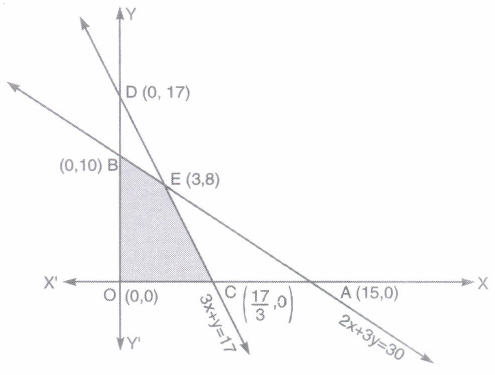
The shaded portion represents the feasible region OCEB, which is bounded.
Its vertices are O(0,0), \(C\left( \frac { 17 }{ 3 } ,0 \right) \) , B(0,10) and E(3,8).
[Solving 2x + 3y = 30 and 3x + y = 17; x = 3, y = 8]
Applying Corner Point Method, we have:
| Corner Point | Z = 100x + 120y |
| O : (0,0) | 0 |
| \(C:\left( \frac { 17 }{ 3 } ,0 \right) \) | \(\frac { 1700 }{ 3 } \) |
| E : (3,8) | 1260 |
| B : (0,10) | 1200 |
Hence, the maximum total revenue is obtained when 3 units of goods A and 8 units of goods B be produced.
Comments: We agree with the views of the manufacturer because men and women have equal rights according to the constitution of the country.
18.
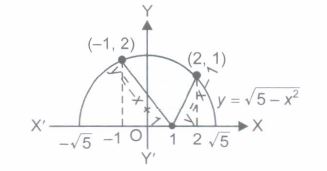
Corresponding equations are y = |x - 1|
\(\text { and } y=\sqrt{5-x^{2}}\)
\(\text { Eliminating } y \text { , we get }|x-1|=\sqrt{5-x^{2}}\)
\(\Rightarrow x^{2}+1-2 x=5-x^{2} \Rightarrow x=2,-1\)
\(\therefore \text { area }=\int_{-1}^{2} \sqrt{5-x^{2}} d x-\int_{-1}^{1}-(x-1) d x-\int_{1}^{2}(x-1) d x \)
\(=\left[\frac{x}{2} \sqrt{5-x^{2}}+\left.\frac{5}{2} \sin ^{-1} \frac{x}{\sqrt{5}}\right|_{-1} ^{2}-\left[-\frac{x^{2}}{2}+x\right]_{-1}^{1}\right.\)
\(-\left[\frac{x^{2}}{2}-x\right] \mid\)
\(=\left(1+\frac{5}{2} \sin ^{-1} \frac{2}{\sqrt{5}}\right)-\left[-1+\frac{5}{2} \sin ^{-1}\left(-\frac{1}{\sqrt{5}}\right)\right] \)
\(-\left[-\frac{1}{2}+1\right]+\left[-\frac{1}{2}-1\right]-[2-2]+\left(\frac{1}{2}-1\right) \)
\(=1+\frac{5}{2} \sin ^{-1} \frac{2}{\sqrt{5}}+1+\frac{5}{2} \sin ^{-1} \frac{1}{\sqrt{5}}-\frac{1}{2}-\frac{3}{2}-\frac{1}{2}\)
\(=\frac{5}{2} \sin ^{-1}\left[\frac{2}{\sqrt{5}} \sqrt{1-\frac{1}{5}}+\frac{1}{\sqrt{5}} \sqrt{1-\frac{4}{5}}\right]-\frac{1}{2} \)
\(=\frac{5}{2} \sin ^{-1}\left[\frac{4}{5}+\frac{1}{5}\right]-\frac{1}{2}=\frac{5}{2} \cdot \frac{\pi}{2}-\frac{1}{2} \)
\(=\frac{1}{4}(5 \pi-2) \text { sq units }
\)
19.
Equation of plane through the intersection of given two planes is:
\((x+y+z-1)+\lambda(2x+3y+4z-5)=0\)
\(\Rightarrow\) \((1+2\lambda)x+(1+3\lambda)y+(1+4\lambda)z-1-5\lambda=0\) ...(i)
Plane (i) is perpendicular to the plane
x - y + z = 0
So, \(1(1+2\lambda)-1(1+3\lambda)+1(1+4\lambda=0)\)
\(\Rightarrow\) \(3\lambda=-1\)
\(\therefore\) \(\lambda=-{{1}\over{3}}\)
\(\therefore\) Equation of plane is
\(\left(1-{{2}\over{3}} \right)x+(1-1)y+\left( 1-{{4}\over{3}}\right)z-1+{{5}\over{3}}=0\)
i.e., x - z + 2 = 0
Distance of above plane from origin
\(={{2}\over{\sqrt{2}}}=\sqrt{2}\) units.
20.
Let the young man drives x km and y km at 25kmh and 40 km!h speed respectively, then the LPP is Maximise distance:
Z = x + y
Subject to
2x + 5y \(\le\)100
\(x \geq 0, y \geq 0, \frac{x}{25}+\frac{y}{40} \leq 1\)
x, y \(\ge\)0
Plotting the inequations as graph we notice shaded portion is feasible solution.
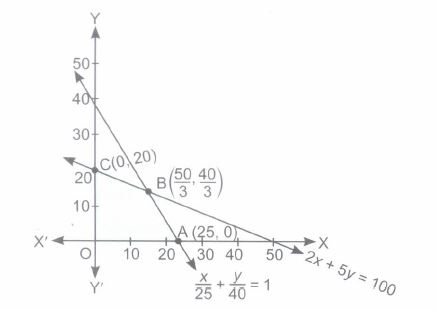
Possible points for maximum Z are A(25, 0), \(B\left(\frac{50}{3}, \frac{40}{3}\right)\) and C(0, 20).
| Points | Z = x + y | Values |
| A(25, 0) | 25 + 0 | 25 |
| \(B\left(\frac{50}{3}, \frac{40}{3}\right)\) | \(\frac{50}{3}+\frac{40}{3}\) | 30 \(\leftarrow\) Maximum |
| C(0, 20) | 0 + 20 | 20 |
Z is maximum at \( B\left(\frac{50}{3}, \frac{40}{3}\right) \text {, i.e. } x=\frac{50}{3}, y=\frac{40}{3} \text {. }\)
Hence, he must travel \( \frac{50}{3} \mathrm{~km} \)at a speed of 25 km h
\(\text { and } \frac{40}{3} \mathrm{~km} \text { at a speed of } 40 \mathrm{~km} / \mathrm{h} \)for a maximum distance of 30 km.
21.
Here a = 1, b = 3, nh = 2, f(x) = 3x2 + 1
\(\int _{ 1 }^{ 3 }{ \left( { 3x }^{ 2 }+1 \right) } dx\)
\(=\lim _{ h\rightarrow 0 }{ h\left[ { 3h }^{ 2 }\left( { 1 }^{ 2 }+{ 2 }^{ 2 }+...+\left( n-1 \right) ^{ 2 } \right) +6h\left( 1+2+...+\left( n-1 \right) \right) +4n \right] } \)
\(=\lim _{ h\rightarrow 0 }{ h\left[ \frac { 3\left( nh-h \right) \left( nh \right) \left( 2nh-h \right) }{ 6 } +\frac { 6\left( nh-h \right) \left( nh \right) }{ 2 } +4nh \right] } \)
\(=\lim _{ h\rightarrow 0 }{ h\left[ \frac { 3\left( 2-h \right) .2.\left( 4-h \right) }{ 6 } +\frac { 6\left( 2-h \right) .2 }{ 2 } +8 \right] } \)
= 8 + 12 + 8 = 28
22.
\(\frac{dx}{d\theta}=ae^{ \theta }(\sin\theta-\cos\theta)+ae^{ \theta }(\sin\theta+\cos\theta)\)
\(=2ae^{ \theta}\sin\theta\)
\(\frac{dy}{d\theta}=ae^{ \theta }(\sin\theta+\cos\theta)+ae^{ \theta }(\cos\theta-\sin\theta)\)
\(=2ae^{ \theta}\cos\theta\)
\(\therefore \frac{dy}{dx}=\frac{2ae^{ \theta}\cos\theta}{2ae^{ \theta}\sin\theta}=\cot\theta\)
\( \frac { dy }{ dx } |_{at\theta=\frac{\pi}{4}}=\cot\frac{\pi}{4}=1\)
23.
The given differential equation is :
\(x\frac { dy }{ dx } \sin { \left( \frac { y }{ x } \right) } +x-y\sin { \left( \frac { y }{ x } \right) } =0\)
\(\Rightarrow y\sin { \left( \frac { y }{ x } \right) } -x=\frac { xdy }{ dx } \sin { \left( \frac { y }{ x } \right) } \)
\(\Rightarrow \frac { dy }{ dx } =\frac { y\sin { \left( \frac { y }{ x } \right) } -x }{ x\sin { \left( \frac { y }{ x } \right) } } \) ... (i)
\(f\left( x,y \right) =\frac { y }{ x } -cosec\left( \frac { y }{ x } \right) \)
Now, put \(x=\lambda x,y=\lambda y\), then
\(f\left( \lambda x,\lambda y \right) =\frac { \lambda y }{ \lambda x } -cosec\left( \frac { \lambda y }{ \lambda x } \right) \)
\(=\frac { y }{ x } -cosec\left( \frac { y }{ x } \right) \)
= f (x, y)
So, it is homogeneous
Now, put y = vx in equation (i).
On differentiating both sides w.r.t. x, we get
\(\frac { dy }{ dx } =v+x\frac { dv }{ dx } \)
Now from (i), \(v+x\frac { dv }{ dx } =\frac { vx }{ x } -\frac { 1 }{ \sin { \left( \frac { vx }{ x } \right) } } \)
\(\Rightarrow x\frac { dv }{ dx } =-\frac { 1 }{ \sin { v } } \)
\(\Rightarrow -\int { \sin { v } dv } =\int { \frac { dx }{ x } } \)
\(\Rightarrow \cos { v } =\log { \left| x \right| } +C\)
\(\Rightarrow \cos { \left( \frac { y }{ x } \right) } =\log { \left| x \right| } +C\)
It is given that x = 1 and y = \(y={ \pi }/{ 2 }\)
So, \(\cos { \frac { \left( \frac { \pi }{ 2 } \right) }{ 1 } } =C+\log { \left| 1 \right| } \)
\(\Rightarrow C=0\)
\(\Rightarrow \cos { \left( \frac { y }{ x } \right) } =\log { \left| x \right| } \)
Hence, required solution is
\(\cos { \left( \frac { y }{ x } \right) } =\log { \left| x \right| } \)
24.
\(={ (x+y+z) }^{ 3 }\left| \begin{matrix} { (y+z) }^{ 2 } & x-y-z & x-y-z \\ { y }^{ 2 } & x+z-y & 0 \\ { z }^{ 2 } & 0 & x+y-z \end{matrix} \right| \)
LHS = \(\left| \begin{matrix} { (y+z) }^{ 2 } & xy & zx \\ xy & { (x+z) }^{ 2 } & yz \\ xz & yz & { (x+y) }^{ 2 } \end{matrix} \right| \)
Apply \(({ R }_{ 1 }\rightarrow x{ R }_{ 1 },\quad { R }_{ 2 }y\rightarrow { R }_{ 2 },{ R }_{ 3 }z\rightarrow { R }_{ 3 })\)
\(=\frac { 1 }{ xyz } \left| \begin{matrix} { x(y+z) }^{ 2 } & { x }^{ 2 }y & z{ x }^{ 2 } \\ x{ y }^{ 2 } & { y(x+z) }^{ 2 } & { y }^{ 2 }z \\ x{ z }^{ 2 } & y{ z }^{ 2 } & { z(x+y) }^{ 2 } \end{matrix} \right| \)
\(=\left| \begin{matrix} { (y+z) }^{ 2 } & { x }^{ 2 } & { x }^{ 2 } \\ { y }^{ 2 } & { (x+z) }^{ 2 } & { y }^{ 2 } \\ x{ z }^{ 2 } & { z }^{ 2 } & { (x+y) }^{ 2 } \end{matrix} \right| \)
Applying \({ C }_{ 2 }\rightarrow { C }_{ 2 }-{ C }_{ 1 },{ C }_{ 3 }\rightarrow { C }_{ 3 }-{ C }_{ 1 }\)
\(=\left| \begin{matrix} { (y+z) }^{ 2 } & { x }^{ 2 }-{ (y+z) }^{ 2 } & { x }^{ 2 }-{ (y+z) }^{ 2 } \\ { y }^{ 2 } & { (x+z) }^{ 2 }-{ y }^{ 2 } & 0 \\ { z }^{ 2 } & 0 & { (x+y) }^{ 2 }-{ z }^{ 2 } \end{matrix} \right| \)
Taking (x + y + z) common from C2 and C3 .
\(={ (x+y+z) }^{ 3 }\left| \begin{matrix} { (y+z) }^{ 2 } & x-y-z & x-y-z \\ { y }^{ 2 } & x+z-y & 0 \\ { z }^{ 2 } & 0 & x+y-z \end{matrix} \right| \)
Apply \({ R }_{ 1 }\rightarrow { R }_{ 1 }-{ R }_{ 2 }-{ R }_{ 3 }\)
\(={ (x+y+z) }^{ 2 }\left| \begin{matrix} { (y+z) }^{ 2 } & x-y-z & x-y-z \\ { y }^{ 2 } & x+z-y & 0 \\ { z }^{ 2 } & 0 & x+y-z \end{matrix} \right| \)
Apply, \({ C }_{ 2 }\rightarrow y{ C }_{ 2 },{ C }_{ 3 }\rightarrow z{ C }_{ 3 }\)
\(=\frac { { (x+y+z) }^{ 2 } }{ yz } \left| \begin{matrix} 2yz & 0 & 0 \\ { y }^{ 2 } & x+z-y & { y }^{ 2 } \\ { z }^{ 2 } & { z }^{ 2 } & zx+yz \end{matrix} \right| \)
\(=\frac { { (x+y+z) }^{ 2 } }{ yz } \left| (2yz).({ x }^{ 2 }yz+x{ y }^{ 2 }z+xy{ z }^{ 2 }+{ y }^{ 2 }{ z }^{ 2 }-{ y }^{ 2 }{ z }^{ 2 } \right| \)
\(=2xyz{ (x+y+z) }^{ 3 }=RHS\)
25.
(i) \(A+B=\left( \begin{matrix} 15000 & 30000 & 36000 \\ 70000 & 40000 & 20000 \end{matrix} \right) \)
(ii) 2 % of B = \(A+B=\left( \begin{matrix} 100 & 200 & 120 \\ 400 & 200 & 200 \end{matrix} \right) \)
Amount paid by X = Rs. 420
Amount paid Y = Rs. 800
(iii) Kindness, Helpfulness, Service to the society etc.
26.
For getting A2 = \(\left( \begin{matrix} 5 & 0 & 8 \\ 2 & 4 & 5 \\ 8 & 0 & 13 \end{matrix} \right) \)
For getting A3 = \(\left( \begin{matrix} 21 & 0 & 34 \\ 12 & 8 & 23 \\ 34 & 0 & 55 \end{matrix} \right) \)
Simplifying A3 - 6A2 + 7A + kI3 as
\(\left( \begin{matrix} k-2 & 0 & 0 \\ 0 & k-2 & 0 \\ 0 & 0 & k-2 \end{matrix} \right) \)
Equating \(\left( \begin{matrix} k-2 & 0 & 0 \\ 0 & k-2 & 0 \\ 0 & 0 & k-2 \end{matrix} \right) \)
\(=\left( \begin{matrix} 0 & 0 & 0 \\ 0 & 0 & 0 \\ 0 & 0 & 0 \end{matrix} \right) \)
\(\Rightarrow\) k - 2 = 0
\(\Rightarrow\) k = 2
Alternative Method :
\(A=\left[ \begin{matrix} 1 & 0 & 2 \\ 0 & 2 & 1 \\ 2 & 0 & 3 \end{matrix} \right] \)
\({ A }^{ 2 }=\left[ \begin{matrix} 1 & 0 & 2 \\ 0 & 2 & 1 \\ 2 & 0 & 3 \end{matrix} \right] \times \left[ \begin{matrix} 1 & 0 & 2 \\ 0 & 2 & 1 \\ 2 & 0 & 3 \end{matrix} \right] \)
\(=\left[ \begin{matrix} 1+0+4 & 0+0+0 & 2+0+6 \\ 0+0+2 & 0+4+0 & 0+2+3 \\ 2+0+6 & 0+0+0 & 4+0+9 \end{matrix} \right] \)
\(=\left[ \begin{matrix} 5 & 0 & 8 \\ 2 & 4 & 5 \\ 8 & 0 & 13 \end{matrix} \right] \)
A3 = A2 . A = \(\left[ \begin{matrix} 5 & 0 & 8 \\ 2 & 4 & 5 \\ 8 & 0 & 13 \end{matrix} \right] \left[ \begin{matrix} 1 & 0 & 2 \\ 0 & 2 & 1 \\ 2 & 0 & 3 \end{matrix} \right] \)
\(=\left[ \begin{matrix} 21 & 0 & 34 \\ 12 & 8 & 23 \\ 34 & 0 & 55 \end{matrix} \right] \)
Now A3 - 6A2 + 7A + kP3 = 0
\(\Rightarrow \left[ \begin{matrix} 21 & 0 & 34 \\ 12 & 8 & 23 \\ 34 & 0 & 55 \end{matrix} \right] -\left[ \begin{matrix} 30 & 0 & 48 \\ 12 & 24 & 30 \\ 48 & 0 & 78 \end{matrix} \right] +\left[ \begin{matrix} 7 & 0 & 14 \\ 0 & 14 & 7 \\ 14 & 0 & 21 \end{matrix} \right] +\left[ \begin{matrix} k & 0 & 0 \\ 0 & k & 0 \\ 0 & 0 & k \end{matrix} \right] \)
\(=\left[ \begin{matrix} 0 & 0 & 0 \\ 0 & 0 & 0 \\ 0 & 0 & 0 \end{matrix} \right] \)
\(\Rightarrow\) 21 - 30 + 7 + k = 0
\(\Rightarrow\) k = 2
27.
Given, \(\left[ \begin{matrix} 2x & 3 \end{matrix} \right] \left[ \begin{matrix} 1 & 2 \\ -3 & 0 \end{matrix} \right] \left[ \begin{matrix} x \\ 3 \end{matrix} \right] =0\)
\(\Rightarrow \quad \left[ \begin{matrix} 2x-9 & 4x \end{matrix} \right] \left[ \begin{matrix} x \\ 3 \end{matrix} \right] =0\)
\(\Rightarrow \quad \left[ { 2x }^{ 2 }-9x+12x \right] =0\)
\(\Rightarrow \quad { 2x }^{ 2 }+3x=0\)
\(\Rightarrow \quad x\left( 2x+3 \right) =0\)
\(\therefore\) x = 0 or x = \(-\frac{3}{2}\)

12th Standard CBSE Syllabus & Materials
12th Standard CBSE
CBSE 12th Computer Science Python Revision Tour I - New Previous year Question Papers Study Material - QB365 Set A
NEW12th Standard CBSE
CBSE 12th Business Studies Planning Important Questions And Answers Study Material - QB365 Set A
NEW12th Standard CBSE
CBSE 12th Business Studies Business Environment Important Questions And Answers Study Material - QB365 Set A
NEW12th Standard CBSE
CBSE 12th Business Studies Principles of Management Important Questions And Answers Study Material - QB365 Set A



CBSE 12th Standard CBSE Subjects
CBSE Standards










