
 100% FREE ACCESS
12th Standard CBSE Syllabus & Materials
12th Standard CBSE
CBSE 12th Economics Government Budget and the Economy Previous year Question Papers Study Material - QB365 Set A
NEW12th Standard CBSE
CBSE 12th Computer Science Interface Python with MySQL - New Previous year Question Papers Study Material - QB365 Set A
NEW12th Standard CBSE
CBSE 12th Computer Science Database Concept - New Previous year Question Papers Study Material - QB365 Set A
NEW12th Standard CBSE
CBSE 12th Computer Science Data Communication - New Previous year Question Papers Study Material - QB365 Set A
NEW12th Standard CBSE
CBSE 12th Computer Science Data Structures - New Previous year Question Papers Study Material - QB365 Set A
NEW12th Standard CBSE
CBSE 12th Computer Science Functions - New Previous year Question Papers Study Material - QB365 Set A

Published on: 28/09/2019
Biodiversity and Conservation
Download CBSE Class 12th Standard CBSE Biology question papers, sample papers, important questions, and previous year solved papers in PDF format. Get free study materials, NCERT solutions, and exam preparation resources for Class 12th Standard CBSE Biology
Questions + Answers key
Take MCQ Biology Test
1.
Since the origin of life on earth and evolution there have been 5 episodes of mass extinction, but the current rate of extinction is 100-1000 times. What are the main causes of high extinction rate and how is it going to harm human beings?
2.
Name any one greenhouse gas and its possible source of production on a large scale. What are the harmful effects of it?
3.
Create an aquatic food chain in a water body into which effluents flow from a pesticide factory. Diagrammatically represent and answer the following questions:
What is the phenomenon called?
4.
The figure is given shows relative contributions of various greenhouse gasses to the total global warming.

(i) Name the gasses (a) and (b)
5.
(a) Why are people living in West Bengal prove to Black foot disease?
(b) What is blue baby syndrome? Explain.
6.
What is acid rain? What are its effects on plants?
7.
What is photochemical smog? How does smog affect the biological world?
8.
What does 'red' indicate in the IUCN red list (2004)?
9.
What is the ' wise use' concept of Ramsar convention? Name four types of wetlands included in its mission.
10.
When and where was the world summit on sustainable development held? How many countries signed the convention? What was the objective?
11.
Mention the three attributes that a stable community has.
12.
Describe with an example the latitudinal gradients of biodiversity
13.
Write an account on biodiversity in India.
14.
Give three reasons as to why the prokaryotes are not given any figures for their diversity by the ecologist.
15.
List the reasons that account for the greater biological diversity in tropics.
1.
Human activities are the basic cause for it.
Causes – 4 major causes (The evil Quartet along with suitable examples of each:
i) Habitat loss and fragmentation-decline in covered forest area from 14% to 6%.
ii) Overexploitation- extinction of steller’s sea cow
iii) Alien species invasion-Nile perch introduction into Lake Victoria resulted in extinction of 200 species cichlid fish.
iv) Co-extinction-coevolved plant pollinator mutualism.
Harms: (a) Decline in plant production
b) Lowered resistance to Env. Perturbations like drought.
c) Increased variability in certain ecosystem processes such as plant productivity, water use etc.
2.
Carbon dioxide is a major greenhouse gas. Various human activities such as combustion of fossil fuels, electricity generation, transportation and industries are sources of its large scale production. Excess of CO2 is harmful and considered as a pollutant. It is because it traps longer wavelength IR radiations reflected by earth's surface, thus causing global warming.
3.
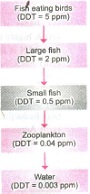
Biomagnification or biological magnification.
4.
(i) (a) N2O (nitrous oxide) (b) CH4(Methane)
5.
(a) In West Bengal, ground water is contaminated with arsenic.Chronic exposure to arsenic causes black foot disease in humans.
(b) Presence of excess nitrates in drinking water are harmful for human health and may be fatal for infants.In infants, excess nitrates react with haemoglobin to form non-functional methamoglobin that impairs oxygen transport.This condition is termed as blue baby syndrome or methaemoglobinemia.
6.
Acid rain refers to precipitation with a pH of less than 5. It is, in fact, a mixture of sulphuric acid and nitric acid.
7.
Photochemical smog is grey or yellowish brown, opaque smog formed at high temperature over cities and towns due to still air, emission of nitrogen oxides and volatile hydrocarbons from automobile exhausts and solar energy.It contains secondary pollutants. It is having oxidizing environment.
8.
'Red' in IUCN red list (2004) indicates the threatened species i.e. the species under varying degree of extinction risk categories.
9.
The 'wise use' of wetlands refers to the maintenance of their ecological characters through the implementation of ecosystem approaches and the conservation and sustainable use of wetlands and their resources for human benefit. e.g. swamps and marshes, coral reefs, mangroves, estuaries, near-shore marine areas, peatlands.
10.
1. The world summit on sustainable development was held in 2002, in Johannesburg, south Africa.
2. 190 countries signed the convention.
3. Its objective was achive by 2010, a significant reduction in the current rate of biodiversity loss at global, regional and local levels.
11.
Stable community
(i) It shall not show too much variations in the year-to-year productivity.
(ii) It must be either resistant or resilient to sesonal disturbances.
(iii) It must be resistant to invasion of alien species.
12.
Latitudinal Gradients of Biodiversity
1. Species diversity decreases from equator towards poles.
2. The tropics (between 23.5°N to 23.5°S) has about 1400 species of birds, while New York (41°N) has about 56 species; India has 1200 species
3. The number of species of vascular plants in tropics is about ten times more that of temperate forests.
4. The Amazonian rainforest in South America has the greatest biodiversity on earth; it harbours about 40,000 species of plants, 1,25,000 species of insects, 3000 of fishes, 427 of amphibians, 378 of reptiles, 1300 of birds and 427 of mammals.
13.
1. India is one of the twelve biodiversity rich countries of the world.
2. Though India has only 2.4% of the land area of the world, it has 8.1% of the global species biodiversity.
3. There are about 45,000 species of plants and 90,000-1,00,000 species of animals, many more species are yet to be discovered and named.
4. If we apply Robert May's global estimate that only 22% of the total species have been recorded, India probably has more than 1,00,000 species of plants and 3,00,000 species of animals to be discovered and described.
14.
(i) The conventional taxonomic methods are not suitable/sufficient for identifying these microbes.
(ii) Many of these cannot be cultures under laboratory conditions.
(iii) Biochemical and molecular biology techniques wopuld put their diversity into millions.
15.
(i) Speciation is a function of time: the temperate regions were subjected to frequent glaciation in the past, while the tropics have remained undisturbed and hence had longer time to evolve more species diversity.
(ii) The tropical environments are less seasonal and relatively more constant and more predictable than temperate regions; speciation has been promoted/favoured by such constant environments and hence there is greater species diversity.
(iii) There is more solar radiation available in the tropical region; this contributes directly to more productivity and indirectly to greater species diversity.

12th Standard CBSE Syllabus & Materials
12th Standard CBSE
CBSE 12th Computer Science Python Revision Tour I - New Previous year Question Papers Study Material - QB365 Set A
NEW12th Standard CBSE
CBSE 12th Business Studies Planning Important Questions And Answers Study Material - QB365 Set A
NEW12th Standard CBSE
CBSE 12th Business Studies Business Environment Important Questions And Answers Study Material - QB365 Set A
NEW12th Standard CBSE
CBSE 12th Business Studies Principles of Management Important Questions And Answers Study Material - QB365 Set A



CBSE 12th Standard CBSE Subjects
CBSE Standards










