
 100% FREE ACCESS
12th Standard CBSE Syllabus & Materials
12th Standard CBSE
CBSE 12th Economics Government Budget and the Economy Previous year Question Papers Study Material - QB365 Set A
NEW12th Standard CBSE
CBSE 12th Computer Science Interface Python with MySQL - New Previous year Question Papers Study Material - QB365 Set A
NEW12th Standard CBSE
CBSE 12th Computer Science Database Concept - New Previous year Question Papers Study Material - QB365 Set A
NEW12th Standard CBSE
CBSE 12th Computer Science Data Communication - New Previous year Question Papers Study Material - QB365 Set A
NEW12th Standard CBSE
CBSE 12th Computer Science Data Structures - New Previous year Question Papers Study Material - QB365 Set A
NEW12th Standard CBSE
CBSE 12th Computer Science Functions - New Previous year Question Papers Study Material - QB365 Set A

Published on: 28/09/2019
Biotechnology and its Applications
Download CBSE Class 12th Standard CBSE Biology question papers, sample papers, important questions, and previous year solved papers in PDF format. Get free study materials, NCERT solutions, and exam preparation resources for Class 12th Standard CBSE Biology
Questions + Answers key
Take MCQ Biology Test
1.
(a) What is Gene therapy?
(b) Describe the procedure of such a therapy that could be a permanent cure for a disease. Name the disease.
2.
Why is the 'insertional inactivation' method to detect recombinant DNA preferred to 'antibiotic resistance' procedure?
3.
Explain enzyme-replacement therapy to treat adenosine deaminase deficiency. Mention two disadvantages of this procedure.
4.
A new type of drug, PTC 124, enables translation to continue through the nonsense codon. Trials in mice homozygous for a CFTR allele containing the nonsense codon have found that animals treated with PTC 124 produce normal CFTER protein in their cells. The drug is taken orally and is readily taken up into cells all over the body.
Using your knowledge of the progress toward successful gene therapy for cystic fibrosis, suggest why PTC 124 could be simpler and more reliable treatment for this disease.
5.
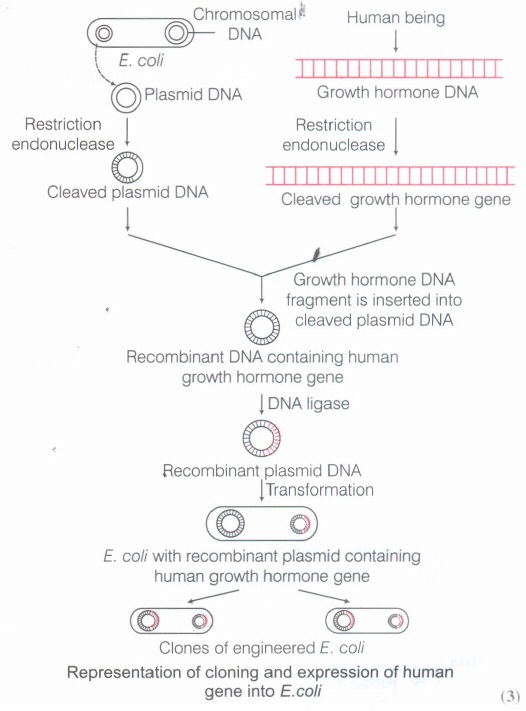
Diagrammatically represent the experimental steps in cloning and expressing a human gene (say the gene for growth hormone) into a bacterium like E. coli.
6.
Described any three potential applications of geneticlly modified plants.
7.
Explain how polymerase chain reaction (PCR) technique is helpful in detecting bacterial and viral diseases when symptoms of the disease are not yet visible? Give two examples.
8.
(i) A transgenic organism gives milk which has huge quantities of human protein.
(ii) A transgenic fruit acts as edible vaccine which protects children against diarrhoea.
(iii) A transgenic fruit has capability of producing ethylene 10% less as compared to normal slowing down the process of ripening.
9.
What are genetically modified organisms?
10.
(A) Define cloning.What are its benefits?
(B) Describe transgenics.Write briefly about a transgenic crop that has been introduced in India.
11.
Enlist with examples the different groups of insects to which the crystal proteins are toxic.
12.
Mention the advantages of recombinant therapeutics. How many of them have been approved world over for human buse and how many are marketed in India?
13.
What are the three critical reaseach areas of biotechnology?
14.
Mention any six fields of applications of biotechnology for human welfare.
15.
Differentiate between diagnostics and therapeutics. Give one example for each category.
1.
(a) (Collection of) methods that allows correction of gene defect that has been diagnosed in a child/embryo/Here the genes are inserted into a person's cells and tissues to treat a hereditary disease. It compensate the non-functional gene this involves delivery of a normal gene into the individual/embryo to take over the function of non-functional/a defective gene.
(b) If the desired gene is isolated and introduced into cells at early embryonic stages it can provide a permanant cure. ADA/Adenosine deaminase deficiency
2.
The presence of a chromogenic substrate gives blue coloured colonies, in absence of an insert/in non-transformants, presence of an insert (in the enzyme site), results into (insertional inactivation of the β-galactosidase) colonies which do not produce colour.
Antibiotic resistance method requires duplicate plating/cumbersome procedure.
3.
Functional adenosine is given to the patient by injection.
Disadvantages:
Therapy is not completely curative, periodic infusion of enzyme required
Detailed Answer:
Adenosine deaminase deficiency is a genetic disorder. The disorder is caused due to the deletion of the gene for adenosine deaminase, the enzyme crucial for the immune system to function. Adenosine deaminase deficiency in patients can be treated by enzyme replacement therapy. In this treatment, patients are regularly injected with the functional ADA enzyme.
Disadvantages of this process:
(a) It does not completely eradicate the disease.
(b) The requirement of repeated doses of the enzymes makes it expensive.
4.
Drug PTC, 124 is taken orally while gene therapy requires the delivery of gene by vectors into respiratory tract. PTC 124 can be self administered while gene therapy requires proper medical treatment monitored by professionals. PTC 124 is readily taken up by cells while gene by vector system may be poorly or partially taken up by few cells.PTC 124 may have fewer or no side effects while gene therapy has possibility of side effects, i.e. viral vectors may cause infections.
5.
The multiple identical copies of specific template DNA can be produced by DNA cloning. It can be carried out by the use of a vector to carry specific foreign DNA fragment into the host cell. The mechanism of cloning and transfer of a gene for human growth hormone into
E. coil is diagrammatically represented below:
6.
Potential applications of genetically modified plants are:
(i) nutritional enhancement, e.g vitamin-A enriched rice.
(ii) Stress tolerance crops are more toleeant to abiotic stresses such as cold, drought, etc.
(iii) Creation of tailor made plants by using GM plants to supply alternative resources to industries in the form of starches, biofuels, etc.
7.
Very low concentration of a bacteria or virus in human body can be detected by amplification of their nucleic acid using the technique of polymerase chain reaction (PCR).This method is applied to detect HIV in suspected AIDS patients and to detect mutations in genes in suspected cancer patients.
8.
(i) A sheep named 'Tracy'.
(ii) Transgenic bananas that contain a portion of the 'enterotoxin' gene of E.coli.These bananas have potential to protect children against diarrhoea.
(iii) Flavr Savr tomatoes.
9.
Genetically modified organisms are the living organisms (plants, animals, or bacteria) which have been genetically 'engineered' by the insertion of a foreign gene (a transgene).
10.
(A) The production of one individual organism or a group of organisms of identical genotype or cells that have been derived from a single parental organism or cell by some kind of asexual reproduction or parthenogenesis.There are two types of cloning - gene cloning at molecular level and cell or organism cloning.Cloning is beneficial in DNA-finger printing, DNA-probe, genetherapy and genetic engineering.
(B) An organism which becomes transformed following the introduction of new DNA sequence into its geneome is called transgenic organism. Most popularly the transgenic crops are called genetically modified crops or GM crops.
A transgenic crop that has been recently introduced in India is Bt cotton. This transgenic variety of cotton contains a foreign gene obtained from a soil bacterium -Bacillus thuringiensis. The bacterium produces a crystal (Cry) protein which is toxic to larvae of certain insects.The gene responsible for production of Cry protein, i.e.., cry gene, has been isolated and introduced into the cotton genome so that the transgenic Bt cotton has become insects resistant.The Bt cotton is now grown in different parts of India and has resulted approximately 3% to 27% increase in cotton yield.
11.
Insect groups to which cry protein is toxic.
(i) Lepidopterans - Tobacco bud worm Army worm
(ii) Coleopterans - Beetles
(iii) Dipterans - Files, mosquitoes
12.
Recombinant Therapeutics
The recombinant therapeutics do not induce unwanted immunological responses like similar products of non-human origin.
About 30 recombinant therapeutics have been approved world over.
12 of them are being marketed in India.
13.
Research areas of Biotechnology:
(i) Providing the best catalyst in the form of improved organisms (usually a microbe) or pure enzyme.
(ii) Creating optimal conditions through engineering for a catalyst to act.
(iil) Downstream processing technologies to purify the protein/organic compound.
14.
Applications of Biotechnology:
(i) Therapeutics
(ii) Genetically modified crops
(iii) Molecular diagnostics
(iv) Processed food items
(v) Bioremediation
(vi) Biological waste treatment
(vii) Energy production
15.
A diagnostic technique helps to identify or confirm a disorder.
e.g., ELISA is used to diagnose HIV infection.
A therapeutic agent is used to help in the treatment of a disease.
e.q., \(\alpha \)-1 antitrypsin is used to treat emphysema.

12th Standard CBSE Syllabus & Materials
12th Standard CBSE
CBSE 12th Computer Science Python Revision Tour I - New Previous year Question Papers Study Material - QB365 Set A
NEW12th Standard CBSE
CBSE 12th Business Studies Planning Important Questions And Answers Study Material - QB365 Set A
NEW12th Standard CBSE
CBSE 12th Business Studies Business Environment Important Questions And Answers Study Material - QB365 Set A
NEW12th Standard CBSE
CBSE 12th Business Studies Principles of Management Important Questions And Answers Study Material - QB365 Set A



CBSE 12th Standard CBSE Subjects
CBSE Standards










