
 100% FREE ACCESS
12th Standard CBSE Syllabus & Materials
12th Standard CBSE
CBSE 12th Economics Government Budget and the Economy Previous year Question Papers Study Material - QB365 Set A
NEW12th Standard CBSE
CBSE 12th Computer Science Interface Python with MySQL - New Previous year Question Papers Study Material - QB365 Set A
NEW12th Standard CBSE
CBSE 12th Computer Science Database Concept - New Previous year Question Papers Study Material - QB365 Set A
NEW12th Standard CBSE
CBSE 12th Computer Science Data Communication - New Previous year Question Papers Study Material - QB365 Set A
NEW12th Standard CBSE
CBSE 12th Computer Science Data Structures - New Previous year Question Papers Study Material - QB365 Set A
NEW12th Standard CBSE
CBSE 12th Computer Science Functions - New Previous year Question Papers Study Material - QB365 Set A

Published on: 28/09/2019
Ecosystem
Download CBSE Class 12th Standard CBSE Biology question papers, sample papers, important questions, and previous year solved papers in PDF format. Get free study materials, NCERT solutions, and exam preparation resources for Class 12th Standard CBSE Biology
Questions + Answers key
Take MCQ Biology Test
1.
(a) Healthy ecosystems are the base of wide range of (ecosystem) services. Justify.
(b) Explain the difference and the similarities between hydrarch and xerarch successions of plants.
2.
State the function of a reservoir in a nutrient cycle. Explain the simplified model of carbon cycle in nature.
3.
"Man can be primary as well as secondary consumer". Justify this statement.
4.
Construct labelled grazing and detritus food chains with minimum three trophic levels each.
5.
How does a detritivore differ froma decomposer? Explain each with an example.
6.
What is Predation ? Explain with the help of suitable examples why is it required in a community with rich biodiversity?
7.
What is ecological succession? Where and why would the rate of succession be faster in newly created pond or a forest destroyed by a forest fire?
8.
Construct a pryamid of biomass starting with phytoplankton. Label trophic levels. Is the pyramid upright or inverted? Why?
9.
Name the pioneer species on a bare rock. How do they helping establishing the next type of vegetation? Mention the type of climax community that will ultimately get established.
10.
What is humus?Mention its properties.
11.
Describe the different classes of consumers.
12.
Give two examples of each of:
(i) Terrestrial ecosystem
(ii) Aquatic ecosystem
(iii) Man-made ecosystem
13.
What is primary productivity? Give a brief description of factors that affect primary productivity.
1.
(a) Healthy ecosystems are the base for a wide range of economic, environmental and aesthetic goods and services. The products of ecosystem processes are named as ecosystem services. For examples, healthy forest ecosystem purifies air and water, minimize droughts and floods, cycle nutrients, generates fertile soils, provides wildlife habitat, maintains biodiversity, pollinate crops, provid storage site for carbon and also provide aesthetic,cultural and spiritual values. Though value of such services of biodiversity is difficult to determine, it seems reasonable to think that biodiversity should carry a healthy price tag.
(b) Based on the nature of the habitat - whether it is water (or very wet areas) or it is on very dry areas- succession of plants is called hydrarch or xerarch, respectively.
Differences: Hydrarch succession takes place in wetter areas and the successional series progress from hydric to mesic conditions. As against this, xerarch succession takes place in dry areas and the series progress from xeric to mesic conditions.
Similarity: Both hydrarch and xerarch successions lead to medium water conditions (mesic), neither too dry (xeric) nor too wet (hydric).
2.
Function: To meet the deficit which occurs due to imbalance in the rate of influx and efflux.
.jpg)
3.
Man can be a primary as well as secondary consumer because man eats plants as well as meat of other animals. So, man is herbivores as well as carnivores.
4.
Grazing food chain:
Autotrophs ---> herbivores ---> primary carnivores ---> secondary carnivores
Detritus food chain:
Decay and ---> decomposer ---> soil animal
Excretory organism which consume Materials other soil from the organisms. grazing food.
5.
| S.No | Detritivore | Decomposer |
| 1. | Feeds on waste dead plant and animal remains including faecal matter | Degrades dead organic matter |
| 2. | Breaks feeding material into fragments. | Secretes enzymes into dead organic matter for decomposition. |
| 3. | e.g., Earthworm | e.g., Bacteria/Fungi. |
6.
Transfer of energy from one trophic level to the next, keeps the prey population under control, biological control, helps maintain species diversity.
7.
Gradual/predictable change in the species composition of given area. Rate of succession would be faster in a forest destroyed by a forest fire. Such disturbances create new conditions that encourage some species and discourage or eliminate other species/since after a forest fire some soil is already present. So, succession is faster than primary succession.
8.
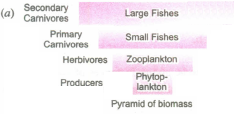
(b) Pyramid is inverted. It is because in pond ecosystem, producers are the smallest organisms while herbivores and carnivores are largest in size. Consequently, there is a gradual increase in biomass of organisms at successive trophic levels.
9.
(i) Lichens are the pioneer species on a bare rock. They are resistant to desiccation and temperature extremes. They produce organic acids which corrode the rock surface. This produces depressions and releases minerals which facilitate their further growth. The dead lichens add organic matter to the forming soil. The next community develops on thismeagre soil formed.
(ii) The climax community will be trees.
10.
Humus is a dark-coloured, amorphous substance accumulated by the process of humification during decomposition of detritus.
Properties:
(i) It is highly resistant to microbial action and undergoes decomposition at an extremely slow rate.
(ii) Being colloidal in nature ,it serves as a reservoir of nutrient.
(iii) It improves the water-holding capacity of soil.
11.
All organisms/animals which depend directly or indirectly on plants for their food are called consumers.
Consumers are of the following types:
(i) Primary consumers
They are the organisms/animals which depend directly on producers for their food;they are also called as herbivores,e.g. deer, rabbit, zooplanktons.
(ii)Secondary consumers
Secondary consumers are those animals which depend on the primary consumers for their food; they are primary carnivores, e.g frogs,hyena.
(iii)Tertiary consumers
Tertiary consumers are those animals which depend on the secondary consumers for their food;they are the secondary carnivores, e.g. lion, eagle, kite, etc.
12.
(i) Grasslands,Forests.
(ii) Oceans, Ponds, Lakes.
(iii) Agricultural fields, Aquariums.
13.
Primary productivity is defined as the amount of biomass or organic matter produced per unit area over a time period by the plants during photosynthesis.
It is also defined as the amount of biomass or organic matter produced per unit area over a time period by the plants during photosynthesis.
Primary productivity depends on:
(i)The plant species inhabiting a particular area.
(ii)The environmental factors.
(iii) Available of nutrient.
(iv) Photosynthetic capacity of plants.

12th Standard CBSE Syllabus & Materials
12th Standard CBSE
CBSE 12th Computer Science Python Revision Tour I - New Previous year Question Papers Study Material - QB365 Set A
NEW12th Standard CBSE
CBSE 12th Business Studies Planning Important Questions And Answers Study Material - QB365 Set A
NEW12th Standard CBSE
CBSE 12th Business Studies Business Environment Important Questions And Answers Study Material - QB365 Set A
NEW12th Standard CBSE
CBSE 12th Business Studies Principles of Management Important Questions And Answers Study Material - QB365 Set A



CBSE 12th Standard CBSE Subjects
CBSE Standards










