
 100% FREE ACCESS
12th Standard CBSE Syllabus & Materials
12th Standard CBSE
CBSE 12th Economics Government Budget and the Economy Previous year Question Papers Study Material - QB365 Set A
NEW12th Standard CBSE
CBSE 12th Computer Science Interface Python with MySQL - New Previous year Question Papers Study Material - QB365 Set A
NEW12th Standard CBSE
CBSE 12th Computer Science Database Concept - New Previous year Question Papers Study Material - QB365 Set A
NEW12th Standard CBSE
CBSE 12th Computer Science Data Communication - New Previous year Question Papers Study Material - QB365 Set A
NEW12th Standard CBSE
CBSE 12th Computer Science Data Structures - New Previous year Question Papers Study Material - QB365 Set A
NEW12th Standard CBSE
CBSE 12th Computer Science Functions - New Previous year Question Papers Study Material - QB365 Set A

Published on: 28/09/2019
Organisms and Populations
Download CBSE Class 12th Standard CBSE Biology question papers, sample papers, important questions, and previous year solved papers in PDF format. Get free study materials, NCERT solutions, and exam preparation resources for Class 12th Standard CBSE Biology
Questions + Answers key
Take MCQ Biology Test
1.
The range of tolerance to the variations in each environmental factor varies greatly in different species.Name the terms used for species.
(i) Which live in regions of nearly uniform temperature throughout the year and showing narrow range of tolerance to temperature changes.
(ii) Which live in areas where temperature changes significantly at different times of the year and showing wide range of tolerance to temperature changes.
2.
(a) Write an equation for Verhulst Pearl logistic Growth where
N = Population density at a time t
r = Intrinsic rate of natural increase
K = Carrying capacity
(b) Draw a graph for a Population whose population density has reached the carrying capacity.
(c) Why is the logistic growth model considered a more realistic one for most animal populations?
(d) Draw a growth curve where resources are not limiting to growth of a population.
3.
Why is the thermoregulation more effective achieved in larger animals than in smaller ones?
4.
Distinguish between the following:
(a) Hiberation and aestivation
(b) Ectotherms and endotherms.
5.
If the population growing exponentially doubles in size in 3 years, what is the intrinsic rate of increase (r) of the population?
6.
Mutualism often involves co-evolution of the mutualists. Describe taking the example of animal plant (wast-fig) relationship.
7.
Competition does not always occur between closely related species for the same resources. Substantiate the statement with examples.
8.
Describe any three reproductive strategies that organisms have evolved in relation to a particular set of selective pressures.
9.
Name six major terrestrial biomes of the world.
10.
Give one example for each of the following:
(a) Migratory animal
(b) Predator animal
(c) Phytophagous animals
(d) Camouflaged animal
(e) Chemical defense agent.
11.
Write a short note on adaptations of desert plants and animals.
12.
How do organisms like fungi, zooplanktons and bears overcome the temporary, short-lived climatic stressful conditions? Explain.
13.
How do organisms cope with stressful environmental conditions, which are localised or of short duration?
14.
Water is very essential for life. Write any three features both for plants and animals, which enable them to survive in water-scarce environment.
1.
(i) Stenothermal species
(ii) Eurythermal species
2.
(a) Density equation \(\frac { dN }{ dt } =\quad r\quad N\left( \frac { K-N }{ K } \right) \)
(b and d) 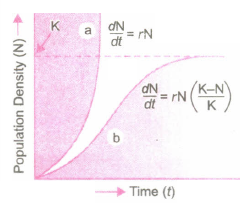
(a) When responses are not limiting the growth.
(b) When responses are limiting the growth. K = Carrying capacity
(c) The reasons for growth for most animal populations are finite and become limiting sooner or later. This is why the logistic model is considered a more realistic one.
3.
Larger animals such as birds and mammals are able to maintain body temperature by physiological means.These have more volume and smaller surface area as compared to smaller animals.
4.
(a) Differences between hibernation and aestivation
| Hibernation | Aestivation |
| 1. Spending the winter in an inactive/dormant state, is called hibernation (winter sleep). | 1.Spending dry,hot period (summer) in an inactive period is called aestivation (summer sleep). |
| 2. Example. Northern ground squirrels. | 2. Example. Ground squirrels in the South West deserts. |
(b) Difference between ectotherms and endotherms.
| Ectotherms | Endotherms |
|
Ecthotherms are those animals whose body temperature changes to match with that of the surroundings, in which they are living |
Endotherms are those animals whose body temperature is maintained relatively constant by physiological regulation. |
5.
The intrinsic rate of increase (r) of such a population will be towards maximum.Intrinsic rate of increase (r) of population can be calculated by applying following equation:
rN = \(\frac { dN }{ dt } \) when N= population size
6.
Co-evolution of mutualists:
Evolution of the flower characteristics and its pollinator species is highly linked with each other as in wasp-fig relationship.
A given species of fig is pollinated by a specific (partner) wasp species.
The wasp pollinates the fig inflorescence while searching fon a suitable egg laying site.
The female wasp uses the ovary of flowers for oviposition (laying eggs) and the developing seeds provide nourishment to the young ones.
Later the young ones emerge from the fruits of fig.
7.
a) These are places at high altitudes, i.e. 73,500 m above sea level.
Tourists may experience altitude sickness, whose symptoms include nausea, heart palpitations and fatigue.
Since the atmospheric pressure is low at high altitude, the body does not get enough oxygen.
But gradually, the body gets acclirnatised and stops experiencing altitude sickness.
(b) Heat loss or gain is a function of the surface area of the body.
Small animals have a larger surface area relative to the volume of the body; hence they tend to lose body heat very fast, when it is cold outside.
They have to spend more energy to generate body heat through metabolism; hence small animals are not found in polar regions.
8.
Reproductive strategies:
(i) Some organisms breed only once in their life time-e.g. Bamboo, Pacific Salmon.
(ii) Some produce a large number of small-sized offspring-Oysters.
(iii) Some breed many times during their life time-e.g. birds.
(iv) Some produce a small number of large sized offspring, e.g. Mammals.
9.
(i) Tropical rainforest
(ii) Deciduous forest
(iii) Desert
(iv) Coniferous forest
(v) Agricultural fields
(vi) Grassland.
10.
(a) Arctic tern
(b) Tiger/Lion
(c) Aphid
(d) Chameleon
(e) Glycosides (in Calotropis).
11.
(a) Adaptations of desert plants and animals.
Adaptations of desert animals.
1. Animals faced with water scarcity as found in arid or desert areas, show two types of adaptations, reducing water loss and ability to tolerate arid conditions KangaroolDesert Rat seldom drinks water. It has a thick coat to minimise evaporative desiccation. The animal seldom comes out of its comparatively humid and cool burrow during the day time. 90%of its water requirement is met from metabolic water (water produced by respiratory breakdown) while 10% is obtained from food.
2. Loss of water is minimised by producing nearly solid urine and feces.
3. Spiny skin and highly cornified in Phrynosoma (horned toad) and Maloch horridus.
Adaptations of desert plants.
1. Plants have thick cuticle, succulent organs where water and mucilage are stored.
2. Stomata are sunken.
3. They have well developed branched root system.
4. They possess waxy coating on surface.
5. Crassilucean pathway of photosynthesis.
6. They \({ C }_{ 4 }\) are plants.
(b) Adaptations of plants to water scarcities. They are called xerophytes. The above mentioned adaptation of plants are applicable (see part (a)))
(c) Behavioural adaptations in animals.
(i) Hibernation
(ii) Aestivation
(iii) Periodic activity
(iv) Camouflage migration.
(d) Importance of light to plants.
(1) Source of energy
(2) Photoperiodism
(3) Pigmentation
(4) Daily rhythm
(5) Plant movements and
(6) Growth.
(e) Effect of temperature or water scarcity and adaptation of animals. As discussed in(c) and reducing loss of water from body, and ability to tolerate arid condition.
12.
Fungi produce various kinds of thick-walled spores to survive under unfavorable conditions; they germinate when conditions become favorable.
Zooplanktons enter diapause, a stage of suspended development, under unfavourable conditions.
Bears go into hibernation during winter to escape in time of unfavourable conditions.
13.
Organisms either migrate or suspend their metabolic functions when the stressful conditions are localised or of short duration. Under such conditions, the organisms follow one of the following alternatives:
(i) The organism moves away from the stressful habitat to a more hospitable area and return to their habitat when the stressful period is over, e.g. Birds from Siberia and other cold countries migrate to Bharatpur Sanctuary in Rajasthan.
(ii) Animals which cannot migrate show hibernation during winter (e.g., frogs) or aestivation in summer (e.g. snails) or enter diapause (zooplanktons).
(iii) In bacteria, fungi and lower groups of plants, various types of thick-walled spores are formed. They germinate under suitable conditions.
14.
Plants:
The adaptations of plants to water scarcity are as follows:
(i) Desert plants have a thick cuticle on their leaf surface.
(ii) Their stomata are arranged in deep pits (sunken) to minimise water loss through transpiration.
(iii) Leaves are reduced to spines and the photosynthetic function is carried out by thick, fleshy flattened stems (phylloclades).
Animals:
(i) Animals like kangaroo rats are capable of meeting the water requirements through internal oxidation of fat.
(ii) They can concentrate their urine so that minimal volume of water is excreted.
(iii) Animals like snails undergo aestivation during hot summers.

12th Standard CBSE Syllabus & Materials
12th Standard CBSE
CBSE 12th Computer Science Python Revision Tour I - New Previous year Question Papers Study Material - QB365 Set A
NEW12th Standard CBSE
CBSE 12th Business Studies Planning Important Questions And Answers Study Material - QB365 Set A
NEW12th Standard CBSE
CBSE 12th Business Studies Business Environment Important Questions And Answers Study Material - QB365 Set A
NEW12th Standard CBSE
CBSE 12th Business Studies Principles of Management Important Questions And Answers Study Material - QB365 Set A



CBSE 12th Standard CBSE Subjects
CBSE Standards










