
 100% FREE ACCESS
12th Standard CBSE Syllabus & Materials
12th Standard CBSE
CBSE 12th Economics Government Budget and the Economy Previous year Question Papers Study Material - QB365 Set A
NEW12th Standard CBSE
CBSE 12th Computer Science Interface Python with MySQL - New Previous year Question Papers Study Material - QB365 Set A
NEW12th Standard CBSE
CBSE 12th Computer Science Database Concept - New Previous year Question Papers Study Material - QB365 Set A
NEW12th Standard CBSE
CBSE 12th Computer Science Data Communication - New Previous year Question Papers Study Material - QB365 Set A
NEW12th Standard CBSE
CBSE 12th Computer Science Data Structures - New Previous year Question Papers Study Material - QB365 Set A
NEW12th Standard CBSE
CBSE 12th Computer Science Functions - New Previous year Question Papers Study Material - QB365 Set A

Published on: 28/09/2019
Aldehydes , Ketones and Carboxylic Acids
Download CBSE Class 12th Standard CBSE Chemistry question papers, sample papers, important questions, and previous year solved papers in PDF format. Get free study materials, NCERT solutions, and exam preparation resources for Class 12th Standard CBSE Chemistry
Questions + Answers key
Take MCQ Chemistry Test
1.
Why are aliphatic carboxylic acids stronger acids than phenols?
2.
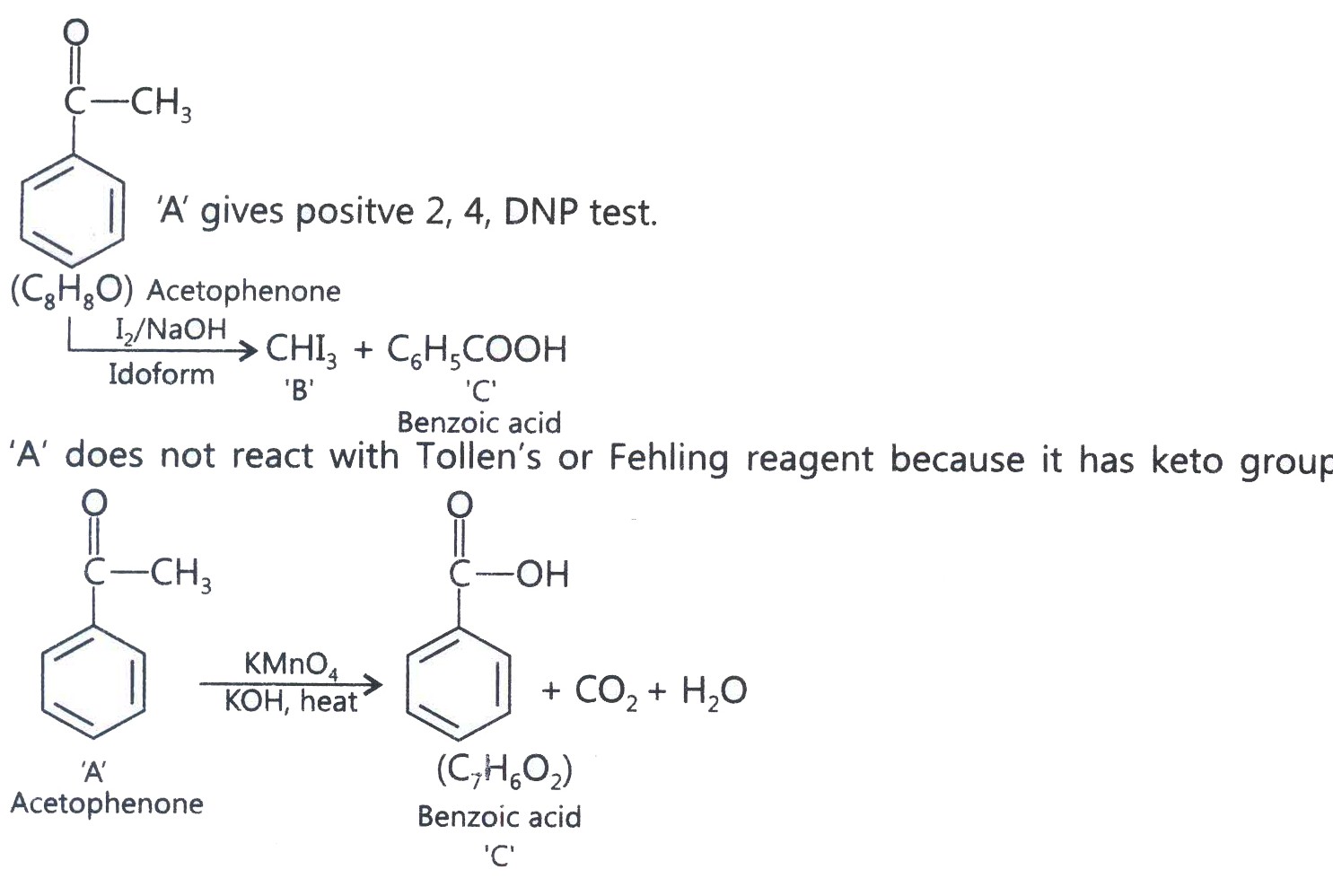
An aromatic compound 'A' (Molecular formula C8H8O) gives positive 2, 4-DNP test. It gives a yellow precipitates of compound 'B' on treatments with iodine and sodium hydroxide solution. Compound 'A' does not give Tollen's or Fehling's test. On drastic oxidation with potassium permanganate it forms a carboxylic acid 'C' (Molecular formula C7HO)6O2), which is also formed along with the yellow compound in the above reaction. Identify A, B and C write all the reacitons involved.
3.
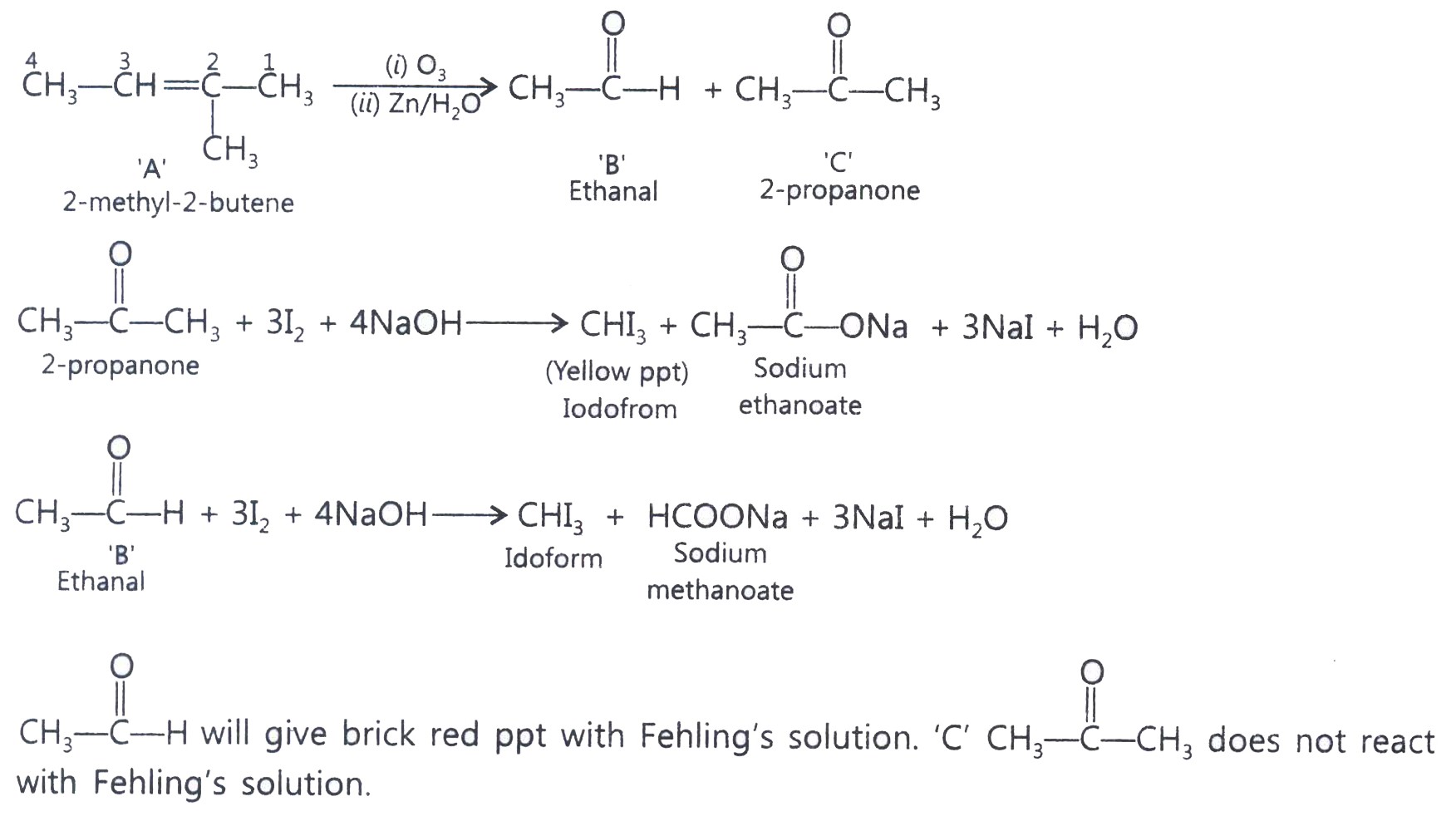
An alkene 'A' (Mol. formula C5H10) on ozonolysis gives a mixture of two compounds 'B' and 'C'. Compound 'B' gives positive Fehling's test and also forms iodoform on treatment with I2 and NaOH. Compound 'C' does not give Fehling's test but forms iodoform. Identify the compounds A, B and C. Write the reaction for ozonolysis and formation of iodoform from B and C.
4.
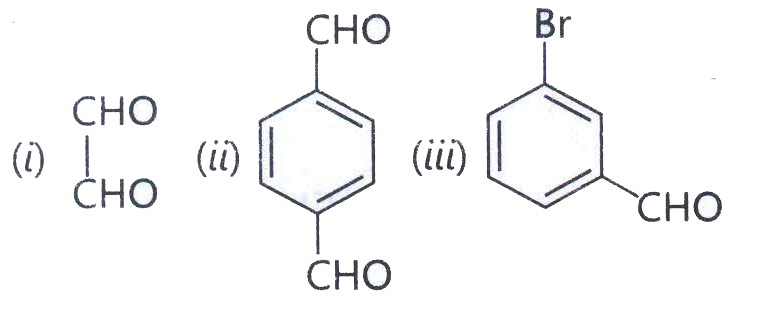
Write IUPAC names of the following structures.
5.
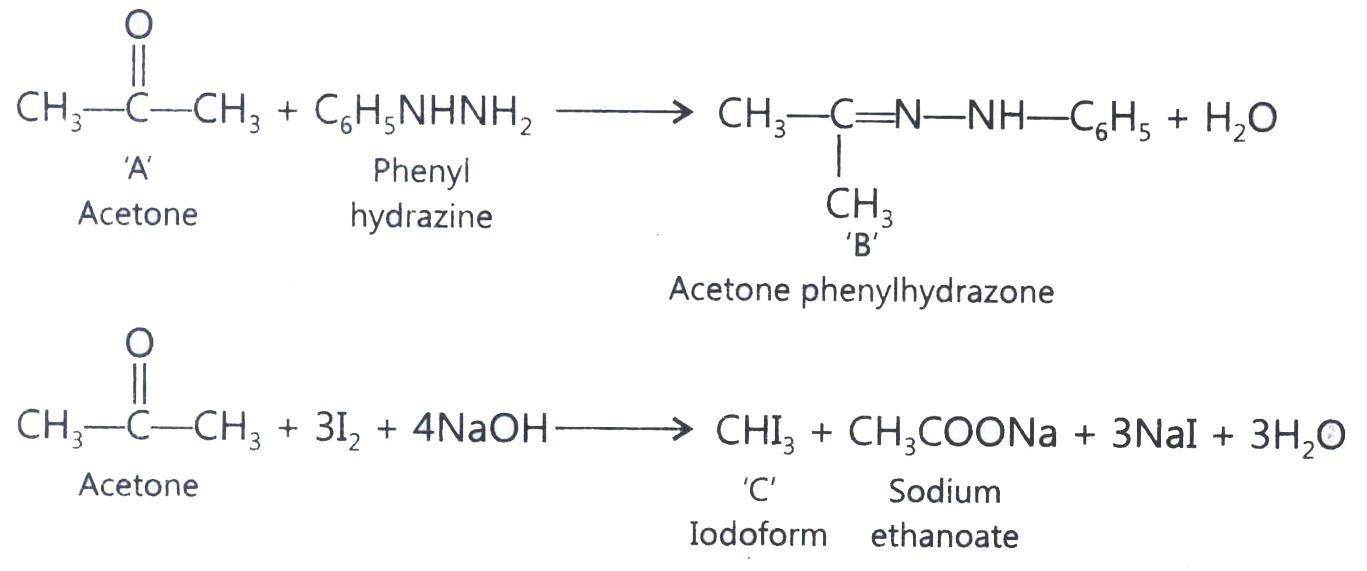
An aliphatic compound 'A' with a molecular formula of C3H6O reacts with phenylhydrazine to give compound 'B'. Reaction of 'A' with I2 in alkaline medium on warming, gives a yellow precipitate 'C'. Identify the compounds A, B and C.
6.
Why is carboxyl group in benzoic acid meta directing? Support your answer with two examples.
7.
How will you carry out the following conversions:
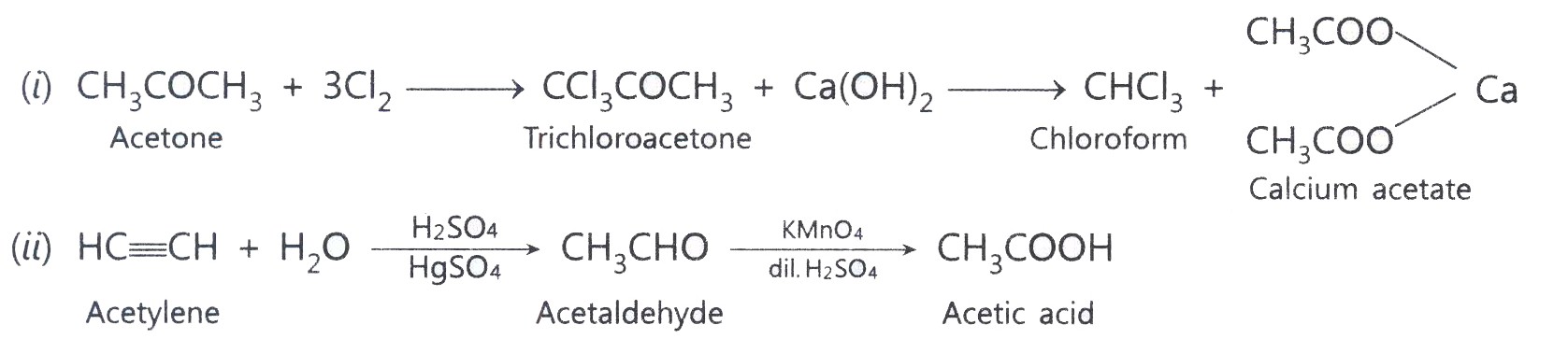
(i) Acetone to chloroform?
(ii) Acetylene to Acetic acid?
8.
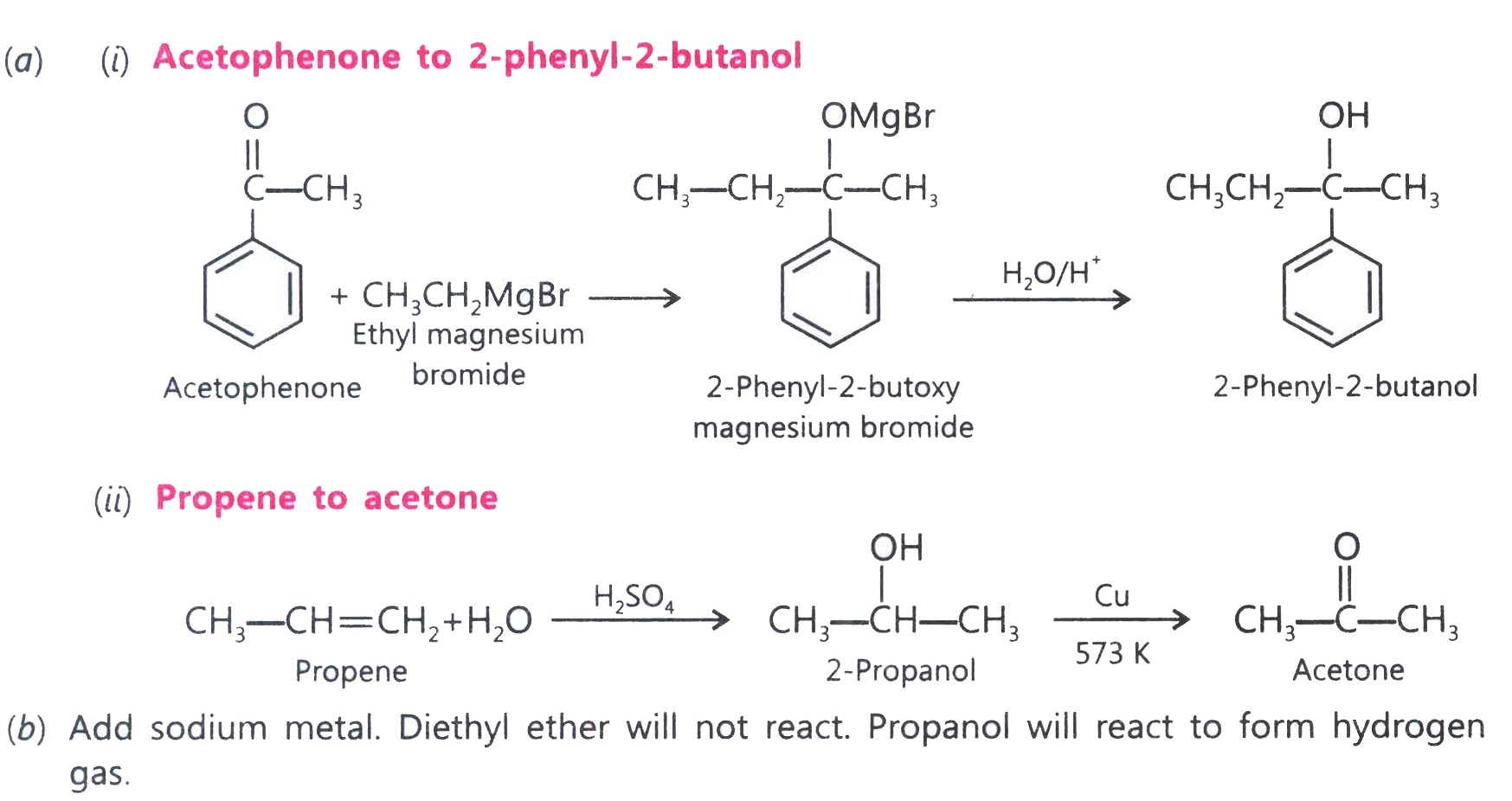
(a) Write the step and conditions involved in the following conversions:
(i) Acetophenone to 2-phenyl-2-butanol
(ii) Propene to acetone
(b) Describe simple chemical tests to distinguish between the following pairs of compounds:
Diethyl ether and Propanol
9.
Write chemical reactions to affect the following transformations:
(a) Butan-1-ol to butanoic acid
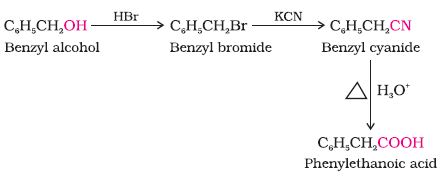
(b) Benzyl alcohol to phenylethanoic acid
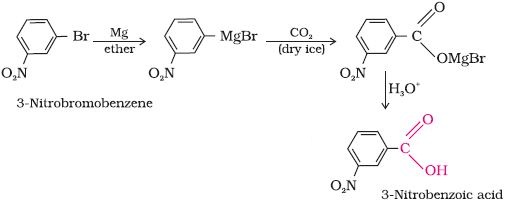
(c) 3-Nitrobromobenzene to 3-nitrobenzoic acid
(d) 4-Methylacetophenone to benzene-1, 4-di-carboxylic acid
(e) Cyclohexene to hexane-1,6-dioic acid
(f) Butanal to butanoic acid.
10.
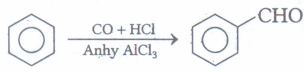
Can Gattermann-Koch reaction be considered simular to Friedel-Crafts acylation? Discuss
1.
The aliphatic carboxylic acids are stronger acids than phenols. The difference in the relative acidic strengths can be understood if we compare the resonance hybrids of carboxylate ion and phenoxide ion.
(i) The electron charge in the carboxylate ion is more dispersed in comparison to the phenoxide ion since 'there are two electronegative oxygen atoms in carboxylate ion as compared to only one oxygen atom in phenoxide ion.
(ii) Carboxylate ion is stabilised by two equivalent resonance structures in which negative charge is on more electronegative O atom. But phenoxide ion has non-equivalent resonance structures in which the negative charge is also on less electronegative carbon atom.
Therefore, the carboxylate ion is relatively more stable as compared to phenoxide ion. Thus, the release of H+ ion from carboxylic acid is comparatively easier or it behaves as a stronger acid than phenol.
2.
3.
4.
(i) Ethane-1, 2-dial
(ii) Benzene-1, 4-dicarbaldehyde
(iii) 3-bromobenzaldehyde
5.
6.
In benzoic acid, carboxyl group is meta-directing because it is electron withdrawing, therefore, there is +ve charge on 0- and p-positions, therefore, electrophilic substitution takes places at m-position due to greater electron density, e.g

7.
8.
9.
(i)

(ii)
(iii)
(iv)
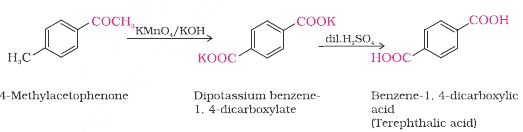
(v)
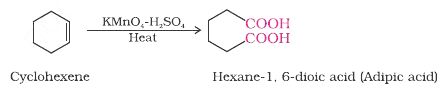
(vi)

10.
In Gattermann-Koch reaction, benzene or its derivative is treated with CO and HCI in the presence of anhydrous aluminium chloride to produce benzaldehyde. In this reaction, CO and HCI combine to form HCOCI, i.e. formyl chloride which gets substituted on benzene by the replacement of l-l-atom.

12th Standard CBSE Syllabus & Materials
12th Standard CBSE
CBSE 12th Computer Science Python Revision Tour I - New Previous year Question Papers Study Material - QB365 Set A
NEW12th Standard CBSE
CBSE 12th Business Studies Planning Important Questions And Answers Study Material - QB365 Set A
NEW12th Standard CBSE
CBSE 12th Business Studies Business Environment Important Questions And Answers Study Material - QB365 Set A
NEW12th Standard CBSE
CBSE 12th Business Studies Principles of Management Important Questions And Answers Study Material - QB365 Set A



CBSE 12th Standard CBSE Subjects
CBSE Standards










