
 100% FREE ACCESS
12th Standard CBSE Syllabus & Materials
12th Standard CBSE
CBSE 12th Economics Government Budget and the Economy Previous year Question Papers Study Material - QB365 Set A
NEW12th Standard CBSE
CBSE 12th Computer Science Interface Python with MySQL - New Previous year Question Papers Study Material - QB365 Set A
NEW12th Standard CBSE
CBSE 12th Computer Science Database Concept - New Previous year Question Papers Study Material - QB365 Set A
NEW12th Standard CBSE
CBSE 12th Computer Science Data Communication - New Previous year Question Papers Study Material - QB365 Set A
NEW12th Standard CBSE
CBSE 12th Computer Science Data Structures - New Previous year Question Papers Study Material - QB365 Set A
NEW12th Standard CBSE
CBSE 12th Computer Science Functions - New Previous year Question Papers Study Material - QB365 Set A

Published on: 28/09/2019
Coordination Compounds
Download CBSE Class 12th Standard CBSE Chemistry question papers, sample papers, important questions, and previous year solved papers in PDF format. Get free study materials, NCERT solutions, and exam preparation resources for Class 12th Standard CBSE Chemistry
Questions + Answers key
Take MCQ Chemistry Test
1.
Give the formula of each of the following coordination entities:
(i) Co3+ ion is bound to one Cl-, one NH3 molecule (en) molecules.
(ii) Ni2+ ion is bound to two water molecules and two oxalate ions.
Write the name and magnetic behaviour of each of the above coordination entities.
(At. nos. Co = 27, Ni = 28)
2.
What is menat by unidentate, didentate and ambidentate ligands? Give twoo examples for each.
3.
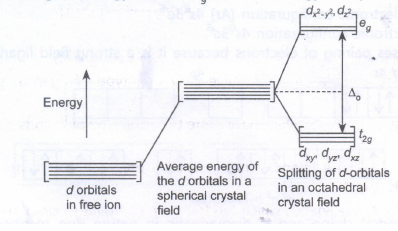
Draw figure to show splitting of d orbitals in an octahedral crystal field.
4.
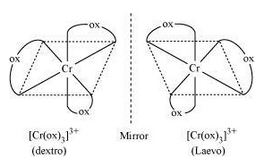
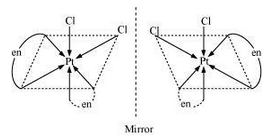
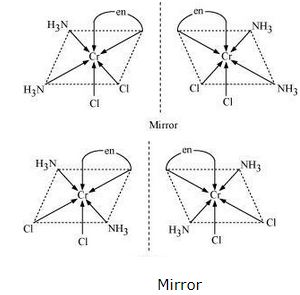
Draw the structures of optical isomers of:
(a) [Cr(C2O4)3]3-
(b) [PtCl2(en)2]2+
(c) [Cr(NH3)2Cl2(en)]+
5.
Write the name and draw the structure of each of the following complex compounds:
(i) [Co(NH3)4(H2O)2]Cl3
(ii) [Pt(NH3)4] [NiCl4]
6.
Describe the limitations of valence bond theory.
7.
Write the name, stereochemistry and magnetic behaviour of the following:
(At. nos. Mn = 25, Co = 27, Ni = 28)
(i) K4(Mn(CN)6]
(ii) [Co(NH3)5Cl]Cl2
(iii) K2[Ni(CN)4]
1.
(i) [CoNH3CI(en)2]2+
amminechloridobis(ethane-1,2-diamine)cobalt (Ill) ion

Co3+ : 4s03d6
(ii) [Ni(H2O)2(OX)2]2-
diaquadioxalatonickelate (II) ion
Ni2+ : 4s03d8
.png)
2.
Unidentate Ligands: Those ligands which can form only one coordinate bond are called unidentate ligands, e.g. NH3 , CN- Didentate Ligands: Those ligands which can form two coordinate bonds are called bidentate ligands,\(\overset { { COO }^{ - } }{ \underset { { COO }^{ - } }{ | } } \) (ox), H2NCH2CH2NH2(en). Ambidentate Ligands: Those ligands which can form bond through either of the two donor atoms are called ambidentate ligands, e.g. CN- , NO2- etc.
3.
Let us assume that the six ligands are positioned symmetrically along the cartesian axes, with metal atom at the origin. As the ligands approach, first there is an increase in energy of d-orbitals relative to that of the free ion just as would be the case in a spherical field The orbitals lying along the axes (\({ d }_{ { z }^{ 2 } }\)nd \({ d }_{ { x }^{ 2 }-{ y }^{ 2 } }\))get repelled more strongly than dx1 d and dyz and dzx orbitals which have lobes directed between the axes. The \({ d }_{ { z }^{ 2 } }\)and orbitals get raised in energy and dxy dyz d xz orbitals are lowered in energy relative to the average energy in the spherical crystal field. Thus, the degenerate set of d-orbitals get split into two sets : the lower energy orbitals set and the higher energy orbitals eg set. The energy is separated by t2g and the higher energy orbitals eg set. The energy is separated by \({ \Delta }_{ 0 }\)
4.
(a) [Cr(C2O4)3]3-
(b) [PtCl2(en)2]2+
(c) [Cr(NH3)2Cl2(en)]+
5.
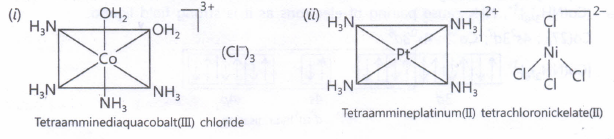
6.
(i) It does not explain why a metal ion in particular oxidation state forms low spin or high spin complexes.
(ii) It cannot justify magnetic behaviour in some cases.
(iii) It cannot explain colour shown by complex compounds.
(iv) It does not give idea about thermodynamic and kinetic stability of complex compound.
(v) It is based on assumptions which may not be true.
(vi) There is no quantitative interpretation of magnetic moment.
7.
(i) Potassium hexacyanomaganate (II). It has octahedral shape and is paramagnetic in nature.
(ii) Pentaamine chloridocobalt (III) chloride. It has octahedral shape and is diamagnetic in nature.
(iii) Potassium tetracyano nickelate (II). It has square planar shape and is diamagnetic in nature.

12th Standard CBSE Syllabus & Materials
12th Standard CBSE
CBSE 12th Computer Science Python Revision Tour I - New Previous year Question Papers Study Material - QB365 Set A
NEW12th Standard CBSE
CBSE 12th Business Studies Planning Important Questions And Answers Study Material - QB365 Set A
NEW12th Standard CBSE
CBSE 12th Business Studies Business Environment Important Questions And Answers Study Material - QB365 Set A
NEW12th Standard CBSE
CBSE 12th Business Studies Principles of Management Important Questions And Answers Study Material - QB365 Set A



CBSE 12th Standard CBSE Subjects
CBSE Standards










