
 100% FREE ACCESS
12th Standard CBSE Syllabus & Materials
12th Standard CBSE
CBSE 12th Economics Government Budget and the Economy Previous year Question Papers Study Material - QB365 Set A
NEW12th Standard CBSE
CBSE 12th Computer Science Interface Python with MySQL - New Previous year Question Papers Study Material - QB365 Set A
NEW12th Standard CBSE
CBSE 12th Computer Science Database Concept - New Previous year Question Papers Study Material - QB365 Set A
NEW12th Standard CBSE
CBSE 12th Computer Science Data Communication - New Previous year Question Papers Study Material - QB365 Set A
NEW12th Standard CBSE
CBSE 12th Computer Science Data Structures - New Previous year Question Papers Study Material - QB365 Set A
NEW12th Standard CBSE
CBSE 12th Computer Science Functions - New Previous year Question Papers Study Material - QB365 Set A

Published on: 28/09/2019
Organic Compounds Containing Nitrogen
Download CBSE Class 12th Standard CBSE Chemistry question papers, sample papers, important questions, and previous year solved papers in PDF format. Get free study materials, NCERT solutions, and exam preparation resources for Class 12th Standard CBSE Chemistry
Questions + Answers key
Take MCQ Chemistry Test
1.
Give reasons for the following:
(i) Aniline does not undergo Friedel-Crafts reaction,
(ii) (CH3)2NH is more basic than (CH3)2N in an aqueous solution,
(iii) Primary amines have higher boiling point than tertiary amines.
2.
Give the structure of A, B and C in the following reactions:
(i) \({ C }_{ 6 }{ H }_{ 5 }{ NO }_{ 2 }\overset { Sn/HCI }{ \longrightarrow } A\overset { NaNO_{ 2 }+HCI }{ \underset { 273K }{ \longrightarrow } } B\overset { { H }_{ 2 }O }{ \longrightarrow } C\)
(ii) \({ C }{ H }_{ 3 }CN\overset { { H }_{ 2 }O/{ H }^{ + } }{ \longrightarrow } A\overset { NH_{ 3 } }{ \underset { \triangle }{ \longrightarrow } } B\overset { { Br }_{ 2 }+KOH }{ \longrightarrow } C\)
3.
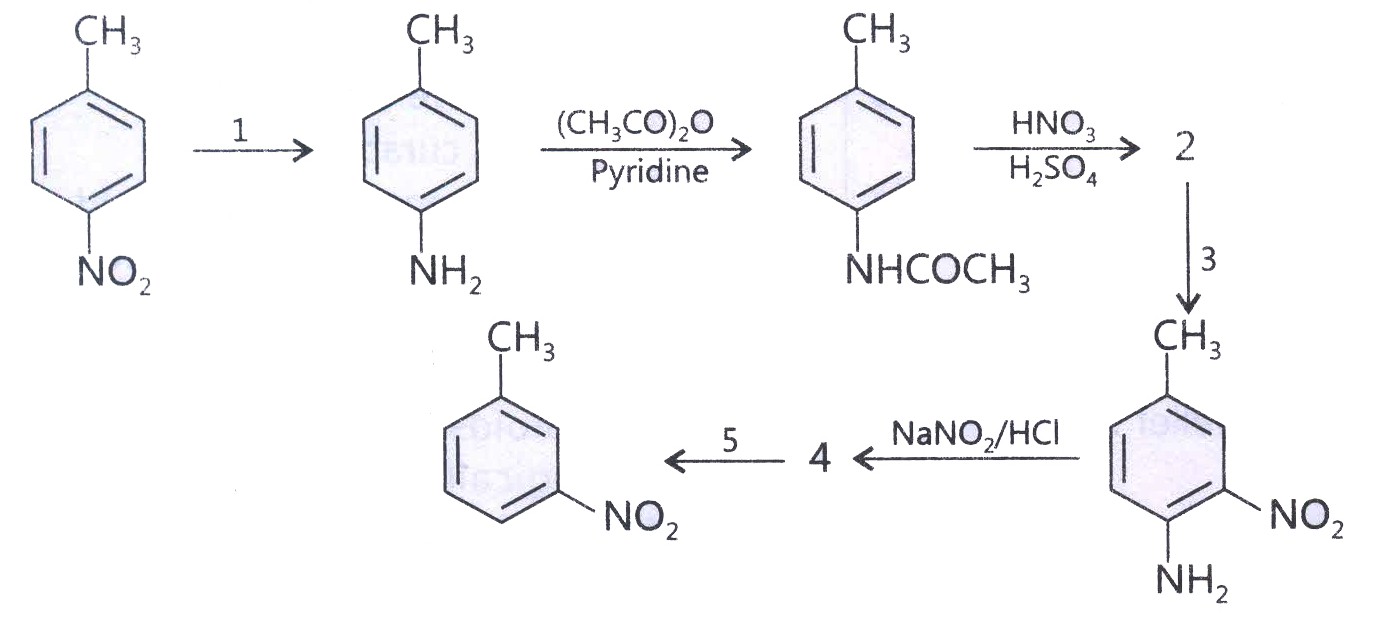
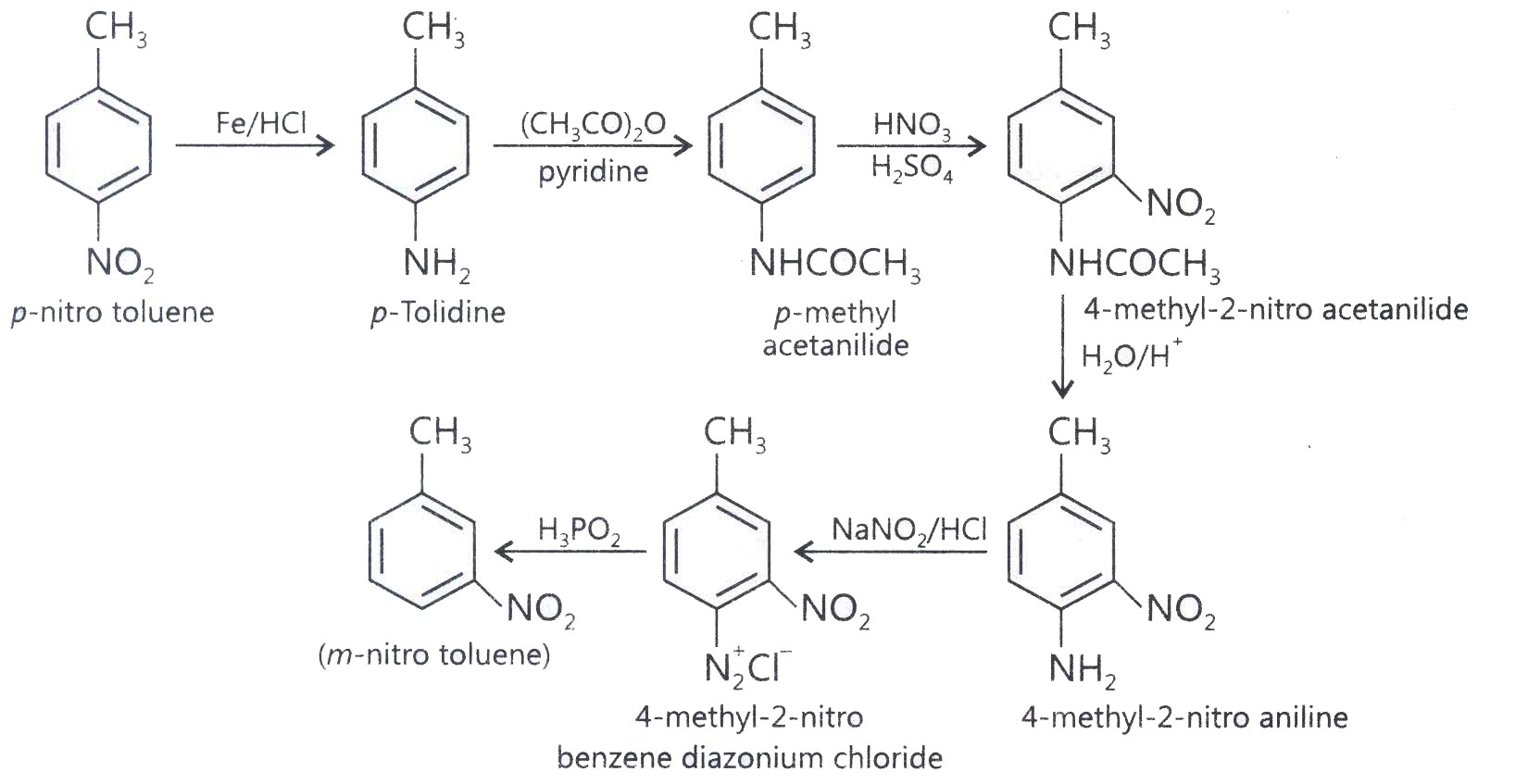
Predict the reagent or the product in the following reaction sequence.
4.
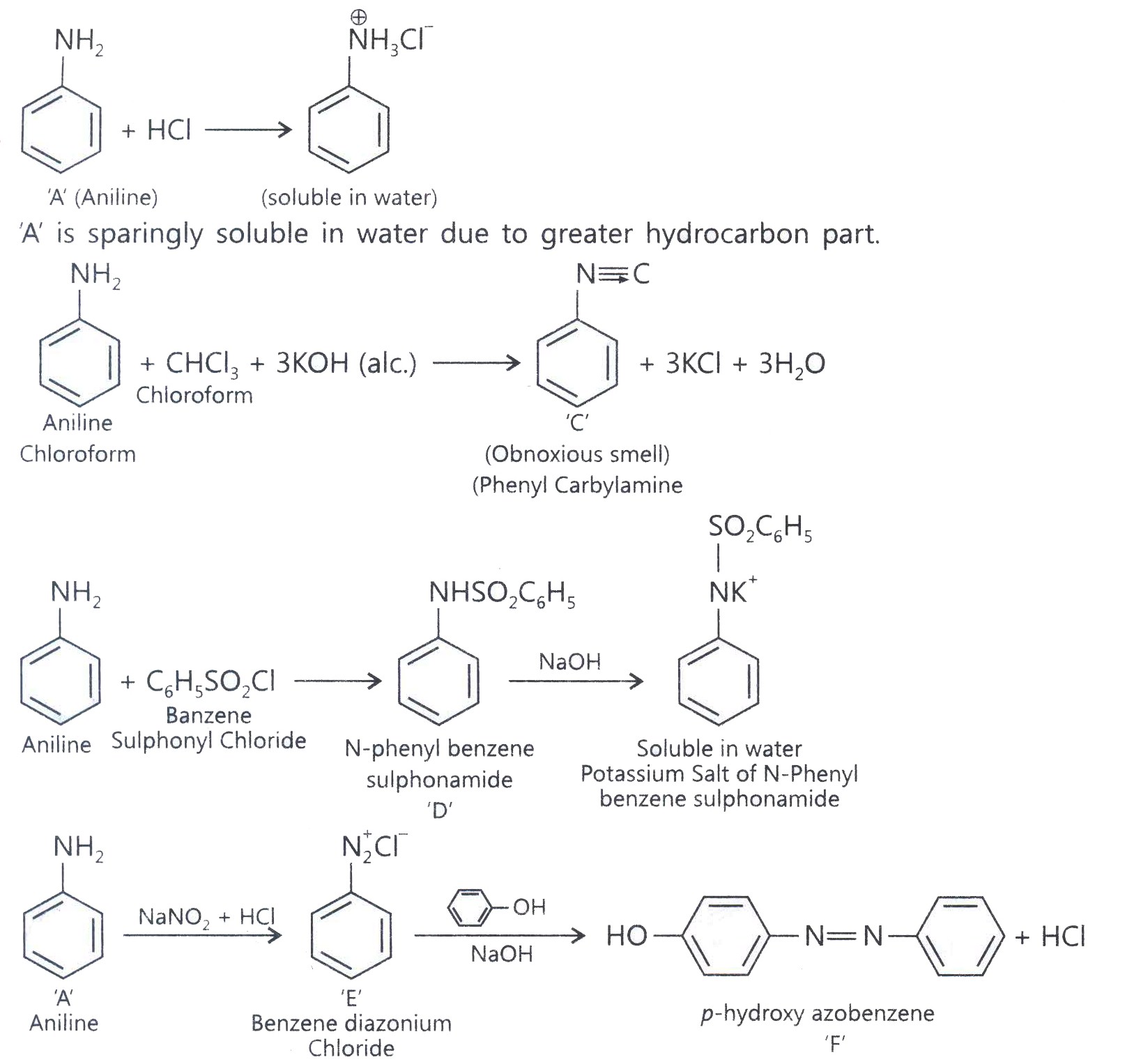
A colourless substance 'A' (C6H7N) is sparingly soluble in water and gives a water soluble compound 'B' on treating with mineral acid. On reacting with CHCl3 and alcoholic potash 'A' produces an obnoxious smell due to the formation of compoung 'C'. Reaction of 'A' with benzenesulphonyl chloride gives compound 'D' which is soluble in alkali. With NaNO2 and HCl, 'A' forms compound 'E' which reacts with phenol in alkaline medium to give an orange dye 'F' . Identify compounds 'A' to 'F'.
5.
Describe a method for the identification of primary, secondary and tertiary amines. Also write chemical equations of the reactions involved.
6.
Accmplish the following conversions:
(i) Aniline to 2,4,6-tribromofluorobenzene
(ii) Benzyl chloride to 2-phenylethanamine
(iii) Chlorobenzene to p-chloroaniline.
7.
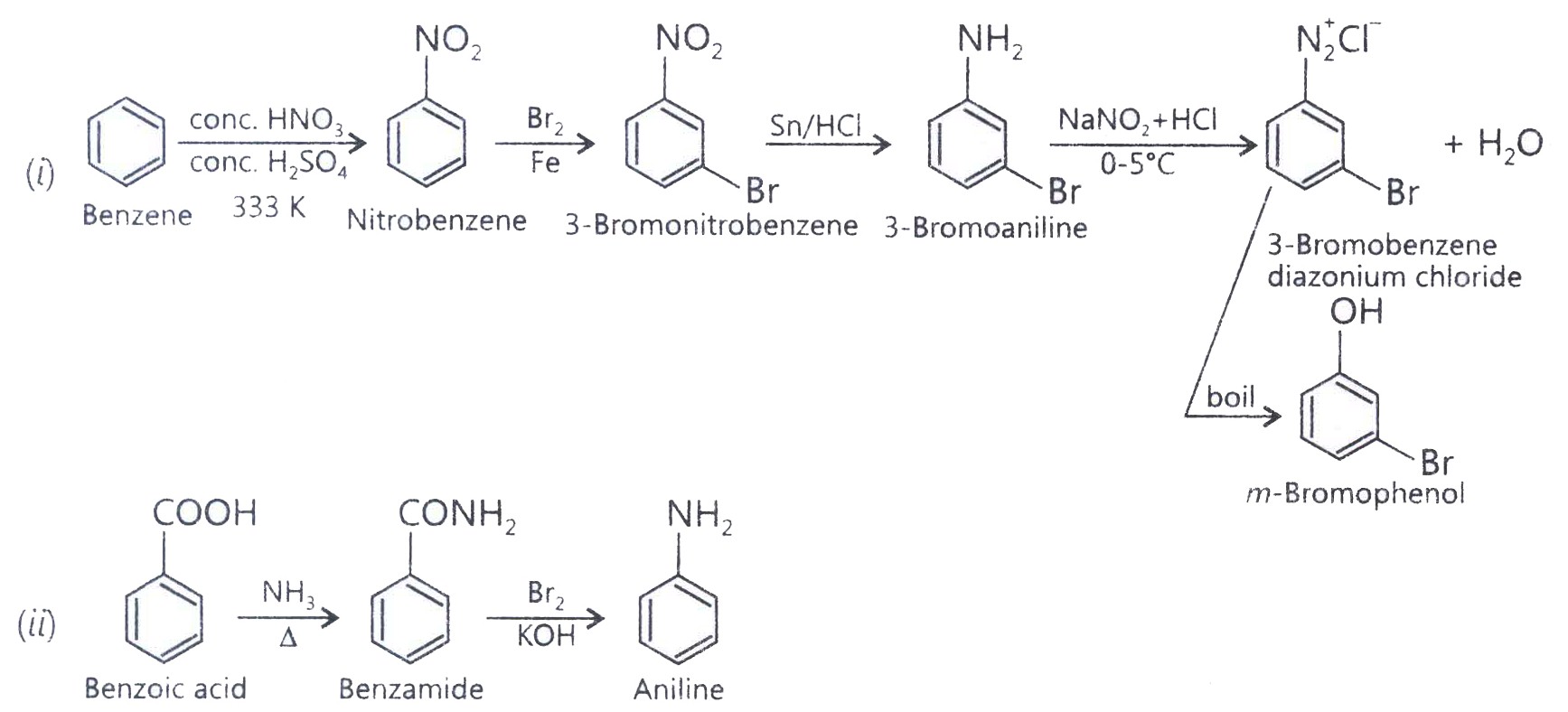
Accomplish the following conversions:
(i) Benzene to m-bromophenol
(ii) Benzoic acid to aniline
8.
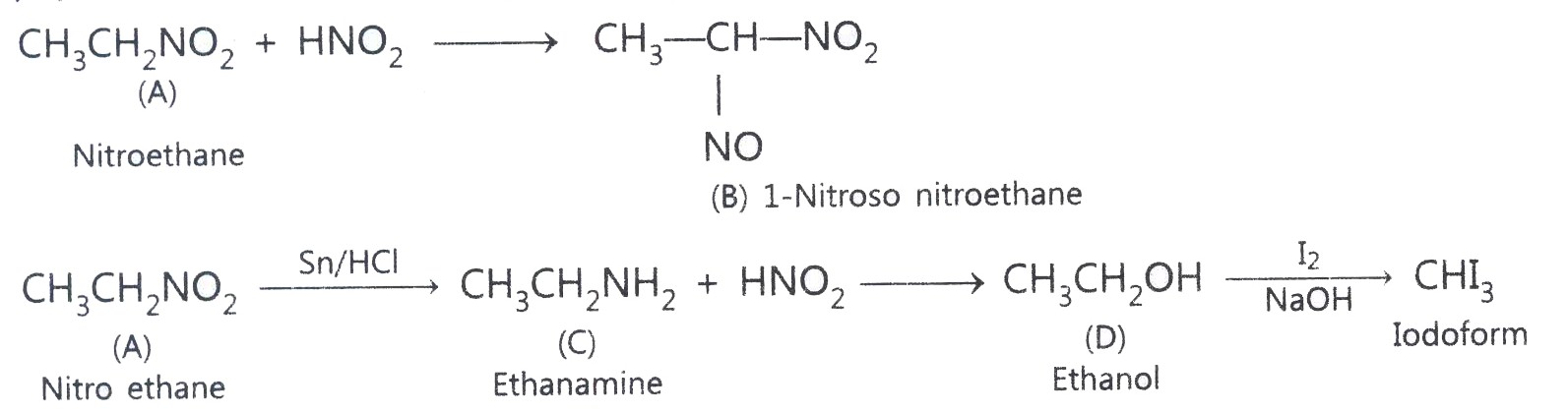
An organic compound 'A' having molecular formula C2H5O2N reacts with HNO2 and gives'B' C2H4O3N2. On reduction, 'A' gives a compound 'C' on treatment with HNO2 gives 'D' which gives positive iodoform test. Identify 'A' .
9.
Iodomethane reacts with KCN to form a major product 'A' . Compund 'A' on reduction in presence of LiAIH4 forms a higher amine 'B'. Compound B on treatment with CuCl2 frms a blue colour complex 'C'. Identify the compounds 'A', 'B' and 'C' .
10.
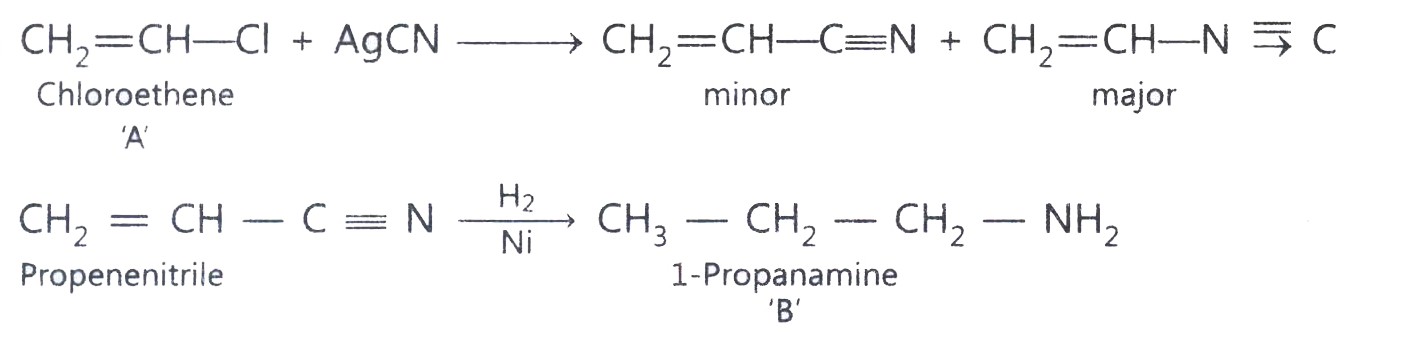
An aliphatic compound 'A' with molecular formula C2H3Cl on treatment with AgCN hives two isomeric compounds of unequal amounts with the molecular formula C3H3N. The minor of nthese two products on complete reduction with H2 in the presence of Ni gives a compound 'B' with molecular formula C3H9N. Identify the compounds 'A' , 'B' and write the reactions involved.
11.
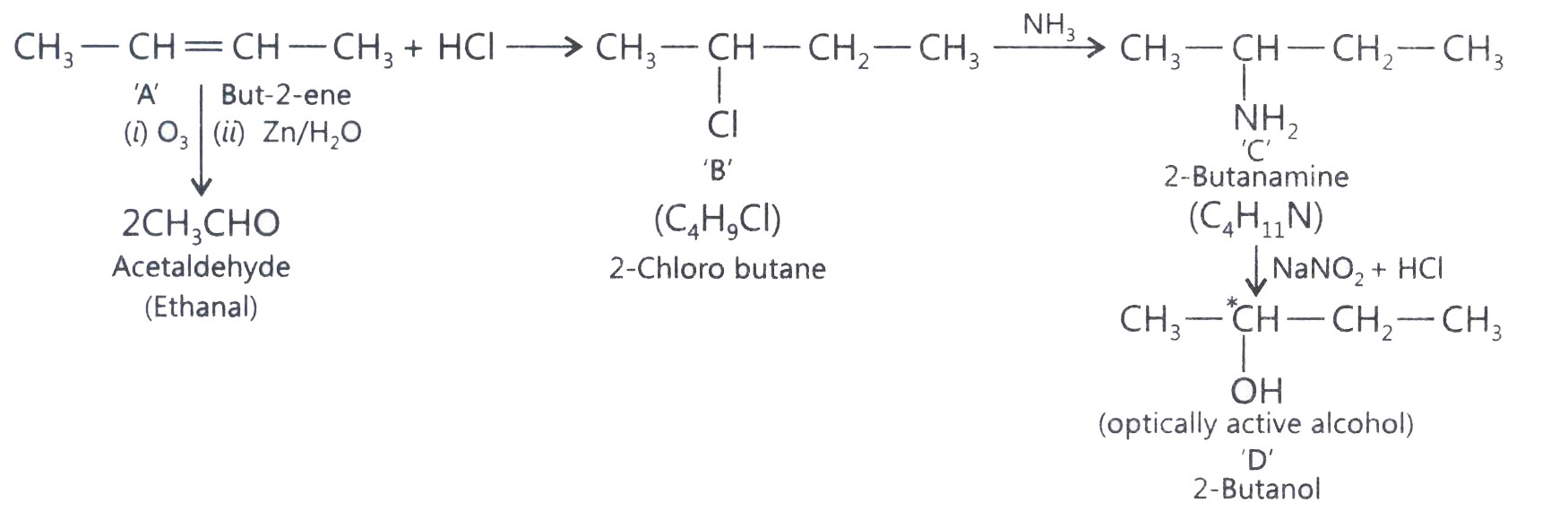
A hydrocarbon 'A' (C4H8) on reaction with HCI gives a compound 'B' , (C4H11N). On reacting with NaNO2 and HCI followed by treatment with water, compound 'C'. Ozonolysis of 'A' gives 2 moles of acetaldehyde. Identify compounds 'A' to 'D' . Explain the reactions involved.
1.
(i) A Friedel Crafts reaction is carried out in the presence of AlCl3. But AlCl3 used as catalyst and is acidic in nature i.e., Lewis acid whereas aniline is a strong Lewis base. Thus, aniline reacts with AlCl3 to form a salt.
Due to the positive charge on the N-atom, electrophilic substitution in the benzene ring is deactivated. Hence, aniline does not undergo
Friedel-Crafts reaction.
(ii) (CH3)2NH is more basic than (CH3)3 in an aqueous solution. + I effect will increase in alkyl group that results in increasing the case of donation of lone pair electron. Amine accepts a proton and form cation which will be stabilised in water by solvation. Higher the solvation by hydrogen bonding, higher will be the basic strength.
Therefore, with increase in methyl group, hydrogen bonding and stabilisation by solvation decreases. This net effect results in decrease of basic strength from secondary to tertiary amine.
(iii) In tertiary amine, there are no H-atoms whereas, in primary amines, two H-atoms are present. Due to the presence of H-atoms, primary amines undergo extensive intermolecular H-bonding.
As a result, extra energy is required to separate the molecules of primary amine. Therefore, primary amines have higher boiling point than tertiary amine.
2.
(i) \({ C }_{ 6 }{ H }_{ 5 }{ NO }_{ 2 }\overset { Sn/HCI }{ \longrightarrow } { { C }_{ 6 }{ H }_{ 5 }{ NH }_{ 2 }\overset { NaNO_{ 2 }+HCI }{ \underset { 273K }{ \longrightarrow } } }{ C }_{ 6 }{ H }_{ 5 }{ N }_{ 2 }^{ + }{ CI }^{ - }\overset { { H }_{ 2 }O }{ \longrightarrow } { C }_{ 6 }{ H }_{ 5 }OH+{ N }_{ 2 }+HCI\)
(ii)\({ C }{ H }_{ 3 }CN\overset { { H }_{ 2 }O/{ H }^{ + } }{ \longrightarrow } { C }{ H }_{ 3 }-\overset { \begin{matrix} O \\ \parallel \end{matrix} }{ C } -OH\overset { NH_{ 3 } }{ \underset { \triangle }{ \longrightarrow } } { CH }_{ 3 }{ CONH }_{ 2 }\overset { { Br }_{ 2 }+KOH }{ \longrightarrow } { CH }_{ 3 }{ NH }_{ 2 }\)
3.
4.
5.
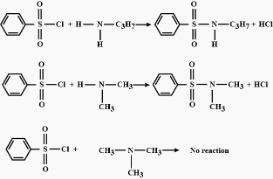
Hinsberg's test is used for the identification of primary, secondary, and tertiary amines.
Hinsberg's reagent is benzenesulphonyl chloride (C6H5SO2Cl).
It reacts differently with primary, secondary, and tertiary amines.
(i) Hinsberg's reagent reacts with primary amines to form N− alkylbenzenesulphonyl amide which is acidic in nature and soluble in alkali.
Note: N− alkylbenzenesulphonyl amide contains a strong electron-withdrawing sulphonyl group. Due to this, the H− atom attached to nitrogen can be removed easily. Hence, it is acidic.
(ii) Hinsberg's reagent reacts with secondary amines to form a sulphonamide which is insoluble in alkali.
Note: As there is no hydrogen atom attached to the N atom in the sulphonamide, it is not acidic and insoluble in alkali.
(iii) Hinsberg's reagent does not react with tertiary amines.
6.
s.jpg)
s.jpg)
7.
8.
9.

10.
11.

12th Standard CBSE Syllabus & Materials
12th Standard CBSE
CBSE 12th Computer Science Python Revision Tour I - New Previous year Question Papers Study Material - QB365 Set A
NEW12th Standard CBSE
CBSE 12th Business Studies Planning Important Questions And Answers Study Material - QB365 Set A
NEW12th Standard CBSE
CBSE 12th Business Studies Business Environment Important Questions And Answers Study Material - QB365 Set A
NEW12th Standard CBSE
CBSE 12th Business Studies Principles of Management Important Questions And Answers Study Material - QB365 Set A



CBSE 12th Standard CBSE Subjects
CBSE Standards










