
 100% FREE ACCESS
12th Standard CBSE Syllabus & Materials
12th Standard CBSE
CBSE 12th Economics Government Budget and the Economy Previous year Question Papers Study Material - QB365 Set A
NEW12th Standard CBSE
CBSE 12th Computer Science Interface Python with MySQL - New Previous year Question Papers Study Material - QB365 Set A
NEW12th Standard CBSE
CBSE 12th Computer Science Database Concept - New Previous year Question Papers Study Material - QB365 Set A
NEW12th Standard CBSE
CBSE 12th Computer Science Data Communication - New Previous year Question Papers Study Material - QB365 Set A
NEW12th Standard CBSE
CBSE 12th Computer Science Data Structures - New Previous year Question Papers Study Material - QB365 Set A
NEW12th Standard CBSE
CBSE 12th Computer Science Functions - New Previous year Question Papers Study Material - QB365 Set A

Published on: 28/09/2019
Polymers
Download CBSE Class 12th Standard CBSE Chemistry question papers, sample papers, important questions, and previous year solved papers in PDF format. Get free study materials, NCERT solutions, and exam preparation resources for Class 12th Standard CBSE Chemistry
Questions + Answers key
Take MCQ Chemistry Test
1.
Giving one example each of
(i) addition polymers,
(ii) condensation polymers,
(iii) copolymers.
2.
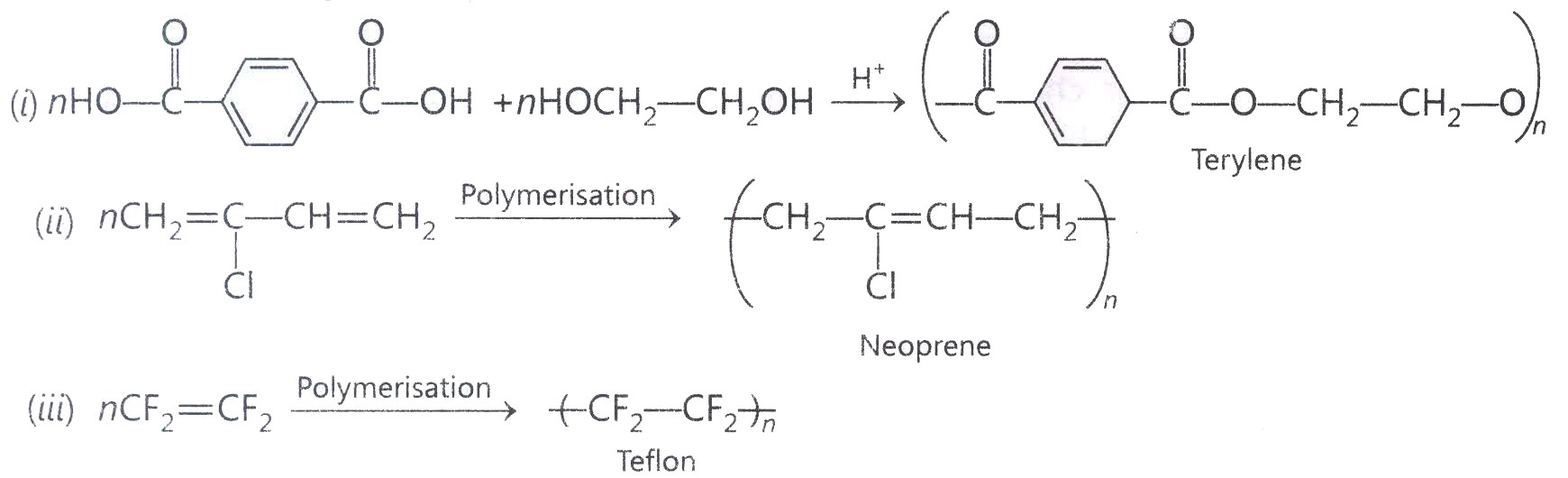
Write chemical equations for the synthesis of
(a) terylene
(b) neoprene
(c) teflon
3.
Explain the following terms giving a suitable example for each :
(i) Elastomers
(ii) Condensation polymers
(iii) Addition polymers
4.
Which of the following polymers soften on heating and harden on cooling? What are the polymers with this property collectively called? What are the structural similarities between such polymers Bakelite, urea-formaldehyde resin, polythene, polyvinyl, polystyrene.
1.
(i) Polythene or PVC is example of addition polymer.
(ii) Nylon-66 or Nylon-6 is example of condensation polymer.
(iii) Buna-S or Buna-N is example of copolymer.
2.
3.
(i) Elastomers: The polymers in which polymer chains are held together by the weakest intermolecular forces.These weak forces permit the polymer to be stretched.A few 'cross-links' are introduced in between the chains which held the polymer to retract to its original position after the force is released, as in vulcanised rubber
(ii) Condensation polymers: It involves a series of condensation reaction generally involving two monomers.Each monomer normally contains two functional groups.The condensation reactions result in the loss of small molecules usually water and ammonia, e.g. nylon, terylene, bakelite are condensation polymers.This process is Known as 'condensation polymerisation'
(iii) Addition polymers: The polymers which are formed by repeated addition of monomers to the polymer chain.The monomers are unsaturated compounds and commonly derivatives of ethene.the addition polymers have same empirical as their monomers, e.g
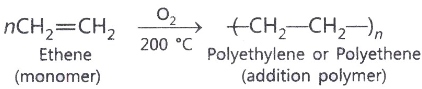
This process is 'addition polymerisation'.
4.
Polythene, polyvinyl and polystyrene soften on heating and harden on cooling. Such polymers are called thermoplastic polymers. These possess intermolecular forces of attraction whose strength lies between strength of intermolecular forces of elastomers and. fibers. These polymers are linear or slightly.

12th Standard CBSE Syllabus & Materials
12th Standard CBSE
CBSE 12th Computer Science Python Revision Tour I - New Previous year Question Papers Study Material - QB365 Set A
NEW12th Standard CBSE
CBSE 12th Business Studies Planning Important Questions And Answers Study Material - QB365 Set A
NEW12th Standard CBSE
CBSE 12th Business Studies Business Environment Important Questions And Answers Study Material - QB365 Set A
NEW12th Standard CBSE
CBSE 12th Business Studies Principles of Management Important Questions And Answers Study Material - QB365 Set A



CBSE 12th Standard CBSE Subjects
CBSE Standards










