
 100% FREE ACCESS
12th Standard CBSE Syllabus & Materials
12th Standard CBSE
CBSE 12th Economics Government Budget and the Economy Previous year Question Papers Study Material - QB365 Set A
NEW12th Standard CBSE
CBSE 12th Computer Science Interface Python with MySQL - New Previous year Question Papers Study Material - QB365 Set A
NEW12th Standard CBSE
CBSE 12th Computer Science Database Concept - New Previous year Question Papers Study Material - QB365 Set A
NEW12th Standard CBSE
CBSE 12th Computer Science Data Communication - New Previous year Question Papers Study Material - QB365 Set A
NEW12th Standard CBSE
CBSE 12th Computer Science Data Structures - New Previous year Question Papers Study Material - QB365 Set A
NEW12th Standard CBSE
CBSE 12th Computer Science Functions - New Previous year Question Papers Study Material - QB365 Set A

Published on: 28/09/2019
The p-Block Elements
Download CBSE Class 12th Standard CBSE Chemistry question papers, sample papers, important questions, and previous year solved papers in PDF format. Get free study materials, NCERT solutions, and exam preparation resources for Class 12th Standard CBSE Chemistry
Questions + Answers key
Take MCQ Chemistry Test
1.
An almorphous solid "A" burns in air to form a gas "B" Which turns lime water milky. The gas is also produced as a by-product during roasting of sulphide ore. This gas decolourises acidified aqueous KMnO4 solution and reduces Fe3+ to Fe2+. Identify the soild "A" and the gas "B" and write the reactions involved.
2.
Phosphorus has three allotropic forms -
(i) white phosphorus
(ii) red phosphorus and
(iii) black phosphorus.
Write the difference between white and red phosphorus on the basis of their structure and reactivity.
3.
White phosphorus reacts with chlorine and the product hydrolyses in the presence of water. Calculate the mass of HCl obtained by the hydrolysis of the product formed by the reaction of 62g of white phosphorus with chlorine in the presence of water.
4.
P4O6 reacts with water according to equation P4O6 + 6H2O \(\to\) 4H3PO3. Calculate the volume of 0.1 M NaOH solution required to neutralise the acid formed by dissolving 1.1 g of P4O6 in H2O.
5.
On reaction with Cl2, phosphorus forms two types of halides 'A' and 'B'. Halide A is yellowish-white powder but halide 'B' is colourless oily liquid. Identify A and B and write the formulas of their hydrolysis products.
6.
Describe the following about halogen family (group 17 elements):
(i) Relative oxidising power
(ii) Relative strength of their hydrides
(iii) Oxyacids and their related oxidising ability.
7.
Give reasons for each of the following:
(a) Sulphur in vapour state exhibits paramagnetic behaviour.
(b) Hydrogen fluoride is weaker acid than hydrogen chloride in water.
(c) NH3 has higher proton affinity than PH3.
8.
Account for the following:
(i) BiCl3 is less covalent than PCl3
(ii) O3 acts as a powerful oxidising agent.
(iii) F2 is a stronger oxidising agent than Cl2
1.
\('A'\quad is\quad { S }_{ 8 }.\quad 'B'is{ SO }_{ 2 }(g).\)
\({ S }_{ 8 }+{ 8O }_{ 2 }\overset { heat }{ \rightarrow } { 8SO }_{ 2 }(g)\)
'B' decolorizes \(KMnS{ O }_{ 4 }\)
\(2KMn{ O }_{ 4 }+5S{ O }_{ 2 }+{ 2H }_{ 2 }O\longrightarrow { 2H }_{ 2 }{ SO }_{ 4 }+2Mn{ SO }_{ 4 }+{ K }_{ 2 }{ SO }_{ 4 }\)
'B' turns lime water milky due to formation of
\(Ca{ (OH) }_{ 2 }(aq)+{ SO }_{ 2 }(g)\longrightarrow CaSO_{ 3 }(s)+{ H }_{ 2 }O(l)\)
'B' is obtained by roasting of sulphideores
\(2ZnS(s)+{ 3O }_{ 2 }\longrightarrow 2ZnO(s)+{ 2SO }_{ 2 }(g)\)
'B' reduces in aqueous solution.
\(2{ Fe }^{ 3+ }+{ SO }_{ 2 }+{ 2H }_{ 2 }O\longrightarrow { Fe }^{ 2+ }+{ SO }_{ 4 }^{ 2- }+{ 4H }^{ + }\)
2.
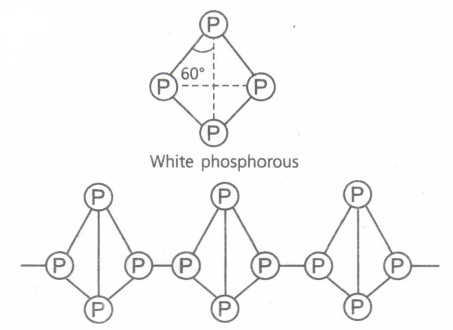
(a) White phosphorus exists as discrete (separate) tetrahedral molecules. Thus, it has tetrahedral structure with six P-P bonds. Red phosphorus has polymeric  structure in which molecules (tetrahedral) are linked through P-P bonds to form chain. Black phosphorus has two forms -black and -black phosphorus. It can be sublined in air and has opaque monoclinic or rhomohedral crystals; It does not oxidise in air. -black phosphorus does not burn in air up to 673 K. Black phosphorus is thermodynamically most stable.
Reactivity: White phosphorus is more reactive than red phosphorus because it is monomeric and has angular strain due to bond angles at 60°C. Black phosphorus is also less reactive.
3.
\({ P }_{ 4 }={ 6CI }_{ 2 }\longrightarrow { 4PCI }_{ 3 }\)
\(\left[ { PCI }_{ 3 }+{ 6H }_{ 2 }O\longrightarrow { H }_{ 3 }{ PO }_{ 3 }+3HCI \right] \times 4\)
\({ P }_{ 4 }+{ 6CI }_{ 2 }+{ 12H }_{ 2 }O\longrightarrow { 4H }_{ 3 }{ PO }_{ 3 }+{ 12HCI }\)
1 mole of white phosphorus produces 12 moles of HCI.
\(\frac { 62 }{ 124 }\)mole of white phosphorus produces \(12\times \frac { 62 }{ 124 } =6\)moles of HCI.
Mass of 6 moles of HCI= 6 X 36.5
= 219.0 g of HCI.
4.
P4O6 + 6H2O \(\to\) 4H3PO3
\(\left[ { H }_{ 3 }{ PO }_{ 3 }+2HaOH\longrightarrow { Na }_{ 2 }HPO_{ 3 }+{ 2H }_{ 2 }O \right] \times 4\)
\({ P }_{ 4 }{ O }_{ 6 }+8NaOH\longrightarrow { 4Na }_{ 2 }{ HPO }_{ 4 }+{ 2H }_{ 2 }O\)
1 mole P4O6 is neutralised by \(8\times \frac { 1.1 }{ 220 } =\frac { 8 }{ 200 } =0.04\)
Volume of 0.1 M NaOH need 0.1 x in L=0.04 mol
\({ V }_{ 1 }=\frac { 0.04 }{ 0.1 } =0.4\) Litre = 400ml of NaOH
5.
'A' is PCl5. (It is a yellowish-white solid).
'B' is PCl3 (It is a colourless oily liquid).
P4(s) + 10Cl2(g) \(\to\) 4PCl5(s)
P4(s) + 6Cl2 (g) \(\to\) 4PCI3(l)
PCl5, on hydrolysis gives H3PO4, whereas
PCl3, on hydrolysis gives H3PO3.
PCl5 + 4H2O \(\to\) H3PO4 + 5HCl
PCl3 + 3H2O \(\to\) H3PO3 + 3HCl
6.
(i) F2 > Cl2 > Br2 > I2 is decreasing order of oxidising power.
(ii) HI > HBr > HCl > HF is decreasing order of strength of acid.
(iii) HClO > HClO2 > HCIO3 > HCIO4 is order of oxidising power.
HOI > HOBr > HOCl is order of oxidising power>
HOF does not exist at room temperature.
7.
(a) It is due to presence of unpaired electrons in vapour state in S2 like in O2.
(b) HF has more bond dissociation energy than HCl due to smaller bond length.
(c) NH3 is more basic than PH3 due to smaller size of nitrogen, therefore, NH3 has more proton affinity than PH3 . Lone pair of electrons is more available on nitrogen than phosphorous.
8.
(i) It is because ionisation enthalpy of Bi is lower than phosphorus, therefore, Bi forms ionic BiCl3; whereas PCl3 is covalent.
(ii) It is because O3 is highly unstable and gives out [O] due to which it is powerful oxidising agent.
(iii) It is because F2 has highest standard reduction potential, higher than Cl2.

12th Standard CBSE Syllabus & Materials
12th Standard CBSE
CBSE 12th Computer Science Python Revision Tour I - New Previous year Question Papers Study Material - QB365 Set A
NEW12th Standard CBSE
CBSE 12th Business Studies Planning Important Questions And Answers Study Material - QB365 Set A
NEW12th Standard CBSE
CBSE 12th Business Studies Business Environment Important Questions And Answers Study Material - QB365 Set A
NEW12th Standard CBSE
CBSE 12th Business Studies Principles of Management Important Questions And Answers Study Material - QB365 Set A



CBSE 12th Standard CBSE Subjects
CBSE Standards










