
 100% FREE ACCESS
12th Standard CBSE Syllabus & Materials
12th Standard CBSE
CBSE 12th Economics Government Budget and the Economy Previous year Question Papers Study Material - QB365 Set A
NEW12th Standard CBSE
CBSE 12th Computer Science Interface Python with MySQL - New Previous year Question Papers Study Material - QB365 Set A
NEW12th Standard CBSE
CBSE 12th Computer Science Database Concept - New Previous year Question Papers Study Material - QB365 Set A
NEW12th Standard CBSE
CBSE 12th Computer Science Data Communication - New Previous year Question Papers Study Material - QB365 Set A
NEW12th Standard CBSE
CBSE 12th Computer Science Data Structures - New Previous year Question Papers Study Material - QB365 Set A
NEW12th Standard CBSE
CBSE 12th Computer Science Functions - New Previous year Question Papers Study Material - QB365 Set A

Published on: 06/09/2019
Three Dimensional Geometry
Download CBSE Class 12th Standard CBSE Maths question papers, sample papers, important questions, and previous year solved papers in PDF format. Get free study materials, NCERT solutions, and exam preparation resources for Class 12th Standard CBSE Maths
Questions + Answers key
Take MCQ Maths Test
1.
A plane meets the co-ordinate axes in A, B, and C such that the centroid of \(\triangle\)ABC is the point \((\alpha,\beta,\gamma).\) Show that the equation of the plane is \({{x}\over{\alpha}}+{{y}\over{\beta}}+{{z}\over{\gamma}}=3.\)
2.
Find the distance of point \(2\check { i } +\check { j } -\check { k } \) from the plane \(\overrightarrow{r}.(\hat{i}-\hat{2}j+4\hat{k})=9. \)
3.
Find the angle between the planes 7x + 2y + 6z = 15 and 3x-y + 10z = 17.
4.
Find the vector equation of the plane with intercepts 3, - 4 and 2 on x, y and z-axis respectively.
5.
Find the vector equation of a plane of 5 units from the origin an its normal vector is \(2\check { i } -3\check { j } +6\check { k } \)
6.
Find the distance between the point (5, ,4, - 6) and its image in xy-plane.
7.
If the equation of a line \(\frac { x-2 }{ 2 } =\frac { 2y-5 }{ -3 } ,z=-1\) then find the ratio of the line and a point on the line.
8.
Find the vector equation for the line which passes through the point (1, 2, 3) and is parallel to the line \(\frac { x-1 }{ -2 } =\frac { 1-y }{ 3 } =\frac { 3-z }{ -4 } \)
9.
Write the direction ratio's of the vector \(3\overset { \rightarrow }{ a } +2\overset { \rightarrow }{ b } \) where \(\overset { \rightarrow }{ a } +\overset { \wedge }{ i } +\overset { \wedge }{ j } -2\overset { \wedge }{ k } \) and \(\overset { \rightarrow }{ b } +\overset { \wedge }{ 2i } +\overset { \wedge }{ 4j } +5\overset { \wedge }{ k } \\ \)
10.
Using direction ratios, show that the points (2, 3, 4), (-1, -2, 1) and (5, 8, 7) are collinear.
11.
Write the Cartesian equation of the plane \(\vec { r } .(3\hat { i } +2\hat { j } +5\hat { k } )=7.\)
12.
The Cartesian equation of a line AB is \(\frac { 2x-1 }{ \sqrt { 3 } } =\frac { y+2 }{ 2 } \frac { z-3 }{ 3 } \). Find the direction cosines of a line parallel to AB.
13.
If a line makes angle \(90°,135°,45°\) with the positive direction of x,y and z-axis respectively, fond its direction-cosines.
14.
Find the equation of the plane with intercept 2, 3 and 4 on the x, y and z-axis respectively.
15.
Find the vector equation for the line passing through the points(-1, 0, 2) and (3, 4, 6)
16.
If a line makes angle 90°,60°and 30° with the positive direction of x,y and z-axis respectively, fond its direction-cosines.
17.
Find the coordinates of the foot of the perpendicular and the perpendicular distance of the point P(3, 2, 1) from the plane 2x - y + z + 1 = 0. Find also the image of the point in the plane.
18.
Find the distance between the point (7, 2, 4) and the plane determined by the points A(2, 5, - 3) B(- 2, - 3, 5) and C(5, 3, - 3).
19.
Find the vector and cartesian forms of the equation of the plane passing through the point (1, 2, - 4) and parallel to the lines \(\\ \vec { r } =\left( \hat { i } +2\hat { j } -4\hat { k } \right) +\lambda \left( 2\hat { i } +3\hat { j } +6\hat { k } \right) \)
and \(\vec { r } =\left( \hat { i } -3\hat { j } +5\hat { k } \right) +\mu \left( \hat { i } +\hat { j } -\hat { k } \right) \)
Also, find the distance of the point (9, -8, -10) from the plane thus obtained.
1.
We know that the equation of the plane having intercepts a, band c on the three
co-ordinate axes is
\({{x}\over{a}}+{{y}\over{b}}+{{y}\over{c}}=1\)
Here, the co-ordinates of A, Band C are (a, 0, 0), (0, b, 0) and (0, 0, c) respectively.
The centroid of \(\triangle \)ABC is \(\left({{a}\over{3}},{{b}\over{3}},{{c}\over{3}}\right).\)
Equating \(\left( {{a}\over{3}},{{b}\over{3}},{{c}\over{3}} \right)\) to \((\alpha,\beta,\gamma),\) we get a = \(3\alpha,\) b = \(3\beta\) and c = \(3\gamma\)
Thus, the equation of the plane is
\({{x}\over{3\alpha}}+{{y}\over{3\beta}}+{{z}\over{3\gamma}}=1\)
or \({{x}\over{\alpha}}+{{y}\over{\beta}}+{{z}\over{\gamma}}=3\)
2.
\(\hat { r } .(\hat { i } -2\hat { j } -\hat { k } )\)
\(\overset { \rightarrow }{ a } =2\hat { i } -\hat { j } -\hat { k } \)
\(\overset { \rightarrow }{ n } =\hat { i } -2\hat { j } -4\hat { k } ,d=9\)
Distance = \(\frac { \left| \overset { \rightarrow }{ a. } \quad \overset { \rightarrow }{ n. } \quad -d \right| }{ \overset { \rightarrow }{ n } } \)
\(\frac { \left| (2\hat { i } +\hat { j } -\hat { k } )+4\hat { k } -9 \right| }{ \sqrt { 1+4+16 } } \)
\(\Rightarrow \) Required distance = \(\frac { \left| 2-2-4-9 \right| }{ \sqrt { 21 } } \)
= \(\frac { 12 }{ \sqrt { 21 } } \) units
3.
\(cos\theta =\left| \frac { a_{ 1 }a_{ 2 }+b_{ 1 }b_{ 2 }+c_{ 1 }c_{ 2 } }{ \sqrt { { a }_{ 1 }^{ 2 }+b_{ 1 }^{ 2 }+{ c }_{ 1 }^{ 2 } } \sqrt { { a }_{ 2 }^{ 2 }+b_{ 2 }^{ 2 }+c_{ 2 }^{ 2 } } } \right| \)
\(a_{ 1 }=7,b_{ 1 }=2,c_{ 1 }=6\)
\(a_{ 2 }=3,b_{ 2 }=-1,c_{ 2 }=-10\)
\(cos\theta =\left| \frac { 7\times 3+2\times -1+6\times -10 }{ \sqrt { 49+4+36 } \sqrt { 9+1+100 } } \right| \)
\(=\left| \frac { 21-2-60 }{ \sqrt { 89 } \sqrt { 110 } } \right| \)
\(cos\theta =\frac { 41 }{ \sqrt { 9790 } } \)
\(\Rightarrow \theta =cos^{ -1 }\left( \frac { 41 }{ \sqrt { 9790 } } \right) \)
4.
Intercepts are (3, 0, 0), (0, - 4,0), (0,0,2)
\(\overset { \rightarrow }{ a } =3\check { i } ,b,\overset { \rightarrow }{ b } =-4\overset { \rightarrow }{ j } ,\overset { \rightarrow }{ c } =2\check { k } \)
Vector equation of the plane passing through \(\overset { \rightarrow }{ a } ,\overset { \rightarrow }{ b } \) and \(\overset { \rightarrow }{ c } \) is
\((\overset { \rightarrow }{ r } -\overset { \rightarrow }{ a } ).[(\overset { \rightarrow }{ b } -\overset { \rightarrow }{ a } )\times (\overset { \rightarrow }{ c } -\overset { \rightarrow }{ a } )]=0\)
Here,
\(.(\overset { \rightarrow }{ b } -\overset { \rightarrow }{ a } )\times (\overset { \rightarrow }{ c } -\overset { \rightarrow }{ a } )=(-4\check { j } -3\check { i } )=\times (2\check { k } -3\check { i } )\)
\(=\left| \begin{matrix} \check { i } & \check { j } & \check { k } \\ -3 & -4 & 0 \\ -3 & 0 & 2 \end{matrix} \right| \)
= \(-8\check { i } +6\check { j } -12\check { k } \)
5.
Here \(2\check { i } -3\check { j } +6\check { k } \) , then
\(|\check { n } |=\sqrt { 4+9+36 } =\sqrt { 49 } \)
=7 units
\(\check { n } =\frac { \check { n } }{ |\check { n } | } =\frac { 2 }{ 7 } \check { i } -\frac { 3 }{ 7 } \check { j } +\frac { 6 }{ 7 } \check { k } \)
So, the required equation is
\(r\left( \frac { 2 }{ 7 } \check { i } -\frac { 3 }{ 7 } \check { j } +\frac { 6 }{ 7 } \check { k } \right) \)
6.
Let A be the point (5, 4, - 6)
Image A' be the point (5, 4, - 6)
\(\therefore\) A'(5, 4, - 6)
Distance between AA'
\(=\sqrt { (5-5)^{ 2 }+(4-4)^{ 2 }+(6+6)^{ 2 } } \)
\(=\sqrt { 0+0+12^{ 2 } } \)
=123 units
7.
\(\frac { x-2 }{ 2 } =\frac { 2y-5 }{ -3 } ,z=-1\)
\(\Rightarrow \frac { x-2 }{ 2 } =\frac { 2y-5 }{ -3 } =\lambda ,z=-1+0\lambda \)
\(\frac { x-2 }{ 2 } =\frac { 2y-5 }{ -3 } ,z=-1\)
\(\Rightarrow \frac { x-2 }{ 2 } =\frac { y-5/2 }{ -3/2 } =\lambda ,z=-1+0\lambda \)
\(\Rightarrow \frac { x-2 }{ 2 } =\frac { y-5/2 }{ -3/2 } =\lambda ,\frac { z+1 }{ 0 } =\lambda \)
ratios are (2, - 3/2, 0) and the point on the given line is(2, 5/2, -1).
8.
\(\overset { \rightarrow }{ r } =(2\overset { \wedge }{ i } +\overset { \wedge }{ j } +3\overset { \wedge }{ k } +\lambda (-2\overset { \wedge }{ i } -3\overset { \wedge }{ j } +4\overset { \wedge }{ k } )\)
9.
Getting
\(3\overset { \rightarrow }{ a } +2\overset { \rightarrow }{ b } =7\overset { \wedge }{ i } -5\overset { \wedge }{ j } -4\overset { \wedge }{ j } +5\overset { \wedge }{ k } \)
D.R'S are 7, -5, 4
10.
Let points be A(2, 3, 4), B(- 1, - 2, 1) and C(5, 8, 7)
Direction ratios or AB are 2 + 1, 3 + 2, 4 - 1, i.e. 3, 5, 3;
Direction ratios of Be are 5 + 1, 8 + 2, 7 - 1, i.e. 3,5,3
As \(\frac{3}{3}=\frac{5}{5}=\frac{3}{3}\)
⇒ AB is parallel to BC, B is common.
Hence, A, B, C are collinear.
11.
()
\(\vec { r } =x\hat { i } +y\hat { j } +z\hat { k } .\) Equation is 3x + 2y + 5z = 7
12.
AB
13.
Direction-angles are \(90°,135°,45°\)
Direction-cosines are \(\left< \cos { 90° } ,\cos { 135° } ,\cos { 45° } \right> \)
\(<0,-\frac { 1 }{ \sqrt { 2 } } ,\frac { 1 }{ \sqrt { 2 } } >\)
14.
Let the equation of the plane be
\(\frac { x }{ a } +\frac { y }{ b } +\frac { z }{ c } =1\)
Here a = 2, b = 3, c = 4.
Substituting the values of a, b and c in (1), we get the required equation of the plane as
\(\frac { x }{ 2 } +\frac { y }{ 3 } +\frac { z }{ 4 } =1\Rightarrow 6x+4y+3z=12\)
15.
Let \(\vec { a } \)and \(\vec { b } \) be the position vectors of the points: A(-1,0,2) and B(3,4,6) respectively
\(\text {Then }\vec{a}=-\hat{i}+2 \hat{k} \)
\(\text {and }\vec{b}=3 \hat{i}+4 \hat{j}+6 \hat{k} \)
\(\therefore \vec{b}-\vec{a}=4 \hat{i}+4 \hat{j}+4 \hat{k}\)
Let \(\vec{r}\) be the position vector of any point on the line. Then the vector equation of the line is
\(\vec{r}=-\hat{i}+2 \hat{k}+\lambda(4 \hat{i}+4 \hat{j}+4 \hat{k})\)
16.
Direction cosines are: \(\left< \cos { 90° } ,\cos { 60° } ,\cos { 30° } \right> (i.e.,<0,\frac { 1 }{ 2 } ,\frac { \sqrt { 3 } }{ 2 } >)\)
17.
The given plane is 2x - y + z + 1 = 0 ...(1}
Let P (3, 2, 1) be the given point.
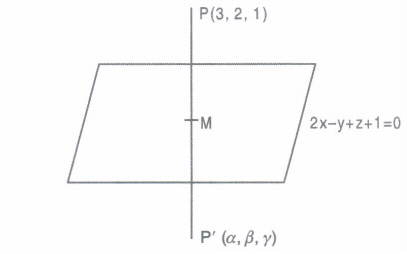
Let M be the foot of perpendicular from P on plane (1).
Let P' be the image of P in the plane (1).
The equations of PM are
\(\frac { x-3 }{ 2 } =\frac { y-2 }{ -1 } =\frac { z-1 }{ 1 } ...(2)\)
Any point on (2) is (3 + 2k, 2 - k, 1 + k) ...(3)
This point is M if it lies on (1)
if 2 (3 + 2k) - (2 - k) + (1 + k) + 1 = 0
if 6k = -6 if k = -1.
Putting in (3), the point M is :
(3 + 2 (- 1), 2 - (- 1), 1 - 1) i.e. (1, 3, 0). ,
Hence, the co-ordinates of M, the foot of perpendicular are (1, 3, 0).
And perpendicular distance = IPMI
\(\sqrt { { \left( 3-1 \right) }^{ 2 }+{ \left( 2-3 \right) }^{ 2 }+{ \left( 1-0 \right) }^{ 2 } } \)
\(=\sqrt { 4+1+1 } =\sqrt { 6 } units\)
If P' \(\left( \alpha ,\beta ,\gamma \right) \) is then:
\(\sqrt { { \left( 3-1 \right) }^{ 2 }+{ \left( 2-3 \right) }^{ 2 }+{ \left( 1-0 \right) }^{ 2 } } \)
\(=\sqrt { 4+1+1 } =\sqrt { 6 } units\)
Hence, the required image is P'(-1, 4, -1)
18.
Equation of plane through points A, B and C is
\(\left| \begin{matrix} x-2 & y-5 & z+3 \\ -4 & -8 & 8 \\ 3 & -2 & 0 \end{matrix} \right| =0\Rightarrow 16x+24y+32z-56=0\)
i.e., 2x + 3y + 4z-7 = 0
Distance of plane from (7, 2, 4)
= \(\left| \frac { 2\left( 7 \right) +3\left( 2 \right) +4\left( 4 \right) -7 }{ \sqrt { 4+9+16 } } \right| =\sqrt { 29 } \)
19.
Let equation of plane through (1, 2, -4) be a(x-1) + b(y-2) + c(z+4) = 0.
The plane is parallel to the given lines
\(\therefore\) 2a + 3b + 6c = 0; a + b - c = 0
Solving: \(\frac { a }{ -9 } =\frac { b }{ 8 } =\frac { c }{ -1 } =k\left( say \right) \)
\(\therefore\) a = -9k, b = 8k, c = -k
From (i), -9k(x-1) + 8k(y-2) - k(z+4) = 0
\(\therefore\) Equation of plane in cartesian form is 9x - 8y + z+11 = 0
Vector form of plane is: \(\Rightarrow \vec { r } .\left( 9\hat { i } -8\hat { j } +\hat { k } \right) =-11\)
Distance of (9, -8, -10) from the plane = \(\left| \frac { 9.9-8\left( -8 \right) +1\left( -10 \right) +11 }{ \sqrt { 81+64+1 } } \right| =\sqrt { 146 } \)

12th Standard CBSE Syllabus & Materials
12th Standard CBSE
CBSE 12th Computer Science Python Revision Tour I - New Previous year Question Papers Study Material - QB365 Set A
NEW12th Standard CBSE
CBSE 12th Business Studies Planning Important Questions And Answers Study Material - QB365 Set A
NEW12th Standard CBSE
CBSE 12th Business Studies Business Environment Important Questions And Answers Study Material - QB365 Set A
NEW12th Standard CBSE
CBSE 12th Business Studies Principles of Management Important Questions And Answers Study Material - QB365 Set A



CBSE 12th Standard CBSE Subjects
CBSE Standards










