
 100% FREE ACCESS
12th Standard CBSE Syllabus & Materials
12th Standard CBSE
CBSE 12th Economics Government Budget and the Economy Previous year Question Papers Study Material - QB365 Set A
NEW12th Standard CBSE
CBSE 12th Computer Science Interface Python with MySQL - New Previous year Question Papers Study Material - QB365 Set A
NEW12th Standard CBSE
CBSE 12th Computer Science Database Concept - New Previous year Question Papers Study Material - QB365 Set A
NEW12th Standard CBSE
CBSE 12th Computer Science Data Communication - New Previous year Question Papers Study Material - QB365 Set A
NEW12th Standard CBSE
CBSE 12th Computer Science Data Structures - New Previous year Question Papers Study Material - QB365 Set A
NEW12th Standard CBSE
CBSE 12th Computer Science Functions - New Previous year Question Papers Study Material - QB365 Set A

Published on: 06/09/2019
Linear Programming
Download CBSE Class 12th Standard CBSE Maths question papers, sample papers, important questions, and previous year solved papers in PDF format. Get free study materials, NCERT solutions, and exam preparation resources for Class 12th Standard CBSE Maths
Questions + Answers key
Take MCQ Maths Test
1.
Solve the following Linear Programming Problem graphically:
Maximize Z = 3x + 4y subject to the constraints:
\(x+y\le 4,\)
\(x\ge 0 \ \text {and} \)
\(y\ge 0.\)
2.
Solve the following LLP graphically:
Maximise Z = 2x + 3y, subject to \(x+y\le 4,x\ge 0,y\ge 0.\)
3.
An aeroplane can carry a maximum of 200 passengers. A profit of Rs. 1000 is made 0n each executive class ticket and a profit of Rs. 600 is made on each economy class ticket. The airline reserves at least 20 seats for executive class. However at least, 4 times as many passengers prefer to travel by economy class than by the executive class. Determine how many tickets of each type must be sold to in order to maximise the profit for the airline. What is the maximum profit?
4.
There are two types of fertilizers F1 and F2. F1 consists of 10% nitrogen and 6% phosphoric acid and F2 consists of 5% nitrogen and 10% phosphoric acid. After testing the soil conditions, a farmer finds that she needs at least 14 kg. of nitrogen and 14 kg of phosphoric acid for her crop. If F1 costs Rs. 6/kg and F2 costs Rs. 5/kg, determine how much of each type of fertilizer should be used that nutrient requirement are met at a minimum cost. What is the minimum cost?
5.
A manufacturer produces nuts and bolts. It takes 1 hour of work on machine A and 3 hours on machine B to produce a package of nuts while It takes 3 hours on machine A and 1 hour on machine B to produce a package of bolts. He earns a profit of Rs. 17.50 per package on nuts and Rs. 7per package of bolts. How many packages of each should be produced each day so as to maximise his profits if he operates his machines for at the most 12 hours a day? Formulate this mathematically and then solve it.
6.
Solve the following Linear Programming Problems graphically:
Minimise Z = 3x + 5y
such that x + 3y ≥ 3, x + y ≥ 2, x, y ≥ 0.
7.
Solve the following Linear Programming Problems graphically:
Maximise Z = 3x + 4y
subject to the constraints:
\(x+y\le 4,x\ge 0,y\ge 0.\)
8.
Solve the following linear programming problem graphically:
Minimise Z = 200 x + 500 y
subject to the constraints
\(x+2y\ge 10,\)
\(3x+4y\le 24,\)
\(x\ge 0,y\ge 0.\)
9.
A cooperative society of farmers has 50 hectare of land to grow two crops X and Y. The profit from crops X and Y per hectare are estimated as Rs. 10,500 and Rs. 9,000 respectively. To control weeds, a liquid herbicide has to be used for crops X and Y at rates of 20 litres and 10 litres per hectare. Further, no more than 800 litres of herbicide should be used in order to protect fish and wild life using a pond which collects drainage from this land. How much land should be allocated to each crop so as to maximise the total profit of the society?
10.
The objective function is maximum or minimum, which lies on the boundary of the feasible region.
11.
An aeroplane can carry a maximum of 200 passengers. A profit of Rs. 500 is made on each executive class ticket out of which 20% will go to the welfare fund of the employees. Similarly a profit of Rs. 400 is made on each economy class ticket out of which 25% will go for the improvement of facilities provided to economy class passengers. In both cases, the remaining profit goes to the airline's fund. The airline reserves at least 20 seats for executive class. However, at least 4 times as many passengers prefer to travel by economy class than by the executive class. Determine how many tickets of each type must be sold in order to maximize the profit for the airline. Make the above as an LPP and solve it graphically. Do you think, more passengers would prefer to travel by such an airline than by others?
12.
A company manufactures two types of sweaters, type A and B. It costs Rs. 360 to make one unit of type A and Rs. 120 to make a unit of type B. The company can make at most 300 sweaters and can spend Rs. 72,000 a day. The number of sweaters of type A cannot exceed the number of type B by more than 100. The company makes a profit of Rs 200 on each unit of type A. The company charging a nominal profit of Rs. 20 on a unit of type B. Using LPP, solve for max. profit.
13.
A manufacturer produces nuts and bolts. It takes 2 hours work on machine A and 3 hours on machine B to produce a package of nuts. It takes 3 hours on machine A and 2 hours on machine B to produce a package of bolts. He earns a profit of Rs. 24 per package on nuts and Rs. 18 per package on bolts. How many packages of each should be produced each day so as to maximize his profit, if he operates his machines both for at the most 10 hours a days. Make an LPP from above and solve it graphically?
1.
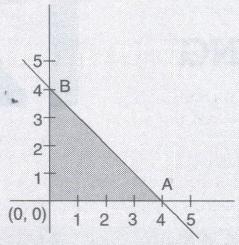
The feasible region determined by the constraints, x + y ≤ 4, x ≥ 0, y ≥ 0, is as follows.
The corner points of the feasible region are O (0, 0), A (4, 0), and B (0, 4). The values of Z at these points are as follows.
| Corner point | Z = 3x + 4y | |
| O(0, 0) | 0 | |
| A(4, 0) | 12 | |
| B(0, 4) |
16 |
→ Maximum |
Therefore, the maximum value of Z is 16 at the point B (0, 4).
2.
The system of constraints is:
\(x+y\le 4\)..(1)
\(x\ge 0,y\ge 0\) ..(2)
It is observed that the feasible region OAB is bounded.
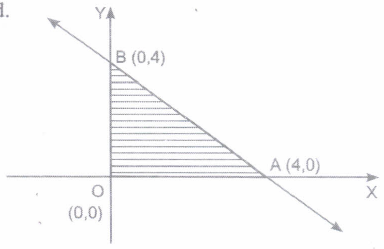
∴ By Corner Point Method, we have:
| Corner Point | Corresponding Value of Z |
| O : (0, 0) | 0 |
| A : (4, 0) | 8 |
| B : (0, 4) | 12 (Maximum) |
Hence, Zmax = 12 at (0, 4).
3.
Let the airline sell x tickets of executive class and y tickets of economy class.
The mathematical formulation of the given problem is as follows.
Maximize z = 1000x + 600y … (1)
subject to the constraints,
\(x+y\le 200\) ..(1)
\(x\ge 20\)...(2)
\(y\ge 80\) ..(3)
\(x,y\ge 0\) ..(4)
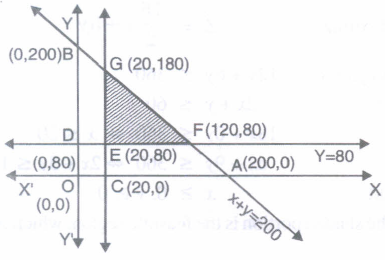
The feasible region determined by the constraints is as follows.
The corner points of the feasible region are A (20, 80), B (40, 160), and C (20, 180).
The values of z at these corner points are as follows.
| Corner point | z = 1000x + 600 | |
| A (20, 80) | 68000 | |
| B (40, 160) | 136000 | → Maximum |
| C (20, 180) | 128000 |
The maximum value of z is 136000 at (40, 160).
Thus, 40 tickets of executive class and 160 tickets of economy class should be sold to maximize the profit and the maximum profit is Rs. 136000.
4.
Let the farmer buy x kg of fertilizer F1 and y kg of fertilizer F2. T`herefore,
x ≥ 0 and y ≥ 0
The given information can be complied in a table as follows.
| Nitrogen (%) | Phosphoric Acid (%) | Cost (Rs/kg) | |
| F1 (x) | 10 | 6 | 6 |
| F2 (y) | 5 | 10 | 5 |
|
Requirement (kg) |
14 | 14 |
F1 consists of 10% nitrogen and F2 consists of 5% nitrogen. However, the farmer requires at least 14 kg of nitrogen.
∴ 10% of x + 5% of y ≥ 14
x10 + y 20 ≥ 14
2x + y ≥ 280
F1 consists of 6% phosphoric acid and F2 consists of 10% phosphoric acid. However, the farmer requires at least 14 kg of phosphoric acid.
∴ 6% of x + 10% of y ≥ 14
6x/100 + 10y/100 > = 14
3x +56y > = 700
Total cost of fertilizers, Z = 6x + 5y
The mathematical formulation of the given problem is
Minimize Z = 6x + 5y … (1)
subject to the constraints,
2x + y ≥ 280 … (2)
3x + 5y ≥ 700 … (3)
x, y ≥ 0 … (4)
The feasible region determined by the system of constraints is as follows.
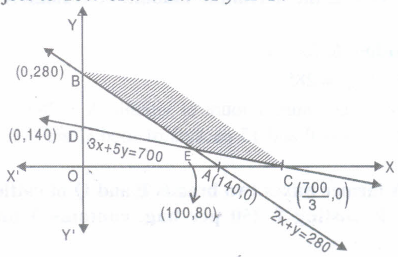
It can be seen that the feasible region is unbounded.
The corner points are A(700/3, 0), B(100, 80) and C(0, 280)
The values of Z at these points are as follows.
|
Corner point |
Z = 6x + 5y | |
| A(700/3,0) | 1400 | |
| B(100, 80) | 1000 | → Minimum |
| C(0, 280) | 1400 |
As the feasible region is unbounded, therefore, 1000 may or may not be the minimum value of Z.
For this, we draw a graph of the inequality, 6x + 5y < 1000, and check whether the resulting half plane has points in common with the feasible region or not.
It can be seen that the feasible region has no common point with
6x + 5y < 1000
Therefore, 100 kg of fertiliser F1 and 80 kg of fertilizer F2 should be used to minimize the cost. The minimum cost is Rs. 1000.
5.
Let the manufacturer produce x packages of nuts and y packages of bolts. Therefore, x ≥ 0 and y ≥ 0
The given information can be compiled in a table as follows.
| Nuts | Bolts | Availability | |
| Machine A (h) | 1 | 3 | 12 |
| Machine B (h) | 3 | 1 | 12 |
The profit on a package of nuts is Rs. 17.50 and on a package of bolts is Rs. 7. Therefore, the constraints are
x + 3y ≤ 12
3x + y ≤ 12
Total profit, Z = 17.5x + 7y
The mathematical formulation of the given problem is
Maximise Z = 17.5x + 7y … (1)
subject to the constraints,
x + 3y ≤ 12 … (2)
3x + y ≤ 12 … (3)
x, y ≥ 0 … (4)
The feasible region determined by the system of constraints is as follows.
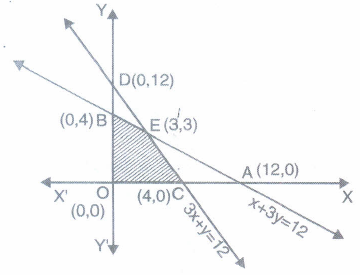
The corner points are A (4, 0), B (3, 3), and C (0, 4).
The values of Z at these corner points are as follows.
| Corner point | Z = 17.5x + 7y | |
| O(0, 0) | 0 | |
| A(4, 0) | 70 | |
| B(3, 3) | 73.5 | → Maximum |
| C(0, 4) | 28 |
The maximum value of Z is Rs. 73.50 at (3, 3).
Thus, 3 packages of nuts and 3 packages of bolts should be produced each day to get the maximum profit of Rs. 73.50.
6.
The feasible region determined by the system of constraints, x + 3y ≥ 3, x + y ≥ 2, and x, y ≥ 0, is as follows.
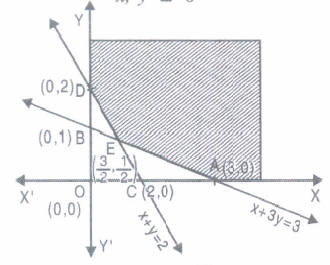
It can be seen that the feasible region is unbounded.
The corner points of the feasible region are A (3, 0) B \(\left( \frac { 3 }{ 2 } ,\frac { 1 }{ 2 } \right) \) and C (0, 2).
The values of Z at these corner points are as follows.
| Corner Point | Corresponding Value of Z |
| A : (3,0) | 9 |
| E : \(\left( \frac { 3 }{ 2 } ,\frac { 1 }{ 2 } \right) \) | 7 (Minimum) |
| D : (0,2) | 10 |
As the feasible region is unbounded, therefore, 7 may or may not be the minimum value of Z.
For this, we draw the graph of the inequality, 3x + 5y < 7, and check whether the resulting half plane has points in common with the feasible region or not.
It can be seen that the feasible region has no common point with 3x + 5y < 7. Therefore, the minimum value of Z is 7 at (3/2,1/2).
7.
The system of constraints is:
\(x+y\le 4\) ..(1)
and \(x\ge 0,y\ge 0.\) ...(2)
The shaded region in the following figure is the feasible region determined by the system of constraints (1)-(2)
It is observed that the feasible region OAB is bounded.
Thus we use Corner Point Method to determine the maximum value of Z, where:
Z = 3x + 4y...(3)
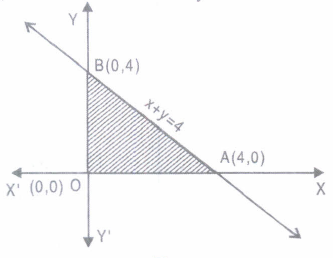
The co-ordinates of O, A and B are (0, 0), (4, 0) and (0, 4) respectively.
We evaluate Z at each corner point.
| Corner Point | Corresponding Value of Z |
| O : (0,0) | 0 |
| A : (4,0) | 12 |
| B : (0,4) | 16 (Maximum) |
Hence, \(Z_{ max }=16\) at the point (0, 4)
8.
The shaded region is the feasible region ABC determined by the system of constraints (2) to (4), which is bounded. The coordinates of corner points
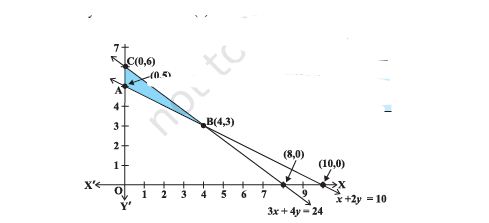
A, B and C are (0,5), (4,3) and (0,6) respectively. Now we evaluate Z = 200x + 500y at these points.
Hence, minimum value of Z is 2300 attained at the point (4, 3)
| Corner Point | Corresponding Value of Z |
| B : (0,5) | 2500 |
| D : (0,6) | 3000 |
| E : (4,3) | 2300 (Minimum) |
9.
Let x hectare of land be allocated to crop X and y hectare to crop Y. Obviously,
x ≥ 0, y ≥ 0.
Profit per hectare on crop X = Rs. 10500
Profit per hectare on crop Y = Rs. 9000
Therefore, total profit = Rs. (10500x + 9000y)
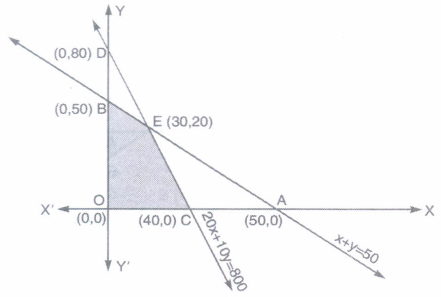
The mathematical formulation of the problem is as follows:
Maximise Z = 10500 x + 9000 y subject to the constraints:
x + y ≤ 50 (constraint related to land) ... (1)
20x + 10y ≤ 800 (constraint related to use of herbicide)
i.e. 2x + y ≤ 80 ... (2)
x ≥ 0, y ≥ 0 (non negative constraint) ... (3)
Let us draw the graph of the system of inequalities (1) to (3). The feasible region OABC is shown (shaded) in the Figure Observe that the feasible region is bounded.
The coordinates of the corner points O, A, B and C are (0, 0), (40, 0), (30, 20) and (0, 50) respectively. Let us evaluate the objective function Z = 10500 x + 9000y at these vertices to find which one gives the maximum profit.
| Corner Point | Z = 10,500x + 9,000y |
| O : (0,0) C : (40,0) E : (30,20) B : (0,50) |
0 4,20,000 4,95,000 (Maximum) 4,50,000 |
Hence, the society will get the maximum profit of Rs. 4,95,000 by allocating 30 hectares for crop X and 20 hectares for crop Y.
10.
True.
11.
Let there be x tickets of executive class and y tickets of economy class. Let 2 be net profit of the airline.
Now \(z = 500\times \frac { 80 }{ 100 } +400y\times \frac { 75 }{ 100 } \)
Z = 400x + 300y ..(i)
According to the question,
x \(\ge\) 20 ...(ii)
Also x + y \(\le\)200 ...(iii)
y\(\ge\)4x ....(iv)
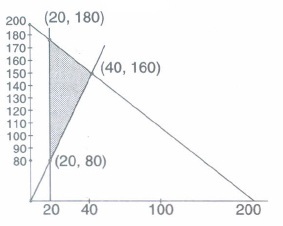
Shaded region is feasible region having corner points A(20, 0), B(40, 0), C(40, 160), D(20, 180).
Now value of 2 is calculated at comer point as
\(\begin{array}{|c|c|} \hline \begin{array}{c} \text { Corner } \\ \text { Points } \end{array} & Z=400 x+300 y \\ \hline(20,80) & 32,000 \\ \hline(40,160) & 64,000 \\ \hline(20,180) & 62,000 \\ \hline \end{array}\)
Hence, 40 tickets of executive class and 160 tickets of economy class should be sold to maximise the net profit of the airlines.
Yes, more passengers would prefer to travel by such an airline, because some amount of profit is invested for welfare fund.
12.
Let the company manufactures sweaters of type A = x, type B = y, daily.
\(\therefore\) LPP is maximize. P = 200x + 20y s.t.
360x + 120y \(\le \) 72000
\(\Rightarrow\) 3x + y \(\le \) 300
x + y \(\le \) 300
x - y \(\le \) 100
\(3x+y=600,\begin{cases} x=0,y=600 \\ y=0,x=200 \end{cases}\)
\(x+y=300,\begin{cases} x=0,y=300 \\ y=0,x=300 \end{cases}\)
\(x-y=100,\begin{cases} x=100,\quad y=0 \\ y=100,\quad x=200 \end{cases}\)
\(\\ x\ge 0\)
\(y\ge 0\)
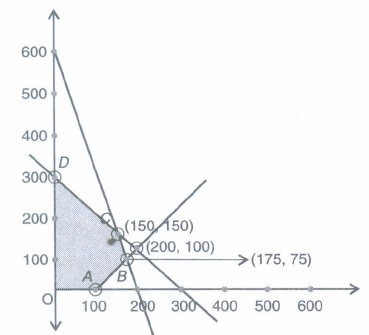
Getting vertices of feasible region as, O(0, 0), A(100, 0), B(175, 75), C(150, 150) and D(0, 300)
Maximum profit is P = 200(175) + 20(75)
= 35000 + 1500 = Rs. 36500
13.
Let x and y be nut packages and bolt packages produced each day, respectively.
\(\therefore\) LPP is Maximize Z = 24x + 18y
Subject to 2x + 3y \(\le \) 10
3x + 2y \(\le \) 10
x, y \(\ge \) 0
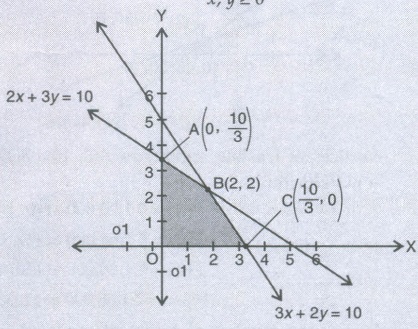
Vertices are
\(A\left( 0,\frac { 10 }{ 3 } \right) ,B(2,2)\quad and\quad C\left( \frac { 10 }{ 3 } ,0 \right) \)
| Points | Z = 24x + 18y |
| \(0,\frac { 10 }{ 3 } \) | z = 0+ 60 = Rs. 60 |
| (2, 2) | z = 48 + 36 = Rs. 84 (Max) |
| \(\left( \frac { 10 }{ 3 } ,0 \right) \) | z = 80 + 0 = Rs. 80 |
Hence, 2 nuts & 2 bolts to be produced to get max. profit of Rs. 84.

12th Standard CBSE Syllabus & Materials
12th Standard CBSE
CBSE 12th Computer Science Python Revision Tour I - New Previous year Question Papers Study Material - QB365 Set A
NEW12th Standard CBSE
CBSE 12th Business Studies Planning Important Questions And Answers Study Material - QB365 Set A
NEW12th Standard CBSE
CBSE 12th Business Studies Business Environment Important Questions And Answers Study Material - QB365 Set A
NEW12th Standard CBSE
CBSE 12th Business Studies Principles of Management Important Questions And Answers Study Material - QB365 Set A



CBSE 12th Standard CBSE Subjects
CBSE Standards










