
 100% FREE ACCESS
12th Standard CBSE Syllabus & Materials
12th Standard CBSE
CBSE 12th Economics Government Budget and the Economy Previous year Question Papers Study Material - QB365 Set A
NEW12th Standard CBSE
CBSE 12th Computer Science Interface Python with MySQL - New Previous year Question Papers Study Material - QB365 Set A
NEW12th Standard CBSE
CBSE 12th Computer Science Database Concept - New Previous year Question Papers Study Material - QB365 Set A
NEW12th Standard CBSE
CBSE 12th Computer Science Data Communication - New Previous year Question Papers Study Material - QB365 Set A
NEW12th Standard CBSE
CBSE 12th Computer Science Data Structures - New Previous year Question Papers Study Material - QB365 Set A
NEW12th Standard CBSE
CBSE 12th Computer Science Functions - New Previous year Question Papers Study Material - QB365 Set A

Published on: 15/09/2018
Term Test
Download CBSE Class 12th Standard CBSE Biology question papers, sample papers, important questions, and previous year solved papers in PDF format. Get free study materials, NCERT solutions, and exam preparation resources for Class 12th Standard CBSE Biology
Questions + Answers key
Take MCQ Biology Test
1.
Mention the reasons for difference in ploidy of zygote and primary endosperm nucleus in an angiosperm.
2.
Name the type od blastula present in following animals:
(i) Amphioxus
(ii) Reptiles, birds and prototherian mammals
(iii) Insects
(iv) Annelids, molluscs
(v) Frog
3.
Differentiate
(a) Morula and Blastula
(b) Blastulation and gastrulation
(c) Trophectoderm and ectoderm
4.
Differentiate anemophilous and entomophilous flowers
5.
Name the pollinating agents of flowers like maize and wheat. Give any two favourable features of such a flower.
6.
Name the pollinating agent of flowers like Salvia, Nasturtium and sunflower. Give two favourable features of such a flower for pollination.
7.
(a) Name the human embryonic stage shown below. Identify 'a' and 'b' in it.
.png)
(b) Mention the part of the above embryonic stage that forms the foetus.
8.
Match between the following representing parts of the sperm and the functions:
|
Column A |
Column B |
|
A. Head |
(i) Enzymes |
|
B. Middle piece |
(ii) Sperm motility |
|
C. Acrosome |
(iii) Energy |
|
D. Tail |
(iv) Genetic material |
9.
Cleistogamous flowers of Commelina are invariably autogamous. Mention its one advantage and one disadvantage to the plant.
10.
Mention an advantage and a disadvantage of a cleistogamous flower.
11.
State one advantage and one disadvantage of cleistogamy.
12.
In oogamy, fertilization involves
A large non-motile female gamete and a small non-motile male gamete
A large motile female gamete and a small non-motile male gamete
A small non-motile female gamete and a large motile male gamete
A large non-motile female gamete and a small motile male gamete
13.
Which one of the following statements about human sperm is correct?
Acrosome serves no particular function
Acrosome has a conical pointed structure used for piercing and penetrating the egg resulting in fertilization
The sperm lysis in the acrosome dissolve the egg envelope facilitating fertilization
Acrosome serves as a sensory structure leading the sperm towards the ovum
14.
During embryonic development, the establishment of polarity along anterior/posterior, dorsal/ventral or medial/lateral axis is called
Organizer phenomena
Axis formation
Anamorphosis
Pattern formation
15.
The membranous cover of the ovum at ovulation is
Corona radiata
Zona radiata
Zona pellucida
Chorion
16.
From among the sets of terms given below, identify those that are associated with gynoecium.
Stigma, ovule, embryo sac, placenta
Thalamus, pistil, style, ovule
Ovule, ovary, tapetum, embryo sac
Egg, integument, embryo sac, nucellus
17.
Which one of the following is surrounded by a callose wall?
Male gamete
Egg
Pollen grain
Microspore mother cell
18.
Plants of which one of the following groups of genera are pollinated by the same agency?
Triticum, Cocos, Mangifera
Ficus, Kigelia, Casuarina
Salvia, Morus, Euphorbia
Bombax, Butea, Bauhinia
19.
Which type of association is found in between entomophilous flower and pollinating agent?
Mutualism
Commensalism
Cooperation
Coevolution
20.
Intraspecific incompatibility can be overcome by
Wetting of anthers
Mixed pollination
Intraovarian fertilization
Intraspecific competition
21.
Male and female gametes are ________.(diploid/haploid)
22.
With the help of an example of each explain the following?
Apomixis, Parthenocarpy, Polyembryony.
23.
Give a schematic representation, showing the events of spermatogenesis in human male.
24.
Match the items in Column (A) with Column (B). Each point in column (A) has minimum one match in column (B) and maximum two matches.
| Column (A) | Column (B) |
| 1. Autogamy | (a) Megasporangia |
| 2. Apomixis | (b) Xenogamy |
| 3. Pollen sacs | (c) Female gametophyte |
| 4. Ovules | (d) Asexual reproduction |
| 5. Embryosac | (e) Allogamy |
| 6. Pollar nuclei | (f) Secondary nucleus |
| 7. Cross pollination | (g) Microsporangia |
| (h) Agamospermy | |
| (i) Self pollination |
25.
Nisha's grandmother often blames her mother for giving birth to 3 daughters and no son and therefore wants another marriage of her son. Answer following questions on the basis of above information.
(i) Is it right to blame a female for determination of sex and giving birth to only girls? Justify.
(ii) What values are not exhibited by Nisha's grandmother.
26.
The following is the illustration of the sequence of ovarian events "a" to "i" in a human female:

(a)Identify the figure that illustrates corpus luteum and name the pituitary hormone that influences its formation.
(b) Specify the endocrine function of corpus luteum. How does it influence the uterus? Why is it essential ?
(c)What is the difference between "d" and "e"?
(d) Draw a neat labelled sketch of Graffian follicle.
27.
During the reproductive cycle of a human female, when, where and how does a placenta develop? What is the function of placenta during pregnancy and embryo development?
28.
Ramesh got a job in Mumbai but his family was still living in the village. One day, he received a letter from his father stating that he is planning marriage of her sister who will be fifteen years old in March. Ramesh did not like the idea of his father of arranging plan of his sister till she attains age of 18 years.
Read the above passage and answer the following questions:
(i) In your opinion, who is right Ramesh or his Father?
(ii) What is the right age of marriage for girls?
(iii) What are the risks involved in early marriage?
29.
Name the cells that nourish germ cells in testes. Where are these cells located in the testes?
30.
Name the pouch in which the human tests are present.
31.
Cervix contains the largest and the strongest sphincter in its wall. Give reason.
32.
Give the name of the common function that cotyledons and nucellus perform
33.
What is the position of plumlue in monocot embryo?
1.
Zygote is formed by fusion of male gamete (n) and egg cell (n), hence diploid (2n).
Primary endosperm nucleus is formed by the fusion of two polar nuclei or secondary nucleus (n + n) and male gemete (n), hence triploid (3n).
2.
(i) Coeloblastula with blastocoel surrounded by single - layered blastoderm
(ii) Discoblastula
(iii) Periblastula or superficial blastula
(iv) Stereoblastula
(v) Coeloblastula with blastocoel surrounded by many layered blastoderm.
3.
Difference between Morula and Blastula
| Morula | Blastula |
| 1.It is solid | 1.It is hollow |
| 2.Cells are rounded | 2.Cells are flattened. |
| 3.Segmentation cavity is absent. | 3.Segmentation cavity is present. |
Difference between blastulation and gastrulation
| Blastulation | Gastrulation |
| 1.Rapid mitotic division occurs | 1.Movement and rearrangements |
| 2.The segmentation cavity (blastocoel) is formed | 2.Archenteron or gut is formed. |
| 3.It is lined by one layer (ectoderm) | 3.It is lined by two layers in the beginning and later on, three layers are present. |
| 4.Blastomeres become flattened and arrange along the periphery(ectoderm). | 4.Cells show morphogenetic movements (Epiboly and emboly) and chemical changes.The cells get arranged in three layers (ectoderm, mesoderm and endoderm) |
Difference between Trophectoderm and Ectoderm
| Trophectoderm | Ectoderm |
| 1.It is special layer which develops in viviparous animals. | 1.It is germinal layer present in all animals. |
| 2.It lies outer to the blastocyst. | 2.From the blastocyst, the ectoderm is formed. |
| 3.From it, the placenta and extraembryonic membranes are formed. | 3.Epidermis of skin, nervous system and sense organs are formed from ectoderm. |
| 4.It helps in feeding during the development. | 4.No such function is performed by the ectoderm. |
4.
|
Anemophilous flower |
Entomophilous flower |
|
1. The flower are small. |
1. The flowers are either large or small they are grouped to form a mass. |
|
2. Flowers are neither brightly coloured nor emit any odour. |
2. The flowers are brightly coloured and emit odour. |
|
3. The flowers are devoid of any nectar and edible pollen. |
3. The flowers usually possess nectar or edible pollen. |
5.
In maize, the flower are pollinated by wind. These flowers are unisexual, small, colourless, inconspicuous and odourless. In wheat, the flowers are self-pollinated. Anthers and stigma of the bisexual flowers of same plant mature before the opening of the bud to ensure self-pollination.
6.
The flowers of Salvia, Nasturtium and Sunflower are pollinated by insects. The insect pollinated flowers are usually large, conspicuous, bilabiate in Salvia, brightly coloured and showy. They produce specific odours to attract specific insects.
7.
(a) It is a blastocyst.
'a' - Inner cell mass.
'b' -Trophoblast
(b) Inner cell mass
8.
A - iv; B - iii; C - i; D - ii
9.
Advantage
Since cleistogamous flowers are autogamous, there is an assured seed-set.
Disadvantage
Continued self-pollination leads to inbreeding depression.
10.
Advantage
1. Since cleistogamous flowers are autogamous, there is an assured seed-set.
Disadvantage
1. Continued self-pollination leads to inbreeding depression.
11.
Advantage
1. Since cleistogamous flowers are autogamous, there is an assured seed-set.
Disadvantage
1. Continued self-pollination leads to inbreeding depression.
12.
(d)
A large non-motile female gamete and a small motile male gamete
13.
(c)
The sperm lysis in the acrosome dissolve the egg envelope facilitating fertilization
14.
(a)
Organizer phenomena
15.
(a)
Corona radiata
16.
(a)
Stigma, ovule, embryo sac, placenta
17.
(d)
Microspore mother cell
18.
(d)
Bombax, Butea, Bauhinia
19.
(a)
Mutualism
20.
(b)
Mixed pollination
21.
()
haploid
22.
(i) Apomixis: It is a kind of an asexual process which imitates the sexual reproduction by formation of seed without fertilization. It can be referred to as special type of sexual reproduction which does not involve the process of meiosis and syngamy.
(ii) Parthenocarpy : The formation of fruit without of fertilization is called as parthenocarpy. Such fruits are seedless and called as parthenocarpic fruits. e.g., Banana.
(iii) Polyembryony: The occurrence of plural embryos in a seed is called polyembryony, e.g., citrus fruits like orange. Normally, one embryo is formed in a seed as a result of fertilization but additional embryos may develop apomictly.
23.
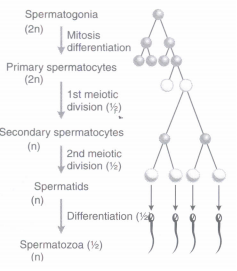
24.
1.(i); 2. (d), (h), 3. (g); 4. (a); 5. (c); 6.(f) ; 7.(b), (e)
25.
(i) It is not correct to blame a females for giving birth to female child. The sex of the baby is determined by the male gamete, because the man is heterogametic and produces two types of sperms x and y. Female is homogametic and produce only one type of ova i.e., X. Now if the X sperm with X chromosome fuses with egg the zygote XX will develop into female baby and if sperm with Y chromosome fuses with egg the (XY) baby would be male.
(ii) Values: Following values are not exhibited by Nisha's grandmother:
(a) understanding and awareness
(b) Respect to females.
26.
(a) 'g', Luteinising hormone (LH).
(b) Produces the hormone progesterone, causes proliferation ofthe endometrium which gets highly vascularised. It is essential for the implantation of the fertilized ovum and to maintain the same during pregnancy.
(c) "d" is the developing tertiary follicle
"e" is the Graffian follicle
(d)
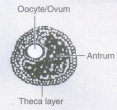
27.
After implantation, uterus, chorionic villi and uterine tissue become interdigitated (physically fused)
Placenta facilitates supply of oxygen / nutrients to the embryo.
Removal of carbon dioxide / waste material / excretory material produced by the embryo.
Production of hCG/hPL / estrogens / progestogens.
28.
(i) Ramesh is right in this matter as early or child marriage can endanger the life of girl.
(ii) 18 years
(iii) The reproductive organs of girls below 18 years are not fully prepared for pregnancy. Also, early pregnancy may have serious harmful effects on the health of the young mother.
29.
()
Name of cells - Sertoli cells.
Location - They are found lining - up the inner surface of seminiferous tubules.
30.
()
Scrotum
31.
()
Cervix can hold about 7kg of foetus and fluid in the uterus against the pull of gravity for several days during pregnancy. Thus, it contains the largest and strongest sphincter.
32.
()
The common function of nucellus and cotyledons are:
(i) storage of reserve food material
(ii) nourishment of embryo and embryo sac respectively
33.
()
Lateral

12th Standard CBSE Syllabus & Materials
12th Standard CBSE
CBSE 12th Computer Science Python Revision Tour I - New Previous year Question Papers Study Material - QB365 Set A
NEW12th Standard CBSE
CBSE 12th Business Studies Planning Important Questions And Answers Study Material - QB365 Set A
NEW12th Standard CBSE
CBSE 12th Business Studies Business Environment Important Questions And Answers Study Material - QB365 Set A
NEW12th Standard CBSE
CBSE 12th Business Studies Principles of Management Important Questions And Answers Study Material - QB365 Set A



CBSE 12th Standard CBSE Subjects
CBSE Standards










