
 100% FREE ACCESS
12th Standard CBSE Syllabus & Materials
12th Standard CBSE
CBSE 12th Economics Government Budget and the Economy Previous year Question Papers Study Material - QB365 Set A
NEW12th Standard CBSE
CBSE 12th Computer Science Interface Python with MySQL - New Previous year Question Papers Study Material - QB365 Set A
NEW12th Standard CBSE
CBSE 12th Computer Science Database Concept - New Previous year Question Papers Study Material - QB365 Set A
NEW12th Standard CBSE
CBSE 12th Computer Science Data Communication - New Previous year Question Papers Study Material - QB365 Set A
NEW12th Standard CBSE
CBSE 12th Computer Science Data Structures - New Previous year Question Papers Study Material - QB365 Set A
NEW12th Standard CBSE
CBSE 12th Computer Science Functions - New Previous year Question Papers Study Material - QB365 Set A

Published on: 29/12/2018
Class 12 Full Test Model
Download CBSE Class 12th Standard CBSE Physics question papers, sample papers, important questions, and previous year solved papers in PDF format. Get free study materials, NCERT solutions, and exam preparation resources for Class 12th Standard CBSE Physics
Questions + Answers key
Take MCQ Physics Test
1.
(a) A point object is placed in front of a double convex lens (of refractive index n =n2/n1 with respect air) with its spherical faces of radii of curvature R1 and R2.. Show the path of rays due to surface to obtain the formation of the real image of the object.
Hence obtain the lens maker's formula for a thin lens.
(b) A double convex lens having both faces of the same radius of curvature has refractive index 1.55. Find out the radius of curvature of the lens required to get the focal length of 20 cm.
2.
(i) What do you understand by sharpness of resonance in a series L-C-R circuit? Derive an expression for Q-factor of the circuit.
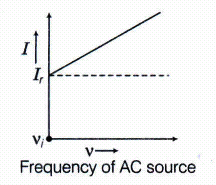
(ii) Three electrical circuits having AC sources of variable frequency are shown in the figures. Initally, the current following in each of these is same.If the frequency of the applied AC source is increased, how will the current flowing in these circuits be affected?
Give the reason for your answer.

3.
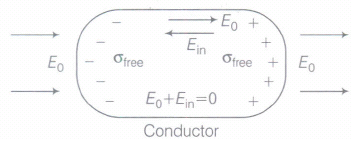
(i) Explain, using suitable diagram, the difference in the behaviour of a
(a) conductor
(b) dielectric in the presence of external electric field. Define the terms polarisation of a dielectric and write its relation with susceptibility.
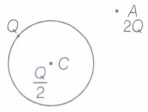
(ii) A thin metallic spherical shell of radius R carries a charge Q on its surface. A point charge Q/2 is placed at its centre C and an another charge +2Q is placed outside the shell at a distance x from the centre as shown in figure. Find
(a) the force on the charge at the centre of the shell and at point A,
(b) the electric flux through the shell.
4.
Establish the relation between current and drift velocity.
5.
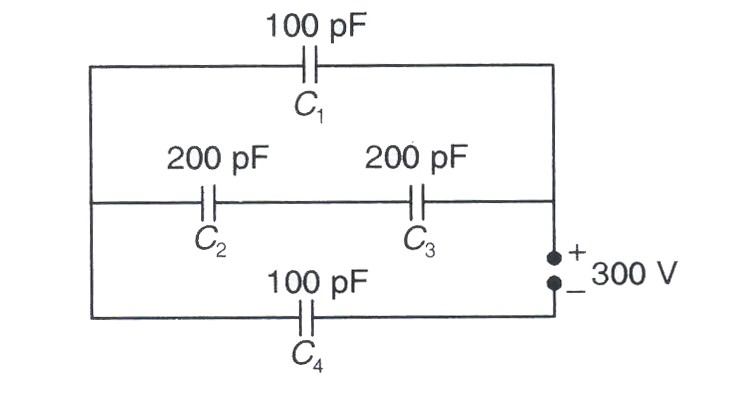
Obtain the equivalent capacitance of the network in adjoining figure.For a 300V supply,determine the charge and voltage across each capacitor.
6.
A charge + Q is uniformly distributed within a sphere of radius R. Find the electric field, due to this charge distribution, at a point distant from the centre of the sphere where:(i) 0 < r < R (ii) r > R
7.
An electric dipole is kept in a uniform electric field. Derive an expression for the net torque acting on it and write its direction. State the conditions under which the dipole is in
(i) stable equilibrium
(ii) unstable equilibrium.
8.
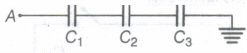
Calculate the potential difference and the energy stored in the capacitor C2 in the circuit shown in the figure. Given potential at A is 90 V, C1 = 20 \(\mu F\) , C2 = 30\(\mu F\), C3 = 15\(\mu F\).
9.
An electric dipole of length 2 cm, when placed with its axis making an angle of 60o with a uniform electric field, experiences a torque of \(8\sqrt { 3 } \)N-m. Calculate the potential energy of the dipole, if it has a charge of \(\pm \)4nC.
10.
A charged 30\(\mu \)F capacitor is connected to a 27mH inductor. What is the angular frequency of free oscillations of the circuit?
11.
A 100 resistor is connected to a 220V, 50Hz ac supply.
(a) What is the rms value of current in the circuit?
(b) What is the net power consumed over a full cycle?
12.
What do you understand by conservation of charge?
13.
Check that the ratio ke2/Gmemp is dimensionless. Look up a table of physical constants and determine the value of this ratio. What does the ratio signify?
14.
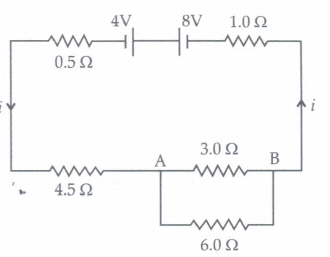
In the circuit shown in the figure, find the current through each resistor.
15.
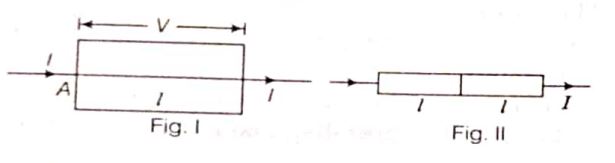
A metal rod of square cross-sectional area A having length l has current I flowing through it when a potential difference of V volt is applied across its ends (figure I). Now the rod is cut parallel to its length into two identical pieces and joined as shown in figure II. What potential difference must be maintained across the length of 2l so that the current in the rod is still I?
16.
An infinite number of charges, each of q coulomb, are placed along X-axis at x = 1m, 3 m, 9 m and so on. Calculate the electric field at the point x = 0, due to these charges if all the charges are of the same sign.
17.
Why is adsorption always exothermic?
18.
Draw a plot showing the variation of
(i) electric field (E)and
(ii) electric potential (V) with distance r due to a point charge Q.
19.
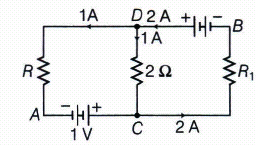
In the given circuit, assuming point A to be at zero potential, use Kirchhoff,s rules to determine the potential at point B.

20.
Deduce Coulomb's law from Gauss' law.
21.
Ordinary rubber is an insulator. But the special rubber tyres of aircraft's are made slightly conducting. Why is this necessary?
22.
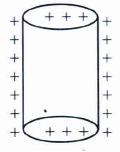
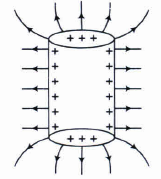
Sketch the electric field lines for a uniformly charged hollow cylinder as shown in the figure.
23.
A bird perches on a bare high power line and nothing happens to the bird. A man standing on the ground touches the same line and gets a fatal shock why?
24.
Is it correct to write the unit of electric dipole moment as mC?
25.
Why should electrostatic field be zero inside a conductor?
26.
Guess a possible reason, why water has a much greater dielectric constant (= 80) than mica (= 6)?
27.
What are the SI units of pole strength and magnetic moment ?
28.
If the radius of the Gaussian surface enclosing a charge q is halved, how does the electric flux through the Gaussian surface change?
29.
How is capacitative reactance affected when frequency of a.c. supply is tripled?
30.
A point charge q is placed at the origin. How does the electric field due to the charge vary with distance r from the origin?
31.
A wire is drawn into double its length and half its original cross-section. What will increase in its
(i) resistance and
(ii) resistivity?
32.
How does a current loop behave like a bar magnet?
1.
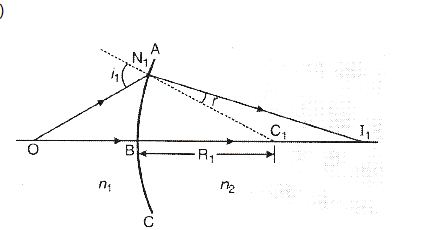
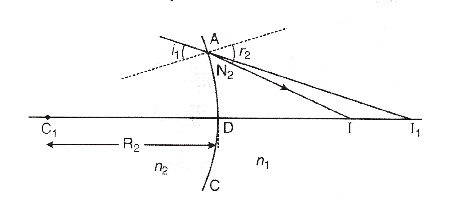
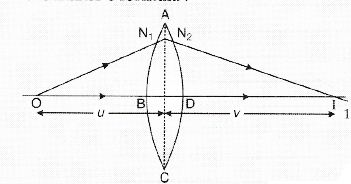
The first refracting ABC forms the image I1 of the object O. The image I1 acts as virtual object for the second refracting surface ADC, which forms the real image I as shown in the diagram
For refraction at ABC
\(\frac { { n }_{ 2 } }{ { v }_{ 1 } } -\frac { { n }_{ 1 } }{ u } =\frac { { n }_{ 2 }-{ n }_{ 1 } }{ { R }_{ 1 } } \)
For refraction at ADC
\(\frac { { n }_{ 1 } }{ v } -\frac { { n }_{ 2 } }{ { v }_{ 1 } } =\frac { { n }_{ 1 }-{ n }_{ 2 } }{ { R }_{ 2 } } \)
Adding equation (i) and equation (ii)
\(\frac { { n }_{ 1 } }{ v } -\frac { { n }_{ 2 } }{ u } =\left( { n }_{ 2 }-{ n }_{ 1 } \right) \left( \frac { 1 }{ { R }_{ 1 } } -\frac { 1 }{ { R }_{ 2 } } \right) \)
\(\frac { 1 }{ v } -\frac { 1 }{ u } =\left( \frac { { n }_{ 2 } }{ { n }_{ 1 } } -1 \right) \left( \frac { 1 }{ { R }_{ 1 } } -\frac { 1 }{ { R }_{ 2 } } \right) \)
We know, If \(u=\infty ,v=f\)
\(\frac { 1 }{ v } -\frac { 1 }{ u } =\frac { 1 }{ f } \)
\(\frac { 1 }{ f } =\left( \frac { { n }_{ 2 } }{ { n }_{ 1 } } -1 \right) \frac { 1 }{ { R }_{ 1 } } -\frac { 1 }{ { R }_{ 2 } } \)
\(\frac { 1 }{ f } =\left( { \mu }_{ 21 }-1 \right) \left( \frac { 1 }{ { R }_{ 1 } } -\frac { 1 }{ { R }_{ 2 } } \right) \)
\(\frac { 1 }{ f } =\left( { \mu }_{ 21 }-1 \right) \left( \frac { 1 }{ { R }_{ 1 } } -\frac { 1 }{ { R }_{ 2 } } \right) \)
\(\frac { 1 }{ f } =\left( 1.55-1 \right) \left( \frac { 1 }{ R } -\frac { 1 }{ -R } \right) \)
\(=0.55\times \frac { 2 }{ R } \)
\(R=0.55\times 2\times 20=22 \ cm\)
2.
(ii) Let initially, Ir, be current flowing in all the three circuits. If frequency of applied AC source is increased, then the change in current will occur in following manner.
(a) AC circuit contanining resistance only where,
Vi = initial frequency of AC source.
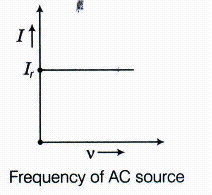
There is no effect on current with the increase i frequency.
(b) AC circuit containing inductance only with the increase of frequency of AC soure, inductive reactance increase as,
\(I=\frac { { V }_{ rms } }{ { X }_{ L } } =\frac { { V }_{ rms } }{ 2\pi vL } \)
\(\Rightarrow \ { X }_{ L }=2\pi vL\)
\(for \ given \ circuit, \ I\propto \frac { 1 }{ V } \)
Current decrease with the increase in frequency.
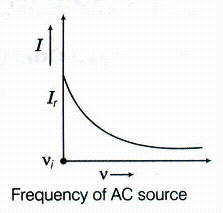
(c) AC circuit containing capacitor only
\({ X }_{ C }=\frac { 1 }{ \omega C } =\frac { 1 }{ 2\pi vC }\)
\(Current, \ I=\frac { { V }_{ rms } }{ { X }_{ C } } =\frac { { V }_{ rms } }{ (\frac { 1 }{ 2\pi vC } ) }\)
\( I=2\pi vC{ V }_{ rms }\)
For given circuit, \(I\propto v\)
Current increase with the increase in frequency.
3.
(i) (a) When a capacitor is placed in an external electric field, the free charges present inside the conductor redistribute themselves in such a manner that electric field within the conductor. This happens until a static situation is achieved,i.e. when the two fields cancel each other and the net electrostatic field in the conductor becomes zero.
(b) In contrast to conductors, dielectrics are non-conducting substance, i.e. they have no charge carriers.Thus, in a dielectric, free movement of charges in not possible.It turns out that the external field induces dipole moment by stretching molecules of the dielectric.
The collective effect of all the molecular dipole moments is the net charge on the surface of the dielectric which produces a field that opposes the external field. However, the opposing field is so induced, that does not exactly cancel the extent of the effect depends on the nature of dielectric.
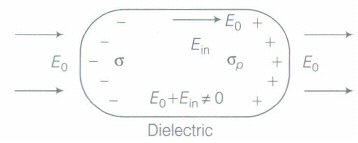
Both polar and non-polar dielectrics develop net dipole moment in the presence of an external field. The dipole moment per unit volume is called polarisation and is denoted by P for linear isotropic dielectrics.
P = XE
Where, X is constant of proportionality and is called electric susceptibility of the electric slab.
(ii) (a) At point C, inside the shell. Electric field inside a spherical shell is zero.
Thus, the force experienced by charge at centre C will also be zero.
\(\because \) Fc = qE (Einside the shell = 0)
\(\therefore \) Fc = 0
At point A, | FA | = 2Q \(\left[ \frac { 1 }{ { 4\pi \varepsilon }_{ 0 } } .\frac { 3Q/2 }{ { x }^{ 2 } } \right] \\.\)
\( F \ = \ \frac { { 3Q }^{ 2 } }{ { { 4\pi \varepsilon }_{ 0 } }{ x }^{ 2 } } ,\) away from shell
Electric flux through the shell,
\(\Phi =\frac { 1 }{ { \varepsilon }_{ 0 } } \) x magnitude of charge enclosed by shell
\(=\frac { 1 }{ { \varepsilon }_{ 0 } } \times \frac { Q }{ 2 } \Rightarrow \Phi =\frac { Q }{ { 2\varepsilon }_{ 0 } } \)
4.
Consider that a wire of length l and area of cross-section A be subjected to an electric field of strength E.
If V = Potential difference applied across the end of the wire,
\(E=\frac { V }{ l } or \ V=El\)
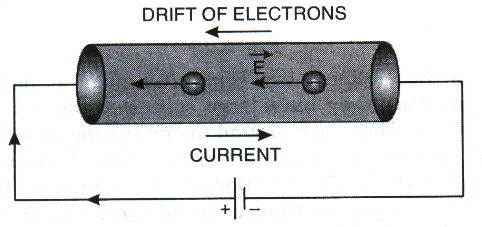
Let n = number of free electrons per unit volume of the conductor
\({ v }_{ d }\) = drift velocity of electrons charge flowing through the conductor wire,
q = nAle
Time taken by the electrons to cross the conductor,
\(t=\frac { Distance\quad }{ Velocity } =\frac { 1 }{ { v }_{ d } } \)
\( Current \ I=\frac { charge }{ time } =\frac { nAle }{ \frac { l }{ { v }_{ d } } } \)
5.
Capacitance of capacitor C1 is 100 pF.
Capacitance of capacitor C2 is 200 pF.
Capacitance of capacitor C3 is 200 pF.
Capacitance of capacitor C4 is 100 pF.
Supply potential, V = 300 V
Capacitors C2 and C3 are connected in series. Let their equivalent capacitance be C' .
\(\therefore \frac{1}{C^{\prime}}=\frac{1}{200}+\frac{1}{200}=\frac{2}{200}\)
C' = 100 pF
Capacitors C1 and C' are in parallel. Let their equivalent capacitance be
\(\therefore\) C'' =C' + C1
= 1000 + 100 =200 pF
C" and C4 are connected in series. Let their equivalent capacitance be C.
\(\therefore \frac{1}{C}=\frac{1}{C^{\prime \prime}}+\frac{1}{C_{4}}\)
\(=\frac{1}{200}+\frac{1}{100}=\frac{2+1}{200}\)
\(C=\frac{200}{3} \mathrm{pF}\)
Hence, the equivalent capacitance of the circuit is \(\frac{200}{3} \mathrm{pF}\)
Potential difference across C" = V"
Potential difference across C4 = V4
\(\therefore\) Vn + V 4= V =300V
Charge on C4 is given by
Q4= CV
\(=\frac{200}{3} \times 10^{-12} \times 300\)
= 2 x 10⁻⁸ C
\(\therefore V_{4}=\frac{Q_{4}}{C_{4}}\)
\(=\frac{2 \times 10^{-8}}{100 \times 10^{-12}}=200 \mathrm{~V}\)
\(\therefore\) Voltage across C1 is given below
V1 =V -V4
= 300- 200 =100 V
Hence, potential difference, V1, across C1 is 100 V.
Charge on C1 is given by,
Q1 = C1V1
= 100 x 10-12 x 100
= 10-8 C
C2 and C3 having same capacitances have a potential difference of 100 V together. Since C2 and C3 are in series,
the potential difference across C2 and C3 is given by,
V2= V3 = 50 V
Therefore, charge on C2 is given by,
Q2 = C2V2
= 200 x 10-12 x 50
= 10-8 C
And charge on C3 is given by,
Q3 = C3V3
= 200 x 10-12 x 50 = 10-8 C
Hence, the equivalent capacitance of the given circuit is \(\frac{200}{3} \mathrm{pF}\)
6.
\(E=\frac { 1 }{ 4\pi { \varepsilon }_{ 0 } } \frac { q }{ { r }^{ 2 } } for \ a \ point \ charge\)
Now (volume) charge density
\(p=\frac { Q }{ (\frac { 4\pi }{ 3 } { R }^{ 3 }) } \)
(i) Charge contained within a sphere of radius r (0 < r < R)
\(Q=p\frac { 4\pi }{ 3 } { r }^{ 3 }=Q(\frac { { r }^{ 3 } }{ { R }^{ 3 } } )\)
Electric Field
\(E=\frac { 1 }{ 4\pi { \varepsilon }_{ o } } \frac { { Q }^{ 1 } }{ { r }^{ 2 } } =(\frac { 1 }{ { 4\pi \varepsilon }_{ o } } \frac { Q }{ { R }^{ 3 } } )\)
For r > R electric field = (Electric field due to a point charge Q at the centre
\(=\frac { 1 }{ { 4\pi \varepsilon }_{ o } } \frac { Q }{ { r }^{ 2 } } \)
7.
(i) When θ = 0; ፔ = O and p and E are parallel and the dipole is in a position of stable equilibrium.
(ii) When θ = 180°, ፔ = 0 and p and E are anti-parallel and the dipole is in a position of unstable equilibrium.
8.
Consider the given figure,
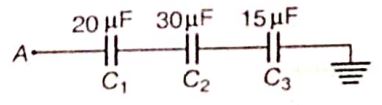
Given, C1 = 20 \(\mu\)F, C2 = 30 \(\mu\)F, C3 = 15 \(\mu\)F
Potential at A, V = 90 V
As we can see that capacitor C3 is earthed, therefore potential across C3 will be zero.
since, capacitors C1,C2 and C3 are connected in series therefore
\(\begin{aligned} \frac{1}{C_{\text {eq }}} & =\frac{1}{C_1}+\frac{1}{C_2}+\frac{1}{C_3} \\ \end{aligned}\)
\(\begin{aligned} =\frac{1}{20}+\frac{1}{30}+\frac{1}{15} \\ \end{aligned}\)
\(\begin{aligned} \Rightarrow \quad & \frac{1}{C_{\text {eq }}}=\frac{3+2+4}{60}=\frac{9}{60} \\ \end{aligned}\)
\(\begin{aligned} \Rightarrow \quad C_{\text {eq }} & =\frac{60}{9}=\frac{20}{3} \mu \mathrm{F} \end{aligned}\)
Since, charge remains same in series combination.
So, \(\begin{aligned} q & =C_{\mathrm{eq}} V=\frac{20}{3} \times 90 \\ \end{aligned}\)
\(\begin{aligned} \Rightarrow \quad q & =600 \mu \mathrm{C} \\ \end{aligned}\)
\(\begin{aligned} & =600 \times 10^{-6} \mathrm{C} \\ \end{aligned}\)
\(\begin{aligned} & =6 \times 10^{-4} \mathrm{C} \end{aligned}\)
\(\therefore\) Potential difference across C2 = \(\frac{q}{V_2}\)
\(\begin{array}{ll} \Rightarrow & V_2=\frac{q}{C_2} \\ \end{array}\)
\(\begin{array}{ll} \Rightarrow & V_2=\frac{6 \times 10^{-4}}{30 \times 10^{-6}}=20 \mathrm{~V} \end{array}\)
\(\therefore\) Energy stored in capacitor C2 is given by
\(\begin{aligned} U & =\frac{1}{2} C_2 V_2^2 \\ \end{aligned}\)
\(\begin{aligned} & =\frac{1}{2} \times 30 \times 10^{-6} \times(20)^2 \\ \end{aligned}\)
\(\begin{aligned} & =\frac{1}{2} \times 30 \times 400 \times 10^{-6} \\ \end{aligned}\)
\(\begin{aligned} & =6 \times 10^{-3} \mathrm{~J} \end{aligned}\)
9.
\(Here,length,2a=2cm=2\times { 10 }^{ -2 }m.\)
\(\theta ={ 60 }^{ 0 },\tau =8\sqrt { 3 } N-m\)
Charges, Q = 4\(\times\) 10-9 C, U = ?
As we know that, \(\tau =Q(2a) E\sin { \theta } \)
\(\Longrightarrow \)Electric field,
\(e=\frac { \tau }{ Q(2a)\sin { \theta } } =\frac { 8\sqrt { 3 } }{ 4\times { 10 }^{ -9 }\times 2\times { 10 }^{ -2 }\times \sin { { 60 }^{ 0 } } } N/C\)
\(\\ \therefore Potential\quad energy, U=-\rho E\cos { \theta } =-Q(2a)E\cos { \theta }\)
\( \\ =-4\times { 10 }^{ -9 }+2\times { 10 }^{ -2 }\times \frac { 8\sqrt { 3 } \times \cos { { 60 }^{ 0 } } }{ 4\times { 10 }^{ -9 }\times 2\times { 10 }^{ -2 }\times \sin { { 60 }^{ 0 } } }\)
\( \\ \Longrightarrow U=-\frac { 8\sqrt { 3 } }{ \sqrt { 3 } } =-8J\)
10.
Capacitance, C = 30μF = 30 × 10−6F
Inductance, L = 27 mH = 27 × 10−3 H
Angular frequency is given as:
\({ \omega }_{ r }=\frac { 1 }{ \sqrt { LC } } =\frac { 1 }{ \sqrt { 27\times { 10 }^{ -3 }\times 30\times { 10 }^{ -6 } } } =\frac { { 10 }^{ 4 } }{ 9 } =1.1\times { 10 }^{ 3 }rad/s\)
Hence, the angular frequency of free oscillations of the circuit is 1.11 × 10³ rad/s.
11.
\(Here, \ R=100\Omega , \ { E }_{ v }=220V, \ v=50Hz\)
\((a) \ { I }_{ v }=?, \ { I }_{ v }=\frac { { E }_{ v } }{ R } =\frac { 220 }{ 100 } =2.2A\)
\((b) \ Net \ power \ consumed \ over \ a \ full \ cycle,\)
\(P={ E }_{ v }{ I }_{ v }=220\times 2.2=484W\)
12.
The law of conservation of charge states that the total charge in an isolated system remains constant.
The electric charge can neither be produced nor destroyed. This law has been found to be true for all events as well as for those at nuclear and atomic levels. In other words, there is no exception to the law. Like the law of conservation of energy, the law of conservation of charge is also a universal law.
Examples (i) When a glass rod is rubbed with silk the charges developed on the glass rod and the piece of silk are equal and opposite.
(ii) Charge is conserved in all chemical and nuclear reactions.
13.
Since \({ F }_{ e }=-\frac { { ke }^{ 2 } }{ { r }^{ 2 } } \)
So \({ ke }^{ 2 }={ -F }_{ e }{ r }^{ 2 }\)
And \({ F }_{ G }=-G\frac { { m }_{ p }{ m }_{ e } }{ { r }^{ 2 } } \)
So \({ Gm }_{ p }{ m }_{ e }={ -F }_{ G }{ r }^{ 2 }\)
So dimensions of \(\frac { { ke }^{ 2 } }{ { Gm }_{ e }{ m }_{ p } } =\frac { { F }_{ e }{ r }^{ 2 } }{ { F }_{ G }{ r }^{ 2 } } =\frac { { F }_{ e } }{ { F }_{ G } } \)
\(=\frac { { [MLT }^{ -2 }] }{ { [MLT }^{ -2 }] } =[{ M }^{ 0 }{ L }^{ 0 }{ T }^{ 0 }]\)
= No dimensions
The value of \(\frac { { ke }^{ 2 } }{ { Gm }_{ e }{ m }_{ p } } \)
\(=\frac { 9\times { 10 }^{ 9 }\times (1.6\times { 10 }^{ -19 })^{ 2 } }{ 6.67\times { 10 }^{ -11 }(1.67\times { 10 }^{ -27 })(9.1\times { 10 }^{ -31 }) } \)
\(=2.9\times { 10 }^{ 39 }\)
From Eq. (1) and (2), we have
\(\left| \frac { { F }_{ e } }{ { F }_{ G } } \right| =\frac { { ke }^{ 2 } }{ { Gm }_{ p }{ m }_{ e } } =2.9\times { 10 }^{ 39 }\)
The ratio of the two forces shows that electrical forces are enormously stronger than the gravitational forces.
14.
Total emf in the circuit = SV - 4V = 4V|
Total resistance of the circuit = S\({ \Omega }\)
Hence current flowing in the circuit
i = V/R = 4/8 A = 0.5A
Current flowing through the resistors:
Current through 0.5 0, 1.0 0 and 4.5 0 is 0.5 A
Current through 3.0 \({ \Omega }\) is \(\frac { 1 }{ 6 } \)A
Current through 6.0 \({ \Omega }\) \(\frac { 1 }{ 3 } \)A
15.
From Ohm's law, we have V = IR
\(\Rightarrow\) \(V=I \rho \frac{l}{A}\) \(\left[ \because \quad R=\rho \frac { l }{ A } \right] \) .......(i)
When the rod is cut parallel, and rejoined by length, the length of the conductor becomes 2l, whereas the area decrease to \(\frac{A}{2}\). If the current remains the same, the potential changes as
V = \(I\rho \frac { 2l }{ A/2 } =4\times I\rho \frac { l }{ A } \)=4V [using Eq (i)]
The new potential applied across the metal rod will be four times the original potential (V).
16.
According to principle of superposition of electric fields, E (electric field) at a point due to system of three charges,
E = \({{1}\over{4\pi{\epsilon}_{0}}}=\left[{{q}\over{{ r }_{ { 1 }^{ p } }^{ 2 }}}\hat{r}_{{1}_{p}} +{{{q}_{2}}\over{{ r }_{ { 2 }^{ p } }^{ 2 }}}\hat{r}_{{2}_{p}}+{{{q}_{3}}\over{{ r }_{ { 3 }^{ p } }^{ 2 }}}\hat{r}_{{3}_{p}} \right]\)
= \({ { q }\over{ 4\pi{\epsilon}_{0} } }\times{ { 9 }\over{ 8 } }\) [ using \({S}_{\infty}={ { a }\over{ 1 -r } }\) ] = \({ { 1 }\over{ 4\pi{\epsilon}_{0} } }.{{9q}\over{8}}{NC}^{-1}\)
17.
In adsorption there is a decrease in residual forces of the surface which evolves as heat. Hence it is exothermic in nature.
18.
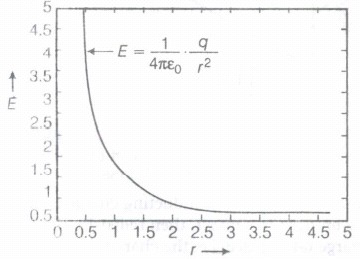
The plot showing the variation of electric field and electric potential with distance r due to a point charge q is shown as below:
19.
By Kirchhoff's first law at D,
\({ I }_{ DC }=1A\) \([\because { I }_{ Dc }+1=2]\)
Along ACDBA,
\({ V }_{ A }+1+1\times 2-2={ V }_{ B }\) (VA = 0)
But, \({ V }_{ B }=1+2-2=1V\)
\({ V }_{ B }=1V\)
20.
According to Gauss' theorem,
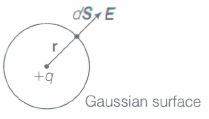
\(\int\)s E. dS \(=\frac { q }{ { \varepsilon }_{ 0 } } \Rightarrow\) E. \(4\pi r^2=\frac { q }{ { \varepsilon }_{ 0 } }\)
\(\therefore\) \(E=\frac { q }{ 4\pi { \varepsilon }_{ 0 } r^2 }\)
If a charge q0 is kept on the surface, then
F = E\(\times\) q0 \(=\frac { q{ q }_{ 0 } }{ 4\pi { \varepsilon }_{ 0 } r^2 } \) , which is Coulomb's law.
21.
During landing or take off, the tyres of aircraft's get charged due to the friction between tyres and ground. In case, the tyres are slightly conducting, the charge developed on the tyres will not stay on them and it finds its way to the earth.
22.
Here the hollow cylinder is positively charged. We know that the electric field lines appear to come out from the conductor. thus the field lines for a uniformely positive charged hollow cyclinder is shown in the figure.
23.
When a bird is perched on a bare high power line, the circuit does not get complete between the bird and the earth, therefore, nothing happens to the bird.
When a man standing on ground touches the same line, the circuit between the man and the earth gets completed. As a result, he gets a fatal shock.
24.
No, it is not correct to write the unit of electric dipole moment as mC. The symbol mC represents milli-coulomb, i.e. unit of electric charges. IN SI system unit symbols are written in alphabetical order.
∴ Unit of dipole moment is C-m.
25.
Electric field lines do not pass through a conductor.Hence, the interior of the conductor is free from the influence of the electric field
26.
Dielectric constant of water is much greater than that of mica because of the following reason
(i) water has a symmetrical shape as compared to mica
(ii) water has permanent dipole moment.
27.
SI units of pole strength is ampere metre and SI unit of magnetic moment is ampere metre2 .
28.
As \(\pi={q\over \epsilon_o}\) so flux does not depend upon the radius of Gaussian surface, it will remain unchanged.
29.
\(X_C=\frac{1}{\omega C}=\frac{1}{2 \pi \omega v C}\) therefore, when v is tripled
30.
Electric field varies inversely as square of distance from the point charge.
31.
\(R_1=\rho(2l)/(A/2)=4 \rho l/A=4R;\) so increase in resistance = R1 - R = 4R - R = 3R. Resistivity will not change as it independent of the dimensions of the wire but depends upon nature of the wire and also on the temperature of the wire.
32.
A current loop behaves as a bar magnet because
(i) one face of current loop behaves as a south pole and the other face as north pole.
(ii) it possesses a magnetic dipole moment (M = IA) and
(iii) it experiences a torque in an external magnetic field, which tends to align the axis of the loop along the direction of magnetic field as bar magnet does.

12th Standard CBSE Syllabus & Materials
12th Standard CBSE
CBSE 12th Computer Science Python Revision Tour I - New Previous year Question Papers Study Material - QB365 Set A
NEW12th Standard CBSE
CBSE 12th Business Studies Planning Important Questions And Answers Study Material - QB365 Set A
NEW12th Standard CBSE
CBSE 12th Business Studies Business Environment Important Questions And Answers Study Material - QB365 Set A
NEW12th Standard CBSE
CBSE 12th Business Studies Principles of Management Important Questions And Answers Study Material - QB365 Set A



CBSE 12th Standard CBSE Subjects
CBSE Standards










