
 100% FREE ACCESS
12th Standard CBSE Syllabus & Materials
12th Standard CBSE
CBSE 12th Economics Government Budget and the Economy Previous year Question Papers Study Material - QB365 Set A
NEW12th Standard CBSE
CBSE 12th Computer Science Interface Python with MySQL - New Previous year Question Papers Study Material - QB365 Set A
NEW12th Standard CBSE
CBSE 12th Computer Science Database Concept - New Previous year Question Papers Study Material - QB365 Set A
NEW12th Standard CBSE
CBSE 12th Computer Science Data Communication - New Previous year Question Papers Study Material - QB365 Set A
NEW12th Standard CBSE
CBSE 12th Computer Science Data Structures - New Previous year Question Papers Study Material - QB365 Set A
NEW12th Standard CBSE
CBSE 12th Computer Science Functions - New Previous year Question Papers Study Material - QB365 Set A

Published on: 29/12/2018
First Full Test Class 12
Download CBSE Class 12th Standard CBSE Maths question papers, sample papers, important questions, and previous year solved papers in PDF format. Get free study materials, NCERT solutions, and exam preparation resources for Class 12th Standard CBSE Maths
Questions + Answers key
Take MCQ Maths Test
1.
Let * be a binary operation on N given by a * b = LCM(a,b) for all a,b \(\in \) N. Find 5*7
2.
If y = ax +xa+xx+aa, find dy/dx
3.
Use elementary column operation \({ C }_{ 2 }\rightarrow { C }_{ 2 }+2{ C }_{ 1 }\) in the following matrix equation :
\(\left( \begin{matrix} 4 & 2 \\ 3 & 3 \end{matrix} \right) =\left( \begin{matrix} 1 & 2 \\ 0 & 3 \end{matrix} \right) \left( \begin{matrix} 2 & 0 \\ 1 & 1 \end{matrix} \right) \)
4.
Write in the simplest form: \(({ tan }^{ -1 }\left[ \frac { \sqrt { 1+sin\quad x } +{ \sqrt { 1-sin\quad x } }\quad }{ \sqrt { 1+sin\quad x } +{ \sqrt { 1-sin\quad x } } } \right] ,0<x<\frac { \pi }{ 2 } \)
5.
Define Reflexive. Give one example.
6.
If \(A=\left| \begin{matrix} 2 & 3 & -1 \\ 4 & 1 & 0 \\ 3 & 3 & 2 \end{matrix} \right| \) , find \(M_{ 12 }\times M_{ 21 }+C_{ 21 }\times C_{ 12 }\) when Mjj called minor and Cjj called co-factors of A.
7.
Find \(\lambda\) when the projection of \(\overrightarrow { a } =\lambda \hat { i } +\hat { j } +4\hat { k } \ on\ \overrightarrow { b } =2\hat { i } +6\hat { j } +3\hat { k } \) is 4 units.
8.
Evaluate the integral: \(\int {(1-x)\sqrt x\ dx}\)
9.
Prove that: \(\int _{ 0 }^{ \pi /4 }{ (\sqrt { \tan { x } } +\sqrt { \cot { x } } ) } dx=\sqrt { 2 } \frac { \pi }{ 2 } .\)
10.
Find the transpose of each of the following matrices:
\((i)\ \left[ \begin{matrix} 5 \\ \frac { 1 }{ 2 } \\ -1 \end{matrix} \right] \)
\((ii)\ \begin{bmatrix} 1 & -1 \\ 2 & 3 \end{bmatrix}\)
\((iii)\ \left[ \begin{matrix} -1 & 5 & 6 \\ \sqrt { 3 } & 5 & 6 \\ 2 & 3 & -1 \end{matrix} \right] .\)
11.
Find the value of \(\lambda \) for which the points with position vectors \(\hat { i } -\hat { j } +3\hat { k } 3\hat { i } +\lambda \hat { j } +3\hat { k } \) are equidistant from the plane \(\vec { r } .(5\hat { i } +2\hat { j } -7\hat { k } )+9=0\)
12.
The probability of a student A passing an examination is \(3\over5\) and of student B is \(4\over5\).Assuming that the two events "A passes", "B passes" as independent. Find the probability of:
(i) Both the students passing the examination
(ii) Only A passing the examination
(iii) Only of them passing the examination
(iv) none of them passing the examination.
13.
Find the points of local maxima and local minima, if any, of the function: f(x) = 3x4-2x3-6x2+6x+1. Also, find the local maximum and local minimum value.
14.
Show that the differential equation x\(\frac {dy}{dx}\) sin\((\frac {x}{y})\)+ x - y sin = \((\frac {x}{y})\) = 0 is homogeneous. Find the particular solution of this differential equation, given that x = 0 when y = \(\frac{\pi}{2}\).
15.
Find the position vectors of the point which divide the join of the points \(2\overrightarrow { a } -3\overrightarrow { b } \ and \ 3\overrightarrow { a } -2\overrightarrow { b } \) internally and externally in the ratio 2:3.
16.
(Manufacturing Problem) A small firm manufactures gold rings and chains. The total number of rings and chains manufactured per day is atmost 24. It takes 1 hour to make a ring and 30 minutes to make a chain. The maximum number of hours available per day is 16. If the profit on a ring is Rs. 300 and that on a chain is Rs. 190, find the number of rings and chains that should be manufactured per day, so as to earn the maximum profit. Make it as an LPP and solve it graphically.
17.
Find the area of the region included between the parabola \(y=\frac { 3 }{ 4 } { x }^{ 2 }\) and the line 3x - 2y + 12 =0.
18.
Using matrices, solve the following system of linear equations:
2x + 3y + 3z = 5, x - 2y + z = -4, 3x - y - 2z = 3
19.
A dealer in rural area wishes to purchase a number of sewing machines. He has only Rs. 5,760 to invest and has space for at most 20 items for storage. An electronic sewing machine cost him Rs. 360 and a manually operated sewing machine Rs. 240. He can sell an electronic sewing machine at a profit of Rs. 22 and a manually operated sewing machine a profit of Rs. 18. Assuming that he can sell all the items that he can buy, how should he invest his money in order to maximize his profit? Make it as a LPP and solve it graphically.
20.
Find the particular solution satisfying the given condition : \({ x }^{ 2 }dy+\left( xy+{ y }^{ 2 } \right) dx=0\); y = 1, when x = 1.
21.
Find : \(\int { \frac { \sqrt { x^{ 2 }+1 } \left\{ log({ x }^{ 2 }+1)-2logx \right\} }{ x^{ 4 } } } dx\)
22.
Find the vector and cartesian equations of the plane passing through the line of intersection of the planes. \(\vec { r } .\left( 2\hat { i } +2\hat { j } -3\hat { k } \right) =7,\quad \vec { r } .\left( 2\hat { i } +5\hat { j } +3\hat { k } \right) =9\)where x and z intercept are equal.
23.
Using elementary column operations, find the inverse of the following matrix :
\(\left[ \begin{matrix} -1 & 1 & 2 \\ 1 & 2 & 3 \\ 3 & 1 & 1 \end{matrix} \right] \)
24.
Find the inverse of the matrix \(A=\left[\begin{matrix}a&b\\c&{1+bc\over a}\end{matrix}\right]\) and show that : aA-1 = (a2+bc+1)I-aA
25.
If \(A=\left[ \begin{matrix} \frac { 2 }{ 3 } & 1 & \frac { 5 }{ 3 } \\ \frac { 1 }{ 3 } & \frac { 2 }{ 3 } & \frac { 4 }{ 3 } \\ \frac { 7 }{ 3 } & 2 & \frac { 2 }{ 3 } \end{matrix} \right] \)and \(B=\left[ \begin{matrix} \frac { 2 }{ 5 } & \frac { 3 }{ 5 } & 1 \\ \frac { 1 }{ 5 } & \frac { 2 }{ 5 } & \frac { 4 }{ 5 } \\ \frac { 7 }{ 5 } & \frac { 6 }{ 5 } & \frac { 2 }{ 5 } \end{matrix} \right] \) , then compute 3A-5B.
26.
If \(A=\begin{bmatrix} 4 & 3 \\ 2 & 5 \end{bmatrix}\), find values of x and y such that A2- xA+yl = 0 where l is a \(2\times 2\) unit matrix and O is a \(2\times 2\) zero matrix.
1.
Given a*b = LCM(a,b)
∴ (5*7) = LCM(5, 7) = 35
2.
We have, y = ax +xa+xx+aa
Let v = xx
log v = x log x
\(\frac { 1 }{ v } \frac { dv }{ dx } =x+\frac { 1 }{ x } +logx\)
\(\frac { dv }{ dx } =v\left| 1+logx \right| \)
= xx(1+lodx)
\(\frac { dy }{ dx } ={ a }^{ x }loga+a{ x }^{ a-1 }+\frac { dv }{ dx } +0\)
\(\Rightarrow \frac { dy }{ dx } ={ a }^{ x }loga+a{ x }^{ a-1 }+{ x }^{ x }(1+logx)\)
3.
\(\left( \begin{matrix} 4 & -6 \\ 3 & -3 \end{matrix} \right) =\left( \begin{matrix} 1 & 2 \\ 0 & 3 \end{matrix} \right) \left( \begin{matrix} 2 & -4 \\ 1 & -1 \end{matrix} \right)\)
Alternative Method :
We have \(\left( \begin{matrix} 4 & 2 \\ 3 & 3 \end{matrix} \right) =\left( \begin{matrix} 1 & 2 \\ 0 & 3 \end{matrix} \right) \left( \begin{matrix} 2 & 0 \\ 1 & 1 \end{matrix} \right)\)
Applying \({ C }_{ 2 }\rightarrow { C }_{ 2 }+2{ C }_{ 1 }\)
\(\Rightarrow \ \left( \begin{matrix} 4 & -6 \\ 3 & -3 \end{matrix} \right) =\left( \begin{matrix} 1 & 2 \\ 0 & 3 \end{matrix} \right) \left( \begin{matrix} 2 & -4 \\ 1 & -1 \end{matrix} \right)\)
4.
\({ tan }^{ -1 }\left[ \frac { \sqrt { 1+sin\quad x } +{ \sqrt { 1-sin\quad x } }\quad }{ \sqrt { 1+sin\quad x } +{ \sqrt { 1-sin\quad x } } } \right] \)
\(\begin{cases} \because 1+sin\quad x={ \left( cos\frac { x }{ 2 } +sin\frac { x }{ 2 } \right) }^{ 2 },0\le x\le \frac { \pi }{ 2 } \\ and\quad 1-sin\quad x={ \left( cos\frac { x }{ 2 } -sin\frac { x }{ 2 } \right) }^{ 2 } \end{cases}\)
\(={ tan }^{ -1 }\left[ \frac { \sqrt { { \left( cos\frac { x }{ 2 } +sin\frac { x }{ 2 } \right) }^{ 2 } } +\sqrt { { \left( cos\frac { x }{ 2 } -sin\frac { x }{ 2 } \right) }^{ 2 } } }{ \sqrt { { \left( cos\frac { x }{ 2 } +sin\frac { x }{ 2 } \right) }^{ 2 } } -\sqrt { { \left( cos\frac { x }{ 2 } -sin\frac { x }{ 2 } \right) }^{ 2 } } } \right] \)
\(={ tan }^{ -1 }\left[ \frac { cos\frac { x }{ 2 } +sin\frac { x }{ 2 } +cos\frac { x }{ 2 } -sin\frac { x }{ 2 } }{ cos\frac { x }{ 2 } +sin\frac { x }{ 2 } -cos\frac { x }{ 2 } +sin\frac { x }{ 2 } } \right] \)
\(={ tan }^{ -1 }\left( \frac { 2cos\frac { x }{ 2 } }{ 2sin\frac { x }{ 2 } } \right) \)
\(={ tan }^{ -1 }\left( cot\frac { x }{ 2 } \right) \)
\(={ tan }^{ -1 }tan\left( \frac { \pi }{ 2 } -\frac { x }{ 2 } \right) =\left( \frac { \pi }{ 2 } -\frac { x }{ 2 } \right) \)
5.
Reflexive Relation : A relation R on a set A is called reflexive relation if aRa for every \(a\in A\) ; if (a, a) \(\in \) R, for every \(a\in A\)
Example let
A = [1, 2, 3]
A x A =(1, 1) (1, 2)(1, 3) (2, 1) (2, 2) (2, 3) (3, 1)(3, 2) (3, 3) \(\in R\)
Since (a, a) \(\in R\) for every \(a\in A\)
6.
We have, \(A=\left| \begin{matrix} 2 & 3 & -1 \\ 4 & 1 & 0 \\ 3 & 3 & 2 \end{matrix} \right| \)
\(M_{ 12 }\left| \begin{matrix} 4 & 0 \\ 3 & 2 \end{matrix} \right| =8-0=8\)
\(M_{ 21 }\left| \begin{matrix} 3 & -1 \\ 3 & 2 \end{matrix} \right| =6+3=9\)
\(C_{ 21 }=-\left| \begin{matrix} 3 & -1 \\ 3 & 2 \end{matrix} \right| =-(6+3)=-9\)
\(C_{ 12 }=-\left| \begin{matrix} 4 & 0 \\ 3 & 2 \end{matrix} \right| =-(8-0)=-8\)
\( M_{ 12 }\times M_{ 21 }+C_{ 21 }\times C_{ 12 }\)
\( 8\times (9)+(-9)(-8)=72+72\)
\(=144\)
7.
The projection of \(\vec{a}\) on \(\vec{b} \vec{b}=\frac{\vec{a} \cdot \vec{b}}{\overrightarrow{|b|}}\) by the question \(\frac{(\lambda \hat{i}+\hat{j}+4 \hat{k}) \cdot(2 \hat{i}+6 \hat{j}+3 \hat{k})}{|2 \hat{i}+6 \hat{j}+3 \hat{k}|}=4\)
\( \Rightarrow \frac{(\lambda)(2)+(1)(6)+(4)(3)}{\sqrt{4+36+9}}=4 \)
\( \Rightarrow \frac{2 \lambda+6+12}{7}=4 \)
\( \Rightarrow 2 \lambda+18=28 \)
\( \Rightarrow 2 \lambda=10 .\)
Hence \(\lambda=5\)
8.
\(={2\over3}x^{3/2}-{2\over5}x^{5/2}+c\)
9.
Let \(\int _{ 0 }^{ \pi /4 }{ (\sqrt { \tan { x } } +\sqrt { \cot { x } } ) } dx\)
\(=\int _{ 0 }^{ \pi /4 }{ \frac { \tan { x+1 } }{ \sqrt { \tan { x } } } } dx\)
\(Put \sqrt { \tan { x } } =t\ i.e. \tan { x } x={ t }^{ 2 }\)
so that \(\sec ^{ 2 }{ x } dx=2t\ dt \Rightarrow dx=\frac { 2t }{ 1+{ t }^{ 4 } } dt.\)
When \(x=0, t=0.\) When \(x=\frac { \pi }{ 4 } ,t=1.\)
\(\therefore I= \int _{ 0 }^{ 1 }{ \frac { { t }^{ 2 }+1 }{ t } } .\frac { 2t }{ 1+{ t }^{ 4 } } dt\)
\(=2\int _{ 0 }^{ 1 }{ \frac { { t }^{ 2 }+1 }{ { t }^{ 4 }+1 } } dx=2\int _{ 0 }^{ 1 }{ \frac { 1+1/{ t }^{ 2 } }{ { t }^{ 2 }+1/{ t }^{ 2 } } } dt\)
\(Put\ t-\frac { 1 }{ t } =y\) so that \(\left( 1+\frac { 1 }{ { t }^{ 2 } } \right) dt=dy.\)
Also \({ t }^{ 2 }-2+\frac { 1 }{ { t }^{ 2 } } ={ y }^{ 2 } \Rightarrow { t }^{ 2 }+\frac { 1 }{ { t }^{ 2 } } ={ y }^{ 2 }+2\)
\(\therefore I=2\int _{ t=0 }^{ 1 }{ \frac { dy }{ { y }^{ 2 }+2 } } \)
\(=\frac { 2 }{ \sqrt { 2 } } { \left[ \tan ^{ -1 }{ \frac { y }{ \sqrt { 2 } } } \right] }_{ t=0 }^{ 1 }\)
\(=\sqrt { 2 } { \left[ \tan ^{ -1 }{ \frac { 1 }{ \sqrt { 2 } } } \left( t-\frac { 1 }{ t } \right) \right] }_{ 0 }^{ 1 }\)
\(=\sqrt { 2 } \left[ \tan ^{ -1 }{ (0) } -\tan ^{ -1 }{ (-\infty ) } \right] \)
\(=\sqrt { 2 } \left[ \tan ^{ -1 }{ (-\infty ) } \right] =\sqrt { 2 } .\frac { \pi }{ 2 } .\)
10.
(i) Let \(A= \left[ \begin{matrix} 5 \\ \frac { 1 }{ 2 } \\ -1 \end{matrix} \right]\). Then \(A\prime =\left[ \begin{matrix} 5 & \frac { 1 }{ 2 } & -1 \end{matrix} \right] \).
(ii) Let \(A= \begin{bmatrix} 1 & -1 \\ 2 & 3 \end{bmatrix}\). Then \(A\prime =\begin{bmatrix} 1 & 2 \\ -1 & 3 \end{bmatrix}\ \).
(iii) Let \(A= \left[ \begin{matrix} -1 & 5 & 6 \\ \sqrt { 3 } & 5 & 6 \\ 2 & 3 & -1 \end{matrix} \right] \). Then \(A\prime =\left[ \begin{matrix} -1 & \sqrt { 3 } & 2 \\ 5 & 5 & 3 \\ 6 & 6 & -1 \end{matrix} \right] .\)
11.
\(2\lambda +3=\pm 9\)
12.
(i) P(both the students passing the examination)
\(=\frac{3}{5} \times \frac{4}{5}=\frac{12}{25}\)
(ii) P( only student A passing the examination)
\(=\frac{3}{5} \times \frac{1}{5}=\frac{3}{25}\)
(iii) P( only one of them passing the examination)
= p(A passes and B does not pass) or (A does not pass and B passes)
\(=\frac{3}{5} \times \frac{1}{5}+\frac{2}{5} \times \frac{4}{5}=\frac{3+8}{25}=\frac{11}{25}\)
(iv) P(none of them passing the examination)
= P (A does not pass and B does not pass)
\(=\frac{2}{5} \times \frac{1}{5}=\frac{2}{25}\)
13.
\(f(x) =3 x^{4}-2 x^{3}-6 x^{2}+6 x+1 \)
\(f^{\prime}(x) =12 x^{3}-6 x^{2}-12 x+6 \)
\(=6\left(2 x^{3}-x^{2}-2 x+1\right) \)
\(=6\left(x^{2}-1\right)(2 x-1) \)
For a point of local maximum or minimum
\(f^{\prime}(x) =0 \)
\(\Rightarrow x =\pm 1, \frac{1}{2} \)
\(f^{\prime \prime}(x) =6\left[\left(x^{2}-1\right) 2+(2 x-1)(2 x)\right] \)
\(=6\left(5 x^{2}-2 x-2\right) \)
\(\text { when } x=1, f^{\prime \prime}(1)=6(5-2-2)>0\)
Therefore function attains local minimum at x = 1
Local minimum value
\(f(1)=3(1)^{4}-2(1)^{3}-6(1)^{2}+6(1)+1\)
\(=3-2-6+6+1=2\)
when x = -1 f'(-1) = 6(5 + 2 - 2) > 0
function attains local minimum at x = -1
Local minimum value = f(-1)
\(=3(-1)^{4}-2(-1)^{3}-6(-1)^{2}+6(-1)+1 \)
\(=3+2-6-6+1=-6 \)
\(\text { when } x =\frac{1}{2}, f^{\prime \prime}\left(\frac{1}{2}\right)=6\left(\frac{5}{4}-1-2\right)<0\)
\(\therefore \text { function attains local maximum at } x=\frac{1}{2}\)
\(\text { Local maximum value }=f\left(\frac{1}{2}\right)\)
\(=3\left(\frac{1}{2}\right)^{4}-2\left(\frac{1}{2}\right)^{3}-6\left(\frac{1}{2}\right)^{2}+6\left(\frac{1}{2}\right)+1 \)
\(=\frac{3}{16}-\frac{1}{4}-\frac{6}{4}+3+1 \)
\(=\frac{3}{16}-\frac{2}{4}+4=\frac{3-28+64}{15}=\frac{39}{16} \)
14.
cos\((\frac {y}{x})\) = log |x| is the particular solution.
15.
\(-5\overrightarrow { b } \)
16.
Let 'x' and 'y' be the number of gold rings and chains respectively.
We have:
\(x\ge 0\) ...(1)
\(y\ge 0\)...(2)
\(x+y\le 24\)...(3)
\(x+\frac { y }{ 2 } \le 16\) ...(4)
The objective function, or the profit, Z is:
Z = 300x + 190y ..(5)
We have to maximise Z subject to (1)-(4).
For solution set, we draw the lines:
x = 0, y = 0, x + y = 24, 2x + y = 32.
The lines x + y = 24 and 2x + y = 32 meet at E (8,16).
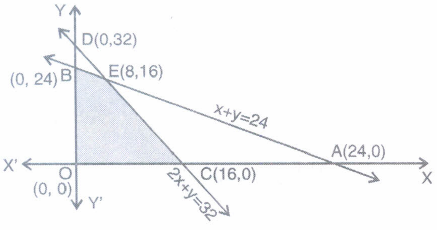
The shaded portion represents the feasible region, which is bounded.
Applying Corner Point Method, we have:
| Corner Point | Z = 300x + 190y |
| O : (0,0) | 0 |
| C : (16,0) | 4800 |
| E : (8,16) | 5440 (Maximum |
| B : (0,24) | 4560 |
Hence, the maximum profit is Rs. 5,440 and it is obtained when 8 gold rings and 16 chains are manufactured.
17.
Eliminating y from the equations, we get
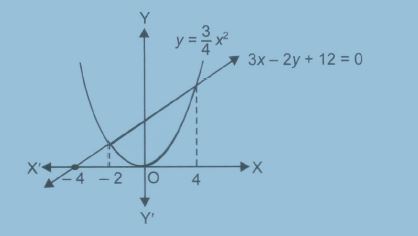
\(3 x-\frac{3}{2} x^{2}+12=0 \Rightarrow x^{2}-2 x-8=0 \)
\(\Rightarrow (x-4)(x+2)=0 \Rightarrow x=-2,4 \)
\(\text { Area }=\int_{-2}^{4}\left\{\frac{3 x+12}{2}-\frac{3}{4} x^{2}\right\} d x \)
\(=\left[\frac{3 x^{2}}{4}+6 x-\frac{x^{3}}{4}\right]_{-2}^{4} \)
\(=[(12+24-16)-(3-12+2)] \text { sq units } \)
\(=[20+7]=27 \text { sq units }
\)
18.
The given system of equations can be written as
AX = B
where A = \(\left[ \begin{matrix} 2 & 3 & 3 \\ 1 & -2 & 1 \\ 3 & -1 & -2 \end{matrix} \right] \)
X = \(\left[ \begin{matrix} x \\ y \\ z \end{matrix} \right] \) and B =\(\left[ \begin{matrix} 5 \\ -4 \\ 3 \end{matrix} \right] \)
\(\therefore\) X = A-1B, if A-1 exists
|A| = 40 => A-1 exists
adj A = \(\left[ \begin{matrix} 5 & 3 & 9 \\ 5 & -13 & 1 \\ 5 & 11 & -7 \end{matrix} \right] \)
=> A-1 = \(\frac { 1 }{ 40 } \left[ \begin{matrix} 5 & 3 & 9 \\ 5 & -13 & 1 \\ 5 & 11 & -7 \end{matrix} \right] \)
\(\therefore\) X = \(\left[ \begin{matrix} x \\ y \\ z \end{matrix} \right] \)
= \(\frac { 1 }{ 40 } \left[ \begin{matrix} 5 & 3 & 9 \\ 5 & -13 & 1 \\ 5 & 11 & -7 \end{matrix} \right] \left[ \begin{matrix} 5 \\ -4 \\ 3 \end{matrix} \right] \)
=\(\left[ \begin{matrix} 1 \\ 2 \\ -1 \end{matrix} \right] \)
\(\therefore\) x = 1, y = 2 and z = -1
19.
Let x and y be electronic and manually operated sewing machine purchased respectively.
\(\therefore\) LPP is Maximize.
P = 22x + 18y
Subject to,
360x + 240y \(\ge \) 5,760
\(\Rightarrow\) 3x + 2y \(\le \) 48
x + y \(\le \) 20
x \(\ge \) 0 , y \(\ge \) 0
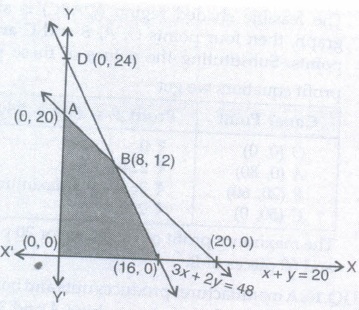
Vertices of feasible region are:
A (0, 20), B(8, 12), C(16, 0) & O(0, 0)
P(A) = 360, P(B) = 392. P(C) = 352
\(\therefore\) For Maximum P, Electronic machines = 8, and Manual machines = 12.
20.
Given, \({ x }^{ 2 }dy+\left( xy+{ y }^{ 2 } \right) dx=0\)
\(\therefore \ \frac { dy }{ dx } =\frac { -\left( xy+{ y }^{ 2 } \right) }{ { x }^{ 2 } } \)
Put y = vx
\(\Rightarrow \frac { dy }{ dx } =v+x\frac { dv }{ dx } \)
\(\therefore \) The differential equation becomes
\(v+x\frac { dv }{ dx } =-\left( v+{ v }^{ 2 } \right) \)
\(\Rightarrow \frac { dv }{ { v }^{ 2 }+2v } =\frac { dx }{ x } \)
\(\Rightarrow \int { \frac { dv }{ \left( v+1 \right) ^{ 2 }-{ 1 }^{ 2 } } } =-\int { \frac { dx }{ x } } \)
\(\Rightarrow \frac { 1 }{ 2 } \log { \frac { v }{ v+2 } } =-\log { x } +\log { C } \)
\(\Rightarrow \frac { C }{ x } =\sqrt { \frac { y }{ y+2x } } \)
If x = 1, y = 1 then \(c=\frac { 1 }{ \sqrt { 3 } } \)
\(\Rightarrow \frac { 1 }{ \sqrt { 3 } x } =\sqrt { \frac { y }{ y+2x } } \)
21.
\(\int { \frac { \sqrt { x^{ 2 }+1 } \left\{ log({ x }^{ 2 }+1)-2logx \right\} }{ x^{ 4 } } } dx\)
\(=\sqrt { 1+\frac { 1 }{ { x }^{ 2 } } } \left( log\left( 1+\frac { 1 }{ x^{ 2 } } \right) \right) \frac { 1 }{ x^{ 3 } } dx\)
Let, \(1+\frac { 1 }{ { x }^{ 2 } } ={ t }^{ 2 }\)
\(\Rightarrow \frac { -2 }{ { x }^{ 3 } } dx=2tdt\)
\(\Rightarrow \frac { 1 }{ { x }^{ 3 } } dx=-tdt\)
\(=-\int { t(2logt)t\quad dt+ } -2\int { logt.{ t }^{ 2 }dt } \)
\(=-2logt.\frac { { t }^{ 3 } }{ 3 } +\int { 2\frac { 1 }{ t } .\frac { t^{ 3 } }{ 3 } dt } \)
\(=-\frac { 2 }{ 3 } logt.{ t }^{ 3 }+\frac { 2 }{ 9 } { t }^{ 3 }+C\)
\(=\frac { 2 }{ 3 } \left( 1+\frac { 1 }{ { x }^{ 2 } } \right) ^{ 3 }\left( -log\left( 1+\frac { 1 }{ { x }^{ 2 } } \right) +\frac { 1 }{ 3 } \right) +C\)
22.
Equation of plane through the given lines is
\(\left\{ \vec { r } .\left( 2\hat { i } +2\hat { j } -3\hat { k } \right) -7 \right\} +\lambda \left\{ \left( 2\hat { i } +5\hat { j } +3\hat { k } \right) -9 \right\} =0......\left( i \right) \)
\(\Rightarrow \vec { r } .\left\{ \left( 2+2\lambda \right) \hat { i } +\left( 2+5\lambda \right) \hat { j } +\left( -3+3\lambda \right) \hat { k } \right\} =\left( 7+9\lambda \right) .\left( ii \right) \)
Here, x intercept = z intercept
\(\therefore \frac { 7+9\lambda }{ 2+2\lambda } =\frac { 7+9\lambda }{ -3+3\lambda } \Rightarrow \lambda =5\)
\(\therefore\) Equation of plane in vector form is obtained by putting the value of in equation (ii).
i.e., \(\vec { r } .\left( 12\hat { i } +27\hat { j } +12\hat { k } \right) =52\) and equation of plane in cartesian form is
given as \(\left( x\hat { i } +y\hat { j } +z\hat { k } \right) .\left( 12\hat { i } +27\hat { j } +12\hat { k } \right) =52\)
i.e., 12x + 27y + 12z - 52 = 0
23.
Let \(A=\left[ \begin{matrix} -1 & 1 & 2 \\ 1 & 2 & 3 \\ 3 & 1 & 1 \end{matrix} \right] \)
A = AI
\(\therefore \left[ \begin{matrix} -1 & 1 & 2 \\ 1 & 2 & 3 \\ 3 & 1 & 1 \end{matrix} \right] =A\left[ \begin{matrix} 1 & 0 & 0 \\ 0 & 1 & 0 \\ 0 & 0 & 1 \end{matrix} \right] \)
\({ C }_{ 1 }\leftrightarrow { C }_{ 2 }\)
\(\left[ \begin{matrix} 1 & -1 & 2 \\ 2 & 1 & 3 \\ 1 & 3 & 1 \end{matrix} \right] =A\left[ \begin{matrix} 0 & 1 & 0 \\1 & 0 & 0 \\ 0 & 0 & 1 \end{matrix} \right] \)
\({ C }_{ 2 }\rightarrow { C }_{ 2 }+{ C }_{ 1 }\)
\({ C }_{ 3 }\rightarrow { C }_{ 3 }-{ 2C }_{ 1 }\)
\(\left[ \begin{matrix} 1 & 0 & 0 \\ 2 & 3 & -1 \\ 1 & 4 & -1 \end{matrix} \right] =A\left[ \begin{matrix} 0 & 1 & 0 \\ 1 & 1 & -2 \\ 0 & 0 & 1 \end{matrix} \right] \)
\({ C }_{ 1 }\rightarrow { C }_{ 1 }+{ 2C }_{ 3 }\)
\({ C }_{ 2}\rightarrow { C }_{ 2 }+{ 2C }_{ 3 }\)
\(\left[ \begin{matrix} 1 & 0 & 0 \\ 0 & 1 & -1 \\ -1 & 2 & -1 \end{matrix} \right] =A\left[ \begin{matrix} 0 & 1 & 0 \\ -3 & -3 & -2 \\ 2 & 2 & 1 \end{matrix} \right] \)
\({ C }_{ 3}\rightarrow { C }_{ 3 }+{ C }_{ 2 }\)
\(\left[ \begin{matrix} 1 & 0 & 0 \\ 0 & 1 & 0 \\ -1 & 2 & 1 \end{matrix} \right] =A\left[ \begin{matrix} 0 & 1 & 1 \\ -3 & -3 & -5 \\ 2 & 2 & 3 \end{matrix} \right] \)
\({ C }_{ 1 }\rightarrow { C }_{ 1 }+{ C }_{ 3 }\)
\({ C }_{ 2 }\rightarrow { C }_{ 2 }-{ 2C }_{ 3 }\)
\(\left[ \begin{matrix} 1 & 0 & 0 \\ 0 & 1 & 0 \\ 0 & 0 & 1 \end{matrix} \right] =A\left[ \begin{matrix} 1 & -1 & 1 \\ -8 & 7 & -5 \\ 5 & -4 & 3 \end{matrix} \right] \)
\(\Rightarrow { A }^{ -1 }=\left[ \begin{matrix} 1 & -1 & 1 \\ -8 & 7 & -5 \\ 5 & -4 & 3 \end{matrix} \right] \)
24.
\(|A|=\left[\begin{matrix}a&b\\c&{1+bc\over a}\end{matrix}\right]\)
\(=a\left(1+bc\over a\right)-bc =1+bc-bc=1\neq0\)
Since A is non-singular matrix ∴ A-1 exists
Now \(A_{11}={1+bc\over a}; A_{12}=-b; A_{22}=a\)
\(\therefore\ adj.A=\begin{bmatrix}A _{11}&A_{12}\\A_{21}&A_{22} \end{bmatrix}'=\begin{bmatrix}{1+bc\over a}&-c\\-b&a \end{bmatrix}\)
\(=\begin{bmatrix} {1+bc\over a}&-b\\-c&a\end{bmatrix}.\)
\(\therefore\ A^{-1}={adj.A\over |A|}={1\over1}\begin{bmatrix} {1+bc\over a}&-b\\-c&a\end{bmatrix}\)
\(\therefore\ aA^{-1}=a\begin{bmatrix}{1+bc\over a}&-b\\-c&a \end{bmatrix}=\begin{bmatrix} 1+bc&-ab\\-ac&a^2\end{bmatrix}\)....(1)
And (a1+bc+1)I-aA
\(=(a^2+bc+1)\begin{bmatrix} 1&0\\0&1\end{bmatrix}-a\begin{bmatrix} a&b\\c&{1+bc\over a}\end{bmatrix}\)
\(=\begin{bmatrix}a^2+bc+1&0\\0&a^2+bc+1 \end{bmatrix}=\begin{bmatrix}-a^2&-ab\\-ac&-(1+bc) \end{bmatrix}\)
\(=\begin{bmatrix}a^2+bc+1-a^2&0-ab\\0-ac&a^2+bc+-1-1bc \end{bmatrix}\)
\(=\begin{bmatrix}1+bc&-ab\\-ac&a^2 \end{bmatrix}\)..(2)
From (1) and (2), aA-1 = (a2 + bc + 1)I-aA
25.
\(3A-5B=3\left[ \begin{matrix} \frac { 2 }{ 3 } & 1 & \frac { 5 }{ 3 } \\ \frac { 1 }{ 3 } & \frac { 2 }{ 3 } & \frac { 4 }{ 3 } \\ \frac { 7 }{ 3 } & 2 & \frac { 2 }{ 3 } \end{matrix} \right] -5\left[ \begin{matrix} \frac { 2 }{ 3 } & \frac { 3 }{ 5 } & 1 \\ \frac { 1 }{ 5 } & \frac { 2 }{ 5 } & \frac { 4 }{ 5 } \\ \frac { 7 }{ 5 } & \frac { 6 }{ 5 } & \frac { 2 }{ 5 } \end{matrix} \right] \)
\(=\left[ \begin{matrix} 2 & 3 & 5 \\ 1 & 2 & 4 \\ 7 & 6 & 2 \end{matrix} \right] -\left[ \begin{matrix} 2 & 3 & 5 \\ 1 & 2 & 4 \\ 7 & 6 & 2 \end{matrix} \right] \)
\(=\left[ \begin{matrix} 2-2 & 3-3 & 5-5 \\ 1-1 & 2-2 & 4-4 \\ 7-7 & 6-6 & 2-2 \end{matrix} \right] \)
\(=\left[ \begin{matrix} 0 & 0 & 0 \\ 0 & 0 & 0 \\ 0 & 0 & 0 \end{matrix} \right] .\)
26.
\(A^{2}=\left[\begin{array}{ll} 4 & 3 \\ 2 & 5 \end{array}\right]\left[\begin{array}{ll} 4 & 3 \\ 2 & 5 \end{array}\right]=\left[\begin{array}{cc} 16+6 & 12+15 \\ 8+10 & 6+25 \end{array}\right]=\left[\begin{array}{ll} 22 & 27 \\ 18 & 31 \end{array}\right]\)
\(A^{2}-x A+y I=O \)
\(\Rightarrow\left[\begin{array}{ll} 22 & 27 \\ 18 & 31 \end{array}\right]-\left[\begin{array}{ll} 4 x & 3 x \\ 2 x & 5 x \end{array}\right]+\left[\begin{array}{ll} y & 0 \\ 0 & y \end{array}\right]=\left[\begin{array}{ll} 0 & 0 \\ 0 & 0 \end{array}\right] \)
\(\Rightarrow\left[\begin{array}{ll} 22-4 x+y & 27-3 x+0 \\ 18-2 x+0 & 31-5 x+y \end{array}\right]=\left[\begin{array}{ll} 0 & 0 \\ 0 & 0 \end{array}\right] \)
\(\Rightarrow 27-3 x=0 \Rightarrow x=9 \)
\(\text {Also } 22-4 x+y=0 \)
y = 14

12th Standard CBSE Syllabus & Materials
12th Standard CBSE
CBSE 12th Computer Science Python Revision Tour I - New Previous year Question Papers Study Material - QB365 Set A
NEW12th Standard CBSE
CBSE 12th Business Studies Planning Important Questions And Answers Study Material - QB365 Set A
NEW12th Standard CBSE
CBSE 12th Business Studies Business Environment Important Questions And Answers Study Material - QB365 Set A
NEW12th Standard CBSE
CBSE 12th Business Studies Principles of Management Important Questions And Answers Study Material - QB365 Set A



CBSE 12th Standard CBSE Subjects
CBSE Standards










