
 100% FREE ACCESS
12th Standard CBSE Syllabus & Materials
12th Standard CBSE
CBSE 12th Economics Government Budget and the Economy Previous year Question Papers Study Material - QB365 Set A
NEW12th Standard CBSE
CBSE 12th Computer Science Interface Python with MySQL - New Previous year Question Papers Study Material - QB365 Set A
NEW12th Standard CBSE
CBSE 12th Computer Science Database Concept - New Previous year Question Papers Study Material - QB365 Set A
NEW12th Standard CBSE
CBSE 12th Computer Science Data Communication - New Previous year Question Papers Study Material - QB365 Set A
NEW12th Standard CBSE
CBSE 12th Computer Science Data Structures - New Previous year Question Papers Study Material - QB365 Set A
NEW12th Standard CBSE
CBSE 12th Computer Science Functions - New Previous year Question Papers Study Material - QB365 Set A

Published on: 27/07/2018
Based on the chapter Kinetics, some of the important questions are prepared in this question paper. It covers one mark, two and five marks questions from the book back and PTA question.
Teacher please subscribes and gets the plenty of question paper based on chapter wise and also predefined blueprint. For subscription, please Click Here.
Download CBSE Class 12th Standard CBSE Chemistry question papers, sample papers, important questions, and previous year solved papers in PDF format. Get free study materials, NCERT solutions, and exam preparation resources for Class 12th Standard CBSE Chemistry
Questions + Answers key
Take MCQ Chemistry Test
1.
Write two differences between 'order of reaction' and 'molecularity of reaction'.
2.
Define the following:
(i) Elementary step in a reaction
(ii) Rate of reaction
3.
Write the expression showing the change of concentration with time in the exponential form for reactions of first order.
4.
The reaction A + B \(\longrightarrow\) C has zero order. What is the rate equation ?
5.
From the rate expressions for the following reactions, determine their order of reaction and the dimentions of the rate constants :
(i) 3 NO (g) \(\longrightarrow\) N2) (g) ; Rate = k [NO]2
(ii) H2O2 (aq) + 3I- (aq) + 2 H+ \(\longrightarrow\) 2H2O (I) + I-3 ; Rate = k [H2O2]I-]
(iii) CH3CHO (g) \(\longrightarrow\) CH4 (g) + CO (g) ; Rate k[CH3CHO]3/2
(iv) C2H5CI (g) \(\longrightarrow\) C2 H4 (g) + HCI (g) ; Rate k[C2H5CI].
6.
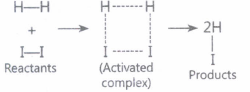
With the help of diagram explain the role of activated complex in a reaction.
7.
A first order reactions has rate constant k = 5.5 \(\times\) 10-14 s-1. Find the half life of the reaction.
8.
(a) Explain the following terms:
(i) Order of a reaction
(ii) Molecularity of a reaction
(b) The rate of a reaction increases four times when the temperature changes from 300 k to 320 K. Calculate the energy of activation of the reaction, assuming that it does not change with temperature.
(R = 8.314 J K-1 mol-1)
9.
(a) Define the following:
(i) Order of a reaction
(ii) Elementary step in a reaction
(b) A first order reaction has a rate constant value of 0.00510 min-1. If we begin with 0.10 M concentration of the reactant, how much of the reactant will remain after 3.0 hours?
10.
1[A] vs time is a straight line. The order of the reaction is
1
2
3
0
11.
75% of the first order reaction was completed in 32 min. 50% of the reaction was completed in
24 min
8 min
16 min
4 min
12.
The rate of a chemical reaction doubles for every 10oC rise of temperature. If the temperature is raised by 50oC, the rate the reaction increses by about :
24 times
32 times
64 times
10 times
13.
The molecularity and order of the reaction 2 NO (g) + O2 (g) \(\rightarrow\)2NO2 (g) are respectively
one and one
two and two
three and three
two and three
14.
Rate constant of a reaction (k) is 175 litre2 mol-2 sec-1. What is the order of reaction?
first
second
third
zero
15.
A first order reaction has a half-life period of 34.65 seconds. Its rate constant is
2 \(\times 10\) -2 sec-1
4 \(\times 10\) -4 sec-1
20 sec-1
2 \(\times 10\) -4 sec-1
16.
The unit of rate constant for a zero order reaction is
mol L-1 s-1
L mol-1 s-1
L2mol-1 s-1
s-1
17.
The rate of the reaction 2 NO + CI2 \(\rightarrow\) 2NOCI is given by the rate equation : rate = k [NO]2 [CI2]. The value of the rate constant can be increased by
increasing the temperature
increasing the concentration of NO
increasing the concentration of CI2
doing all of these
18.
In a reaction \(\longrightarrow\) B, the rate of reaction increases two times on increasing the concentration of the reactant four times, then order of reaction is
0
2
1/2
4
19.
The rate of a gaseous reaction is given by the expression k [A][B]. If the volume of the reaction vessel is suddenly reduced to 1/4 th of the initial volume, the reaction rate relating to original rate will be
1/10
1/8
8
16
1.
| Order of reaction | Molecularity of reaction |
| (i) It is the sum of powers to which concentration terms are raised in rate law or rate equation | (i) It is the sum of number of molecules which takes part in a chemical reaction. |
| (ii) It is determined experimentally, can be in fraction and even zero. | (ii) It is determined theoretically and is always a whole number |
2.
(i) Each step of a complex reaction is called an elementary step.
(ii) Rate of reaction is the change in concentration of any one of the reactants or products per unit time.
3.
\([A]=[A]_0 \mathrm{e}^{-k t}\) where [A]0 is initial concentration.[A] is concentration time t and k is rate constant.
4.
\(\text {Rate }=\left(\frac{d x}{d t}\right)=k[A]^0[B]^0=\mathrm{k} \text { (rate const.) }\)
5.
(i) Order = 2, Dimensions of k \(=\frac { Rate }{ { \left[ NO \right] }^{ 2 } } =\frac { mol \ { L }^{ -1 } \ { s }^{ -1 } }{ { \left( mol \ { L }^{ -1 } \right) }^{ 2 } } =L \ { mol }^{ -1 }{ s }^{ -1 }\)
(ii) Order = 2, Dimensions of k = same as in (i)
(iii) Order = \(\frac { 3 }{ 2 } \), Dimensions of k\(=\frac { Rate }{ { \left[ { CH }_{ 3 }CHO \right] }^{ { 3 }/{ 2 } } } =\frac { mol \ { L }^{ -1 } \ { s }^{ -1 } }{ { \left( mol \ { L }^{ -1 } \right) }^{ { 3 }/{ 2 } } } ={ L }^{ { 1 }/{ 2 } }{ mol }^{ -{ 1 }/{ 2 } }{ s }^{ -1 }\)
(iv) Order = 1, Dimensions of k\(=\frac { Rate }{ { \left[ { C }_{ 2 }{ H }_{ 5 }Cl \right] } } =\frac { mol \ { L }^{ -1 } \ { s }^{ -1 } }{ mol \ { L }^{ -1 } } ={ s }^{ -1 }\)
6.
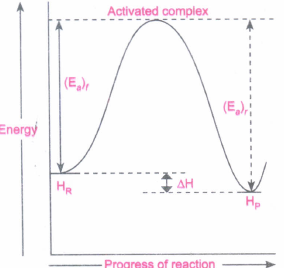
Activated complex is intermediate compound between reactants and products as shown above. It is highly unstable as it has highest energy. It readily charges into product. Those molecules which can form activated complex can lead to formation of products, e.g
7.
\({ t }_{ { 1 }/{ 2 } }=\frac { 0.693 }{ k } \)
\(=\frac { 0.693 }{ 5.5\times { 10 }^{ -14 }{ s }^{ -1 } }\)
\(=1.26\times { 10 }^{ 13 }s\)
8.
(a) (i) Order of a reaction. The sum of the exponents (powers) of the concentration of reactants in the rate law is termed as order of the reaction. It can be in fraction. It can be zero also.
(ii) Molecularity: Total number of atoms, ions or molecules of the reactants involved in the reaction is termed as its molecularity. It is always in whole number. It is never more than three. It cannot be zero.
(b)
\(\log { \frac { { k }_{ 2 } }{ { k }_{ 1 } } } =\frac { { E }_{ a } }{ 2.303R } \left( \frac { 1 }{ { T }_{ 1 } } -\frac { 1 }{ { T }_{ 2 } } \right)\)
\(\log { 4 } =\frac { { E }_{ a } }{ 2.303\times 8.314 } \left( \frac { 1 }{ 300 } -\frac { 1 }{ 320 } \right) \)
\({ E }_{ a }=\frac { 19.147\times 0.6021\times 300\times 320 }{ 20 }\)
\(=55.336\quad kJ\ { mol }^{ -1 }\)
9.
(a) (i) It is sum of powers to which cone. terms are raised in rate law or rate equation.
(ii) Each step of complex reaction (which takes place in more than one step) is called elementary, step in a reaction.
\((b) \ k=0.00510 \ { min }^{ -1 }\)
\(t=\frac { 2.303 }{ k } \log { \frac { { \left[ R \right] }_{ 0 } }{ \left[ R \right] } }\)
\(3\times 60\times 60=\frac { 2.303 }{ 0.00510 } \log { \frac { 0.1 }{ \left[ R \right] } }\)
\(\log { \frac { 0.1 }{ \left[ R \right] } } =\frac { 10800\times 0.00510 }{ 2.303 } \)
\(=23.94\)
\(\frac { 0.1 }{ \left[ R \right] } =Antilog \ 23.94\)
\(\frac { 0.1 }{ \left[ R \right] } =8.71\times { 10 }^{ 23 }\)
\(\left[ R \right] =\frac { 0.1 }{ 8.71\times { 10 }^{ 23 } }\)
\(\left[ R \right] =0.1148\times { 10 }^{ -24 }\)
\(\left[ R \right] =1.148\times { 10 }^{ -25 }M\)
10.
(b) : log [A] vs times is linear for 1st order reactions, 1/[A] vs time is linear for 2nd order reactions ; 1/[A]2 vs time is linear for 3rd order reactions.
11.
(c) : 75% of reaction is completed in two half-lived i.e., 2 \(\times\) t 12 = 32 min or t 1/2 = 16 min
12.
(b)
32 times
13.
(c)
three and three
14.
(c) : On the basis of given units of k, the reactions of 3 rd order.
15.
(a) : \(k = \frac {0.693}{t/2}= \frac {0.693}{34.65}s^{-1} = 2 \times 10^{-2}\)s-1
16.
(a) Rate = \(\frac {dx}{dt} = k[A_o]^{o} = k \) or \(k = \frac {dx}{dt} = \frac {conc}{Time} =\frac {mol L^{-1}}{s}\)mol L-1 s-1.
17.
(a) : The rate of constant of a reaction depends only on temperature and does not depend upon concentrations of the reactants.
18.
(c) : (i) r = k \(a ^ { \alpha}\) (ii) 2 r = k (4 a) \(\alpha\) dividing (ii) by (i), 4 \(\alpha\)= 2 or 2 \(\alpha\)= 1/2
19.
(d) : Rate = k ab. When volume is reduced to 1/4 th, Concentrations will become = 4 times
New rate = k (4 a) (4 b) = 16 k ab = 16 times.

12th Standard CBSE Syllabus & Materials
12th Standard CBSE
CBSE 12th Computer Science Python Revision Tour I - New Previous year Question Papers Study Material - QB365 Set A
NEW12th Standard CBSE
CBSE 12th Business Studies Planning Important Questions And Answers Study Material - QB365 Set A
NEW12th Standard CBSE
CBSE 12th Business Studies Business Environment Important Questions And Answers Study Material - QB365 Set A
NEW12th Standard CBSE
CBSE 12th Business Studies Principles of Management Important Questions And Answers Study Material - QB365 Set A



CBSE 12th Standard CBSE Subjects
CBSE Standards










