
 100% FREE ACCESS
12th Standard CBSE Syllabus & Materials
12th Standard CBSE
CBSE 12th Economics Government Budget and the Economy Previous year Question Papers Study Material - QB365 Set A
NEW12th Standard CBSE
CBSE 12th Computer Science Interface Python with MySQL - New Previous year Question Papers Study Material - QB365 Set A
NEW12th Standard CBSE
CBSE 12th Computer Science Database Concept - New Previous year Question Papers Study Material - QB365 Set A
NEW12th Standard CBSE
CBSE 12th Computer Science Data Communication - New Previous year Question Papers Study Material - QB365 Set A
NEW12th Standard CBSE
CBSE 12th Computer Science Data Structures - New Previous year Question Papers Study Material - QB365 Set A
NEW12th Standard CBSE
CBSE 12th Computer Science Functions - New Previous year Question Papers Study Material - QB365 Set A

Published on: 15/09/2018
Model Question Paper
Download CBSE Class 12th Standard CBSE Biology question papers, sample papers, important questions, and previous year solved papers in PDF format. Get free study materials, NCERT solutions, and exam preparation resources for Class 12th Standard CBSE Biology
Questions + Answers key
Take MCQ Biology Test
1.
Give the name of techniques, that are used genetic engineering.
2.
Discuss with your teacher and find out how to distinguish between RNA and DNA
3.
What are selectable markers?
4.
Name two enzymes involved in PCR.
5.
Name any two industrially important enzymes.
6.
Name any genetically modified crop.
7.
What is the source organism for EcoRI restriction endonuclease?
8.
What are sampling ports in a bioreactor?
9.
What is the advantage of sparged stirredtank bioreactor?
10.
Given below is the diagram of agarose gel kept under UV light:
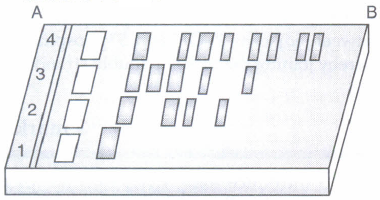
(a)Mark the positive and negative terminals.
(b) What is the charge carried by DNA molecule and how does it help in its separation?
(c)How are the separated DNA fragments finally isolated?
11.
Refer to the diagram given below and answer the questions that follow.
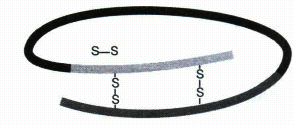
(i) The diagram shown above is insulin or proinsulin, Justify.
(ii) How is mature insulin syntheised?
12.
Give the name of the source organisms of the gene cry Iac and its target pest.
13.
Name the enzyme that can link these two DNA fragments.
14.
What is BOD? What does it mean if a water sample gas more BOD?
15.
In the daily Tribune dt. August 20, 2012 there was a news under heading 'New Stem Cell treatement to cure cancer'. Professor Revenue head of bone marrow transplantation at Israel's Hadassah' Medical Centre in Jerusalem said: The technique uses specialised harvested cells to produce infection - fighting bone marrow. Patients with blood cancers have most of their bone marrow destroyed when given radiation or chemotherapy to destroy their disease.
(i) What are stem cells?
(ii) What is the source of stem cells?
(iii) What are the infection - fighting cells produced by bone marrow?
(iv) Name the diseases which can be curved by this life saving treatements.
(v) What is the effect of bone marrow transplantation?
16.
How do microbes reduce the environmental degradation caused by chemicals?
17.
Do eukaryotic cells have restriction endonucleases? Justify your answer.
18.
What will happen if you add a small amount of curd to the fresh milk and keep it for few hours at 25oC.name the process, chemical changes and the resultant products? Name any three edible products prepared from it.
19.
Give an example of a natural form of genetic engineering in which the bacterium inserts gene into plants to cause gall or tumour formation.
20.
Few gaps have been left in the following table. Fill up the gaps.
| Restriction Enzyme | Source | Recognition sequence and site of cleavage |
| Bam HI | Bacillus amyloliquiefaciens H | a |
| Eco RI | b | \(\downarrow \) 5'-G-A-A-T-T-C-3' 3'-C-T-T-A-A-G-5' \(\uparrow \) |
| c | Haemophillus influenzae Rd | \(\downarrow \) 5'-G-T-C-G-A-C-3' 3'-C-A-G-C-T-G-5' \(\uparrow \) |
21.
Identify a,b, c, d, e and f in the table given below:
| S.No | Organism | Bioactive molecule | Use |
| 1. | Monascus purpureus | (a) | (b) |
| 2. | (c) | (d) | antibiotic |
| 3. | (e) | cyclosporin A | (F) |
22.
Collect 5 examples of palindromic DNA sequences by consulting your teacher. Better try to create a palindromic sequence by following base-pair rules.
23.
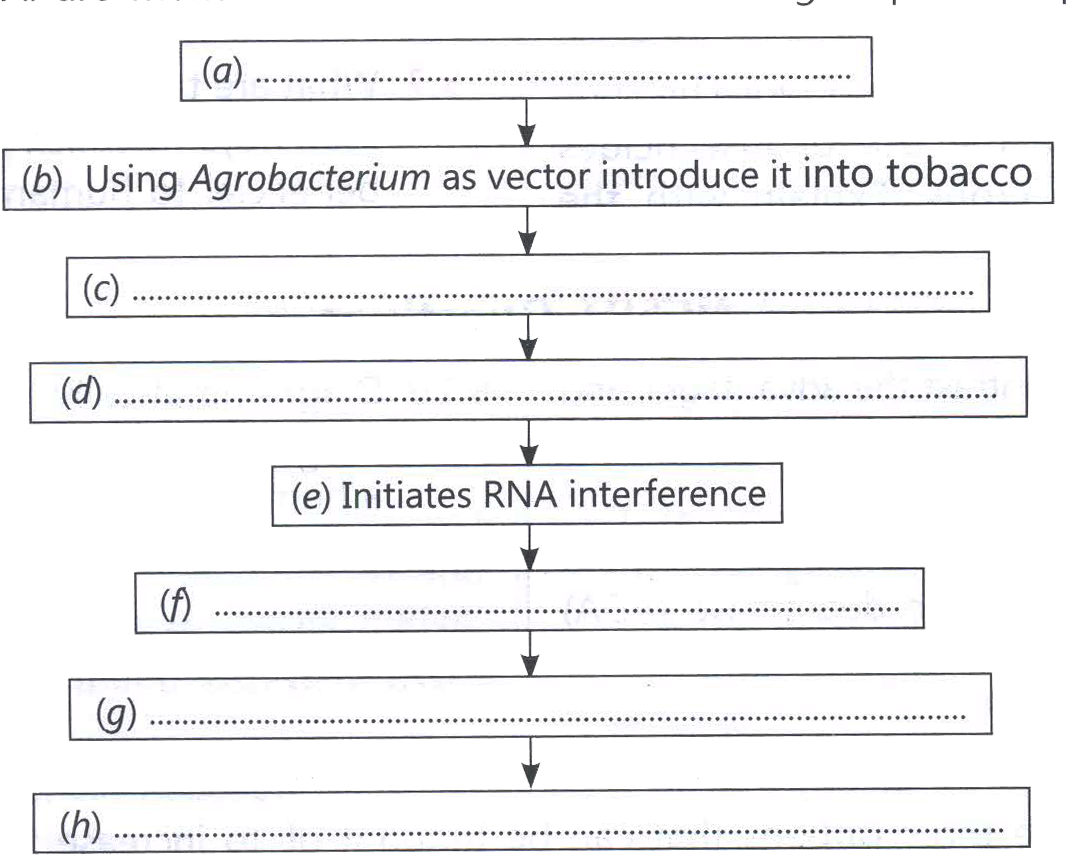
Two of the steps involved in producing nematode resistant tobacco plants based on the process of RNAi are mentioned below. Write the missing steps in its proper sequence.
24.
An organic farmer releies on natural predection for controlling plant pests and diseases. Justify giving reasons why this is considered to be holistic approch.
25.
Enzyme that cleaves nucleic acids within the polynucleotide chain is known as
endonuclease
exonuclease
arysulfatase
phosphotriesterase
26.
Match List I with List II and select the correct option
| List I | List II |
| Bacillus thuringiensis | Production of chitinases |
| Rhizobium meliloti | Scavenging of oil spills |
| Escherichia coli | Incorporation of 'nif' gene |
| Pseudomonas putida | production of Bt toxin |
| Trichoderma | Productiion of human insulin |
a-2,b-4,c-1,d-5,e-3
a-2,b-4,c-5,d-1,e-3
a-4,b-3,c-5,d-2,e-1
a-3,b-4,c-5,d-1,e-2
a-4,b-2,c-5,d-3,e-1
27.
When domestic sewage mixes with-------
Small animals like rats will die after drinking river water.
The increased microbial activity releases micronutrients such as iron.
The increased microbial activity uses up dissolved oxygen.
The river water is still suitable for drinking as impurities are only about 0.1%
28.
Select the correct combination of the statements a-d regarding the characteristics of certain organisms
(1) Methanogens are archaebacteria which produce methane in marshy areas.
(2) Nostoc is a filamentous blue green alga which fixes atmospheric nitrogen.
(3) Chemosynthetic autotrophic bacteria synthesise cellulose from glucose.
(4) Mycoplasma lacks a cell wall and can survive without oxygen.
(2) and (3)
(1), (2), (3)
(2), (3) and (4)
(1), (2), (4)
29.
Blindness is prevented by use of which crop in poor countries?
Golden rice
Wheat
Gram
Pea
30.
Which of the following is widely used as a successful biofertiliser in Indian rice field?
Rhizobium
Acacia arabica
Acalypha indica
Azolla pinnata
31.
Which of the following is maintained for optimum production of vinegar?
Anaerobic condition
Temperature of \(65^{ \circ }C\)
Aerobic condition
Microaerophilic condition
32.
Which of the following antibiotic is active against fungus?
Streptomycin
Polyenes
Tetracycline
Neomycin
33.
Restriction endonucleases are most widely used in recombinant DNA technology. They are obtained from
Bacteriophages
Bacterial cells
Plasmids
All prokaryotic cells
34.
Transgenic plants are developed by
clone and genetically modified genes
introduction of foreign genes
genetic engineering
purified genes
35.
Mohan is a farmer in a village of Karnataka. He is worried about his cotton crop, which being destroyed by insects. His friend suggested him to use Bt variety of cotton. Explain:
(i)Why to use Bt variety of cotton?
(ii) What are the advantage of genetically modified crops?
36.
Sohan's mother was suffering from diabetes. Doctors suggested her to take insulin injection, but she refused to go for it because she knows that the insulin is prepared from the body organs of animals (usually from pancreas of cattle and pig). Sohan convinced his mother that the insulin which is being prepared now-a-days is not that which is prepared by slaughterid animals, but it is being prepared by making use of biotechnology. Answer the following questions on the basis of above information.
(i) How insulin is produced through recombinant DNA technology?
(ii) How is the insulin produced through recombinant DNA technology better than one used earlier by diabetic patients.
(iii) What values were exhibited by Sohan in the above situation?
37.
Unless the vector and source DNA are cut, fragments separated and joined, the desired recombinant vector molecule cannot be created.
(a) How are the desirable DNA sequence cut?
(b) Explain the technique used to separate the cut fragments.
(c)How are the resultant fragments joined to the vector DNA molecule?
38.
As we know, our rivers Ganga and Yamuna are getting polluted day-by-day.
Many factories discharge sewage effluents into these rivers. The load of pollution in these rivers also increases due to municipal sewage and many things thrown by people in the name of worship. The government has however taken some steps to save these rivers.
(i) What are the values shown by people who throw wastes in rivers?
(ii) How could we help in decreasing pollution of rivers?
(iii) State some advantages of saving the river.
(iv) State the action taken by the government to stop the pollution in these rivers.
1.
()
Creation of recombinant DNA, gene cloning and gene transfer.
2.
()
Difference between DNA and RNA
| DNA | RNA |
| 1.It is mainly confined to the nucleus. A small quantity occurs in mitochondria and chloroplasts. | 1. It mainly occurs in the cytoplasm. A small quantity is found in the nucleus. |
| 2. Its quantity is constant in each cell of a species. | 2. Its quantity varies in different cells. |
| 3. It contains deoxyribose sugar. | 3. It contains ribose sugar. |
| 4. Its pyrimidines are adenine and thymine. | 4. Its pyrimidines are adenine and uracil. |
| 5. The amount of adenine is equal to the amount of thymine, also the amount of cytosine is equal to the amount of guanine. | 5. Adenine and uracil are not necessarily in equal amounts, nor are cytosine and guanine necessarily in equal amounts. |
| 6. It consist of 2 polynucleotide chains held together by hydrogen bonds, and coiled into a double helix. Some viruses (\(\phi \)X 174) have single-stranded DNA. | 6. It consists of a single polynucleotide chain. It may fold on itself and get hydrogen-bonded and coiled into a pseudohelix. Some viruses (rheovirus) have double-stranded RNA. |
| 7. Its molecular weight varies from 2 to 6 million. | 7. Its molecular weight varies from 25,000 to 2 million. |
| 8. It is 2 types : linear intranuclear and circular extranuclear. | 8. It is of 3 types : mRNA, tRNA, rRNA. Each type is further of many subtypes. |
| 9. It can replicate itself. | 9. It cannot replicate itself. It is formed by DNA. Some RNA viruses (paramyxo virus) can produce RNA from RNA template. |
| 10. It controls structure, metabolism, heredity, differentiation and evolution. | 10. It brings about protein synthesis. It also starts replication |
| 11. It is a component of chromosomes. | 11. It is a component of ribosomes. |
| 12. It is genetic material in all organisms | 12. It is genetic material in certain viruses. |
| 13. It does not contain unusual bases. | 13. It may contain unusual bases in additional to the normal ones. |
| 14. A primer is needed for replication. | 14. No prime is needed for transcription. |
| 15. Its renaturation after melting is slow. | 15. Its renaturation after melting is quick. |
| 16. It transfers its information to mRNA (transcription). | 16. mRNA transfers its information to polypeptide (translation). |
| 17. DNA is hydrolysed by the enzyme DNA-ase. | 17. RNA is hydrolysed by the enzyme RNA-ASE. |
3.
()
Genes which are able to select transformed cell from the non - recombinant cells are called selectable markers.
4.
()
(i) DNA polymerase
(ii) Taq polymerase.
5.
()
Lipase and Amylase.
6.
()
Bt Cotton.
7.
()
Escherichia coli.
8.
()
Sampling ports are the outlets through which small volumes of the culture can be withdrawn periodically.
9.
()
In the sparged stirred tank the stirrer facilities the mixing and oxygen availability throughout the bioreator.
10.
(a) Positive terminal-B' Negative terminal-' A'
(b) DNA being negatively charged, moves towards the positive electrode (anode)
(c) By elution-separated bands of DNA are cut out from the agarose gel and extracted from the gel piece.
11.
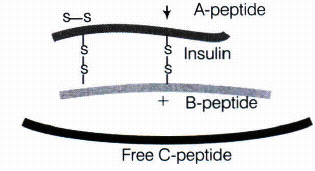
(i) The diagram is proinsulin as it contains C-peptide.
(ii) Mature insulin is synthesised by removal of extra stretch called C-peptide.
12.
Source-Bacillus thuringiensis. Target pest-cotton bollworms.
13.
DNA ligase.
14.
1. Biochemical oxygen demand (BOD) represents the amount of dissolved oxygen that would be consumed if all the organic matter in one litre of water were oxidised by microorganisms.
2. More value of BOD means the water sample is polluted by organic matter
15.
(i) Stem cells are the young, immature totipotent cells which differentiate into any type of cells, tissue or organs under specific conditions.
(ii) Placental stem cells or the umbilical stem cells to cure patients with immune system failure.
(iii) T - lymphocytes and B - lymphocytes.
(iv) Leukaemia, myeloma, lymphoma and Hodgkin's disease can be curved, to save thousands of victims of cancer which die every year.
(v) Bone marrow transplant rebuild the body's immune system. To avoid rejection of new cells by body, a perfect good match has to found before a transplant can go a head.
16.
Microbes can absorb and accumulate the chemicals as well as metabolise the same so as to clean environment. The phenomenon is called bioremediation. Pseudomonas putida has been genetically modified (chakravarthy bug) to metabolise most of the pollutant chemicals including oil spills.
17.
No, eukaryotic cells do not have restriction endonucleases.
All the restriction endonucleases have been isolated from various strains of bacteria. Prokaryotes/bacteria have this enzyme as a defence mechanism to destroy the foreign DNA or to restrict the growth of bacteriophages.
18.
The milk will be converted into fermented milk and finally into curd. The process is called lactic acid fermentation. During this process, the microorganisms such as Lactobacillus, Pediococcus, Streptococcus and other commonly called lactic acid bacteria (LAB) convert Lactose (Carbohydrates) into lactic acid by fermentation and coagulate milk protein (Casein) to produce a homogenous curd.
Carbohydrate \(\underrightarrow { LAB } \) Lactic acid + CO2
The products of fermented milk are Dahi, Lassi, Buttermilk, Shrikhand, etc. These products have originated from India.
19.
The best example of a natural form of genetic engineering is Agrobacterium tumefaciens inserting genes into plants and getting the plants to express those genes in the form of proteins. This infection results in the formation of a gall or tumour in the host.
20.
a = 5'- G-G-A-T-C-C-3',
b = Escherichia coli RY 13,
c = Hin d II
3'-C-C-T-A-G-G-5'
21.
Monascus purpureus is a yeast which produces statins (a) that is used as a blood-cholesterol lowering agent (b) Penicillium notatum (c) is a mould (fungus) which produces penicillin (d) that is used as an antibiotic.
Trichoderma polysporum (e) is a fungus which produces cyclosporin-A that is used as an immunosuppressive agent (f) in organ-transplant patients.
22.
Five examples of palindromic DNA sequences are
(i) 5'-A A G C T T-3' 3'-T T C G A A-5'
(ii) 5'-G G A T C C-3' 3'-C C T A G G-5'
(iii) 5'-A G G C C T-3' 3'-T C C G G A-5'
(iv) 5'-G A A T T C-3' 3'-C T T A A G-5'
(v) 5'-A C T A G T-3' 3'-T G A T C A-5'
23.
(a) Isolation of nematode-specific gene.
(c) Production of sense and anti-sense RNA in the host.
(d) Formation of ds RNA (as the sense and anti-sense RNA are complementary to each other). if Silencing of specific mRNA of the nematode.
(g) Host expresses the interfering RNA.
(h) Parasite cannot survive and host (tobacco) plant is protected.
24.
1. Organic farming is a holistic approach that seeks to develop an understanding of the webs of interaction among the myriads of organisms that form the flora and fauna of the field.
2. The organic farmer works to create a system where the insects (called pests) are not eradicated, but kept at manageable levels by a complex system of checks and balance within a living and vibrant ecosystem.
3. According to the organic farmer, the eradication of the creatures, called pests, is not only possible but also undesirable, because many beneficial predatory and parasitic insects cannot survive without them.
4. Such a use of biocontrol measures reduces the use of chemical pesticides and thereby the pollution.
25.
(a)
endonuclease
26.
(c)
a-4,b-3,c-5,d-2,e-1
27.
(c)
The increased microbial activity uses up dissolved oxygen.
28.
(d)
(1), (2), (4)
29.
(a)
Golden rice
30.
(d)
Azolla pinnata
31.
(a)
Anaerobic condition
32.
(b)
Polyenes
33.
(b)
Bacterial cells
34.
(b)
introduction of foreign genes
35.
(i) Because Bt cotton is resistant to some insects and therefore it decreases the need of pesticides.
(ii) The advantages of genetically modified crops are:
(a) These are tolerant to abiotic stresses.
(b) These have enhanced nutritional value of food.
(c) These are resistant against some plant pathogens.
(d) These have reduced the use of chemical pesticides.
36.
(i) The DNA containing insulin gene is isolated from human cell. Two DNA sequences corresponding to A and B chains of human insulin are prepared and introduced into the plasmid vector of E. coli to produce insulin chains A and B. Separate chains are extracted and combined by creating disulphide bonds to form genetically engineered human insulin which is also called as humilin.
(ii) The insulin produced through recombinant DNA technology is better than one used earlier by diabetic patients because it does not produce sensitive allergic reactions and other immunological complications, whereas the earlier insulin extracted from the pancreas of slaughtered cattle and pig cause allergy or other types of reactions, because they are foreign proteins.
(iii) Sohan exhibited the sense of responsibility and care towards his parents. He is aware of various biotechnical applications. He makes use of this knowledge to convince his mother
37.
(a) DNA sequences of the vector as well as the source are cut by the same restriction enzyme like EcoRI, in a palindromic sequence. (The cut ends overhang to as sticky ends in the medium.)
(b) These cut ends fragments are to be extracted from the culture medium using gel electrophoresis. This has an agarose gel matrix. Fragments are fed in the wells. They are negatively charged. So, they move towards anode under an electric field through the gel. Smaller fragments move faster, thus separated.
(c) Fragments are now added to the medium containing the vector DNA. The sticky ends facilitates the action of the enzyme ligase and join the source DNA to the vector.
38.
(i) People are careless, superstitious and unaware.
(ii) We can help in decreasing pollution of rivers by adopting following habits:
(a) By throwing litter or polybags in dustbin instead of rivers.
(b) By using environment friendly household products such as washing powder, household cleaning agents, etc.
(c) By planting more and more trees, which prevent fertilisers, pesticides and contaminated water from running in to nearby rivers.
(iii) Some advantages of saving rivers are:
(a) Constant supply of water and food to us.
(b) Huge supply of all natural fertilisers, which is good for growing crops.
(iv) Government has initiated Ganga Action Plan and Yamuna Action Plan to save these rivers from pollution.

12th Standard CBSE Syllabus & Materials
12th Standard CBSE
CBSE 12th Computer Science Python Revision Tour I - New Previous year Question Papers Study Material - QB365 Set A
NEW12th Standard CBSE
CBSE 12th Business Studies Planning Important Questions And Answers Study Material - QB365 Set A
NEW12th Standard CBSE
CBSE 12th Business Studies Business Environment Important Questions And Answers Study Material - QB365 Set A
NEW12th Standard CBSE
CBSE 12th Business Studies Principles of Management Important Questions And Answers Study Material - QB365 Set A



CBSE 12th Standard CBSE Subjects
CBSE Standards










