
 100% FREE ACCESS
12th Standard CBSE Syllabus & Materials
12th Standard CBSE
CBSE 12th Economics Government Budget and the Economy Previous year Question Papers Study Material - QB365 Set A
NEW12th Standard CBSE
CBSE 12th Computer Science Interface Python with MySQL - New Previous year Question Papers Study Material - QB365 Set A
NEW12th Standard CBSE
CBSE 12th Computer Science Database Concept - New Previous year Question Papers Study Material - QB365 Set A
NEW12th Standard CBSE
CBSE 12th Computer Science Data Communication - New Previous year Question Papers Study Material - QB365 Set A
NEW12th Standard CBSE
CBSE 12th Computer Science Data Structures - New Previous year Question Papers Study Material - QB365 Set A
NEW12th Standard CBSE
CBSE 12th Computer Science Functions - New Previous year Question Papers Study Material - QB365 Set A

Published on: 29/12/2018
Class 12 Half Yearly Model
Download CBSE Class 12th Standard CBSE Chemistry question papers, sample papers, important questions, and previous year solved papers in PDF format. Get free study materials, NCERT solutions, and exam preparation resources for Class 12th Standard CBSE Chemistry
Questions + Answers key
Take MCQ Chemistry Test
1.
The chemistry of actinoids is not so smooth as that of lanthanoids. Give reason.
2.
Write the products of hydrolysis of maltose?
3.
Explain the following:
(i) Same substance can act both as colloids and crystalloids.
(ii) Artificial rain is caused by spraying salt over clouds.
4.
What fraction of edge is not covered by atoms in bcc arrangement ?
5.
Which will have higher boiling point: 0.1MNaCl or 0.1M, BaCI2 in water? Explain.
6.
Why are halogens strong oxidising agents?
7.
Vapour pressures of benzene and toluene in a mixture at 50oC are given in mm by P = 179 XB + 92 where XB is the mole fraction of benzene. Calculate
(a) Vapour pressures of pure benzene and toluene at 50oC.
(b) Vapour pressure of a liquid mixture obtained by mixing 224 g benzene and 184 g of toluene.
(c) If the vapours are removed and condensed into liquid and again brought to the temperature of 50oC, what would be the mole fraction of benzene in the vapour phase ?
8.
Ethylene dibromide (C2H4Br2) and 1, 2-dibromo propane form a series of ideal solutions over the whole range of composition.At 850C, the vapour pressure of these two liquids are 173 and 127 torr respectively. What would be the mole fraction of ethylene dibromide in a solution at 850 C equilibrated with 1:1 molar mixture in the vapour?
9.
What is de - icing agent ? How does it work ?
10.
Alkenes, 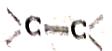 and carbonyl compounds ,
  both contain a \(\pi\) - bond but alkenes show electrophilic addition reactions whereas carbonyl compounds show nucleophilic addition reactions. Explain.
11.
Name one example each of
(i) acidic flux
(ii) basic flux.
12.
Show that in cubic packed structure, eight tatrahedral voids are persent per unit cell.
13.
Following compounds are given to you:
2-bromopentane, 2-bromo-2-methylbutane, I-bromoperltane
(a) Write the compound which is most reactive towards SN2 reaction.
(b) Write the compound which is optically active.
(c) Write the compound which is most reactive towards \(\beta \) elimination reaction.
14.
From the following data,show that the decomposition of hydrogen peroxide is a reaction of the first order:
| t | 0 | 10 | 20 |
| x | 46.1 | 29.8 | 19.3 |
where t is the time in minutes and x is the volume of standard KMnO4 solution in cm3 required for titrating the same volume of the reaction mixture.
15.
How many Faradays/coulombs are required to produce
(i) 20.0 g of calcium from moltenCaCl2?
(ii) 40.0 g of aluminium from molten AI2O3?
16.
Name the following compounds according to IUPAC system of nomenclature:
(i) CH3CH2COCH(C2H5)CH2CH2Cl
(ii) CH3COCH2COCH3
(iii) (CH3)3CCH2COOH
17.
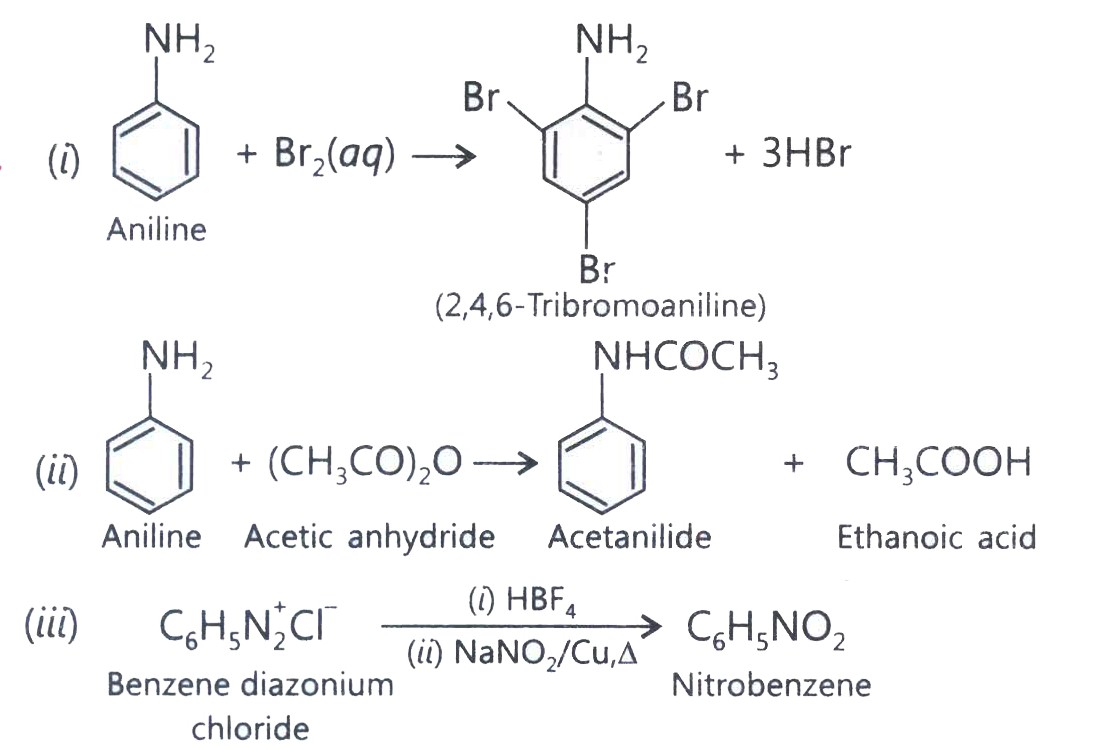
Complete the following reactions:
(i)\(C_6H_5NH_2+Br_2(aq)\rightarrow\)
(ii)\(C_6H_5NH_2+(CH_3CO)_2O\rightarrow\)
(iii)\(C_6H_5N_2Cl\overset { (i)HBF_{ 4 } }{ \underset { (ii)NaNO_{ 2 }/Cu,\Delta }{ \longrightarrow } } \)
18.
On reaction with Cl2, phosphorus forms two types of halides 'A' and 'B'. Halide A is yellowish-white powder but halide 'B' is colourless oily liquid. Identify A and B and write the formulas of their hydrolysis products.
19.
Write balanced chemical equation for the following reactions:
(i) Chlorine is passed through hot concentrated NaOH solution.
(ii) XeF6 is hydrolysed.
(iii) Excess of SO2 reacts with sodium hydroxide solution.
20.
Two first reactions proceed at the same rate at 15oC when started with same initial concentration. The temperature coefficient of the first reaction is 2 while that of the second reaction is 3. What will be the ratio of the rates of these reactions at 55oC ?
21.
(a) Complete the following chemical equations:
(i) \(\underset{Hot\ and\ conc.}{NaOH(aq)}\) + Cl2(g) \(\longrightarrow \)
(ii) XeF6(s) + H2O(l) \(\longrightarrow \)
(b) How would you account for the following?
(i) The value of electron gain enthalpy with negative sign for sulphur is higher than that for oxygen.
(ii) NF3 is an exothermic compound but NCl3 is endothermic compound.
(iii) ClF3 molecule has a T-shaped structure and nota trigonal planar one.
22.
What is the composition of 'copper matte'?
23.
Why is chemisorption irreversible?
24.
How the supersonic jet aeroplanes are responsible for the depletion of ozone layer ?
25.
In a crystal of zinc sulphide, zinc occupies tetrahedral voids. What is the coordination number of zinc?
26.
The well known refrigerant freon has the structure .........
1.
Chemistry of the actinoids is more complex in the view of their ability to exist in different oxidation states. Further, many of the actinoid elements are radioactive which make the study of these elements rather difficult.
2.
molecules of Glucose.
3.
(i) The nature of the substance whether colloid or crystalloid depends upon size of the solute particles. When the size of solute particles lies between 1 to 1000 nm, it behaves as a colloid.
(ii) The colloidal water particles of the clouds get neutralized and coagulated to bigger water drops by spraying salt.
4.
If a is the edge length of bcc unit cell and r is the radius of atom, then
edge not covered by atom = a = 2r.
In bcc, body diagonal = \(\sqrt { 3 } a\)
\(4r=\sqrt { 3 } a\)
or \(r=\frac { \sqrt { 3 } }{ 4 } a\)
\(\therefore \) Edge not covered by atoms = \(a-2\times \frac { \sqrt { 3 } }{ 4 } a\)
= \(\frac { a\left( \frac { 2-\sqrt { 3 } }{ 2 } \right) }{ a } \)
= \(\frac { 2-1.732 }{ 2 } =0.134%\)%
5.
01 M BaCI2 solution will have higher boiling point because of large number of particles on dissociation.
\(
\mathrm{NaCI} \longrightarrow \mathrm{Na}^{+}+\mathrm{CI}^{-}(2 \text { particles }) \\
\mathrm{BaCI}_2 \longrightarrow \mathrm{Ba}^{2+}+2 \mathrm{CI}^{-}(3 \text { particles })
\)
6.
Due to low bond dissociation enthalpy, high electronegativity and large negative electron gain enthalpy halogens have a strong tendency to accept electrons and thus get reduced.
\({ X }_{ 2 }+2{ e }^{ - }\longrightarrow 2{ X }^{ - }\)
As a result, halogens act as strong oxidising agents. Their oxidising power, however, decreases from \({ F }_{ 2 }\) to \({ I }_{ 2 }\) as is evident from their electrode potentials :
\({ { E }^{ ° } }_{ { F }_{ 2 }/{ F }^{ - } }=+2.87,\ { { E }^{ ° } }_{ { Cl }_{ 2 }/{ Cl }^{ - } }=+1.36V\ ;\ { { E } }_{ { Br }_{ 2 }/{ Br }^{ - } }=+1.09V\ and\ { { E }^{ ° } }_{ { I }_{ 2 }/{ I }^{ - } }=+0.54V\)
Thus, \({ F }_{ 2 }\) is the strongest while \({ I }_{ 2 }\) is the weakest oxidising agent.
7.
New \({ P }_{ Total }=222.2+16.6=238.8mm\) New \({ y }_{ B }=\frac { 222.2 }{ 238.8 } =0.93\)
8.
0.423
9.
Common salt is called de - icing agent because it lowers the freezing point of water to such an extent that it does not freeze to form ice. Hence, it is used to clear snow from roads.
10.
Carbon atom in carbonyl compounds acquires slight positive charge and is attacked by nucleophile.
Alkenes undergo electrophilic addition whereas aldehydes and ketones undergo nucleophilic addition because in alkenes the double bond joins two carbon atoms and there is no resultant polarity.
11.
(i) Acidic flux: SiO2 is acidic flux.
(ii) Basic flux: CaO is basic flux.
12.
In ccp structure, there are 8 tetrahedral voids. In dose-packed structure, there are eight spheres in the corner of the unit cell and each sphere is in contact with three others giving rise to eight tetrahedral voids.
13.
A) SN2 reactions involve the formation of transition state. Higher the steric hindrance, lesser the stability of transition state and lower is their reactivity towards SN2.
.png)
b) Among the given compounds, 2-bromopentane is optically active due to presence of chiral carbon (*)
.png)
A chiral carbon have four different groups or atoms attached separately to its four valencies
c) 2-bromo-2-methylbutane is most reactive towards \(\beta \) -elimination reaction because in this case more substituted alkene is the major product.
.png)
14.
The volume of k comes out to be nearly constant. Hence of the first order.
15.
(i) 1 F or 96500 C
(ii) 4.44 F or 428460 C
16.
(i) 6-Chloro-4-ethylhexan-3-one
(ii) Pentane-2, 4-dione
(iii) 3, 3-Dimethylbutanoic acid
17.
18.
'A' is PCl5. (It is a yellowish-white solid).
'B' is PCl3 (It is a colourless oily liquid).
P4(s) + 10Cl2(g) \(\to\) 4PCl5(s)
P4(s) + 6Cl2 (g) \(\to\) 4PCI3(l)
PCl5, on hydrolysis gives H3PO4, whereas
PCl3, on hydrolysis gives H3PO3.
PCl5 + 4H2O \(\to\) H3PO4 + 5HCl
PCl3 + 3H2O \(\to\) H3PO3 + 3HCl
19.
(i) 3Cl2 + \(\underset {hot\ and \ conc} {6NaOH}\) \(\to\) 5NaCl + NaCIO3 + 3H2O
(ii) XeF4 + 3H2O \(\to\) XeO3 + 6HF
(iii) SO2 + 2NaOH \(\to\) Na2So3 + H2O
20.
If RI is the rate of first reaction at 25°C, then as its temperature coefficient is 2, its rate at 35°C will be = 2 R1, at 45°C = 2 x 2 R1 = 4 R1 and at 55°C = 2 x 4 R1 = 8 R1
If R2.is the rate of the second reaction at 25°C, then as its temperature coefficient is 3, its rate at 35°C will be = 3 R2, at 45°C = 3 x 3 R2 = 9 R2 and at 55°C = 3 x 9 R2 = 27 R2
Also, we are given R1 = R2, i.e., at 25°C, the rates are equal.
At 550C, \({Rate\ of\ 2nd\ reaction\over Rate\ of\ 1st\ reaction}={27R_2\over 8R_1}={27\over 8}\)
21.
(a) \((i)\ 6NaOH+3CI_{ 2 }\longrightarrow 5NaCI+NaCIO_{ 3 }+3H_{ 2 }O\)
\(\\ (ii)\ { XeF }_{ 6 }+3H_{ 2 }O\longrightarrow { XeO }_{ 3 }+6HF\)
(b)
(i) It is due to more inter-electronic repulsion between valence electrons of oxygen atom.
(ii) \({ F }_{ 2 }\) is stronger oxidising agent and has lower bond energy than \({ CI }_{ 2 }\) therefore, \({ NF }_{ 3 }\)is a exothermic compound due to stronger N-F bond than N-CI bond i.e., energy is released in its formation whereas \({ NCI }_{ 3 }\)is an endothermic compound i.e., energy is absorbed in its formation.
(iii) It is due to presence of two lone pairs of electrons and has \({ sp }^{ 3 }d\)hybirdisation.
22.
()
Cuprous sulphide and traces of ferrous sulphide.
23.
()
Gases obtained on desorption not only contain the gases adsorbed but also contain surface compounds formed during chemisorption
24.
()
The exhausts of supersonic jet aeroplanes contain nitric oxide (NO) which combines with ozone present in
\(NO\ (g) + O_3\ (g) \rightarrow NO_2(g)+O_2\ (g)\)
Since supersonic jet aeroplanes fly near the ozone layer, they are reponsible for depletion of ozone layer.
25.
()
4
26.
()
CF2Cl2

12th Standard CBSE Syllabus & Materials
12th Standard CBSE
CBSE 12th Computer Science Python Revision Tour I - New Previous year Question Papers Study Material - QB365 Set A
NEW12th Standard CBSE
CBSE 12th Business Studies Planning Important Questions And Answers Study Material - QB365 Set A
NEW12th Standard CBSE
CBSE 12th Business Studies Business Environment Important Questions And Answers Study Material - QB365 Set A
NEW12th Standard CBSE
CBSE 12th Business Studies Principles of Management Important Questions And Answers Study Material - QB365 Set A



CBSE 12th Standard CBSE Subjects
CBSE Standards










