
 100% FREE ACCESS
12th Standard CBSE Syllabus & Materials
12th Standard CBSE
CBSE 12th Economics Government Budget and the Economy Previous year Question Papers Study Material - QB365 Set A
NEW12th Standard CBSE
CBSE 12th Computer Science Interface Python with MySQL - New Previous year Question Papers Study Material - QB365 Set A
NEW12th Standard CBSE
CBSE 12th Computer Science Database Concept - New Previous year Question Papers Study Material - QB365 Set A
NEW12th Standard CBSE
CBSE 12th Computer Science Data Communication - New Previous year Question Papers Study Material - QB365 Set A
NEW12th Standard CBSE
CBSE 12th Computer Science Data Structures - New Previous year Question Papers Study Material - QB365 Set A
NEW12th Standard CBSE
CBSE 12th Computer Science Functions - New Previous year Question Papers Study Material - QB365 Set A

Published on: 06/08/2018
Based on the Term I syllabus, the model question paper is prepared. The chapter that covers syllabus are
1.The Solid State
2. Solution
3. Electrochemistry
4. Chemical Kinetics
Download CBSE Class 12th Standard CBSE Chemistry question papers, sample papers, important questions, and previous year solved papers in PDF format. Get free study materials, NCERT solutions, and exam preparation resources for Class 12th Standard CBSE Chemistry
Questions + Answers key
Take MCQ Chemistry Test
1.
Give the main difference between an electrochemical cell and an electrolytic cell.
2.
Define conductivity and give its units. Why is alternating current not used in place of direct current for measuring the electrolytic.
3.
If half-life period of a reaction is inversely proiportional to initial concentration of the reactant, what is the order of reaction ?
4.
For a first order reaction, time taken for half of the reaction to complete is t1 whereas that for 3/4 th of the reaction to complete id t2. how are t1 and t2 related to each other?
5.
A reaction is first order in A and second order in B
(i) Write differential rate equation.
(ii) How is the rate affected on increasing the concentration of B three times ?
(iii) How is the rate affected when concentration of both A and B is doubled ?
6.
(a) Define Azeotropes and explain broefly minimum boiling azeotrope by taking suitable example.
(b) The vapour pressures of pure liquids A and B are 450 mm 700 mm of Hg respectively at 350 K. Calculate the composition of the liquid mixture if total vapour pressure is 600 mm of Hg. Also find the composition of the mixture in the vapour phase.
7.
Classify the following solids in different categories based on the nature of intermolecular forces operating in them. Potassium sulphate, tin, benzene, urea, ammonia, water, zinc sulphide, graphite, rubidium, argon, silicon carbide.
8.
How does amorphous silica differ from quartz?
9.
Explain the following with suitable example:An n-type semiconductor.
10.
What is physical significance of energy of activation? Explain with diagram.
11.
With the help of diagram explain the role of activated complex in a reaction.
12.
Predict the structure of MgO crystal and coordination number of its cation in which cation and anion radii are equal to 65 pm and 140 pm respectively.
13.
Br- ions form a close-packed structure. If the radius of Br- ion is 195 pm, calculate the radius of the cation that just fits into the tetrahedral hole. Can a cation A+ having a radius of 82pm be slipped into the octahedral hole of the crystal A+ Br- ?
14.
The two ions A+ and B- have radii 88 and 200pm respectively. In the close packed crystal of compound AB, predict the coordination number of A+
15.
In a solid oxide ions are arranged in ccp. One-sixth of the tetrahedral voids are occupied by the cations A while one-third of the octahedral voids are occupied by the cations B. What is the formula of the compound?
16.
In corrundum, oxide ions are arranged in hexagonal close packing and aluminum ions ocupy two-third of the octahedral voids. What is the formula of corrundum?
17.
A cubic solid is made up of two elements A and Y are present at the corners of the cube and atoms A at the body centre. What is the formula of the compound? What are the coordination numbers of X and Y?
18.
A compound formed by elements A and B has a cubic structure in which A atoms are at the corners of the cube and B atoms are at the face centres. Derive the formula of the compound.
19.
(a) Assuming complete ionization, calculate the expected freezing point of solution prepared by dissolving 6.00 g of Glauber's salt, Na2SO4. 10H2O in 0.1 kg of H2O. (K f for H2O = 1.86 K kg mol-1) [At. mass of Na = 23, S = 32, O= 16, H = 1 u].
(b) Two liquids X and Y boil at 110 oC and 130 oC respectively. Which of them has higher vapor pressure at 50oC ?
20.
Assign reasons for the following:
(i) Phosphorus doped silicon is a semiconductor.
(ii) Schottky defect lowers the density of a solid.
(iii) Some of the very old glass objects appear slightly milky instead of being transparent.
21.
(a) What type of semiconductor is obtained when silicon is doped with boron?
(b) What type of magnetism is shown in the following alignment of magnetic moments?

(c) What type of point defects are produced when AgCl is doped with CdCl2?
22.
Standard reduction potentials of the half reactions are given below :
\({ F }_{ 2 }(g)+{ 2e }^{ - }\longrightarrow 2{ F }^{ - }(aq);{ E }^{ 0 }=+2.85V\)
\({ Cl }_{ 2 }(g)+{ 2e }^{ - }\longrightarrow 2{ Cl }^{ - }(aq);{ E }^{ 0 }=+1.36V\)
\({ Br }_{ 2 }(s)+{ 2e }^{ - }\longrightarrow 2{ Br }^{ - }(aq);{ E }^{ 0 }=+1.06V\)
\({ I }_{ 2 }(s)+{ 2e }^{ - }\longrightarrow 2{ I }^{ - }(aq);{ E }^{ 0 }=+0.53V\)
The strongest oxidizing and reducing agents respectively are :
Cl2 and Br-
Cl2 and I2
F2 and I-
Br2 and Cl-
23.
Given
\({ E }_{ { Cr }^{ 3+ }/{ Cr } }^{ 0 }=-0.74V,\\ { E }_{ { MnO }_{ 4 }^{ - }/{ Mn }^{ 2+ } }^{ 0 }=1.51V\)
\({ E }_{ { CrO }_{ 7 }^{ - }/{ Cr }^{ 3+ } }^{ 0 }=1.33V,{ E }_{ Cl/{ Cl }^{ - } }^{ 0 }=1.36V\)
Based on the data given above, strongest oxidizing agent will be
MnO4-
Cl-
Cr3+
Mn2+
24.
When measured against a standard calomel electrode, an electrode is found to have a standard reduction potential of 0.100 V. If standard reduction potential of calomel electrode is + 0.244 V and it acts as anode, the standard electrode potential of the same electrode against standard hydrogen electrode will be
- 0.144 V
+ 0.100 V
- 0.344 V
- 0.100 V
25.
The reaction taking place in the cell
Pt | H2 (g) | HCl (1.0 M) | AgCl | Ag is 1 atm
\(AgCl+\left( 1/2 \right) { H }_{ 2 }\longrightarrow Ag+{ H }^{ + }+{ Cl }^{ - }\)
\(Ag+{ H }^{ + }+{ Cl }^{ - }\longrightarrow AgCl+\left( 1/2 \right) { H }_{ 2 }\)
\(2{ Ag }^{ + }+{ H }_{ 2 }\longrightarrow 2Ag+2{ H }^{ + }\)
\(2Ag+2{ H }^{ + }\longrightarrow 2{ Ag }^{ + }+{ H }_{ 2 }\)
26.
Equivalent conductivity at infinite dilution for sodium potassium oxalate, (COO-)2 Na+ K+ , will be (given, molar conductivities of oxalate, K+ and Na+ ions at infinite dilution are 148.2, 50.1, 73.5 S cm2 mol-1 respectively)
271.8 S cm2 eq-1
67.95 S cm2 eq-1
543.6 S cm2 eq-1
135.9 S cm2 eq-1
27.
Schottky defect is observed in crystal when ..................................... .
some cations move from their lattice sites to interstitial sites.
equal number of cations and anions aremissing from the lattice.
some lattice sites are occupied by electrons.
some impurity is present in the lattice.
28.
Cations are present in the interstital site in............................... .
Frenkel defect
Schottky defect
Vacancy defect
Metal deficiency defect
29.
Which of the following is a network solid?
SO2 (Solid)
I2
Diamond
H2O (Ice)
30.
For which crystal anion-anion contact is valid?
NaF
NaI
CsBr
KCl
31.
The energy gap(E8)between valence band and conduction band for diamond,silicon and germanium are in the order
E8(diamond)>E8(silicon)>E8(germanium)
E8(diamond)>E8(silicon)<E8(germanium)
E8(diamond)=E8(silicon)=E8(germanium)
E8(diamond)>E8(silicon)>E8(germanium)
32.
A metal crystallize with a face-centred cubic lattice.The edge of the unit cell is 408pm.The diameter of the metal atom is
288pm
408pm
144pm
204pm
33.
A solid compound XY has NaCl structure.If the radius of the cation is 100pm,the radius of the anion(Y-) will be
275.1
322.5pm
241pm
165.7pm
34.
In an ionic compound A+X-,the radii of A+ and X- ions are 1.0pm and 2.0pm respectively.The volume of the unit cell of the crystal AX will be
27pm3
64pm3
125pm3
216pm3
35.
The arrangement of X- ions around A+ ions in solid AX is given in the fig(not drawn to scale).If the radius of X- is 250pm,the radius of A+ is
104pm
125pm
183pm
57pm
36.
Wax is an example of
ionic crystal
covalent crystal
molecular crystal
amorphous crystal
37.
Calculate the standard electrode potential of Cu+/Cu half cell. Given that the standard reduction potentials of Cu2+/Cu and Cu2+/Cu+ are 0.337 V and 0.153 V respectively.
38.
When inversion of surcose is studied at pH = 5, the half-life period is always found to be 500 minutes irrespective of any initial concentration but when it is studied at pH = 6, the half-life period is found to be 50 minutes. Derive the rate law expression for the inversion of surcose.
39.
The half time of first order decomposition of nitramide is 2.1 hour at 15oC. NH2NO2(aq) \(\longrightarrow\) N2O(g) + H2O (I)
If 6.2 g of MH2NO2 is allowed to decompose, calculate
(i) time taken for NH2NO2 to decompose 99% and
(ii) volume of dry N2O produced at this point, measured at STP.
1.
Differences between electrochemical cell and electrolytic cell.
| Electrochemical cell | Electrolytic cell |
| 1. It is a device which converts chemical energy into electrical energy |
1. It is a device which converts electrical energy into chemical energy |
|
2. In this case, the redox reaction is spontaneous. |
2. In this case, the redox reaction is non-spontaneous and electrical energy |
| 3. In electrochemical cell, anode is negative and cathode is positive. | 3. In electrolytic cell, anode is positive and cathode is negative electrode. |
2.
Conductivity is the conductance of a solution of 1 cm length and having 1 sq.cm as the area of cross-section i.e., of one-centimeter cube.
Direct current results in the electrolysis of the electrolytic solution. As a result, the concentration of the electrolyte near the electrodes changes and these result change in the resistance of the solution.
3.
Two. This is because for reaction of nth order, \({ t }_{ { 1 }/{ 2 } }\propto \frac { 1 }{ { \left[ { A }_{ 0 } \right] }^{ n-1 } } .Hence\quad { t }_{ { 1 }/{ 2 } }\propto \frac { 1 }{ { \left[ { A }_{ 0 } \right] } } when \ n=2\)
4.
\({ t }_{ 2 }=2{ t }_{ 1 }\) This is because, for 3/4th of the reaction to complete, time required = two half-lives.
5.
\((i) \ \frac { dx }{ dt } =k{ \left[ A \right] }{ \left[ B \right] }^{ 2 }.\)
\((ii) \ Rate=k{ \ ab }^{ 2 }\)
If [B] is tripled, Rate = \(ka{ \left( 3b \right) }^{ 2 }=9k \ { ab }^{ 2 }=9 \ times \)
(iii) If both [A]and[B] are doubled, Rate = \(k(2a){ \left( 2b \right) }^{ 2 }=8k \ { ab }^{ 2 }=8 \ times\)
6.
(b) If xA is mol fraction of A in liquid phase, then xA (450)+(1 - xA)(700) = 600 or xA = 0.4, xB = 0.6.
Hence, \({ p }_{ A }=0.4\times 450=180\quad mm,{ p }_{ B }=0.6\times 700=420\quad mm,{ y }_{ A }=\frac { 180 }{ 600 } =0.3,{ y }_{ B }=\frac { 420 }{ 600 } =0.7\)
7.
Ionic solids: Potassium sulphate, Zinc sulphide.
Metallic solids: Tin, Rubidium.
Molecular solids: Benzene, Urea, Ammonia, Water, Argon.
Covalent solids: Graphite, Silicon carbide.
8.
Amorphous silica is obtained when molten silica is cooled rapidly because the solid silica so obtained lacks the internal order of repeating SiO4 tetrahedra. Since the degree of internal order known as crystallinity is a variable quantity, it is possible to increase the crystallinity of amorphous solids by employing special techniques. Quartz has greater degree of crystallinity in its structure.
9.
When group 14 element is doped with group 15 elements, we get n-type semiconductor, e.g. silicon doped with arsenic.
10.
Energy of activation is the extra energy which must be supplied to the reactants so that these can change into products. It is difference between energy of reactants and energy of activated complex as shown in diagram below.
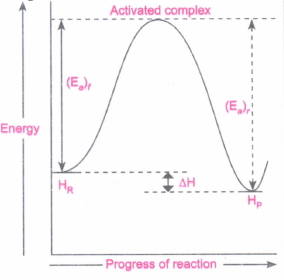
The reactants molecules which possess activation energy and collide in proper orientation lead to formation of product molecules.
11.
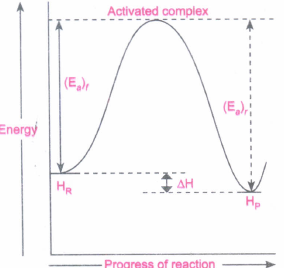
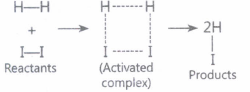
Activated complex is intermediate compound between reactants and products as shown above. It is highly unstable as it has highest energy. It readily charges into product. Those molecules which can form activated complex can lead to formation of products, e.g
12.
6,octahedral
13.
80.73 pm
14.
6
15.
ABO3
16.
Al2O3
17.
Coordination number of each of X and Y = 8
18.
AB3
19.
(i) Dispersion forces
(ii) Dispersion forces
(iii) Ion-dipole attraction
(iv) H-bound and dipole-dipole attraction
(v) Dipole -dipole attraction.
20.
(i) It is because its conductance is intermediate between conductor and insulator.
(ii) In Schottky defect, both cations and anions are missing which lead to lowering in the density of a solid.
(iii) The glass is supercooled liquid, therefore, very old glass objects become slightly milky because of heating during the day and cooling at nights, i.e. annealing over a number of years, glass acquires some crystalline structure.
21.
(a) p-type semiconductor
(b) Ferromagnetism
(c) Impurity defects lead to vacancy defects.
22.
(c)
F2 and I-
23.
(a)
MnO4-
24.
(b)
+ 0.100 V
25.
(a)
\(AgCl+\left( 1/2 \right) { H }_{ 2 }\longrightarrow Ag+{ H }^{ + }+{ Cl }^{ - }\)
26.
(d)
135.9 S cm2 eq-1
27.
(b)
equal number of cations and anions aremissing from the lattice.
28.
(a)
Frenkel defect
29.
(c)
Diamond
30.
Iodide ion is largest in size and Na+ ion is small in size.Hence,I--I- contact is possible in Na+I-(Na+ ion present in the void)
31.
(A)is the correct option because diamond is an insulator and non-metallic character decreases down the group
32.
(a)
288pm
33.
(c)
241pm
34.
(d)
216pm3
35.
(a)
104pm
36.
(c)
molecular crystal
37.
Cu+ + e-⇾ Cu; ∆Go3=?
(i)------(ii) gives the required result, i.e.,ΔG3° = ∆G01 - ΔG2° = [-0.674 - (- 0·153)] F = - 0·521 F
\(-nFE^0_{Cu^+/CU}=-0.5621F\ or\ E^0_{CU^+/Cu}=0.521V\)
38.
At pH = 5, as half-life period is found to be independent of initial concentration of sucrose, this means with respect to sucrose, it is a reaction of first order, i.e., Rate = k [Sucrose].
If n is the order with respect to H+ion, t1/2 ∝ [H+]I-n,
i.e., 500 ∝ (10-5)I-n [PH = 5 means [H+] = 10-5 M] .......(I)
and 50 ∝ (l0-6)I-n [pH = 6 means [H+] = 10-6 M] .......(ii)
Dividing (i) by (ii), 10 = (lo)l-n i.e. 1 - n = 1 or n = 0, i.e., order with respect to H+ion = O.Hence, overall rate law is Rate = k [Sucrose] [H+]o.
39.
\(k={0.693\over t_{1/2}}={0.693\over 2.1hr}=0.33hr^{-1}\)
x = 99% of a = 0·99 a
\(t={2.303\over k}log{a\over a-x}={2.303\over 0.33hr^{-1}}log{a\over a-0.99a}={2.303\over 0.33}log 10^2=13.69hours\)
(ii) Amount decomposed = 99% of 6.2 g =\({99\over 100}\times 6.2g=6.138g\)
1 mol NH2NO2 (63g) produce N2O at STP = 22·4 L
6.138 g will produce N2O at STP =\({22.4\over 63}\times6.138\ L=2.2176L\)

12th Standard CBSE Syllabus & Materials
12th Standard CBSE
CBSE 12th Computer Science Python Revision Tour I - New Previous year Question Papers Study Material - QB365 Set A
NEW12th Standard CBSE
CBSE 12th Business Studies Planning Important Questions And Answers Study Material - QB365 Set A
NEW12th Standard CBSE
CBSE 12th Business Studies Business Environment Important Questions And Answers Study Material - QB365 Set A
NEW12th Standard CBSE
CBSE 12th Business Studies Principles of Management Important Questions And Answers Study Material - QB365 Set A



CBSE 12th Standard CBSE Subjects
CBSE Standards










