
 100% FREE ACCESS
12th Standard CBSE Syllabus & Materials
12th Standard CBSE
CBSE 12th Economics Government Budget and the Economy Previous year Question Papers Study Material - QB365 Set A
NEW12th Standard CBSE
CBSE 12th Computer Science Interface Python with MySQL - New Previous year Question Papers Study Material - QB365 Set A
NEW12th Standard CBSE
CBSE 12th Computer Science Database Concept - New Previous year Question Papers Study Material - QB365 Set A
NEW12th Standard CBSE
CBSE 12th Computer Science Data Communication - New Previous year Question Papers Study Material - QB365 Set A
NEW12th Standard CBSE
CBSE 12th Computer Science Data Structures - New Previous year Question Papers Study Material - QB365 Set A
NEW12th Standard CBSE
CBSE 12th Computer Science Functions - New Previous year Question Papers Study Material - QB365 Set A

Published on: 15/09/2018
Term Test
Download CBSE Class 12th Standard CBSE Physics question papers, sample papers, important questions, and previous year solved papers in PDF format. Get free study materials, NCERT solutions, and exam preparation resources for Class 12th Standard CBSE Physics
Questions + Answers key
Take MCQ Physics Test
1.
When a plane wave front, of light, of wavelength I, is incident on a narrow slit, an intensity distribution pattern, of the form shown is observed on a screen, suitable kept behind the slit. Name the phenomenon observed.
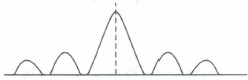
(i) Obtain the conditions for the formation of central maximum and secondary maxima and the minima.
(ii) Why is there significant fall in intensity of the secondary maxima compared to the central maximum, where as in double slit experiment all the bright fringes are of the same intensity?
(iii) When the width of the slit is made double the original width, how is the size of the central band affected?
2.
Identify the type of waves which are produced by the following way and write one application for each:
(i) Radioactive decay of the nucleus.
(ii) Rapid acceleration and decelerations of electrons in aerials.
(iii) Bombarding a metal target by high energy electrons.
3.
A jar of height is filled with a transparent liquid of refractive index \(\mu \)(figure). At the centre of the jar on the bottom surface is a dot. Find the minimum diameter of a disc, such that when placed on the top surface symmetrically about the centre, the dot is invisible.

The problem is based on the principle of total inter reflection and area of visibility.
4.
When a surface is irradiated with light of wavelength \(4950\mathring { A, } \)a photocurrent appears which vanishes if a retarding potential greater than 0.6 volts is applied across the photo-tube. When a different source of light is used, it is found that the critical retarding potential is changed to 1.1volt. Find the work function of the emitting surface and the wavelength of the second source. If the photoelectrons are subjected to a magnetic field of 10 teslas, what changes will be observed in the above two retarding potentials?
5.
An electron and a photon each have a wavelength 2nm. Find (i) their momenta (ii) the energy of a photon and (iii) the kinetic energy of electron. \(Given\ h=6.6\times { 10 }^{ -34 }Js\)
6.
Magnetic field lines can be neither emanate from a point nor end on a point. Yet the field lines outside a bar magnet do seem to start from the North pole and end on the South pole. Does the second fact contradict the first? Explain.
7.
Following Q.19, the radiation force on the roof will be
\(8.53\times { 10 }^{ -5 }N\)
\(2.3\times { 10 }^{ -3 }N\)
\(1.33\times { 10 }^{ -3 }N\)
\(5.33\times { 10 }^{ -4 }N\)
8.
The sun delivers of electromagnetic\({ 10 }^{ 3 } \ W/{ m }^{ 2 }\) flux to the earth surface. The total power that is incident on a roof of dimension 8 m\(\times \) 20 m, will be
\(2.56\times { 10 }^{ 4 }W\)
\(6.4\times { 10 }^{ 5 }W\)
\(4.0\times { 10 }^{ 5 }W\)
\(1.6\times { 10 }^{ 5 }W\)
9.
A flood light is covered with a filter that transmits red light. The electric field of the emerging beam is represented by a sinusoidal wave.
\({ E }_{ x }=36 \ sin\quad (1.20\times { 10 }^{ 7 }z=3.6\times { 10 }^{ 15 }t) \ V/m\)
the average intensity of the beam is watt/\({ (metre) }^{ 2 }\) will be:
6.88
3.44
1.72
0.86
10.
A small metallic ball is charged positively and negatively in a sinusoidal manner at a frequency of \({ 10 }^{ 6 } \ cps\) . The maximum charge on the ball is \({ 10 }^{ -6 } \ C\). what is the displacement current due to the alternating current?
6.28 A
3.8 A
\(3.75\times { 10 }^{ -4 } \ A\)
122.56 A
11.
Electromagnetic waves travel in a medium which has relative permeability 1.3 and relative permittivity 2.14. The speed of electromagnetic wave in the medium will be
\(13\times { 10 }^{ 6 } \ m/s\)
\(1.7\times { 10 }^{ 2 } \ m/s\)
\(36\times { 10 }^{ 8 } \ m/s\)
\(1.7\times { 10 }^{ 8 } \ m/s\)
12.
In an electromagnetic wave, the electric and magnetic fields are 100 V/m and 0.265 A/m. The maximum energy flow per second per unit area will be
\(79 \ W/{ m }^{ 2 }\)
\(13.2 \ W/{ m }^{ 2 }\)
\(53 \ W/{ m }^{ 2 }\)
\(26.5 \ W/{ m }^{ 2 }\)
13.
The electric field intensity produced by the radiations coming from 100 W bulb at a 3m distance is E. The electric field intensity produced by the radiations coming from 50w bulb at the same distance is:
\(\frac { E }{ 2 } \)
\(2E\)
\(\frac { E }{ \sqrt { 2 } } \)
\(\sqrt { 2E } \)
14.
Light with an energy flux of \(20 \ W/cm^{ 2 }\) falls on a non-reflecting surface at normal incidence. If the surface has an area of \(30 cm^{ 2 }\), the total momentum delivered (for complete absorption) during \(30\) minutes is:
\(36\times 10^{ -5 } \ Kg \ m/s\)
\(36\times 10^{ -4 } \ Kg \ m/s\)
\(108\times 10^{ 4 } \ Kg \ m/s\)
\(1.08\times 10^{ 7 } \ Kg \ m/s\)
15.
A linearly polarized electromagnetic wave given as \(E={ E }_{ 0 }\overset { \wedge }{ i } cos \ (kz-wt)\) incident wall at \(z=a\) . Assuming that the material of the wall os optically inactive, the reflected wave will be given as
\(\overset { \rightarrow }{ { E }_{ r } } ={ E }_{ 0 }\overset { \wedge }{ i } cos(kz-wt)\quad \)
\(\overset { \rightarrow }{ { E }_{ r } } ={ E }_{ 0 }\overset { \wedge }{ i } cos(kz+wt)\quad \)
\(\overset { \rightarrow }{ { E }_{ r } } ={ -E }_{ 0 }\overset { \wedge }{ i } cos(kz+wt)\quad \)
\(\overset { \rightarrow }{ { E }_{ r } } ={ -E }_{ 0 }\overset { \wedge }{ i } sin(kz+wt)\quad \)
16.
(a) A point object is placed in front of a double convex lens (of refractive index n =n2/n1 with respect air) with its spherical faces of radii of curvature R1 and R2.. Show the path of rays due to surface to obtain the formation of the real image of the object.
Hence obtain the lens maker's formula for a thin lens.
(b) A double convex lens having both faces of the same radius of curvature has refractive index 1.55. Find out the radius of curvature of the lens required to get the focal length of 20 cm.
17.
A child is observing a thin film such as a layer of oil on water showing beautiful colours, when illuminated by white light. He feels happy and surprised to see this.His teacher explains him example of spreading of kerosene oil on water to prevent malaria and dengue.
Read the above passage and answer the following questions:
(i) What values are displayed by his teacher?
(ii) Name the phenomenon involved.
18.
An angular magnification (mafnifying power) of 30 is desired using an objective of focal length 1.25cm and an eyepiece of focal length 5cm. How will you set up the compound microscope?
19.
Em waves have a wide range of wavelength starting from \({ 10 }^{ -14 }\)m to \({ 10 }^{ 3 }\) m. The em waves of different wavelength are used for different purpose. The gamma rays which have the lowest wavelength are most energetic em waves and radio waves which have the largest wavelength are least energetic.
Read the above passage and answer the following question
(i) What are more energetic waves, x-rays or ultraviolet rays?
(ii) Why are the radio waves not used to detect fracture in the bones of the human body when they can deliver a message at large distance?
(iii) What are the basic values displayed by above study
20.
The magnifying power of an astronomical telescope in the normal adjustment position is 100. The distance between the objective and eye piece is 101 cm. Calculate the focal lengths of objective and eye piece.
21.
If light passes near a massive object, the gravitational interaction causes a bending of the ray. This can be thought of as happening due to a change in the effective refractive index of the medium given by
\(n(r)=\frac { 1+2GM }{ { rc }^{ 2 } } \)
where r is the distance of the point of consideration from the centre of the mass of the massive body. G is the universal gravitational constant, M the mass of the body and c the speed of light in vacuum. considering a spherical object find the deviation of the ray from the original path as it grazes the object
22.
The Kinetic Energy (K.E.), of a beam of electrons, accelerated through a potential V, equals the energy of a photon of wavelength 5460 nm. Find the de Broglie wavelength associated with this beam of electrons.
23.
(a) How are electromagnetic waves produced?
(b) How do you convince yourself that electromagnetic waves carry energy and mimentum?
(c) Draw a skctch of linearly polarised elcctromagnetic waves propagating in the z-direction. Indicate the directions of the oscillating electric and magnetic fields.
24.
How are the magnitudes of the electric and magnetic fields related to the velocity of the EM wave?
25.
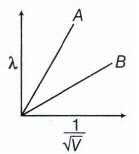
The two lines marked A and B in the given figure. Show a plot of de-Broglie wavelength \(\lambda \) versus \(\frac { 1 }{ \sqrt { V } } \), where V is the accelerating potential for two nuclei \(_{ 1 }^{ 2 }{ H }\) and \(_{ 1 }^{ 3 }{ H }\).
(i) What does the slope of the lines represent?
(ii) Identify, which of the lines corresponded to these nuclei.
26.
Consider figure for photoemission. How would you reconcile with momentum conservation? Note light (photons) have momentum in a different direction than the emitted electrons.
27.
In Young's double experiment the intensity of central maxima is I. What will be the intensity at the same place, if one slit is closed?
28.
How does the fringe width in Young's double slit experiment change when the distance of separation between the slits and screen is doubled?
29.
A parallel plate capacitor with plate area A and plate separation d is charged by a steady current I. Let a plane surface of area A/3 parallel to the plates and situated symmetrically between the plates. what is the displacement current through this area?
30.
Why does galvanometer show a momentary deflection at the time of charging or discharging a capacitor? Write the necessary expression to explain this observation?
31.
A and B are two point on water surface where waves are generated. What is the phase different
(i) A and B are on same wave front separated by distance \(\lambda\).
(ii) a and B are on successive crests separated by distance 2\(\lambda\).
(iii) A and B are on successive troughs separated by distance 3\(\lambda\).
32.
In a plane electromagnetic wave, the electric field varies with time having an amplitude. \(1 \ V{ m }^{ -1 }\) The frequency of a wave is \(0.5\times { 10 }^{ 15 }Hz.\) The wave is propagating along Z-axis. what is the average energy density of
(i) electric field
(ii) magnetic field
(iii) total
(iv) what is the amplitude of magnetic field?
33.
Which part of electromagnetic spectrum is absorbed from sunlight by ozone layer?
34.
What are the basic sources of an electromagnetic wave?
35.
Write the formula for the velocity of light in a material medium of relative permeability \({ \epsilon }_{ r }\) and relative magnetic permeability \({ \mu }_{ r }\)
36.
The stopping potential in an experiment on a photoelectric effect is 1.5V. What is the maximum kinetic energy of the photoelectrons emitted?
37.
How will the photoelectric current change on decreasing the wavelength of incident radiation for a given photosensitive material?
38.
What is the least distance of distinct vision for a normal eye? Is it the same as the distance of near point?
39.
A mirror is turned through\(15°\). Through what angle will the reflected ray turn?
1.
The phenomenon observed is the phenomenon of diffraction
(i) At the cental maxima The contributions due to the secondary wavelets, frotn all parts of the wave front (at the slit), arrive in phase at the central maxima \(\theta\) = a
At the secondary maxima
It is only the contributions from (nearly) 1/3 (or 1/5, or 117,...) of the secondary maxima. These occur at points for which
\(\theta\cong \left(n+{1\over2}\right){\lambda\over a}(n=0,1,2,3,...)\)
At the minima
The contribution, from 'corresponding pairs', of the sub-parts of the incident wavefront, cancel each other and the net contribution, at the location of the minima, is zero. The minima occur at points for which \(\theta=n{\lambda\over a}(n=1,2,3,...)\)
(ii) There is a significant fall in intensity at the secondary maxima because the intensity there, is only due to the contribution of (nearly)(1/3 or 1/5 or 1/7,......) of the incident wavefronts.
(iii) The size of the central maxima would get halved when width of the slit is doubled.
2.
| S.No | Type of Wave | Application |
| (i) | Gamma rays | Treatment of tumors |
| (ii) | Radio waves | Radio and television Communication system |
| (iii) | X-rays | Study of crystals |
3.
Let d be the diameter of the disc. The sopt shall be invisible, if the incident rays OA and OB suffer total internal reflection.
Let i be the angle of incidence

Using relationship between refractive index and critical angle, then
\(\sin { i=\frac { 1 }{ \mu } }\)
Using geometry and trigonometry,
Now,
\(\frac { d/2 }{ h } =\tan { i } \Rightarrow \frac { d }{ 2 } =h\tan { i } =h[\sqrt { { \mu }^{ 2 }-1{ ] }^{ -1 } }\)
\( [\because \ From \ the \ figure,\ tani=\frac { 1 }{ \sqrt { { \mu }^{ 2 } } -1 } ]\)
\( d=\frac { 2h }{ \sqrt { { \mu }^{ 2 } } -1 } \)
This is required expression of d.
4.
\(1.9eV,4125\mathring { A;no \ change } \)
5.
\((i) \ 3.3\times { 10 }^{ -25 }kg{ ms }^{ -1 } \)
\((ii) \ 6.2\times { 10 }^{ -2 }eV\)
\((iii) \ 0.377 \ eV\)
6.
There is no contradiction. Field lines inside the bar go away from S towards N. The next flux of B over any surface fully enclosing N or S must be identically zero.
7.
(d)
\(5.33\times { 10 }^{ -4 }N\)
8.
(d)
\(1.6\times { 10 }^{ 5 }W\)
9.
(c)
1.72
10.
(a)
6.28 A
11.
(d)
\(1.7\times { 10 }^{ 8 } \ m/s\)
12.
(d)
\(26.5 \ W/{ m }^{ 2 }\)
13.
(a)
\(\frac { E }{ 2 } \)
14.
(b)
\(36\times 10^{ -4 } \ Kg \ m/s\)
15.
(b)
\(\overset { \rightarrow }{ { E }_{ r } } ={ E }_{ 0 }\overset { \wedge }{ i } cos(kz+wt)\quad \)
16.
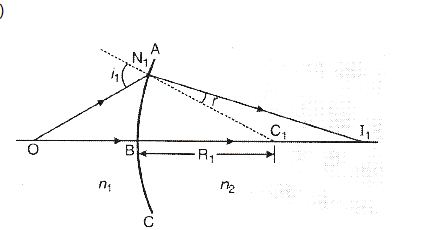
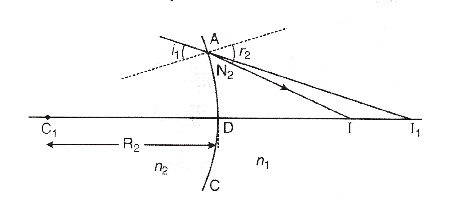
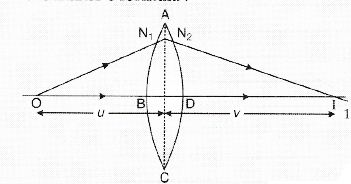
The first refracting ABC forms the image I1 of the object O. The image I1 acts as virtual object for the second refracting surface ADC, which forms the real image I as shown in the diagram
For refraction at ABC
\(\frac { { n }_{ 2 } }{ { v }_{ 1 } } -\frac { { n }_{ 1 } }{ u } =\frac { { n }_{ 2 }-{ n }_{ 1 } }{ { R }_{ 1 } } \)
For refraction at ADC
\(\frac { { n }_{ 1 } }{ v } -\frac { { n }_{ 2 } }{ { v }_{ 1 } } =\frac { { n }_{ 1 }-{ n }_{ 2 } }{ { R }_{ 2 } } \)
Adding equation (i) and equation (ii)
\(\frac { { n }_{ 1 } }{ v } -\frac { { n }_{ 2 } }{ u } =\left( { n }_{ 2 }-{ n }_{ 1 } \right) \left( \frac { 1 }{ { R }_{ 1 } } -\frac { 1 }{ { R }_{ 2 } } \right) \)
\(\frac { 1 }{ v } -\frac { 1 }{ u } =\left( \frac { { n }_{ 2 } }{ { n }_{ 1 } } -1 \right) \left( \frac { 1 }{ { R }_{ 1 } } -\frac { 1 }{ { R }_{ 2 } } \right) \)
We know, If \(u=\infty ,v=f\)
\(\frac { 1 }{ v } -\frac { 1 }{ u } =\frac { 1 }{ f } \)
\(\frac { 1 }{ f } =\left( \frac { { n }_{ 2 } }{ { n }_{ 1 } } -1 \right) \frac { 1 }{ { R }_{ 1 } } -\frac { 1 }{ { R }_{ 2 } } \)
\(\frac { 1 }{ f } =\left( { \mu }_{ 21 }-1 \right) \left( \frac { 1 }{ { R }_{ 1 } } -\frac { 1 }{ { R }_{ 2 } } \right) \)
\(\frac { 1 }{ f } =\left( { \mu }_{ 21 }-1 \right) \left( \frac { 1 }{ { R }_{ 1 } } -\frac { 1 }{ { R }_{ 2 } } \right) \)
\(\frac { 1 }{ f } =\left( 1.55-1 \right) \left( \frac { 1 }{ R } -\frac { 1 }{ -R } \right) \)
\(=0.55\times \frac { 2 }{ R } \)
\(R=0.55\times 2\times 20=22 \ cm\)
17.
(i) The teacher displays the qualities of deep knowledge of the phenomenon and eagerness to explain it to the child.
(ii) The phenomenon involved in a thin film is interference. Different colours of light interfere at different points in space and hence, child is able to see different colours.
18.
Given, focal length of objective, f = 1.25cm
Focal length of eyepiece, fe = 5cm
Least distance of distinct vision, D = 25cm
Angular magnification of lens,m = 30
The magnification produced by eyepiece
me = \(1+\cfrac { D }{ { f }_{ e } } =1+\cfrac { 25 }{ 5 } =6\)
The magnification produced by microscope,
m = mo \(\times\) me
30 = mo \(\times\)6
Where, mo is the magnification produced by objective lens.
mo = 5
Again, we know that magnification of objective lens,
\(\Rightarrow \) \(5=\cfrac { -{ v }_{ 0 } }{ { u }_{ 0 } } \)
\(\Rightarrow \) \({ v }_{ 0 }\ =-5{ u }_{ 0 }\) ................(i)
Using lens formula for objective lens,
\(\cfrac { 1 }{ { f }_{ 0 } } =\cfrac { 1 }{ { v }_{ 0 } } -\cfrac { 1 }{ { u }_{ 0 } } \)
\(\Rightarrow \) \(\cfrac { 1 }{ 1.25 } =\cfrac { 1 }{ -5{ u }_{ 0 } } -\cfrac { 1 }{ { u }_{ 0 } } =-\cfrac { 6 }{ 5{ u }_{ 0 } } \) [From Eq.(i)]
\({ u }_{ 0 }=-\cfrac { 6 }{ 5 } \times 1.25=-1.5cm\)
\({ v }_{ 0 }=-5{ u }_{ 0 }\)
\(=-5(-1.5)=7.5cm\)
Thus, the objective should be placed at a distance of 1.5cm from the objective lens to get the desired magnification.(1)
Now, using the lens formula for eyepiece,
\(\cfrac { 1 }{ { f }_{ e } } =\cfrac { 1 }{ { v }_{ e } } -\cfrac { 1 }{ { u }_{ e } } \)
\(\Rightarrow \) \(\cfrac { 1 }{ { u }_{ e } } =\cfrac { 1 }{ { v }_{ e } } -\cfrac { 1 }{ { f }_{ e } } \)
\(=-\cfrac { 1 }{ 25 } -\cfrac { 1 }{ 5 } =-\cfrac { 6 }{ 25 } [\because \quad { v }_{ e }=-25cm]\)
\({ u }_{ e }=-4.17cm\)
The separation between objective and eyepiece
\(\left| { v }_{ 0 } \right| +\left| { u }_{ e } \right| =4.17+7.5=11.67cm\)
Thus, the microscope is settled as the distance between eyepiece and objective is 11.67cm.
19.
(i) x-rays have the wavelength range,\({ 10 }^{ 13 } \ m \ to \ 3\times { 10 }^{ -8 }m\) which is smaller than that of ultraviolet rays of a wavelength range \(6\times { 10 }^{ -9 }m \ to \ 4\times { 10 }^{ -7 }m, \ i.e., \ { \lambda }_{ x }<{ \lambda }_{ uv }\)
since energy. \(E=\frac { hc }{ \lambda } \ or \ E\propto \frac { 1 }{ \lambda } ; \ so \ \frac { { E }_{ x } }{ { E }_{ uv } } =\frac { { \lambda }_{ uv } }{ \lambda _{ x } } >1 \ or \ { E }_{ x }>{ E }_{ uv }\) Thus x-rays are more energetic than ultraviolet rays
(ii) The wavelength of radio waves is of range. \(0.3m \ to \ 6\times { 10 }^{ 2 }m\) which is very large as compared to the size of molecules of our blood, flesh and bones etc. As the energy of radio waves is quite small so these radio waves can not penetrate the blood of our body. That is why we can not use the radio waves to detect the fracture in bones
(iii) Just as different em waves have different application depending on their wavelength, in the same way, every person has different qualities, which make him suitable for different purpose/fields.
The aim of a teacher or manager is to is identify the quality in different children/persons and put them to their best use accordingly.
20.
m = -100, f0 + fe = 101 cm, f0 = ?, fe = ?
\(m=-{f_0\over f_e}=-100\ \ \therefore f_0=100 f_3\)
Now f0 + fe = 101
100 fe + fe = 101,
fe = 1 cm,
f0 = 100 fe = 100 cm
21.
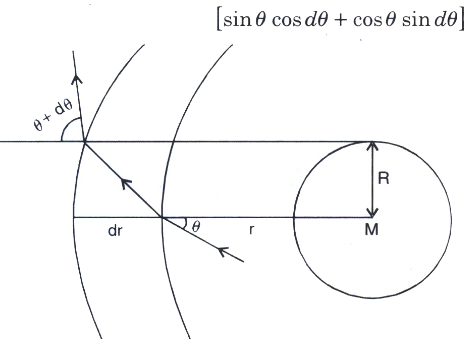
Let the light be incident at the angle \(\theta \) at the plane at r and leave r+dr at an angle \(\theta +d\theta \)
From snell's law
\(n(r)sin \ \theta \ = \ n(r+dr) \ sin(\theta +d\theta )\)
\(=\left[ n(r)+\frac { dn }{ dr } dr \right] \ \left[ sin\theta \ cos \ d\theta +cos\theta \ sind\theta \right] \)
As \(d\theta \) is small, so \(cos \ d\theta = \ 1\) and \(sind\theta =d\theta \) and neglecting the product of differentiates, we get
\( n(r)sin \ \theta \ = \ n(r) \ sin\theta +n(r) \ cos \ d\theta +\frac { dn }{ dr } dr \ sin\theta \)
\( -\frac { dn }{ dr } dr \ sin\theta \ = \ n(r)cos\theta \ d\theta\)
\(-\frac { dn }{ dr } dr \ tan\theta \ = \ n(r)\frac { d\theta }{ dr } \)
\( As n(r) \ =\ 1+\frac { 2GM }{ { rc }^{ 2 } } \)
\(\\ \therefore \frac { dn }{ dr } \ = \ \frac { -2GM }{ { r }^{ 2 }{ c }^{ 2 } } \)
Putting in eq, we get
\( \frac { -2GM }{ { r }^{ 2 }{ c }^{ 2 } } tan\theta \ = \ \left( 1+\frac { 2GM }{ { rc }^{ 2 } } \right) \frac { d\theta }{ dr } =\frac { d\theta }{ dr } \)
\( or d\theta \ =\ \frac { 2GM }{ { c }^{ 2 } } \frac { tan\theta }{ { r }^{ 2 } } dr\)
Integrating both sides, we get
\(\int _{ 0 }^{ { \theta }_{ 0 } }{ d\theta } \ = \ \frac { 2GM }{ { c }^{ 2 } } \int _{ -\infty }^{ \infty }{ \frac { tan\theta \ dr }{ { r }^{ 2 } } }\)
\(=\frac { 2GM }{ { c }^{ 2 } } \int _{ -\infty }^{ \infty }{ \frac { tan\theta \ dr }{ { r }^{ 3 } } } .r\)
\(As \ { r }^{ 2 }={ x }^{ 2 }+{ R }^{ 2 } \ and \ tan\theta =\frac { R }{ X } ,\ we \ get\)
\(2r \ dr=2xdx\)
\(\therefore \int _{ 0 }^{ { \theta }_{ 0 } }{ d\theta } =\frac { 2GM }{ { c }^{ 2 } } \int _{ -\infty }^{ \infty }{ \frac { R }{ x } \frac { x\quad dx }{ ({ { X }^{ 2 }+{ R }^{ 2 } })^{ 3/2 } } } \)
\( let\ x=R \ tan \ \phi \)
\(\therefore dx=R\quad { sec }^{ 2 }\phi \ d\phi \)
\( \therefore{ \theta }_{ 0 }=\frac { 2GMR }{ { c }^{ 2 } } \int _{ -\pi /2 }^{ \pi /2 }{ \frac { R{ sec }^{ 2 }\phi \ d\phi }{ { R }^{ 3 }{ sec }^{ 3 }\phi } }\)
\(=\frac { 2GMR }{ { c }^{ 2 } } \int _{ -\pi /2 }^{ \pi /2 }{ cos\phi \quad d\phi } =\frac { 4GM }{ { Rc }^{ 2 } } \)
22.
K = Energy of the photon \(\frac { hc }{ \lambda } \)
de Broglie wavelength,
\({ \lambda }_{ B }=\frac { h }{ p } =\frac { h }{ \sqrt { 2mk } } \)
\({ \lambda }_{ B }=\frac { h }{ \sqrt { 2mc\frac { hc }{ { \lambda } } } } \)
= \(\sqrt { \frac { h\lambda }{ 2mc } }\)
= \({ \left[ \frac { 6.63\times { 10 }^{ -34 }\times 5460\times { 10 }^{ -9 } }{ 2\times 9.1\times { 10 }^{ -31 }\times 3\times { 10 }^{ 8 } } \right] }^{ \frac { 1 }{ 2 } }\)
= 25.75\(\times \)\({ 10 }^{ -10 }\)m
23.
(a) The electromagnetic waves are produced by the accelerated charge. The electric and magnetic field produced by the accelerated charge change with time. Hence it radiates electromagnetic waves.
(b) The EM waves are produced by the accelerated charge. The electron jumping from outer to inner orbit of the electron radiates EM waves. EM waves are propagated as electric & magnetic fields oscillation in mutually perpendicular directions which is why cause of momentum & energy
(c) 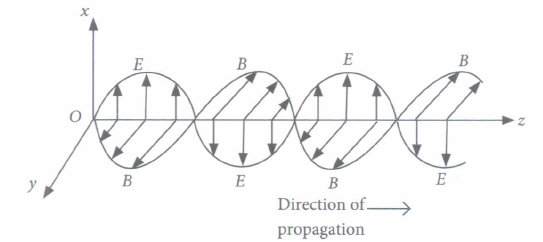
24.
\(\frac { { E }^{ 0 } }{ { B }^{ 0 } } =c\)
25.
de-Broglie wavelength of accelerating charged particle is given by
\(\lambda =\frac { h }{ \sqrt { 2mqV } } \Rightarrow \lambda \sqrt { V } =\frac { h }{ \sqrt { 2mq } } =constant\)
(i) The slope of the lines represent \(\frac { h }{ \sqrt { 2mq } } .\)
where, h is Planck's constant, q is the charge and m is the mass of charged particle.
(ii) 1H2 and 1H3 carry same charge (as they have same atomic number).
\(\therefore \ \lambda \sqrt { V } \propto \frac { 1 }{ \sqrt { m } } \)
The lighter mass i.e 1H2 is represented by line of greater slope i.e A and similarly 1H3 by line B.
26.
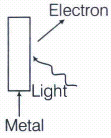
During photelectric emission, the momentum of incident photon is transferred to the metal. At microscopic level, atoms of a metal absorb the photon and its momentum is transferred mainly to the nucleus and electrons.
The excited electron is emitted. Therefore, the conservation of momentum is to be considerd as the momentum of incident photon transferred to the nucleus and electrons.
27.
When one slit is closed, amplitude becomes \(\frac { 1 }{ 2 } \) and hence, intensity becomes\(\frac { 1 }{ 4 } \)th and there is no interference.
28.
As we know that, fringe width \(\beta \)
\(\beta =\frac { \lambda D }{ d } \)
Here \({ D }^{ ' }=2D\)
So \({ \beta }^{ 1 }=\frac { 2\lambda D }{ D } \)
\(\Rightarrow \) \({ \beta }^{ 1 }=2\beta \)
29.
Let q be the charge on capacitor plates at any instant \(t\) and \(\sigma \) be the surface density of charge. Then electric field between the plates of capacitor will be \(E=\frac { \sigma }{ { \epsilon }_{ 0 } } =\frac { q }{ { \epsilon }_{ 0 }A } \)
Electric flux through area A/3 will be
\({ \phi }_{ E }=E\frac { A }{ 3 } =\frac { q }{ { \epsilon }_{ 0 }A } \times \frac { A }{ 3 } =\frac { 1 }{ { 3\epsilon }_{ 0 } } \)
The displacement current will be
\(I={ \epsilon }_{ 0 }\frac { { d\phi }_{ E } }{ dt } ={ \epsilon }_{ 0 }\frac { { d }_{ E } }{ dt } \left( \frac { q }{ 3{ \epsilon }_{ 0 } } \right) =\frac { { \epsilon }_{ 0 } }{ 3{ \epsilon }_{ 0 } } \frac { dq }{ dt } =\frac { 1 }{ 3 } \)
30.
During charging or discharging of a capacitor. Increasing or decreasing current in a circuit with time flows due to conduction current in wire and displacement current between the plates of a capacitor. when capacitor get fully charged both conduction and displacement current becomes zero. That is why galvanometer shows a momentary. deflection at the time of charging or discharging.
The expression to explain this observation is \(\oint { \overset { \rightarrow }{ B } .\overset { \rightarrow }{ dt } } ={ \mu }_{ 0 }(I+{ I }_{ D })\)
31.
(i) Zero
(ii) \(2\pi\) radian
(iii) \(2\pi\) radian
32.
(i) \(2.21\times { 10 }^{ -12 }\quad J{ m }^{ -3 }\)
(ii) \(2.21\times { 10 }^{ -12 }\quad J{ m }^{ -3 }\)
(iii) \(4.42\times { 10 }^{ -12 }\quad J{ m }^{ -3 }\)
(iv) \(3.3\times { 10 }^{ -12 }\quad J{ m }^{ -3 }\)
33.
Ultraviolet rays
34.
The basic source of an electromagnetic wave is the time varying electric field produces magnetic field and vice versa
35.
\(v=\frac{1}{\sqrt{\mu_0 \mu_r \varepsilon_0 \varepsilon_r}}=\frac{c}{\sqrt{\mu_r \varepsilon_r}}\)
\(\left[\therefore c=\frac{1}{\sqrt{\mu_0 \epsilon_0}}\right]\)
36.
\(M a x . K . E .=K_{\max }=e V_0=e \times 1.5 \mathrm{~V}=1.5 \mathrm{eV}\)
37.
Photoelectric current is not affected by decreasing the wavelength of incident radiation provided its intensity remains unchanged.
38.
d = 25c.Yes
39.
30o as the reflected ray turns through twice the angle through which mirror is turned.

12th Standard CBSE Syllabus & Materials
12th Standard CBSE
CBSE 12th Computer Science Python Revision Tour I - New Previous year Question Papers Study Material - QB365 Set A
NEW12th Standard CBSE
CBSE 12th Business Studies Planning Important Questions And Answers Study Material - QB365 Set A
NEW12th Standard CBSE
CBSE 12th Business Studies Business Environment Important Questions And Answers Study Material - QB365 Set A
NEW12th Standard CBSE
CBSE 12th Business Studies Principles of Management Important Questions And Answers Study Material - QB365 Set A



CBSE 12th Standard CBSE Subjects
CBSE Standards










