
 100% FREE ACCESS
12th Standard CBSE Syllabus & Materials
12th Standard CBSE
CBSE 12th Economics Government Budget and the Economy Previous year Question Papers Study Material - QB365 Set A
NEW12th Standard CBSE
CBSE 12th Computer Science Interface Python with MySQL - New Previous year Question Papers Study Material - QB365 Set A
NEW12th Standard CBSE
CBSE 12th Computer Science Database Concept - New Previous year Question Papers Study Material - QB365 Set A
NEW12th Standard CBSE
CBSE 12th Computer Science Data Communication - New Previous year Question Papers Study Material - QB365 Set A
NEW12th Standard CBSE
CBSE 12th Computer Science Data Structures - New Previous year Question Papers Study Material - QB365 Set A
NEW12th Standard CBSE
CBSE 12th Computer Science Functions - New Previous year Question Papers Study Material - QB365 Set A

Published on: 29/12/2018
Class 12 Model Question
Download CBSE Class 12th Standard CBSE Chemistry question papers, sample papers, important questions, and previous year solved papers in PDF format. Get free study materials, NCERT solutions, and exam preparation resources for Class 12th Standard CBSE Chemistry
Questions + Answers key
Take MCQ Chemistry Test
1.
What is meant by 'doping' in a semiconductor?
2.
State the principle of the method of zone refining of metals.
3.
Why do we add alum to purify water?
4.
How is copper extracted from a low grade ore of it?
5.
What is the coordination number in a rock salt type structure?
6.
Why is glass considered as supercooled liquid?
7.
Define rate of reaction
8.
Differentiate between thermoplastic and thermosetting polymers.Give one example of each
9.
Explain superconductivity.
10.
(a) Define Azeotropes and explain broefly minimum boiling azeotrope by taking suitable example.
(b) The vapour pressures of pure liquids A and B are 450 mm 700 mm of Hg respectively at 350 K. Calculate the composition of the liquid mixture if total vapour pressure is 600 mm of Hg. Also find the composition of the mixture in the vapour phase.
11.
Arrange the following solutions in increasing order of their van't Hoff factor :
0.1 M CaCI2 , 0.1 M KCI , 0.1 M AI2(SO4) , 0.1 M C12H22O11
12.
Between 2 M glucose solution and 1 M glucose solution, which one has a lower freezing point ?
13.
What are isotonic solutions ? Give one example.
14.
What is the boiling point of an azeotrope of non - ideal solution showing positive deviations as compared to the boiling points of its components ?
15.
Calculate the molality of H2SO4 if the density of 10% (w/w) aqueous solution of H2SO4 is 1.84 g cm-3 (Molar mass of H2SO4 = 98g mol-1).
16.
A NaCl crystal is found to have CsCl structure. Guess how it might have happened?
17.
How are the following properties of crystals affected by Schottky and Frenkel defects?
(i) Density
(ii) Electrical conductivity.
18.
(a) Draw the structures of the following:
(i) XeF4 (ii) H2S2O7
(b) Explain the following observations:
(i) Phosphorus has a greater tendency for catenation than nitrogen.
(ii) The negative value of electron gain enthalpy is less for fluorine than that for chlorine.
(iii) Hydrogen fluoride has a much higher boiling point than hydrogen chloride.
19.
(a) Define the following:
(i) Order of a reaction
(ii) Elementary step in a reaction
(b) A first order reaction has a rate constant value of 0.00510 min-1. If we begin with 0.10 M concentration of the reactant, how much of the reactant will remain after 3.0 hours?
20.
(a) Explain the following:
(i) Henry's law about dissolution of a gas in a liquid.
(ii) Boiling point elevation constant for a solvent.
(b) A solution of glycerol (C3H8O3) in water was prepared by dissolving some glycerol in 500 g of water. This solution as a boiling point of 100.42 oC. What mass of glycerol was dissolved to make this solution?
(K b for water = 0.512 K kg mol-1)
21.
For a reaction
\({ N }_{ 2 }+{ 3H }_{ 2 }\longrightarrow { 2NH }_{ 3 }\)
the rate of reaction measured as \(\frac { \Delta \left[ { NH }_{ 3 } \right] }{ \Delta t } \) was found to be \(2.4\times { 10 }^{ -4 } \ mol{ L }^{ -1 }{ S }^{ -1 }\) . calculate the rate of the reaction expressed in terms of
(i) \({ N }_{ 2 }\)
(ii) \({ H }_{ 2 }\)
22.
For the reaction at 500K,NO2(g)+CO(g)\(\longrightarrow\)CO2(g)+NO(g),the proposed mechanism is as below:
(i) NO2+NO2\(\longrightarrow\)NO+NO3(slow)
(ii) NO3+CO\(\longrightarrow\)CO2+NO2(fast) What is the rate law for the reaction?
23.
How many Faradays/coulombs are required to produce
(i) 20.0 g of calcium from moltenCaCl2?
(ii) 40.0 g of aluminium from molten AI2O3?
24.
Two isomeric compounds A and B having molecular formula C4H11N, both lose N2 on treatment with HNO2 and gives compound C and D respectively. C is resistant to oxidation but immediately responds to Lucas reagent, where as 'D' responds to Lucas reagent after 5 minutes and gives a positive iodoform test. Identify A and B.
25.
An organic compound 'A' having molecular formula C2H5O2N reacts with HNO2 and gives'B' C2H4O3N2. On reduction, 'A' gives a compound 'C' on treatment with HNO2 gives 'D' which gives positive iodoform test. Identify 'A' .
26.
A compound 'X' having molecular formula C3H7NO, reacts with Br2 in presence of KOH to give another compound 'Y'. The compound Y reacts with NHO2 to form ethanol and N2 gas. Identify the compounds X and Y and write the reactions involved.
27.
KCl, KNO3 etc. are preferred in a salt bridge because they have equal --------------
28.
Red blood cells (RBC) are isotonic with .............. % NaCI solution.
1.
()
Addition of a suitable impurity to the semiconductor to increase its conductivity is called doping.
2.
()
Zone refining is based on the principle that the impurities are more soluble in the melt than in the solid state of the metal.
3.
()
It coagulates sand particles present in water.
4.
()
Extraction of Copper from low-grade ores and scraps: It is extracted by hydrometallurgy. It is carried out in two steps:
(a) Leaching: Low-grade copper ores and scraps are leached by using acid or bacteria.
(b) Reduction: The solution containing copper ions is treated with H2.
\({ Cu }^{ 2+ }(aq)+{ H }_{ 2 }(g)\rightarrow Cu(s)+2{ H }^{ + }(aq)\)
5.
()
The coordination number of each type of ions is 6 in a rock-salt type crystal structure, i.e. Na+ has 6, CI- has 6.
6.
()
It is because glass windows are thicker at the bottom and thinner at the top. it shows that glass can flow, that is why it is called super cooled liquid.
7.
It is defined as the change in concentration of reactant (or product) in a particular time interval i.e.,
Rate of reaction \(=\frac{\text { Change in centration }}{\text { Timse Taken }}\)
8.
| Thermoplastic | Thermosetting |
| 1. These can be softened repeatedly by heating and can be remoulded without any change in their properties. | 1. These cannot be softened on heating and cannot be remoulded |
| 2. Example: Polythene | 2. Example: Bakelite |
9.
The property of a substance to offer no resistance to the flow of electricity at a particular temperature is called superconductivity.
10.
(b) If xA is mol fraction of A in liquid phase, then xA (450)+(1 - xA)(700) = 600 or xA = 0.4, xB = 0.6.
Hence, \({ p }_{ A }=0.4\times 450=180\quad mm,{ p }_{ B }=0.6\times 700=420\quad mm,{ y }_{ A }=\frac { 180 }{ 600 } =0.3,{ y }_{ B }=\frac { 420 }{ 600 } =0.7\)
11.
Greater the number of ions produced on dissociation, greater is the van't Hoff factor. Hence, the order is
\(0.1 \mathrm{M} \mathrm{C}_{12} \mathrm{H}_{22} \mathrm{O}_{11}<0.1 \mathrm{M} \mathrm{KCl}<0.1 \mathrm{M} \mathrm{CaCl}_2<0.1 \mathrm{M} \mathrm{Al}_2\left(\mathrm{SO}_4\right)_3\)
12.
Higher the concentration, greater is the depression and hence lower is the freezing point. Thus, 2 M glucose solution will have lower freezing point.
13.
Solutions having equal osmotic pressure are called isotonic solutions,
e.g., 0.1 M glucose and 0.1 M sucrose solutions.
14.
The boiling point of such an azeotrope is lower than that of its components.
15.
Molality \(=\frac{10 / 98}{90} \times 1000=1.13 \mathrm{~m}\)
16.
NaCl must have been subjected to high pressure.
17.
(i) Density remains the same in Frenkel defect, where as Schottky defect leads to lowering of density.
(ii) Electrical conductivity increases in both Frenkel and Schottky defects.
18.
(a) (i)
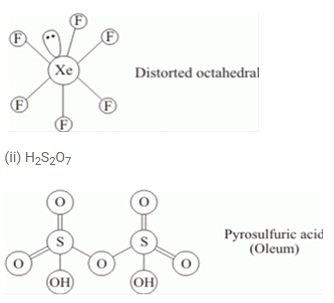
(b) (i) It is because P-P single bond is stronger than the single N-N bond.
(ii) It is because there is more interelectronic repulsion between valence electrons in 'F' atoms as compared to 'CI' atoms.
(iii) It is because HF molecules are associated with intermolecular H-bonding while HCI is not that is why HF is liquid and has higher boiling point than HCI which is a gas.
19.
(a) (i) It is sum of powers to which cone. terms are raised in rate law or rate equation.
(ii) Each step of complex reaction (which takes place in more than one step) is called elementary, step in a reaction.
\((b) \ k=0.00510 \ { min }^{ -1 }\)
\(t=\frac { 2.303 }{ k } \log { \frac { { \left[ R \right] }_{ 0 } }{ \left[ R \right] } }\)
\(3\times 60\times 60=\frac { 2.303 }{ 0.00510 } \log { \frac { 0.1 }{ \left[ R \right] } }\)
\(\log { \frac { 0.1 }{ \left[ R \right] } } =\frac { 10800\times 0.00510 }{ 2.303 } \)
\(=23.94\)
\(\frac { 0.1 }{ \left[ R \right] } =Antilog \ 23.94\)
\(\frac { 0.1 }{ \left[ R \right] } =8.71\times { 10 }^{ 23 }\)
\(\left[ R \right] =\frac { 0.1 }{ 8.71\times { 10 }^{ 23 } }\)
\(\left[ R \right] =0.1148\times { 10 }^{ -24 }\)
\(\left[ R \right] =1.148\times { 10 }^{ -25 }M\)
20.
(a) (i) Henry's Law: It states that the solubility of a gas in liquid is directly proportional to the pressure of the gas. P = KHx, where 'P' is pressure of gas, 'x' is mole fraction of of the gas and KH is Henry's law constant.
(ii) Boiling Point Elevation Constant (Molal Boiling Point Elevation Constant): It is equal to elevation in boiling point of 1molal solution, i.e. 1mole of solute is dissolved in 1 kg of solvent. The units of Kb is Kim or 0C/m or K kg mot".
(b) WB =? MB = 36 + 8 + 48 = 92 g mol-1, WA = 500 g, ~Tb = 100.420C - 1000C = 0.420C
\(\Delta T_b=K_b\times {W_B\over M_B}\times{1000\over W_A}\)
\(\Rightarrow\ 0.42=0.512\times{W_B\over 92}\times{1000\over 500}\)
\(\Rightarrow\ W_B={0.42\times92\over 2\times0.512}={38.64\over 1.024}=37.73g\)
21.
\(\frac { \Delta \left[ { N }_{ 2 } \right] }{ \Delta t } =\frac { 3 }{ 2 } \frac { \Delta \left[ { NH }_{ 3 } \right] }{ \Delta t }\)
\(=\frac { 1 }{ 2 } \times 2.4\times { 10 }^{ -4 }\)
\(=1.2\times { 10 }^{ -4 } \ mol \ { L }^{ -1 }{ S }^{ -1 }\)
\(-\frac { \Delta \left[ { H }_{ 2 } \right] }{ \Delta t } =\frac { 3 }{ 2 } \frac { \Delta \left[ { NH }_{ 3 } \right] }{ \Delta t } \)
\(=\frac { 3 }{ 2 } \times 2.4\times { 10 }^{ -4 }\)
\(=3.6\times { 10 }^{ -4 } \ mol \ { L }^{ -1 }{ S }^{ -1 }\)
22.
Rate = k[NO2]2
23.
(i) 1 F or 96500 C
(ii) 4.44 F or 428460 C
24.
s.jpg)
25.
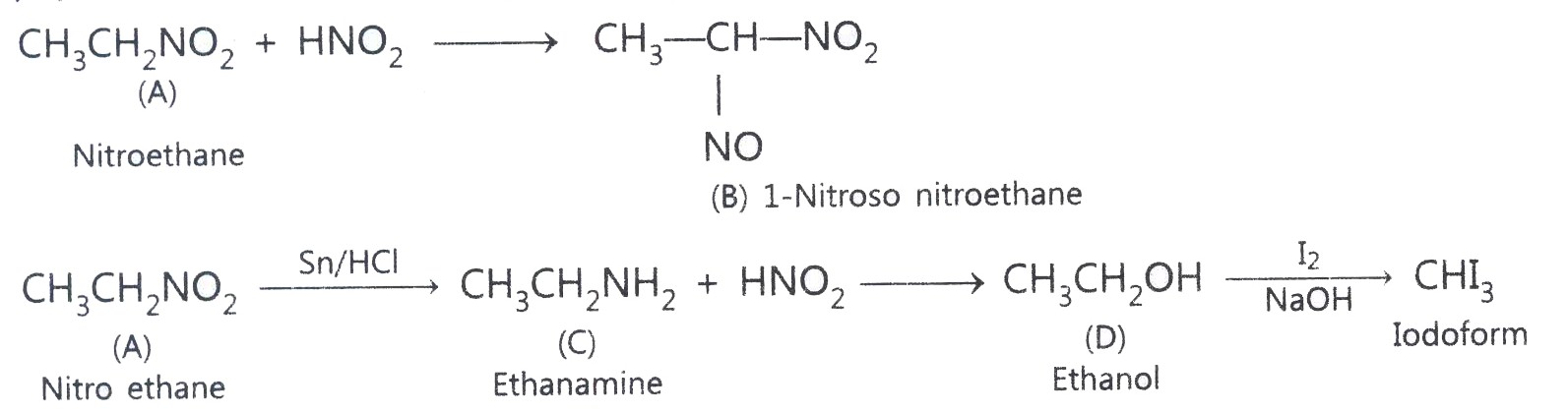
26.

27.
()
transport number
28.
()
0.9%

12th Standard CBSE Syllabus & Materials
12th Standard CBSE
CBSE 12th Computer Science Python Revision Tour I - New Previous year Question Papers Study Material - QB365 Set A
NEW12th Standard CBSE
CBSE 12th Business Studies Planning Important Questions And Answers Study Material - QB365 Set A
NEW12th Standard CBSE
CBSE 12th Business Studies Business Environment Important Questions And Answers Study Material - QB365 Set A
NEW12th Standard CBSE
CBSE 12th Business Studies Principles of Management Important Questions And Answers Study Material - QB365 Set A



CBSE 12th Standard CBSE Subjects
CBSE Standards










