
 100% FREE ACCESS
12th Standard CBSE Syllabus & Materials
12th Standard CBSE
CBSE 12th Economics Government Budget and the Economy Previous year Question Papers Study Material - QB365 Set A
NEW12th Standard CBSE
CBSE 12th Computer Science Interface Python with MySQL - New Previous year Question Papers Study Material - QB365 Set A
NEW12th Standard CBSE
CBSE 12th Computer Science Database Concept - New Previous year Question Papers Study Material - QB365 Set A
NEW12th Standard CBSE
CBSE 12th Computer Science Data Communication - New Previous year Question Papers Study Material - QB365 Set A
NEW12th Standard CBSE
CBSE 12th Computer Science Data Structures - New Previous year Question Papers Study Material - QB365 Set A
NEW12th Standard CBSE
CBSE 12th Computer Science Functions - New Previous year Question Papers Study Material - QB365 Set A

Published on: 08/09/2022
QB365 provides a detailed and simple solution for every Possible Case Study Questions in Class 12 Biology Subject - Evolution, CBSE. It will help Students to get more practice questions, Students can Practice these question papers in addition to score best marks.
Download CBSE Class 12th Standard CBSE Biology question papers, sample papers, important questions, and previous year solved papers in PDF format. Get free study materials, NCERT solutions, and exam preparation resources for Class 12th Standard CBSE Biology
Questions + Answers key
Take MCQ Biology Test
1.
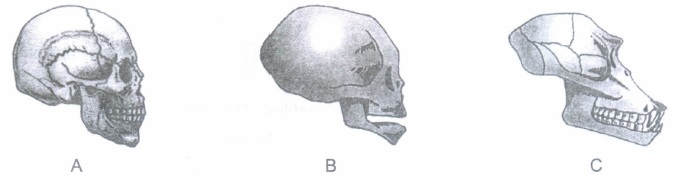
(a) Identify the respective animal to which each of the following skulls, A, Band C belongs. Which two among them resemble more closely?
(b) Name the (I) ape-like and (ii) man-like primates that existed 15 million years ago.
2.
A few stages and their respective time period in the evolutionary history of human beings are mentioned in the flow-chart given below. Answer the questions that follow, as asked.
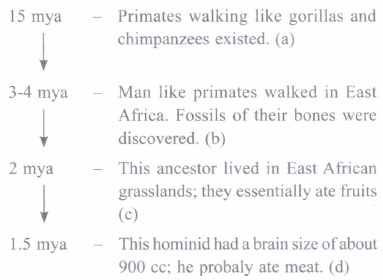
(a) Name the two primates.
(b) Name two places where the fossils were discovered.
(c) Name the ancestor.
(d) Name the hominid.
3.
Read the passage and answer the questions that follow:
(i) Fish with stout and strong fins existed about 350 mya; they could move on land and go back into water.
(ii) Reptiles dominated the earth for about 200 million years.
(iii) Some land reptiles went back into water and evolved into fish-like reptiles.
(iv) The land reptiles of that period were dinosaurs; they disagpeared suddenly from the earth.
(a) Name the fish that could move on land and go back into water. What did they evolve into?
(b) Give an example-ofthe fish-like reptiles. Mention the time period when they were evolved.
(c) Name the largest of the dinosaurs. When did the dinosaurs suddenly disappeared?
4.
Fill in the blanks in the following statements, with the time period [as million years ago (mya)] of evolution of various life forms on the earth.
(a) The first non-cellular forms of life, i.e., giant organic molecules like RNA, proteins, etc. could have originated _______________________.
(b) About _______________ the first cellular forms of life appeared on the earth; slowly single-celled forms became multicellular forms.
(c) By the time of _______________ invertebrates were formed.
(d) Jawless fish probably ev-olved around _______________.
(e) Sea weeds and a few plant species existed probably around_______________ ; the first organisms that invaded land were plants.
(f) About _____________ fish with stout and strong fins that could move on land and go back to water were present; they were called lobefins.
5.
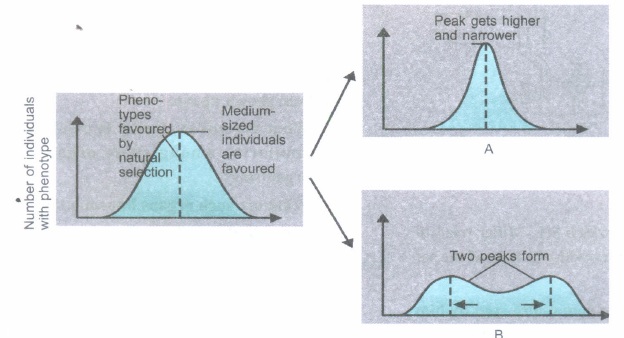
Identify and describe the type of Natural selection operating in A and B, respectively.
6.
In 1950s, there were hardly any mosquitoes in Delhi. The use of the pesticide, DDT on standing water
killed their larvae. But, now there are mosquitoes because they have evolved DDT-resistance through the interaction of mutation and Natural selection. State in a sequences, how that could have happened.
7.
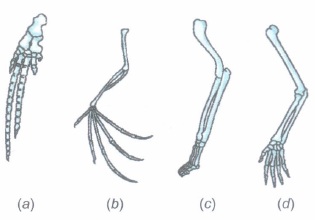
The forelimbs of four vertebrates are shown in the diagram shown above.
(a) What type of evolution is exhibited by the similarity among these organs in those organisms?
(b) What are such organs known as?
(c) What do they indicate?
8.
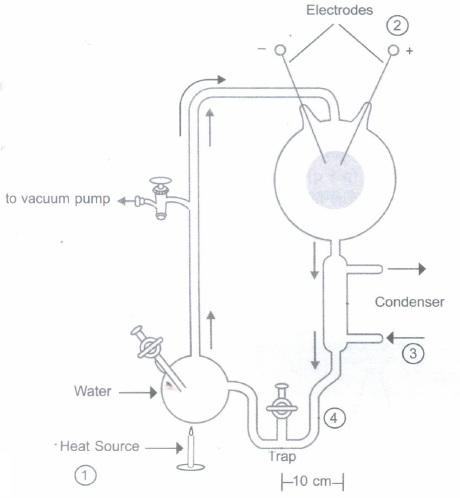
(a) State the hypothesis which S.L. Miller tried to prove in the laboratory with the help of the set up given above.
(b) Name the organic compound observed by him in the liquid water after running the above experiment.
(c) A scientist simulated a similar set up and added CH4, NH3 and water vapour at 800°C.
Which important component is missing in his experiment?
1.
(a) A. Modern man
B. Baby Chimpanzee
C. Adult Chimpanzee.
Skull of baby chimpanzee resembles more closely the skull of modern man.
(b) (i) Dryopitheeus
(ii) Ramapitheeus.
2.
(a) Dryopitheeus and Ramapitheeus.
(b) Ethiopia and Tanzania
(c) Australopitheeus
(d) Homo ereetus.
3.
(a) (i) They were called lobefins.
(ii)They evolved into amphibians.
(b) (i) Ichthyosaurs
(ii) About 200 mya.
(c) (i) Tyrannosaurus rex
(ii) About 65 mya.
4.
(a) 3000 mya (b) 2000 mya
(c) 500 mya (d) 350 mya
(e) 320 mya (f) 350 mya
5.
A: Stabilising selection.
(i) In this type of Natural selection, more individuals acquire mean character value, i.e., medium sized individuals are favoured.
B: Disruptive selection.
(i) In this type of Natural selection, more individuals acquire peripheral character value at both ends of the distribution curve.
6.
(i) There were some larvae with a mutated gene that conferred resistance to DDT.
(ii) The DDT-resistant larvae survived while the others died.
(iii) The DDT-resistant larvae reached adulthood and reproduced in large numbers.
(iv) The progeny also consisted mostly ofDDT-resistant larvae.
(v) Natural selection operating over a number of generations, favoured the DDT-resistant mosquitoes to reproduce in large numbers.
(vi) Hence, today there is a large number of mosquitoes that are resistant to DDT.
7.
(a) Divergent evolution.
(b) Homologous organs.
(c) Homology indicates common ancestry.
8.
(a) S.L. Miller tried to prove the hypothesis of Oparin and Haldane; it is as follows:
(i) The first from oflife could have come from the pre-existing non-living organic molecules like RNA, proteins, etc.
(ii) Formation oflife was preceded by chemical evolution that resulted in the formation of diverse organic molecules from inorganic constituents.
(b) Amino acids.
(c) Hydrogen is missing.

12th Standard CBSE Syllabus & Materials
12th Standard CBSE
CBSE 12th Computer Science Python Revision Tour I - New Previous year Question Papers Study Material - QB365 Set A
NEW12th Standard CBSE
CBSE 12th Business Studies Planning Important Questions And Answers Study Material - QB365 Set A
NEW12th Standard CBSE
CBSE 12th Business Studies Business Environment Important Questions And Answers Study Material - QB365 Set A
NEW12th Standard CBSE
CBSE 12th Business Studies Principles of Management Important Questions And Answers Study Material - QB365 Set A



CBSE 12th Standard CBSE Subjects
CBSE Standards










