
 100% FREE ACCESS
12th Standard CBSE Syllabus & Materials
12th Standard CBSE
CBSE 12th Economics Government Budget and the Economy Previous year Question Papers Study Material - QB365 Set A
NEW12th Standard CBSE
CBSE 12th Computer Science Interface Python with MySQL - New Previous year Question Papers Study Material - QB365 Set A
NEW12th Standard CBSE
CBSE 12th Computer Science Database Concept - New Previous year Question Papers Study Material - QB365 Set A
NEW12th Standard CBSE
CBSE 12th Computer Science Data Communication - New Previous year Question Papers Study Material - QB365 Set A
NEW12th Standard CBSE
CBSE 12th Computer Science Data Structures - New Previous year Question Papers Study Material - QB365 Set A
NEW12th Standard CBSE
CBSE 12th Computer Science Functions - New Previous year Question Papers Study Material - QB365 Set A

Published on: 08/09/2022
QB365 provides a detailed and simple solution for every Possible Case Study Questions in Class 12 Biology Subject - Molecular Basic of Inheritance, CBSE. It will help Students to get more practice questions, Students can Practice these question papers in addition to score best marks.
Download CBSE Class 12th Standard CBSE Biology question papers, sample papers, important questions, and previous year solved papers in PDF format. Get free study materials, NCERT solutions, and exam preparation resources for Class 12th Standard CBSE Biology
Questions + Answers key
Take MCQ Biology Test
1.
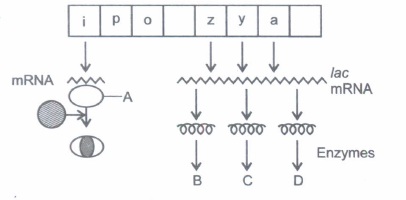
Lac operon in the 'switched on' position is shown above.
(a) Identify the molecule A and the enzymes B, C and D in the diagram.
(b) When will this operon get 'switched off'?
2.
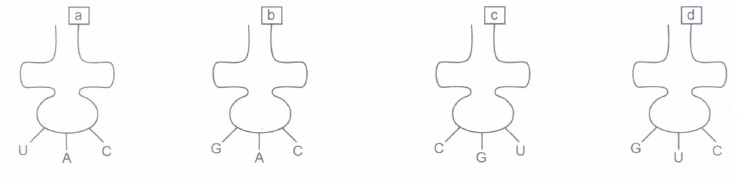
Given above are four amino acyl-tRNAs with their anticodons.
(a) Name the process by which the tRNA binds to the amino acid. Which end of the tRNA is the amino acid bound to?
(b) Find the sequence oftheir binding to the mRNA transcribed by a template strand of DNA having the base sequence as follows:
3' TAC CGT GAC GTC 5'.
(c) Write the sequence of bases on the mRNA transcribed.
3.
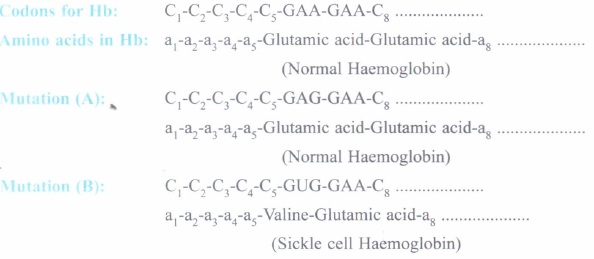
Study the following carefully and explain why mutation (A) did not cause any sickle cell anaemia inspite of change in the molecular structure of the gene which codes for Haemoglobin, whereas a similar mutation (B) did.
(The question is based on properties of the genetic code. c = codon, a = amino acid, Hb = Haemoglobin).
4.
A small stretch of DNA that codes for a polypeptide is given below:
3' ... CAT CAT AGA TGAAAC ... 5'
(a) Which type of mutation could have occurred in each type resulting in the following mistakes during replication of the above original sequence?

(b) How many amino acids will be translated in each of the above two cases?
5.
Read the sequence of nucleotides in the given segment of mRNA and the sequence of amino acids in the polypeptide translated by it.
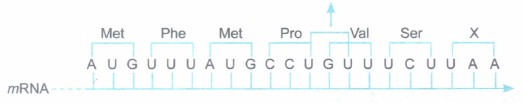
Polypeptide: Met - Phe - Met - Pro - Val - Ser.
(a) Write the sequence of nucleotides in the template strand of DNA, along with its polarity, from which this mRNA has been transcribed.
(b) If the three bases (shown by the arrow) are deleted, what will be the amino acid sequence in the new polypeptide chain?
(c) What does the last codon (X) of this mRNA stand for?
6.

A hypothetical mRNA with 12 codons is shown above.
(a) How many amino acids will be coded by this? Justify your answer.
(b) Mention the dual functions of the codon, AUG.
7.
Given below is a sequence of steps in the transcription in a eukaryotic cell.

(a) Fill in the blanks 1, 2, 3 and 4.
(b) Why is splicing necessary?
8.
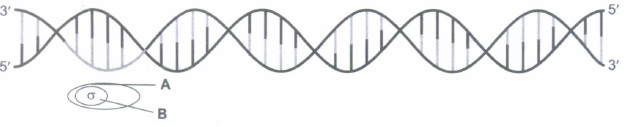
A stage in the process of transcription in a prokaryote is shown above.
(a) Name the stage in transcription.
(b) Identify A and B in the diagram.
(c) Can this process be coupled to translation ? Justify your answer.
9.
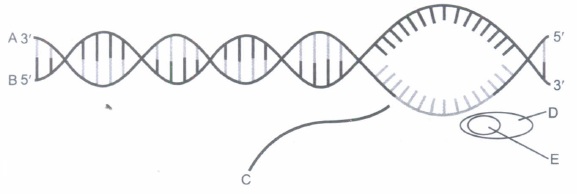
A particular stage in the transcription of a bacterium is given above. Answer the following questions:
(a) Name the stage in the process.
(b) Identify A, B, C, D and E in the diagram.
10.
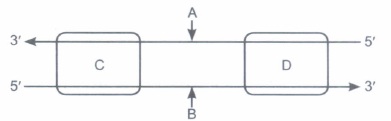
A complete transcription unit is given above.
(a) Identify A, B, C and D in the figure.
(b) Name the enzyme that catalyses this process.
11.
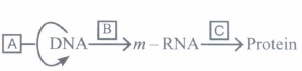
The Central dogma of molecular biology is shown above.
(a) Who proposed this?
(b) Identify the processes A, Band C in the above representation.
(c) Why is it not applicable to certain viruses?
12.
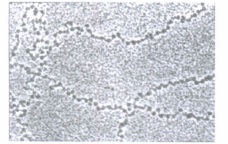
Given above is the electron micrograph (EM) picture of 'beads-on-string'.
a) What do the 'beads' represent?
(b) What do they constitute in a eukaryotic nucleus? When does its maximum condensation occur in a ceU?
(c) What is the function of non-histone chromosomal proteins in the nucleus?
13.
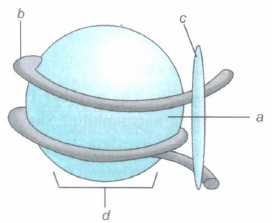
The diagram of a nucleosome is shown above.
(i) Identify the parts labeUed a, b, c and d in it.
(ii) Name the positively-charged and negatively charged components in it.
14.
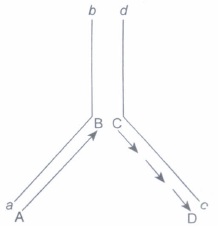
A DNA replication fork is shown above. Answer the following questions based on that.
(a) Identity the polarity of the strands a - b and c-d.
(b) Name the enzyme that catalyses the process.
(c) What are the newly synthesised strands A - B and C - D known as?
1.
(a) A -Repressor
B -galactosidase
C-Permease
D -Transacetylase.
(b) It will get 'switched off' when
(i) the substrate/inducer lactose is not available
(ii) the energy source, glucose is available to the cells.
2.
(a) (i) Amino acylation or charging of tRNA.
(ii) 3' end of tRNA.
(b)a-c-b-d.
(c)5' AUG GCA CUG CAG 3'.
3.
Mutation A
(i) The mutated codon, GAG also codes for the same amino acid, glutamic acid; hence, there is no change in the structure of haemoglobin.
(ii) It is because genetic code is degenerate, i.e., some amino acids are coded by more than one codon.
Mutation B
(i) The mutated codon, GUG codes for valine; hence, there is change in the structure of haemoglobin.
(ii) It is because genetic code is unambiguous and specific, i.e., one codon codes only for a particular amino acid.
4.
(a) (i) Point mutation.
(i) There is a single base change (substitution) in the last triplet AAC to ATe.
(ii) Point mutation
(i) A single base (c) is deleted from the second triplet; hence, the reading frame shifts from that point, i.e., frameshift-deletion mutation.
(b) Four amino acids will be coded by each of the above two strands.
5.
(a) 3' TAC AAA TAC GGA CAA AGA ATT 5'
(b) Met - Phe - Met - Pro - Ser.
(c) X stands for termination codon.
6.
(a) 11 amino acids will be coded, as the last codon is a termination codon that does not code for any amino acid.
(b) Dual functions of AVG:
(i) It acts as the initiation codon for translation.
·(ii) It codes for the amino acid, methionine.
7.
(a) 1. RNA polymerase II
2. hn (RNA)
3. m (RNA)
4. Adenylate residues, 200-300.
8.
(a) Initiation step in transcription.
(b) A - RNA polymerase.
B - Sigma (\(\sigma \)) factor.
(c) Yes, this process can be coupled to translation because
(i) the RNA synthesised does not require any processing to become active.
(ii) both transcription and translation occur in the cytosol, as there is no distinct nucleus and cytosol in prokaryotes.
9.
(a) 'Termination of transcription.
(b) A - Template strand of DNA.
B - Coding strand of DNA.
C - RNA synthesised
D - RNA-polymerase
E - rho (p) factor.
10.
(a) A - Template strand of DNA.
B - Coding strand of DNA.
C - Promoter
D - Terminator
(b) DNA-dependent RNA-poJymerase.
11.
(a) Francis Crick proposed this.
(b) A - Replication (of D A)
B - Transcription
C - Translation
(c) In some viruses (retroviruses), the flow of information is in reverse direction, i.e., from RNA to DNA catalysed by enzyme, reverse transcriptase; hence, it is not applicable to these viruses.
12.
(a) The beads represent the nuc\eosomes.
(b) (i) They constitute the repeating units of chromatin.
(ii) The chromatin fibres are condensed maximum at metaphase of cell division.
(c) Non-histone chromosomal proteins are involved in the packaging of chromatin at higher levels.
13.
(i) a - Histone octamer
b - DNA
c - H1 histone
d - Core of histone molecules.
(ii) (a) Positively-charged component-Histone.
(b) Negatively-charged component-DNA.
14.
(a) Strand a - b - 3' - 5'
Strand c - b - 5' - 3'
(b) DNA-dependent DNA-polymerase.
(c) (i) Strand A-8 is called leading strand.
(ii) Strand C-D is called lagging strand.

12th Standard CBSE Syllabus & Materials
12th Standard CBSE
CBSE 12th Computer Science Python Revision Tour I - New Previous year Question Papers Study Material - QB365 Set A
NEW12th Standard CBSE
CBSE 12th Business Studies Planning Important Questions And Answers Study Material - QB365 Set A
NEW12th Standard CBSE
CBSE 12th Business Studies Business Environment Important Questions And Answers Study Material - QB365 Set A
NEW12th Standard CBSE
CBSE 12th Business Studies Principles of Management Important Questions And Answers Study Material - QB365 Set A



CBSE 12th Standard CBSE Subjects
CBSE Standards










