
 100% FREE ACCESS
12th Standard CBSE Syllabus & Materials
12th Standard CBSE
CBSE 12th Economics Government Budget and the Economy Previous year Question Papers Study Material - QB365 Set A
NEW12th Standard CBSE
CBSE 12th Computer Science Interface Python with MySQL - New Previous year Question Papers Study Material - QB365 Set A
NEW12th Standard CBSE
CBSE 12th Computer Science Database Concept - New Previous year Question Papers Study Material - QB365 Set A
NEW12th Standard CBSE
CBSE 12th Computer Science Data Communication - New Previous year Question Papers Study Material - QB365 Set A
NEW12th Standard CBSE
CBSE 12th Computer Science Data Structures - New Previous year Question Papers Study Material - QB365 Set A
NEW12th Standard CBSE
CBSE 12th Computer Science Functions - New Previous year Question Papers Study Material - QB365 Set A

Published on: 08/09/2022
QB365 provides a detailed and simple solution for every Possible Case Study Questions in Class 12 Biology Subject - Principles of Inheritance and Variation, CBSE. It will help Students to get more practice questions, Students can Practice these question papers in addition to score best marks.
Download CBSE Class 12th Standard CBSE Biology question papers, sample papers, important questions, and previous year solved papers in PDF format. Get free study materials, NCERT solutions, and exam preparation resources for Class 12th Standard CBSE Biology
Questions + Answers key
Take MCQ Biology Test
1.
Read the following and answer any four questions from (i) to (v) given below:
A relevant portion of \(\beta\)-chain of haemoglobin of a normal human is as follows

The codon for the sixth amino acid is GAG. The sixth codon GAG mutates to GAA as a result of mutation X and into GUG as a result of mutation Y.
(i) Which of the following is incorrect statement?
| (a) Mutation X carries no change in shape of red blood cells. |
| (b) Mutation Y causes change in shape of red blood cell shape |
| (c) Both mutations X and Y causes change in shape of red blood cell shape. |
| (d) Both (a) and (b) |
(ii) Due to mutation Y the shape of RBCs under oxygen tension will be
| (a) biconcave disc like | (b) elongated and curve | (c) circular | (d) spherical |
(iii) GUG is code for
| (a) valine | (b) proline | (c) glutamic acid | (d) leucine |
(iv) Which of the following genotype shows diseased phenotype due to mutation Y?
| (a) Hbs Hbs | (b) HbA Hbs | (c) HbA HbA | (d) Both (a) and (b) |
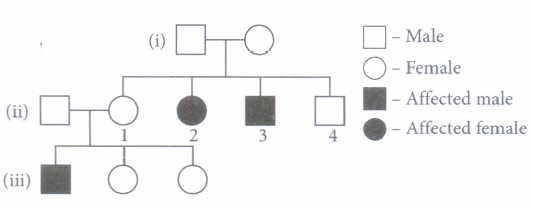
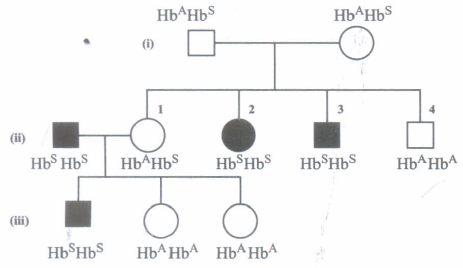
(v) Study the given pedigree chart for sickle-cell anaemia and select the most appropriate option for the genotypes.
| Genotypes of parents | Genotypes of 1st and 3rd child in F1 |
| (a) HbA HbS, HbA HbA | HbA HbA, HbA HbS |
| (b) HbA HbS, HbA HbS | HbA HbA, HbA HbA |
| (c) HbA HbA, HbA HbS | HbA HbA, HbS HbS |
| (d) HbA Hbs, HbA Hbs | HbA HbS, HbS HbS |
2.
Read the following and answer any four questions from (i) to (v) given below:
Haemophilia is a sex linked disease which is also known as bleeder's disease as the patient will continue to bleed even from a minor cut since he or she does not possess the natural phenomenon of blood clotting due to absence of anti-haemophilic globulin or factor VIII and plasma thromboplastin factor IX essential for it. As a result of continuous bleeding the patient may die of blood loss. Colour blindness is another type of sex linked trait in which the eye fails to distinguish red and green colours. Vision is however, not affected and the colour blind can, lead a normal life, reading, writing and driving (distinguishing traffic lights by their position).(i) If a haemophilic man marries a woman whose father was haemophilic and mother was normal then which of the following holds true for their progenies?
| (a) Of the total number of daughters, 50% daughters are carrier and 50% are haemophilic |
| (b) All the daughters are haemophilic. |
| (c) All sons are haemophilic and all daughters are normal. |
| (d) All sons are normal, all daughters are carriers. |
(ii) A man whose father was colourblind and mother was normal marries a woman whose father was haemophilic and mother was normal. Which of the following is true for their progenies? [Note: Percentage is from the total number of progenies.
| (a) 25% female progenies carry the gene for both haemophilia and colourblindness |
| (b) 25% male progenies carry only the gene of colourblindness |
| (c) 25% female progenies carry only the gene of colourblindness. |
| (d) 25% male progenies and 25% female progenies carry the gene of haemophilia |
(iii) Which of the following statements is incorrect regarding haemophilia?
| (a) It is a dominant disease | (b) A single protein involved in clotting of blood is affected | (c) It is recessive disease | (d) It is Mendelian disorder |
(iv) Anup is having colourblindness and is married to Soni who is normal. What is the chance that their son will have the disease?
| (a) 100% | (b) 50% | (c) 25% | (d) 0% |
(v) Refer to the given cross
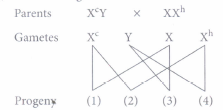
Select the correct option regarding 1, 2, 3 and 4.
| (a) 1. Colourblind carrier female 2. Colourblind haemophilic female 3. Normal male 4. Haemophilic male |
(b) 1.Colourblind people 2.Haemophilic female 3.Normal male 4..Haemophilic male |
(c) 1. Colourblind female 2. Colourblind and haemophilic female 3. Normal male 4. Normal male |
(d) 1.Colourblind carrier female 2.Normal female 3.Normal male 4.Haemophilic male |
3.
Read the following and answer any four questions from (i) to (v) given below :
According to Mendel, one gene control the expression of one character only. The ability of a gene to have multiple phenotypic effect because it influences a number of characters is an exception. The gene having a multiple phenotypic effect because of its ability to control of two or more characters can be seen in cotton. In cotton, a gene for the lint also influences the height of plant, size of the ball, number of ovules and viability of seeds.
(i) Genes with multiple phenotypic effects are known as
| (a) hydrostatic genes | (b) duplicate genes | (c) pleiotropic genes | (d) complimentary genes |
(ii) Which of the following disorder is an example of genes with multiple phenotypic effects?
| (a) Phenylketonuria | (b) Haemophilia | (c) Sickle cell anaemia | (d) Both (a) and (c) |
(iii) Which of the following is an example of gene with multiple phenotypic effect?
| (a) Drosophila white eye mutation | (b) Kernel colour in wheat | (c) Height in human beings | (d) Skin colour in human beings |
(iv) Which of the following statements is not correct regarding genes with multiple phenotypic effect?
| (a) It is not essential that all the traits are equally influenced |
| (b) Occasionally a number of related changes are caused by a gene. |
| (c) It occurs due to effect of the gene on two or more inter-related metabolic pathways |
| (d) None of these |
(v) Assertion : In garden pea, the gene which controls the flower colour also controls the colour of the seed coat and presence of red spots in the leafaxils.
Reason : A pleiotropic gene influences more than one trait.
| (a) Both assertion and reason are true and reason is the correct explanation of assertion. |
| (b) Both assertion and reason are true but reason is not the correct explanation of assertion. |
| (c) Assertion is true but reason is false |
| (d) Both assertion and reason are false. |
4.
Read the following and answer any four questions from (i) to (v) given below :
Turner's syndrome is an example of mono somy. It is formed by the union of an allosome free egg and a normal 'X' containing sperm or a normal egg and an allosome free sperm. The individual has 2n = 45 chromosomes (44 + X0) instead of 46. Such individuals are sterile females who have rudimentary ovaries, under developed breasts, small uterus, short stature, webbed neck and abnormal intelligence. They may not menstruate or ovulate. This disorder can be treated by giving female sex hormone to the women from the age of puberty to make them develop breasts and have menstruation. This makes them feel more normal.
(i) Number of Barr body present in a female with Turner's syndrome is
| (a) 0 | (b) 1 | (c) 2 | (d) < 2. |
(ii) Turner's syndrome is an example of
| (a) aneuploidy | (b) euploidy | (c) polyploidy | (d) autosomal abnormality |
(iii) Turner's syndrome is a/an
| (a) autosomal recessive Mendelian disorder | (b) autosomal dominant Mendelian disorder |
| (c) sex linked Mendelian disorder | (d) chromosomal disorder |
(iv) Which of the following statements regarding Turner's syndrome is incorrect?
| (a) It is a case of monosomy of chromosomes |
| (b) The suffering individual is a sterile female having one 'X' chromosome missing in the cells |
| (c) The problem is due to an extra chromosome |
| (d) The individual are of short stature |
(v) Assertion : Turner's syndrome is caused due to absence of anyone of the X and Y sex chromosome.
Reason : Individuals suffering from Turner's syndrome show masculine as well as feminine development
| (a) Both assertion and reason are true and reason is the correct explanation of assertion. |
| (b) Both assertion and reason are true but reason is not the correct explanation of assertion |
| (c) Assertion is true but reason is false |
| (d) Both assertion and reason are false |
5.
Read the following and answer any four questions from (i) to (v) given below :
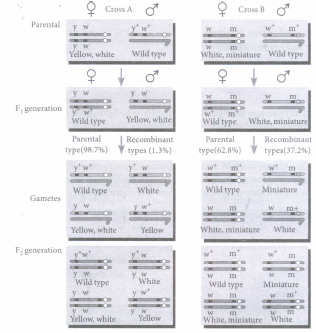
During a study of inheritance of two genes, teacher asked students to perform an experiment. The students crossed white eyed, yellow bodied female Drosophila with a red eyed, brown bodied male Drosophila (i.e., wild). They observed that progenies in F2 generation had 1.3 percent recombinants and 98.7 percent parental type combinations. The experimental cross with results is shown in the given figure.[Note: Dominant wild type alleles are represented with (+) sign in superscript.]
(i) By conducting the given experiment, teacher can conclude that
A. Genes for eye colour and body colour are linked
B. Genes for eye colour and body colour show complete linkage
C. Linked gene remain together and are inherited
| (a) A and B only | (b) B only | (c) A and C only | (d) A, Band C |
(ii) Teacher asked to conduct an experiment on Drosophila because
| (a) the male and female flies are easily distinguishable | (b) it completes its life cycle in about two weeks |
| (c) a single mating could produce a large number of progeny flies | (d) all of these. |
(iii) Genes white eyed and yellow bodied located very close to one another on the same chromosome tend to be transmitted together are called
| (a) allelomorphs | (b) identical genes | (c) linked genes | (d) recessive genes |
(iv) Select the correct statement regarding the given experiment.
| (a) The physical distance between two genes determines strength of linkage |
| (b) The physical distance between two genes determines frequency of crossing over |
| (c) The two linked genes always segregate independently of each other |
| (d) Both (a) and (b) |
(v) Assertion : When yellow bodied, white eyed Drosophila females were hybridised with brown-bodied, red eyed males; and FI progeny was intercross ed, F2 ratio deviated from 9: 3: 3: 1.
Reason : When two genes in a dihybrid are on the same chromosome, the proportion of parental gene combinations are much higher than the non-parental type.
| (a) Both assertion and reason are true and reason is the correct explanation of assertion. |
| (b) Both assertion and reason are true but reason is not the correct explanation of assertion |
| (c) Assertion is true but reason is false |
| (d) Both assertion and reason are false |
6.
Read the following and answer any four questions from (i) to (v) given below:
Prashant wanted to find the genotype of a pea plant bearing purple coloured flowers in his kitchen garden. For this, he crossed purple flowered plant with white flowered plant. As a result, all plants which were produced had purple flower only. Upon selfing these plants, 75 purple flower plants and 25 white flower plants were produced. Now, he can determine the genotype of a purple flowered plant by crossing it with a white flowered plant.
(i) Which of the following cannot be derived from the crosses done by Prashant?
| (a) Mendel's law of segregation | (b) Mendel's law of dominance | (c) Mendel's law of independent assortment | (d) Both (a) and (c) |
(ii) To determine the genotype of a purple flowered plant, Prashant crossed this plant with a white flowered plant. This cross represents a
| (a) test cross | (b) dihybrid cross | (c) reciprocal cross | (d) trihybrid cross |
(iii) In white flowered plant, allele is expressed in
| (a) heterozygous condition only | (b) homozygous condition only | (c) F3 generation | (d) both homozygous and heterozygous condition |
(iv) The character, i.e., purple colour of the flowers that appeared in the first filial generation is called
| (a) recessive character | (b) dominant character | (c) holandric character | (d) lethal character |
(v) Assertion : A geneticist crossed two plants and he obtained 50% purple flowered plants and 50% white flowered plants.
Reasons : Purple coloured flower plant might be heterozygous.
| (a) Both assertion and reason are true and reason is the correct explanation of assertion. |
| (b) Both assertion and reason are true but reason is not the correct explanation of assertion |
| (c) Assertion is true but reason is false. |
| (d) Both assertion and reason are false |
7.
Haemophilia is a sex-linked recessive disorder in humans. The pedigree chart given below shows the inheritance pattern of haemophilia in a family. Study the inheritance pattern and answer the questions that follow:
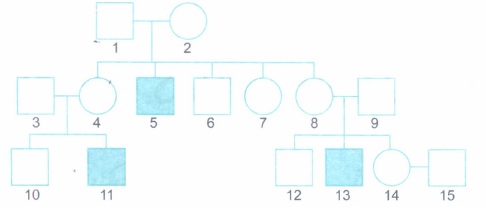
(a) Give the possible genotypes of the members 4 and 5 in the above chart.
(b) A blood test shows that the member 14 is a carrier of haemophilia. The member 15 has recently married the member 14. What is the probability of their first child being haemophilic? Show it with the help of a Punnett square.
8.
Study the pedigree chart showing the pattern of inheritance of blood group character in a family.
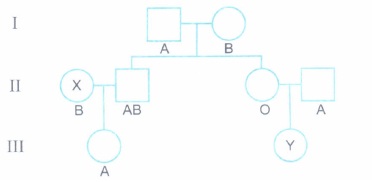
(a) Give the genotypes of the parents in generation I.
(b) State the possible genotypes of the individuals.
(i) X in generation II.
(ii) Y in generation III.
(c) How does the inheritance of this blood group explain codominance?
9.
Study the pedigree chart given below showing the inheritance pattern of a human trait and answer the questions that follow:
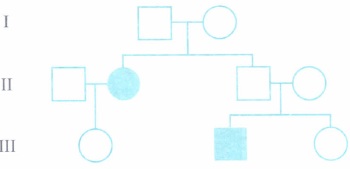
(a) Is the trait autosomal dominant or recessive or sex-linked? Why?
(b) Give the genotypes of the parents in generation I and of the son in generation II.
(c) Give the genotype of the first grand daughter.
10.
During a cytological study conducted on the chromosomes of certain insect species, it was observed that only 50% of the sperms had a specific structure after spermatogenesis.
(a) Name the scientist who conducted the above experiment.
(b) Name the structure, the scientist observed.
(c) Give an example of an insect that could possibly show such a phenomenon and name the mechanism of sex determination.
(d) Write the sex chromosome complement of males and females.
11.
In pea plants, let symbol Y represent dominant yellow, symbol y, the recessive green, symbol R, the round seed shape, and symbol r, the wrinkled seed shape. A typical Mendelian dihybrid cross was carried out starting with homozygous dominant and recessive parents.
Answer the following questions.
(a) Write the genotype and phenotype of the F1offspring.
(b) The genetic make up of the gametes produced by F1 individual.
(c) Give the phenotypic ratio of F2 generation.
12.
ABO blood group character in human population exhibits four possible phenotypes and six different genotypes. Explain the different mechanisms of inheritance involved in exhibiting the possibility of four phenotypes and six genotypes.
13.
Two independent monohybrid crosses were carried out involving a tall pea plant with a dwarf pea plant. In the first cross, the offspring population had equal number of tall and dwarf plants, whereas in the second cross, it was different. Work out the crosses and explain giving reasons for the difference in the offspring populations.
14.
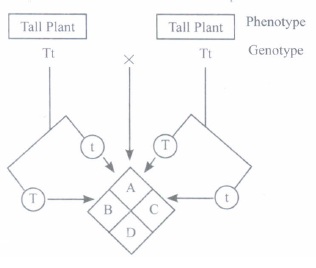
Look at the cross given above and answer the following questions:
(a) Give the genotypes of A, B, C and D.
(b) Write the phenotypic ratio.
(c) What type of a cross is this?
1.
(i) (C) : Due to mutation X, GAG mutates to GAA. But both GAG and GAA code for glutamic acid and hence there is no change in shape of RBC whereas in mutation Y, GUG is substituted by GAA that codes for valine and so the RBCs become sickle shaped.
(ii) (b) : Mutation Y causes sickle cell anaemia and the mutant haemoglobin molecule undergoes polymerisation under low oxygen tension causing the change in the shape of RBC from biconcave disc to elongated sickle cell like.
(iii) (a) : Due to mutation X, GAG mutates to GAA. But both GAG and GAA code for glutamic acid and hence there is no change in shape of RBC whereas in mutation Y, GUG is substituted by GAA that codes for valine and so the RBCs become sickle shaped.
(iv) (a) : Mutation Y causes sickle cell anaemia that is controlled by a single pair of allele, HbA and HbS Out of three possible genotypes only homozygous individuals for HbS (HbS HbS) show the diseased phenotype.
(v) (d) : Given pedigree chart for sickle-cell anaemia can be illustrated as :
2.
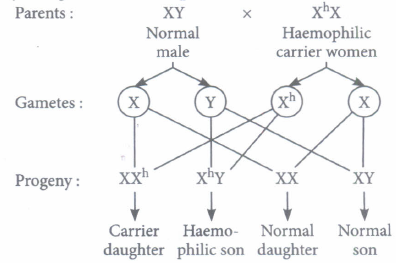
(i) (a) : When a haemophilic man (Xhy) marries a woman whose father was haemophilic and mother was normal i.e., carrier woman (XXh), then 50% daughters are carriers and 50% are haemophilic. This can be explained as follows:

(ii) (d) : When a man whose father was colourblind and mother was normal (i.e., normal man XY) marries a woman whose father was haemophilic and mother was normal (i.e., carrier haemophilic woman XhX), then 25% male progenies and 25% female progenies carry the gene of haemophilia.
(iii) (a) : Haemophilia is sex linked recessive Mendelian disorder.
(iv) (d) : When Anup who is colourblind (Xcy) marries Soni who is normal (XX) then 0%, chances that their son will have colourblindness.
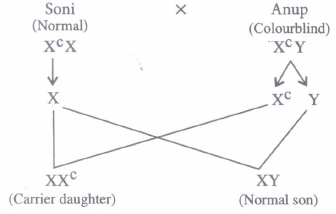
(v) (a)
3.
(i) (c)
(ii) (d) : The ability of a gene to have multiple phenotypic effects because it influences a number of characters simultaneously is known as pleiotropy. In human beings pleiotropy is exhibited by syndromes, i.e., sickle cell anaemia and phenylketonuria.
(iii) (a) : Kernel colour in wheat, height in human beings and skin colour in human beings are examples of polygenic inheritance, i.e., inheritance controlled by three or more genes. In Drosophila, white eye mutation pleiotropic effect, it causes depigmentation in many part of the body.
(iv) (d)
(v) (a)
4.
(i) (a) : Barr body is a structure consisting of a condensed X chromosome that is found in nondividing nuclei of female mammals. The presence of Barr body is used to confirm the sex of athletes in sex determination tests. It is named after the Canadian anatomist M.L. Barr, who identified it. The number of Barr bodies is one less than total number of X chromosomes. In Turner's syndrome genotype is 45 + X0,so, the number of Barr body is O.
(ii) (a) : Failure of segregation of chromatids during cell division result in the gain or loss of a chromosomes called aneuploidy. For example, Turner's syndrome results due to loss of X chromosome in human females.
(iii) (d) : Turner's syndrome is a chromosomal disorder that occurs due to absence of one chromosome.
(iv) (c) : In Turner's syndrome individual lacks one X chromosome. This situation is known as monosomy.
(v) (d): Turner's syndrome occurs due to absence of X chromosome. Individuals having a single X chromosome 22A + X0 (45) have female sexual differentiation but ovaries are rudimentary. Other associated phenotypes of this condition are short stature, webbed-neck, broad chest, lack of secondary sexual characteristics and sterility. Thus, any imbalance in the copies of the sex chromosomes may disrupt the genetic information necessary for normal sexual development.
5.
(i) (c) : By conducting the given cross teacher can conclude that the genes for eye colour and body colour are linked. Thus these genes were very tightly linked and showed very low recombination.
(ii) (d)
(iii) (c) : Genes located very close to one another on the same chromosome tend to be transmitted together and are called linked genes.
(iv) (a) : The physical distance between two genes determines both the strength of the linkage and the frequency of the crossing over between two genes. The strength of the linkage increases with the closeness of the two genes. On the other hand the frequency of crossing over increases with the increase in the physical distance between the two genes.
(v) (a) : In Drosophila, the genes for body and eye colour are located on X chromosome. When two genes in a dihybrid cross are situated on the same chromosome, the proportion of parental gene combination are higher than non-parental type. This occurs due to physical association or linkage of the two genes while non-parental gene combinations due to recombination between two genes. Thus, linkage and recombirtation deviates the ratio from Mendelian ratio of a dihybrid cross (9 : 3 : 3 : 1).
6.
(i) (c) : Mendel's law of independent assortment states 'when two pairs of traits are combined in a hybrid, segregation of one pair of characters is independent of the other pair of characters: This law can be derived by dihybrid cross but Prashant has performed monohybrid cross only, i.e., one pair of traits.
(ii) (a) : In a test cross, an organism (pea plant) showing a dominant phenotype whose genotype is to be determined is crossed with the recessive parent instead of self-crossing. The progenies of such a cross can easily be analysed to predict the genotype of the test organism. Normal test cross ratio for a monohybrid cross is 1 : 1 and for a dihybrid cross is 1 : 1 : 1 : 1.
(iii) (b) : The factor of an allelic or allelomorphic pair which is unable to express its effect in the presence of its contrasting factor in a heterozygote is called recessive factor or allele, e.g., the allele 't' in hybrid tall pea plant Tt. The effect of recessive factor becomes known only.when it is present in the pure or homozygous state,
e.g., tt in dwarf pea plant.
(iv) (b) : In first filial generation or heterozygous individuals, out of the two factors or alleles representing the alternate traits of a character, one is dominant and expresses itself in the hybrid or F1 generation. The other factor or allele is recessive and does not show its effect in the heterozygous individual.
(v) (a) : The given cross can be illustrated as follows:
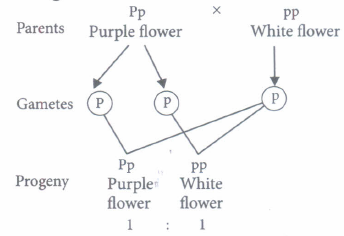
or 50% purple flowered plant, 50% white flowered plant.
7.
(a) Genotype of 4 - XXh
Genotype of 5 - xhv.
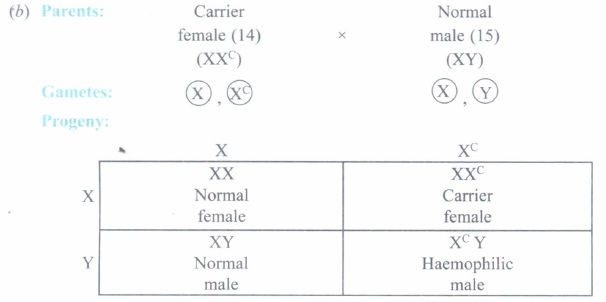
T4e probability of their first child being haemophilic is 25 per cent.
8.
(a) Father - IAi, Mother IBi
(b) (i) -IBi
(ii) IAi or ii
(C) (i) The alleles IAand IBofthe blood group character are equally dominant and both of them express themselves when present together, resulting in blood group AB.
9.
(a) It is an autosomal recessive trait.
(i) The trait that is hidden in the parents (generation 1) has appeared in the daughter (generation II).
(b) (i) Parents - Mother Aa, Father Aa
(ii) Son (generation II) - Aa.
(c) First grand daughter - Aa.
10.
(a) Henking
(b) X-chromosome
(c) (i) Grasshopper
(ii) It shows XO type of sex-determination.
(d) (i) Males are XO
(ii) Females are XX.
11.
(a) Genotype of FI - YyRr
Phenotype of FI - Yellow, round seeds
(b) Gametes: 
(c) Phenotypic ratio of F2 generation: Yellow, round 9: Yellow, wrinkled 3: Green, round 3: Green, wrinkled I.
12.
Mechanisms of Inheritance.
(i) Multiple allelism.
(a) The gene I controlling blood group character exists in three allelic forms, lA, IB and i.
(ii) Dominance.
(a) The allele IA is dominant over the allele i and the allele IB is also dominant over the allele, i.
(iii) Codominance.
(a) The alleles IA and IB are equally dominant and both of them express themselves, when they are present together; blood group AB results.
13.
Cross 1
(i) Since dwarf individuals have appeared in the progeny, the tall plant must be heterozygous, i.e., its genotype is Tt.
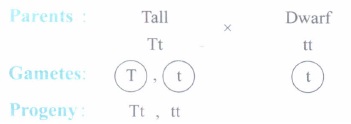
Tall: Dwarf in the ratio 1: 1.
Cross 2
(i) If the tall pea plant were homozygous dominant (IT), all the offspring in the progeny will be tall; hence, different from the first cross.
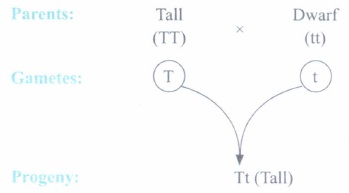
14.
(a) Genotype of:
A - Tt, B - TT, C - tt, D - Tt
(b) The phenotypic ratio is
3 Tall : I Dwarf
(c) It is a monohybrid cross.

12th Standard CBSE Syllabus & Materials
12th Standard CBSE
CBSE 12th Computer Science Python Revision Tour I - New Previous year Question Papers Study Material - QB365 Set A
NEW12th Standard CBSE
CBSE 12th Business Studies Planning Important Questions And Answers Study Material - QB365 Set A
NEW12th Standard CBSE
CBSE 12th Business Studies Business Environment Important Questions And Answers Study Material - QB365 Set A
NEW12th Standard CBSE
CBSE 12th Business Studies Principles of Management Important Questions And Answers Study Material - QB365 Set A



CBSE 12th Standard CBSE Subjects
CBSE Standards










