
 100% FREE ACCESS
12th Standard CBSE Syllabus & Materials
12th Standard CBSE
CBSE 12th Economics Government Budget and the Economy Previous year Question Papers Study Material - QB365 Set A
NEW12th Standard CBSE
CBSE 12th Computer Science Interface Python with MySQL - New Previous year Question Papers Study Material - QB365 Set A
NEW12th Standard CBSE
CBSE 12th Computer Science Database Concept - New Previous year Question Papers Study Material - QB365 Set A
NEW12th Standard CBSE
CBSE 12th Computer Science Data Communication - New Previous year Question Papers Study Material - QB365 Set A
NEW12th Standard CBSE
CBSE 12th Computer Science Data Structures - New Previous year Question Papers Study Material - QB365 Set A
NEW12th Standard CBSE
CBSE 12th Computer Science Functions - New Previous year Question Papers Study Material - QB365 Set A

Published on: 08/09/2022
QB365 provides a detailed and simple solution for every Possible Case Study Questions in Class 12 Biology Subject - Reproduction in Organisms, CBSE. It will help Students to get more practice questions, Students can Practice these question papers in addition to score best marks.
Download CBSE Class 12th Standard CBSE Biology question papers, sample papers, important questions, and previous year solved papers in PDF format. Get free study materials, NCERT solutions, and exam preparation resources for Class 12th Standard CBSE Biology
Questions + Answers key
Take MCQ Biology Test
1.
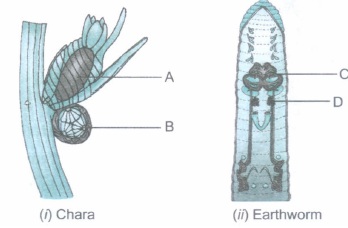
The reproductive organs of
(i) Chara, an alga and
(ii) earthworm, an animal are sbown in tbe above diagram.
(a) Identify and name tbe male and female reproductive organs of tbese two organisms.
(b) What technical term is given to
(i) the plant, Chara and
(ii) the animal, earthworm, respectively, that possess both male and female reproductive organs in the same individual?
2.
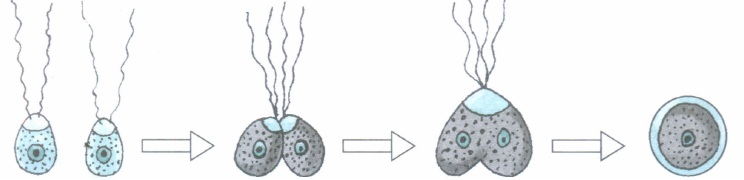
(a) State the type of gametes sbown in the diagram.
(b) Identify the process taking place and the resultant structure.
(c) Name an organism that reproduces in tbis manner.
3.
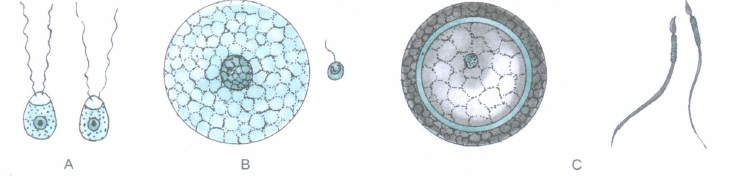
Identify the types of gametes and give an example for each of A, Band C shown in tbe diagram, given below.
4.
Many of you would be knowing that a particular plant species flowered during September - October, 2006. Its mass flowering transformed large tracts of the hilly areas of Kerala, Karnataka, and Tamil Nadu into blue stretches and attracted a large number of tourists.
(a) Write the scientific name of the plant whose flowering was responsible for this.
(b) What is unique about its flowering phenomenon?
(c) Name another plant and its unusual flowering phenomenon.
5.
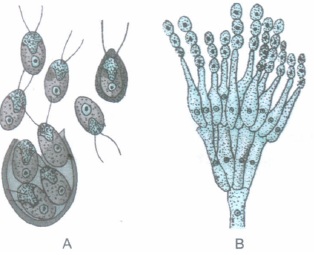
(a) Identify the asexual reproductive units and the respective organism (A and B) producing each of them, as shown in the diagram given.
(b) Write two differences between these two reproductive units.
6.
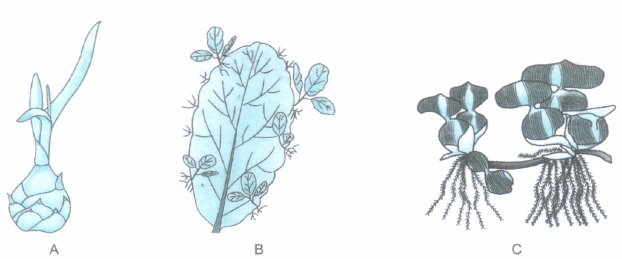
Identify the plant and the vegetative propagule ofA, Band C.
7.
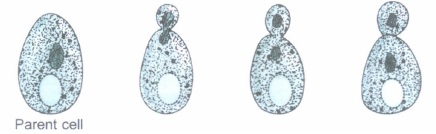
(a) Name the organism and the mode of reproduction shown in the diagram given above.
(b) Write two differences between budding and the binary fission in Amoeba.
8.
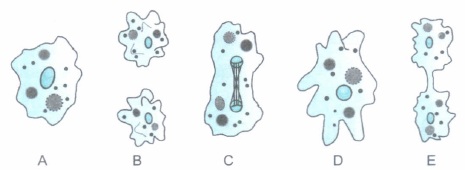
The stages in the binary fission of Amoeba are shown above.
(a) Arrange the stages in their proper natural sequence in binary fission.
(b) How does this differ from the process of sporulation employed by Amoeba?
1.
(i) A - Female organ (Oogonium)
B - Male organ (Antheridium)
(ii) C - Male organ (Testis)
D - Female organ (Ovary)
b) (i) Monoecious
(ii) HermaphroditelBisexual
2.
(a) Isogametes (b) Syngamy (c) Zygote
3.
A - Isogametes; e.g. Cladophora, an alga
B - Heterogametes, e.g. Fueus, an alga
C - Heterogametes, e.g. Homo sapiens, (Human beings)
4.
(a) Strobilanthus kunthiana
(b) It flowers once in twelve years.
(c) Bamboo flowers only once in its life time, generally after 50-100 years, produces a large number of fruits (seeds) and die.
5.
(a) A - Zoospores, produced by Chlamydomonas
B - Conidia, produced by Penicillium
(b) Differences
| Zoospores | Conidia |
| (i) Zoospores are motile - celts with flagella. | (i) Conidia are nonmotile and dispersed by wind. |
| (ii) Zoospores are produced endogenously, i.e. within zoosporangium. | (ii) Conidia are nonmotile and dispersed by wind. |
6.
A - Agave, Bulbil
B - Bryophyl/um, Adventitious leaf buds
C - Eichhornia, Offset
7.
(a) (i) Yeast is the organism.
(ii) It reproduces asexually by budding.
(b) Differences.
| Budding | Binary fission |
| (i) The cell division is unequal; a large cell and a small cell, called bud, are formed. |
(i) The cell division is equal and the daughter cells are almost equal in size. |
| (ii) The parent cell does exist. | (ii) The parent cell ceases to exist. |
8.
(a) D\(\rightarrow\)A\(\rightarrow\)C\(\rightarrow\)E\(\rightarrow\)B
(b) Differences
| Binary Fission | Sporulation |
| (i) It occurs during favourable conditions. | (i) It occurs during unfavourable seasons |
| (ii) No cyst is formed | (ii) A cyst is formed. |
| (iii) By binary fission, only two daughter cells are formed. | (iii) By multiple fission, a number of daughter cells are formed |

12th Standard CBSE Syllabus & Materials
12th Standard CBSE
CBSE 12th Computer Science Python Revision Tour I - New Previous year Question Papers Study Material - QB365 Set A
NEW12th Standard CBSE
CBSE 12th Business Studies Planning Important Questions And Answers Study Material - QB365 Set A
NEW12th Standard CBSE
CBSE 12th Business Studies Business Environment Important Questions And Answers Study Material - QB365 Set A
NEW12th Standard CBSE
CBSE 12th Business Studies Principles of Management Important Questions And Answers Study Material - QB365 Set A



CBSE 12th Standard CBSE Subjects
CBSE Standards










