
 100% FREE ACCESS
12th Standard CBSE Syllabus & Materials
12th Standard CBSE
CBSE 12th Economics Government Budget and the Economy Previous year Question Papers Study Material - QB365 Set A
NEW12th Standard CBSE
CBSE 12th Computer Science Interface Python with MySQL - New Previous year Question Papers Study Material - QB365 Set A
NEW12th Standard CBSE
CBSE 12th Computer Science Database Concept - New Previous year Question Papers Study Material - QB365 Set A
NEW12th Standard CBSE
CBSE 12th Computer Science Data Communication - New Previous year Question Papers Study Material - QB365 Set A
NEW12th Standard CBSE
CBSE 12th Computer Science Data Structures - New Previous year Question Papers Study Material - QB365 Set A
NEW12th Standard CBSE
CBSE 12th Computer Science Functions - New Previous year Question Papers Study Material - QB365 Set A

Published on: 08/09/2022
QB365 provides a detailed and simple solution for every Possible Case Study Questions in Class 12 Biology Subject - Reproductive Health, CBSE. It will help Students to get more practice questions, Students can Practice these question papers in addition to score best marks.
Download CBSE Class 12th Standard CBSE Biology question papers, sample papers, important questions, and previous year solved papers in PDF format. Get free study materials, NCERT solutions, and exam preparation resources for Class 12th Standard CBSE Biology
Questions + Answers key
Take MCQ Biology Test
1.
Read the following and answer any four questions from (i) to (v) given below:
Medical termination of pregnancy is termination of pregnancy before the fetus become viable. To reduce the incidence of illegal abortion and consequent maternal mortality, MTP Amendment Act, 2017 was enacted by the government of India. About 40-50 million MTPs are done in a year all over the world.
(i) Abortion can be safely done for about_________ weeks of pregnancy.
| (a) 4 | (b) 12 | (c) 8-10 | (d) 15-18 |
(ii) How is MTP helpful in decreasing human population?
| (a) By aborting normal female fetus | (b) By increasing maternal mortality rate |
| (c) By getting rid of unwanted pregnancies | (d) None of these |
(iii) Select an incorrect statement for MTP.
| (a) Second trimester abortions are more risky than first trimester | (b) It is being misused to abort normal female fetus. |
| (c) It helps to get rid of unwanted pregnancies. | (d) Child detected with congenital heart disease cannot be aborted |
(iv) MTP was legalised by Government of India in
| (a) 1971 | (b) 1982 | (c) 1973 | (d) 1991. |
(v) Assertion : MTPs are safe during first trimester of pregnancy.
Reason : After first trimester, fetus become intimately associated with the maternal tissues.
| (a) Both assertion and reason are true and reason is the correct explanation of assertion | (b) Both assertion and reason are true but reason is not the correct explanation of assertion. |
| (c) Assertion is true but reason is false | (d) Both assertion and reason are false |
2.
Read the following and answer any four questions from (i) to (v) given below:
Rohan, a 13 year old school student has been diagnosed with AIDS. He often complains of fever, nausea, headache and lethargy. Doctor advised some drugs to prolong his life.
(i) What could be the most likely mode of transmission of disease to Rohan?
| (a) Artificial insemination | (b) Sexual intercourse with infected partner |
| (c) From injected mother through placenta | (d) Use of contaminated blade |
(ii) Name the drug prescribed for treatment of this disease.
| (a) Zidovudine | (b) Taxol | (c) Vinblastine | (d) Both (a) and (c) |
(iii) Assertion: AIDS is an incurable STD.
Reason : AIDS virus attacks helper T-Lymphocytes
| (a) Both assertion and reason are true and reason is the correct explanation of assertion. |
| (b) Both assertion and reason are true but reason is not the correct explanation of assertion |
| (c) Assertion is true but reason is false |
| (d) Both assertion and reason are false. |
(iv) AIDS cannot be diagnosed by
| (a) ELISA | (b) PCR | (c) Western blotting | (d) VDRL |
(v) AIDS can be transmitted, by
| (a) sharing towels | (b) kissing | (c) sharing contaminated needles | (d) all of these |
3.
Read the following and answer any four questions from (i) to (v) given below:
A technique knowa as amniocentesis is used to determine fetal abnormalities. This test is based on the chromosomal pattern in amniotic fluid. However, this technique is legally banned now.
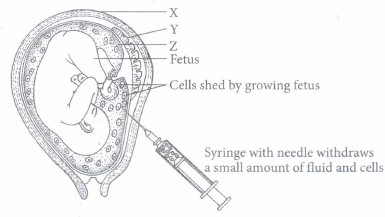
(i) Identify X and Y in the above given figure.
| X | y | |
| (a) | Amnion | Chorion |
| (b) | Uterine wall | Placenta |
| (c) | Placenta | Uterine wall |
| (d) | Uterine wall | Amnion |
(ii) What is the function of Z?
| (a) Z is an amniotic fluid which prevents dessication of an embryo. | (b) Z is yolk sac which functions as site of early blood cell formation |
| (c) Z is amnion which takes part in placenta formation. | (d) None of these |
(iii) Which of the following diseases can not be diagnosed by amniocentesis?
| (a) Down's syndrome | (b) Sickle cell disease | (c) Jaundice | (d) Cystic fibrosis |
(iv) Assertion: Amniocentesis is legally banned for sex determination.
Reason: Amniocentesis was being misused for aborting normal female fetus
| (a) Both assertion and reason are true and reason is the correct explanation of assertion | (b) Both assertion and reason are true but reason is not the correct explanation of assertion |
| (c) Assertion is true but reason is false. | (d) Both assertion and reason are false. |
(v) Which of these is a non-invasive technique of detecting fetal disorder?
| (a) Fetoscopy | (b) Chorionic villi sampling | (c) Amniocentesis | (d) Ultrasound imaging |
4.
Read the following and answer any four questions from (i) to (v) given below:
A young couple married for 5 years is unable to bear a child invite of not practicing any birth control method. Upon consultation, doctor advised them an assisted reproductive technology involving transfer of gametes into oviducts.
(i) Identify the technique adopted by the couple
| (a) ZIFT | (b) IUI | (c) GIFT | (d) ICSI |
(ii) What is the pre-requisite of this technique?
| (a) Gamete formation should be normal | (b) Fallopian tubes should be normal |
| (c) Female should have thick endometrial lining | (d) Male should be able to copulate the female |
(iii) Assertion : GIFT is an in-vitro fertilisation technique.
Reason : In GIFT, gametes are fertilised outside the female body
| (a) Both assertion and reason are true and reason is the correct explanation of assertion. |
| (b) Both assertion and reason are true but reason is not the correct explanation of assertion. |
| (c) Assertion is true but reason is false. |
| (d) Both assertion and reason are false |
(iv) The procedure advised to couple involves the transfer of
| (a) fertilised ovum | (b) embryo with 8 blastomeres | (c) sperms and unfertilised ovum | (d) embryo with 16 blastomeres |
(v) What is the success rate of this procedure?
| (a) 30-50% | (b) < 20% | (c) 80-85% | (d) 27-30% |
5.
Read the following and answer any four questions from (i) to (v) given below:
A 23 year old Sahil has been diagnosed with an infection of reproductive tract caused by bacteria. He complains about burning sensation during urination, pus-containing discharge and pain around genitalia. This infection has incubation period of 2-5 days but can be cured.
(i) From which disease is Sahil suffering?
| (a) Chlamydiasis | (b) Herpes | (c) Gonorrhoea | (d) Syphilis |
(ii) Which among the following reproductive tract infections is transmitted by bacteria?
| (a) Trichomoniasis | (b) Chancroid | (c) Genital warts | (d) Both (a) and (b) |
(iii) Which mode of treatment would be useful for Sahil?
| (a) Cryosurgery | (b) Use of Podophyllum preparation | (c) Use of antibiotic ampicillin | (d) It cannot be treated |
(iv) What technique was used to diagnose Sahil's disease?
| (a) Gram staining of discharge and culture | (b) ELISA Test | (c) Antibody detection | (d) Antigen test |
(v) Find the odd one out
| (a) Treponema pallidum | (b) Neisseria gonorrhoeae | (c) Haemophilus ducreyi | (d) Trichomonas vaginalis |
6.
Read the following and answer any four questions from (i) to (v) given below:
Intrauterine devices are most widely accepted methods of contraception. These are used by females and are inserted by doctor or nurses in the uterus through vagina. However these devices are not recommended for those who eventually intend to conceive.
(i) How does CuT prevent conception?
| (a) Cu ions make uterus unsuitable for implantation | (b) Cu ions make cervix hostile to the sperms |
| (c) Cu ions suppress sperms motility | (d) Cu ions inhibit ovulation |
(ii) Which of the following IUDs makes uterus unsuitable for implantation?
| (a) LNG-20 | (b) Multiload 375 | (c) Cu7 | (d) Lippes loop |
(iii) Identify the correct statement for IUDs,
| (a) They slowly release synthetic progesterone in the body. | (b) They increase phagocytosis of sperms within the uterus |
| (c) They block entry of sperms through the cervix. | (d) Both (b) and (c) |
(iv) Select the correct matched pair.
| (a) Hormone releasing IUD - LNG-20 | (b) Non-medicated IUD - Progestasert | (c) Copper releasing IUD - Lippes loop | (d) None of these |
(v) Assertion : IUDs can cause excess menstrual bleeding and pain.
Reason : IUD s can perforate uterus.
| (a) Both assertion and reason are true and reason is the correct explanation of assertion. |
| (b) Both assertion and reason are true but reason is not the correct explanation of assertion |
| (c) Assertion is true but reason is false |
| (d) Both assertion and reason are false. |
7.
Read the following and answer any four questions from (i) to (v) given below:
Over population causes number of family problems. Strategies like birth control methods help to control population explosion. Natural methods of birth control do not involve medications or devices to prevent pregnancy but rather rely on behavioural practices and/or making observations about menstrual cycle.
(i) Which method helps in contraception by temporary absence of sex?
| (a) Coitus interruptus | (b) Withdrawal method | (c) Rhythm method | (d) Lactational amenorrhea method |
(ii) Assertion : The effectiveness of coitus interruptus method is limited.
Reason : Some sperms may pass into vagina before ejaculation.
| (a) Both assertion and reason are true and reason is the correct explanation of assertion | (b) Both assertion and reason are true but reason is not the correct explanation of assertion. |
| (c) Assertion is true but reason is false | (d) Both assertion and reason are false. |
(iii) Why is lactational amenorrhea effective for about 4-5 months after parturition?
| (a) Ovulation occurs on about the 14th day of menstruation | (b) Ovulation does not occur during intense lactation |
| (c) This method inhibits mobility of sperms | (d) Both (b) and (c) |
(iv) Which fact is not the basis of periodic absence method of birth control?
| (a) Ovum remains alive for about 1-2 days. | (b) Ovulation occurs on about 14th day of menstruation. |
| (c) Sperms survive for about 3 days | (d) Alteration in uterine endometrium |
(v) On which days of menstrual cycle should coitus be avoided to prevent fertilisation?
| (a) 100-17 | (b) 6-13 | (c) 1-5 | (d) 15-28 |
8.
Read the following and answer any four questions from (i) to (v) given below:
Population is defined as the total number of individuals of a species present in a particular area at a given time. The scientific study of human population is called demography. The rapid increase in population over a relatively short period is called population explosion. Four basic processes are involved in increase or decrease in the population size. Population shows two types of growth; exponential and logistic.
(i) Which of the following factors are responsible for population explosion?
A. Decrease in number of people of reproducible age
B. Decline in infant mortality rate
C. Increase in maternal mortality rate
D. Rapid decline in death rate
| (a) A and B | (b) Band C | (c) B and D | (d) A and D |
(ii) What is the shape of curve showing logistic growth?
| (a) Sigmoid | (b) J-shape | (c) Linear | (d) Hyperbola |
(iii) What is immigration?
| (a) Number of individuals of the population who left the habitat. | (b) Number of individuals that have come into the habitat. |
| (c) Number of individuals of a species per unit area at given time. | (d) Number of births per 1000 individuals. |
(iv) Equation of Verhulst-Pearl logistic growth is
| (a) \(\frac{d N}{d t}=r N\) | (b) \(\frac{d N}{d t}=\frac{K-N}{k}\) | (c) \(\frac{d N}{d t}=r N\left(\frac{K-N}{K}\right)\) | (d) \(\frac{d N}{d t}=\left(1-\frac{N}{K}\right) r\) |
(v) Which of the following contributes to decrease in population?
| (a) Fertility | (b) Natality | (c) Social mobility | (d) Emigration |
9.
A large number of couples all over the world are infertile. Such infertile couples could be assisted to have children through certain special techniques, commonly called 'Assisted Reproductive Technologies' (ART).
Give the technical term for each of the methods described below.
(a) Transfer of ovum collected from a donor into the fallopian tube of another female, who cannot produce functional ova, but can provide suitable environment for fertilisation and embryo development.
(b) Semen collected from the husband or a healthy donor is artificially introduced into the uterus of a woman.
(c) An embryo is formed in the laboratory by directly injecting the sperm into the ovum.
10.
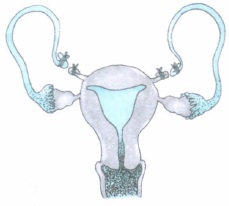
The surgical method of contraception in human females is shown above.
Answer the following questions.
(a) Give the technical term for the process shown above.
(b) How is the process carried out?
(c) What is the principle behind it as a method of contraception?
11.
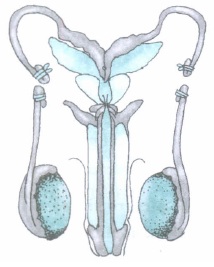
Shown above is the surgical method of contraception in human males.
Answer the following questions:
(a) Give the technical term for the process shown above.
(b) What is the principle behind it as a contraceptive method?
(c) How is the process carried out?
12.
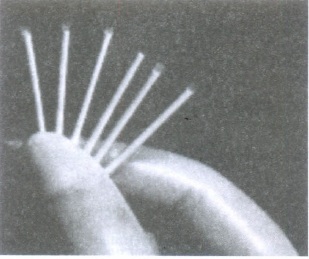
(a) Identify the contraceptive device shown in the picture.
(b) What does it contain and how is it used?
(c) How does it function as a contraceptive?
13.
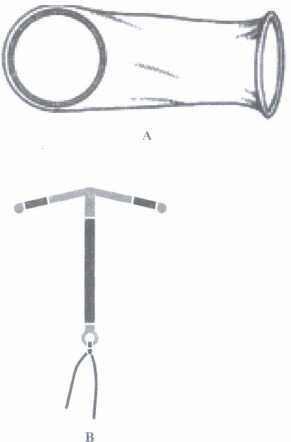
The picture shows two different contraceptive devices, used by human females.
(a) Identify A and B.
(b) Mention how each ofthem prevents fertilisation and conception.
14.
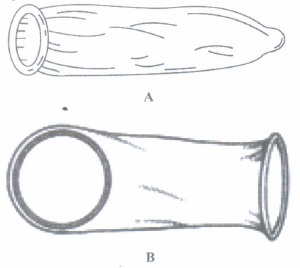
a) Identify the male and the female contraceptive devices, A and B.
(b) How do they prevent conception?
(c) Mention two advantages (other than contraception), why they are preferred.
15.
The population of India which was approximately 350 million at the time of independence crossed one billion in May, 2000. At the current rate of growth (17/1000/year), the population will double in 33 years. It will lead to scarcity of the basic needs like food, shelter, clothing, etc. So, the Government is forced to take some serious measures to control the population growth.
Mention three steps the Government has taken to control the growth of population.
1.
(i) (b) : MTP is comparatively safe upto 12 weeks (the first trimester) of pregnancy. It becomes more risky after the first trimester period of pregnancy as the fetus becomes intimately associated with the maternal tissues.
(ii) (c) : MTP helps to get rid of unwanted pregnancies due to casual unprotected intercourse, or where pregnancy can be harmful to either mother or fetus.
(iii) (d) : Child detected with congenital heart disease can be aborted upto 28th week of pregnancy under the guidance of family physician and the gynaecologist.
(iv) (a) : Government ofIndia legalised MTP in 1971 with some strict conditions to avoid its misuse.
(v) (a) : MTP is comparatively safe upto 12 weeks (the first trimester) of pregnancy. It becomes more risky after the first trimester period of pregnancy as the fetus becomes intimately associated with the maternal tissues.
2.
(i) (d)
(ii) (a) : There is no cure of AIDS, however use of certain drugs can prolong the life of AIDS patients.
E.g., Zidovudine, Didanosine.
(iii) (b)
(iv) (d) : AIDS can be diagnosed by ELISA test and western blotting test. Western blotting test is used for confirmation of ELISA positive cases. PCR is also used to diagnose AIDS. VDRL (Venereal Disease Research Laboratory) is not used to detect AIDS.
(v) (c) : Virus of AIDS is transmitted via blood and semen.
3.
(i) (b)
(ii) (a)
(iii) (c) : Amniocentesis is a fetal disorder test based on the chromosomal pattern in the amniotic fluid surrounding the developing embryo. It detects genetic disorders like Down syndrome, sickle cell anaemia
and cystic fibrosis.
(iv) (a)
(v) (d) : Non invasive techniques are available to determine the fetal condition. These techniques do not pose any risk to fetus. Ultrasound imaging is a non-invasive technique.
4.
(i) (c) : In GIFT (Gamete Intra Fallopian Transfer), gametes (sperm and unfertilised ovum) are transferred into fallopian tubes.
(ii) (b)
(iii) (d) : GIFT is an in-vivo technique, in which fertilisation take place inside the body of the female.
(iv) (c) : In GIFT technique, both the sperm and unfertilised oocytes are transferred into the fallopian tubes.
(v) (d)
5.
(i) (c) : Sahil is suffering from gonorrhoea, a sexually transmitted disease caused by an bacterium Neisseria gonorrhoeae.
(ii) (b) : Trichomoniasis, chancroid and genital warts are STDs caused by protozoa, bacteria and virusrespectively.
(iii) (c) : Gonorrhoea can be cured through use of appropriate antibiotics like penicillin and ampicillin.
(iv) (a)
(v) (d) : Treponema pallidum, Neisseria gonorrhoeae and Haemophilus ducreyi are bacterial organisms which cause syphilis, gonorrhoea and chancroid respectively. Trichomonas vaginalis is an protozoan which causes trichomoniasis.
6.
(i) (c) : Cu ions suppress motility and fertilising capacity of sperms.
(ii) (a) : Hormone releasing IUDs (progestasert, LNG-20) make the uterus unsuitable for implantation and the cervix hostile to the sperms.
(iii) (b)
(iv) (a) : Lippes loop is a non-medicated IUD and progestasert is a hormone releasing IUD.
(v) (b)
7.
(i) (c) : Rhythm method is temporary avoidance of sex in which couples avoid from intercourse from day 10-17 of menstrual cycle because ovulation can occur during this period.
(ii) (a) :
(iii) (b) : Ovulation does not occur during intense lactation following parturition. Hence, lactationalamenorrhea is effective for about 4-5 months after parturition.
(iv) (d) ;
(v) (a) :Rhythm method is temporary avoidance of sex in which couples avoid from intercourse from day 10-17 of menstrual cycle because ovulation can occur during this period.
8.
(i) (c) : A rapid decline in death rate, maternal mortality rate, infant mortality rate and an increase in number of of people in reproducible age are reasons for population explosion.
(ii) (a) : Logistic growth shows S-shaped or sigmoid growth curve.
(iii) (b) :
(iv) (c) :
(v) (d) : Emigration is the number of individuals of the population who left the habitat.
9.
(a) Gamete intra-fallopian transfer (GIFT)
(b) Intra-uterine insemination (LUI).
(c) Intra-cytoplasmic sperm injection. (ICSI).
10.
(a) It is tubectomy.
(b) In this method, a small part of the fallopian tube is removed or tied up through a small incision in the abdomen or through the vagina.
(c) The surgical intervention blocks the transport of gametes and thus prevents fertilisation.
11.
(a) Vasectomy.
(b) The surgical intervention blocks the transport of gametes and thereby prevent fertilisation and conception.
(c) In this method, a small part of the vas deferens is either removed or tied up through a small incision on the scrotum.
12.
(a) Implants.
(b) (i) It contains progestogens or a combination of estrogens and progestogens.
(ii) It is placed under the skin (implant).
(c) It functions as a contraceptive by
(i) inhibiting ovulation and implantation.
(ii) altering the quality of cervical mucus to prevent or retard the entry of sperms.
13.
(a) A - Condom; B - Copper T
(b) (i) A is a barrier that prevents the entry of sperms (semen) into the reproductive tract and prevents meeting of sperm and ovum for fertilisation.
(ii) The Cu2+ released by B suppress sperm motility and thereby the fertilising capacity of sperms.
14.
(a) A. Condom for males.
B. Condom for females
(b) They act as barriers and prevent the entry of sperms (semen) into the female genital tract and thereby prevent fertilisation.
(c) (i) They protect the user from contracting sexually-transmitted diseases.
(ii) Since they are self-inserted, they give privacy to the user.
15.
The steps taken include:
(i) motivating the couples to have small families by using various contraceptive methods.
(ii) raising the marriageable age of the females to 18 years and of males to 21 years.
(iii) providing incentives to couples with small families.

12th Standard CBSE Syllabus & Materials
12th Standard CBSE
CBSE 12th Computer Science Python Revision Tour I - New Previous year Question Papers Study Material - QB365 Set A
NEW12th Standard CBSE
CBSE 12th Business Studies Planning Important Questions And Answers Study Material - QB365 Set A
NEW12th Standard CBSE
CBSE 12th Business Studies Business Environment Important Questions And Answers Study Material - QB365 Set A
NEW12th Standard CBSE
CBSE 12th Business Studies Principles of Management Important Questions And Answers Study Material - QB365 Set A



CBSE 12th Standard CBSE Subjects
CBSE Standards










