
 100% FREE ACCESS
12th Standard CBSE Syllabus & Materials
12th Standard CBSE
CBSE 12th Economics Government Budget and the Economy Previous year Question Papers Study Material - QB365 Set A
NEW12th Standard CBSE
CBSE 12th Computer Science Interface Python with MySQL - New Previous year Question Papers Study Material - QB365 Set A
NEW12th Standard CBSE
CBSE 12th Computer Science Database Concept - New Previous year Question Papers Study Material - QB365 Set A
NEW12th Standard CBSE
CBSE 12th Computer Science Data Communication - New Previous year Question Papers Study Material - QB365 Set A
NEW12th Standard CBSE
CBSE 12th Computer Science Data Structures - New Previous year Question Papers Study Material - QB365 Set A
NEW12th Standard CBSE
CBSE 12th Computer Science Functions - New Previous year Question Papers Study Material - QB365 Set A

Published on: 08/09/2022
QB365 provides a detailed and simple solution for every Possible Case Study Questions in Class 12 Chemistry Subject - The Solid State, CBSE. It will help Students to get more practice questions, Students can Practice these question papers in addition to score best marks.
Download CBSE Class 12th Standard CBSE Chemistry question papers, sample papers, important questions, and previous year solved papers in PDF format. Get free study materials, NCERT solutions, and exam preparation resources for Class 12th Standard CBSE Chemistry
Questions + Answers key
Take MCQ Chemistry Test
1.
Solids may be classified as amorphous and crystalline. Amorphous solids are isotropic where as crystalline solids are anisotropic. Solids can also be classified on the basis of type of forces of attraction as ionic, covalent, metallic and molecular solids. Unit cells represent crystal lattice. Types of crystal lattice-bee, fee, simple cubic, end centred cubic are most common in seven crystal systems and 14 bravais lattices. The constituent particles arrange in square close packing, beep, jeep, hep. Packing efficiency of hep and jeep is 74%, beep 68%.and simple cubic packing (52%). The vacant sites in packing are called voids, tetrahedral and octahedral being most common. Density of solids can be calculated by using \(\left(d=\frac{\boldsymbol{Z} \times \boldsymbol{M}}{\boldsymbol{a}^{3} \times \boldsymbol{N}_{A}}\right)\) .There are defects in crystal lattice, point defects like Frenkel and Schottky. Non-stoichiometric defects are metal excess type and metal deficient type and impurity defects. These defects affects properties of solids.
Solids may be paramagnetic, diamagnetic, ferromagnetic, ferrimagnetic depending upon presence of unpaired electrons. Solids may be conductors, insulators, semiconductors (n type and p type) formed by doping (adding group 13 or 15 as impurity), band theory can explain conductors, semiconductors and insulators.
(a) Which type of defects are shown by ZnS?
(b) A given metal has fcc structure with edge length of 361 pm. What is radius of atom?
(c) A compound is formed by cation 'C' which occupy 75% of octahedral voids and anion' A' form hcp. What is formula of compound?
(d) What is forbidden zone?
(e) Give one ferrimagnetic mixed oxide.
(f) What happens when ZnO is heated and why?
(g) What type of solid is silicon carbide (Carborundum)?
2.
Read the passage given below and answer the following questions:
Most important crystal lattices are the simple cubic, body centred cubic and face centred cubic. In simple cubic lattice, all the atoms are present at all the corners of the cube. In body-centred cubic lattice, atoms are present at all the corners and at the body-centre. In face-centred cubic lattice, atoms are present at the corners and at the centers of all' six faces.
In the formation of crystals, the constituent particles get closely packed together. The closely packed arrangement is that in which maximum available space is occupied leaving minimum vacant space. The most efficient close packing, can be achieved in two ways, one which is called hexagonal close packing (hcp) and the other, cubic close packing (ccp or fcc).
In these questions (i-iv), a statement of assertion followed by a statement of reason is given. Choose the correct answer out of the following choices.
(a) Assertion and reason both are correct statements and reason is correct explanation for assertion.
(b) Assertion and reason both are correct statements but reason is not correct explanation for assertion.
(c) Assertion is correct statement but reason is wrong statement.
(d) Assertion is wrong statement but reason is correct statement.
(i) Assertion: Face centred cubic cell has 4 atoms per unit cell.
Reason: In fcc unit cell, there are 8 atoms at the corners and 6 atoms at face centres.
(ii) Assertion: fee and hep have same packing efficiency.
Reason: bee and fee both have same number of atoms per unit cell and same arrangement.
(iii) Assertion: The total number of atoms present in a simple cubic unit cell is one.
Reason: Simple cubic unit cell has atoms at its corners, each of which is shared between eight adjacent unit cells.
(iv) Assertion: The packing efficiency is maximum for the fccstructure.
Reason: The coordination number is 12 in fcc structures.
3.
Read the passage given below and answer the following questions:
In an assembly of atoms or molecules, a solid phase is formed whenever the interatomic attractive forces significantly exceed the disruptive thermal forces and thus restrict the mobility of atoms, forcing them into more or less fixed positions. From energy considerations, it is evident that in such solids the atoms or molecules will always attempt to assume highly ordered structures which are characterised by symmetry. Depending on the nature of the active interatomic forces, all solids may be subdivided into the following categories:
Ionic solids: These solids consist of positively and negatively charged ions arranged in a regular fashion throughout the solid. These solids are veryhard and brittle, have very high melting points and have high enthalpies of vaporisation, e.g., NaCl, MgO, KCl, LiCl etc.
Covalent solids: In these solids, the constituent particles are atoms which are linked together by a continuous system of covalent bonds. These bonds are strong and directional in nature. The covalent crystals are hard, have high melting points, are poor conductors of electricity. Diamond is a typical example of covalent solids.
Metallic solids : In these solids, the constituent particles are positive ions immersed in a sea of mobile electrons. Metallic solids may be hard as well as soft. They are good conductors of heat and electricity e.g., common metals such as nickel, copper and alloys.
Molecular solids : In these the constituent particles are molecules. The molecules are held together by dispersion forces or London forces, dipole-dipole forces or hydrogen bonds.
In these questions (Q. No. i-iv), a statement of assertion followed by a statement of reason is given. Choose the correct answer out of the following choices.
(a) Assertion and reason both are correct statements and reason is correct explanation for assertion.
(b) Assertion and reason both are correct statements but reason is not correct explanation for assertion.
(c) Assertion is correct statement but reason is wrong statement.
(d) Assertion is wrong statement but reason is correct statement.
(i) Assertion: Molecular solids are characterized by low melting point.
Reason: Molecular solids are made up of covalent molecules.
(ii) Assertion: Ionic solids are characterized by high melting and boiling point.
Reason: Ionic solids have coulombic forces of attraction between their ions.
(iii) Assertion: Covalent solids are insulators of electricity.
Reason: Covalent solids are constituted by ions.
(iv) Assertion: Diamond and graphite do not have the same covalent structure.
Reason: Silicon carbide is typical example of network solid.
4.
Read the passage given below and answer the following questions:
Electron microscopic study of crystal defects enables us not only to reveal various structural imperfections, but also to discover their formation, mechanisms and to understand their effects on the properties of solid materials. There are commonly two types of imperfections: electronic imperfections and atomic imperfections or point defects.
Electronic imperfections correspond to defects in ionic crystal due to the electrons. Atomic imperfections or point defects correspond to the irregularity of atoms around a point or an atom. The point defects in ionic crystals may be classified as : defects in stoichiometric crystals, defects in non-stoichiometric crystals and impurity defects.
In stoichiometric crystals, generally two types of defects are observed: Schottky defect and Frankel defect. Schottky defect arises when some of the atoms or ions are missing from their normal lattice sites. Due to the schottky defect, density of ionic crystals decreases markedly. For example NaCI, KCI, CsCI, AgBr ionic solids have schottky defects. It has been observed that in NaCl, there are about 106 Schottky pairs per cm3 at room temperature. Frankel defect arises when an ion is missing from its normal position and occupies an interstitial site between the lattice points. It does not affect the density of the crystals.
In non-stoichiometric crystals, two types of defects are there; metal excess defects and metal deficient defects. In metal excess defect, the positive ions are in excess whereas in metal deficient defects, number of positive ions are less than the negative ions. Impurity defects arise due to presence of some impurity ions at the lattice sites.
In these questions (i - iv), a statement of assertion followed by a statement of reason is given. Choose the correct answer out of the following choices.
(a) Assertion and reason both are correct statements and reason is correct explanation for assertion.
(b) As ertion and reason both are correct statements but reason is not correct explanation for assertion.
(c) Assertion is correct statement but reason is wrong statement.
(d) Assertion is wrong statement but reason is correct statement.
(i) Assertion: In any ionic solid [MX] with Schottky defects, the number of positive and negative ions are same.
Reason: Equal number of cation and anion vacancies are present.
(ii) Assertion: Due to Frenkel defect there is no effect on the density of the crystalline solid.
Reason: In Frenkel defect, no cation or anion leaves the crystal.
(iii) Assertion: No compound has both Schottky and Frenkel defects.
Reason: Schottky defects change the density of the solid.
(iv) Assertion: NaCI and KCI show metal excess defect.
Reason: Zinc oxide is white in colour at room temperature and on heating it loses oxygen and turns yellow due to metal excess defect.
5.
Read the passage given below and answer the following questions:
In hexagonal system of crystals, a frequently encountered arrangement of atoms is described as a hexagonal prism. Here, the top and bottom of the cell are regular hexagons and three atoms are sandwiched in between them. A space-filling model of this structure, called hexagonal close packed (hep), is constituted of a sphere on a flat surface surrounded in the same plane by six identical spheres as closely as possible. Three spheres are then placed over the first layer so that they touch each other and represent the second layer. Each one of these three spheres touches three spheres of the bottom layer. Finally, the second layer is covered with a third layer that is identical to the bottom layer in relative position.
The following questions are multiple choice questions. Choose the most appropriate answer:
(I) The number of atoms in this hep unit cell is
| (a) 4 | (b) 6 | (c) 12 | (d) 17 |
(ii) The volume of this hep unit cell is
| \(\text { (a) } 24 \sqrt{2} r^{3}\) | \(\text { (b) } 16 \sqrt{2} r^{3}\) | \(\text { (c) } 12 \sqrt{2} r^{3}\) | \(\text { (d) } \frac{64}{3 \sqrt{3}} r^{3}\) |
(iii) The empty space in this hep unit cell is
| (a) 74% | (b) 47.6% | (c) 32% | (d) 26% |
(iv) In hexagonal close packing of spheres in three-dimensions
| (a) in one unit cell there are 12 octahedral voids and all are completely inside the unit cell |
| (b) in one unit cell there are six octahedral voids and all are completely inside the unit cell |
| (c) in one unit cell there are six octahedral voids out of which three are completely inside the unit cell and other three are from contributions of octahedral voids which are partially inside the unit cell |
| (d) in one unit cell there are 12 tetrahedral voids, all are completely inside the unit cell. |
6.
Read the passage given below and answer the following questions:
The idealized ionic solid consists of two interpenetrating lattices of oppositely-charged point charges that are held in place by a balance of coulombic force of long range. But real ions occupy space, no such "perfect" ionic solid exists in nature. Chemists usually apply the term "ionic solid" to binary compounds of the metallic elements of groups 1 - 2 with one of the halogen elements or oxygen. The most well known ionic solid is sodium chloride, also known by its geological names as rock-salt or halite. Structurally, each ion in sodium chloride is surrounded and held in tension by six neighbouring ions of opposite charge; this is known as (6, 6) coordination. The resulting crystal lattice is of a type known as simple cubic. There are many other fundamental ionic structures (not all cubic) and these are:
Zinc blende structure (ZnS) : having ccp arrangement of S2- and Zn2+ in alternate tetrahedral voids; Wurtzite structure (ZnS) : having hcp arrangement of S2- and Zn2+ in alternate tetrahedral voids; Fluorite structure (CaF2) : having ccp arrangement of Ca2+ and F- in all tetrahedral voids; Antifluorite structure (Na2O): having ccp arrangement of O2- and Na+ in all tetrahedral voids. These solids tend to be quite hard and have high melting points.
The following questions are multiple choice questions. Choose the most appropriate answer:
(i) In NaCl crystal, each Cl- ion is surrounded by
| (a) 4 Na+ ions | (b) 6 Na+ ions | (c) 1Na+ ion | (d) 2 Na+ ions. |
(ii) In an antifluorite structure, cations occupy
| (a) tetrahedral voids | (b) centre of cube | (c) octahedral voids | (d) corners of cube |
(iii) Antifluorite structure is derived from fluorite structure by
| (a) heating fluorite crystal lattice |
| (b) subjecting fluorite structure to high pressure |
| (c) interchanging the positions of positive and negative ions in the lattice |
| (d) none of these. |
(iv) Ionic solid BaF2 has which kind of structure?
| (a) Fluorite | (b) Antifluorite | (c) Wurtzite | (d) Rock-salt |
7.
Read the passage given below and answer the following questions:
In an ideal crystal, there must be regular repeating arrangement of the constituting particles and its entropy must be zero at absolute zero temperature. However, it is impossible to obtain an ideal crystal and it suffers from certain defects called imperfections. In pure crystal, these defects arises either due to disorder or dislocation of the constituting particles from their normal positions or due to the movement of the particles even at absolute zero temperature. Such defects increase with rise in temperature. In addition to this, certain defects arise due to the presence of some impurities. Such defects not only modify the existing properties of the crystalline solids but also impart certain new characteristics to them.
The following questions are multiple choice questions. Choose the most appropriate answer:
(i) AgCI is crystallized from molten AgCI containing a little CdCI2. The solid obtained will have
| (a) cationic vacancies equal to number of Cd2+ ions incorporated |
| (b) cationic vacancies equal to double the number of Cd2+ ions |
| (c) anionic vacancies |
| (d) neither cationic nor anionic vacancies. |
(ii)The ionic substances in which the cation and anion are of almost similar size shows
| (a) non-stoichiometric defect | (b) Schottky defect |
| (c) Frenkel defect | (d) all of these. |
(iii) If A13+ions replace Na+ ions at the edge centres of NaCl lattice, then the number of vacancies in 1mole of NaCI will be
| (a) 3.01 x 10²³ | (b) 6.02 x 10²³ | (c) 9.03 x 10²³ | (d) 12.04 x 10²³ |
(iv) Which of the following gives both Frenkel and Schottky defect?
| (a) AgCl | (b) CsCI | (c) KCI | (d) AgBr |
8.
Read the passage given below and answer the following questions:
In ideally ionic structures, the coordination numbers of the ions are determined by electrostatic considerations. Cations surround themselves with as many anions as possible and vice versa. This maximizes the attractions between neighbouring ions of opposite charge and hence maximizes the lattice energy of the crystal. This requirement led to the formulation of the radius ratio rule for ionic structures in which the ions and the structure adopted for a particular compound depend on the relative sizes of the ions. Thus, for the stable ionic crystalline structures, there is definite radius ratio limit for a cation to fit perfectly in the lattice of anions, called radius ratio rule. This depends upon the ratio of radii of two types of ions, r+/r-.
This ratio for coordination numbers 3, 4, 6 and 8 are respectively 0.155 - 0.225, 0.225 - 0.414, 0.414 - 0.732 and 0.732 - 1.000. The coordination number of ionic solids also depends upon temperature and pressure. On applying high pressure, coordination number increases. On the other hand, on applying high temperature, it decreases.
The following questions are multiple choice questions. Choose the most appropriate answer:
(i) The ionic radii of K+, Rb+ and Br- are 137, 148 and 195 pm. The coordination number of cation in RbBr and KBr structures are respectively
| (a) 8,6 | (b) 6,4 | (c) 6,8 | (d) 4,6 |
(ii) If the radius of Na+ ion is 95 pm and that of Cl- ion is 181 pm, the coordination number of Na+ ion is
| (a) 6 | (b) 4 | (c) 8 | (d) 12 |
(iii) Which is not the correct statement for ionic solids in which positive and negative ions are held by strong electrostatic attractive forces?
| (a) The radius ratio r+/r- increases as coordination number increases |
| (b) As the difference in size of ions increases, coordination number increases. |
| (c) When coordination number is eight, r+/r- ratio lies between 0.225 to 0.414 |
| (d) In ionic solid of the type AX (ZnS, wurtzite), the coordination number of Zn2+ and S2- respectively are 4 and 4 |
(iv) If the pressure of CsCl is increased, then its coordination number will
| (a) increase | (b) remain the same | (c) decrease | (d) none of these |
9.
Read the passage given below and answer the following questions:
In contrast to the disorders of gases and liquids, there is translational order in crystals. However, disordered or amorphous solids also exist which lack such order, they are really highly viscous liquids. In translational order entire structure or lattice, can be generated by repeated replication of a small regular figure, termed as unit cell. The planes of any crystalline structure can be specified using Miller indices, which is also serve to identify single crystal faces.
The ordered structure or lattice, of a solid can be determined by X-ray or neutron diffraction studies, in which a beam of X-rays of neutrons is scattered from the sample to produce a diffraction pattern which can be analyzed to reveal the crystal structure of the sample. All crystal lattices can be classified into 14 Bravais lattices belonging to 7 systems. For example, the simple cubic, face-centred cubic and body-centred cubic lattices are the 3 lattices of the cubic system. Cubic and hexagonal close- packed structures have the structure of tightly packed spheres where each sphere touches 12 neighbours, 6 in the same plane and 3 above and 3 below. These two close-packed structures differ in the placement of successive planes or layers. For the hexagonal close packing, a third layer is laid down to reproduce the first layer, so that the structure could be represented by ABABAB .... For cubic close packing, third layer is again displaced, corn spending to ABCABC ...
The following questions are multiple choice questions. Choose the most a propriate answer:
(i) In hexagonal close packing, a sphere has coordination number of
| (a) 4 | (b) 6 | (c) 8 | (d) 12 |
(ii) Which of the following arrangements correctly represents hexagonal and cubic close packed structure respectively?
| (a) ABCABC .. and ABAB ... | (b) ABAB ... and ABCABC .. |
| (c) Both have ABAB ... arrangement. | (d) Both have ABCABC .. arrangement |
(iii) The arrangement of the first two layers, one above the other in hep and eep arrangements is
| (a) exactly same in both cases | (b) partly same and partly different |
| (c) different from each other | (d) nothing definite |
(iv) Which of the following statements about amorphous solids is incorrect?
| (a) They melt over a range of temperature. |
| (b) There is no orderly arrangement of particles. |
| (c) They are anisotropic |
| (d) They are rigid and incompressible. |
10.
Read the passage given below and answer the following questions:
The adjective, 'crystalline' when applied to solids, implies an ideal crystal in which the structural units, termed as unit cells, are repeated regularly and indefinitely in three dimensions in space. The unit cell, containing at least one molecule, has a definite orientation and shape defined by the translational vectors, a, band c. The unit cell therefore has a definite volume, V that contains the atoms and molecules necessary for generating the crystal. Every crystal can be classified as a member of one of the seven possible crystal systems or crystal classes that are defined by the relationships between the individual dimensions, a, band c of the unit cell and between the individual angles, \(\alpha, \beta \ and \ \gamma\) of the unit cell. The structure of the given crystal may be assigned to one of the 7 crystal systems, to one of the 14 Bravais lattices, and to one of the 230 space groups. These uniquely define the possible ways of arranging atoms in a three-dimensional solid. Based on these observations, seven crystal systems were identified: triclinic, monoclinic, trigonal or rhombohedral, tetragonal, hexagonal, rhombic or orthorhombic and cubic.
The following questions are multiple choice questions. Choose the most appropriate answer :
(i) The crystal system of a compound with unit cell dimensions, a = 0.387 nm, b = 0.387 nm and c = 0.504 nm and \(\alpha, \beta \ =90^o\) and \(\gamma\) = 120° is
| (a) cubic | (b) hexagonal | (c) orthorhombic | (d) rhombohedral. |
(ii) The unit cell with the structure given below represents __________crystal system.
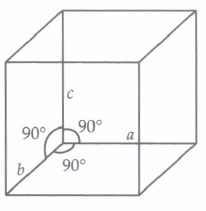
| a) cubic | (b) orthorhombic | (c) tetragonal | (d) trigonal |
(iii) In a triclinic crystal
| \(\text { (a) } a=b=c, \quad \alpha=\beta=\gamma \neq 90^{\circ}\) | \(\text { (b) } a \neq b=c, \quad \alpha=\beta=\gamma=90^{\circ}\) |
| \(\text { (c) } a \neq b \neq c, \quad \alpha \neq \beta \neq \gamma \neq 90^{\circ}\) | \(\text { (d) } a \neq b \neq c, \quad \alpha=\gamma=90^{\circ}, \beta \neq 90^{\circ}\) |
(iv) The unit cell with dimensions \(\alpha=\beta=\gamma=90^{\circ}, a=b \neq c \) is
| (a) cubic | (b) triclinic | (c) hexagonal | (d) tetragonal |
1.
(a) Frenkel defect
(b) \(4 r=\sqrt{2} a \Rightarrow r=\frac{1.414 \times 361}{4}=127 \mathrm{pm}\)
(c) C3 A4
(d) The energy gap between conduction band and valence band is large in insulators called forbidden zone.
(e) Fe3O4 is ferrimagnetic.
(f) It becomes yellow due to metal excess defect
(g) Covalent solid
2.
(i) (a)
(ii) (c): fcc and hep both have 74% packing efficiency. In bcc there are 2 atoms per unit cell while in fcc there are 4 atoms per unit cell and both have different arrangements.
(iii) (a)
(iv) (b): The no. of atoms in fcc structure is 4 per unit cell which provides a maximum efficiency as 74%.
3.
(I) (b): In molecular solids, molecules are held together by weak forces of attractions.
(ii) (a)
(iii) (c) : Covalent solids are constituted by atoms which can not conduct electricity. That is why covalents solids are insulators of electricity. Covalent solids are constituted by atoms.
(iv) (b)
4.
(i) (a): In Schottky defect equal number of cations and anions are missing from their lattice sites. Therefore, an ionic solid MX with Schottky defect will still have the same number of anions and cations.
(ii) (a): In a Frenkel defect an ion leaves its position in the lattice and occupies normally vacant interstitial position.
(iii) (d): AgBr has both Schottky and Frenkel defect. Schottky defects lower the density of the crystal.
(iv) (b): ZnO shows such colour due to metal excess defect because of the presence of extra cation in interstitial sites.
5.
(i) (b)
(ii) (a): Height of unit cell = \(4 r \sqrt{\frac{2}{3}}\)
Volume of unit cell = Height x Base area
\(=4 r \sqrt{\frac{2}{3}} \times 6 \times \frac{\sqrt{3}}{4} \times 4 r^{2}=24 \sqrt{2} r^{3}\)
(iii) (d): Packing fraction
\(\begin{array}{l} =\frac{\text { Volume of the atoms in one unit cell }}{\text { Volume of one unit cell }} \\ =\frac{6 \times \frac{4}{3} \pi r^{3}}{24 \sqrt{2} r^{3}}=\frac{\pi}{3 \sqrt{2}}=0.74=74 \% \end{array}\)
\(\therefore\) Empty space = 26%.
(iv) (b).
6.
(i) (b): In NaCl crystal, each Cl- ion is surrounded by 6 Na+ ions.
(ii) (a): Anti-fluorite structure (NaCl) have eep arrangement of O2- and Na+ in all tetrahedral voids.
(iii) (c) : Antifluorite structure is derived from fluorite structure by interchanging the positions of positive and negative ions.
(iv) (a) : BaF2 has fluorite structure.
7.
(i) (a): In the crystallisation, some Ag+ ions will get replaced by Cd2+ ions and each Cd2+ ion replaces two Ag+ions so as to maintain electrical neutrality. Thus, the cation vacancies will be the same as the number of Cd2+ ions incorporated.
(ii) (b): Number of defects per mole of NaCl
\(=\frac{1 \times 6.02 \times 10^{23}}{10^{15}}=6.02 \times 10^{8}\)
(iii) (a) : There are 12 edge centres
Contribution of Na+ions at edge centres \(=12 \times \frac{1}{4}=3\)
Besides, there is one Na+ ion at body centre
Thus, there are four Na+ions per unit cell.
\(\frac{3}{4}\) are replaced by Al3+ ions.
Total Na+ions in 1 mole of NaCl = 6.023 x 10²³
Na+ion replaced by Al3+= 3/4 x 6.023 x 1023
1 Al3+ replaces 3 Na+ions thereby creating 2 vacancies.
\(\therefore\) No. of vacancies created \(=\frac{2}{3} \times\left(\frac{3}{4} \times 6.023 \times 10^{23}\right)\)
= 3.01 x 10²³
(iv) (d): In AgBr, Ag+ions are small in size and when removed from lattice point they can occupy interstitial site and therefore show both Frenkel and Schottky defects.
8.
\(\text { (i) }(a): \frac{r\left(\mathrm{Rb}^{+}\right)}{r\left(\mathrm{Br}^{-}\right)}=\frac{148}{195}=0.76(\text { C.N. } 8 \text { above } 0.732)\)
\(\frac{r\left(\mathrm{~K}^{+}\right)}{r\left(\mathrm{Br}^{-}\right)}=\frac{137}{195}=0.702 \text { (C.N. } 6 \text { between } \left.0.414-0.732\right)\)
\({ (ii) }(a): \frac{r_{+}}{r_{-}}=\frac{r\left(\mathrm{Na}^{+}\right)}{r\left(\mathrm{Cl}^{-}\right)}=\frac{95}{181}=0.524\)
The radius ratio lies between 0.414 - 0.732.
Hence, Na + ions prefer to occupy octahedral holes having coordination number 6.
(iii) (c): When coordination number is 8, r+/r- ratio lies between 0.732 - 1.
(iv) (a): If the pressure of CsCl is increased, then its coordination number will increase.
9.
(i) (d): For hep packing, the coordination number of each sphere is 12 (6 in its own layer, 3 in the upper layer and 3 in the lower layer).
(ii) (b): In hexagonal close packing, each sphere of third layer lies exactly above the sphere of first layer.
Thus, hep is abbreviated as ABAB ....
In cubic close packing, the spheres of third layer do not come over those of first layer and spheres of fourth layer correspond with those in first layer. Thus, it is represented as ABCABC ....
(iii) (a)
(iv) (c): They are isotropic as they show same properties in all directions.
10.
(i) (b): For hexagonal crystal system, \(a=b \neq c\) and \(\alpha=\beta=90^{\circ}, \gamma=120^{\circ}\)
(ii) (a): Here, \(a=b=c ; \alpha=\beta=\gamma=90^{\circ}\) It belongs to cubic system.
(iii) (c)
(iv) (d): For tetragonal crystal system \(a=b \neq c \text { and }\)\(\alpha=\beta=\gamma=90^{\circ}\)

12th Standard CBSE Syllabus & Materials
12th Standard CBSE
CBSE 12th Computer Science Python Revision Tour I - New Previous year Question Papers Study Material - QB365 Set A
NEW12th Standard CBSE
CBSE 12th Business Studies Planning Important Questions And Answers Study Material - QB365 Set A
NEW12th Standard CBSE
CBSE 12th Business Studies Business Environment Important Questions And Answers Study Material - QB365 Set A
NEW12th Standard CBSE
CBSE 12th Business Studies Principles of Management Important Questions And Answers Study Material - QB365 Set A



CBSE 12th Standard CBSE Subjects
CBSE Standards










