
 100% FREE ACCESS
12th Standard CBSE Syllabus & Materials
12th Standard CBSE
CBSE 12th Economics Government Budget and the Economy Previous year Question Papers Study Material - QB365 Set A
NEW12th Standard CBSE
CBSE 12th Computer Science Interface Python with MySQL - New Previous year Question Papers Study Material - QB365 Set A
NEW12th Standard CBSE
CBSE 12th Computer Science Database Concept - New Previous year Question Papers Study Material - QB365 Set A
NEW12th Standard CBSE
CBSE 12th Computer Science Data Communication - New Previous year Question Papers Study Material - QB365 Set A
NEW12th Standard CBSE
CBSE 12th Computer Science Data Structures - New Previous year Question Papers Study Material - QB365 Set A
NEW12th Standard CBSE
CBSE 12th Computer Science Functions - New Previous year Question Papers Study Material - QB365 Set A

Published on: 08/09/2022
QB365 provides a detailed and simple solution for every Possible Case Study Questions in Class 12 Chemsitry Subject - Electrochemistry, CBSE. It will help Students to get more practice questions, Students can Practice these question papers in addition to score best marks.
Download CBSE Class 12th Standard CBSE Chemistry question papers, sample papers, important questions, and previous year solved papers in PDF format. Get free study materials, NCERT solutions, and exam preparation resources for Class 12th Standard CBSE Chemistry
Questions + Answers key
Take MCQ Chemistry Test
1.
Observe the following table in which conductivity and molar conductivity of NaCI at 298 K at different concentration for different electrolytes is given. Answer the questions based in the table that follows:
Conductivities and molar conductivities of NaCI at 298 K at different concentrations.
| S. No | Conc. (M) | K m S cm-1 | \(\Lambda_{\mathrm{m}} \mathrm{S} \mathrm{cm}^{2} \mathrm{~mol}^{-1}\) |
| 1 | 0.001 | 1.237 x 10⁻⁴ | 123.7 S cm2 mol-1 |
| 2 | 0.010 | 11.85 x 10⁻⁴ | 118.5 S cm2 mol-1 |
| 3 | 0.020 | 23.15 x 10⁻⁴ | 115.8 S cm2 mol-1 |
| 4 | 0.050 | 55.53 x 10⁻⁴ | 111.1 S cm2 mol-1 |
| 5 | 0.100 | 106.74 x 10⁻⁴ | 106.7 S cm2 mol-1 |
| \(\Lambda_{\mathrm{m}}^{\mathrm{o}}\) |
| NaCI 126.4 S cm2 mol-1 |
| HCl 426.1 S cm2 mol-1 |
| CH3COONa 91 S cm 2 mol-1 |
| NH4CI 129.8 S cm2 mo1-1 |
(a) What happens to conductivity on dilution and why?
(b) Why is \(\Lambda_{\mathrm{m}}^{\mathrm{o}}\) (limiting molar conductivity) for HCI more than NaCl?
(c) Calculate degree of dissociation (\(\alpha\)) of NaCI of 0.001 M concentration using the table.
(d) Calculate \(\Lambda_{\mathrm{m}}^{\mathrm{o}}\) of CH3COOH using the table.
(e) Calculate Ka of 0.01 M CH3 COOH solution if \(\Lambda_{\mathrm{m}}^{\mathrm{o}}\) for CH3COOH is 390.07S cm2 mol-1, \(\Lambda_{\mathrm{m}}\) = 39.07S cm-1.
2.
Observe the graph shown in figure between Am (molar conductivity) Vs \(\sqrt{\mathrm{C}}\) (Molar concentration) and answer the questions based on graph.
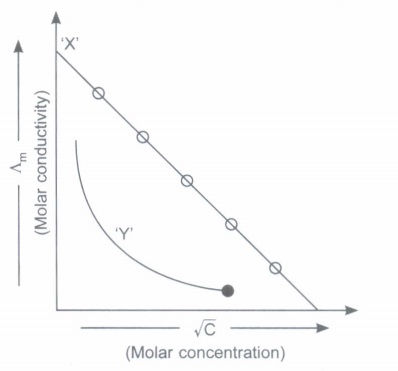
(a) The curve 'V' is for KCI or CH3 COOH?
(b) What is intercept on \(\Lambda\)m axis for 'X' equal to?
(c) Give mathematical equation representing straight line.
(d) What is slope equal to?
(e) What happens to molar conductivity on dilution in case of weak electrolyte and why?
3.
Electrochemistry plays a very important part in our daily life. Primary cells like dry cell is used in torches, wall clock, mercury cell is used in hearing aids, watches. Secondary cells Ni-Cd cell is used in cordless phones, lithium battery is used in mobiles, lead storage battery is used in vehicle and inverter. Fuel cells like H2 -O2 cell was used in apollo space programme. A 38% solution of sulphuric and is used in lead storage battery. Its density is 1.30 g mL -1. The battery holds 3.5 L of the acid. During the discharge of the battery, the density of H2 SO4 falls to 1.14 g mL -1 (20% solution by mass) (Molar mass of H2 SO4 is 98 g mol -1).
(a) Write the chemical reaction taking place at anode when lead storage battery is in use.
(b) How much electricity in Faraday is required to carry out the reduction of one mole of PbO2 ?
(c) What is molarity of sulphuric acid before discharge?
(d) What is mass of sulphuric acid in solution after discharge?
(e) Write the products of electrolysis when dilute sulphuric acid is electrolysed using platinum electrodes.
4.
Metallic conductance involves movement of electrons where as electrolytic conductance involves movement of ions. Specific conductance increases with increase in concentration where as Am (molar conductivity) decreases with increase in concentration. Electrochemical cell converts chemical energy of redox reaction into electricity. Mercury cell, Dry cells are primary cells where as Ni-Cd cell, lead storage battery are secondary cells. Electroehemical series is arrangement of elements in increasing order of their reduction potential. Electrolytic cell converts electrical energy into chemical energy which is used in electrolysis. Amount of products formed are decided with the help of Faraday's laws of Electrolysis. Kohlrausch law helps to determine limiting molar conductivity of weak electrolyte, their degree of ionisation (\(\alpha\)) and their dissociation constants. Corrosion is electrochemical phenomenon. Metal undergoing corrosion acts as anode, loses electrons to form ions which combine with substances present in atmosphere to form surface compounds. More reactive metals are coated over less reactive metals to prevent corrosions. H2 -O2 fuel cell was used in apollo space programme.
(a) Out of 0.5 M, 0.01 M, 0.1 M and 1.0 M which solution of KCl will have highest value of specific conductance? Why?
(b) Write the product of electrolysis of aq. NaCI on cathode. Why?
(c) When does electrochemical cell behaves like electrolytic cell?
(d) For an electrochemical cell Mg(s) + 2Ag+(aq) \(\rightarrow\) 2Ag(s) + Mg2+. Give the cell representation and write Nernst equation.
(e) Which will have higher conductance, silver wire at 30° or at 60°C?
(f) Calculate maximum work obtained from the cell Ni(s) + 2Ag+(aq) \(\rightarrow\) Ni2+(aq) + 2Ag(s) Eocell = 1.05V.
(g) Which cell is used in hearing aids and watches?
5.
Read the passage given below and answer the following questions:
Nernst equation relates the reduction potential of an electrochemical reaction to the standard potential and activities of the chemical species undergoing oxidation and reduction. Let us consider the reaction, \(M_{(a q)}^{n+} \longrightarrow n M_{(s)}\)
For this reaction, the electrode potential measured with respect to standard hydrogen electrode can be given as
\(E_{\left(M^{n+} / M\right)}=E_{\left(M^{n+} / M\right)}^{\circ}-\frac{R T}{n F} \ln \frac{[M]}{\left[M^{n+}\right]}\)
In these questions ( i-iv), a statement of assertion followed by a statement of reason is given. Choose the correct answer out of the following choices.
| (a) Assertion and reason both are correct statements and reason is correct explanation for assertion. |
| (b) Assertion and reason both are correct statements but reason is not correct explanation for assertion |
| (c) Assertion is correct statement but reason is wrong statement |
| (d) Assertion is wrong statement but reason is correct statement. |
(i) Assertion : For concentration cell, \(\begin{array}{c} \mathrm{Zn}_{(s)}\left|\mathrm{Zn}^{2+}{ }_{(a q)} \| \mathrm{Zn}^{2+}{ }_{(a q)}\right| \mathrm{Zn} \\ \mathrm{C}_{1} \quad \mathrm{C}_{2} \end{array}\)
For spontaneous cell reaction, C1 < C2.
Reason : For concentration cell \(E_{\text {cell }}=\frac{R T}{n F} \log \frac{C_{2}}{C_{1}}\)
For spontaneous reaction, \(E_{\text {cell }}=+\mathrm{ve} \Rightarrow C_{2}>C_{1}\)
(ii) Assertion : For the cell reaction, \(\mathrm{Zn}_{(s)}+\mathrm{Cu}_{(a q)}^{2+} \longrightarrow \mathrm{Zn}_{(a q)}^{2+}+\mathrm{Cu}_{(s)}\) voltmeter gives zero reading at equilibrium.
Reason : At the equilibrium, there is no change in concentration of Cu2+ and Zn2+ ions.
(iii) Assertion : The Nernst equation gives the concentration dependence of emf of the cell.
Reason : In a cell, current flows from cathode to anode
(iv) Assertion : Increase in the concentration of copper half cell in a cell, increases the emf of the cell
Reason : \(E_{\text {cell }}=E_{\text {cell }}^{\circ}+\frac{0.059}{2} \log \frac{\left[\mathrm{Cu}^{2+}\right]}{\left[\mathrm{Zn}^{2+}\right]}\)
6.
Read the passage given below and answer the following questions:
Electrical work done in unit time is equal to electrical potential multiplied by total charge passed. In order to obtain maximum work from a cell, the charge has to be passed reversibly. The reversible work done by a cell is equal to decrease in its Gibb's energy. Hence, Gibb's energy of reaction is given by
\(\Delta G=-n F E_{\text {cell }}\)
Hence, E is the emf of the cell and nF is the amount of energy.
In these questions (i-iv), a statement of assertion followed by a statement of reason is given. Choose the correct answer out of the following choices
(i) Assertion : \(\Delta G^{\circ}=-n F E^{\circ}\)
Reason : Eo should be positive for a spontaneous reaction
| (a) Assertion and reason both are correct statements and reason is correct explanation for assertion |
| (b) Assertion and reason both are correct statements but reason is not correct explanation for assertion. |
| (c) Assertion is correct statement but reason is wrong statement. |
| (d) Assertion is wrong statement but reason is correct statement. |
(ii) Assertion : An electrochemical cell can be set up only if the redox reaction is spontaneous.
Reason : A reaction is spontaneous if free energy change is negative.
| (a) Assertion and reason both are correct statements and reason is correct explanation for assertion |
| (b) Assertion and reason both are correct statements but reason is not correct explanation for assertion. |
| (c) Assertion is correct statement but reason is wrong statement. |
| (d) Assertion is wrong statement but reason is correct statement. |
(iii) Assertion : Current stops flowing when Ecell = 0.
Reason : Equilibrium of the cell reaction is attained.
| (a) Assertion and reason both are correct statements and reason is correct explanation for assertion |
| (b) Assertion and reason both are correct statements but reason is not correct explanation for assertion. |
| (c) Assertion is correct statement but reason is wrong statement. |
| (d) Assertion is wrong statement but reason is correct statement. |
(iv) Assertion: Ecell should have a positive value for the cell to function.
Reason : Ecell = Ecathode - Eanode
| (a) Assertion and reason both are correct statements and reason is correct explanation for assertion |
| (b) Assertion and reason both are correct statements but reason is not correct explanation for assertion. |
| (c) Assertion is correct statement but reason is wrong statement. |
| (d) Assertion is wrong statement but reason is correct statement. |
7.
Read the passage given below and answer the following questions:
Two types of conductors are generally used, metallic and electrolytic. Free electrons are the current carrier in metallic and in electrolytic conductors, free ions. Specific conductance or conductivity of an electrolytic solution is given by
\(\kappa=C \times \frac{l}{A}\)
where, C = l/R and l/A = G* (cell constant)
Molar conductance (\(\Lambda_{m}\)) and equivalent conductance (\(\Lambda_{e}\) ) of an electrolyte solution are calculated as
\(\Lambda_{m}=\frac{\kappa \times 1000}{M} \text { or } \Lambda_{e}=\frac{\kappa \times 1000}{N}\)
where, M = molarity of solution and Nis normality of solution. Molar conductance of strong electrolyte depends on the concentration.
\(\Lambda_{m}=\Lambda_{m}^{0}-b \sqrt{C}\)
\(\Lambda_{m}^{\circ}\) = molar conductance at infinite dilution, b = constant, C = conc of solution
In these questions (i-iv), a statement of assertion followed by a statement of reason is given. Choose the correct answer out of the following choices.
(i) Assertion : The molar conductivity of strong electrolyte decreases with increase in concentration.
Reason : At high concentration, migration of ions is slow
| (a) Assertion and reason both are correct statements and reason is correct explanation for assertion |
| (b) Assertion and reason both are correct statements but reason is not correct explanation for assertion. |
| (c) Assertion is correct statement but reason is wrong statement |
| (d) Assertion is wrong statement but reason is correct statement. |
(ii) Assertion : Equivalent conductance of all electrolytes increases with increasing concentration.
Reason : More number of ions are available per gram equivalent at higher concentration.
| (a) Assertion and reason both are correct statements and reason is correct explanation for assertion |
| (b) Assertion and reason both are correct statements but reason is not correct explanation for assertion. |
| (c) Assertion is correct statement but reason is wrong statement |
| (d) Assertion is wrong statement but reason is correct statement. |
(iii) Assertion : Specific conductance decreases with dilution whereas equivalent conductance increases.
Reason : On dilution, number of ions per milli litre decreases but total number of ions increases considerably
| (a) Assertion and reason both are correct statements and reason is correct explanation for assertion |
| (b) Assertion and reason both are correct statements but reason is not correct explanation for assertion. |
| (c) Assertion is correct statement but reason is wrong statement |
| (d) Assertion is wrong statement but reason is correct statement. |
(iv) Assertion : The ratio of specific conductivity to the observed conductance does not depend upon the concentration of the solution taken in the conductivity cell.
Reason : Specific conductivity decreases with dilution whereas observed conductance increases with dilution.
| (a) Assertion and reason both are correct statements and reason is correct explanation for assertion |
| (b) Assertion and reason both are correct statements but reason is not correct explanation for assertion. |
| (c) Assertion is correct statement but reason is wrong statement |
| (d) Assertion is wrong statement but reason is correct statement. |
8.
Read the passage given below and answer the following questions :
The potential of each electrode is known as electrode potential. Standard electrode potential is the potential when concentration of each species taking part in electrode reaction is unity and the reaction is taking place at 298 K. By convention, the standard ectrode potential of hydrogen (SHE) is 0.0 V. The electrode potential value for eacfi electrode process is a measure of relative tendency of the active species in the process to remain in the oxidisedlreduced form. The negative electrode potential means that the redox couple is stronger reducing agent than H+/H2 couple. A positive electrode potential means that the redox couple is a weaker reducing agent than the H+/H2 couple. Metals which have higher positive value of standard reduction potential form the oxides of greater thermal stability.
In these questions (i-iv), a statement of assertion followed by a statement of reason is given. Choose the correct answer out of the following choices.
(i) Assertion : An electrochemical cell can be set-up only if the redox reaction is spontaneous.
Reason : A reaction is spontaneous if the free energy change is negative.
| (a) Assertion and reason both are correct statements and reason is correct explanation for assertion. |
| (b) Assertion and reason both are correct statements but reason is not correct explanation for assertion |
| (c) Assertion is correct statement but reason is wrong statement. |
| (d) Assertion is wrong statement but reason is correct statement. |
(ii) Assertion : The standard electrode potential of hydrogen is 0.0 V.
Reason : It is by convention.
| (a) Assertion and reason both are correct statements and reason is correct explanation for assertion. |
| (b) Assertion and reason both are correct statements but reason is not correct explanation for assertion |
| (c) Assertion is correct statement but reason is wrong statement. |
| (d) Assertion is wrong statement but reason is correct statement. |
(iii) Assertion : The negative value of standard reduction potential means that reduction takes place on this electrode with reference to hydrogen electrode.
Reason : The standard electrode potential of a half cell has a fixed value.
| (a) Assertion and reason both are correct statements and reason is correct explanation for assertion. |
| (b) Assertion and reason both are correct statements but reason is not correct explanation for assertion |
| (c) Assertion is correct statement but reason is wrong statement. |
| (d) Assertion is wrong statement but reason is correct statement. |
(iv) Assertion : The absolute value of electrode potential cannot be determined experimentally.
Reason : The electrode potential values are generally determined with respect to SHE.
| (a) Assertion and reason both are correct statements and reason is correct explanation for assertion. |
| (b) Assertion and reason both are correct statements but reason is not correct explanation for assertion |
| (c) Assertion is correct statement but reason is wrong statement. |
| (d) Assertion is wrong statement but reason is correct statement. |
9.
Read the passage given below and answer the following questions:
The electrochemical cell shown below is concentration cell. M|M2+ (saturated solution of a sparingly soluble salt, MX2 ) || M2+ (0.001 mol dm-3 ) | M The emf of the cell depends on the difference in concentrations of M2+ ions at the two electrodes. The emf of the cell at 298 K is 0.059 V.
The following questions are multiple choice questions. Choose the most appropriate answer:
(i) The solubility product (Ksp, mol3 dm-9) of MX2 at 298 K based on the information available for the given concentration cell is (take 2.303 x R x 298/P = 0.059)
| (a) 2 x 10-15 | (b) 4 x 10-15 | (c) 3 x 10-12 | (d) 1 x 10¹² |
(ii) The value of \(\Delta G\) (in kJ mol-1) for the given cell is (take 1F = 96500 C mol-1)
| (a) 3.7 | (b) -3.7 | (c) 10.5 | (d) -11.4 |
(iii) The equilibrium constant for the following reaction is
\(\mathrm{Fe}^{2+}+\mathrm{Ce}^{4+} \rightleftharpoons \mathrm{Ce}^{3+}+\mathrm{Fe}^{3+}\)
(Given, \(E^{0} \mathrm{Ce}^{4+} / \mathrm{Ce}^{3+}=1.44\) and Eo \(E_{\mathrm{Fe}^{3+} / \mathrm{Fe}^{2+}}=0.68 \mathrm{~V}\))
| (a) 7.6 x 10¹² | (b) 6.5 x 10¹⁰ | (c) 5.2 x 10⁹ | (d) 3.4 x 10¹² |
(iv) To calculate the emf of the cell, which of the following options is correct?
| (a) emf = Ecathode - Eanode | (b) emf = Eanode - Ecathode |
| (c) emf = Eanode + Ecathode | (d) None of these |
10.
Read the passage given below and answer the following questions:
The concentration of potassium ions inside a biological cell is at least twenty times higher than the outside. The resulting potential difference across the cell is important in several processes such as transmission of nerve impulses and maintaining the ion balance. A simple model for such a concentration cell involving a metal M is M(s) | M+(aq.; 0.05 molar) || M+(aq; 1 molar) |M(s).
The following questions are multiple choice questions. Choose the most appropriate answer:
(i) For the above cell,
| (a) \(E_{\text {cell }}<0 ; \Delta G>0\) | (b) \(E_{\text {cell }}>0 ; \Delta G<0\) | (c) \(E_{\text {cell }}<0 ; \Delta G^{\circ}>0\) | (d) \(E_{\text {cell }}>0 ; \Delta G^{\circ}<0\) |
(ii) The value of equilibrium constant for a feasible cell reaction is
| (a) < 1 | (b) = 1 | (c) > 1 | (d) zero |
(iii) What is the emf ofthe cell when the cell reaction attains equilibrium?
| (a) 1 | (b) 0 | (c) > 1 | (d) < 1 |
(iv) The potential of an electrode change with change in
| (a) concentration of ions in solution | (b) position of electrodes |
| (c) voltage of the cell | (d) all of these |
11.
Read the passage given below and answer the following questions :
All chemical reactions involve interaction of atoms and molecules. A large number of atoms/molecules are present in a few gram of any chemical compound varying with their atomic/molecular masses. To handle such large number conveniently, the mole concept was introduced. All electrochemical cell reactions are also based on mole concept. For example, a 4.0 molar aqueous solution of NaCI is prepared and 500 mL of this solution is electrolysed. This leads to the evolution of chlorine gas at one of the electrode. The amount of products formed can be calculated by using mole concept.
The following questions are multiple choice questions. Choose the most appropriate answer :
(i) The total number of moles of chlorine gas evolved is
| (a) 0.5 | (b) 1.0 | (c) 1.5 | (d) 1.9 |
(ii) If cathode is a Hg electrode, then the maximum weight of amalgam formed from this solution is
| (a) 300 g | (b) 446 g | (c) 396 g | (d) 296 g |
(iii) In the electrolysis, the number of moles of electrons involved are
| (a) 2 | (b) 1 | (c) 3 | (d) 4 |
(iv) In electrolysis of aqueous NaCl solution when Pt electrode is taken, then which gas is liberated at cathode?
| (a) H2 gas | (b) C2 gas | (c) O2 gas | (d) None of these |
12.
Read the passage given below and answer the following questions:
Standard electrode potentials are used for various processes:
(i) It is used to measure relative strengths of various oxidants and reductants.
(ii) It is used to calculate standard cell potential.
(iii) It is used to predict possible reactions.
A set of half-reactions (in acidic medium) along with their standard reduction potential, Eo (in volt) values are given below
\(\mathrm{I}_{2}+2 e^{-} \rightarrow 2 \mathrm{I}^{-} ; \quad E^{\circ}=0.54 \mathrm{~V}\)
\(\mathrm{Cl}_{2}+2 e^{-} \rightarrow 2 \mathrm{Cl}^{-} ; \quad E^{\circ}=1.36 \mathrm{~V}\)
\(\mathrm{Mn}^{3+}+e^{-} \rightarrow \mathrm{Mn}^{2+} ; \quad E^{\circ}=1.50 \mathrm{~V}\)
\(\mathrm{Fe}^{3+}+e^{-} \longrightarrow \mathrm{Fe}^{2+} ; \quad E^{\circ}=0.77 \mathrm{~V}\)
\(\mathrm{O}_{2}+4 \mathrm{H}^{+}+4 e^{-} \longrightarrow 2 \mathrm{H}_{2} \mathrm{O} ; E^{\circ}=1.23 \mathrm{~V}\)
The following questions are multiple choice questions. Choose the most appropriate answer:
(i) Which of the following statements is correct?
| (a) CI- is oxidised by O2 | (b) Fe2+ is oxidised by iodine |
| (c) I- is oxidised by chlorine. | (d) Mn2+ is oxidised by chlorine |
(ii) Mn3+ is not stable in acidic medium, while Fe3+is stable because
| (a) O2 oxidises Mn2+ to Mn3+ |
| (b) O2 oxidises both Mn2+ to Mn3+ and Fe2+ to Fe3+ |
| (c) Fe3-oxidises H2O to O2 |
| (d) Mn3+ oxidises H2O to O2 |
(iii) The strongest reducing agent in the aqueous solution is
| (a) I- | (b) Cl- | (c) Mn2+ | (d) Fe2+ |
(iv) The emf for the following reaction is
\(\mathrm{I}_{2}+\mathrm{KCl} \rightleftharpoons 2 \mathrm{KI}+\mathrm{Cl}_{2}\)
| (a) -0.82 V | (b) +0.82 V | (c) -0.73 V | (d) +0.73 V |
13.
Read the passage given below and answer the following questions:
Molar conductivity of ions are given as product of charge on ions to their ionic mobilities and Faraday's constant.
\(\lambda_{A^{n+}}=n \mu_{A^{n+}} F\) (here \(\mu\) is the ionic mobility of An+).
For electrolytes say AXBy, molar conductivity is given by
\(\lambda_{m\left(A_{x} B_{y}\right)}=x_{n} \mu_{A^{n+}} F+y_{m} \lambda_{A^{m}-F}\)
| Ions | Ionic mobility |
| K+ | 7.616 x 10- 4 |
| Ca2+ | 12.33 x 10⁻⁴ |
| Br- | 8.09 x 10- 4 |
| \(\mathrm{SO}_{4}^{2-}\) | 16.58 x 10- 4 |
The following questions are multiple choice questions. Choose the most appropriate answer
(i) At infinite dilution, the equivalent conductance of CaSO4 is
| (a) 256 x 10-4 | (b) 279 | (c) 23.7 | (d) 2.0 x 10- 8 |
(ii) If the degree of dissociation of CaSO4 solution is 10% then equivalent conductance of CaSO4 is
| (a) 3.59 | (b) 36.9 | (c) 27.9 | (d) 30.6 |
(iii) What is the unit of equivalent conductivity?
| (a) ohm-1 cm2 eq-1 | (b) ohm cm2eq-1 |
| (c) ohm-1 cm eq-1 | (d) ohm cm2 eq-1 |
(iv) If the molar conductance value of Ca2+ and Cl- at infinite dilution are 118.88 x 10⁻⁴ m2 mho mol-1 and 77.33 x 10⁻⁴ m 2 mho mol-1 respectively then the molar conductance of CaCl2 (in m2 mho mol-1) will be
| (a) 120.18 x 10- 4 | (b) 135 x 10-4 | (c) 273.54 x 10⁻⁴ | (d) 192.1 x 10⁻⁴ |
1.
(a) Conductivity decreases with decrease in concentration (dilution) because number of ions per unit volume decreases.
(b) It is because mobility of H+ is more than Na + became H+ are lighter than Na +.
(c) \(\alpha=\frac{\wedge_{m}}{\Lambda_{m}^{\circ}}=\frac{123.7}{126.4}=0.978 \Rightarrow \alpha=97.8 \%\)
(d) \(\Lambda_{\mathrm{m}}^{\circ} \mathrm{CH}_{3} \mathrm{COOH}=\Lambda^{\circ} \mathrm{CH}_{3} \mathrm{COONa}+\Lambda^{\circ} \mathrm{HCl}\) \(-\Lambda^{\circ} \mathrm{NaCl}\)
\(\Lambda_{\mathrm{m}}^{\mathrm{o}}\) CH3COOH = 91.0 + 426.1 - 126.4
= 390.07S cm2 mol-1.
(e) \(\alpha=\frac{\wedge_{m}}{\Delta_{m}^{\circ}}=\frac{39.07}{390.07}=0.1\)
\(\mathrm{Ka}=\frac{\mathrm{C} \alpha}{1-\alpha}=\frac{0.01 \times(0.1)^{2}}{1-0.1}\)
\(\mathrm{Ka}=\frac{10^{-4}}{0.9}=1.11 \times 10^{-4}\)
2.
(a) It is for CH3COOH.
(b) It is equal \(\Lambda\)° (limiting molar conductivity).
(c) \(\Lambda_{\mathrm{m}}=\Lambda_{\mathrm{m}}^{\circ}-\mathrm{A} \sqrt{\mathrm{C}}\)
(d) Slope = -A
(e) \(\Lambda\)m for weak electrolyte increases sharply on dilution because both number of ions as well as mobility of ions increases.
3.
(a) \(\mathrm{Pb}+\mathrm{SO}_{4}^{2-} \longrightarrow \mathrm{PbSO}_{4}+2 \mathrm{e}^{-}\) (At anode)
(b) \(\mathrm{PbO}_{2}+4 \mathrm{H}^{+}+2 \mathrm{e}^{-}+\mathrm{SO}_{4}^{2-} \longrightarrow \mathrm{PbSO}_{4}+2 \mathrm{H}_{2} \mathrm{O}\)
2 Faraday is required.
(c) \(\mathrm{M}=\frac{\text { percentage by mass } \times d \times 10}{\text { Molar mass }}\)
\(=\frac{38 \times 1.30 \times 10}{98}=\frac{494}{98}=5.041 \mathrm{M}\)
(d) Mass of solution after discharge = 3500 mL x 1.14 g mL-1 = 3990 g
Mass of H2 SO4 present in solution (20%) = \(\frac{20}{100} \times 3990 \mathrm{~g}=798 \mathrm{~g}\)
(e) \(\mathrm{H}_{2} \mathrm{SO}_{4}(\mathrm{dil}) \longrightarrow 2 \mathrm{H}^{+}+\mathrm{SO}_{4}^{2-}\)
H2O \(\rightarrow\) H+ + OH-
At cathode: 2H+ + 2e- \(\rightarrow\) H2(g)
At anode: \(2 \mathrm{H}_{2} \mathrm{O} \longrightarrow 4 \mathrm{H}^{+}+4 \mathrm{e}^{-}+\mathrm{O}_{2}(g)\)
H2 gas is liberated at cathode and O2 gas is formed at anode.
4.
(a) 1,0 M KCI solution because it will have more number of ions per unit volume of solution.
(b) \(2 \mathrm{H}^{+}+2 e^{-} \rightarrow \mathrm{H}_{2}(g)\)
\(\left[\because \mathrm{E}_{\mathrm{H}^{+} / \mathrm{H}_{2}}^{\circ}=0\right.\) , is higher than \(\left.\mathrm{E}_{\mathrm{Na}^{+} / \mathrm{Na}}^{\circ}=-2.71 \mathrm{~V}\right]\)
(c) When Eextemal > Eo cell
(d) Mg(s) I Mg2+ (aq) II Ag+ (aq) I Ag(s)
\(\mathrm{E}_{\mathrm{cell}}=\mathrm{E}_{\text {cell }}^{\circ}-\frac{0.0591}{2} \log \frac{\left[\mathrm{Mg}^{2+}\right]}{\left[\mathrm{Ag}^{+}\right]^{2}}\)
(e) Silver wire at 30°C. Metallic conductance decreases with increase in temperature.
(f) \(\triangle\)Go = - nPF = - 2 x l.05 V x 96500 C = - 202.65 kJ
Wmax= - \(\triangle\)Go = - (-202.65 kJ) = + 202.65 kJ
(g) Mercury cell
5.
(i) (a) : \(\log \left(\frac{C_{1}}{C_{2}}\right)<0\) for spontaneity.
∴ C1 < C2
(ii) (a)
(iii) (b)
(iv) (a)
6.
(i) (b)
(ii) (b): If redox reaction is spontaneous, \(\Delta G\) is -ve and hence, Eo is positive.
\(-\Delta G^{\mathrm{o}}=n F E^{\circ} \mathrm{cell}\)
(iii) (a)
(iv) (b)
7.
(i) (a)
(ii) (d) : At higher concentration, mobility of ions decreases. Hence, conductance decreases.
(iii) (c) : Total number of ions will increase slightly on dilution (not considerably).
(iv) (b)
8.
(i) (b)
(ii) (a)
(iii) (d) : A negative value of standard reduction potential means that oxidation takes' place on the electrode with reference to SHE.
(iv) (a)
9.
(i) (b) : \(0.059=\frac{+0.059}{2} \log \frac{0.001}{\left[M^{2+}\right]}\)
\(\log \frac{0.001}{\left[M^{2+}\right]}=2 \text { or }\left[M^{2+}\right]=10^{-5}\)
Let solubility of salt be S mol/litre
\(\begin{array}{cc} \text {Thus,} \ M X_{2} & \rightarrow M^{2+}+2 X^- \\ S & S& 2 S \end{array}\)
\(\therefore\) Ksp = 4S3 = 4 x (10-5 )3 = 4 x 10-15
(ii) (d) : \(\Delta G=-n F E=-2 \times 96500 \times 0.059\)
= -11387 J mol-1 = -11.4 kJ mol-1
(iii) (a) : \(E_{\mathrm{cell}}^{\circ}=\frac{0.059}{1} \log K_{\mathrm{C}}\)
\(E_{\mathrm{cell}}^{\circ}=E_{\mathrm{Fe}^{2+} / \mathrm{Fe}^{3+}}^{\circ}+E_{\mathrm{Ce}^{4+} / \mathrm{Ce}^{3+}}^{\circ}\)
= -0.68 + 1.44 = 0.76 V
\(\log _{10} K_{C}=\frac{0.76}{0.059}=12.88\)
KC = 7.6 x 10¹²
(iv) (a)
10.
(i) (b) : \(\begin{array}{l} M \longrightarrow M^{+}+e^{-} \\ (1 \cdot M)(0.05 M) \end{array}\)
For concentration cell, \(E_{\text {cell }}=-\frac{0.059}{1} \log \frac{0.05}{1}\)
\(E_{\text {cell }}=-\frac{0.059}{1} \log \left(5 \times 10^{-2}\right)\)
\(E_{\text {cell }}=-\frac{0.059}{1}[(-2)+\log 5]-0.059(-2+0.698)\)
= -0.059(-1.302) = 0.0768
\(\Delta G=-n F E_{\text {cell }}\)
If Ecell is positive, \(\Delta G\) is negative.
(ii) (c) : \(K=\operatorname{antilog}\left(\frac{n E^{\circ}}{0.0591}\right)\)
For feasible cell, Eo is positive, hence from the above equation K > 1 for a feasible cell reaction.
(iii) (b)
(iv) (a)
11.
(i) (b) : \(n_{\mathrm{NaCl}}=\frac{4 \times 500}{1000}=2 \mathrm{~mol}\)
\(\therefore\) \(n_{\mathrm{Cl}_{2}}=1 \mathrm{~mol}\)
(ii) (b) : nNa deposited = 2 mol
\(\therefore\) nNa _ Hg formed = 2 mol
\(\therefore\) Mass of amalgam formed = 2 x 223 = 446 g
(iii) (a)
(iv) (a)
12.
(i) (c) : The half cell having the higher reduction potential will undergo reduction process.
(ii) (d) : Electrode potential of Mn3+ is higher than O2.
(iii) (a) : Due to least electrode potential value.
(iv) (a) : Half reactions :
| \(\mathrm{I}_{2}+2 e^{-} \rightarrow 2 \mathrm{I}^{-}\) | Reduction Eo = 0.54 V |
| \(2 \mathrm{Cl}^{-} \longrightarrow \mathrm{Cl}_{2}+2 e^{-}\) | Oxidation Eo = -1.36 V |
| ------------------------------- | |
| e.m.f = -0.82 V |
13.
(i) (b) : Equivalent conductance of CaSO4 :
\(\Lambda_{\mathrm{CaSO}_{4}}^{\infty}=\lambda_{\mathrm{Ca}^{2+}}^{\infty}+\lambda_{\mathrm{SO}_{4}^{2-}}^{\infty}\)
\(\lambda_{\mathrm{Ca}^{2+}}^{\infty}=\left(\mu_{\mathrm{Ca}^{2+}}\right) F ; \lambda_{\mathrm{SO}_{4}^{2-}}^{\infty}=\left(\mu_{\mathrm{SO}_{4}^{2-}}\right) F\)
\(\mu_{\mathrm{Ca}^{2+}}\) and \(\mu_{\mathrm{SO}_{4}^{2-}}\) - are ionic mobilities.
\(\Lambda_{\mathrm{CaSO}_{4}}^{\infty}=F(12.33+16.58) \times 10^{-4}\)
= 96500 x 10- 4 x 28.91 = 279
(ii) (c) : \(\alpha=\frac{\Lambda_{C}}{\Lambda^{\infty}} \Rightarrow 0.1=\frac{\Lambda_{C}}{279} \Rightarrow \Lambda_{C}=27.9\)
(iii) (a)
(iv) (c) : \(\Lambda_{m\left(\mathrm{CaCl}_{2}\right)}^{\circ}=\lambda_{\mathrm{Ca}^{2+}}^{\circ}+2 \lambda_{\mathrm{Cl}^{-}}^{\circ}\)
= (118.88 x 10- 4 ) + 2(77.33 x 10- 4 )
= 273.54 x 10⁻⁴ m2 mho mol-1

12th Standard CBSE Syllabus & Materials
12th Standard CBSE
CBSE 12th Computer Science Python Revision Tour I - New Previous year Question Papers Study Material - QB365 Set A
NEW12th Standard CBSE
CBSE 12th Business Studies Planning Important Questions And Answers Study Material - QB365 Set A
NEW12th Standard CBSE
CBSE 12th Business Studies Business Environment Important Questions And Answers Study Material - QB365 Set A
NEW12th Standard CBSE
CBSE 12th Business Studies Principles of Management Important Questions And Answers Study Material - QB365 Set A



CBSE 12th Standard CBSE Subjects
CBSE Standards










