
 100% FREE ACCESS
12th Standard CBSE Syllabus & Materials
12th Standard CBSE
CBSE 12th Economics Government Budget and the Economy Previous year Question Papers Study Material - QB365 Set A
NEW12th Standard CBSE
CBSE 12th Computer Science Interface Python with MySQL - New Previous year Question Papers Study Material - QB365 Set A
NEW12th Standard CBSE
CBSE 12th Computer Science Database Concept - New Previous year Question Papers Study Material - QB365 Set A
NEW12th Standard CBSE
CBSE 12th Computer Science Data Communication - New Previous year Question Papers Study Material - QB365 Set A
NEW12th Standard CBSE
CBSE 12th Computer Science Data Structures - New Previous year Question Papers Study Material - QB365 Set A
NEW12th Standard CBSE
CBSE 12th Computer Science Functions - New Previous year Question Papers Study Material - QB365 Set A

Published on: 08/09/2022
QB365 provides a detailed and simple solution for every Possible Case Study Questions in Class 12 Chemsitry Subject - General Principles and Processes of Isolation of Elements, CBSE. It will help Students to get more practice questions, Students can Practice these question papers in addition to score best marks.
Download CBSE Class 12th Standard CBSE Chemistry question papers, sample papers, important questions, and previous year solved papers in PDF format. Get free study materials, NCERT solutions, and exam preparation resources for Class 12th Standard CBSE Chemistry
Questions + Answers key
Take MCQ Chemistry Test
1.
The melting point of some metals are given in the table. Observe the table and answer the questions that follow:
| Metal | Melting Point |
| 1. Sodium | 98°C |
| 2. Iron | 1538°C |
| 3. Aluminium | 660.3°C |
| 4. Tin | 231.9°C |
| 5. Zinc | 419.5°C |
| 6. Germanium | 938.2°C |
| 7. Titanium | 1668°C |
| 8. Mercury | 356.7° (Boiling point) |
| 9. Copper | 1085°C |
| 10. Gold | 1064°C |
(a) Name two metals which can be purified by distillation and why?
(b) Which methods is used for refining AI, Cu and Zn?
(c) Which method is most suitable for tin and why?
(d) How is Titanium refined?
(e) How is germanium of high purity obtained? What is its basic principle?
2.
Observe the plots of \(\triangle\)Go Vs T for formation of various oxides and answer the questions based on this diagram.
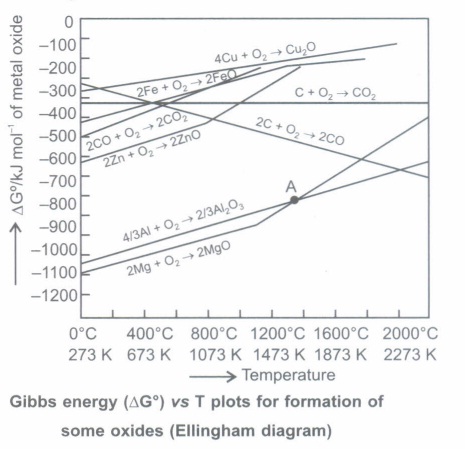
(a) What are these plots called?
(b) Below whattemperature Mg can reduce Al2 O3 ?
(c) What is limitation of Ellingham diagram?
(d) Why is reduction easier if metal formed is in molten state?
(e) Name the reducing agent used in extraction of Fe2O3 . Give chemical reaction.
3.
Aluminium is most abundant metal in earth crust. It is extracted by electrolytic reduction of molten Al2 O3 mixed with cryolite. Chemical reduction is used in reduction of oxide of zinc, iron, copper. Mn and Cr can also extracted by chemical reduction using' AI' as reducing agent. If at a particular temperature \(\triangle\)Go of the reaction is -ve with a particular reducing agent then that reducing agent is most effective of that temperature. In electrolytic reduction \(\Delta \mathbf{G}^{\circ}=-\mathbf{n} \mathbf{E}^{\circ} \mathbf{F},+\mathbf{v e}, \mathbf{E}^{\circ} \mathbf{y}\) value will make \(\triangle\)Go negative and make the process feasible. More reactive metal can displace less reactive metal from its salt solution or complex.
(a) \(\mathbf{2 C l}+2 \mathrm{H}_{2} \mathbf{O} \rightarrow \mathbf{2} \mathbf{O H}^{-}+\mathbf{H}_{2}+\mathbf{C l}_{2}, \Delta \mathbf{G}=+\mathbf{4 2 2} \mathbf{k J}\) calculate the minimum potential difference required for the process?
(b) Which reducing agent is used in extraction of gold from \(\left[\mathbf{A u}(\mathbf{C N})_{2}\right]^{\ominus}\) why?
(c) What is role of limestone in extraction of iron?
(d) What is use of Ellingham diagram?
(e) What are coupled reactions?
1.
(a) Sodiwn and Mercury can be purified by distillation because they have low melting and boiling points.
(b) These are purified by electrolytic refining.
(c) Tin is purified by liquation because it has lower melting point than iron which is an impurity.
(d) It is refined by van-Arkel method.
(e) Zone refining is used to obtain to germanium of high purity. It is based on the principle that impurities are more soluble in melt than pure metal.
2.
(a) These diagrams are called Ellingham diagrams
(b) Below 1665 K, Mg can reduce Al2 O3 .
(c) It does not tell anything about the rate of reduction of process.
(d) t is because \(\triangle\)So (entropy change) will be more +ve, \(\triangle\)Go will be more negative and reduction will be easier.
(e) Carbon monoxide is used
\(\mathrm{Fe}_{2} \mathrm{O}_{3}+3 \mathrm{CO} \stackrel{\Delta}{\longrightarrow} 2 \mathrm{Fe}+3 \mathrm{CO}_{2}\)
3.
(a) \(\triangle\)Go =- nEoF\(\Rightarrow\) +422 x 1000J = -2 x Eo x 96500C
\(\Rightarrow\) Eo = -2.2 V
Actual voltage needed for this process is more than 2.2 V due to over voltage.
(b) Zinc is used because it is more reactive than Au.
(c) It is used as flux so as to remove SiO2 in form of CaSiO3 (slag).
(d) They help us in predicting the feasibility of thermal reduction of ore at a particular temperature.
(e) Those reactions in which one of the reaction has \(\triangle\)G = -ve and other has \(\triangle\)G = +ve but if both are carried out simultaneously, \(\triangle\)G becomes -ve are called coupled reactions.

12th Standard CBSE Syllabus & Materials
12th Standard CBSE
CBSE 12th Computer Science Python Revision Tour I - New Previous year Question Papers Study Material - QB365 Set A
NEW12th Standard CBSE
CBSE 12th Business Studies Planning Important Questions And Answers Study Material - QB365 Set A
NEW12th Standard CBSE
CBSE 12th Business Studies Business Environment Important Questions And Answers Study Material - QB365 Set A
NEW12th Standard CBSE
CBSE 12th Business Studies Principles of Management Important Questions And Answers Study Material - QB365 Set A



CBSE 12th Standard CBSE Subjects
CBSE Standards










