
 100% FREE ACCESS
12th Standard CBSE Syllabus & Materials
12th Standard CBSE
CBSE 12th Economics Government Budget and the Economy Previous year Question Papers Study Material - QB365 Set A
NEW12th Standard CBSE
CBSE 12th Computer Science Interface Python with MySQL - New Previous year Question Papers Study Material - QB365 Set A
NEW12th Standard CBSE
CBSE 12th Computer Science Database Concept - New Previous year Question Papers Study Material - QB365 Set A
NEW12th Standard CBSE
CBSE 12th Computer Science Data Communication - New Previous year Question Papers Study Material - QB365 Set A
NEW12th Standard CBSE
CBSE 12th Computer Science Data Structures - New Previous year Question Papers Study Material - QB365 Set A
NEW12th Standard CBSE
CBSE 12th Computer Science Functions - New Previous year Question Papers Study Material - QB365 Set A

Published on: 08/09/2022
QB365 provides a detailed and simple solution for every Possible Case Study Questions in Class 12 Chemsitry Subject - Surface Chemistry, CBSE. It will help Students to get more practice questions, Students can Practice these question papers in addition to score best marks.
Download CBSE Class 12th Standard CBSE Chemistry question papers, sample papers, important questions, and previous year solved papers in PDF format. Get free study materials, NCERT solutions, and exam preparation resources for Class 12th Standard CBSE Chemistry
Questions + Answers key
Take MCQ Chemistry Test
1.
Observe the table 1, 2 in which coagulation values of cations and anions are given and table 3 given gold numbers of some protective colloids. Answer the questions based on these table.
Coagulation Value of Electrolyte
| For -vely charged AS2 S3 sol | |
| Cation | Coagulation Values |
| Na+ | 52 |
| K+ | 49.5 |
| H+ | 30.8 |
| Mg2+ | 0.72 |
| Ba2+ | 0.69 |
| A13+ | 0.093 |
| For +vely charge Fe(OH)3 sol | |
| Anion | Coagulation Values |
| Br- | 138 |
| Cl- | 132 |
| \(\mathrm{NO}_{3}^{-}\) | 132 |
| \(\mathrm{SO}_{4}^{2-}\) | 0.210 |
| \(\mathrm{C}_{2} \mathrm{O}_{4}^{2-}\) | 0.238 |
| \(\left[\mathrm{Fe}(\mathrm{CN})_{6}\right]^{3-}\) | 0.096 |
| Gold Numbers of Protective Colloid | |
| Sol | Gold Numbers |
| Gelatin | 0.005 - 0.01 |
| Casein | 0.01 - 0.02 |
| Haemoglobin | 0.03 - 0.07 |
| Albumin | 0.1 - 0.2 |
| Gun Arabic | 0.15 - 0.25 |
| Potato Starch | 20 - 25 |
(a) Which ion has maximum coagulation power for As2 S3 sol?
(b) Which ion is best to coagulate Fe(OH)3 Fe3 + sol?
(c) Which is best protective colloid?
(d) What is protective colloid?
(e) Which is least effective protective colloid?
2.
Observe the graph between log \(\frac{x}{m}\) (extent of adsorption) Vs log p(pressure) at constant temperature and answer the questions that follow:
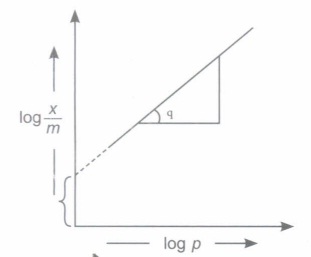
(a) What does this graph shows?
(b) What is slope of line equal to?
(c) What does intercept of line represent?
(d) Write the expression of Freundlich adsorption isotherm of moderate pressure.
(e) What is effect oftemperature on chemisorption?
3.
Surface chemistry deals with phenomenon that occur at the surfaces. Corrosion electrode processes, heterogeneous catalysis, dissociation and crystallisation occur at the surface. Evaporation is a surface phenomenon. Adsorption takes place at the surface. Easily liquefiable gas are more easily adsorbed on the surface of catalyst. Gas mass contain activated charcoal to adsorb poisonous gases.
(a) Out of H2, N2, CO and NH3 , which gas will absorb to maximum extent and why?
(b) Write the reaction at anode and cathode in corrosion of iron?
(c) What happen when O2 is adsorbed on the metallic surface?
(d) What will happen if aqueous solution of raw sugar is passed over activated charcoal and why?
(e) What happens of \(\Lambda\)m (molar conductivity) of an aqueous solution of soap (sodium stearate) of CMC (Critical Micelle Concentration)?
4.
Catalysis play very important role in industrial processes. In contact process, V2O5 is used as heterogeneous catalysis, where as W ions are used as homogenous catalyst in hydrolysis of ester. Activity of catalyst means how many times it increases the rate of reaction. Selectivity means different catalysts give different products with same reactants under different conditions. Enzymes are biological catalyst which catalyse specific biochemical reactions by lowering down activation energy. Shape selective catalyst ZSM-5 converts alcohol into gasoline.
Glucose forms true solution in water given to patients. Suspension is heterogeneous, particles can be separated by filtration. Medicines are more effective in colloidal form. Lyophilic sols are more stable than lyophobic sols which need protective colloids like starch, gelatin. Sky is blue in colour due to Tyndall effect. Brownian movement is responsible for stability of colloids. Electric chimney in kitchen and industries is based on electrophoresis. Milk is oil in water emulsion where as liquefied butter is water in oil emulsion. Emulsifier stabilise emulsion where as change in pH, heating leads to coagulation of lyophilic sols. Lyophobic sols are coagulated by electrolyte. Greater the charge on ion, more effective it will be for coagulation, is Hardy Schulze Rule.
(a) Hardening of lather is done by tannin. What is process called?
(b) Which property of catalyst depends upon the strength of chemisorption to large extent?
(c) Out of MgCl2 , K2SO4, K4[Fe(CN)6), which is most effective to coagulate Agl/Ag +sol.
(d) What is charge on colloidal solution of haemoglobin?
(e) Name the protective colloid used in ice cream.
5.
Read the passage given below and answer the following questions :
A colloid is a heterogeneous system in which one substance is dispersed as very fine particles (called dispersed phase) in another substance (called dispersion medium). A colloid is classified on the basis of various criteria. Depending upon the nature of the interaction between the dispersed phase and the dispersion medium, colloidal sols are divided into two categories, viz., lyophilic and lyophobic sols. Depending upon whether the dispersed phase and the dispersion medium are solids, liquids or gases, the most common division are sols (solids in liquids), gels (liquids in solids) and emulsion (liquids in liquids). Depending upon the type of particles of the dispersed phase, these are of three types, multimolecular colloids, macromolecular colloids and associated colloids.
In these questions ( i-iv), a statement of assertion followed by a statement of reason is given. Choose the correct answer out of the following choices
| (a) Assertion and reason both are correct statements and reason is correct explanation for assertion. |
| (b) Assertion and reason both are correct statements but reason is not correct explanation for assertion |
| (c) Assertion is correct statement but reason is wrong statement |
| (d) Assertion is wrong statement but reason is correct statement. |
(i) Assertion: The range of diameters of the colloidal particles is between 1 and 1000 nm.
Reason : Colloidal particles are larger than the particles of true solution, but smaller enough to remain suspended
(ii) Assertion: Colloid is a heterogeneous system.
Reason: Colloidal particles have an enormous surface area per gram as a result of their small size.
(iii) Assertion: Fire fighting foams, used at emergency airplane landing is a colloidal system.
Reason: Gold sol is a multimolecular colloid.
(iv) Assertion: Gel on standing exudes small amounts ofliquid. This phenomenon is known as syneresis.
Reason : A colloidal solution of Fe(OH)3 in water is a hydrophobic colloid.
6.
Read the passage given below and answer the following questions :
Colloidal particles carry either positive or negative charge. The nature of this charge is the same on all the dispersed particles in a given colloidal solution and may be either positive or negative. When two or more ions are present in the dispersion medium, preferential adsorption of the ion common to the colloidal particles usually takes place. When KI solution is added to the AgNO3 solution till KI is in excess, the precipitated silver iodide adsorbs iodide ions from the dispersion medium, and negatively charged colloidal solution results. If the colloidal sol of AgI is prepared by adding AgNO3 solution to KI solution till AgNO3 is in slight excess, Ag+ ions will be adsorbed giving positive charge to the colloidal particles. The combination of the two layers of opposite charges around the colloidal particles is called Helmholtz electrical double layer. The presence of equal and similar charges on colloidal particles is largely responsible for providing stability to the colloidal solution.
In these questions (i-iv), a statement of assertion followed by a statement of reason is given. Choose the correct answer out of the following choices.
| (a) Assertion and reason both are correct statements and reason is correct explanation for assertion. |
| (b) Assertion and reason both are correct statements but reason is not correct explanation for assertion. |
| (c) Assertion is correct statement but reason is wrong statement |
| (d) Assertion is wrong statement but reason is correct statement. |
(i) Assertion : The presence of electric charge on colloidal particles is indicated by electrophoresis.
Reason : Lyophilic sols, in contrast to lyophobic sols are easily coagulated on addition of small amounts of electrolytes.
(ii) Assertion : Gold number is a measure of protective action by a lyophilic colloid on a lyophobic colloid.
Reason : Zeta potential (or electrokinetic potential) is the potential difference between fixed charged layer and the diffused layer having opposite charge.
(iii) Assertion: The presence of equal and similar charges on colloidal particles islargely responsible in providing stability to the colloidal solution.
Reason : The repulsive forces between charged particles having the same charge prevent them from aggregating and provide stability.
(iv) Assertion: When FeCl3 is added to an excess of hot water, a positively charged sol of hydrated ferric oxide is formed.
Reason : When ferric chloride is added to NaOH solution a negatively charged sol is obtained due to adsorption of OH- ions.
7.
Read the passage given below and answer the following questions :
Adsorption is a spontaneous process and involves unequal distribution of the molecules of the gaseous substance on the surface of solid or liquid. Adsorption is an exothermic process. The attractive forces between adsorbate and adsorbent are either van der Waals' forces or chemical bonds. Adsorption of gases on solids is generally controlled by the factors like temperature, pressure and nature of adsorbate and adsorbent.
The following questions are multiple choice questions.Choose the most appropriate answer:
(i) In physisorption process, the attractive forces between adsorbate and adsorbent are
| (a) covalent bonds | (b) ionic bonds |
| (c) van der Waals' force | (d) H-bonds |
(ii) Which of the following graph represents the variation of physical adsorption with temperature?

(iii) Which one of the following processes does not use adsorption?
| (a) Froth floatation process | (b) Chromatography |
| (c) Decolourisation of sugar liquors | (d) Dissolution of sugar in water |
(iv) Which of the following statements is true?
| (a) Chemisorption forms unimolecular layer |
| (b) Chemisorption is a reversible process. |
| (c) Chemisorption is independent of pressure. |
| (d) Chemisorption has low enthalpy change. |
8.
Read the passage given below and answer the following questions :
Hardy Schulze rule states that the precipitating effect of an ion on dispersed phase of opposite charge increases with the valency of the ion. The higher the valency of the flocculating ion, the greater is its precipitating power. Thus, for the precipitation of AS2 S3 sol (-ve sol) the precipitating power of Al3+, Ba2+ and Na+ ions is of the order, Al3+> Ba2+ > Na+. Similarly, for precipitating Fe(OH)3 sol (-ve sol) the precipitating power of \(\left[\mathrm{Fe}(\mathrm{CN})_{6}\right]^{3-}\)\(\mathrm{SO}_{4}^{2-}\) and Cl- is of the order,\(\left[\mathrm{Fe}(\mathrm{CN})_{6}\right]^{3-}>\mathrm{SO}_{4}^{2-}>\mathrm{Cl}^{-}\) . The minimum concentration of an electrolyte in millimoles per litre required to cause precipitation of a sol in 2 hours is called flocculation value. The smaller the flocculation value, the higher will be the coagulating power of the ion. The minimum mass of the protective colloid (lyophilic colloid) in milligrams that must be added to 10 mL of a standard red gold sol so that no coagulation occurs when 1 mL of 10% NaCl solution is rapidly added to it is called the gold number of the protective colloid.
The following questions are multiple choice questions. Choose the most appropriate answer:
(i) The gold number of four protective colloids A, B, C and Dare 0.03, 0.003, 10 and 30 respectively. Protective power of these colloids will be of the order:
| (a) B > A > C > D | (b) A > B > C > D | (c) C >B> D > A | (d) D > A > C > |
(ii) Which of the following has least flocculating value for positive sol?
| (a) Cl- | (b) \(\mathrm{SO}_{4}^{2-}\) | (c) \(\mathrm{PO}_{4}^{3-}\) | (d) [Fe(CN6)4- |
(iii) Which of the following colloidal solutions is positively charged?
| (a) TiO2 | (b) AS2 S3 | (c) Blood | (d) Gold sol |
(iv) The coagulation value in millimoles per litre of electrolytes used for the coagulation of As2 S3 are as below:
| I. NaCl = 52 | II. KCl = 50 | III. BaCl2 = 0.69 | IV. MgSO4 = 0.72 |
The correct order of their flocculating power is
| (a) I > II > III > IV | (b) I > II > IV > III | (c) I < II < IV <III | (d) IV < I < II < III |
9.
Read the passage given below and answer the following questions :
A graph between the amount adsorbed (x/m) by an adsorbent and the equilibrium pressure of the adsorbate at a constant temperature is called the adsorption isotherm. A relationship between the amount adsorbed (x/m) and the equilibrium pressure (P) can be obtained as follows:
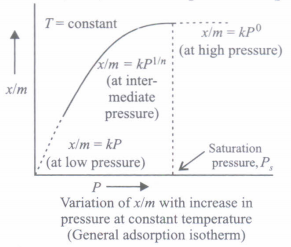
In the intermediate range of pressure, x/m = kP1/n (was originally put forward by Freundlich and is known as Freundlich adsorption isotherm).
The following questions are multiple choice questions. Choose the most appropriate answer :
(i) According to Freundlich adsorption isotherm, which of the following is correct?
| (a) \(\frac{x}{m} \propto P^{0}\) | (b) \(\frac{x}{m} \propto P^{1}\) |
| (c) \(\frac{x}{m} \propto P^{1 / n}\) | (d) All the above are correct for different range of pressure |
(ii) In the Freundlich adsorption isotherm equation
\(\log \frac{x}{m}=\log k+\frac{1}{n} \log p\) ,the value of 1/n is
| (a) any value from 0 to 1 | (b) a negative integer |
| (c) a positive integer | (d) a positive or a negative fractional number. |
(iii) Plot of log xlm against log p is a straight line inclined at an angle of 45°. When the pressure is 0.5 atm and Freundlich parameter, k is 10, the amount of solute adsorbed per gram of adsorbent will be (log 5 = 0.6990)
| (a) 1g | (b) 2g | (c) 3g | (d) 5g |
(iv) In the plot of log \(\frac{x}{m}\) vs log p for an adsorption, a straight line inclined at an angle of \(\theta=14.04^{\circ}\) to the x-axis was obtained.The 'n' value for this adsorption process is (tan 14.04° = 0.25)
| (a) 5 | (b) 8 | (c) 4 | (d) 2 |
10.
Read the passage given below and answer the following questions :
Adsorption depends on the nature of the adsorbent. The rough solid surface has more number of pores and adsorb more number of gases than the smooth surface. Most common adsorbents are silica gel, activated charcoaL The extent of adsorption also depends on the surface area of the solid. Specific surface area of an adsorbent is the surface area available for adsorption per gram of the adsorbent. The greater the surface area of the solid, the greater would be the adsorption. Charcoal is a more effective adsorbent than solid wood. Desorption is a process of removing an adsorbed substance from a surface on which it is absorbed.
Physisorption is non-specific and any gas can be adsorbed. But the gases which are easily liquefiable (e.g., NH3 , HCl, CO2 ) are adsorbed at a faster rate and to a large extent than the gases which are difficult to liquefy (e.g., H2 , O2, N2 ). It depends on the critical temperature. Higher the critical temperature of a gas, more easily liquefiable the gas is and more is the rate of adsorption. Chemisorption is specific in nature. Therefore, only those gases can be adsorbed which are capable of forming chemical bonds with the adsorbent.
The following questions are multiple choice questions. Choose the most appropriate answer :
(i) Select the correct statement regarding desorption.
| (a) It is done by cooling or by increasing the pressure applied. |
| (b) It is done by cooling or by reducing the pressure applied. |
| (c) It is done by heating or by reducing the pressure applied |
| (d) It is done by heating or by increasing the pressure applied. |
(ii) Which of the following statements regarding the physical adsorption of a gas on surface of solid is not correct?
| (a) On increasing temperature, adsorption increases continuously |
| (b) Enthalpy changes are negative |
| (c) It is non-specific in nature |
| (d) It is reversible in nature |
(iii) At the same temperature and pressure, select the correct order of adsorption of the following gases on the same mass of charcoal.
| (a) SO2 > CH4 > H2 | (b) CH4 < SO2 < H2 |
| (c) Hz > CH4 > SO2 | (d) CH4 < H2 < SO2 |
(iv) Select the incorrect statement among the following.
| (a) Physical adsorption occurs at a low temperature and chemisorption occurs at all temperature |
| (b) In physisorption heat of adsorption is low while in chemisorption it is high |
| (c) Chemisorption is irreversible and physisorption is reversible |
| (d) Magnitude of chemisorption decreases with rise in temperature while physisorption increases with rise in temperature. |
1.
(a) A13+
(b) [Fe(CN)6]3-
(c) Gelatin
(d) It is lyophilic sol which stabilises lyophobic sols and prevents its coagulation.
(e) Potato starch
2.
(a) It shows log \(\frac{x}{m}\) is directly proportional to log p i.e. extent of adsorption of gases on solid increase with increase in pressure.
(b) It is equal to \(\frac{1}{n}\) , where 'n' is whole number except zero, \(\frac{1}{n}\) , lies between 0 and 1.
(c) log k where 'k' is constant depending upon native of adsorbent and adsorbate.
(d) \(\log \frac{x}{m}=\log \mathrm{K}+\frac{1}{n} \log p \quad \text { Or } \quad \frac{x}{m}=\mathrm{K} p^{1 / n}\)
(e) It first increases, then decreases with increase in temperature.
3.
(a) NH3 , because it has high critical temprature maximum intermolecular forces of attraction easily liquefiable.
(b) Fe(s) \(\rightarrow\) Fe2+ (aq) + 2e- (At anode)
4H+ + O2 + 4e -\(\rightarrow\) 2H2O (At cathode)
(c) Heat is released, bond length of O2 is increased and \(\pi\) x 2p orbital of O2 is occupied.
(d) It becomes colourless as the co louring material gets adsorbed on the surface of charcoal.
(e) At CMC, the concentration of current carrier anions decreases, hence molar conductivity \(\Lambda\)m decreases abruptly,
4.
(a) Mutual coagulation.
(b) Activity of catalyst
(c) K4 [Fe(CN)6]
(d) Positively charged
(e) Gelatin
5.
(i) (b)
(ii) (b) : A colloid is a heterogeneous system in which one substance is dispersed (dispersed phase) as very fine particles in another substance called dispersion medium.
(iii) (b) : Gold sol is a multimolecular colloid since large number of molecules are combined to form this.
(iv) (b) : Syneresis is the extraction or expulsion of a liquid from a gel. Colloidal solution of Fe(OH)3 in water is hydrophobic colloid.
6.
(i) (c) : Lyophilic sols are stable and do not coagulate easily.
(ii) (b) : Gold number gives a comparative idea of protective power of various lyophilic colloids on a lyophobic colloid. Zeta potential is the potential difference between fixed charged layer and the diffused layer having opposite charge.
(iii) (a)
(iv) (b)
7.
(i) (c) : In physisorption process, the attractive forces between adsorbate and adsorbent are van der Waals' forces.
(ii) (a)
(iii) (d)
(iv) (a)
8.
(i) (a) : Lesser is the gold number, greater is the protective power.
(ii) (d) : Charge of [Fe(CN)6]4- is highest, hence, it will be most effective for the coagulation of positive colloids. More is the coagulating power lesser will be the flocculating value.
(iii) (a)
(iv) (c) : Coagulation value is inversely proportional to their flocculating power.
9.
(i) (d) : At low pressure \(\frac{x}{m} \propto P\)
At high pressure, \(\frac{x}{m} \propto P^{0}\)
In the intermediate range of pressure, \(\frac{x}{m} \propto P^{\frac{1}{n}}\)
(ii) (a)
In \(\frac{x}{m}=\ln k+\frac{1}{n} \ln P ; \quad \text { slope }=\frac{1}{n}=0\)
Thus, \(\frac{x}{m}=k P^{0}\)
(iii) (d) : According to Freundlich equation
\(\log \left(\frac{x}{m}\right)=\log k+\frac{1}{n} \log P\)
\(\therefore\) Plot oflog xlm vs log P is linear with slope = l/n and intercept = log k
Thus, \(\frac{1}{n}=\tan \theta=\tan 45^{\circ}=1 \text { or } n=1\)
At P = 0.5 atm and k = 10
\(\frac{x}{m}=k P^{1 / n}\)
\(\frac{x}{m}=10 \times(0.5)^{1}=5 \quad \therefore x=5 \mathrm{~g}\)
(iv) (c) : Plot of \(\log \frac{x}{m} v s \log P\) is a straight line with slope = \(\frac{1}{n}\)
Also, \(\text { slope }=\tan \theta=\tan 14.04^{\circ}=0.25\)
\(\Rightarrow \frac{1}{n}=0.25 \text { or } n=4\)
10.
(i) (c) : Desorption is done by heating or by reducing the pressure applied.
(ii) (a) : Physisorption is exothermic in nature. Therefore, according to Le Chatelier's principle, it occurs readily at low temperature and decreases with increase in temperature. Bonds between surface and adsorbate are weak so when temperature is increased the bonds break easily, so rate will decrease on increasing temperature.
(iii) (a) : Higher the critical temperature of a gas, greater is the amount of gas adsorbed. Critical temperature (in Kelvin) of the gases :
\(\begin{array}{l} \mathrm{H}_{2}<\mathrm{CH}_{4}<\mathrm{SO}_{2} \\ 33.2 \quad 190.6 \quad 430.3 \end{array}\)
(iv) (d) : Chemisorption first increases with increase of temperature. Physisorption decreases with rise in temperature.

12th Standard CBSE Syllabus & Materials
12th Standard CBSE
CBSE 12th Computer Science Python Revision Tour I - New Previous year Question Papers Study Material - QB365 Set A
NEW12th Standard CBSE
CBSE 12th Business Studies Planning Important Questions And Answers Study Material - QB365 Set A
NEW12th Standard CBSE
CBSE 12th Business Studies Business Environment Important Questions And Answers Study Material - QB365 Set A
NEW12th Standard CBSE
CBSE 12th Business Studies Principles of Management Important Questions And Answers Study Material - QB365 Set A



CBSE 12th Standard CBSE Subjects
CBSE Standards










