
 100% FREE ACCESS
12th Standard CBSE Syllabus & Materials
12th Standard CBSE
CBSE 12th Economics Government Budget and the Economy Previous year Question Papers Study Material - QB365 Set A
NEW12th Standard CBSE
CBSE 12th Computer Science Interface Python with MySQL - New Previous year Question Papers Study Material - QB365 Set A
NEW12th Standard CBSE
CBSE 12th Computer Science Database Concept - New Previous year Question Papers Study Material - QB365 Set A
NEW12th Standard CBSE
CBSE 12th Computer Science Data Communication - New Previous year Question Papers Study Material - QB365 Set A
NEW12th Standard CBSE
CBSE 12th Computer Science Data Structures - New Previous year Question Papers Study Material - QB365 Set A
NEW12th Standard CBSE
CBSE 12th Computer Science Functions - New Previous year Question Papers Study Material - QB365 Set A

Published on: 08/09/2022
QB365 provides a detailed and simple solution for every Possible Case Study Questions in Class 12 Chemsitry Subject - The d- and f- Block Elements, CBSE. It will help Students to get more practice questions, Students can Practice these question papers in addition to score best marks.
Download CBSE Class 12th Standard CBSE Chemistry question papers, sample papers, important questions, and previous year solved papers in PDF format. Get free study materials, NCERT solutions, and exam preparation resources for Class 12th Standard CBSE Chemistry
Questions + Answers key
Take MCQ Chemistry Test
1.
Observe the table given below belonging to 3d series, their first, second, third ionisation enthalpy and \(\mathbf{E}_{\mathbf{M}^{2+} / \mathbf{M}}^{\circ}\) and \(\mathbf{E}_{\mathbf{M}^{3+} / \mathbf{M}^{2+}}^{\circ}\) and answer the questions that follow based on table and related concepts.
| Element | Sc | Ti | V | Cr | Mn | Fe | Co | Ni | Cu | Zn |
| 1 st ionisation enthalpy | 631 | 656 | 650 | 652 | 717 | 762 | 758 | 736 | 745 | 905 kJ ml -1 |
| IInd ionisation enthalpy | 1245 | 1320 | 1376 | 1635 | 1513 | 1564 | 1648 | 1757 | 1962 | 1736 |
| IIIrd ionisation enthalpy | 2451 | 2721 | 2874 | 2995 | 3258 | 2964 | 3238 | 3401 | 3561 | 3839 |
| \(\mathbf{E}_{\mathbf{M}^{2+} / \mathbf{M}}^{\circ}\) in volts | - | -1.63V | -1.18V | -0.91V | -1.18V | -0.44V | -0.28V | -0.25V | +0.34V | -0.76V |
| \(\mathbf{E}_{\mathbf{M}^{3+} / \mathbf{M}^{2+}}^{\circ}\)in volts | - | -0.37V | -0.26V | -0.41V | +1.57V | +0.77V | +1.97V | - | - | - |
(a) Why does zinc have highest first ionisation enthalpy?
(b) Why is 3 rd ionisation enthalpy of Mn high?
(c) Why is Cr3 + more stable than Cr2+?
(d) Why is \(\mathbf{E}_{\mathbf{M n}^{2+} / \mathbf{M n}}^{\circ}-\mathbf{1 . 1 8 V} ?\)
(e) Why is \(\mathbf{E}_{\mathbf{C n}^{2+} / \mathrm{Cn}}^{\circ}+\mathbf{0 . 3 4 V} ?\)
(f) Why is Fe3+ more stable than Fe2+?
(g) Why is Mn 3 + good oxidising agent and \(\mathbf{E}_{\mathbf{M n}^{3+} / \mathrm{Mn}^{2+}}^{\circ}=\mathbf{1 . 5 7 V} ?\)
2.
Observe the graph of transition metal and their melting points and answer the questions based on the graph and related concepts.
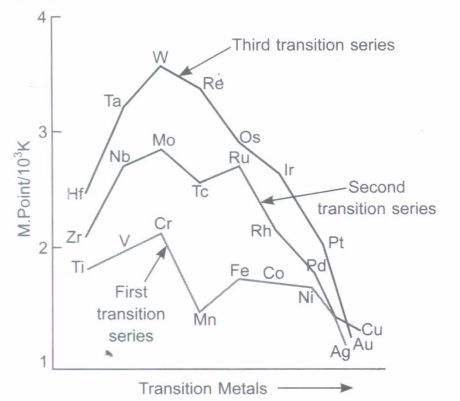
(a) Why does W (tungsten) has highest melting point?
(b) Which element in 3d series has lowest enthalpy of atomisation and why?
(c) Why is mercury liquid?
(d) Why are transition metals less electropositive than 's'-block elements?
(e) How does density vary from left to right in 3d series and why?
3.
The d-block of the periodic table contains the elements of the groups 3 to 12 and are known as transition elements. In general, the electronic configuration of these elements is \((n-1) d^{1-10} n s^{1-2}\). The d-orbitals of the penultimate energy level in their atoms receive electrons giving rise to the three rows of the transition metals i.e. 3d, 4d and 5d series. However Zn, Cd and Hg are not regarded as transition elements. Transition elements exhibit certain characteristic properties like variable oxidation stables, complex formation, formation of coloured ions, alloys, catalytic activity etc. Transition metals are hard (except Zn, Cd and Hg) and have a high melting point.
(a) Why are Zn, Cd and Hg non-transition elements?
(b) Which transition metal of 3d series does not show variable oxidation state?
(c) Why do transition metals and their compounds show catalytic activity?
(d) Why are melting points of transition metals high?
(e) Why is Cu2+ ion coloured while Zn2+ ion is colourless in aqueous solution?
4.
KMnO4 and K2Cr 2O7 are most important chemicals which are used as oxidising agents and disinfectants. K2MnO4 is prepared by fusing MnO2 with KOH in presence of O2.K2MnO 4 is electrolysed to get purple coloured KMnO4 . Na2CO4 is prepared by heating chromite ore with Na2CO3 in presence of O2. Na2CrO4 is converted into Na2Cr2 O7 by reacting with concentrated H2 SO4 , Na2Cr2 O7 is reacted with KCI to get K2Cr2O7 orange coloured solid, soluble in water, changes to yellow coloured \(\mathrm{CrO}_{4}^{2-}\) in basic medium, KMnO4 acts as oxidising agent in acidic, neutral as well tasic medium. In acidic medium, it converts Fe2+ to Fe3 +, Sn2+ to Sn4+,  to CO2. In asic medium it converts I- to \(\mathrm{IO}_{3}^{-} \cdot \mathrm{K}_{2} \mathrm{Cr}_{2} \mathrm{O}_{7}\) acts as oxidising agent only in acidic medium, converts H2S to S, SO2 to \(\mathrm{SO}_{4}^{2-}, \mathbf{I}^{-}\) to I2. Lanthanoids and actinoids belong to f-block elements with general electronic configuration \((n-2) f^{1 \text { to } 14}(n-1) d^{0-2} n s^{2}\) . All actinoids are radio active. Both show contraction in atomic and ionic radii but actinoid contraction is more than lanthanoid contraction. Lanthanoid show +3 oxidation state, few elements show +2 and +4 oxidation states also. Actinoids show +3, +4, +5, +6, +7 oxidation states.
(a) Which lanthanoid shows +4 oxidation state and why?
(b) Give two similarity between lanthanoids and actinoids.
(c) Complete the equation and balance:
\(\mathrm{Cr}_{2} \mathrm{O}_{7}^{2-}+\mathrm{Fe}^{2+}+\mathrm{H}^{+} \longrightarrow\)
(d) Convert sodium chromate to sodium dichromate. Give chemical equation.
(e) Complete the following:
\(\mathbf{3} \mathbf{M n} \mathbf{O}_{4}^{2-}+\mathbf{4} \mathbf{H}^{+} \longrightarrow\)
5.
Read the passage given below and answer the following questions:
Transition elements are elements that have partially filled d-orbitals. The configuration of these elements corresponds to (n - 1)d1-10 ns1-2. It is important to note that the elements mercury, cadmium and zinc (Ire not considered transition elements because of their electronic configurations, which corresponds to (n - 1)d1-10 ns2.
Some general properties of transition elements are :
These elements can form coloured compounds and ions due to d-d transition;
These elements exhibit many oxidation states;
A large variety of ligands can bind themselves to these elements, due to this, a wide variety of stable complexes formed by these ions. The boiling and melting point of these elements are high. These elements have a large ratio of charge to the radius.
In these questions (i-iv), a statement of assertion followed by a statement of reason is given. Choose the correct answer out of the following choices.
(a) Assertion and reason both are correct statements and reason is correct explanation for assertion.
(b) Assertion and reason both are correct statements but reason is not correct explanation for assertion.
(c) Assertion is correct statement but reason is wrong statement.
(d) Assertion is wrong statement but reason is correct statement.
(i) Assertion: Tungsten has very high melting point.
Reason: Tungsten is a covalent compound.
(ii) Assertion: Zn, Cd and Hg are normally not considered transition metals.
Reason: d-Orbitals in Zn, Cd and Hg elements are completely filled, hence these metals do not show the general characteristics properties of the transition elements.
(iii) Assertion: Copper metal gets readily corroded in acidic aqueous solution such as HCI and dil. H2SO4
Reason: Free energy change for this process is positive.
(iv) Assertion: Tailing of mercury occurs on passing ozone through it.
Reason: Due to oxidation of mercury.
6.
Read the passage given below and answer the following questions:
Transition metal oxides are compounds formed by the reaction of metals with oxygen at high temperature. The highest oxidation number in the oxides coincides with the group number. In vanadium, there is a gradual change from the basic V2O3 to less basic V2O4 and to amphoteric V2O5・V2O4 dissolves in acids to give VO2+ salts. Transition metal oxides are commonly utilized for their catalytic activity and semiconductive properties. Transition metal oxides are also frequently used as pigments in paints and plastic. Most notably titatnium dioxide. One of the earliest application of transition metal oxides to chemical industry involved the use of vanadium oxide for catalytic oxidation of sulfur dioxide to sulphuric acid. Since then, many other applications have emerged, which include benzene oxidation to maleic anhydride on vandium oxides; cyclohexane oxidation to adipic acid on cobalt oxides. An important property of the catalyst material used in these processes is the ability of transition metals to change their oxidation state under a given chemical potential of reductants and oxidants.
The following questions are multiple choice questions. Choose the most appropriate answer:
(i) Which oxide of vanadium is most likely to be basic and ionic ?
| (a) VO | (b) V2O3 | (c) VO2 | (d) V2O5 |
(ii) Vanadyl ion is
| (a) VO2+ | (b) VO2+ | (c) V2O+ | (d) VO43- |
(iii) The oxidation state of vanadium in V2O5 is
| (a) +5/2 | (b) +7 | (c) +5 | (d) +6 |
(iv) Identify the oxidising agent in the following reaction.
| (a) V2O5 | (b)Ca | (c) V | (d) None of these |
7.
Read the passage given below and answer the following questions:
The unique behaviour of Cu, having a positive Eo accounts for its inability to liberate H2 from acids. Only oxidising acids (nitric and hot concentrated sulphuric acid) react with Cu, the acids being reduced. The stability of the half-filled (d5) subshell in Mn2+ and the completely filled (d10 ) configuration in Zn2+ are related to their Eo (M3+ /M2+) values. The low value for Sc reflects the stability of Sc3+ which has a noble gas configuration. The comparatively high value for Mn shows that Mn2+(d5) is particularly stable, whereas a comparatively low value for Fe shows the extra stability of Fe3+ (d5). The comparatively low value for V is related to the stability of V2+ (half-filled t2g level).
The following questions are multiple choice questions.Choose the most appropriate answer :
(i) Standard reduction electrode potential of Zn2+ /Zn is - 0.76 V. This means
| (a) ZnO cannot be reduced to Zn by H2 under standard conditions |
| (b) Zn cannot liberate H2 with concentrated acids |
| (c) Zn is generally the anode in an electrochemical cell |
| (d) Zn is generally the cathode in an electrochemical cell. |
(ii) Eo values for the couples Cr3+/Cr2+ and Mn3+ /Mn2+ are -0.41 and +1.51 volts respectively. These values suggest that
| (a) Cr2+ acts as a reducing agent whereas Mn3+ acts as an oxidizing agent |
| (b) Cr2+ is more stable than Cr3+ state |
| (c) Mn3+ is more stable than Mn2+ |
| (d) Cr2+ acts as an oxidizing agent whereas Mn3+ acts as a reducing agent |
(iii) The reduction potential values of M, Nand O are +2.46, -1.13 and -3.13 Y respectively. Which of the following order is correct regarding their reducing property?
| (a) O>N>M | (b) O>M>N | (c) M>N>O | (d) M>O>N |
(iv) Which of the following statements are true?
(i) Mn2+ compounds are more stable than Fe2+ towards oxidation to +3 state.
(ii) Titanium and copper both in the first series of transition metals exhibits +1 oxidation state most frequently.
(iii) Cu+ ion is stable in aqueous solutions.
(iv) The E0 value for the Mn3+ /Mn2+ couple is much more positive than that for Cr3+/Cr2+ or Fe3+/Fe2+.
| (a) (ii) and (iii) | (b) (i) and (iv) | (c) (i) and (iii) | (d) (ii) and (iv) |
8.
Read the passage given below and answer the following questions:
The transition elements have incompletely filled d-subshells in their ground state or in any of their oxidation states. The transition elements occupy position in between s- and p-blocks in groups 3-12 of the Periodic table. Starting from fourth period, transition elements consists of four complete series : Sc to Zn, Y to Cd and La, Hf to Hg and Ac, Rf to Cn. In general, the electronic configuration of outer orbitals of these elements is (n - 1) d1-10 ns1-2. The electronic configurations of outer orbitals of Zn, Cd, Hg and Cn are represented by the general formula (n - 1)d10 n2. All the transition elements have typical metallic properties such as high tensile strength, ductility, malleability. Except mercury, which is liquid at room temperature, other transition elements have typical metallic structures. The transition metals and their compounds also exhibit catalytic property and paramagnetic behaviour. Transition metal also forms alloys. An alloy is a blend of metals prepared by mixing the components. Alloys may be homogeneous solid solutions in which the atoms of one metal are distributed randomly among the atoms of the other.
The following questions are multiple choice questions. Choose the most appropriate answer :
(i) Which of the following characteristics of transition metals is associated with higher catalytic activity?
| (a) High enthalpy of atomisation | (b) Variable oxidation states |
| (c) Paramagnetic behaviour | (d) Colour of hydrated ions |
(ii) Transition elements form alloys easily because they have
| (a) same atomic number | (b) same electronic configuration |
| (c) nearly same atomic size | (d) same oxidation states. |
(iii) The electronic configuration of tantalum (Ta) is
| (a) \([\mathrm{Xe}] 4 f^{0} 5 d^{1} 6 s^{2}\) | (b) \([\mathrm{Xe}) 4 f^{14} 5 d^{2} 6 s^{2}\) |
| (c) \([\mathrm{Xe}] 4 f^{14} 5 d^{3} 6 s^{2}\) | (d) \(\left[\mathrm{Xe}\left]4 f^{14} 5 d^{4} 6 s^{2}\right.\right.\) |
(iv) Which one of the following outer orbital configurations may exhibit the largest number of oxidation states?
| (a) 3d54s1 | (b) 3d54s2 | (c) 3d24s2 | (d) 3d34s2 |
9.
Read the passage given below and answer the following questions:
The f-block elements are those in which the differentiating electron enters the (n -2) forbital. There are two series of f-block elements corresponding to filling of 4f and 5f-orbitals. The series of 4f- orbitals is called lanthanides. Lanthanides show different oxidation states depending upon stability of f0, f7 and f14 configurations, though the most common oxidation states is +3. There is a regular decrease in size of lanthanides ions with increase in atomic number which is known as lanthanide contraction.
The following questions are multiple choice questions. Choose the most appropriate answer:
(i) The atomic numbers of three lanthanide elements X, Y and 2 are 65, 68 and 70 respectively, their Ln3+ electronic configuration is
| (a) 4f8, 4f11, 4f13 | (b) 4f11, 4f8 , 4f13 | (c) 4fo, 4f2, 4f11 | (d) 4f3, 4f7, 4f9 |
(ii) Lanthanide contraction is observed in
| (a) Gd | (b) At | (c) Xe | (d) Te |
(iii) Name a member of the lanthanoid series which is well known to exhibit +4 oxidation state.
| (a) Cerium (Z = 58) | (b) Europium (Z = 63) | (c) Lanthanum (Z = 57) | (d) Gadolinium (Z = 64) |
(iv) Identify the incorrect statement among the following.
| (a) Lanthanojd contraction is the accumulation of successive shrinkages. |
| (b) The different radii of Zr and Hf due to consequence of the lanthanoid contraction. |
| (c) Shielding power of 4f electrons is quite weak. |
| (d) There is a decrease in the radii of the atoms or ions as one proceeds from La to Lu. |
1.
(a) It is because Zn has completely filled '4s' orbital which is stable.
(b) It is because after losing 2 electrons, it becomes 3d5 which is more stable.
(c) It is because \(\mathrm{Cr}^{3+}\left(t_{2 g}^{3}\right)\) half filled t2g orbitals are more stable than Cr2+(3d4).
(d) It is due to low enthalpy of atomisation, sublimation enthalpy, ionisation enthalpy.
(e) It is due to high ionisation enthalpy and low hydration enthalpy.
(f) Fe3+(3d5) is half filled which is more stable than Fe2+(3d6).
(g) It is because it can gain one electron easily to from Mn2+(3d5) which is more stable that is why\(\mathrm{E}_{\mathrm{Mn}^{3+} / \mathrm{Mn}}^{\circ}=1.57 \mathrm{~V}\)
2.
(a) It is due to presence of unpaired electrons and there is more frequent metal-metal bonding in 5d series than 3d and 4d series.
(b) Zinc has lowest enthalpy of atomisation due to weak metallic bond which is due to absence of unpaired electrons.
(c) It is due to larger size, absence of unpaired electron and weak interatomic attraction and weaker metallic bond.
(d) It is due to smaller atomic size and higher ionisation enthalpies.
(e) Density goes on increasing from Sc to Cu because atomic mass increase more than atomic volume .
3.
(a) It is because neither they nor their ions have incompletely filled d-orbitals.
(b) Scandium (Sc) and Zinc (Zn).
(c) It is because they show variable oxidation state, can form intermediate complexes and have large surface area for adsorption of gases.
(d) It is due to strong interatomic forces of attraction due to presence of unpaired electrons.
(e) It is because Cu2 + has one unpaired electron and undergoes d-d transition by absorbing light from visible region and radiate blue colour, where as Zn2 + is colourless due to absence of unpaired electron.
4.
(a) 'Ce' shows +4 oxidation state because if has stable electronic configuration.
(b) (i) Both show contraction, lanthanoid and actinoid contraction.
(ii) Both form coloured ions and undergo f· f transition
(c) \(\mathrm{Cr}_{2} \mathrm{O}_{7}^{2-}+6 \mathrm{Fe}^{2+}+14 \mathrm{H}^{+} \longrightarrow 2 \mathrm{Cr}^{3+}+7 \mathrm{H}_{2} \mathrm{O}+6 \mathrm{Fe}^{3+}\)
(d) \(2 \mathrm{Na}_{2} \mathrm{CrO}_{4}+\mathrm{H}_{2} \mathrm{SO}_{4}(\text { conc. }) \longrightarrow\) \(\mathrm{Na}_{2} \mathrm{Cr}_{2} \mathrm{O}_{7}+\mathrm{Na}_{2} \mathrm{SO}_{4}+\mathrm{H}_{2} \mathrm{O}\)
(e) \(3 \mathrm{MnO}_{4}^{2-}+4 \mathrm{H}^{+} \longrightarrow 2 \mathrm{MnO}_{4}^{-}+\mathrm{MnO}_{2}+2 \mathrm{H}_{2} \mathrm{O}\)
5.
(i) (c) :Tungsten is a transition element and is very hard due to high metallic bonding.
(ii) (a)
(iii) (d): Non-oxidising acids (HCI and dil. H2SO4) do not have any effect on copper. However they dissolve the metal in presence of air. As it is a non-spontaneous process so, \(\Delta\)G cannot be -ve.
(iv) (a): When mercury is exposed to ozone it gets superficially oxidised and loses its meniscus and sticks to the glass.
6.
(i) (a): Oxide of V in lowest oxidation state, i.e., VO is basic and ionic in character.
(ii) (a): Vanadyl ion is VO2+ where V is in +4 oxidation state.
(iii) (c)
(iv) (a)
7.
(i) (a)
(ii) (a): Lesser and negative reduction potential indicates that Cr2+ is a reducing agent. Higher and positive reduction potential indicates that Mn3+ is a stronger oxidizing agent.
(iii) (a) : The electrode which has more reduction potential is a good oxidizing agent and has least reducing power.
(iv) (b): (i) It is because Mn2+ has 3d5 electronic configuration which has extra stability.
(ii) Not titanium but copper, because with + 1 oxidation state an extra stable configuration, 3d10 results.
(iii) It is not stable as it undergoes disproportionation;
2Cu+(aq) ➝Cu2+(aq) + Cu(s). The Eo value for this is favourable.
(iv) Much larger third ionisation energy ofMn (where the required change is d5 to d4) is mainly responsible for this.
8.
(i) (b): The transition metals and their compounds are known for their catalytic activity. This activity is ascribed to their ability to adopt multiple oxidation states to form complexes.
(ii) (c) : Because of similar radii and other characteristics of transition metals, alloys are readily formed by these metals.
(iii) (c)
(iv) (b): Greater the number of valence electrons, more will be the number of oxidation states exhibited by the element.
9.
(i) (a):Terbium (65), 4f8; Dysprosium (Dy), 4f9; Ytterbium (Yb), 4f13.
(ii) (a)
(iii) (a)
(iv) (b): The almost identical radii of Zr (160 pm) and Hf(159 pm), a consequence of lanthanoid contraction.

12th Standard CBSE Syllabus & Materials
12th Standard CBSE
CBSE 12th Computer Science Python Revision Tour I - New Previous year Question Papers Study Material - QB365 Set A
NEW12th Standard CBSE
CBSE 12th Business Studies Planning Important Questions And Answers Study Material - QB365 Set A
NEW12th Standard CBSE
CBSE 12th Business Studies Business Environment Important Questions And Answers Study Material - QB365 Set A
NEW12th Standard CBSE
CBSE 12th Business Studies Principles of Management Important Questions And Answers Study Material - QB365 Set A



CBSE 12th Standard CBSE Subjects
CBSE Standards










