
 100% FREE ACCESS
12th Standard CBSE Syllabus & Materials
12th Standard CBSE
CBSE 12th Economics Government Budget and the Economy Previous year Question Papers Study Material - QB365 Set A
NEW12th Standard CBSE
CBSE 12th Computer Science Interface Python with MySQL - New Previous year Question Papers Study Material - QB365 Set A
NEW12th Standard CBSE
CBSE 12th Computer Science Database Concept - New Previous year Question Papers Study Material - QB365 Set A
NEW12th Standard CBSE
CBSE 12th Computer Science Data Communication - New Previous year Question Papers Study Material - QB365 Set A
NEW12th Standard CBSE
CBSE 12th Computer Science Data Structures - New Previous year Question Papers Study Material - QB365 Set A
NEW12th Standard CBSE
CBSE 12th Computer Science Functions - New Previous year Question Papers Study Material - QB365 Set A

Published on: 08/09/2022
QB365 provides a detailed and simple solution for every Possible Case Study Questions in Class 12 Chemsitry Subject - The p-Block Elements, CBSE. It will help Students to get more practice questions, Students can Practice these question papers in addition to score best marks.
Download CBSE Class 12th Standard CBSE Chemistry question papers, sample papers, important questions, and previous year solved papers in PDF format. Get free study materials, NCERT solutions, and exam preparation resources for Class 12th Standard CBSE Chemistry
Questions + Answers key
Take MCQ Chemistry Test
1.
Group 18 elements are called noble gases and not inert gases because compounds of Kr, Xe and Rn have been prepared. Their general electronic configuration is ns2np6 except He(1s2). They have highest ionisation enthalpy and positive electron gain enthalpy due to stable electronic configuration. Helium is found in sun and stars. Noble gases have low boiling points due to weak van der Waals' forces of attraction. Xenon forms XeF 2, XeF 4, XeF 6, XeOF 4, XeO3 , XeO2 F 2 their structures can be drawn on bases of VSEPR theory. Helium is mixed with oxygen by deep sea divers to avoid pain. Neon is used in coloured advertising lights. Argon is used in bulbs as inert gas. Kr and Xe are used in high efficiency lamps, head light of cars. Radon is radioactive formed by \(\alpha\)-decay of Radium \({ }_{88}^{226} \mathrm{Ra}\) Argon is most abundant (0.9%) noble gas in atmosphere.
(a) How does boiling points of noble gases vary down the group?
(b) Which noble gas has highest ionisation enthalpy and why?
(c) Which was first noble gas compound prepared by Neil Bartlett?
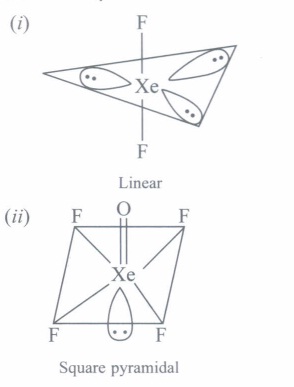
(d) Draw the shapes of
(i) XeF2
(ii) XeOF4 .
(e) Complete the following reactions:
(i) XeF6 + KF \(\rightarrow\)
(ii) XeF6 + 2H2O \(\rightarrow\)
2.
Observe the following tables related to properties of halogens (group 17) elements. Answer the questions that follow based on these tables and related concepts.
| Property | F(9) | Cl(17) | Br(35) | l(53) | At(85) Radio active | Ts (117) Radioactive |
| Atomic mass | 19 | 35.50 | 80.0 | 127 | 210 | 294 |
| Ionisation enthalpy | 1680 | 1256 | 1142 | 1008 | - | - |
| Electronegativity | 4.0 | 3.2 | 3.0 | 2.7 | 2.2 | - |
| Electron gain enthalpy | -333 | -349 | -325 | -296 | - | - |
| Hydration enthalpy (X-) | 515 | 381 | 347 | 305 | - | - |
| Property | F2 | CI2 | Br2 | l2 |
| Melting point (K) | 54.4 | 172.0 | 265.8 | 386.6 |
| Density for liquid | 1.51 | 1.66 | 3.19 | 4.94 |
| X2 \(\rightarrow\) 2X(g) | 168.8 | 242.6 | 192.8 | 151.1 |
| \(\mathrm{E}_{\mathrm{X}_{2} \mathrm{X}}^{\circ}\) | 2.87V | 1.36V | 1.09V | 0.54V |
(a) How was Ts(117) discovered? Is it likely to be metallnon-metallsolid?
(b) Why does melting points of halogens increases down the group?
(c) Arrange halogens in increasing order of oxidising power. Why?
(d) Why is F2 most reactive among halogens?
(e) Why is HF liquid, HCI, HBr, HI are gases?
3.
Observe the graph shown in the diagram and answer the questions that follow. The graph is plotted between molar mass of hydrides of group 16 Vs boiling points of hydrides of group 16.
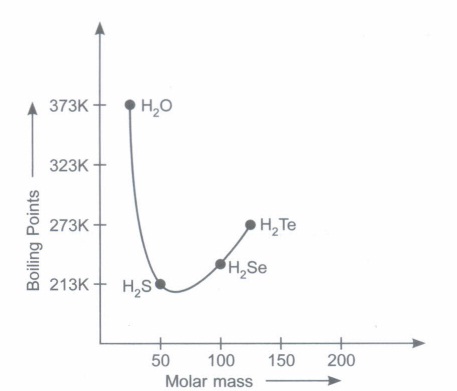
(a) Arrange the hydrides of group 16 in increasing order of boiling points
(b) Why does H2O have highest boiling point?
(c) Arrange H2S, H2O, H2Se, H2Te in increasing order of reducing power. Give reason.
(d) Why does H2 S have lowest boiling points?
(e) Arrange H2O, H2S, H2 Se, H2Te in decreasing order of acidic character?
4.
Group 16 elements are called chalcogens i.e., ore forming elements (oxygen, sulphur, selenium etc.) because most of the ores are oxides and sulphides. Oxygen is gas where as other elements of group 16 are solids. Oxygen shows anomalous behaviour. Oxygen is diatomic where is sulphur exists as S8 which has crown shaped structure. It shows allotropy. Sulphur is present in onion and garlic that is why they have pungent smell. Sulphur is used for manufacture of sulphuric acid which is called 'King of chemicals', used in fertilizer, detergents, dyes and drugs.
(a) Name the most abundant element in the earth crust.
(b) A gas 'X' is obtained from roasting of sulphide ore. It turns lime water milky. Identify the gas and write the chemical reaction involved.
(c) What happens when SO2 gas is reacted with o, in presence of V2O5 at 770K temperature and high pressure? Write the chemical reaction involved.
(d) What happens when SO3 is passed through sulphuric acid? Write chemical equation for the reaction
(e) Why is SO3 not directly absorbed in water to get sulphuric acid?
5.
Group 15 elements consist of N, P, As, Sb, Bi and Mc (Moscovium) with general electronic configuration ns2 np3 and oxidation states +3 and +5. Nitrogen differs from rest of the elements. Phosphorus show allotropy and is more reactive than Nitrogen. Hydrides of group 15 elements show variation in bond angle, boiling point, basic character, stability and reducing character. Oxides of group 15 elements show decrease in acidic character and more increase in basic character. Nitrogen forms large number of oxides. Halides of group 15 elements are mostly covalent. Nitrogen and phosphorus form oxoacids along with As. Nitric acid is manufactured by Ostwald process and useful for nitration and as oxidising agent. NH3 is used in manufacture of fertilisers. HNO3 reacts with metals and non-metals to give different products under different conditions. Phosphorus reacts with oxygen, halogens, nitric acid, NaOH to form different products.
(a) Why does reducing character increases from NH3 to BiH3?
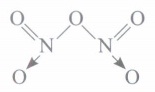
(b) Draw the structure of oxides of nitrogen in which oxidation state of nitrogen is +5.
(c) What happens when white phosphorus reacts with NaOH in inert atmosphere? Write the reaction involved.
(d) Which one out of \(\mathrm{PCl}_{4}^{+} \text {and } \mathrm{PCl}_{4}^{-}\) is not likely to exist, why?
(e) Write the formula of the compound of phosphorus which is obtained when HNO3 (conc.) oxidises phosphorus.
(f) Why does PCI3 fumes in moist air?
(g) What happen when copper sulphate reacts with phosphine gas? Give chemical equation.
6.
Read the passage given below and answer the following questions :
All the elements of group 16 form hydrides : H2O, H2S, H2Se, H2Te and H2Po. All these hydrides have angular structure which involves sp3 hybridisation of the central atom. All hydrides are volatile. The volatility increases from H2O to H2S and then decreases. All hydrides are weakly acidic in character. The increase in acidic characterfrom H2O to H2 Te is a result of the decrease in the 1 H- E (where E = 0, S, Se, Te, Po) bond dissociation enthalpy from H2O to H2Te. All the hydrides except water are reducing agents. The reducing property of these hydrides increases from H2S to H2Te.
In these questions ( i-iv), a statement of assertion followed by a statement of reason is given. Choose the correct answer out of the following choices.
(a) Assertion and reason both are correct statements and reason is correct explanation for assertion.
(b) Assertion and reason both are correct statements but reason is not correct explanation for assertion.
(c) Assertion is correct statement but reason is wrong statement.
(d) Assertion is wrong statement but reason is correct statement
(i) Assertion: Water has high boiling -point.
Reason: Water molecules are associated with hydrogen bonding.
(ii) Assertion: H2Te has less acidic character than H2S.
Reason: Bond dissociation enthalpy of H - Te is less than H - S.
(iii) Assertion: Reducing nature of hydrides of group-16 elements increases as the atomic number of central
atom increases.
Reason : Due to strong force of attraction of H - E bond.
(iv) Assertion: H2O is the only hydrides of the chalcogens which is liquid.
Reason : In ice each a-atom is surrounded by 4H -atoms.
7.
Read the passage given below and answer the following questions :
The halogen elements show great resemblances to one another in their chemical behaviour and properties of their compounds with other elements. There is, however, a progressive change in properties from F through Cl, Br, and I to At. F is most reactive among the halogens and infact, from all other elements and it has certain other properties that set it apart from the other halogens.
In these questions (i-iv), a statement of assertion followed by a statement of reason is given. Choose the correct answer out of the following choices.
| (a) Assertion and reason both are correct statements and reason is correct explanation for assertion. |
| (b) Assertiqn and reason both are correct statements but reason is not correct explanation for assertion. |
| (c) Assertion is correct statement but reason is wrong statement |
| (d) Assertion is wrong statement but reason is correct statement. |
(i) Assertion: F2 has high reactivity.
Reason: F2 has low bond dissociation enthalpy
(ii) Assertion: The bond between F - F is weaker than between Cl - Cl.
Reason : Atomic size of F is smaller than that of Cl.
(iii) Assertion: F atom has less negative electron affinity than Cl atom.
Reason: Additional electrons are repelled more effectively by 3p- electrons in Cl than by 2p- electrons in F atom.
(iv) Assertion : Fluorine is strongest oxidising agent in halogens.
Reason : It displaces other halogens from its aqueous solution.
8.
Read the passage given below and answer the following questions :
Chlorine is a greenish yellow gas with pungent and suffocating odour. With dry slaked lime, it gives bleaching powder. Bleaching powder is a mixture of calcium hypochlorite and basic calcium chloride :
[Ca(OCI)2. CaCl2 ·Ca(OH)2· 2 H2O].
The amount of chlorine obtained from a sample of bleaching powder by the treatment with excess of dilute
acids or CO2 is called available chlorine. Chlorine is a powerful bleaching agent. Bleaching effect of chlorine is permanent.
The following questions are multiple choice questions. Choose the most appropriate answer :
(i) Chlorine gas reacts with_____to form bleaching powder
| (a) Ca(OH)2 | (b) CaCl2 |
| (c) CaSO4 | (d) dry CaO |
(ii) Chlorine reacts with cold and dilute alkali to form
| (a) chloride | (b) hypochlorite | (c) chlorate | (d) both (a) and (b) |
(iii) Chlorine is used as a bleaching agent. The bleaching action is due to
| (a) oxidation | (b) chlorination | (c) hydrogenation | (d) reduction |
(iv) Bleaching powder contains a salt of an oxoacid as one of its components. The anhydride of that oxoacid is
| (a) Cl20 | (b) Cl2O7 | (c) CIO2 | (d) Cl2O6 |
9.
Read the passage given below and'answer the following questions :
Ozone is an unstable, dark blue diamagnetic gas. It absorbs the UV radiation strongly, thus protecting the people on earth from the harmful UV-radiation from the sun. The use of chlorofluorocarbon (CFC) in aerosol and refrigerators and their subsequent escape into the atmosphere, is blamed for making holes in the ozone layer over the Antarctica. Ozone acts as a strong oxidising agent in acidic and alkaline medium. For this property, ozone is used as a germicide and disinfectant for sterilizing water. It is also used in laboratory for the ozonolysis of organic compounds and in industry for the manufacture of potassium permanganate, artificial silk, etc
The following questions are multiple choice questions. Choose the most appropriate answer :
(i) Which of the following statements is not correct for ozone?
| (a) It oxidises lead sulphide | (b) It oxidises potassium iodide |
| (c) It oxidises mercury. | (d) It cannot act as bleaching agent in dry state. |
(ii) Ozone reacts with moist iodine gives
| (a) HI | (b) HIO3 | (c) I2O5 | (d) I2O4 |
(iii) Ozone acts as an oxidising agent due to
| (a) liberation of nascent oxygen | (b) liberation of oxygen gas |
| (c) both (a) and (b) | (d) none of these |
(iv) The colour of ozone molecule is
| (a) white | (b) blue | (c) pale green | (d) pale yellow. |
10.
Read the passage given below and answer the following questions:
Nitric acid reacts with most of the metals (except noble metals like gold and platinum) and non-metals. Towards its reaction with metals, HNO3 acts as an acid as well as an oxidising agent. Like other acids, HNO3 liberate nascent hydrogen from metals which further reduces the nitric acid into number of products like NO, NO2, N2O or NH3. The different stages of reduction of nitric acid are:
\(\mathrm{HNO}_{3} \stackrel{+e^{-}}{\longrightarrow} \mathrm{NO}_{2} \stackrel{+4}{\longrightarrow} \stackrel{+2 e^{-}}{\longrightarrow} \mathrm{NO} \frac{+2^{-}}{\mathrm{NaOH}} \stackrel{+1}{\mathrm{~N}}_{2} \mathrm{O} \stackrel{+4 e^{-}}{\longrightarrow} \stackrel{-3}{\mathrm{NH}}_{3}\)
The product of the reduction of HNO3 depends upon the nature of the metal, concentration of nitric acid and temperature.
The following questions are multiple choice questions. Choose the most appropriate answer :
(i) Which of the following reactions Is used to prepare laughing gas?
| (a) \(\mathrm{Pb}+\text { dil. } \mathrm{HNO}_{3} \longrightarrow\) | (b) \(\mathrm{Hg}+\text { dil. } \mathrm{HNO}_{3} \longrightarrow\) |
| (c) \(\mathrm{Zn}+\mathrm{dil} . \mathrm{HNO}_{2} \longrightarrow\) | (d) \(\mathrm{Cu}+\text { dil. } \mathrm{HNO}_{3} \longrightarrow\) |
(ii) Gold and platinum does not dissolve in HN03 but soluble in 1 : 3 mixture of HNO3 and HCI due to the formation of respectively
| (a) Au(NO3)2' [Pt(NO3)2] | (b) H[AuCI4], H2[PtCI6] |
| (c) [AuCI6]2-, [PtCI2]2- | (d) [Au(NO3)4]+, [Pt(NO3)6]2- |
(iii) Identify B in the following reaction.
\(\mathrm{Cu}+\mathrm{HNO}_{3(\text { conc. })} \rightarrow(A)+(B)+\mathrm{H}_{2} \mathrm{O}\)
Deep blue colour Gas
| (a) NO2 | (b) N2 | (c) NO | (d) N2O |
(iv) In which of the following reactions HN03 will not act as an oxidising agent?
| (a) \(\mathrm{HNO}_{3}+\mathrm{H}_{2} \mathrm{SO}_{4} \rightarrow\) | (b) \(\mathrm{HNO}_{3}+\mathrm{FeSO}_{4}+\mathrm{H}_{2} \mathrm{SO}_{4} \rightarrow\) |
| (c) \(\mathrm{KI}+\mathrm{HNO}_{3} \rightarrow\) | (d) \(\mathrm{Au}+\mathrm{HNO}_{3} \rightarrow\) |
11.
Read the passage given below and answer the following questions:
All the elements of group 16 have ns2 np4 configuration in their outermost shell. Therefore, the atoms of these elements try to gain or share two electrons to achieve noble gas configuration. Sulphur and other elements of group 16 are less electronegative than oxygen, so, they cannot accept electrons easily. By sharing of two electrons with other elements, these elements acquire ns2 np6 configuration and exhibit +2 oxidation state. Except oxygen, group 16 elements have vacant d-orbitals in their valence shell to which electrons can be promoted from p- and s-orbitals of the same shell. As a result, they can show +4 and +6 oxidation states also.
The following questions are multiple choice questions. Choose the most appropriate answer:
(i) Oxygen shows +2 oxidation state in
| (a) OF2 | (b) H2O | (c) Cl2O | (d) H2O2 |
(ii) Like sulphur, oxygen is not able to show +4 and +6 oxidation states because
| (a) oxygen is a gas while sulphur is a solid |
| (b) sulphur has high ionisation enthalpy as compared to oxygen |
| (c) oxygen has no d-orbitals in its valence shell |
| (d) oxygen has high electron affinity as compared to sulphur. |
(iii) Oxidation state of sulphur in Na2S4O6
| (a) 7/2 | (b) 5/2 | (c) 1/2 | (d) 3/2 |
(iv) The oxidation states of sulphur in S8' SO3 and H2S are respectively
| (a) 0, +6 and -2 | (b) +6,0 and -2 | (c) -2,0 and +6 | (d) +2, +6 and -2 |
12.
Read the passage given below and answer the following questions :
Noble gases are inert gases with general electronic configuration of ns2np6. These are mono atomic, colourless, odourless and tasteless gases. The first compound of noble gases was obtained by the reaction of Xe with PtF6. A large number of compounds of Xe and fluorine have been prepared till now. The structure of these compounds can be explained on the basis of VSEPR theory as well as concept of hybridisation. The compounds of krypton are fewer. Only the difluoride of krypton (KrF2) has been studied in detail. Compounds of radon have not isolated but only identified by radio tracer technique. However, no true compounds of helium, neon or argon are yet known.
The following questions are multiple choice questions. Choose the most appropriate answer:
(i) The formula of the compound when Xe and PtF6 are mixed, is
| (a) XeF6 | (b) XeF4 | (c) Xe2PtF6 | (d) Xe+[PtF6]- |
(ii) Which of the following is not formed by Xe?
| (a) XeFs | (b) XeF | (c) XeF3 | (d) All of these |
(iii) The number of lone pairs and bond pairs of electrons around Xe in XeOF4 respectively are
| (a) O and 5 | (b) 1 and 5 | (c) 1 and 4 | (d) 2 and 3 |
(iv) Which of the following compounds has more than one lone pair of electrons around central atom?
| (a) XeO3 | (b) XeF2 | (c) XeOF4 | (d) XeO2F2 |
13.
Read the passage given below and answer the following questions :
Interhalogen compounds are formed when halogen group elements react with each other. These are the compounds which consist of two or more different elements of group - 17. A halogen with large size and low electronegativity reacts with an element of group - 17 with small size and high electronegativity. As the ratio of radius of larger and smaller halogen increases, the number of atoms in a molecule also increases.
The following questions are multiple choice questions. Choose the most appropriate answer :
(i) The stability of interhalogen compounds follows the order
| (a) IF3> BrF3 > ClF3 | (b) ClF3 > BrF3 > IF3 |
| (c) BrF3 > IF3 > ClF3 | (d) ClF3 > IF3 > BrF3 |
(ii) Identify the correct match from the following.
| (a) [ICl2]- -bent | (b) IF7 - pentagonal bipyramidal |
| (c) ClF3 - trigonal planar | (d) [BrF4r]- -square pyramidal |
(iii) In XA5, the central atom has (both X and A are halogens)
| (a) 5 bond pairs and no lone pairs | (b) 5 bond pairs and one lone pair |
| (c) 6 bond pairs and no lone pairs | (d) 4 bond pairs and one lone pair. |
(iv) In the known interhalogen compounds, the maximum number of atoms are
| (a) 4 | (b) 5 |
| (c) 8 | (d) 7 |
14.
Read the passage given below and answer the following questions:
Under the normal conditions, noble gases are monoatomic and have closed shell electronic configuration. Lighter noble gases have low boiling points due to weak dispersion forces between the atoms and the absence of other interatomic interactions. Xenon, one of the important noble gas, forms a series of compounds with fluorine with oxidation number +2, +4 and +6. All xenon fluorides are strong oxidising agents. XeF4 reacts violently with water to give XeO3. The geometry of xenon compounds can be deduced by considering the total number of electron pairs in their valence shell.
The following questions are multiple choice questions. Choose the most appropriate answer:
(i) Among noble gases (from He to Xe) only xenon reacts with fluorine to form stable xenon fluorides because xenon
| (a) has the largest size |
| (b) has the lowest ionisation enthalpy |
| (c) has the highest heat of vapourisation |
| (d) is the most readily available noble gas. |
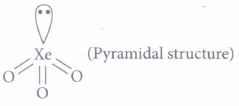
(ii) The structure of XeO3 is
| (a) square planar | (b) pyramidal | (c) linear | (d) T-shaped. |
(iii) In the preparation of compound of xenon, Bartlett had taken \(\mathrm{O}_{2}^{+} \mathrm{PtF}_{6}^{-}\) as a base compound. This is because
| (a) both O2 and Xe have same size |
| (b) both Xe and O2 have same electron gain enthalpy |
| (c) both have almost same ionisation enthalpy |
| (d) both Xe and O2 are gases. |
(iv) The oxidation state of xenon in XeO3 is
| (a) +4 | (b) +2 | (c) +8 | (d) +6 |
1.
(a) Boiling point of noble gases increase down the group due to increase in atomic size, surface area and increase in van der Waals' forces of attraction.
(b) Helium. It is due to smallest atomic size.
(c) Xe+PtF6-
(d)
(e) \((i) \mathrm{XeF}_{6}+\mathrm{KF} \longrightarrow \mathrm{K}^{+}\left[\mathrm{XeF}_{7}\right]^{\ominus}
\)
\((ii) \mathrm{XeF}_{6}+2 \mathrm{H}_{2} \mathrm{O} \longrightarrow \mathrm{XeO}_{2} \mathrm{~F}_{2}+4 \mathrm{HF}\)
2.
(a) It was prepared by bombardment of Ca2+ (40) from cyclotron with Berkalium, Bk(97) in heavy particle bombardment lab of Russia.
It is metalloid and exist in solid state at room temperature.
(b) It is due to increase in surface area, therefore, van der Waals' forces of attraction increasing, hence melting point increases.
(c) l2 < Br2 < CI2 < F2 , because reduction potential Increases.
(d) It is due to low bond dissociation enthalpy, high electron gain enthalpy and highest hydration energy of F-(aq).
(e) It is because HF molecules are associated with intermolecular H-bonding where as HCl, HBr, HI do not form .H-bonds.
3.
(a) H2 S < H2 Se < H2Te < H2O
(b) H2O is liquid associated with inter molecular H-bonding where as H2 S, H2 Se, H2Te are gases.
(c) H2O < H2 S < H2 Se < H2Te because bond dissociation enthalpy decreases due to increase in bond length.
(d) It has lowest molar mass, less surface area, weak van der Waals' forces of altraction, hence lowest boiling point.
(e) H2Te > H2 Se > H2 S > H2O
4.
(a) Oxygen
(b) 'X' is SO2. It turns lime water milky due to formation of calcium sulphite.
Ca(OH)2 + SO2(g) \(\rightarrow\) CaSO3 (s) + H2O(l)
(c) SO3 gas is formed.
\(2 \mathrm{SO}_{2}(g)+\mathrm{O}_{2}(g)=\frac{\mathrm{V}_{2} \mathrm{O}_{5}}{770 \mathrm{~K}, \text { high pressure }} 2 \mathrm{SO}_{3}(g)\)
(d) Oleum is formed SO3 + H2 SO4 \(\rightarrow\) H2 S2 O7
(Oleum)
(e) It is because reaction is highly exothermic, beyond control.
5.
(a) It is because bond length increases, bond dissociation enthalpy decreases.
(b)
(c) Sodium hypophosphite and poisonous gas phosphine is formed.
P4 + 3NaOH + 3H2O \(\rightarrow\) 3NaH2PO2 + PH3
(Phosphine)
(d) \(\mathrm{PCl}_{4}^{\ominus}\) is not likely to exist because octet of phosphorus is not complete.
(e) H3 PO4 (Phosphoric acid)
(f) It gets hydrolysed to form HCI which fumes in moist air.
PCl3 + 3H2O \(\rightarrow\) H3 PO3 + 3HCl
(g) Copper (II) phosphide and sulphuric acid are formed.
3CuSO4 + 2PH3 \(\rightarrow\) Cu3 P2 + 3H2 SO4
6.
(i) (a) :The high boiling point of water is due to the association of H2O molecules through hydrogen bonding.
(ii) (d) : H2Te is more acidic than H2S.
(iii) (c) : Due to weakening of H-E bond as the bond length increases with increase of size of E-atom.
(iv) (b)
7.
(i) (a) : Fluorine is most electronegative element and has low bond dissociation enthalpy.
(ii) (a) : In F - F bond, due to smaller size of fluorine, e--e- repulsion occur, so its bond strength is less.
(iii) (c) : Additional electrons are repelled more effectively by 2p-electrons in F than by 3p- electrons in CI atom.
(iv) (b) : The electrode potential of F2 is maximum while that of I2is minimum.
8.
(i) (a)
(ii) (d) : In cold, chlorine reacts with dilute alkalies to form chlorides and hypochlorites.
(iii) (a) : \(\mathrm{Cl}_{2}+\mathrm{H}_{2} \mathrm{O} \longrightarrow 2 \mathrm{HCl}+[\mathrm{O}]\)
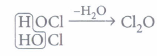
(iv) (a) : Bleaching powder contains OCl- ion, hence the oxoacid is HOCI. Anhydride of HOCI is Cl2O.
9.
(i) (d)
(c) : Ozone reacts with alkenes to form ozonides which on hydrolysis or reduction gives carbonyl compounds.
(ii) (b) : \(\mathrm{I}_{2}+5 \mathrm{O}_{3}+\mathrm{H}_{2} \mathrm{O} \rightarrow 2 \mathrm{HIO}_{3}+5 \mathrm{O}_{2}\)
(iii) (a)
(iv) (b)
10.
(i) (c) : \( 4 \mathrm{Zn}+10 \mathrm{HNO}_{3} \rightarrow\)\(4 \mathrm{Zn}\left(\mathrm{NO}_{3}\right)_{2}\) +\( 5 \mathrm{H}_{2} \mathrm{O}+\mathrm{N}_{2} \mathrm{O}\\ \text { Laughing gas } \)
(ii) (b) : \(\begin{aligned} &\mathrm{Au}+3[\mathrm{Cl}] \rightarrow \mathrm{AuCl}_{3} \stackrel{\mathrm{HCl}}{\longrightarrow} \mathrm{H}\left[\mathrm{AuCl}_{4}\right]\\ &\text { From aqua regia } \end{aligned}\)
\(\begin{aligned} &\mathrm{Pt}+4[\mathrm{Cl}] \rightarrow \mathrm{PtCl}_{4} \stackrel{\mathrm{HCl}}{\rightarrow} \mathrm{H}_{2}\left[\mathrm{PtCl}_{6}\right]\\ &\text { From aqua regia } \end{aligned}\)
(iii) (a) : \(\mathrm{Cu}+4 \mathrm{HNO}_{3(\text { conc. })} \rightarrow\) \(\mathrm{Cu}\left(\mathrm{NO}_{3}\right)_{2}+2 \mathrm{NO}_{2}+2 \mathrm{H}_{2} \mathrm{O} (A) (B)\)
(iv) (a) : \(\mathrm{HNO}_{3}+\mathrm{H}_{2} \mathrm{SO}_{4} \longrightarrow \mathrm{NO}_{2}^{+}+\mathrm{HSO}_{4}^{-}+\mathrm{H}_{2} \mathrm{O}\)
In this reaction HNO3 is acting as OH- donor and H2SO4 as H+ donor. This is not a redox reaction.
11.
(i) (a) : As fluorine is more electronegative than oxygen, so, oxygen exhibits +2 oxidation state in OF2.
(c) : In SO2 sulphur having +4 oxidation state, so it can lose its two more electrons to attain +6 oxidation state. It can gain electrons to attain its lowest oxidation state of -2. Therefore, it can behave as both reducing and oxidising agent.
(iii) (b) : \(\mathrm{Na}_{2} \mathrm{~S}_{4} \mathrm{O}_{6} \Rightarrow 2(+1)+4 x+6(-2)=0 \Rightarrow x=5 / 2\)
(iv) (a)
12.
(i) (d)
(d) : XeF6 has sp3d3 hybridisation and distorted octahedral shape
(ii) (d) : Xe has completely filled 5p -orbital. As a result, when it undergoes bonding with an odd number (1, 3 or 5) of fluorine atoms, it leaves behind one unpaired electron. This causes the molecule to become unstable. As a result, XeF, XeF3 and XeF5 do not exist.
(iii) (b):
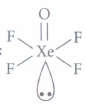
(iv) (b) : XeF2 has 3 lone pairs on Xe atom.
13.
(i) (a) : Thermal stability decreases as the size difference or the electronegativity difference between the two halogen atoms decreases.
(ii) (b) : [ICl2]- - linear, CIF3 - T-shaped, [BrF4] - - Square planar
(iii) (b): It has square pyramidal shape and has 5 bond pairs and one lone pair.
(iv) (c) : In IF7, iodine is the least electronegative halogen, so its highest oxidation number (+7) is more stable than those of the lighter member of the group.
14.
(i) (b)
(ii) (b) :
(iii) (c)
(iv) (d) : \(\mathrm{XeO}_{3} \Rightarrow x+(-2) \times 3=0 \Rightarrow x=+6\)

12th Standard CBSE Syllabus & Materials
12th Standard CBSE
CBSE 12th Computer Science Python Revision Tour I - New Previous year Question Papers Study Material - QB365 Set A
NEW12th Standard CBSE
CBSE 12th Business Studies Planning Important Questions And Answers Study Material - QB365 Set A
NEW12th Standard CBSE
CBSE 12th Business Studies Business Environment Important Questions And Answers Study Material - QB365 Set A
NEW12th Standard CBSE
CBSE 12th Business Studies Principles of Management Important Questions And Answers Study Material - QB365 Set A



CBSE 12th Standard CBSE Subjects
CBSE Standards










