
 100% FREE ACCESS
12th Standard CBSE Syllabus & Materials
12th Standard CBSE
CBSE 12th Economics Government Budget and the Economy Previous year Question Papers Study Material - QB365 Set A
NEW12th Standard CBSE
CBSE 12th Computer Science Interface Python with MySQL - New Previous year Question Papers Study Material - QB365 Set A
NEW12th Standard CBSE
CBSE 12th Computer Science Database Concept - New Previous year Question Papers Study Material - QB365 Set A
NEW12th Standard CBSE
CBSE 12th Computer Science Data Communication - New Previous year Question Papers Study Material - QB365 Set A
NEW12th Standard CBSE
CBSE 12th Computer Science Data Structures - New Previous year Question Papers Study Material - QB365 Set A
NEW12th Standard CBSE
CBSE 12th Computer Science Functions - New Previous year Question Papers Study Material - QB365 Set A

Published on: 08/09/2022
QB365 provides a detailed and simple solution for every Possible Case Study Questions in Class 12 Maths Subject - Application of Integrals, CBSE. It will help Students to get more practice questions, Students can Practice these question papers in addition to score best marks.
Download CBSE Class 12th Standard CBSE Maths question papers, sample papers, important questions, and previous year solved papers in PDF format. Get free study materials, NCERT solutions, and exam preparation resources for Class 12th Standard CBSE Maths
Questions + Answers key
Take MCQ Maths Test
1.
Consider the following equations of curves y = cos x, y = x + 1 and y = 0. On the basis of above information, answer the following questions.
(i) The curves y = cos x and y = x + 1 meet at
| (a) (1, 0) | (b) (0, 1) | (c) (1, 1) | (d) (0,0) |
(ii) y = cos x meet the x-axis at
| (a) \(\left(\frac{-\pi}{2}, 0\right)\) | (b) \(\left(\frac{\pi}{2}, 0\right)\) | (c) both (a) and (b) | (d) None of these |
(iii) Value of the integral \(\int_{-1}^{0}(x+1) d x\) is
| (a) \(\frac{1}{2}\) | (b) \(\frac{2}{3}\) | (c) \(\frac{3}{4}\) | (d) \(\frac{1}{3}\) |
(iv) Value of the integral \(\int_{0}^{\pi / 2} \cos x d x\) is
| (a) 0 | (b) -1 | (c) 2 | (d) 1 |
(v) Area bounded by the given curves is
| (a) \(\frac{1}{2} \mathrm{sq} . \text { unit }\) | (b) \(\frac{3}{2} \text { sq. units }\) | (c) \(\frac{3}{4} \text { sq. unit }\) | (d) \(\frac{1}{4} \text { sq. unit }\) |
2.
A mirror in the shape of an ellipse represented by \(\frac{x^{2}}{9}+\frac{y^{2}}{4}=1\) was hanging on the wall. Arun and his sister were playing with ball inside the house, even their mother refused to do so. All of sudden, ball hit the mirror and got a scratch in the shape of line represented by \(\frac{x}{3}+\frac{y}{2}=1\) .
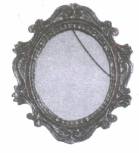
Based on the above information, answer the following questions
(i) Point(s) of intersection of ellipse and scratch (straight line) is (are)
| (a) (0, 2), (3, 0) | (b) (2, 0), (0, 3) | (c) (2, 3), (0, 0) | (d) (0, 3), (3, 0) |
(ii) Area of smaller region bounded by the ellipse and line is represented by

(iii) The value of \(\frac{2}{3} \int_{0}^{3} \sqrt{9-x^{2}} d x\) is
| (a) \(\frac{\pi}{2}\) | (b) \(\pi\) | (c) \(\frac{3 \pi}{2}\) | (d) \(\frac{\pi}{4}\) |
(iv) The value of \(2 \int_{0}^{3}\left(1-\frac{x}{3}\right) d x\) is
| (a) 0 | (b) 1 | (c) 2 | (d) 3 |
(v) Area of the smaller region bounded by the mirror and scratch is
| (a) \(3\left(\frac{\pi}{2}+1\right) \text { sq. units }\) | (b) \(\left(\frac{\pi}{2}+1\right) \text { sq. units }\) | (c) \(\left(\frac{\pi}{2}-1\right) \text { sq. units }\) | (d) \(3\left(\frac{\pi}{2}-1\right) \text { sq. units }\) |
3.
Ajay cut two circular pieces of cardboard and placed one upon other as shown in figure. One of the circle represents the equation (x - 1)2 +1 = 1, while other circle represents the equation x2 +1 = 1.
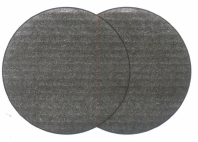
Based on the above information, answer the following questions.
(i) Both the circular pieces of cardboard meet each other at
| (a) x = 1 | (b) \(x=\frac{1}{2}\) | (c) \(x=\frac{1}{3}\) | (d) \(x=\frac{1}{4}\) |
(ii) Graph of given two curves can be drawn as

(iii) Value of \(\int_{0}^{1 / 2} \sqrt{1-(x-1)^{2}} d x\) is
| (a) \(\frac{\pi}{6}-\frac{\sqrt{3}}{8}\) | (b) \(\frac{\pi}{6}+\frac{\sqrt{3}}{8}\) | (c) \(\frac{\pi}{6}-\frac{\sqrt{3}}{8}\) | (d) \(\frac{\pi}{2}-\frac{\sqrt{3}}{4}\) |
(iv) Value of \(\int_{1 / 2}^{1} \sqrt{1-x^{2}} d x\) is
| (a) \(\frac{\pi}{6}-\frac{\sqrt{3}}{8}\) | (b) \(\frac{\pi}{6}+\frac{\sqrt{3}}{8}\) | (c) \(\frac{\pi}{6}-\frac{\sqrt{3}}{8}\) | (d) \(\frac{\pi}{2}-\frac{\sqrt{3}}{4}\) |
(v) Area of hidden portion of lower circle is
| (a) \(\left(\frac{2 \pi}{3}+\frac{\sqrt{3}}{2}\right) \text { sq. units }\) | (b) \(\left(\frac{\pi}{3}-\frac{\sqrt{3}}{8}\right) \text { sq. units }\) | (c) \(\left(\frac{\pi}{3}+\frac{\sqrt{3}}{8}\right) \text { sq. units }\) | (d) \(\left(\frac{2 \pi}{3}-\frac{\sqrt{3}}{2}\right) \text { sq. units }\) |
4.
Location of three houses of a society is represented by the points A(-1, 0), B(1, 3) and C(3, 2) as shown in figure. Based on the above information, answer the following questions
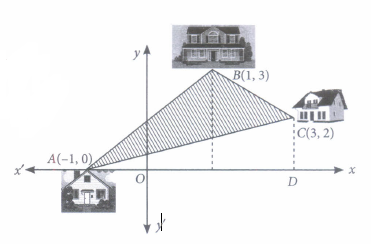
(i) Equation of line AB is
| (a) \(y=\frac{3}{2}(x+1)\) | (b) \(y=\frac{3}{2}(x-1)\) | (c) \(y=\frac{1}{2}(x+1)\) | (d) \(y=\frac{1}{2}(x-1)\) |
(ii) Equation of line BC is
| (a) \(y=\frac{1}{2} x-\frac{7}{2}\) | (b) \(y=\frac{3}{2} x-\frac{7}{2}\) | (c) \(y=\frac{-1}{2} x+\frac{7}{2}\) | (d) \(y=\frac{3}{2} x+\frac{7}{2}\) |
(iii) Area of region ABCD is
| (a) 2 sq. units | (b) 4 sq. units | (c) 6 sq. units | (d) 8 sq. units |
(iv) Area of \(\Delta A D C\) is
| (a) 4 sq. units | (b) 8 sq. units | (c) 16 sq. units | (d) 32 sq. units |
(iv) Area of \(\Delta A B C\) is
| (a) 3 sq. units | (b) 4 sq. units | (c) 5 sq. units | (d) 6 sq. units |
5.
Graphs of two function j(x) = sin x and g(x) = cas x is given below:
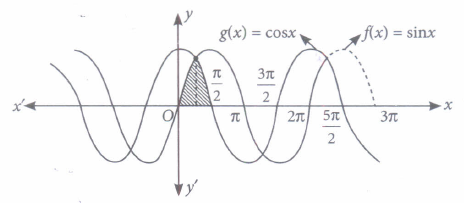
Based on the above information, answer the following questions.
(i) In \([0, \pi]\) ,the curves f(x) = sin x and g(x) = cos x intersect at x =
| (a) \(\frac{\pi}{2}\) | (b) \(\frac{\pi}{3}\) | (c) \(\frac{\pi}{4}\) | (d) \(\pi\) |
(ii) Value of \(\int_{0}^{\pi / 4} \sin x d x\) is
| (a) \(1-\frac{1}{\sqrt{2}}\) | (b) \(1+\frac{1}{\sqrt{2}}\) | (c) \(2-\frac{1}{\sqrt{2}}\) | (d) \(2+\frac{1}{\sqrt{2}}\) |
(iii) Value of \(\int_{\pi / 4}^{\pi / 2} \cos x d x\) is
| (a) \(1+\frac{1}{\sqrt{2}}\) | (b) \(1-\frac{1}{\sqrt{2}}\) | (c) \(2-\frac{1}{\sqrt{2}}\) | (d) \(2+\frac{1}{\sqrt{2}}\) |
(iv) Value of \(\int_{0}^{\pi} \sin x d x\) is
| (a) 0 | (b) 1 | (c) 2 | (d) -2 |
(v) Value of \(\int_{0}^{\pi / 2} \sin x d x\) is
| (a) 0 | (b) 1 | (c) 3 | (d) 4 |
6.
In a classroom, teacher explains the properties of a particular curve by saying that this particular curve has
beautiful up and downs. It starts at 1 and heads down until rt radian, and then heads up again and closely related to sine function and both follow each other, exactly \(\frac{\pi}{2}\) radians apart as shown in figure.
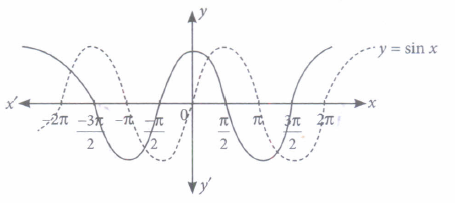
Based on the above information, answer the following questions
(i) Name the curve, about which teacher explained in the classroom
| (a) cosine | (b) sine | (c) tangent | (d) cotangent |
(ii) Area of curve explained in the passage from 0 to \(\frac{\pi}{2}\) is
| (a) \(\frac{1}{3} \mathrm{sq} . \text { unit }\) | (b) \(\frac{1}{2} \mathrm{sq} . \text { unit }\) | (c) 1 sq. unit | (d) 2 sq. units |
(iii) Area of curve discussed in classroom from \(\frac{\pi}{2} \text { to } \frac{3 \pi}{2}\) is
| (a) -2 sq. units | (b) 2 sq. units | (c) 3 sq. units | (d) -3 sq. units |
(iv) Area of curve discussed in classroom from \(\frac{3 \pi}{2} \text { to } 2 \pi\) is
| (a) 1 sq. unit | (b) 2 sq. units | (c) 3 sq. units | (d) 4 sq. units |
(v) Area of explained curve from 0 to \(2 \pi\) is
| (a) 1 sq. unit | (b) 2 sq. units | (c) 3 sq. units | (d) 4 sq. units |
7.
Consider the following equation of curve I' = 4x and straight line x + y = 3.
Based on the above information, answer the following questions.
(i) The line x + y = 3 cuts the x-axis and y-axis respectively at
| (a) (0, 2), (2, 0) | (b) (3, 3), (0, 0) | (c) (0, 3), (3, 0) | (d) (3, 0), (0, 3) |
(ii) Point(s) of intersection of two given curves is (are)
| (a) (1, -2), (-9, 6) | (b) (2, 1), (-6, 9) | (c) (1, 2), (9, -6) | (d) None of these |
(iii) Which of the following shaded portion represent the area bounded by given curves?

(iv) Value of the integral \(\int_{-6}^{2}(3-y) d y\) is
| (a) 10 | (b) 20 | (c) 30 | (d) 40 |
(v) Value of area bounded by given curves is
| (a) 56 sq. units | (b) \(\frac{63}{5} \text { sq; units }\) | (c) \(\frac{64}{3} \text { sq. units }\) | (d) 31 sq. units |
8.
A child cut a pizza with a knife. Pizza is circular in shape which is represented by knife represents a straight line given by \(x=\sqrt{3} y\) .
Based on the above information, answer the following questions
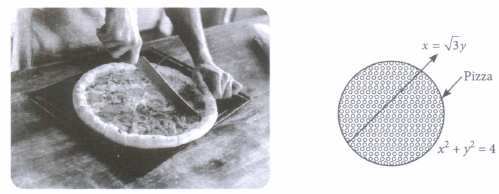
(i) The point(s) of intersection of the edge of knife (line) and pizza shown in the figure is (are)
| (a) \((1, \sqrt{3}),(-1,-\sqrt{3})\) | (b) \((\sqrt{3}, 1),(-\sqrt{3},-1)\) | (c) \((\sqrt{2}, 0),(0, \sqrt{3})\) | (d) \((-\sqrt{3}, 1),(1,-\sqrt{3})\) |
(ii) Which of the following shaded portion represent the smaller area bounded by pizza and edge of knife in first quadrant?

(iii) Value of area of the region bounded by circular pizza and edge of knife in first quadrant is
| (a) \(\frac{\pi}{2} \text { sq. units }\) | (b) \(\frac{\pi}{3} \text { sq. units }\) | (c) \(\frac{\pi}{5} \text { sq. units }\) | (d) \(\pi \text { sq. units }\) |
(iv) Area of each slice of pizza when child cut the pizza into 4 equal pieces is
| (a) \(\pi \text { sq. units }\) | (b) \(\frac{\pi}{2} \mathrm{sq} . \text { units }\)(c) \(3 \pi \text { sq. units }\) | (d) \(2 \pi \text { sq. units }\) |
(v) Area of whole pizza is
| (a) \(3 \pi \text { sq. units }\) | (b) \(2 \pi \text { sq. units }\) | (c) \(5 \pi \text { sq. units }\) | (d) \(4 \pi \text { sq. units }\) |
9.
Consider the curve x2 +y2 = 16 and line y = x in the first quadrant. Based on the above information, answer the following questions.
(i) Point of intersection of both the given curves is
| (a) (0, 4) | (b) \((0,2 \sqrt{2})\) | (c) \((2 \sqrt{2}, 2 \sqrt{2})\) | (d) \((2 \sqrt{2}, 4)\) |
(ii) Which of the following shaded portion represent the area bounded by given two curves?

(iii) The value of the integral \(\int_{0}^{2 \sqrt{2}} x d x\) is
| (a) 0 | (b) 1 | (c) 2 | (d).4 |
(iv) The value of the integral \(\int_{2 \sqrt{2}}^{4} \sqrt{16-x^{2}} d x\) is
| (a) \(2(\pi-2)\) | (b) \(2(\pi-8)\) | (c) \(4(\pi-2)\) | (d) \(4(\pi+2)\) |
(v) Area bounded by the two given curves is
| (a) \(3 \pi \text { sq. units }\) | (b) \(\frac{\pi}{2} \text { sq. units }\) | (c) \(\pi \text { sq. units }\) | (d) \(2 \pi \text { sq. units }\) |
10.
Consider the following equations of curves : x?- = y and y = x.
On the basis of above information, answer the following questions.
(i) The point(s) of intersection of both the curves is (are)
| (a) (0,0), (2, 2) | (b) (0,0), (1, 1) | (c) (0,0), (-1, -1) | (d) (0,0), (-2, -2) |
(ii) Area bounded by the curves is represented by which of the following graph?

(iii) The value of the integral \(\int_{0}^{1} x d x\) is
| (a) 1/4 | (b) 1/3 | (c) 1/2 | 1 |
(iv) The value of the integral \(\int_{0}^{1} x^{2} d x\)
| (a) 1/4 | (b) 1/3 | (c) 1/2 | 1 |
(v) The value of area bounded by the curves x?- = y and x = y is
| (a) \(\frac{1}{6} \mathrm{sq} . \text { unit }\) | (b) \(\frac{1}{3} \text { sq. unit }\) | (c) \(\frac{1}{2} \mathrm{sq} . \text { unit }\) | (d) 1 sq. unit |
1.
(i) b : Curves y = cos x and y = x + 1 meet at point C(O, 1).
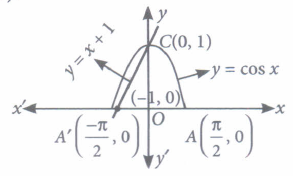
(ii) C : curve y=cosx meet the x axis at \(A^{\prime}\left(\frac{-\pi}{2}, 0\right)\) and \(A\left(\frac{\pi}{2}, 0\right)\) .
(iii) (a) : \(\int_{-1}^{0}(x+1) d x=\left[\frac{x^{2}}{2}+x\right]_{-1}^{0}=0-\left(\frac{1}{2}-1\right)=\frac{1}{2}\)
(iv) (d) : \(\int_{0}^{\pi / 2} \cos x d x=[\sin x]_{0}^{\pi / 2}=\sin \frac{\pi}{2}-\sin 0=1\)
(v) (b) : Required area \(\int_{-1}^{0}(x+1) d x+\int_{0}^{\pi / 2} \cos x d x\)
\(=\frac{1}{2}+1=\frac{3}{2} \text { sq. units }\)
2.
(i) (a) : Points (0, 2) and (3, 0) pass through both line and ellipse.
(ii) (b) :
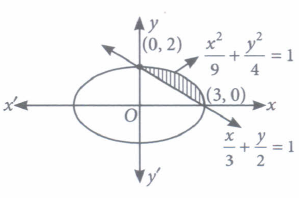
(iii) (c) : \(\frac{2}{3} \int_{0}^{3} \sqrt{9-x^{2}} d x=\frac{2}{3} \int_{0}^{3} \sqrt{(3)^{2}-x^{2}} d x\)
\(=\frac{2}{3}\left[\frac{1}{2} x \sqrt{9-x^{2}}+\frac{9}{2} \sin ^{-1}\left(\frac{x}{3}\right)\right]_{0}^{3}\)
\(=\frac{2}{3}\left[\frac{3}{2} \sqrt{0}+\frac{9}{2} \sin ^{-1}(1)-\frac{1}{2}(0)-\frac{9}{2} \sin ^{-1}(0)\right]\)
\(=\frac{2}{3}\left[\frac{9}{2} \cdot \frac{\pi}{2}\right]=\frac{3 \pi}{2}\)
(iv) d : \(2 \int_{0}^{3}\left(1-\frac{x}{3}\right) d x=2\left[x-\frac{x^{2}}{6}\right]_{0}^{3}\)
\(=2\left(3-\frac{9}{6}-0-0\right)=2 \times \frac{3}{2}=3\)
(v) (d) : Area of smaller region bounded by the mirrorand scratch
\(=\frac{2}{3} \cdot \int_{0}^{3} \sqrt{9-x^{2}} d x-2 \int_{0}^{3}\left(1-\frac{x}{3}\right) d x\)
\(=\frac{3 \pi}{2}-3=3\left(\frac{\pi}{2}-1\right) \text { sq. units }\)
3.
(i) (b) : We have, (x - 1)2+y2 = 1
\(\Rightarrow y=\sqrt{1-(x-1)^{2}}\) ...(i)
Also, \(x^{2}+y^{2}=1 \Rightarrow y=\sqrt{1-x^{2}}\) ...(ii)
From (i) and (ii), we get
\(\sqrt{1-(x-1)^{2}}=\sqrt{1-x^{2}}\)
\(\Rightarrow(x-1)^{2}=x^{2} \Rightarrow 2 x=1 \Rightarrow x=\frac{1}{2}\)
(ii) (c):
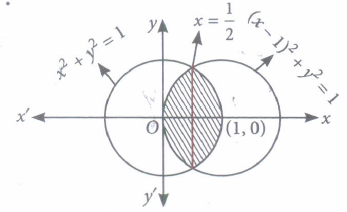
(iii) (a) : \(\int_{0}^{1 / 2} \sqrt{1-(x-1)^{2}} d x\)
\(=\left[\frac{x-1}{2} \sqrt{1-(x-1)^{2}}+\frac{1}{2} \sin ^{-1}\left(\frac{x-1}{1}\right)\right]_{0}^{1 / 2}\)
\(\begin{array}{r} =\frac{1}{2}\left(\frac{1}{2}-1\right) \sqrt{1-\frac{1}{4}}+\frac{1}{2} \sin ^{-1}\left(-\frac{1}{2}\right)-\left(-\frac{1}{2}\right)(0) -\frac{1}{2} \sin ^{-1}(-1) \end{array}\)
\(=\left[\frac{-1}{4} \cdot \frac{\sqrt{3}}{2}-\frac{1}{2} \cdot \frac{\pi}{6}+0+\frac{1}{2} \cdot \frac{\pi}{2}\right]=\frac{-\sqrt{3}}{8}-\frac{\pi}{12}+\frac{\pi}{4}\)
\(=\frac{\pi}{6}-\frac{\sqrt{3}}{8}\)
(iv) (c : \(\int_{1 / 2}^{1} \sqrt{1-x^{2}} d x=\left[\frac{x}{2} \sqrt{1-x^{2}}+\frac{1}{2} \sin ^{-1} x\right]_{1 / 2}^{1}\)
\(=0+\frac{1}{2} \sin ^{-1}(1)-\frac{1}{4} \sqrt{1-\frac{1}{4}}-\frac{1}{2} \sin ^{-1}\left(\frac{1}{2}\right)\)
\(=\frac{\pi}{4}-\frac{\sqrt{3}}{8}-\frac{\pi}{12}=\frac{\pi}{6}-\frac{\sqrt{3}}{8}\)
(v) (d) : Required area
\(=2\left[\int_{0}^{1 / 2} \sqrt{1-(x-1)^{2}} d x+\int_{1 / 2}^{1} \sqrt{1-x^{2}} d x\right]\)
\(=2\left[\frac{\pi}{6}-\frac{\sqrt{3}}{8}+\frac{\pi}{6}-\frac{\sqrt{3}}{8}\right]\)
\(=2\left[\frac{\pi}{3}-\frac{\sqrt{3}}{4}\right]=\left(\frac{2 \pi}{3}-\frac{\sqrt{3}}{2}\right) \text { sq. units }\)
4.
(i) (a) : Equation of line AB is
\(y-0=\frac{3-0}{1+1}(x+1) \Rightarrow y=\frac{3}{2}(x+1)\)
(ii) (c) : Equation of line BC is \(y-3=\frac{2-3}{3-1}(x-1)\)
\(\Rightarrow y=-\frac{1}{2} x+\frac{1}{2}+3 \Rightarrow y=\frac{-1}{2} x+\frac{7}{2}\)
(iii) (d) : Area of region ABCD
= Area of \(\triangle A B E\) + Area of region BCDE
\(=\int_{-1}^{1} \frac{3}{2}(x+1) d x+\int_{1}^{3}\left(\frac{-1}{2} x+\frac{7}{2}\right) d x\)
\(=\frac{3}{2}\left[\frac{x^{2}}{2}+x\right]_{-1}^{1}+\left[\frac{-x^{2}}{4}+\frac{7}{2} x\right]_{1}^{3}\)
\(=\frac{3}{2}\left[\frac{1}{2}+1-\frac{1}{2}+1\right]+\left[\frac{-9}{4}+\frac{21}{2}+\frac{1}{4}-\frac{7}{2}\right]\)
= 3 + 5 = 8 sq. units
(iv) (a) : Equation of line AC is \(y-0=\frac{2-0}{3+1}(x+1)\)
\(\Rightarrow y=\frac{1}{2}(x+1)\)
\(\therefore \text { Area of } \Delta A D C=\int_{-1}^{3} \frac{1}{2}(x+1) d x=\left[\frac{x^{2}}{4}+\frac{1}{2} x\right]_{-1}^{3}\)
\(=\frac{9}{4}+\frac{3}{2}-\frac{1}{4}+\frac{1}{2}=4 \text { sq. units }\)
(v) (b) : Area of \(\Delta A B C\)= Area of region ABCD - Area of \(\Delta A C D=8-4=4 \mathrm{sq} . \text { units }\)
5.
(i) (c) : For point of intersection, we have sin x = cos x
\(\Rightarrow \frac{\sin x}{\cos x}=1 \Rightarrow \tan x=1 \Rightarrow x=\frac{\pi}{4}\)
(ii) (a) : \(\int_{0}^{\pi / 4} \sin x d x=[-\cos x]_{0}^{\pi / 4}=-\cos \frac{\pi}{4}+\cos 0\) \(=1-\frac{1}{\sqrt{2}}\)
(iii) (b) : \(\int_{\pi / 4}^{\pi / 2} \cos x d x=[\sin x]_{\pi / 4}^{\pi / 2}=\sin \frac{\pi}{2}-\sin \frac{\pi}{4}\) \(=1-\frac{1}{\sqrt{2}}\)
(iv) (c) : \(\int_{0}^{\pi} \sin x d x=[-\cos x]_{0}^{\pi}=[-\cos \pi+\cos 0]=2\)
(v) (b) : \(\int_{0}^{\pi / 2} \sin x d x=[-\cos x]_{0}^{\pi / 2}=\left[-\cos \frac{\pi}{2}+\cos 0\right]\) = 0+1=1
6.
(i) (a) : Here, teacher explained about cosine curve.
(ii) (c) : Required area \(\int_{0}^{\pi / 2} \cos x d x\)
\(=[\sin x]_{0}^{\pi / 2}=\sin \frac{\pi}{2}-\sin 0=1-0=1 \text { sq. unit }\)
(iii) (b) : Required area = \(\left|\int_{\pi / 2}^{3 \pi / 2} \cos x d x\right|=\left|[\sin x]_{\pi / 2}^{3 \pi / 2}\right|\)
\(=\left|\sin \frac{3 \pi}{2}-\sin \frac{\pi}{2}\right|=|-1-1|=|-2|\)
= 2 sq. units [Since, area can't be negative]
(iv) (a) : Required area = \(\int_{3 \pi / 2}^{2 \pi} \cos x d x=[\sin x]_{3 \pi / 2}^{2 \pi}\)
\(=\sin 2 \pi-\sin \frac{3 \pi}{2}=0-(-1)=1 \text { sq. unit }\)
(v) (d) : Required area
\(=\int_{0}^{\pi / 2} \cos x d x+\left|\int_{\pi / 2}^{3 \pi / 2} \cos x d x\right|+\int_{3 \pi / 2}^{2 \pi} \cos x d x\)
= 1 + 2 + 1 = 4 sq. units.
7.
(i) (d) : Line x + y = 3 cuts the x-axis and y-axis at (3, 0) and (0, 3) respectively
[Since, at x-axis, y = 0 and at y-axis, x = 0]
(ii) (c) : We have, y2 = 4x and x + y = 3
From (i) and (ii), we have y2 = 4(3 - y)
\(\Rightarrow y^{2}+4 y-12=0 \Rightarrow y^{2}+6 y-2 y-12=0\)
\(\Rightarrow y(y+6)-2(y+6)=0\)
\(\Rightarrow (y+6)(y-2)=0 \Rightarrow y=2, y=-6\)
From (ii), x = 3 - 2 = 1 or x = 3 + 6 = 9
\(\therefore\) Required points of intersection are (1, 2), (9, - 6)
(iii) (b) :
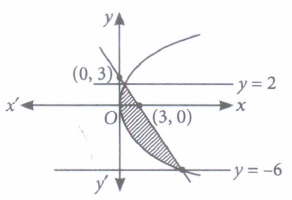
(iv) (d): \(\int_{-6}^{2}(3-y) d y=\left[3 y-\frac{y^{2}}{2}\right]_{-6}^{2}\)
\(=\left[6-\frac{4}{2}-\left[3(-6)-\frac{(-6)^{2}}{2}\right]\right]=4+36=40\)
(v) (c): Required area = \(\int_{-6}^{2}(3-y) d y-\int_{-6}^{2} \frac{y^{2}}{4} d y\)
\(=40-\frac{1}{4}\left[\frac{y^{3}}{3}\right]_{-6}^{2}=40-\frac{1}{4}\left[\frac{8}{3}-\frac{(-6)^{3}}{3}\right]\)
\(=40-\frac{2}{3}-\frac{216}{12}=\frac{480-8-216}{12}=\frac{256}{12}=\frac{64}{3} \mathrm{sq} . \text { units }\)
8.
(i) (b) : We have, y2 + 1 = 4 ...(i)
and \(x=\sqrt{3} y\) ...(ii)
From (i) and (ii), we get
\(3 y^{2}+y^{2}=4 \Rightarrow 4 y^{2}=4 \Rightarrow y^{2}=1 \Rightarrow y=\pm 1\)
From (ii), \(x=\sqrt{3},-\sqrt[4]{3}\)
\(\therefore\) Points of intersection of pizza and edge of knife are \((\sqrt{3}, 1),(-\sqrt{3},-1)\) .
(ii) (a) :
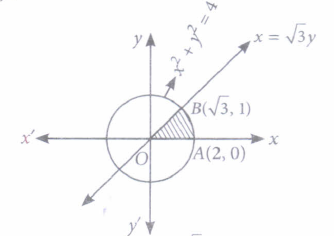
(iii) (b) : Required area = \(\int_{0}^{\sqrt{3}} \frac{x}{\sqrt{3}} d x+\int_{\sqrt{3}}^{2} \sqrt{4-x^{2}} d x\)
\(=\frac{1}{\sqrt{3}}\left[\frac{x^{2}}{2}\right]_{0}^{\sqrt{3}}+\left[\frac{x}{2} \sqrt{4-x^{2}}+\frac{4}{2} \sin ^{-1}\left(\frac{x}{2}\right)\right]_{\sqrt{3}}^{2}\)
\(=\frac{1}{\sqrt{3}}\left[\frac{3}{2}-0\right]+\left[2 \sin ^{-1}(1)-\left(\frac{\sqrt{3}}{2}+2 \sin ^{-1} \frac{\sqrt{3}}{2}\right)\right]\)
\(=\frac{\sqrt{3}}{2}+\frac{2 \pi}{2}-\frac{\sqrt{3}}{2}-\frac{2 \pi}{3}=\frac{\pi}{3} \text { sq. units }\)
(iv) (a) : We have,x2+y2=4
\(\Rightarrow(x-0)^{2}+(y-0)^{2}=(2)^{2}\)
\(\therefore\) Radius = 2
Area of \(\frac{1}{4} \text { th slice of pizza }=\frac{1}{4} \pi(2)^{2}=\pi \mathrm{sq} . \text { units }\)
(v) (d) : Area of whole pizza = \(\pi(2)^{2}=4 \pi \mathrm{sq} . \text { units }\)
9.
(i) (c) : We have, x2 +y2= 16 ..(i)
and y = x ...(ii)
From (i) and (ii), \(2 x^{2}=16 \Rightarrow x^{2}=8 \Rightarrow x=2 \sqrt{2}\) (\(\therefore\) x lies in first quadrant)
\(\therefore\) Point of intersection of (i) and (ii) in first quadrant is \((2 \sqrt{2}, 2 \sqrt{2})\) .
(ii) (b) : The shaded region which represent the areabounded by two given curves in first quadrant is shown below.
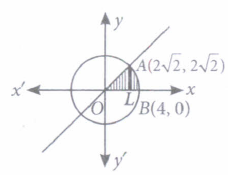
(iii)( d) : \(\int_{0}^{2 \sqrt{2}} x d x=\left[\frac{x^{2}}{2}\right]_{0}^{2 \sqrt{2}}=\frac{(2 \sqrt{2})^{2}}{2}=\frac{8}{2}=4\)
(iv) (a) : \(\int_{2 \sqrt{2}}^{4} \sqrt{16-x^{2}} d x=\left[\frac{x}{2} \sqrt{16-x^{2}}+\frac{16}{2} \cdot \sin ^{-1}\left(\frac{x}{4}\right)\right]_{2 \sqrt{2}}^{4}\)
\(=8 \sin ^{-1}(1)-4-8 \sin ^{-1}\left(\frac{1}{\sqrt{2}}\right)\)
\(=8\left(\frac{\pi}{2}\right)-4-8\left(\frac{\pi}{4}\right)=4 \pi-4-2 \pi=2 \pi-4=2(\pi-2)\)
(v) (d) : Required area = Area (OLA) + Area (BAL)
\(=\int_{0}^{2 \sqrt{2}} x d x+\int_{2 \sqrt{2}}^{4} \sqrt{16-x^{2}} d x\)
\(=4+2(\pi-2)=2 \pi \text { sq. units. }\)
10.
(i) (b) : We have, x2 = y ...(i) and x = y. , ...(ii)
From (i) and (ii), x2= x \(\Rightarrow\)x2 - x = 0
\(\Rightarrow\) x(x - 1) = 0 ~ x = 0, 1
From (ii), y = 0, 1
Required points of intersection are (0, 0), (1, 0)
(ii) (a) :
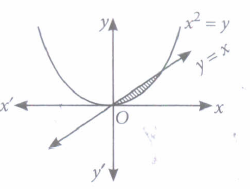
(iii) (c) : \(\int_{0}^{1} x d x=\left[\frac{x^{2}}{2}\right]_{0}^{1}=\frac{1}{2}-0=\frac{1}{2}\)
(iv) (b) : \(\int_{0}^{1} x^{2} d x=\left[\frac{x^{3}}{3}\right]_{0}^{1}=\frac{1}{3}-0=\frac{1}{3}\)
(v) (a) : Required area \(=\int_{0}^{1} x d x-\int_{0}^{1} x^{2} d x\)
\(=\frac{1}{2}-\frac{1}{3}=\frac{1}{6} \text { sq. units. }\)

12th Standard CBSE Syllabus & Materials
12th Standard CBSE
CBSE 12th Computer Science Python Revision Tour I - New Previous year Question Papers Study Material - QB365 Set A
NEW12th Standard CBSE
CBSE 12th Business Studies Planning Important Questions And Answers Study Material - QB365 Set A
NEW12th Standard CBSE
CBSE 12th Business Studies Business Environment Important Questions And Answers Study Material - QB365 Set A
NEW12th Standard CBSE
CBSE 12th Business Studies Principles of Management Important Questions And Answers Study Material - QB365 Set A



CBSE 12th Standard CBSE Subjects
CBSE Standards










