
 100% FREE ACCESS
12th Standard CBSE Syllabus & Materials
12th Standard CBSE
CBSE 12th Economics Government Budget and the Economy Previous year Question Papers Study Material - QB365 Set A
NEW12th Standard CBSE
CBSE 12th Computer Science Interface Python with MySQL - New Previous year Question Papers Study Material - QB365 Set A
NEW12th Standard CBSE
CBSE 12th Computer Science Database Concept - New Previous year Question Papers Study Material - QB365 Set A
NEW12th Standard CBSE
CBSE 12th Computer Science Data Communication - New Previous year Question Papers Study Material - QB365 Set A
NEW12th Standard CBSE
CBSE 12th Computer Science Data Structures - New Previous year Question Papers Study Material - QB365 Set A
NEW12th Standard CBSE
CBSE 12th Computer Science Functions - New Previous year Question Papers Study Material - QB365 Set A

Published on: 08/09/2022
QB365 provides a detailed and simple solution for every Possible Case Study Questions in Class 12 Maths Subject - Vector Algebra, CBSE. It will help Students to get more practice questions, Students can Practice these question papers in addition to score best marks.
Download CBSE Class 12th Standard CBSE Maths question papers, sample papers, important questions, and previous year solved papers in PDF format. Get free study materials, NCERT solutions, and exam preparation resources for Class 12th Standard CBSE Maths
Questions + Answers key
Take MCQ Maths Test
1.
A barge is pulled into harbour by two tug boats as shown in the figure.
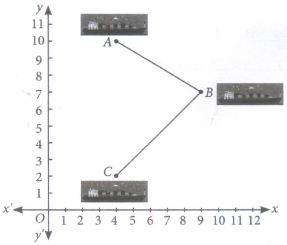
Based on the above information, answer the following questions.
(i) Position vector of A is
| (a) \(4 \hat{i}+2 \hat{j}\) | (b) \(4 \hat{i}+10 \hat{j}\) | (c)\(4 \hat{i}-10 \hat{j}\) | (d) \(4 \hat{i}-2 \hat{j}\) |
(ii) Position vector of B is
| (a) \(4 \hat{i}+4 \hat{j}\) | (b) \(6 \hat{i}+6 \hat{j}\) | (c) \( 9 \hat{i}+7 \hat{j}\) | (d) \(3 \hat{i}+3 \hat{j}\) |
(iii) Find the vector \(\vec{AC}\) in terms of \(\hat{i}, \hat{j}\)
| (a) \(8 \hat{j}\) | (b) \(-8 \hat{j}\) | (c) \(8 \hat{i}\) | (d) None of these |
(iv) If \(\vec{A}=\hat{i}+2 \hat{j}+3 \hat{k}\), then its unit vector is
| (a)\(\frac{\hat{i}}{\sqrt{14}}+\frac{2 \hat{j}}{\sqrt{14}}+\frac{3 \hat{k}}{\sqrt{14}}\) | (b) \(\frac{3 \hat{i}}{\sqrt{14}}+\frac{2 \hat{j}}{\sqrt{14}}+\frac{\hat{k}}{\sqrt{14}}\) | (c) \(\frac{2 \hat{i}}{\sqrt{14}}+\frac{3 \hat{j}}{\sqrt{14}}+\frac{\hat{k}}{\sqrt{14}}\) | (d) None of these |
(v) If \(\vec{A}=4 \hat{i}+3 \hat{j}\) and \(\vec{B}=3 \hat{i}+4 \hat{j}\), then IAI+ IBI = ___________.
| (a) 12 | (b) 13 | (c) 14 | (d) 10 |
2.
Three slogans on chart papers are to be placed on a school bulletin board at the points A, Band C displaying A (Hub of Learning), B (Creating a better world for tomorrow) and C (Education comes first). The coordinates of these points are (1, 4, 2), (3, -3, -2) and (-2, 2, 6) respectively.
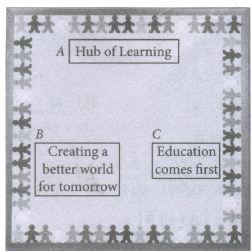
Based on the above information, answer the following questions.
(i) Let \(\vec{a}\), \(\vec{b}\)and \(\vec{c}\) be the position vectors of points A, B and C respectively, then \(\vec{a}\) + \(\vec{b}\)+ \(\vec{c}\) is equal to
| (a) \(2 \hat{i}+3 \hat{j}+6 \hat{k} \) | (b) \(2 \hat{i}-3 \hat{j}-6 \hat{k}\) | (c) \(2 \hat{i}+8 \hat{j}+3 \hat{k} \) | (d) \(2(7 \hat{i}+8 \hat{j}+3 \hat{k})\) |
(ii) Which of the following is not true?
| (a) \(\overrightarrow{A B}+\overrightarrow{B C}+\overrightarrow{C A}=\overrightarrow{0}\) | (b) \(\overrightarrow{A B}+\overrightarrow{B C}-\overrightarrow{A C}=\overrightarrow{0}\) | (c) \(\overrightarrow{A B}+\overrightarrow{ BC}-\overrightarrow{C A}=\overrightarrow{0}\) | (d) \(\overrightarrow{A B}-\overrightarrow{C B}+\overrightarrow{C A}=\overrightarrow{0}\) |
(iii) Area of \(\Delta\)ABC is
| (a) 19 sq. units | (b) \(\sqrt 1937 sq. unit\) | (c) \(\frac{1}{2}\sqrt 1937 sq. unit\) | (d) \(\sqrt 1837 sq. unit\) |
(iv) Suppose, if the given slogans are to be placed on a straight line, then the value of \(|\vec{a} \times \vec{b}+\vec{b} \times \vec{c}+\vec{c} \times \vec{a}|\) will be equal to
| (a) -1 | (b) -2 | (c) 2 | (d) 0 |
(v) If \(\vec{a}=2 \hat{i}+3 \hat{j}+6 \hat{k}\) then unit vector in the direction of vector \(\vec{a}\)is
| (a) \(\frac{2}{7} \hat{i}-\frac{3}{7} \hat{j}-\frac{6}{7} \hat{k}\) | (b) \(\frac{2}{7} \hat{i}+\frac{3}{7} \hat{j}+\frac{6}{7} \hat{k}\) | (c) \(\frac{3}{7} \hat{i}+\frac{2}{7} \hat{j}+\frac{6}{7} \hat{k}\) | (d) None of these |
3.
If two vectors are represented by the two sides of a triangle taken in order, then their sum is represented by the third side of the triangle taken in opposite order and this is known as triangle law of vector addition. lased on the above information, answer the following questions.
(i) If \(\vec{p}, \vec{q}, \vec{r}\)are the vectors represented by the sides of a triangle taken in order, then \( \vec{q} +\vec{r}\) =
| (a) \(\vec{p}\) | (b) \(2 \vec{p}\) | (c) \(-\vec{p}\) | (d) None of these |
(ii) If ABCD is a parallelogram and AC and BD are its diagonals, then\( \vec{AC} +\vec{BD}\) =
| (a) \(2 \vec{DA}\) | (b) \(2 \vec{AB}\) | (c) \(2\overrightarrow{BC}\) | (d) \(2\vec{BD}\) |
(iii) If ABCD is a parallelogram, where \(\overrightarrow{A B}\)\(=2\overrightarrow{a}\) and \(\overrightarrow{BC}\) \(=2\overrightarrow{b}\), then \( \vec{AC} -\vec{BD}\) =
| (a) \(3\vec{a}\) | (b) \(4\vec{a}\) | (c) \(2\vec{b}\) | (d) \(4\vec{b}\) |
(iv) If ABCD is a quadrilateral whose diagonals are \( \vec{AC}\) and \(\vec{BD}\), then \( \vec{BA} +\vec{CD}\) =
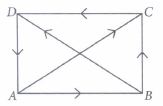
| (a) \(\overrightarrow{A C}+\overrightarrow{D B}\) | (b) \(\overrightarrow{A C}+\overrightarrow{B D}\) | (c) \(\overrightarrow{B C}+\overrightarrow{A D}\) | (d) \(\overrightarrow{B D}+\overrightarrow{C A}\) |
(v) If T is the mid point of side YZ of \(\triangle\)XYZ, then\(\overrightarrow{XY}\) + \(\overrightarrow{XZ}\) =
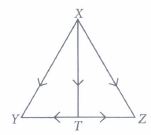
| (a) \(2\vec{YT}\) | (b) \(2\vec{XT}\) | (c) \(2\vec{TZ}\) | (d) None of these |
4.
A building is to be constructed in the form of a triangular pyramid, ABCD as shown in the figure.
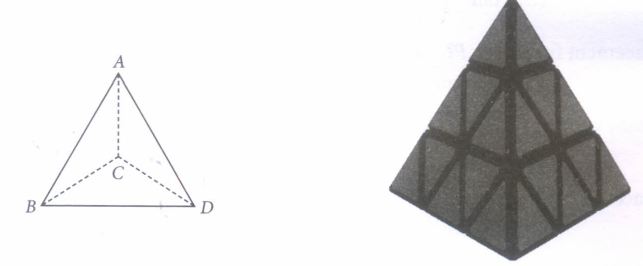
Let its angular points are A(0, 1, 2), B(3, 0, 1), C(4, 3, 6) and D(2, 3, 2) and G be the point of intersection of the medians of \(\Delta\)BCD.
Based on the above information, answer the following questions.
(i) The coordinates of point G are
| (a) (2,3,3) | (b) (3,3,2) | (c) (3,2,3) | (d) (0,2,3) |
(ii) The length of vector \(\overrightarrow{A G}\) is
| (a) \(\sqrt 17\) units | (b) \(\sqrt 11\) units | (c) \(\sqrt 13\) units | (d) \(\sqrt 19\) units |
(iii) Area of \(\Delta\)ABC (in sq. units) is
| (a) \(\sqrt 10\) units | (b) \(2\sqrt 10\) units | (c) \(3\sqrt 10\) units | (d) \(5\sqrt 10\) units |
(iv) The sum of lengths of \(\overrightarrow{A B}\) and \(\overrightarrow{A C}\) is
| (a) 5 units | (b) 9.32 units | (c) 10 units | (d) 11units |
(v) The length of the perpendicular from the vertex D on the opposite face is
| (a) \(\frac{6}{\sqrt{10}}\) units | (b) \(\frac{2}{\sqrt{10}}\) units | (c) \(\frac{3}{\sqrt{10}}\)units | (d) \(8\sqrt 10\) units |
5.
Ishaan left from his village on weekend. First, he travelled up to temple. After this, he left for the zoo. After this he left for shopping in a mall. The positions of Ishaan at different places is given in the following graph.
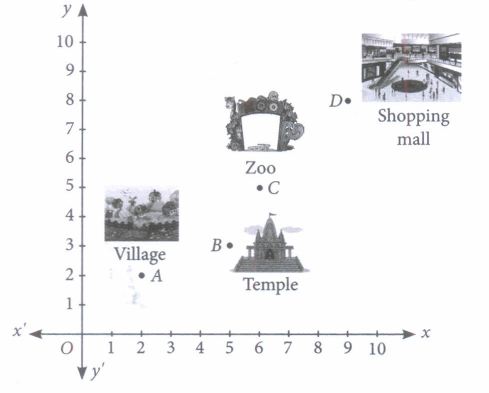
Based on the above information, answer the following questions.
(i) Position vector of B is
| (a) \(3 \hat{i}+5 \hat{j}\) | (b) \(5 \hat{i}+3 \hat{j}\) | (c) \(-5 \hat{i}-3 \hat{j}\) | (d) \(-5 \hat{i}+3 \hat{j}\) |
(ii) Position vector of D is
| (a) \(5 \hat{i}+3 \hat{j}\) | (b) \(3 \hat{i}+5 \hat{j}\) | (c) \(8 \hat{i}+9 \hat{j}\) | (d) \(9 \hat{i}+8 \hat{j}\) |
(iii) Find the vector \(\overrightarrow{B C}\) in terms of \(\hat{i}, \hat{j}\).
| (a) \( \hat{i}-2 \hat{j}\) | (b) \( \hat{i}+2 \hat{j}\) | (c) \(2\hat{i}+ \hat{j}\) | (d) \(2\hat{i}- \hat{j}\) |
(iv) Length of vector \(\overrightarrow{A D}\) is
| (a) \(\sqrt 67\) units | (b) \(\sqrt 85\) units | (c) 90 units | (d) 100 units |
(v) If \(\vec{M}=4 \hat{\jmath}+3 \hat{k}\) , then its unit vector
| (a) \(\frac{4}{5} \hat{j}+\frac{3}{5} \hat{k}\) | (b) \(\frac{4}{5} \hat{j}-\frac{3}{5} \hat{k}\) | (c) \(-\frac{4}{5} \hat{j}+\frac{3}{5}\hat{k}\) | (d) \(-\frac{4}{5} \hat{j}-\frac{3}{5} \hat{k}\) |
6.
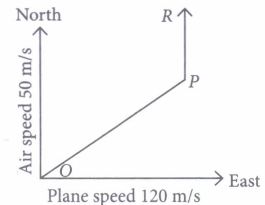
A plane started from airport situated at 0 with avelocity of 120 m/s towards east. Air is blowing at a velocity of 50 m/s towards the north as shown in the figure.
The plane travelled 1 hr in OP direction with the resultant velocity. From P to R the plane travelled 1 hr keeping velocity of 120 m/s and finally landed at R.
Based on the above information, answer the following questions.
(i) What is the resultant velocity from O to P?
| (a) 100 m/s | (b) 130 m/s | (c) 126 m/s | (d) 180 m/s |
(ii) What is the direction of travel of plane from O to P with East?
| (a) \(\tan ^{-1}\left(\frac{5}{12}\right)\) | (b) \(\tan ^{-1}\left(\frac{12}{3}\right)\) | (c) 50 | (d) 80 |
(iii) What is the displacement from O to P?
| (a) 600 km | (b) 468 km | (c) 532 km | (d) 500 km |
(iv) What is the resultant velocity from P to R?
| (a) 120 m/s | (b) 70 m/s | (c) 170 m/s | (d) 200 m/s |
(v) What is the displacement from P to R?
| (a) 450 km | (b) 532 km | (c) 610 km | (d) 612 km |
7.
Teams A, B, C went for playing a tug of war game. Teams A, B, C have attached a rope to a metal ring and is trying to pull the ring into their own area (team areas shown below).
Team A pulls with force F1 = \(\hat{4}+\hat{0} \hat{j}\) KN
Team B ⟶ F2 = \(-2 \hat{i}+4 \hat{j}\) KN
Team C ⟶ F3 = \(-3 \hat{i}-3 \hat{j}\) KN
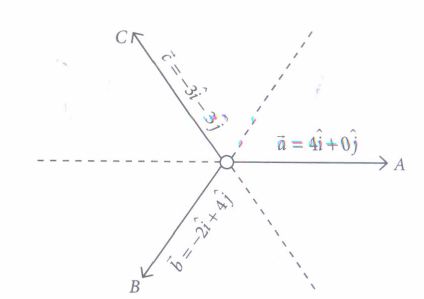
Based on the above information, answer the following questions.
(i) Which team will win the game ?
| (a) Team B | (b) Team A | (c) Team C | (d) No one |
(ii) What is the magnitude of the teams combined force ?
| (a) 7 KN | (b) 1.4 KN | (c) 1.5 KN | (d) 2 KN |
(iii) In what direction is the ring getting pulled?
| (a) 2.0 radian | (b) 2.5 radian | (c) 2.4 radian | (d) 3 radian |
(iv) What is the magnitude of the force of Team B?
| (a) 2\(\sqrt 5\) KN | (b) 6 KN | (c) 2 KN | (d) \(\sqrt 6\) KN |
(v) How many KN force is applied by Team A?
| (a) 5 KN | (b) 4 KN | (c) 2 KN | (d) 16 KN |
8.
Geetika's house is situated at Shalimar Bagh at point 0, for going to Aloks house she first travels 8 km by bus in the East. Here at point A, a hospital is situated. From Hospital, Geetika takes an auto and goes 6 km in the North, here at point B school is situated. From school, she travels by bus to reach Aloks house which is at 30° East, 6 km from point B.
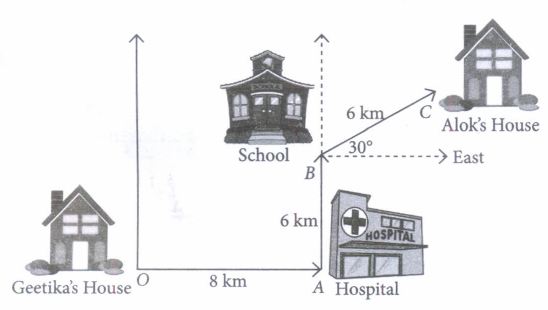
Based on the above information, answer the following questions.
(i) What is the vector distance between Geetikas house and school ?
| (a) \(8 \hat{i}-6 \hat{j}\) | (b) \(8 \hat{i}+6 \hat{j}\) | (c) \(8 \hat{i}\) | (d) \(6 \hat{j}\) |
(ii) How much distance Geetika travels to reach school?
| (a) 14 km | (b) 15 km | (c) 16 km | (d) 17 km |
(iii) What is the vector distance from school to Alok's house ?
| (a) \(\sqrt{3} \hat{i}+\hat{j}\) | (b) \(3 \sqrt{3} \hat{i}+3 \hat{j}\) | (c) \(6 \hat{i}\) | (d) \(6 \hat{j}\) |
(iv) What is the vector distance from Geetikas house to Alok's house?
| (a) \((8+3 \sqrt{3}) \hat{i}+9 \hat{j}\) | (b) \( 4\hat{i}+6 \hat{j}\) | (c) \(15 \hat{i}\) | (d) \(16 \hat{j}\) |
(v) What is the total distance travelled by Geetika from her house to Alok's house?
| (a) 19 km | (b) 20 km | (c) 21 km | (d) 22 km |
9.
Ginni purchased an air plant holder which is in the shape of a tetrahedron.
Let A, B, C and D are the coordinates of the air plant holder where A \(\equiv \) (1, 1, 1), B \(\equiv \) (2, 1, 3), C \(\equiv \) (3, 2, 2) and D \(\equiv \)(3, 3, 4).
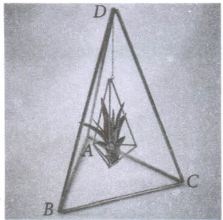
Based on the above information, answer the following questions.
(i) Find the position vector of \(\overrightarrow{A B} \).
| (a) \(-\hat{i}-2 \hat{k}\) | (b) \(2 \hat{i}+\hat{k}\) | (c) \(\hat{i}+2 \hat{k}\) | (d)\(-2 \hat{i}-\hat{k}\) |
(ii) Find the position vector of \(\overrightarrow{A C} \).
| (a) \(2 \hat{i}-\hat{j}-\hat{k}\) | (b) \(2 \hat{i}+\hat{j}+\hat{k}\) | (c) \(-2 \hat{i}-\hat{j}+\hat{k}\) | (d) \(\hat{i}+2 \hat{j}+\hat{k}\) |
(iii) Find the position vector of \(\overrightarrow{AD} .\).
| (a) \( 2 \hat{i}-2 \hat{j}-3 \hat{k}\) | (b) \( \hat{i}+\hat{j}-3 \hat{k}\) | (c) \(3 \hat{i}+2 \hat{j}+2 \hat{k}\) | (d) \(2\hat{i}+2 \hat{j}+3 \hat{k}\) |
(iv) Area of \(\Delta A B C\) =
| (a) \(\frac{\sqrt{11}}{2} \mathrm{sq .units}\) | (b) \(\frac{\sqrt{14}}{2} sq. units\) | (c) \(\frac{\sqrt{13}}{2}\) | (d)\(\frac{\sqrt{17}}{2} \mathrm{sq .units}\) |
(v) Find the unit vector along \(\overrightarrow{AD} .\)
| (a) \(\frac{1}{\sqrt{17}}(2 \hat{i}+2 \hat{j}+3 \hat{k})\) | (b)\(\frac{1}{\sqrt{17}}(3 \hat{i}+3 \hat{j}+2 \hat{k})\) | (c) \(\frac{1}{\sqrt{11}}(2 \hat{i}+2 \hat{j}+3 \hat{k})\) | (d) \((2 \hat{i}+2 \hat{j}+3 \hat{k})\) |
10.
Ritika starts walking from his house to shopping mall. Instead of going to the mall directly, she first goes to a ATM, from there to her daughter's school and then reaches the mall. In the diagram, A, B, C and D represent the coordinates of House, ATM, School and Mall respectively.
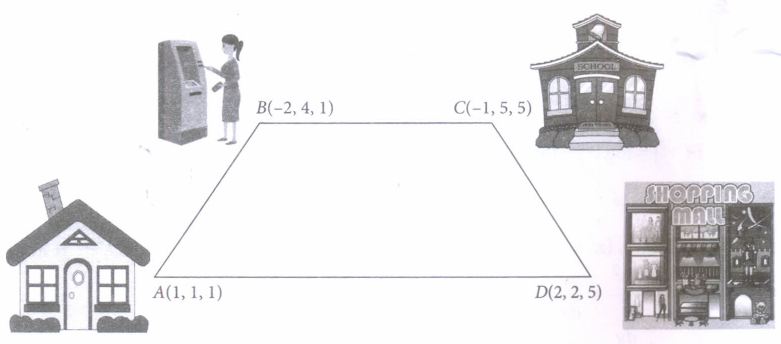
Based on the above information, answer the following questions.
(i) Distance between House (A) and ATM (B) is
| (a) 3 units | (b) 3\(\sqrt 2\) units | (c) \(\sqrt 2\)units | (d) 4\(\sqrt 2\) units |
(ii) Distance between ATM (B) and School (C) is
| (a) \(\sqrt 2\) units | (b) 2\(\sqrt 2\) units | (c) 3\(\sqrt 2\) units | (d) 4\(\sqrt 2\) units |
(iii) Distance. between School (C) and Shopping mall (D) is
| a) 3\(\sqrt 2\) units | (b) 5\(\sqrt 2\) units | (c) 7\(\sqrt 2\) units | (d) 10\(\sqrt 2\) units |
(iv) What is the total distance travelled by Ritika ?
| a) 4\(\sqrt 2\) units | (b) 6\(\sqrt 2\) units | (c) 8\(\sqrt 2\) units | (d) 9\(\sqrt 2\) units |
(v) What is the extra distance travelled by Ritika in reaching the shopping mall?
| a) 3\(\sqrt 2\) units | (b) 5\(\sqrt 2\) units | (c) 6\(\sqrt 2\) units | (d) 7\(\sqrt 2\) units |
1.
(i) (b): Here, (4, 10) are the coordinates of A.
\(\therefore\) P.V. of A = \(4 \hat{i}+10 \hat{j}\)
(ii) (c): Here, (9, 7) are the coordinates of B.
\(\therefore\) P.V. of B \(=9 \hat{i}+7 \hat{j}\)
(iii) (b): Here, P.V. of A = \(4 \hat{i}+10 \hat{j}\) and P.V. of \(C=4 \hat{i}+2 \hat{j}\)
\(\therefore \ \overrightarrow{A C}=(4-4) \hat{i}+(2-10) \hat{j}=-8 \hat{j}\)
(iv) (a): Here \(\vec{A}=\hat{i}+2 \hat{j}+3 \hat{k}\)
\( \therefore \ |\vec{A}|=\sqrt{1^{2}+2^{2}+3^{2}}=\sqrt{1+4+9}=\sqrt{14} \)
\(\therefore \ \hat{A}=\frac{\vec{A}}{|\vec{A}|}=\frac{\hat{i}+2 \hat{j}+3 \hat{k}}{\sqrt{14}}=\frac{1}{\sqrt{14}} \hat{i}+\frac{2}{\sqrt{14}} \hat{j}+\frac{3}{\sqrt{14}} \hat{k}\)
(v) (d): We have, \(\vec{A}=4 \hat{i}+3 \hat{j}\) and \( \vec{B}=3 \hat{i}+4 \hat{j}\)
\(\therefore|\vec{A}|=\sqrt{4^{2}+3^{2}}=\sqrt{16+9}=\sqrt{25}=5\)
and \(|\vec{B}|=\sqrt{3^{2}+4^{2}}=\sqrt{9+16}=\sqrt{25}=5\)
Thus, \(|\vec{A}|+|\vec{B}|=5+5=10\)
2.
(i) (a) : \(\vec{a}=\hat{i}+4 \hat{j}+2 \hat{k}, \vec{b}=3 \hat{i}-3 \hat{j}-2 \hat{k}\) and \(\vec{c}=-2 \hat{i}+2 \hat{j}+6 \hat{k}\)
\(\therefore \ \vec{a}+\vec{b}+\vec{c}=2 \hat{i}+3 \hat{j}+6 \hat{k}\)
(ii) (c): Using triangle law of addition in \(\Delta\)ABC, we get
\(\overrightarrow{A B}+\overrightarrow{B C}+\overrightarrow{C A}=\overrightarrow{0}\) which can be rewritten as
\(\overrightarrow{A B}+\overrightarrow{B C}-\overrightarrow{A C}=\overrightarrow{0} \text { or } \overrightarrow{A B}-\overrightarrow{C B}+\overrightarrow{C A}=\overrightarrow{0}\)
(iii) (c) : We have, A(1, 4, 2), B(3, -3, -2) and C(-2, 2, 6)
Now, \(\overrightarrow{A B}=\vec{b}-\vec{a}=2 \hat{i}-7 \hat{j}-4 \hat{k}\)
and \(\overrightarrow{A C}=\vec{c}-\vec{a}=-3 \hat{i}-2 \hat{j}+4 \hat{k}\)
\(\therefore \overrightarrow{A B} \times \overrightarrow{A C}=\left|\begin{array}{ccc} \hat{i} & \hat{j} & \hat{k} \\ 2 & -7 & -4 \\ -3 & -2 & 4 \end{array}\right|\)
\(=\hat{i}(-28-8)-\hat{j}(8-12)+\hat{k}(-4-21)=-36 \hat{i}+4 \hat{j}-25 \hat{k}\)
Now, \(|\overrightarrow{A B} \times \overrightarrow{A C}|=\sqrt{(-36)^{2}+4^{2}+(-25)^{2}}\)
\(=\sqrt{1296+16+625}=\sqrt{1937}\)
\(\therefore \text { Area of } \Delta A B C=\frac{1}{2}|\overrightarrow{A B} \times \overrightarrow{A C}|=\frac{1}{2} \sqrt{1937} \text { sq. units }\)
(iv) (d): If the given points lie on the straight line, then the points will be collinear and so area of \( \Delta A B C=0 \)
\(\Rightarrow |\vec{a} \times \vec{b}+\vec{b} \times \vec{c}+\vec{c} \times \vec{a}|=0\)
If a, b, c are the position vectors of the three vertices A, Band C of \( \Delta A B C \), then area of triangle
\(\left.=\frac{1}{2}|\vec{a} \times \vec{b}+\vec{b} \times \vec{c}+\vec{c} \times \vec{a}|\right]\)
(v) (b): Here, \( |\vec{a}| =\sqrt{2^{2}+3^{2}+6^{2}}=\sqrt{4+9+36} \)
\(=\sqrt{49}=7\)
\(\therefore\) Unit vector in the direction of vector \(\vec{a}\) is
\(\hat{a}=\frac{2 \hat{i}+3 \hat{j}+6 \hat{k}}{7}=\frac{2}{7} \hat{i}+\frac{3}{7} \hat{j}+\frac{6}{7} \hat{k}\)
3.
(i) (c) : Let OAB be a triangle such that
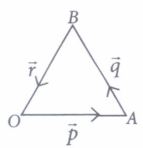
\(\overrightarrow{A O}=-\vec{p}, \overrightarrow{A B}=\vec{q}, \)\(\overrightarrow{B O}=\vec{r}\)
Now, \(\vec{q}+\vec{r} =\overrightarrow{A B}+\overrightarrow{B O}\)
\(=\overrightarrow{A O} =-\vec{p}\)
(ii) (c) : From triangle law of vector addition,
\(\overrightarrow{A C}+\overrightarrow{B D}=\overrightarrow{A B}+\overrightarrow{B C}+\overrightarrow{B C}+\overrightarrow{C D}\)
\( =\overrightarrow{A B}+2 \overrightarrow{B C}+\overrightarrow{C D}\)
\(=\overrightarrow{A B}+2 \overrightarrow{B C}-\overrightarrow{A B}=2 \overrightarrow{B C} \)
(iii) (b) : \(\operatorname{In} \Delta A B C, \overrightarrow{A C}=2 \vec{a}+2 \vec{b}\)
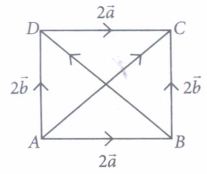
and in \(\Delta A B D, 2 \vec{b}=2 \vec{a}+\overrightarrow{B D}\)..(ii)
[By triangle law of addition]
Adding (i) and (ii), we have
\( \overrightarrow{A C}+2 \vec{b}=4 \vec{a}+\overrightarrow{B D}+2 \vec{b} \)
⇒\( \overrightarrow{A C}-\overrightarrow{B D}=4 \vec{a} \)
(iv) (d) : \(\text { In } \Delta A B C, \overrightarrow{B A}+\overrightarrow{A C}=\overrightarrow{B C}\)... (i)
[By triangle law]
In \(\Delta B C D, \overrightarrow{B C}+\overrightarrow{C D}=\overrightarrow{B D}\) ..(i)
From (i) and (ii), \(\overrightarrow{B A}+\overrightarrow{A C}=\overrightarrow{B D}-\overrightarrow{C D}\)
\(\Rightarrow \overrightarrow{B A}+\overrightarrow{C D}=\overrightarrow{B D}-\overrightarrow{A C}=\overrightarrow{B D}+\overrightarrow{C A}\)
(v) (b): Since T is the mid point of YZ.
So,\(\overrightarrow{Y T}=\overrightarrow{T Z}\)
Now,\(\overrightarrow{X Y}+\overrightarrow{X Z}=(\overrightarrow{X T}+\overrightarrow{T Y})+(\overrightarrow{X T}+\overrightarrow{T Z})\)
[By triangle law]
\(=2 \overrightarrow{X T}+\overrightarrow{T Y}+\overrightarrow{T Z}=2 \overrightarrow{X T} \quad[\because \overrightarrow{T Y}=-\overrightarrow{Y T}]\)
4.
(i) (c) : Clearly, G be the centroid of ABCD, therefore coordinates of G are
\(\left(\frac{3+4+2}{3}, \frac{0+3+3}{3}, \frac{1+6+2}{3}\right)=(3,2,3)\)
(ii) (b): Since, A = (0, 1,2) and G = (3,2,3)
\( \therefore \overrightarrow{A G}=(3-0) \hat{i}+(2-1) \hat{j}+(3-2) \hat{k}=3 \hat{i}+\hat{j}+\hat{k} \\ \)
\(\Rightarrow|\overrightarrow{A G}|^{2}=3^{2}+1^{2}+1^{2}=9+1+1=11 \\\)
\(\Rightarrow|\overrightarrow{A G}|=\sqrt{11} \)
(iii) (c): Clearly, area of \(\Delta A B C=\frac{1}{2}|\overrightarrow{A B} \times \overrightarrow{A C}|\)
Here, \(\overrightarrow{A B} \times \overrightarrow{A C}=\left|\begin{array}{ccc} \hat{i} & \hat{j} & \hat{k} \\ 3-0 & 0-1 & 1-2 \\ 4-0 & 3-1 & 6-2 \end{array}\right|\)
\(=\left|\begin{array}{ccc} \hat{i} & \hat{j} & \hat{k} \\ 3 & -1 & -1 \\ 4 & 2 & 4 \end{array}\right|\)
\(=\hat{i}(-4+2)-\hat{j}(12+4)+\hat{k}(6+4)=-2 \hat{i}-16 \hat{j}+10 \hat{k}\)
\( \therefore |\overrightarrow{A B} \times \overrightarrow{A C}|=\sqrt{(-2)^{2}+(-16)^{2}+10^{2}} \)
\(=\sqrt{4+256+100}=\sqrt{360}=6 \sqrt{10}\)
Hence, area of \(\Delta A B C=\frac{1}{2} \times 6 \sqrt{10}=3 \sqrt{10} \text { sq. units }\)
(iv) (b): Here, \(\overrightarrow{A B}=3 \hat{i}-\hat{j}-\hat{k}\)
\(\Rightarrow|\overrightarrow{A B}|=\sqrt{9+1+1}=\sqrt{11}\)
Also, \(\overrightarrow{A C}=4 \hat{i}+2 \hat{j}+4 \hat{k}\)
\(\Rightarrow|\overrightarrow{A C}|=\sqrt{16+4+16}=\sqrt{36}=6\)
Now,\(|\overrightarrow{A B}|+|\overrightarrow{A C}|=\sqrt{11}+6=3.32+6=9.32 \text { units }\)
(v) (a): The length of the perpendicular from the vertex D on the opposite face
\( =\mid \text { Projection of } \overrightarrow{A D} \text { on } \overrightarrow{A B} \times \overrightarrow{A C} \mid \)
\(=\left|\frac{(2 \hat{i}+2 \hat{j}) \cdot(-2 \hat{i}-16 \hat{j}+10 \hat{k})}{\sqrt{(-2)^{2}+(-16)^{2}+10^{2}}}\right| \)
\(=\left|\frac{-4-32}{\sqrt{360}}\right|=\frac{36}{6 \sqrt{10}}=\frac{6}{\sqrt{10}} \text { units } \)
5.
(i) (b): Here (5, 3) are the coordinates of B.
\(\therefore\) P.V. of B = \(5 \hat{i}+3 \hat{j}\)
(ii) (d) : Here (9, 8) are the coordinates of D.
\(\therefore\) P.V. of D = \({9} \hat{i}+8 \hat{j}\)
(iii) (b) : P.V. of B = \(5 \hat{i}+3 \hat{j}\) and ஃ P.V. of C = \(6 \hat{i}+5 \hat{j}\)
\(\therefore \ \overrightarrow{B C}=(6-5) \hat{i}+(5-3) \hat{j}=\hat{i}+2 \hat{j}\)
(iv) (b): Since P.V. of A = \(2 \hat{i}+2 \hat{j}\) , P.V. of D = \({9} \hat{i}+8 \hat{j}\)
\( \therefore \overrightarrow{A D}=(9-2) \hat{i}+(8-2) \hat{j}=7 \hat{i}+6 \hat{j} \)
\(|\overrightarrow{A D}|^{2}=7^{2}+6^{2}=49+36=85 \)
\(\Rightarrow |\overrightarrow{A D}|=\sqrt{85} \text { units }\)
(v) (a): We have, \(\vec{M}=4 \hat{j}+3 \hat{k}\) ,
\( \therefore |\vec{M}|=\sqrt{4^{2}+3^{2}}=\sqrt{16+9}=\sqrt{25}=5 \)
\(\therefore \hat{M}=\frac{\vec{M}}{|\vec{M}|}=\frac{4 \hat{j}+3 \hat{k}}{5}=\frac{4}{5} \hat{j}+\frac{3}{5} \hat{k}\)
6.
(i) (b): Resultant velocity from to O to P
\(=\sqrt{120^{2}+50^{2}} \)
\(=\sqrt{14400+2500}=\sqrt{16900}=130 \mathrm{~m} / \mathrm{s}\)
(ii) (a): Direction of travel of plane from O to P with east is \(\tan ^{-1}\left(\frac{5}{12}\right)\).
(iii) (b): Resultant velocity from O to A = 130 m/s
\(=\left(\frac{130 \times 3600}{1000}\right) \mathrm{km} / \mathrm{h}\)
Time = 1hr
∴ Displacement = \(\frac{130 \times 3600}{1000}\)= 468 km
(iv) (c): Resultant velocity from P to R
= (120 + 50) = 170 m/s
(v) (d): Displacement from P to R = \(\left(\frac{170 \times 3600}{1000}\right)\)
= 612 km.
7.
Here, \(\left|\vec{F}_{1}\right|=\sqrt{(4)^{2}+0^{2}}=4 \mathrm{KN}\)
\( \left|\vec{F}_{2}\right|=\sqrt{(-2)^{2}+4^{2}}=\sqrt{20} \mathrm{KN} \)
\(\left|\vec{F}_{3}\right|=\sqrt{(-3)^{2}+(-3)^{2}}=\sqrt{18} \mathrm{KN}\)
(i) (a): Since, \(\sqrt 20\) is larger. So, team B will win the game.
(ii) (b): Let F be the combined force
\(\therefore \vec{F}=\vec{F}_{1}+\vec{F}_{2}+\vec{F}_{3}=4 \hat{i}+0 \hat{j}-3 \hat{i}-3 \hat{j}-2 \hat{i}+4 \hat{j} \)
\(=-\hat{i}+\hat{j} \)
\(\therefore |\vec{F}|=\sqrt{(-1)^{2}+1^{2}}=\sqrt{2}=1.4 \mathrm{KN}\)
(iii) (c) : We have, \(\vec{F}=-\hat{i}+\hat{j}\)
\(\therefore \theta=\tan ^{-1}\left(\frac{F_{y}}{F_{x}}\right)=\tan ^{-1}\left(\frac{1}{-1}\right)=\frac{3 \pi}{4} \text { radian }\)
= 0.75 x 3.14 radian = 2.3555 radian ≈ 2.4 radian
(iv) (a): Magnitude of force of Team B = \(\sqrt 20\) KN
= 2\(\sqrt 5\) KN
(v) (b): 4 KN force is applied by team A.
8.
(i) (b) : We have, \(\overrightarrow{O A}=8 \hat{i} \text { and } \overrightarrow{A B}=6 \hat{j}\)
\(\therefore \overrightarrow{O B}=\overrightarrow{O A}+\overrightarrow{A B}=8 \hat{i}+6 \hat{j}\)
(ii) (a) : To reach school Geetika travels
=(8+6) km=14km
(iii) (b): Vector distance from school to Alok's house
\( =6 \cos 30^{\circ} \hat{i}+6 \sin 30^{\circ} \hat{j} \)
\(=6 \times \frac{\sqrt{3}}{2} \hat{i}+6 \times \frac{1}{2} \hat{j}=3 \sqrt{3} \hat{i}+3 \hat{j}\)
(iv) (a): Vector distance from Geetika's house to
Alok'shouse =\(8 \hat{i}+6 \hat{j}+3 \sqrt{3} \hat{i}+3 \hat{j}=(8+3 \sqrt{3}) \hat{i}+9 \hat{j}\)
(v) (b): Total distance travelled by Geetika from her house to Alok's house = (8 + 6 + 6) km = 20 km.
9.
(i) (c): Position vector of \(\overrightarrow{A B} \)
\(=(2-1) \hat{i} \dot{+}(1-1) \hat{j}+(3-1) \hat{k}=\hat{i}+2 \hat{k}\)
(ii) (b): Position vector of \(\overrightarrow{A C} \)
\(=(3-1) \hat{i}+(2-1) \hat{j}+(2-1) \hat{k}=2 \hat{i}+\hat{j}+\hat{k}\)
(iii) (d): Position vector of \(\overrightarrow{AD} \)
\(=(3-1) \hat{i}+(3-1) \hat{j}+(4-1) \hat{k}=2 \hat{i}+2 \hat{j}+3 \hat{k}\)
(iv) (b): Area of \(\Delta A B C\) = \(\frac{1}{2}|\overrightarrow{A B} \times \overrightarrow{A C}|\)
\(\overrightarrow{A B} \times \overrightarrow{A C}=\left|\begin{array}{lll} \hat{i} & \hat{j} & \hat{k} \\ 1 & 0 & 2 \\ 2 & 1 & 1 \end{array}\right|=\hat{i}(0-2)-\hat{j}(1-4)+\hat{k}(1-0)\)
\(=-2 \hat{i}+3 \hat{j}+\hat{k}\)
\( \Rightarrow |\overrightarrow{A B} \times \overrightarrow{A C}| =\sqrt{(-2)^{2}+3^{2}+1^{2}} \)
\(=\sqrt{4+9+1}=\sqrt{14}\)
Area of \(\Delta A B C\) \(=\frac{1}{2} \sqrt{14} \text { sq. units }\)
(v) (a): Unit vector along \(\overrightarrow{A D}=\frac{\overrightarrow{A D}}{|\overrightarrow{A D}|}\)
\(=\frac{2 \hat{i}+2 \hat{j}+3 k}{\sqrt{2^{2}+2^{2}+3^{2}}}=\frac{2 \hat{i}+2 \hat{j}+3 \hat{k}}{\sqrt{4+4+9}}=\frac{1}{\sqrt{17}}(2 \hat{i}+2 \hat{j}+3 \hat{k})\)
10.
(i) (b) : \(\overrightarrow{A B}=(-2 \hat{i}+4 \hat{j}+\hat{k})-(\hat{i}+\hat{j}+\hat{k})=-3 \hat{i}+3 \hat{j}\)
\(\therefore \overrightarrow{A B}=\sqrt{(-3)^{2}+3^{2}}=\sqrt{9+9}=\sqrt{18}=3 \sqrt{2}\)
Distance between House (A) and ATM (B) is 3\(\sqrt 2\) units.
(ii) (c): \(\overrightarrow{B C}=(-\hat{i}+5 \hat{j}+5 \hat{k})-(-2 \hat{i}+4 \hat{j}+\hat{k})=\hat{i}+\hat{j}+4 \hat{k}\)
\( \therefore |\overrightarrow{B C}| =\sqrt{1^{2}+1^{2}+4^{2}}=\sqrt{1+1+16} \)
\(=\sqrt{18}=3 \sqrt{2}\)
Distance between ATM (B) and School (C) is 3\(\sqrt 2\) units.
(iii) (a): \(\overrightarrow{C D}=(2 \hat{i}+2 \hat{j}+5 \hat{k})-(-\hat{i}+5 \hat{j}+5 \hat{k})=3 \hat{i}-3 \hat{j}\)
\(\therefore |\overrightarrow{C D}|=\sqrt{3^{2}+(-3)^{2}}=\sqrt{9+9}=3 \sqrt{2}\)
Distance between School (C) and Shopping mall (D) is 3\(\sqrt 2\) units.
(iv) (d): Total distance travelled by Ritika
\( =|\overrightarrow{A B}|+|\overrightarrow{B C}|+|\overrightarrow{C D}|=(3 \sqrt{2}+3 \sqrt{2}+3 \sqrt{2}) \text { units } \)
\(=9 \sqrt{2} \text { units }\)
(v) (c): Distance between house and shopping mall is \(|\overrightarrow{A D}|\)
Now, \(\overrightarrow{A D}=\hat{i}+\hat{j}+4 \hat{k}\)
\(\therefore|\overrightarrow{A D}|=\sqrt{1^{2}+1^{2}+4^{2}}=\sqrt{1+1+16}=\sqrt{18}=3 \sqrt{2}\)
Thus, extra distance travelled by Ritika in reaching shopping mall = \((9 \sqrt{2}-3 \sqrt{2})\) units = \(6 \sqrt{2} \) units.

12th Standard CBSE Syllabus & Materials
12th Standard CBSE
CBSE 12th Computer Science Python Revision Tour I - New Previous year Question Papers Study Material - QB365 Set A
NEW12th Standard CBSE
CBSE 12th Business Studies Planning Important Questions And Answers Study Material - QB365 Set A
NEW12th Standard CBSE
CBSE 12th Business Studies Business Environment Important Questions And Answers Study Material - QB365 Set A
NEW12th Standard CBSE
CBSE 12th Business Studies Principles of Management Important Questions And Answers Study Material - QB365 Set A



CBSE 12th Standard CBSE Subjects
CBSE Standards










