
 100% FREE ACCESS
12th Standard CBSE Syllabus & Materials
12th Standard CBSE
CBSE 12th Economics Government Budget and the Economy Previous year Question Papers Study Material - QB365 Set A
NEW12th Standard CBSE
CBSE 12th Computer Science Interface Python with MySQL - New Previous year Question Papers Study Material - QB365 Set A
NEW12th Standard CBSE
CBSE 12th Computer Science Database Concept - New Previous year Question Papers Study Material - QB365 Set A
NEW12th Standard CBSE
CBSE 12th Computer Science Data Communication - New Previous year Question Papers Study Material - QB365 Set A
NEW12th Standard CBSE
CBSE 12th Computer Science Data Structures - New Previous year Question Papers Study Material - QB365 Set A
NEW12th Standard CBSE
CBSE 12th Computer Science Functions - New Previous year Question Papers Study Material - QB365 Set A

Published on: 09/09/2022
QB365 provides a detailed and simple solution for every Possible Case Study Questions in Class 12th Physics Subject - Electric Charges And Fields, CBSE. It will help Students to get more practice questions, Students can Practice these question papers in addition to score best marks.
Download CBSE Class 12th Standard CBSE Physics question papers, sample papers, important questions, and previous year solved papers in PDF format. Get free study materials, NCERT solutions, and exam preparation resources for Class 12th Standard CBSE Physics
Questions + Answers key
Take MCQ Physics Test
1.
A thin conducting shell contains a charge +Q distributed uniformly all overit. Now a point charge +q1 is placed at the centre ofthe shell, and another charge +q2 is pLacedoutside the shell. What is the net force on
(i) charge q1
(ii) charge q2
(iii) spherical shell
(iv) also determine charge density on the shell if radius of shell is R.
(v) What is the net electric flux through the sphere?
2.
An electric dipole is a system consisting of the two equal and opposite point charges seperated by a small and finite distance. If dipole moment of this system is \(\vec{p}\) and it is placed in a uniform electric field \(\overrightarrow{\boldsymbol{E}}\).
(i) Write the expression of torque experienced by a dipole.
(ii) Identify two pairs of perpendicular vectors in the expression.
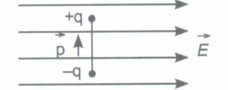
(iii) Show diagrammatically the orientation of the dipole in the field for which the torque is
(a) Maximum.
(b) Half the maximum value.
(c) Zero
3.
Two point charges q1 and q2 of unequal magnitude are placed as shown below
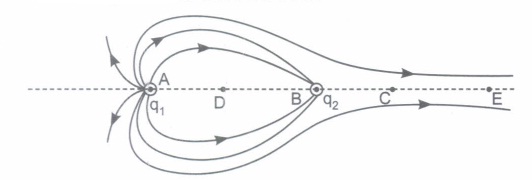
(i) Determine the ratio q1 :q2
(ii) If one !lull point is at infinity, then where is another null point?
(iii) If q1 and q2 are separated by a distance of 10 em, then find the position of a null point.
(iv) Will a positive charge follow the electric lines of force if free to move?
4.
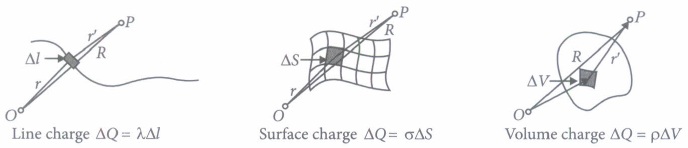
In practice, we deal with charges much greater in magnitude than the charge on an electron, so we can ignore the quantum nature of charges and imagine that the charge is spread in a region in a continuous manner. Such a charge distribution is known as continuous charge distribution. There are three types of continuous charge distribution : (i) Line charge distribution (ii) Surface charge distribution (iii) Volume charge distribution as shown in figure.
(I) Statement 1 : Gauss's law can't be used to calculate electric field near an electric dipole.
Statement 2 : Electric dipole don't have symmetrical charge distribution.
| (a) Statement 1 and statement 2 are true | (b) Statement 1 is false but statement 2 is true |
| (c) Statement 1 is true but statement 2 is false | (d) Both statements are false |
(ii) An electric charge of 8.85 X 10⁻¹³ C is placed at the centre of a sphere of radius 1 m. The electric flux through the sphere is
| (a) 0.2 N C-1 m2 | (b) 0.1 N C-1 m2 | (c) 0.3 N C-1 m2 | (d) 0.01 N C-1 m2 |
(iii) The electric field within the nucleus is generally observed to be linearly dependent on r. So,
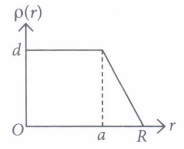
| (a) a=O | \(\text { (b) } a=\frac{R}{2}\) | (c) a=-R | \(\text { (d) } a=\frac{2 R}{3}\) |
(iv) What charge would be required to electrify a sphere of radius 25 cm so as to get a surface charge density of \(\frac{3}{\pi} \mathrm{C} \mathrm{m}^{-2} ?\)
| (a) 0.75 C | (b) 7.5 C | (c) 75 C | (d) zero |
(v) The SI unit of linear charge density is
| (a) Cm | (b) Cm-1 | (c) C m-2 | (d) C m-3 |
5.
Gauss's law and Coulomb's law, although expressed in different forms, are equivalent ways of describing the relation between charge and electric field in static conditions. Gauss's law is \(\varepsilon_{0} \phi=q_{\text {encl }}\), when
qencl is the net charge inside an imaginary closed surface called Gaussian surface. \(\phi=\oint \vec{E} \cdot d \vec{A}\) gives the electric flux through the Gaussian surface. The two equations hold only when the net charge is in vacuum or air.
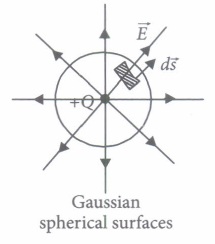
(I) If there is only one type of charge in the universe, then \((\vec{E} \rightarrow \text { Electric field, } d \vec{s} \rightarrow \text { Area vector })\)
| (a) \(\oint \vec{E} \cdot d \vec{s} \neq 0\) on any surface |
| (b) \(\oint \vec{E} \cdot d \vec{s}\) could not be defined |
| (c) \(\oint \vec{E} \cdot d \vec{s}=\infty\) if charge is inside |
| (d) \(\oint \vec{E} \cdot d \vec{s}=0\) if charge is outside, \(\oint \vec{E} \cdot d \vec{s}=\frac{q}{\varepsilon_{0}}\) if charge is inside |
(ii) What is the nature of Gaussian surface involved in Gauss law of electrostatic?
| (a) Magnetic | (b) Scalar | (c) Vector | (d) Electrical |
(iii) A charge 10 \(\mu \)C is placed at the centre of a hemisphere of radius R = 10 cm as shown. The electric flux through the hemisphere (in MKS units) is
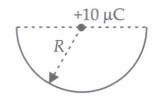
| (a) 20 x 105 | (b) 10 x 105 | (c) 6 x 10⁵ | (d) 2 x 10⁵ |
(iv) The electric flux through a closed surface area S enclosing charge Q is \(\phi\). If the surface area is doubled, then the flux is
| \(\text { (a) } 2 \phi\) | \(\text { (b) } \phi / 2\) | \(\text { (c) } \phi / 4\) | \(\text { (d) } \phi\) |
(v) A Gaussian surface encloses a dipole. 'The electric flux through this surface is
| \(\text { (a) } \frac{q}{\varepsilon_{0}}\) | \(\text { (b) } \frac{2 q}{\varepsilon_{0}}\) | \(\text { (c) } \frac{q}{2 \varepsilon_{0}}\) | (d) zero |
6.
In 1909, Robert Millikan was the first to find the charge of an electron in his now-famous oil-drop experiment. In that experiment, tiny oil drops were sprayed into a uniform electric field between a horizontal pair of oppositely charged plates. The drops were observed with a magnifying eyepiece, and the electric field was adjusted so that the upward force on some negatively charged oil drops was just sufficient to balance the downward force of gravity. That is, when suspended, upward force qE just equaled Mg. Millikan accurately measured the charges on many oil drops and found the values to be whole number multiples of 1.6 x 10⁻¹⁹ C the charge of the electron. For this, he won the Nobel prize.
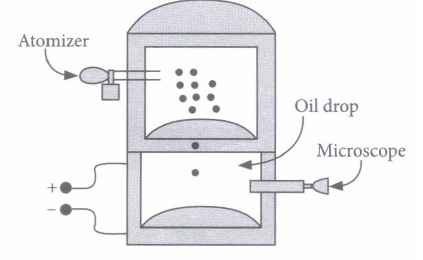
(i) If a drop of mass 1.08 x 10⁻¹⁴ kg remains stationary in an electric field of 1.68 x 10⁵ N C-I, then the charge of this drop is
| (a) 6.40 x 10⁻¹⁹ C | (b) 3.2 x 10⁻¹⁹ C |
| (c) 1.6 X 10⁻¹⁹ C | (d) 4.8 x 10⁻¹⁹ C |
(ii) Extra electrons on this particular oil drop (given the presently known charge of the electron) are
| (a) 4 | (b) 3 | (c) 5 | (d) 8 |
(iii) A negatively charged oil drop is prevented from falling under gravity by applying a vertical electric field 100 V m-1.If the mass of the drop is 1.6 X 10⁻³ g, the number of electrons carried by the drop is (g= 10 m s-2)
| (a) 1018 | (b) 1015 | (c) 1012 | (d) 109 |
(iv) The important conclusion given by Millikan's experiment about the charge is
| (a) charge is never quantized | (b) charge has no definite value |
| (c) charge is quantized | (d) charge on oil drop always increases. |
(v) If in Millikan's oil drop experiment, charges on drops are found to be \(8 \mu \mathrm{C}, 12 \mu \mathrm{C}, 20 \mu \mathrm{C}\) then quanta of charge is
| \(\text { (a) } 8 \mu \mathrm{C}\) | \(\text { (b) } 20 \mu \mathrm{C}\) | \(\text { (c) } 12 \mu \mathrm{C}\) | \(\text { (d) } 4 \mu \mathrm{C}\) |
7.
When a charged particle is placed in an electric field, it experiences an electrical force. If this is the only force on the particle, it must be the net force. The net force will cause the particle to accelerate according to Newton's second law. So
\(\vec{F}_{e}=q \vec{E}=m \vec{a}\)
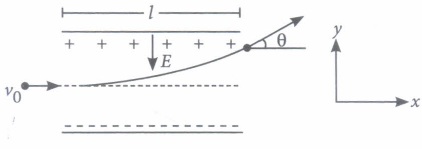
If \(\vec{E}\) is uniform, then \(\vec{a}\) is constant and \(\vec{a}=q \vec{E} / m\). If the particle has a positive charge, its acceleration is in the direction of the field. If the particle has a negative charge, its acceleration is in the direction opposite to the electric field. Since the acceleration is constant, the kinematic equations can be used.
(i) An electron of mass m, charge e falls through a distance h metre in a uniform electric field E. Then time of fall,
| \(\text { (a) } t=\sqrt{\frac{2 h m}{e E}}\) | \(\text { (b) } t=\frac{2 h m}{e E}\) | \(\text { (c) } t=\sqrt{\frac{2 e E}{h m}}\) | \(\text { (d) } t=\frac{2 e E}{h m}\) |
(ii) An electron moving with a constant velocity v along X-axis enters a uniform electric field applied along Y-axis. Then the electron moves.
| (a) with uniform acceleration along Y-axis | (b) without any acceleration along Y-axis |
| (c) in a trajectory represented as y = ax2 | (d) in a trajectory represented as y = ax |
(iii) Two equal and opposite charges of masses ml and m2 are accelerated in an uniform electric field through the same distance. What is the ratio of their accelerations if their ratio of masses is \(\frac{m_{1}}{m_{2}}=0.5 ?\)
| \(\text { (a) } \frac{a_{1}}{a_{2}}=2\) | \(\text { (b) } \frac{a_{1}}{a_{2}}=0.5\) | \(\text { (c) } \frac{a_{1}}{a_{2}}=3\) | \(\text { (d) } \frac{a_{1}}{a_{2}}=1\) |
(iv) A particle of mass m carrying charge q is kept at rest in a uniform electric field E and then released. The kinetic energy gained by the particle, when it moves through a distance y is
| \(\text { (a) } \frac{1}{2} q E y^{2}\) | \(\text { (b) } q E y\) | \(\text { (c) } q E y^{2}\) | \(\text { (d) } q E^{2} y\) |
(v) A charged particle is free to move in an electric field. It will travel
| (a) always along a line of force |
| (b) along a line of force, if its initial velocity is zero |
| (c) along a line of force, if it has some initial velocity in the direction of an acute angle with the line of force |
| (d) none of these. |
8.
Net electric flux through a cube is the sum of fluxes through its six faces. Consider a cube as shown in figure,having sides oflength L = 10.0 cm. The electric field is uniform, has a magnitude E = 4.00 x 10³ N C-I and is parallel to the xy plane at an angle of 37° measured from the +x-axis towards the +y-axis.
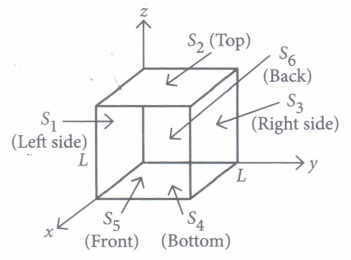
(i) Electric flux passing through surface S6 is
| (a) -24 N m2 C-1 | (b) 24 N m2 C-1 | (c) 32 Nm2C-1 | (d) -32 N m2 C-1 |
(ii) Electric flux passing through surface s1 is
| (a) -24 N m2 C-1 | (b) 24 N m2 C-1 | (c) 32 N m2 C-1 | (d) -32 N m2 C-1 |
(iii) The surfaces that have zero flux are
| (a) S1 and S3 | (b) S5 and S6 | (c) S2 and S4 | (d) S1 and S2 |
(iv) The total net electric flux through all faces of the cube is
| (a) 8 N m2 C-1 | (b) -8 N m2 C-1 | (c) 24 N m2 C-1 | (d) zero |
(v) The dimensional formula of surface integral \(\oint \vec{E} \cdot d \vec{S}\)of an electric field is
| (a) [M L2 T-2 A-1] | (b) [M L3 T-3 A-1] |
| (c) [M-1 L3 T-3 A] | (d) [M L-3 T-3 A-1] |
9.
Coulomb's law states that the electrostatic force of attraction or repulsion acting between two stationary point charges is given by
\(F=\frac{1}{4 \pi \varepsilon_{0}} \frac{q_{1} q_{2}}{r^{2}}\)
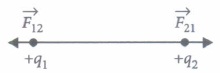
where F denotes the force between two charges q1 and q2 separated by a distance r in free space, Eo is a constant known as permittivity of free space. Free space is vacuum and may be taken to be air practically.
If free space is replaced by a medium, then Eo is replaced by (Eok) or (EoEr)where k is known as dielectric constant or relative permittivity.
(i) In coulomb's law, F = \(k \frac{q_{1} q_{2}}{r^{2}}\), then on which of the following factors does the proportionality constant k depends?
| (a) Electrostatic force acting between the two charges |
| (b) Nature of the medium between the two charges |
| (c) Magnitude of the two charges |
| (d) Distance between the two charges |
(ii) Dimensional formula for the permittivity constant Eo of free space is
| \(\text { (a) }\left[\mathrm{ML}^{-3} \mathrm{~T}^{4} \mathrm{~A}^{2}\right]\) | \(\text { (b) }\left[M^{-1} L^{3} T^{2} A^{2}\right]\) |
| \(\text { (c) }\left[\mathrm{M}^{-1} \mathrm{~L}^{-3} \mathrm{~T}^{4} \mathrm{~A}^{2}\right]\) | \(\text { (d) }\left[M L^{-3} T^{4} A^{-2}\right]\) |
(iii) The force of repulsion between two charges of 1 C each, kept 1 m apart in vaccum is
| \(\text { (a) } \frac{1}{9 \times 10^{9}} \mathrm{~N}\) | \(\text { (b) }\left[M^{-1} L^{3} T^{2} A^{2}\right]\) |
| \(\text { (c) } 9 \times 10^{7} \mathrm{~N}\) | \(\text { (d) } \frac{1}{9 \times 10^{12}} \mathrm{~N}\) |
(iv) Two identical charges repel each other with a force equal to 10 mgwt when they are 0.6 m apart in air. (g = 10 ms-2). The value of each charge is
| (a) 2 mC | (b) 2 x10⁻⁷ mC | (c) 2 nC | (d) 2\(\mu \)C |
(v) Coulomb's law for the force between electric charges most closely resembles with
| (a) law of conservation of energy | (b) Newton's law of gravitation |
| (c) Newton's 2nd law of motion | (d) law of conservation of charge |
1.
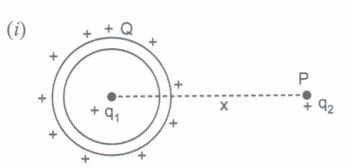
Net force on charge q1 is zero as electric field inside a charged conducting shell is zero.
(ii) Due to induction charge inside the shell is -q1 and outside the shell net charge will be (Q + q1)
Electric field due to charged sphere at point
P is \(\mathrm{E}_{\mathrm{P}}=\frac{k\left(\mathrm{Q}+q_{1}\right)}{x^{2}}\)
Force on charge q2 \(=q_{2} \mathrm{E}=\frac{k\left(\mathrm{Q}+q_{1}\right) \cdot q_{2}}{x^{2}}\)
(iii) Force on spherical shell has same magnitude
\(=\frac{k\left(\mathrm{Q}+q_{1}\right) q_{2}}{x^{2}}\)
(iv) \(\text { Charge density }=\frac{\text { Total charge on the sphere }}{\text { Surface area of sphere }}
\)
\(\therefore \sigma=\frac{\left(Q+q_{1}\right)}{4-R^{2}}
\)
(v) Net electric flux through the sphere is given
\(\phi=\frac{q_{1}}{\varepsilon_{0}^{2}}\) [by Gauss's Theorem]
2.
(i) \(\vec{\tau}=\vec{p} \times \vec{E}\)
or \(\tau=p E \sin \theta\)
here p = 2aq
(If point charges are q and -q separated by a distance 2a.)
(ii) Torque is perpendicular to dipole moment and electric field. \(\vec{\tau} \perp \vec{p} \text { and } \vec{\tau} \perp \vec{E}\).
(iii) (a) Maximum Torque \(\tau\) = pE when \(\theta\) = 90°
(b) \(\tau=\frac{p E}{2} \text { when, } \sin \theta=\frac{1}{2} \text { i.e., } \theta=30^{\circ} \text { or } 150^{\circ}\)
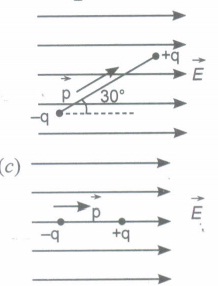
\(\therefore \theta\) = 0° or 180°
\(\therefore \tau \) = pE sin 0° = 0
\(\therefore \tau\) = minimum
3.
(i) \(\frac{q_{1}}{q_{2}}=\frac{8}{4}=\frac{2}{1}\) [Count the Number of field lines associated with each charge]
(ii) \(\because\) q2 < q1 and q1 is positive and q2 is negative, \(\therefore\)Null point will lie at point C to the right side of point B.
Reason: Electric field at C is in opposite direction as shown.
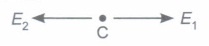
(iii) \(\therefore\) Net electric field at C = 0
\(\therefore \quad\left|\vec{E}_{1}\right|=\left|\vec{E}_{2}\right|\)
\(\frac{k\left|q_{1}\right|}{(\mathrm{AC})^{2}}=\frac{k\left|q_{2}\right|}{(\mathrm{BC})^{2}}\)
Here AB = 10 cm = 0.1 m
Let BC = x
\(\frac{q_{1}}{q_{2}}=\left(\frac{\mathrm{AC}}{\mathrm{BC}}\right)^{2} \Rightarrow \frac{2}{1}=\left(\frac{0.1+x}{x}\right)^{2}\)
Taking square root
\(\sqrt{2}=\frac{0.1+x}{x} \quad\left[\because \sqrt{\frac{q_{1}}{q_{2}}}=\sqrt{\frac{2}{1}}\right]\)
\((\sqrt{2}-1) x=0.1\)
\(x=\frac{0.1}{(\sqrt{2}-1)}=\frac{0.1}{\sqrt{2}-11} \times \frac{(\sqrt{2}+1)}{\sqrt{2} \mp 1}\)
x = 0.141 + 0.1 = 0.241 m
or x = 24.1 cm from point B.
(iv) No. As the electric field lines are curved, and at any point on it a test charge (+ve) will experience acceleration but direction of acceleration and velocity may not be same
4.
(i) (a): Gauss's law is applicable for any closed surface. Gauss's law is most useful in situation where the charge distribution has spherical or cylindrical symmetry or is distributed uniformly over the plane.
Whereas electric dipole is a system of two equal and opposite point charges separated by a very small and finite distance.
So both statements are correct.
(ii) (b): According to Gauss's law, the electric flux through the sphere is
\(\phi=\frac{q_{\mathrm{in}}}{\varepsilon_{0}}=\frac{8.85 \times 10^{-13} \mathrm{C}}{8.85 \times 10^{-12} \mathrm{C}^{2} \mathrm{~N}^{-1} \mathrm{~m}^{-2}}=0.1 \mathrm{~N} \mathrm{C}^{-1} \mathrm{~m}^{2}\)
(iii) (c) : For uniformly volume charge density,
\(E=\frac{\rho r}{3 \varepsilon_{0}}\)
\(E \propto r\)
(iv) (a): r = 25 ern = 0.25 m \(\sigma=\frac{3}{\pi} \mathrm{C} / \mathrm{m}^{2}\)
As, \(\sigma=\frac{q}{4 \pi r^{2}} \Rightarrow q=4 \pi \times(0.25)^{2} \times \frac{3}{\pi}=0.75 \mathrm{C}\)
(v) (b): The line charge density at a point on a line is the charge per unit length of the line at that point
\(\lambda=\frac{d q}{d L}\)
Thus, the SI unit for \(\lambda \text { is } \mathrm{Cm}^{-1} \text {. }\)
5.
(I) (d): If there is only one type of charge in the universe then it will produce electric field somehow. Hence Gauss's law is valid.
(ii) (c)
(iii) (c) : According to Gauss's theorem,
Electric flux through the sphere = \(\frac{q}{\varepsilon_{0}}\)
\(\therefore\) Electric flux through the hemisphere = \(\frac{1}{2} \frac{q}{\varepsilon_{0}}\)
= \(\frac{10 \times 10^{-6}}{2 \times 8.854 \times 10^{-12}}=0.56 \times 10^{6} \mathrm{~N} \mathrm{~m}^{2} \mathrm{C}^{-1}\)
\(\approx 0.6 \times 10^{6} \mathrm{Nm}^{2} \mathrm{C}^{-1}=6 \times 10^{5} \mathrm{~N} \mathrm{~m}^{2} \mathrm{C}^{-1}\)
(iv) (d): As flux is the total number of lines passing through the surface, for a given charge, it is always the charge enclosed \(Q / \varepsilon_{0}\).If area is doubled, the flux remains the same.
(v) (d): As net charge on a dipole is \((-q+q)=0\)
Thus, when a gaussian surface encloses a dipole, as per Gauss's theorem, electric flux through the surface,
\(\oint \vec{E} \cdot d \vec{S}=\frac{q}{\varepsilon_{0}}=0\)
6.
(i) (a): As, \(q E=m g \Rightarrow q=\frac{1.08 \times 10^{-14} \times 9.8}{1.68 \times 10^{5}}\)
\(=6.4 \times 10^{-19} \mathrm{C}\)
(ii) (a): \(q=n e \text { or } \Rightarrow n=\frac{6.4 \times 10^{-19}}{1.6 \times 10^{-19}}=4\)
(iii) (c) : For the drop to be stationary,
Force on the drop due to electric field = Weight of the drop
qE=mg
\(q=\frac{m g}{E}=\frac{1.6 \times 10^{-6} \times 10}{100}=1.6 \times 10^{-7} \mathrm{C}\)
Number of electrons carried by the drop is
\(n=\frac{q}{e}=\frac{1.6 \times 10^{-7} \mathrm{C}}{1.6 \times 10^{-19} \mathrm{C}}=10^{12}\)
(iv) (c)
(v) (d): Millikan's experiment confirmed that the charges are quantized, i.e., charges are small integer multiples of the base value which is charge on electron. The charges on the drops are found to be multiple of 4. Hence, the quanta of charge is 4 \(\mu \)C.
7.
(i) (a): From Newton's law
\(F=m \vec{a} \text { or } q E=m \vec{a} \Rightarrow a=\frac{q E}{m}=\frac{e E}{m}\)
Using, \(s=u t+\frac{1}{2} a t^{2}\)
\(\therefore \quad h=0+\frac{1}{2} \times \frac{e E}{m} t^{2} \Rightarrow t=\sqrt{\frac{2 h m}{e E}}\)
(ii) (c)
(iii) (b): Force is same in magnitude for both.
\(\therefore \quad m_{1} a_{1}=m_{2} a_{2}\)
\(\frac{a_{1}}{b_{2}}=\frac{m_{2}}{m_{1}}=\frac{1}{0.5}=2\)
(iv) (b): Here \(u=0 ; a=\frac{q E}{m} ; s=y\)
Using, \(v^{2}-u^{2}=2 a s \Rightarrow v^{2}=2 \frac{q E}{m} y\)
\(\therefore \quad \mathrm{K.E.}=\frac{1}{2} m v^{2}=q E y\)
(v) (b): If charge particle is put at rest in electric field, then it will move along line of force.
8.
(i) (d): Electric flux \(\phi=\vec{E} \cdot \vec{A}=E A \cos \theta\)
where \(\vec{A}=A \hat{n}\)
For electric flux passing through \(S_{6}, \hat{n}_{S_{6}}=-\hat{i} \text { (Back) }\)
\(\therefore \quad \phi_{S_{6}}=-\left(4 \times 10^{3} \mathrm{NC}^{-1}\right)(0.1 \mathrm{~m})^{2} \cos 37^{\circ}\)
= -32 N m2 C-I
(ii) (a) : For electric flux passing through S1,
\(\hat{n}_{S_{1}}=-\hat{j} \text { (Left) }\)
\(\therefore \quad \phi_{S_{1}}=-\left(4 \times 10^{3} \mathrm{~N} \mathrm{C}^{-1}\right)(0.1 \mathrm{~m})^{2} \cos \left(90^{\circ}-37^{\circ}\right)\)
= -24 N m2 C-1
(iii) (c): Here, \(\hat{n}_{S_{2}}=+\hat{k}(\text { Top })\)
\(\therefore \quad \phi_{S_{2}}=-\left(4 \times 10^{3} \mathrm{~N} \mathrm{C}^{-1}\right)(0.1 \mathrm{~m})^{2} \cos 90^{\circ}=0\)
\(\hat{n}_{S_{3}}=+\hat{j} \text { (Right) }\)
\(\hat{n}_{S_{4}}=-\hat{k}(\text { Bottom })\)
\(\therefore \quad \phi_{S_{4}}=\left(4 \times 10^{3} \mathrm{~N} \mathrm{C}^{-1}\right)(0.1 \mathrm{~m})^{2} \cos 90^{\circ}=0\)
And, \(\tilde{n}_{S_{5}}=+\hat{i} \text { (Front) }\)
\(\therefore \quad \phi_{S_{5}}=+\left(4 \times 10^{3} \mathrm{~N} \mathrm{C}^{-1}\right)(0.1 \mathrm{~m})^{2} \cos 37^{\circ}\)
= 32 N m2 C-1
S2 and S4 surface have zero flux.
(iv) (d): As the field is uniform, the total flux through the cube must be zero, i.e., any flux entering the cube must leave it.
(v) (b): Surface integral \(\oint \vec{E} \cdot d \vec{S}\)is the net electric flux over a closed surface S.
\(\therefore \quad\left[\phi_{E}\right]=\left[\mathrm{ML}^{3} \mathrm{~T}^{-3} \mathrm{~A}^{-1}\right]\)
9.
(i) (b): The proportionality constant k depends on the nature of the medium between the two charges.
(ii) (c): \({ As, }\left[\varepsilon_{0}\right]=\frac{1}{4 \pi F} \cdot \frac{q_{1} q_{2}}{r^{2}} =\frac{[\mathrm{AT}]^{2}}{\left[\mathrm{M} \mathrm{L} \mathrm{T}^{-2}\right]\left[\mathrm{L}^{2}\right]} \)
\(=\left\lfloor\mathrm{M}^{-1} \mathrm{~L}^{-3} \mathrm{~T}^{4} \mathrm{~A}^{2}\right]\)
(iii) (b)
(iv) (d): \(F=\frac{1}{4 \pi \varepsilon_{0}} \frac{q_{1} q_{2}}{d^{2}}\)
\(\therefore\left(10 \times 10^{-3}\right) \times 10=\frac{\left(9 \times 10^{9}\right) \times q^{2}}{(0.6)^{2}}\)
\(\text { or } \ q^{2}=\frac{10^{-1} \times 0.36}{9 \times 10^{9}}=4 \times 10^{-12}\)
\(\text { or } \ q=2 \times 10^{-6} \mathrm{C}=2 \mu \mathrm{C}\)
(v) (b)

12th Standard CBSE Syllabus & Materials
12th Standard CBSE
CBSE 12th Computer Science Python Revision Tour I - New Previous year Question Papers Study Material - QB365 Set A
NEW12th Standard CBSE
CBSE 12th Business Studies Planning Important Questions And Answers Study Material - QB365 Set A
NEW12th Standard CBSE
CBSE 12th Business Studies Business Environment Important Questions And Answers Study Material - QB365 Set A
NEW12th Standard CBSE
CBSE 12th Business Studies Principles of Management Important Questions And Answers Study Material - QB365 Set A



CBSE 12th Standard CBSE Subjects
CBSE Standards










