
 100% FREE ACCESS
12th Standard CBSE Syllabus & Materials
12th Standard CBSE
CBSE 12th Economics Government Budget and the Economy Previous year Question Papers Study Material - QB365 Set A
NEW12th Standard CBSE
CBSE 12th Computer Science Interface Python with MySQL - New Previous year Question Papers Study Material - QB365 Set A
NEW12th Standard CBSE
CBSE 12th Computer Science Database Concept - New Previous year Question Papers Study Material - QB365 Set A
NEW12th Standard CBSE
CBSE 12th Computer Science Data Communication - New Previous year Question Papers Study Material - QB365 Set A
NEW12th Standard CBSE
CBSE 12th Computer Science Data Structures - New Previous year Question Papers Study Material - QB365 Set A
NEW12th Standard CBSE
CBSE 12th Computer Science Functions - New Previous year Question Papers Study Material - QB365 Set A

Published on: 09/09/2022
QB365 provides a detailed and simple solution for every Possible Case Study Questions in Class 12th Physics Subject - Electrostatic Potential And Capacitance, CBSE. It will help Students to get more practice questions, Students can Practice these question papers in addition to score best marks.
Download CBSE Class 12th Standard CBSE Physics question papers, sample papers, important questions, and previous year solved papers in PDF format. Get free study materials, NCERT solutions, and exam preparation resources for Class 12th Standard CBSE Physics
Questions + Answers key
Take MCQ Physics Test
1.
A metal sphere of radius 10 cm is charged to a high voltage. If this metal sphere is mounted on a wooden block, then charge will reside on its surface and will not flow from it. As we know dielectric strength of air is 3 x 10⁶ V m-1, then the surrounding air will start conducting and charge stored on the isolated sphere will be lost.
(i) Explain why air will start conducting if electric field exceeds dielectric strength?
(ii) Calculate the maximum charge this sphere can hold.
(iii) Why sometimes electric charge is leaked before the above value of potential is reached.
2.
Two small charged metal spheres A and Bare situated in a vacuum. The distance between the centres of the sphere is 10 cm. Electric charge on each sphere may be assumed to be a point charge at the centre P of the sphere and is equal to 10- 9 C each. Point P is a movable point that lies on the line joining the centres of the two charged spheres and is at a distance x from the centre of sphere A.
(i) Draw the variation of electric field E with distance x as point P moves towards sphere B.
(ii) Also draw the variation of electric potential vs distance x as point P moves towards B.
(iii) Calculate electric field V at a distance of 5 cm from centre of sphere A.
3.
A student charged the capacitors of capacitances 2\(\mu\)F and 3\(\mu\)F to potential of 100V each separately. Now he connected positive plate of A to negative plate of B and negative plate of A to positive plate of B.
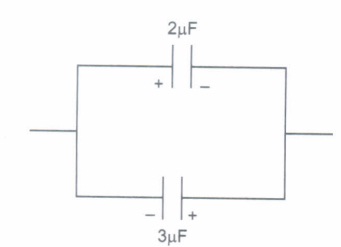
Now answer the following questions:
(i) Determine energy stored in each capacitor.
(ii) What is their common potential after joining?
(iii) Find charge on capacitor A after joining.
(iv) What is the loss of energy in this process?
4.
Although a single piece of an isolated conductor can store charge on its surface.
Ability to store charge is called capacitance (C). If Q is the charge and potential V then
\(C=\frac{Q}{V}\) ..........(i)
If we increase charge, potential on the surface increases, we can store charge only upto some maximum value which is due to some limited maximum potential. Hence, instead of one conducor we use two conductors to form a capacitor, so that more charge can be stored.
(i) What is the capacitance of earth. Radius of earth = R = 6.4 x 10⁶ m
(ii) An uncharged insulated conductor A is brought near a charged insulated conductor B. What happens to charge and potential of B?
(iii) What will happen if potential of conductor exceeds its maximum value, so that electric field becomes 3 x 10⁶ V/m in air.
(iv) On what factors capacitance depends?
5.
Electric field between oppositely charged parallel conducting plates:
When two plane parallel conducting plates, having the size and spacing shown in figure given below are given equal and opposite charges, the field between and around them is approximately as shown, while most of the charge accumulates at the opposing faces of the plates and the field is essentially uniform in the space between them, there is a small quantity of charge on the outer surfaces of the plates and a certain spreadwing or fringing of the field at the edges of the plates.
As the plates are made larger and the distance between them diminished, the fringing becomes relatively less. This kind of arrangement is called capacitors.
Now if two plates are separated by a distance '3d', and are maintained at a potential difference' V' then answer the following questions.
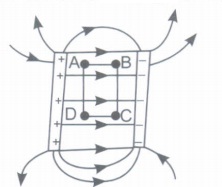
(i) What is the use of capacitors?
(ii) If two protons are placed at points A and B respectively, then which one will experience more force?
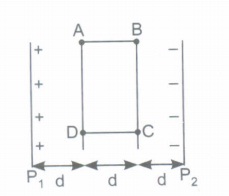
(iii) When both the protons are released then which one will gain more K.E. just before striking the -ve plate?
(iv) If one proton is moved along
(a) A to B
(b) B to C
(c) C to D
(d) Along ABCD, then how much work is done by external agent?
(v) Which property of electric field is shown by answer to (iv) (d) part?
6.
Consider a conducting sphere SI of radius 20 em. A positive charge is given to it so that maximum electric field on it is 2.0 x 10⁴ N/C. The same amount of negative charge is given to another isolated conducting hollow sphere of radius 40 cm, If one shell is now placed inside another so that they are both concentric as shown below. Now answer the following questions:
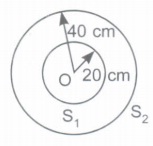
(i) The electric field intensity just inside the outer sphere is __________
(ii) The electrostatic potential at any point inside sphere S1 is _______
(iii) If sphere S1 and S2 are joined by a wire, then what will happen?
7.
A capacitor is a device to store energy. The process of charging up a capacitor involves the transferring of electric charges from its one place to another. This work done in charging the capacitor is stored as its electrical potential energy.
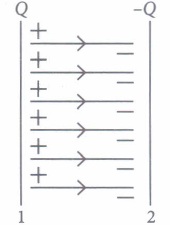
If q is the charge and V is the potential difference across a capacitor at any instant during its charging, then small work done in storing an additional small charge dq against the repulsion of charge q already stored on it is \(d W=V . d q=(q / C) d q\)
(i) A system of 2 capacitors of capacitance \(2 \mu \mathrm{F}\) and \(4 \mu \mathrm{F}\) is connected in series across a potential difference of 6 V. The energy stored in the system is
| \(\text { (a) } 3 \mu \mathrm{J}\) | \(\text { (b) } 24 \mu \mathrm{J}\) | \(\text { (c) } 30 \mu \mathrm{J}\) | \(\text { (d) } 108 \mu \mathrm{J}\) |
(ii) A capacitor of capacitance of \(10 \mu \mathrm{F}\) is charged to 10 V. The energy stored in it is
| \(\text { (a) } 100 \mu \mathrm{J}\) | \(\text { (b) } 500 \mu \mathrm{J}\) | \(\text { (c) } 1000 \mu \mathrm{J}\) | \(\text { (d) } 1 \mu \mathrm{J}\) |
(iii) A parallel plate air capacitor has capacity C farad, potential V volt and energy E joule. When the gap between the plates is completely filled with dielectric
| (a) both V and E increase | (b) both V and E decrease |
| (c) V decreases, E increases | (d) V increases, E decreases |
(iv) A capacitor with capacitance \(5 \mu \mathrm{F}\) is charged to \(5 \mu \mathrm{C}\). If the plates are pulled apart to reduce the capacitance to \(2 \mu \mathrm{F}\),how much work is done?
| \(\text { (a) } 6.25 \times 10^{-6} \mathrm{~J}\) | \(\text { (b) } 3.75 \times 10^{-6} \mathrm{~J}\) | \(\text { (c) } 2.16 \times 10^{-6} \mathrm{~J}\) | \(\text { (d) } 2.55 \times 10^{-6} \mathrm{~J}\) |
(v) A metallic sphere of radius 18 cm has been given a charge of 5 x 10⁻⁶ C. The energy of the charged conductor is
| (a) 0.2 J | (b) 0.6 J | (c) 1.2 J | (d) 2.4 J |
8.
The simplest and the most widely used capacitor is the parallel plate capacitor. It consists of two large plane parallel conducting plates, separated by a small distance.
In the outer regions above the upper plate and below the lower plate, the electric fields due to the two charged plates cancel out. The net field is zero.
In the inner region between the two capacitor plates, the electric fields due to the two charged plates add up. The net field is \(\frac{\sigma}{\varepsilon_{0}}\).
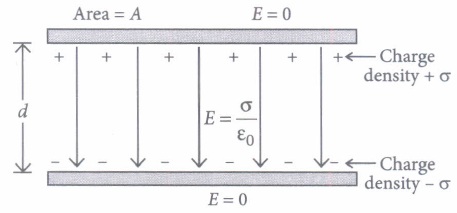
For a uniform electric field, potential difference between the plates = Electric field x distance between the plates. Capacitance of the parallel plate capacitor is, the charge required to supplied to either of the conductors of the capacitor so as to increase the potential difference between then by unit amount.
(i) A parallel plate capacitor is charged and then isolated. The effect of increasing the plate separation on charge, potential and capacitance respectively are
| (a) increases, decreases, decreases | (b) constant, increases, decreases |
| (c) constant, decreases, decreases | (d) constant, decreases, increases |
(ii) In a parallel plate capacitor, the capacity increases if
| (a) area of the plate is decreases | (b) distance between the plates increases |
| (c) area of the plate is increases | (d) dielectric constant decreases |
(iii) A parallel plate capacitor has two square plates with equal and opposite charges. The surface charge densities on the plates are \(+\sigma\) and \(-\sigma\) respectively. In the region between the plates the magnitude of the electric field is
| \(\text { (a) } \frac{\sigma}{2 \varepsilon_{0}}\) | \(\text { (b) } \frac{\sigma}{\varepsilon_{0}}\) | (c) 0 | (d) none of these. |
(iv) If a parallel plate air capacitor consists of two circular plates of diameter 8 cm. At what distance should the plates be held so as to have the same capacitance as that of sphere of diameter 20 cm?
| (a) 9mm | (b) 4mm | (c) 8mm | (d) 2mm |
(v) If a charge of + 2.0 x 10⁻⁸ C is placed on the positive plate and a charge of -1.0 x 10⁻⁸ C on the negative plate of a parallel plate capacitor of capacitance 1.2 x 10⁻³ \(\mu \mathrm{F}\) then the potential difference developed between the plates is
| (a) 6.25 V | (b) 3.0 V | (c) 12.5 V | (d) 25 V |
9.
The electrical capacitance of a conductor is the measure of its ability to hold electric charge. An isolated spherical conductor of radius R. The charge Q is uniformly distributed over its entire surface. It can be assumed to be concentrated at the centre of the sphere. The potential atany point on the surface of the spherical conductor will be \(V=\frac{1}{4 \pi \varepsilon_{0}} \frac{Q}{R}\).
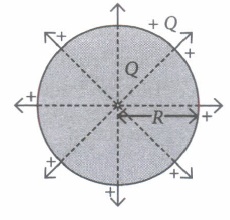
Capacitance of the spherical conductor situated in vacuum is \(C=\frac{Q}{V}=\frac{Q}{\frac{1}{4 \pi \varepsilon_{0}} \cdot \frac{Q}{R}} \text { or } C=4 \pi \varepsilon_{0} R\) Clearly, the capacitance of a spherical conductor is proportional to its radius.
The radius of the spherical conductor of 1F capacitance is R = \(\frac{1}{4 \pi \varepsilon_{0}}\). C and this radius is about 1500 times the radius of the earth \(\left(\sim 6 \times 10^{3} \mathrm{~km}\right)\).
(i) If an isolated sphere has a capacitance 50pF. Then radius is
| (a) 90 ern | (b) 45 cm | (c) 45 m | (d) 90 m |
(ii) How much charge should be placed on a capacitance of 25 pF to raise its potential to l05 V?
| \(\text { (a) } 1 \mu \mathrm{C}\) | \(\text { (b) } 1.5 \mu \mathrm{C}\) | \(\text { (c) } 2 \mu \mathrm{C}\) | \(\text { (d) } 2.5 \mu \mathrm{C}\) |
(iii) Dimensions of capacitance is
| \(\text { (a) }\left[M L^{-2} T^{4} A^{2}\right]\) | \(\text { (b) }\left[\mathrm{M}^{-1} \mathrm{~L}^{-1} \mathrm{~T}^{3} \mathrm{~A}^{1}\right]\) | \(\text { (c) }\left[\mathrm{M}^{-} \mathrm{L}^{-2} \mathrm{~T}^{4} \mathrm{~A}^{2}\right]\) | \(\text { (d) }\left[M^{0} L^{-2} T^{4} A^{1}\right]\) |
(iv) Metallic sphere of radius R is charged to potential V. Then charge q is proportional to
| (a) V | (b) R | (c) both V and R | (d) none of these. |
(v) If 64 identical spheres of charge q and capacitance C each are combined to form a large sphere. The charge and capacitance of the large sphere is
| (a) 64q, C | (b) 16q, 4C | (c) 64q, 4C | (d) 16q, 64C |
10.
This energy possessed by a system of charges by virtue of their positions. When two like charges lie infinite distance apart, their potential energy is zero because no work has to be done in moving one charge at infinite distance from the other.
In carrying a charge q from point A to point B, work done \(W=q\left(V_{A}-V_{B}\right)\). This work may appear as change in KE/PE of the charge. The potential energy of two charges q1 and q2 at a distance r in air is \(\frac{q_{1} q_{2}}{4 \pi \varepsilon_{0} r}\). It is measured in joule. It may be positive, negative or zero depending on the signs of ql and q2.
(i) Calculate work done in separating two electrons form a distance of 1m to 2m in air, where e is electric charge and k is electrostatic force constant.
| (a) ke2 | (b) e2/2 | (c) -ke2/2 | (d) zero |
(ii) Four equal charges q each are placed at four corners of a square of side a each. Work done in carrying a charge -q from its centre to infinity is
| (a) zero | \(\text { (b) } \frac{\sqrt{2} q^{2}}{\pi \varepsilon_{0} a}\) | \(\text { (c) } \frac{\sqrt{2} q}{\pi \varepsilon_{0} a}\) | \(\text { (d) } \frac{q^{2}}{\pi \varepsilon_{0} a}\) |
(iii) Two points A and B are located in diametrically opposite directions of a point charge of +2 \(\mu \mathrm{C}\) at distances 2 m and 1 m respectively from it. The potential difference between A and B is
| (a) 3 x 10³ V | (b) 6 x 10⁴ V | (c) -9 X 10³ V | (d) -3 x 10³ V |
(iv) Two point charges A = +3 nC and B = +1 nC are placed 5 ern apart in air. The work done to move charge B towards A by 1 cm is
| (a) 2.0 x 10⁻⁷ J | (b) 1.35 x 10⁻⁷ J | (c) 2.7 X 10⁻⁷ J | (d) 12.1 x 10⁻⁷ J |
(v) A charge Q is placed at the origin. The electric potential due to this charge at a given point in space is V. The work done by an external force in bringing another charge q from infinity up to the point is
| \(\text { (a) } \frac{V}{q}\) | (b) Vq | (c) V + q | (d) V |
11.
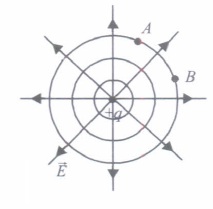
For the various charge systems, we represent equipotential surfaces by curves and line of force by full line curves. Between any two adjacent equipotential surfaces, we assume a constant potential difference the equipotential surfaces of a single point charge are concentric spherical shells with their centres at the point charge. As the lines of force point radially outwards, so they are perpendicular to the equipotential surfaces at all points.
(i) Identify the wrong statement.
| (a) Equipotential surface due to a single point charge is spherical. |
| (b) Equipotential surface can be constructed for dipoles too. |
| (c) The electric field is normal to the equipotential surface through the point. |
| (d) The work done to move a test charge on the equipotential surface is positive |
(ii) Nature of equipotential surface for a point charge is
| (a) Ellipsoid with charge at foci | (b) Sphere with charge at the centre of the sphere |
| (c) Sphere with charge on the surface of the sphere | (d) Plane with charge on the surface |
(iii) A spherical equipotential surface is not possible
| (a) inside a uniformly charged sphere | (b) for a dipole |
| (c) inside a spherical condenser | (d) for a point charge |
(iv) The work done in carrying a charge q once round a circle of radius a with a charge Q at its centre is
| \(\text { (a) } \frac{q Q}{4 \pi \varepsilon_{0} a}\) | \(\text { (b) } \frac{q Q}{4 \pi \varepsilon_{0} a^{2}}\) |
\(\text { (c) } \frac{q}{4 \pi \varepsilon_{0} a}\) |
(d) zero |
(v) The work done to move a unit charge along an equipotential surface from P to Q
| (a) must be defined as \(-\int_{P}^{Q} \vec{E} \cdot d \vec{l}\) | (b) is zero |
| (c) can have a non-zero value | (d) both (a) and (b) are correct |
12.
The potential at any observation point P of a static electric field is defined as the work done by the external agent (or negative of work done by electrostatic field) in slowly bringing a unit positive point charge from infinity to the observation point. Figure shows the potential variation along the line of charges. Two point charges Q1 and Q2 lie along a line at a distance from each other.
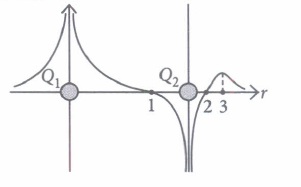
(i) At which of the points 1, 2 and 3 is the electric field is zero?
| (a) 1 | (b) 2 | (c) 3 | (d) Both (a) and (b) |
(ii) The signs of charges Q1 and Q2 respectively are
| (a) positive and negative | (b) negative and positive |
| (c) positive and positive | (d) negative and negative |
(iii) Which of the two charges Q1 and Q2 is greater in magnitude?
| (a) Q2 | (b) Q1 | (c) Same | (d) Can't determined |
(iv) Which of the following statement is not true?
| (a) Electrostatic force is a conservative force |
| (b) Potential energy of charge q at a point is the work done per unit charge in bringing a charge from any point to infinity |
| (c) When two like charges lie infinite distance apart, their potential energy is zero. |
| (d) Both (a) and (c). |
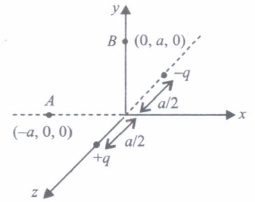
(v) Positive and negative point charges of equal magnitude are kept at \(\left(0,0, \frac{a}{2}\right)\) and \(\left(0,0, \frac{-a}{2}\right)\) respectively.
The work done by the electric field when another positive point charge is moved from (-a, 0, 0) to (0, a, 0) is
| (a) positive |
| (b) negative |
| (c) zero |
| (d) depends on the path connecting the initial and final positions |
13.
Potential difference (\(\Delta\)V) between two points A and B separated by a distance x, in a uniform electric field E is given by \(\Delta V=-E x\),where x is measured parallel to the field lines. If a charge qo moves from P to Q, the changein potential energy \((\Delta U)\) is given as \(\Delta U=q_{0} \Delta V .\) A proton is released from rest in uniform electric field of magnitude \(4.0 \times 10^{8} \mathrm{Vm}^{-1}\) directed along the positive X-axis. The proton undergoes a displacement of 0.25 m in the direction of E.
Mass of a proton = 1.66 x 10⁻²⁷ kg and charge of proton = 1.6 x10⁻¹⁹ C
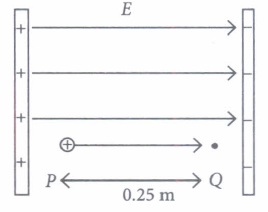
(i) The change in electric potential of the proton between the points A and B is
| \(\text { (a) }-1 \times 10^{8} \mathrm{~V}\) | \(\text { (b) } 1 \times 10^{8} \mathrm{~V}\) |
| \(\text { (c) } 6.4 \times 10^{-19} \mathrm{~V}\) | \(\text { (d) }-6.4 \times 10^{-19} \mathrm{~V}\) |
(ii) The change in electric potential energy of the proton for displacement from A to B is
| \(\text { (a) } 1.6 \times 10^{11} \mathrm{~J}\) | \(\text { (b) } 0.5 \times 10^{23} \mathrm{~J}\) |
| \(\text { (c) }-1.6 \times 10^{-11} \mathrm{~J}\) | \(\text { (d) } 3.2 \times 10^{22} \mathrm{~J}\) |
(iii) The mutual electrostatic potential energy between two protons which are at a distance of 9 x 10-15 m, in \({ }_{92} \mathrm{U}^{235}\) nucleus is
| \(\text { (a) } 1.56 \times 10^{-14} \mathrm{~J}\) | \(\text { (b) } 5.5 \times 10^{-14} \mathrm{~J}\) |
| \(\text { (c) } 2.56 \times 10^{-14} \mathrm{~J}\) | \(\text { (d) } 4.56 \times 10^{-14} \mathrm{~J}\) |
(iv) If a system consists of two charges 4 mC and -3mC with no external field placed at (-5 em, 0, 0) and (5 em, 0, 0) respectively. The amount of work required to separate the two charges infinitely away from each other is
| (a) -1.1 J | (b) 2 J |
| (c) 2.5 J | (d) 3 J |
(v) As the proton moves from P to Q, then
| (a) the potential energy of proton decreases | (b) the potential energy of proton increases |
| (c) the proton loses kinetic energy | (d) total energy of the proton increases |
14.
Electrostatic potential energy of a system of point charges is defined as the total amount of work done in bringing the different charges to their respective positions from infinitely charge mutual separations. The work is stored in the system of two point charges in the form of electrostatic potential energy U of the system. Electric potential difference between any points A and B in an electric field is the amount of work done in moving a unit positive test charge from A to B along any path agents the electrostatic force
\(V_{B}-V_{A}=\frac{W_{A B}}{q_{0}}=\int \mid \vec{E} \cdot d l\)
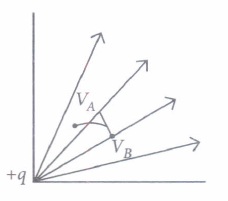
(i) A test charge is moved from lower potential point to a higher potential point. The potential energy of test charge will
| (a) remain the same | (b) increase |
| (c) decrease | (d) become zero |
(ii) Which of the following statement is not true?
| (a) Electrostatic force is a conservative force. |
| (b) Potential energy of charge q at a point is the work done per unit charge in bringing a charge from any point to infinity |
| (c) Spring force and gravitational force are conservative force. |
| (d) Both (a) and (c). |
(iii) Work done in moving a charge from one point to another inside a uniformly charged conducting sphere is
| (a) always zero | (b) non-zero | (c) maybe zero | (d) none of these |
(iv) The work done in bringing a unit positive charge from infinite distance to a point at distance x from a positive charge Q is W. Then the potential \(\phi\) at that point is
| \(\text { (a) } \frac{W Q}{x}\) | (b) W | \(\text { (c) } \frac{W}{x}\) | (d) WQ |
(v) If \(1 \mu C\) charge is shifted from A to B and it is found that work done by an external force is \(40 \mu \mathrm{J}\). In doing so against electrostatics force, the potential difference VA- VB is
| (a) 40 V | (b) -40 V | (c) 20 V | (d) -60 V |
1.
(i) When air molecules/atoms are subjected to high electric field, the centres of negative charges (electrons) and positive charges (nucleus) are separated. Electrons experience force opposite to the direction of electric field and positive charge experiences force in the direction of electric field. If electric field is sufficiently high to pull out electrons, then air gets ionised and starts conducting.
(ii) \(\therefore \ \text { Electric field } \mathrm{E}=\frac{\mathrm{Q}}{4 \pi \varepsilon_{0}}\)
and E = 3 x 10 6 V/m
then \(\mathrm{Q}=4 \pi \varepsilon_{0} \times 3 \times 10^{6} \mathrm{C}\)
\(\mathrm{Q}=\frac{3 \times 10^{6}}{9 \times 10^{9}}=0.33333 \times 10^{-3} \mathrm{C}\)
Q = 333.33 \(\mu\)C
(iii) If air is humid, then also it starts conducting and electric charge leaks away.
2.
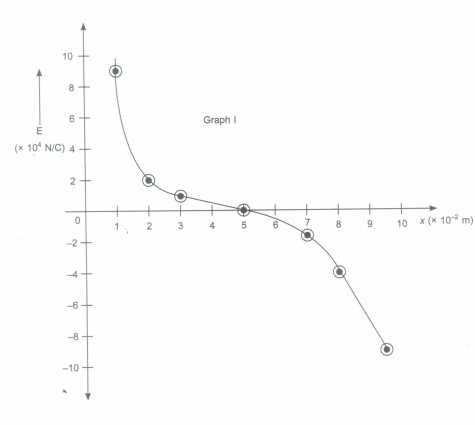
(i) variation of Electric field with distance
If x = 1 cm = 10- 2 m, then net Electric field at P
here rA = 10- 2 m; rB = 9 x 10- 2 m
\(\therefore \quad \mathrm{E}_{1}=9 \times 10^{9} \times 10^{-9}\left[\frac{1}{\left(10^{-2}\right)^{2}}-\frac{1}{\left(9 \times 10^{-2}\right)^{2}}\right]\)
qA = qB = 10- 9 C
k = 9 x 10- 9 Nm2 C-2
E1 = 8.9 x 10 4 N/C
Similarly if x = 2 cm
\(\mathrm{E}_{2}=9\left[\frac{1}{\left(2 \times 10^{-2}\right)^{2}}-\frac{1}{\left(8 \times 10^{-2}\right)^{2}}\right]\)
= 2.0 x 10 4 N/C
for x = 3 cm
\(\mathrm{E}_{3}=9\left[\frac{1}{\left(3 \times 10^{-2}\right)^{2}}-\frac{1}{\left(7 \times 10^{-2}\right)^{2}}\right]\)
= 0.82 x 10⁴N/C
for x = 5 cm; E5 = 0
for x = 7 cm
E7 = - 0.82 x 10⁴ N/S
x = 8 cm, E8 = -2 x 10⁻⁴ N/C
x = 9 cm, E9 = -8.9 x 10⁻⁴ N/C
(ii) Variation of electric Potential is x
if x = 1 cm
\(\mathrm{V}_{1}=\frac{k q}{r_{\mathrm{A}}}+\frac{k q}{r_{\mathrm{B}}}\)
\(=k q\left[\frac{1}{r_{\mathrm{A}}}+\frac{1}{r_{\mathrm{B}}}\right]\)
\(\therefore \ \mathrm{V}_{1}=9 \times 10^{9} \times 10^{-9}\left[\frac{1}{10^{-2}}+\frac{1}{9 \times 10^{-2}}\right]\)
\(\mathrm{V}_{1}=9 \times 10^{2} \times \frac{10}{9}\)
= 1 x 10³ V
for x = 2 cm
\(\mathrm{V}_{2}=9\left[\frac{1}{2 \times 10^{-2}}+\frac{1}{8 \times 10^{-2}}\right]\)
\(=\frac{9 \times 10^{2} \times 10}{16}=0.56 \times 10^{3} \mathrm{~V}\)
x = 3 cm;
\(\mathrm{V}_{3}=9\left[\frac{1}{3 \times 10^{-2}}+\frac{1}{7 \times 10^{-2}}\right]\)
= 0.43 x 10³ V
x = 5 cm;
\(\mathrm{V}_{5}=9 \times \frac{2 \times 10^{3}}{5 \times 10^{-2}}\)
= 0.36 x 10³ V
x = 7 cm;
Y2 = 0.43 x 10³ V
x = 8 cm;
V8 = 0.56 x 10³ V
X = 9 cm;
V9 = 1.0 x 10³V
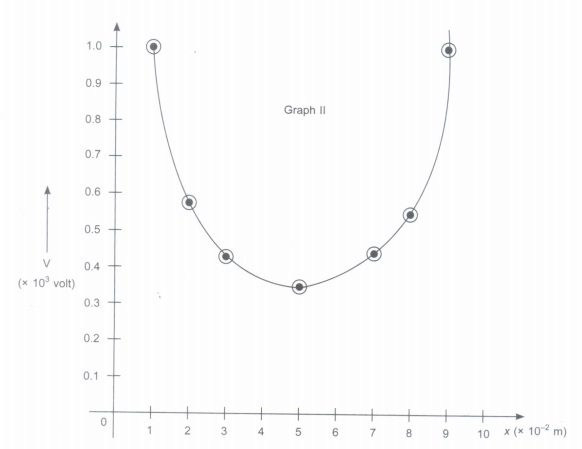
(iii) Electric field and potential at mid point (x = 5 cm) are 0 and 3.6 x 10³ V respectively .
3.
(i) \(\mathrm{U}_{\mathrm{A}}=\frac{1}{2} \mathrm{C}_{\mathrm{A}} \mathrm{V}^{2}\)
\(=\frac{1}{2} \times\left(2 \times 10^{-6}\right) \times(100)^{2}\)
= 10- 2 J
\(\mathrm{U}_{\mathrm{B}}=\frac{1}{2} \mathrm{C}_{\mathrm{B}} \mathrm{V}^{2}\)
\(=\frac{1}{2} \times\left(3 \times 10^{-6}\right) \times(100)^{2}\)
= 1.5 x 10- 2 J
(ii) QA = CAV = 2 x 10-6 x 100
= 2 x 10⁻⁴ C
QB = CBV = 3 x 10-6 x 100
= 3 x 10⁻⁴ C
Common Potential
\(=\mathrm{V}^{\prime}=\frac{\mathrm{Q}_{\mathrm{B}}-\mathrm{Q}_{\mathrm{A}}}{\mathrm{C}_{\mathrm{A}}+\mathrm{C}_{\mathrm{B}}}=\frac{(3-2) \times 10^{-4}}{(2+3) \times 10^{-6}}\)
= 20 V
(iii) Charge on capacitor A is
Q = CV' = 2 x 10-6 x 120
= 4 x 10- 5 C
(iv) Here final electrostatic energy
\(=\frac{1}{2}\left(\mathrm{C}_{1}+\mathrm{C}_{2}\right)\left(\mathrm{V}^{\prime}\right)^{2}\)
\(=\frac{1}{2}(2+3) \times 10^{-6} \times(20)^{2}\)
= 10- 3 J
Loss of energy = Initial electrostatic energy - final electrostatic energy
= (1.5 + 1.0) x 10-2 - 10- 3
= 2.4 x 10- 2 J
4.
(i) R = 6.4 x 10⁶ m,
\(V=\frac{1}{4 \pi \varepsilon_{0}} \frac{\mathrm{Q}}{\mathrm{R}}\) [ Earth is considered as a conducting sphere]
\(\therefore \quad C=\frac{Q}{\mathrm{~V}}=4 \pi \varepsilon_{0} R\)
\(\left[\because \frac{1}{4 \pi \varepsilon_{0}}=9 \times 10^{9} \mathrm{Nm}^{2} \mathrm{C}^{-2}\right]\)
\(=\frac{6.4 \times 10^{6}}{9 \times 10^{9}} \approx 711 \mu \mathrm{F}\)
(ii) Initially the potential of conductor B = V.
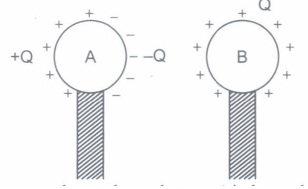
When an uncharged conductor A is brought near to the conductor B, then the charges will induce on A. If -V1 is the potential due to the negative induced charge at A, and V2 is the potential due to the positive induced charge, then \(\left|-V_{1}\right|>\left|V_{2}\right|\) (as -ve charge is near to B).
Net potential on B = V-V1 +V2, which is less than V. But charge on B remains same.
(iii) E = 3 x 10⁶ V /m is the dielectric strength of air. If we further increase potential, the surrounding air will ionise and stored charge will leak away.
(iv) Principle: When an uncharged, earthed conductor is brought near to a charged conductor, then the potential of later decreases and its charge holding capacity increases.
The capacitance depends on:
(i) Geometrical configuration (shape, size and separation) of the system of two conductors.
(ii) Nature ofthe dielectric separating two conductors
5.
(i) Capacitors are used to store electric charges and electric energy.
(ii) Both the protons will experience same force. Reason: F = qE; E = constant; q = +e (same)
(iii) \(\because\) VD =.VA > VB = Vc
\(\therefore\) Gain in K.E. = q x P.D.
\( \therefore\) Gain in K.E. of proton released from point A will be more.
(iv) (a) \(W_{A \rightarrow B}=e\left(V_{B}-V_{A}\right)\) \(\left[\begin{array}{c} \because W=q \times \text { P.D. } \\ E=\frac{V}{d} \end{array}\right]\)
= e[E.2d - E.d]
= eE.d
(b) \(\because\) VB = Vc
\(\therefore\) WBC = 0
(c) WCD = e[VD - VC]
= e[E.(d) - E(2d)]
= - eEd
(d) WABCD = WAB + WBC + WCD + WDA
= eEd + 0 - eEd + 0
= 0
(v) Electric field is conservative as work done along a closed path is zero.
6.
(i) Given electric field on sphere S1
E 1 = 2 x 10⁴ N/C
\(\because \quad E_{1}=2 \times 10^{4} \mathrm{~N} / \mathrm{C}=\frac{k \mathrm{Q}}{r_{1}^{2}}\)
Now just inside outer sphere Electric field
\( E_{2}=\frac{k \mathrm{Q}}{r_{2}^{2}} \)
\(\frac{E_{2}}{E_{1}}=\frac{r_{1}^{2}}{r_{2}^{2}}\)
Here r1 = 0.20 m, r 2 = 0.40 m
\(E_{2}=2 \times 10^{4} \times\left(\frac{0.2}{0.4}\right)^{2}=0.5 \times 10^{4} \mathrm{~N} / \mathrm{c}\)
(ii) Electrostatic potential inside S1
\(V_{1}=\frac{k \mathrm{Q}}{r_{1}}=r_{1} E_{1} \quad\left[\because \frac{E_{1}}{V_{1}}=\frac{1}{r_{1}}\right]\)
= 0.2 x 2 x 104
= 0.4 x 10 4 = 4 x 10 3 V
(iii) If S1 and S2 are joined by a wire entire amount of energy stored in the system will get converted into heat.
Reason: Both the charges on spheres S1 and S2 will get neutralized and energy of the system will be dissipated as heat.
7.
(i) (b): As, \(C_{1}=2 \mu F, C_{2}=4 \mu F\)
In series combination, the equivalent capacitance will be, \(C=\frac{C_{1} C_{2}}{C_{1}+C_{2}}=\left(\frac{2 \times 4}{2+4}\right) \mu \mathrm{F}=\frac{4}{3} \mu \mathrm{F}\)
Potential difference applied, V = 6 V
Energy stored in the system \(U=\frac{1}{2} C V^{2}\)
\(=\frac{1}{2} \times \frac{4}{3} \times 10^{-6} \times(6)^{2} \mathrm{~J}=24 \mu \mathrm{J}\)
(ii) (b): The energy stored in a capacitor is \(U=\frac{1}{2} C V^{2}=\frac{1}{2} \times\left(10 \times 10^{-6}\right)(10)^{2}=500 \mu \mathrm{J}\)
(iii) (b): When the gap between the plates is completely filled with dielectric of dielectric constant K, then potential is
\(V=\frac{Q d}{A \varepsilon_{0} K}\) ... (i)
and electric field is
\(E=\frac{Q}{A \varepsilon_{0} K}\) ...(ii)
From equations (i) and (ii), both electric field and potential decrease.
(iv) (b): Work done = \(U_{f}-U_{i}=\frac{1}{2} \frac{q^{2}}{C_{f}}-\frac{1}{2} \frac{q^{2}}{C_{i}}\)
\(=\frac{q^{2}}{2}\left[\frac{1}{C_{f}}-\frac{1}{C_{i}}\right]=\frac{\left(5 \times 10^{-6}\right)^{2}}{2}\left[\frac{1}{2 \times 10^{-6}}-\frac{1}{5 \times 10^{-6}}\right]\)
\(=3.75 \times 10^{-6} \mathrm{~J}\)
(v) (b) : Here \(r=18 \mathrm{~cm}=18 \times 10^{-2} \mathrm{~m}, q=5 \times 10^{-6} \mathrm{C}\)
As \(C=4 \pi \varepsilon_{0} r=\frac{18 \times 10^{-2}}{9 \times 10^{9}}=2 \times 10^{-11} \mathrm{~F}\)
Energy of charged conductor is
\(U=\frac{q^{2}}{2 C}=\frac{\left(5 \times 10^{-6}\right)^{2} \mathrm{C}}{2 \times 2 \times 10^{-11} \mathrm{~F} \mid}=0.625 \mathrm{~J}\)
8.
(i) (b): As the capacitor is isolated after charging, charge Q on it remains constant: Plate separation d Increases, capaci.tance decreases as \(C=\frac{\varepsilon_{0} A}{d}\) and hence, potential increases as \(V=\frac{Q}{C}\).
(ii) (c): In a parallel plate capacitor, the capacity of capacitor
\(C=\frac{K \varepsilon_{Q} A}{d} \quad \text { i.e., } C \propto A\)
The capacity of capacitor increases if area of the plate increases.
(iii) (b): The magnitude of the electric field between the plates is E = \(\frac{\sigma}{2 \varepsilon_{0}}-\left(-\frac{\sigma}{2 \varepsilon_{0}}\right)=\frac{\sigma}{\varepsilon_{0}}\)
(IV) (b): As \(\frac{\varepsilon_{0} A}{d}=4 \pi \varepsilon_{0} R \text { or } \frac{\varepsilon_{0} \pi D^{2}}{4 d}=4 \pi \varepsilon_{0} R\)
\(\text { or } \quad d=\frac{D^{2}}{16 R}=\frac{(0.08)^{2}}{16 \times 0.10}=4 \times 10^{-3} \mathrm{~m}=4 \mathrm{~mm}\)
(v) (c): Here \(V=\frac{q_{1}-q_{2}}{2 C}\)
\(=\frac{2.0 \times 10^{-8}+1.0 \times 10^{-8}}{2 \times 1.2 \times 10^{-9}}=12.5 \mathrm{~V}\)
9.
(i) (b): Here \(C-50 p F-50 \times 10^{-12} F, V=10^{4} V\)
\(R=\frac{1}{4 \pi \varepsilon_{0}} \cdot C=9 \times 10^{9} \mathrm{mF}^{-1} \times 50 \times 10^{-12} \mathrm{~F}\)
= 45 x 10-2 m = 45 cm
(ii) (d): As \(q=C V=25 \times 10^{-12} \times 10^{5}=2.5 \mu \mathrm{C}\)
(iii) (c)
(iv) (c): As charge \(q=C V=\left(4 \pi \varepsilon_{0} R\right) V\)
\(\therefore\) q depends on both V and R.
(v) (c): 64 drops have formed a single mop of radius R. Volume oflarge sphere = 64 x Volume of small sphere
\(\therefore \frac{4}{3} \pi R^{3}=64 \frac{4}{3} \pi r^{3} \Rightarrow R=4 r \text { and } Q_{\text {total }}=64 q\)
\(C^{\prime}=4 \pi \varepsilon_{0} R \Rightarrow C^{\prime}=\left(4 \pi \varepsilon_{0}\right) \cdot 4 r \Rightarrow C^{\prime}=4 C\)
10.
(i) (c): \(W=(\text { P.E. })_{\text {final }}-(\text { P.E. })_{\text {initial }}\)
\(=\frac{k e^{2}}{2}-\frac{k e^{2}}{1}=\frac{-k e^{2}}{2}\)
(ii) (b) : Potential at the centre of the square due to four equal charges q at four corners
\(V=\frac{4 q}{4 \pi \varepsilon_{0}(a \sqrt{2}) / 2}=\frac{\sqrt{2} q}{\pi \varepsilon_{0} a}\)
\(W_{0 \rightarrow \infty}=-W_{\infty \rightarrow 0}=-(-q) V=\frac{\sqrt{2} q^{2}}{\pi \varepsilon_{0} a}\)
(iii) (c): Here, \(q=2 \mu \mathrm{C}=2 \times 10^{-6} \mathrm{C}, r_{A}=2 \mathrm{~m}, r_{B}=1 \mathrm{~m}\)
\(\therefore \ V_{A}-V_{B}=\frac{q}{4 \pi \varepsilon_{0}}\left[\frac{1}{r_{A}}-\frac{1}{r_{B}}\right]\)
\(=2 \times 10^{-6} \times 9 \times 10^{9}\left[\frac{1}{2}-\frac{1}{1}\right] \mathrm{V}=-9 \times 10^{3} \mathrm{~V}\)
(iv)(b) : Required work done = Change in potential energy of the system
\(W=U_{f}-U_{i}=k \frac{q_{1} q_{2}}{r_{f}}-k \frac{q_{1} q_{2}}{r_{i}}=k q_{1} q_{2}\left[\frac{1}{r_{f}}-\frac{1}{r_{i}}\right]\)
\(\therefore \ W=\left(9 \times 10^{9}\right)\left(3 \times 10^{-9} \times 1 \times 10^{-9}\right)\) \(\times\left[\frac{1}{4 \times 10^{-2}}-\frac{1}{5 \times 10^{-2}}\right]\)
\(=27 \times 10^{-7} \times(0.05)=1.35 \times 10^{-7} \mathrm{~J}\)
(v) (b)
11.
(i) (d)
(ii) (b)
(iii) (b)
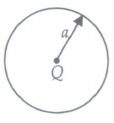
(iv) (d): The electrical potential at any (J) point on circle of radius a due to charge Qa Q.at Its centre I.S V = \(V=\frac{1}{4 \pi \varepsilon_{0}} \frac{Q}{a}\)
It is an equipotential surface.
Hence, work done in carrying a charge q round the circle is zero.
(v) (d): Work done to move a unit charge along an equipotential surface from P to Q,
\(W=-\int_{P}^{Q} \vec{E} \cdot d \vec{l}\)
On equipotential surface \(\vec{E} \perp d \vec{l}\)
\(W=-\int_{P}^{Q} E(d l) \cos 90^{\circ}=0\)
12.
(I) (c) : As \(\frac{-d V}{d r}=E_{r}\) the negative of the slope of V versus r curve represents the component of electric field along r. Slope of curve is zero only at point 3. Therefore, the electric field vector is zero at point 3.
(ii) (a) : Near positive charge, net potential is positive and near a negative charge, net potential is negative. Thus, charge Q1 is positive and Q2 is negative.
(iii) (b) : From the figure, it can be seen that net potential due to two charges is positive everywhere in the region left to charge Q1. Therefore the magnitude of potential due to charge Q1 is greater than due to Q2.
(iv) (b)
(v) (c) : It can be seen that potential at the points both A and B are zero. When the charge is moved from A to B, work done by the electric field on the charge will be zero.
13.
(i) (a) : As \(\Delta V=-E \Delta \psi=-\left(4.0 \times 10^{8} \mathrm{~V} / \mathrm{m}\right)(0.25 \mathrm{~m})\)= -108V
(ii) (c) : As \(\Delta U=q_{0} \Delta V=\left(1.6 \times 10^{-19}\right) \times\left(-1.0 \times 10^{8} \mathrm{~V}\right)\)= \(-1.6 \times 10^{-11} \mathrm{~V}\)
(iii) (c) : Here, \(q_{1}=q_{2}=1.6 \times 10^{-19} \mathrm{C}, r=9 \times 10^{-15} \mathrm{~m}\)
\(U=\frac{9 \times 10^{9} \times 1.6 \times 10^{-19} \times 1.6 \times 10^{-19}}{9 \times 10^{-15}}=2.56 \times 10^{-14} \mathrm{~J}\)
(iv) (a): Here, \(q_{1}=4 \mu \mathrm{C}, q_{2}=-3 \mu \mathrm{C}\)
r = 10 cm = 0.1 m
Electrostatic potential energy,
\(U=\frac{1}{4 \pi \varepsilon_{o}} \frac{q_{1} q_{2}}{r}=9 \times 10^{9} \times \frac{4 \times 10^{-6} \times(-3) \times 10^{-6}}{0.1}=-1.1 \mathrm{~J}\)
(v) (a) : As proton moves in the direction of the electric field, then its potential energy decreases.
14.
(i) (c)
(ii) (b)
(iii) (a): Since, E = 0 inside the conductor and has no tangential component on the surface, no work is done in moving a small test charge within the conductor and on its surface.
(iv) (b): The work done in bringing unit positive charge from infinity to a point which is at a distance x from the positive charge Q is defined as the potential at the given point due to the charge Q. Therefore
\(\phi=W\)
(v) (b): \(W_{\text {ext }}=q_{0} \Delta V\)
\(\left(W_{A B}\right)_{\mathrm{ext}}=q\left(V_{B}-V_{A}\right)\)
\(40 \mu \mathrm{J}=1 \mu \mathrm{C}\left(V_{B}-V_{A}\right)\)
\(V_{A}-V_{B}=-40 \mathrm{~V}\)

12th Standard CBSE Syllabus & Materials
12th Standard CBSE
CBSE 12th Computer Science Python Revision Tour I - New Previous year Question Papers Study Material - QB365 Set A
NEW12th Standard CBSE
CBSE 12th Business Studies Planning Important Questions And Answers Study Material - QB365 Set A
NEW12th Standard CBSE
CBSE 12th Business Studies Business Environment Important Questions And Answers Study Material - QB365 Set A
NEW12th Standard CBSE
CBSE 12th Business Studies Principles of Management Important Questions And Answers Study Material - QB365 Set A



CBSE 12th Standard CBSE Subjects
CBSE Standards










