
 100% FREE ACCESS
12th Standard CBSE Syllabus & Materials
12th Standard CBSE
CBSE 12th Economics Government Budget and the Economy Previous year Question Papers Study Material - QB365 Set A
NEW12th Standard CBSE
CBSE 12th Computer Science Interface Python with MySQL - New Previous year Question Papers Study Material - QB365 Set A
NEW12th Standard CBSE
CBSE 12th Computer Science Database Concept - New Previous year Question Papers Study Material - QB365 Set A
NEW12th Standard CBSE
CBSE 12th Computer Science Data Communication - New Previous year Question Papers Study Material - QB365 Set A
NEW12th Standard CBSE
CBSE 12th Computer Science Data Structures - New Previous year Question Papers Study Material - QB365 Set A
NEW12th Standard CBSE
CBSE 12th Computer Science Functions - New Previous year Question Papers Study Material - QB365 Set A

Published on: 10/06/2018
Download CBSE Class 12th Standard CBSE Maths question papers, sample papers, important questions, and previous year solved papers in PDF format. Get free study materials, NCERT solutions, and exam preparation resources for Class 12th Standard CBSE Maths
Questions + Answers key
Take MCQ Maths Test
1.
If \({ x }^{ y }={ e }^{ x-y }\)show that \(\frac { dy }{ dx } =\frac { log\quad x }{ { \left( log(xe) \right) }^{ 2 } } \)
2.
If \({ x }^{ y }={ e }^{ x-y }\), show that: \(\frac { dy }{ dx } =\frac { log\quad x }{ { \left( 1+logx \right) }^{ 2 } } \)
3.
Differentiate the following with respect to x:
\({ sin }^{ -1 }\left( \frac { { 2 }^{ x+1 }.{ 3 }^{ x } }{ 1+{ \left( 36 \right) }^{ x } } \right) \)
4.
If \(xy={ e }^{ x-y }\)prove that \(\frac { dy }{ dx } =\frac { y(x-1) }{ x(y+1) } \)
5.
Differentiate \({ tan }^{ -1 }\left( \frac { \sqrt { 1+{ x }^{ 2 } } -1 }{ x } \right) \) w.r.t.x.
6.
If \(x={ e }^{ x/y },\)prove that \(\frac { dy }{ dx } =\frac { x-y }{ xlogx } \)
7.
Find \(\frac { dy }{ dx } \)When \({ tan }^{ -1 }\left( { x }^{ 2 }+{ y }^{ 2 } \right) =a\)
8.
If y = tan x + sec x, prove that \(\frac { { d }^{ 2 }y }{ { dx }^{ 2 } } =\frac { cos\quad x }{ { \left( 1-sin\quad x \right) }^{ 2 } } \)
9.
Let \(f\left( x \right) =x\left| x \right| \), for all \(x\in R.\). Discuss the derivability of f(x) at x = 0.
10.
If \(sin\quad x=\frac { 2t }{ 1+{ t }^{ 2 } } \quad and\quad tan\quad y=\frac { 2t }{ 1-{ t }^{ 2 } } \)find \(\frac { dy }{ dx } \)
11.
Given \(f\left( x \right) =\frac { 1 }{ X-1 } \). Find the points of discontinuity of the composite function f[f(x)].
12.
\(If\ cos\ y=x\ cos\left( a+y \right) ,\ prove\ that\ \frac { dy }{ dx } =\frac { { cos }^{ 2 }\left( a+y \right) }{ sin\ y } \)
13.
Differentiate w.r.t. x: \({ x }^{ x }+{ x }^{ a }+{ a }^{ x }+{ a }^{ a }\)
14.
Differentiate w.r.t. x: \({ sin }^{ -1 }(x\sqrt { x } )\)
15.
Differentiate w.r.t. x: \({ \left( 5x \right) }^{ 3\ cos\ 2x }\)
16.
Differentiate w.r.t. x: \({ sin }^{ 3 }x+{ cos }^{ 6 }x\)
17.
Differentiate w.r.t. x: \({ \left( { 3x }^{ 2 }-9x+5 \right) }^{ 9 }\)
18.
\(For\quad what\quad value\quad of\quad \lambda \quad is\quad the\quad function: f\left( x \right) =\begin{cases} \lambda ({ x }^{ 2 }-2x)\quad ifx\le 0 \\ 4x+1\quad \quad \quad \quad ifx>0 \end{cases}continuous\quad at\quad x=0? What\quad about\quad continuity\quad at\quad x=1?\)
19.
Find the point of discontinuity: \(f(x)=\left\{ { { x }^{ 10 }-1,\quad \quad ifx\le 1 }\\ { { x }^{ 2 } },\quad \quad \quad \quad \quad ifx>1 \right\} \)
20.
Prove that the function f(x) = 5x−3 is continuous at x = 0, at x = −3 and x = 5.
21.
Differentiate the following w.r.t. x.
\((i) { cos }^{ -1 }(sin\quad x)\)
\((ii)\ { tan }^{ -1 }\left( \frac { sin\quad x }{ 1+cosx } \right) \)
\((iii){ sin }^{ -1 }\left( \frac { { 2 }^{ x+1 } }{ 1+{ 4 }^{ x } } \right) \)
22.
Differentiate the following with respect to x:
\((i)\ { e }^{ -x } \)
\((ii)\ sin(log\quad x),\ x>0\)
\((iii)\ { cos }^{ -1 }({ e }^{ x }) \)
\((iv)\ { e }^{ cos\quad x }\)
23.
Discuss the continuity of the function f given by:
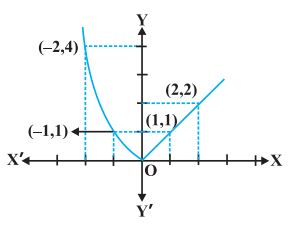
\(f\left( x \right) =\begin{cases} x,\quad if\quad x\ge 0 \\ { x }^{ 2 }\quad if\quad x<0 \end{cases}\)
24.
Discuss the continuity of the function f defined by:
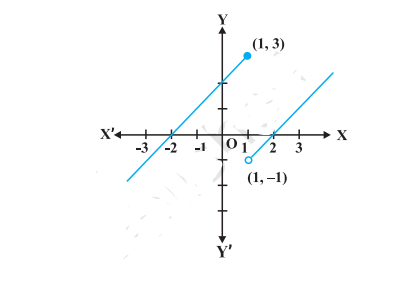
\(f(x)=\left\{\begin{array}{l} x+2, \text { if } x \leq 1 \\ x-2, \text { if } x>1 \end{array}\right.\)
25.
\(If\quad y={ cos }^{ -1 }x,find\quad \frac { { d }^{ 2 }y }{ { dx }^{ 2 } } in\ terms\ of\ y\ alone.\)
26.
\(If=5\quad cosx-3sinx,\quad prove\quad that\quad \frac { { d }^{ 2 }y }{ { dx }^{ 2 } } +y=0\)
27.
Find the second order derivative of the functions: \(sin\ (log\ x)\)
28.
Find the second order derivative of the functions: \(log(log\ x)\)
29.
Find the second order derivative of the functions: \({ tan }^{ -1 }x\)
30.
Find the second order derivative of the functions: \({ e }^{ 6x }cos\ 3x\)
31.
Find the second order derivative of the functions: \({ e }^{ x }sin5x\)
32.
Find the second order derivative of the functions: \({ x }^{ 3 }log\ x\)
33.
Find the second order derivative of the functions: \(log\ x\)
34.
Find the second order derivative of the functions: \(x\ cos\ x\)
35.
Find the second order derivative of the functions: \({ x }^{ 20 }\)
36.
Find the second order derivative of the functions: \({ x }^{ 2 }+3x+2\)
37.
\(If\quad X=\sqrt { { a }^{ { sin }^{ -1 }t } } ,\quad y=\sqrt { { a }^{ { cos }^{ -1 }t } } ,\quad show\quad that: \frac { dy }{ dx } =-\frac { y }{ x } \)
38.
Find dy/dx of the function : \(x=a\quad sec\theta ,\quad y=b\quad tan\theta \)
39.
Find dy/dx of the function :\(x=a(\theta -sin\theta ),\quad y=a(1+cos\theta )\)
40.
Find dy/dx of the function : \(x=sin\quad t,\quad y=cos\quad 2t\)
41.
Find dy/dx of the function : \(x=4t,\quad y=\frac { 4 }{ t } \)
42.
Find dy/dx of the function : \(x=a\ cos\theta ,\ y=b\ cos\theta \)
43.
Find dy/dx of the function : \(x={ 2at }^{ 2 },y={ at }^{ 4 }\)
44.
Find dy/dx of the function : \(xy={ e }^{ (x-y) }\)
45.
Find dy/dx of the function given in: \({ y }^{ x }={ x }^{ y }\)
46.
Differentiate the following with respect to x: \({ \left( x+3 \right) }^{ 2 }{ \left( x+4 \right) }^{ 3 }{ \left( x+5 \right) }^{ 4 }\)
47.
Differentiate the following with respect to x: \({ \left( log\quad x \right) }^{ cos\quad x }\)
48.
Differentiate the following with respect to x: cos x.cos 2x. cos 3x
49.
Differentiate the following with respect to x: \(y=cos(log\quad x+{ e }^{ x })\)
50.
Differentiate the following with respect to x: \(y=\frac { cos\quad x }{ log\quad x } \)
51.
Differentiate the following with respect to x: \(y=log(logx)\)
52.
Differentiate the following with respect to x: \(y=\sqrt { { e }^{ \sqrt { x } } } ={ \left( { e }^{ \sqrt { x } } \right) }^{ 1/2 }\)
53.
Differentiate the following with respect to x: \(y={ e }^{ x }+{ e }^{ { x }^{ 2 } }+......{ e }^{ { x }^{ 5 } }\)
54.
Differentiate the following with respect to x: \(y=log(cos\quad { e }^{ x })\)
55.
Find dy/dx in the following: \(y=sin({ tan }^{ -1 }{ e }^{ -x })\)
56.
Find dy/dx in the following: \(y={ e }^{ x^{ 3 } }\)
57.
Find dy/dx in the following: \(y={ e }^{ { sin }^{ -1 }x }\)
58.
Find dy/dx in the following: \(y=\frac { { e }^{ x } }{ sin\quad x } \)
59.
Find dy/dx in the following: \(y=\sec ^{-1}\left(\frac{1}{2 x^2-1}\right), 0
60.
Find dy/dx in the following: \(y=\sin ^{-1}\left(2 x \sqrt{1-x^2}\right),-\frac{1}{\sqrt{2}}
61.
Find dy/dx in the following: \(y=\cos ^{-1}\left(\frac{2 x}{1+x^2}\right),-1
62.
Find dy/dx in the following: \(y=\sin ^{-1}\left(\frac{1-x^2}{1+x^2}\right), 0
63.
Find dy/dx in the following: \(y={ cos }^{ -1 }\frac { 1-{ x }^{ 2 } }{ 1+{ x }^{ 2 } } \)
64.
Find dy/dx in the following: \(y={ tan }^{ -1 }\frac { 3x-{ x }^{ 3 } }{ 1-3{ x }^{ 2 } } \)
65.
Find dy/dx in the following: \(y={ sin }^{ -1 }\frac { 2x }{ 1+{ x }^{ 2 } } \)
66.
Find dy/dx in the following : \({ sin }^{ 2 }x+cos^{ 2 }y=1\)
67.
Find dy/dx in the following: \({ sin }^{ 2 }y+cosxy=\pi \)
68.
Find dy/dx in the following : \({ x }^{ 3 }+{ x }^{ 2 }y+{ xy }^{ 2 }+{ y }^{ 3 }=81\)
69.
Find dy/dx in the following : \({ x }^{ 2 }+xy+{ y }^{ 2 }=100\)
70.
Find dy/dx in the following : \(xy+{ y }^{ 2 }=tan\ x+y\)
71.
Find dy/dx in the following: \(ax+{ by }^{ 2 }=cos\quad y\)
72.
Find dy/dx in the following: 2x + 3y = sin x
73.
Differentiate the functions with respect to x : \(cos\sqrt { x } \)
74.
Differentiate the functions with respect to x : \(2\sqrt { cot\quad ({ x }^{ 2 } } )\)
75.
Differentiate the functions with respect to x : \(sec(tan\ \sqrt { x } )\)
76.
Differentiate the functions with respect to x : \(sin(ax+b)\)
77.
Differentiate the functions with respect to x : \(cos(sin\quad x)\)
78.
Differentiate the functions with respect to x : \(sin({ x }^{ 2 }+5)\)
79.
Differentiate the functions given in Exercises
\(\sqrt{\frac{(x-1)(x-2)}{(x-3)(x-4)(x-5)}}\)
80.
Show that the function defined by \(f(x)=\left| cos\quad x \right| \) is a continuous function.
81.
Show that the function defined by \(f(x)=cos{ \left( x \right) }^{ 2 }\)
82.
Find the values of k so that the function f is continuous at the indicated point
\(f(x)=\begin{cases} kx+1,\quad if\quad x\le 5 \\ 3X-5,\quad if\quad x>5 \end{cases}at\quad x=5.\)
83.
Find the values of k so that the function f is continuous at the indicated point
\(f(x)=\begin{cases} kx+1\quad if\quad x\le \pi \quad at\quad x=\pi \\ cos\quad x\quad if\quad x>\pi \end{cases}\)
84.
Find the values of k so that the function f is continuous at the indicated point
\(f(x)=\begin{cases} { k }x^{ 2 },\quad if\quad x\le 2 \\ 3\quad \quad \quad if\quad x>2 \end{cases}at\quad x=2.\)
85.
Differentiate the functions given in Exercises x x – 2sin x
86.
Find all points of discontinuity of f, where:
\(f(x)=\begin{cases} \frac { sinx }{ x } ,\quad if\quad x<0 \\ x+1\quad ,\quad if\quad x\ge 0 \end{cases}\)
87.
Find the values of k so that the function f is continuous
\(f(x)=\left\{\begin{array}{rll} \frac{k \cos x}{\pi-2 x}, & \text { if } & x \neq \frac{\pi}{2} \\ 3, & \text { if } & x=\frac{\pi}{2} \end{array}\right.\)
88.
Examine the continuity of the function f(x) = 2x2 – 1 at x = 3
89.
\(Differentiate\quad { sin }^{ 2 }x\quad w.r.t.{ \quad e }^{ cosx }\)
90.
Verify Mean Value Theorem for the function:
\(f(x)={ x }^{ 2 }\quad in\quad the\quad interval[2,4].\)
91.
\(Find\quad \frac { { d }^{ 2 }y }{ { dx }^{ 2 } } ,\quad if\quad y={ x }^{ 3 }+tan\quad x.\)
92.
\(Find\ \frac { dy }{ dx } ,\ if\ { x }^{ 2/3 }+{ y }^{ 2/3 }={ a }^{ 2/3 }\)
93.
\(Find\ \frac { dy }{ dx } ,\ if: x=a\left( \theta +sin\theta \right) ,\ y=a(1-cos\theta )\)
94.
\(Find\ \frac { dy }{ dx } ,\ if\ x={ at }^{ 2 },\ y=2at.\)
95.
Find \(\frac { dy }{ dx }\) , if \(x=a\ cos\theta ,\ y=a\ sin\theta \)
96.
Differentiate \({ x }^{ sinx\quad },x>0\quad w.r.t.\quad x.\)
97.
Is it true that \(x={ e }^{ logx }\)for all real x?
98.
\(Find\ \frac { dy }{ dx } \ if\ y+sin\ y=cos\ x\)
99.
\(Find\ \frac { dy }{ dx } \ if\ x-y=\pi \)
100.
Find dy/dx of the functions given in Exercises
\(x^y+y^x=1\)
101.
Find the derivative of tan(2x+3).
102.
Find the derivative of the function given by:
\(f(x)=sin\left( { x }^{ 2 } \right) \)
103.
Show that the function defined by \(f(x)=sin\left( { x }^{ 2 } \right) \) is a continuous function.
104.
Show that the function f defined by f(x) = |1 – x + | x | |, where x is any real number, is a continuous function
105.
Discuss the continuity of the function f defined by:
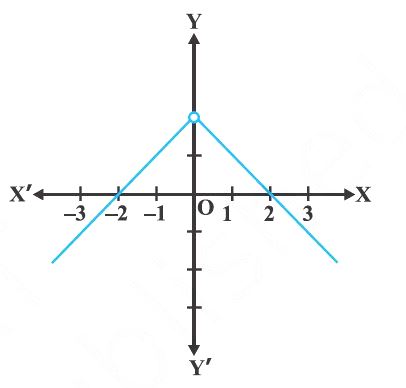
\(f(x)=\begin{cases} x+2\quad if\quad x<0 \\ -x+2\quad if\quad x>0. \end{cases}\)
106.
Is the function defined by f(x) = | x |, a continuous function?
107.
Discuss the continuity of the function f defined by:
\(f(x)=\frac { 1 }{ x } ,x\neq 0\)
108.
Discuss the continuity of the function f defined by:
\(f(x)={ x }^{ 3 }+{ x }^{ 2 }-1\)
109.
Prove that the identity function on real numbers given by: f(x) = x is continuous at every real number.
110.
Check the points where the constant function f(x) = k is continuous
111.
Show that the function f given by: \(f(x)=\begin{cases} { x }^{ 3 }+3,\quad if\quad x\neq 0 \\ 1,\quad \quad \quad if\quad x=0 \end{cases}\) is not continuous at x = 0.
112.
Discuss the continuity of the function f given by f(x) = | x | at x = 0.
113.
Examine whether the function f given by: f(x) = \({ x }^{ 2 }\) is continuous at x = 0.
114.
Check the continuity of the function f given by: f(x) = 2x + 3 at x = 1.
115.
Show that the function f (x) = \(\begin{cases} { x }^{ 3 }+3\quad ,\quad if\quad x\neq 0 \\ 1 ,\quad if\quad x=0 \end{cases}\) is not continuous at x = 0.
116.
Find f′(x) if f (x) = (sin x)sin x for all 0 < x < π.
117.
If a function f is differentiable at a point c, then it is also continuous at that point.
118.
Suppose f and g be two real functions continuous at a real number c.
Then
(1) f + g is continuous at x = c.
(2) f – g is continuous at x = c.
(3) f . g is continuous at x = c.
(4) \(\left(\frac{f}{g}\right)\) is continuous at x = c, (provided g(c) ≠ 0).
119.
Differentiate \(tan^{ -1 }\left( \frac { x }{ \sqrt { 1-x^{ 2 } } } \right) \)with respect to \(sin^{ -1 }(2x\sqrt { 1-x^{ 2 } } )\quad x\neq 0\)
120.
Find \(\frac{dy}{dx},\) if \(y=\sin^{-1}(\frac{2^{x+1}}{1+4^x})\)
121.
If y = \(sin^{ -1 }sin(x\sqrt { 1-x } -\sqrt { x } \sqrt { 1-x^{ 2 } } \) and 0 < x < 1, then find \(\frac { dy }{ dx } \)
122.
If y = \(e^{ ax }\) cos bx then prove that \(\frac { d^{ 2 }y }{ dx^{ 2 } } +(a^{ 2 }+b^{ 2 })y=0\)
123.
The path of a moving bike is given by \(f(x)=\{2x-1, \ if\ x<0 \ 2x+1,\ if\ x\ge0\)
Find the dangerous point on the path. Whether the rider should pass that point or not? Justify your answers.
124.
If \(x\ \in R-[-1,1]\) then prove that the derivative of sec-1x with respect to x is \(\frac{1}{|x|\sqrt{x^2-1}}\)
125.
Verify Rolle's Theorem for the following functions:
f (x)=\({ e }^{ { 1-x }^{ 2 } }\) in [-1,1]
126.
Verify Rolle's Theorem for the following functions:
f (x) = sin2 x in \(\left[ 0,\pi \right] \)
127.
Verify Rolle's Theorem for the following functions:
f (x) = x2-5x+6 in [2,3].
128.
If cos y=x cos (a+y), cos a \(\neq \quad \pm \) 1, prove that=\(\frac { dy }{ dx } =\frac { { cos }^{ 2 }\left( a+y \right) }{ sin\quad a } \)
129.
If ey (1+x)=1, show that \(\frac { { d }^{ 2 }y }{ { dx }^{ 2 } } =\left( \frac { dy }{ dx } \right) ^{ 2 }\).
130.
If x sin (a+y) + sin a cos (a+y)=0, prove that \(\frac { dy }{ dx } =\frac { { sin }^{ 2 }(a+y) }{ sin\quad a } \)
131.
Differentiate w.r.t. x or find \(\frac { dy }{ dx } \) : tan-1(x2+y2)=a
132.
Differentiate w.r.t. x or find \(\frac { dy }{ dx } \) : sec-1\(\left( \frac { 1 }{ { 4 }x^{ 3 }-3x } \right) \)
133.
Differentiate w.r.t. x or find \(\frac { dy }{ dx } \): sin-1\(\left( \frac { 1 }{ \sqrt { x+1 } } \right) \)
134.
Differentiate w.r.t. x or find \(\frac { dy }{ dx } \) : sin x=\(\frac { 2t }{ 1+{ t }^{ 2 } } ,tan \ \ y=\frac { 2t }{ 1-{ t }^{ 2 } } \)
135.
Differentiate w.r.t. x or find \(\frac { dy }{ dx } \): y=sin-1 \(\left( \frac { { 2 }^{ x+1 } }{ 1+4^{ x } } \right) \)
136.
Differentiate w.r.t. x or find \(\frac { dy }{ dx } \)
y=sin (tan-1 e-x).
137.
Differentiate w.r.t. x or find \(\frac { dy }{ dx } \) : \({ 2 }^{ cos^{ 2 }x }\)
138.
Verify Rolle's Theorem for the following functions:
f(x) = |x| in |-1, 1|
139.
Verify Rolle's Theorem for the following functions:
f(x) = cos x + sin x on [0, 2\(\pi\)]
140.
Verify Rolle's Theorem for the following functions:
f(x)=sin 2x in [0,\(\pi\)]
141.
If y= 1+ x+ \(\frac { { x }^{ 2 } }{ 2! } +\frac { { x }^{ 3 } }{ 3! } +......+\quad \frac { { x }^{ n } }{ n! } ,\) show that \(\frac { dy }{ dt } -y+\frac { { x }^{ n } }{ n! } =0\)
142.
If xy yx=1, find \(\frac { dy }{ dx } \)
143.
If y= \(\sqrt { \frac { 1-sin\quad 2x }{ 1+sin\quad 2x } } \)show that \(\frac { dy }{ dx } +{ sec }^{ 2 }\left( \frac { \pi }{ 4 } -x \right) =0\)
144.
If y=cot x, show that \(\frac { { d }^{ 2 }y }{ { dx }^{ 2 } } +2x\frac { dy }{ dx } =0\).
145.
If x= sin\(\left( \frac { 1 }{ a } log\quad y \right) \), show that \((1-x^2) y^2-xy^1-a^2y=0\)
146.
If \(y={ e }^{ { m\sin }^{ -1 }x }\), prove that (1-x2) y2 - xy1 =m2y.
147.
If y=A cos nx +B sin nx , prove that \(\frac { { d }^{ 2 }y }{ { dx }^{ 2 } } +{ n }^{ 2 }y=0\).
148.
Differentiate tan-1 \(\frac { 2x }{ 1-{ x }^{ 2 } } \) with respect to sin-1 \(\frac { 2x }{ 1+{ x }^{ 2 } } \).
149.
If ex + ey = ex+y, prove that \(\frac { dy }{ dx } =\frac { { -e }^{ x }({ e }^{ y }-1) }{ { e }^{ y }({ e }^{ x }-1) } \)
150.
If \(y={ e }^{ { x+e }^{ { x+e }^{ x+...\infty } } }\), prove that \(\frac { dy }{ dx } =\frac { y }{ 1-y } \).
151.
If the derivative of tan-1 (a+bx) takes the value 1 at x=0, prove that b=1+a2
152.
If y= tan-1\(\left( \frac { 5ax }{ { a }^{ 2 }-6{ x }^{ 2 } } \right) \),prove that \(\frac { dy }{ dx } =\frac { 3a }{ { a }^{ 2 }+{ 9x }^{ 2 } } +\frac { 2a }{ { a }^{ 2 }+{ 9x }^{ 2 } } \)
153.
Differentiate the following w.r.t. x or find \(\frac { dy }{ dx } \): tan-1\(\left( \sqrt { 1+{ x }^{ 2 } } -x \right) \)
154.
Differentiate the following w.r.t. x or find \(\frac { dy }{ dx } \): \({ x }^{ { x }^{ x } }\)
155.
Differentiate the following w.r.t. x or find \(\frac { dy }{ dx } \):\(y={ cos }^{ -1 }\sqrt { \frac { { 1 }+x^{ 2 } }{ 2 } } \)
156.
Differentiate the following w.r.t. x or find \(\frac { dy }{ dx } :\) y=tan-1 \(\left[ \frac { \sqrt { 1+{ a }^{ 2 }{ x }^{ 2 } } -1 }{ ax } \right] \)
157.
Differentiate the following w.r.t. x or find \(\frac { dy }{ dx } :\) y=tan-1 \(\left( \frac { a\quad cos\quad x-\quad b\quad sin\quad x }{ b\quad cos\quad x+a\quad sin\quad x } \right) \)
158.
Differentiate the following w.r.t. x or find \(\frac { dy }{ dx } :\) y=tan-1 \(\left( \frac { cos\quad x-\quad sin\quad x }{ cos\quad x+sin\quad x } \right) \).
159.
Differentiate the following w.r.t. x or find \(\frac { dy }{ dx } :\) y=tan-1 \(\sqrt { \frac { 1+sin\quad x }{ 1-sin\quad x } } \).
160.
Differentiate the following w.r.t. x or find \(\frac { dy }{ dx } :\)
y=tan-1\(\left( \frac { 1-cos x }{ sinx } \right) \)
161.
Differentiate the following w.r.t. x or find \(\frac { dy }{ dx } :\) y=tan-1 \(\left( \frac { x }{ 1+\sqrt { 1-{ x }^{ 2 } } } \right) \).
162.
Differentiate the following w.r.t. x or find \(\frac { dy }{ dx } \):y=\({ e }^{ { -x }^{ 2 } }\)sin (log x).
163.
Differentiate the following w.r.t. x or find \(\frac { dy }{ dx } \):
y=log \(\left\{ tan\left( \frac { \pi }{ 4 } +\frac { x }{ 2 } \right) \right\} .\)
164.
Differentiate the following w.r.t. x or find \(\frac { dy }{ dx } \):
y=tan-1( sec x +tan x).
165.
Differentiate the following w.r.t. x or find \(\frac { dy }{ dx } \):
y=ex log (sin 2x).
166.
Differentiate the following w.r.t. x or find \(\frac { dy }{ dx } \): y=log (cos x2).
167.
Differentiate the following w.r.t. x or find \(\frac { dy }{ dx } \):y=tan-1 \(\left( \frac { \sqrt { x } +\sqrt { a } }{ 1-\sqrt { ax } } \right) \).
168.
Differentiate the following w.r.t. x or find \(\frac { dy }{ dx } \).
y=\(\sqrt { a+\sqrt { a+x } } \).
169.
Differentiate the following w.r.t. x or find \(\frac { dy }{ dx } \):
y=sin-1[2ax \(\sqrt { 1-{ a }^{ 2 }{ x }^{ 2 } } \)]
170.
Differentiate the following w.r.t. x or find \(\frac { dy }{ dx } \):
y=sin-1 \(\left[ \frac { \sqrt { 1+x } +\sqrt { 1-x } }{ 2 } \right] \)
171.
Differentiate the following w.r.t. x or find \(\frac { dy }{ dx } \):
\(y={ sec }^{ -1 }\left( \frac { 1+{ x }^{ 2 } }{ 1-{ x }^{ 2 } } \right) \).
172.
If y= sin-1 x, show that \(\left( { 1-x }^{ 2 } \right) ^{ 2 }\frac { { d }^{ 2 }y }{ d{ x }^{ 2 } } -x\frac { { d }y }{ d{ x } } =0\)
173.
If y= (tan-1 x)2, prove that (x2+1)2 \(\frac { { d }^{ 2 }y }{ d{ x }^{ 2 } } +2x\left( { x }^{ 2 }+1 \right) \frac { dy }{ dx } =2\).
174.
If log y= tan-1 x, show that (1+x2) y2 + (2x-1) y1=0
175.
If y=Aemx+Benx, prove that \(\frac { d^{ 2 }y }{ dx^{ 2 } } -(m+n)\frac { dy }{ dx } +mny=0\)
176.
If y=sin (log x), prove that \({ x }^{ 2 }\frac { d^{ 2 }y }{ dx^{ 2 } } +x\frac { dy }{ dx } +y=0\)
177.
Find the derivative of each of the following function w.r.t. x, or find \(\frac { dy }{ dx } \):
\(y={ cos }^{ -1 }\left( \frac { { 2 }^{ x+1 } }{ 1+{ 4 }^{ x } } \right) \)
178.
Find the derivative of each of the following function w.r.t. x, or find \(\frac { dy }{ dx } \):
y=cos-1\(\left( \frac { 3x+4\sqrt { 1-{ x }^{ 2 } } }{ 5 } \right) \)
179.
Find the derivative of each of the following function w.r.t. x, or find \(\frac { dy }{ dx } \):
\(y=\sqrt { \frac { sec \ \ x-1 }{ sec \ \ \ x+1 } } \)
180.
Find the derivative of each of the following function w.r.t. x, or find \(\frac { dy }{ dx } \):
\(y={ sin }^{ -1 }\left( \frac { 5x+12\sqrt { 1-{ x }^{ 2 } } }{ 13 } \right) \)
181.
Examine that sin | x | is a continuous function.
182.
Find the value of k such that the function
\(f(x)=\begin{cases} \frac { { 2 }^{ x+2 }-16| }{ { 4 }^{ x }-16 } \ , \ \ if\quad x\neq 2 \\ \quad k\quad \quad , \ \ if\quad x=2 \end{cases}\)is continuous at x=2
183.
Discuss the continuity of the function \(f(x)=\begin{cases} \frac { log\quad (1+3x) }{ x } \ , \ if\quad x\neq 0 \\ \quad \quad 3\quad \ \ \ \ \ \ , \ if\quad x=0 \end{cases}\) at x=0
184.
For what value of k is the function \(f(x)=\begin{cases} \frac { { e }^{ x }+{ e }^{ -x }-2 }{ x^{ 2 } }\ \ ,if\quad x\neq 0 \\ \quad 4k \ \ \ \ \ \ \ \ \ , if\quad x=0 \end{cases}\)is continuous at x = 0?
185.
Discuss the continuity of the function \(f(x)=\begin{cases} \frac { { e }^{ 3x }-{ e }^{ -5x } }{ x } \ ,if\quad x\neq 0 \\ \quad 8\quad \quad, if\quad x=0 \end{cases}\)at x=0.
186.
Discuss the continuity of the function
\(f(x)=\begin{cases} x\quad \quad , \ if \ \ 0\le x<\frac { 1 }{ 2 } \\ \frac { 1 }{ 2 } \quad \ \ \ \ , \ if \ \ x=\frac { 1 }{ 2 } \quad at \ \ x=\frac { 1 }{ 2 } \\ 1-x \ \ \ , if \ \ x>\frac { 1 }{ 2 } \end{cases}\)
187.
For what value of k is the following function cotinuous at x=0?
\(f(x)=\begin{cases} \frac { sin\quad 5x }{ 3x } \ , \ x\neq 0 \\ \quad \ k \ \ \ \ \ \ \ ,\ x=0 \end{cases}\)
188.
For what value of k is the function defined by
f (x)=\(\begin{cases} \frac { sin \ x \ \ + \ \ x \ cos\ x }{ x } ,if\quad x\neq 0 \\ \quad \quad k\quad \quad \quad , if\quad x=0 \end{cases}\)continuous at x=0?
189.
Is the function f (x)=\(\begin{cases} \frac { { e }^{ 1/x }-1 }{ { e }^{ 1/x }+1 } \ \ \ ,\ if\quad x\neq 0 \\ \quad \quad 0 \ \ \ , \ \ if\quad x=0 \end{cases}\) continuous at x=0?
190.
Fin the constants a and b, so that the function f defined below is continuous.
f (x)= \(\begin{cases} 1\quad \quad \quad , \ if\quad \quad \ \ \ x\le 3 \\ ax+b \ \ \ \ ,\ if\quad 3
191.
Is the function f (x)=\(\begin{cases} \frac { [x]-1 }{ x-1 } \ , \ if\quad x\neq 1 \\ -1\quad ,\ if\quad x=1 \end{cases}\) continuous at x=1?
192.
If f (x) = \(\begin{cases} \frac { |x| }{ x } \ ,\quad if\quad x\neq 0 \\ 0\quad ,\quad if\quad x=0 \end{cases}\), find whether f (x) is continuous at x = 0.
193.
Prove that function f (x)= \(\begin{cases} \frac { x }{ |x|+2{ x }^{ 2 } } \quad ,\quad if\quad x\neq 0 \\ \quad k\quad \quad ,\quad if\quad x=0 \end{cases}\) is discontinuous at x=0, regardless of the value of k.
194.
Show that the function f(x) = |x - 3|, x \(\in\) R is continuous but not differentiable at x = 3.
195.
For what value of λ is the function defined by
\(f(x)=\begin{cases} \lambda ({ x }^{ 2 }-2x)\quad ,\ if\ x\le 0 \\ 4x+1\quad \quad \ ,\quad if\ x>0 \end{cases} \) continuous at x = 0?
What about continuity at x = 1?
196.
For what value of k, is the following function continuous at x=2 ?
\(f(x)=\begin{cases} { 2x }+1,\quad if\quad x<2 \\ \quad k\quad\ ,\quad if\quad x=2 \\ 3x-1,\quad if\quad x>2 \end{cases}\)
197.
Find the value of k, so that the function
\(f(x)=\begin{cases} { kx }^{ 2 },\quad if\quad x\ge 1 \\ 4\quad ,\quad if\quad x<1 \end{cases}\) is continuous at x=1.
1.
We have: \(log{ x }^{ y }=log\quad { e }^{ x-y }\)
\(ylogx=(x-y)\)
\(y(1+log\quad x)=x\)
\(y=\frac { x }{ 1+log\quad x } \)
\(\frac { dy }{ dx } =\frac { \left( 1+log\quad x \right) .1-x\left( 0+\frac { 1 }{ x } \right) }{ { \left( 1+logx \right) }^{ 2 } } \)
\(=\frac { 1+log\quad x-1 }{ { \left( 1+logx \right) }^{ 2 } } =\frac { log\quad x }{ { \left( 1+logx \right) }^{ 2 } } \)
\(\frac { dy }{ dx } =\frac { log\quad x }{ { \left( log\quad e+log\quad x \right) }^{ 2 } } \)
2.
We have: \({ x }^{ y }={ e }^{ x-y }\)
Taking logs., \(ylogx=(x-y)\)
\(y(1+log\quad x)=x\)
\(y=\frac { x }{ 1+log\quad x } \)
\(\frac { dy }{ dx } =\frac { \left( 1+log\quad x \right) .1-x\left( 0+\frac { 1 }{ x } \right) }{ { \left( 1+logx \right) }^{ 2 } } \)
\(=\frac { 1+log\quad x-1 }{ { \left( 1+logx \right) }^{ 2 } } =\frac { log\quad x }{ { \left( 1+logx \right) }^{ 2 } } \)
\(\frac { dy }{ dx } =\frac { log\quad x }{ { \left( log\quad e+log\quad x \right) }^{ 2 } } \)
3.
Let y=\({ sin }^{ -1 }\left( \frac { { 2 }^{ x+1 }.{ 3 }^{ x } }{ 1+{ \left( 36 \right) }^{ x } } \right) \)
\(={ sin }^{ -1 }\left( \frac { { 2.2 }^{ x }.{ 3 }^{ x } }{ 1+{ \left( 6 \right) }^{ 2x } } \right) ={ sin }^{ -1 }\left( \frac { { 2.6 }^{ x } }{ 1+{ \left( 6 \right) }^{ 2x } } \right) \)
Put \({ 6 }^{ x }=tan\theta \) so that \(\theta ={ tan }^{ -1 }\left( { 6 }^{ x } \right) \)
Then \(y={ sin }^{ -1 }\left( \frac { 2tan\theta }{ 1+{ tan }^{ 2 }\theta } \right) \)
\(={ sin }^{ -1 }\left( sin2\theta \right) =2\theta =2{ tan }^{ -1 }\left( { 6 }^{ x } \right) \)
\(\frac { dy }{ dx } =2.\frac { 1 }{ 1+{ \left( { 6 }^{ x } \right) }^{ 2 } } .\frac { d }{ dx } \left( { 6 }^{ x } \right) \)
\(=\frac { { 2.6 }^{ x }log6 }{ 1+{ \left( 6 \right) }^{ 2x } } =\frac { { 2 }^{ x+1 }.{ 3 }^{ x } }{ 1+{ \left( 36 \right) }^{ x } } \)
4.
We have: \(xy={ e }^{ x-y }\) ....(1)
Diff.w.r.t.x, \(x.\frac { dy }{ dx } +y.1={ e }^{ x-y }.\frac { d }{ dx } (x-y)\)
\(x.\frac { dy }{ dx } +y={ e }^{ x-y }\left[ 1-\frac { dy }{ dx } \right] \)
\(\left( x+{ e }^{ x-y } \right) \frac { dy }{ dx } ={ e }^{ x-y }-y\)
\(\frac { dy }{ dx } =\frac { { e }^{ x-y }-y }{ x+{ e }^{ x-y } }\)
\(=\frac { xy-x }{ x+xy } \)
\(=\frac { y(x-1) }{ x(y+1) } \)
which is true.
5.
Let y = \({ tan }^{ -1 }\left( \frac { \sqrt { 1+{ x }^{ 2 } } -1 }{ x } \right) \)
Put \(x=tan\theta \)
\(y={ tan }^{ -1 }\frac { \sqrt { 1+{ tan }^{ 2 }\theta } -1 }{ tan\theta } \)
\(={ tan }^{ -1 }\left( \frac { sec\theta -1 }{ tan\theta } \right) \)
\(={ tan }^{ -1 }\left( \frac { 1-cos\theta }{ sin\theta } \right) \)
\(={ tan }^{ -1 }\left( \frac { 2{ sin }^{ 2 }\frac { \theta }{ 2 } }{ 2{ sin }\frac { \theta }{ 2 } cos\frac { \theta }{ 2 } } \right) \)
\(={ tan }^{ -1 }\left( \frac { { sin }\frac { \theta }{ 2 } }{ cos\frac { \theta }{ 2 } } \right) ={ tan }^{ -1 }\left( { tan }\frac { \theta }{ 2 } \right) \)
\(=\frac { \theta }{ 2 } =\frac { 1 }{ 2 } { tan }^{ -1 }x\)
Hence \(\frac { dy }{ dx } =\frac { 1 }{ 2 } \frac { 1 }{ 1+{ x }^{ 2 } } =\frac { 1 }{ 2(1+{ x }^{ 2 }) } \)
6.
We have: \(x={ e }^{ x/y },\)
Taking logs., \(log\quad x=\frac { x }{ y } \Rightarrow ylogx=x\)
Diff.w.r.t.x, \(y.\frac { 1 }{ x } +logx.\frac { dy }{ dx } =1\)
\( \frac { dy }{ dx } =\frac { 1-y/x }{ log\quad x } =\frac { x-y }{ xlogx } \)
7.
We have: \({ tan }^{ -1 }\left( { x }^{ 2 }+{ y }^{ 2 } \right) =a\)
\({ x }^{ 2 }+{ y }^{ 2 }=tan\quad a\)
Diff.w.r.t.x, 2x+2y
\(\frac { dy }{ dx } =0\Rightarrow \frac { dy }{ dx } =-\frac { x }{ y } \)
8.
We have: y = tan x + sec x
Dif.w.r.t.x, \(\frac { dy }{ dx } ={ sec }^{ 2 }x+secxtanx\)
\(=\frac { 1 }{ { cos }^{ 2 }x } +\frac { sinx }{ { cos }^{ 2 }x } =\frac { 1+sin\quad x }{ { cos }^{ 2 }x } \)
\(=\frac { 1+sin\quad x }{ 1-{ sin }^{ 2 }x } =\frac { 1+sin\quad x }{ \left( 1+sin\quad x \right) \left( 1-sin\quad x \right) } \)
\(=\frac { 1 }{ 1-sin\quad x } \)
Again diff.w.r.t. x,
\(x = {-b \pm \sqrt{b^2-4ac} \over 2a}\)
which is true.
9.
The given function is redefined as below:
\(f\left( x \right) =\begin{cases} { x }^{ 2 },\quad if\quad x\ge 0 \\ { -x }^{ 2 },\quad if\quad x<0 \end{cases}\)
\(Lf'(0)=\lim _{ h\rightarrow 0 }{ \frac { f(0-h)-f(0) }{ -h } } \)
\(=\lim _{ h\rightarrow 0 }{ \frac { -{ h }^{ 2 }-0 }{ -h } } =\lim _{ h\rightarrow 0 }{ (h) } =0\)
\(Rf'(0)=\lim _{ h\rightarrow 0 }{ \frac { { h }^{ 2 }-0 }{ h } } =\lim _{ h\rightarrow 0 }{ (h) } =0\)
\(Thus\ Lf'(0)=Rf'(0)\)
\(Hence,\ 'f'\ is\ derivable\ at\ x=0.\)
10.
We have \(sin\quad x=\frac { 2t }{ 1+{ t }^{ 2 } } \quad and\quad tan\quad y=\frac { 2t }{ 1-{ t }^{ 2 } } \)
\(x={ sin }^{ -1 }\left[ \frac { 2t }{ 1+{ t }^{ 2 } } \right] and\quad y={ tan }^{ -1 }\left[ \frac { 2t }{ 1-{ t }^{ 2 } } \right] \)
\( Put\quad t=tan\theta \)
\(x={ sin }^{ -1 }\left[ \frac { 2tan\theta }{ 1+{ tan }^{ 2 }\theta } \right] \)
\(y={ tan }^{ -1 }\left[ \frac { 2tan\theta }{ 1+{ tan }^{ 2 }\theta } \right]\)
\(x={ sin }^{ -1 }\left( sin\quad 2\theta \right) \)
\(y={ tan }^{ -1 }\left( tan\quad 2\theta \right) \)
\( x=2\theta \)
\(y=2\theta \)
\(x=2{ tan }^{ -1 }t\)
\(and\quad y=2{ tan }^{ -1 }t\)
\(\frac { dx }{ dt } ={ \frac { 2 }{ 1+{ t }^{ 2 } } },\frac { dy }{ dt } =\frac { 2 }{ 1+{ t }^{ 2 } } \)
\(\frac { dy }{ dx } =\frac { dy/dt }{ dx/dt } =\frac { 2/\left( 1+{ t }^{ 2 } \right) }{ 2/\left( 1+{ t }^{ 2 } \right) } =1\)
11.
We have: \( f\left( x \right) =\frac { 1 }{ x-1 } \)
\(f[f(x)]=\frac { 1 }{ f\left( x \right) -1 } =\frac { 1 }{ \frac { 1 }{ x-1 } -1 } =\frac { x-1 }{ 1-x+1 } \)
\(=\frac { x-1 }{ 2-x } \)
Clearly, points of discontinuity are x = 1 and x = 2.
12.
Here cos y = x cos(a + y)
\(Diff.\quad w.r.t.\quad y,\quad we\quad get:\)
\(\frac { dx }{ dy } =\frac { cos\quad y\left( -sin\left( \alpha +y \right) .1 \right) }{ { cos }^{ 2 }\left( a+y \right) } \)
\(=\frac { sin\left( a+y \right) cosy-cos\left( a+y \right) siny }{ { cos }^{ 2 }\left( a+y \right) } \)
\(=\frac { sin\left( \alpha +y-y \right) }{ { cos }^{ 2 }\left( a+y \right) } =\frac { sin\alpha }{ { cos }^{ 2 }\left( a+y \right) } \)
\(Hence,\frac { dy }{ dx } =\frac { 1 }{ dx/dy } =\frac { { cos }^{ 2 }\left( a+y \right) }{ sin\quad \alpha } \)
13.
\(Let\quad y={ x }^{ x }+{ x }^{ a }+{ a }^{ x }+{ a }^{ a }\)
\(\frac { dy }{ dx } =\frac { d }{ dx } \left( { x }^{ x } \right) +\frac { d }{ dx } \left( { x }^{ a } \right) +\frac { d }{ dx } \left( { a }^{ x } \right) +\frac { d }{ dx } \left( { a }^{ a } \right) \)
\( { x }^{ x }(1+log\quad x)+a\quad { x }^{ a-1 }+{ a }^{ x }\quad log\quad a+0\)
\( { x }^{ x }(1+log\quad x)+a\quad { x }^{ a-1 }+{ a }^{ x }\quad log\quad a\)
14.
\(Let\ y={ sin }^{ -1 }(x\sqrt { x } )\)
\( \frac { dy }{ dx } =\frac { 1 }{ \sqrt { 1-{ \left( x\sqrt { x } \right) }^{ 2 } } } .\frac { d }{ dx } (x\sqrt { x } )\)
\(=\frac { 1 }{ \sqrt { 1-{ x }^{ 3 } } } \frac { d }{ dx } \left( { x }^{ 3/2 } \right) \)
\(=\frac { 1 }{ \sqrt { 1-{ x }^{ 3 } } } \frac { 3 }{ 2 } { x }^{ \frac { 3 }{ 2 } -1 }\)
\(=\frac { 3 }{ 2 } \sqrt { \frac { x }{ 1-{ x }^{ 3 } } } \)
15.
\(Let\ y={ \left( 5x \right) }^{ 3\ cos\ 2x }\)
\(Taking\ logs.,\ log\ y=log\ { \left( 5x \right) }^{ 3\ cos\ 2x }\)
\(Diff.w.r.t.x,\quad \frac { 1 }{ y } .\frac { dy }{ dx } \)
\(=3\left[ cos\quad 2x.\frac { 1 }{ 5x } (5)+log(5x).(-sin\quad 2x)2 \right] \)
\(\Rightarrow \frac { dy }{ dx } \)
\(=3y\left[ \frac { cos\quad 2x }{ x } -2sin\quad 2x\quad log\quad 5x \right]\)
\( Hence\quad \frac { dy }{ dx } ={ \left( 5x \right) }^{ 3\quad cos\quad 2x }\left[ 3\frac { cos\quad 2x }{ x } -6sin\quad 2x\quad log\quad 5x \right] \)
16.
\(Let\quad y={ sin }^{ 3 }x+{ cos }^{ 6 }x\)
\(\frac { dy }{ dx } ={ 3sin }^{ 2 }x\frac { d }{ dx } \left( sin\quad x \right) +6{ cos }^{ 5 }x\frac { d }{ dx } (cos\quad x)\)
\(={ 3sin }^{ 2 }x(cos\quad x) +6{ cos }^{ 5 }x(-sin\quad x)\)
\(=3\quad sin\quad x.cos\quad x(sin\quad x-2{ cos }^{ 4 }x)\)
17.
\(Let\quad y={ \left( { 3x }^{ 2 }-9x+5 \right) }^{ 9 }\)
\(\frac { dy }{ dx } =9{ \left( { 3x }^{ 2 }-9x+5 \right) }^{ 8 }\frac { d }{ dx } \left( { 3x }^{ 2 }-9x+5 \right) \)
\(=9{ \left( { 3x }^{ 2 }-9x+5 \right) }^{ 8 }(6x-9+0)\)
\(=27(2x-3){ \left( { 3x }^{ 2 }-9x+5 \right) }^{ 8 }\)
18.
\(At\quad x=0:\)
\(\lim _{ x\rightarrow { 0 }^{ - } }{ \lambda ({ x }^{ 2 }-2x) } \)
\(=\lambda (0-0)=0\)
\(\lim _{ x\rightarrow { 0 }^{ + } }{ f\left( x \right) } =\lim _{ x\rightarrow { 0 }^{ + } }{ (4x+1) } =4(0)+1=1\)
\(Thus\quad \lim _{ x\rightarrow { 0 }^{ - } }{ f\left( x \right) \neq } \lim _{ x\rightarrow { 0 }^{ + } }{ f\left( x \right) } for\quad no\quad value\quad o\quad \lambda \)
\(Hence,\quad 'f'\quad is\quad continuous\quad at\quad x=0\quad for\quad no\quad longer\quad value\quad of\quad \lambda \)
\((ii)At\quad x=1:\)
\(\lim _{ x\rightarrow 1 }{ f\left( x \right) } =\lim _{ x\rightarrow 1 }{ (4x+1) } =4(1)+1=5\)
\(And\quad f(1)=4(1)+1=5.\)
\(Thus\quad \lim _{ x\rightarrow 1 }{ f\left( x \right) } =f(1)\quad for\quad any\quad value\quad of\quad \lambda \)
\( Hence,\quad 'f'\quad is\quad continuous\quad or\quad any\quad value\quad of\quad \lambda \)
19.
\(At\quad x=1\)
\(\lim _{ x\rightarrow { 1 }^{ - } }{ f\left( x \right) } =\lim _{ x\rightarrow { 1 }^{ - } }{ \left( { x }^{ 10 }-1 \right) }\)
\( \lim _{ h\rightarrow 0 }{ ({ \left( 1-h \right) }^{ 10 }-1) } \)
\(={ \left( 1-0 \right) }^{ 10 }-1=1-1=0\)
\(\lim _{ x\rightarrow { 1 }^{ + } }{ f\left( x \right) } =\lim _{ x\rightarrow { 1 }^{ + } }{ \left( { x }^{ 2 } \right) } =\lim _{ h\rightarrow 0 }{ { \left( 1+h \right) }^{ 2 } }\)
\( ={ \left( 1+0 \right) }^{ 2 }=1\)
\(Thus\quad \lim _{ x\rightarrow { 1 }^{ - } }{ f\left( x \right) } \neq \lim _{ x\rightarrow { 1 }^{ + } }{ f\left( x \right) } \)
\('f'\quad is\quad discontinuous\quad at\quad x=1\)
\(At\quad x=c<1:\)
\( \lim _{ x\rightarrow c }{ f\left( x \right) } =\lim _{ x\rightarrow c }{ { x }^{ 10 } } -1={ c }^{ 10 }-1=f(c)\)
\('f'\quad is\quad continuous\quad at\quad x=c<1\)
\(At\quad x=c>1:\)
\(\lim _{ x\rightarrow c }{ f\left( x \right) } =\lim _{ x\rightarrow c }{ { x }^{ 2 } } ={ c }^{ 2 }=f(c)\)
\('f'\quad is\quad continuous\quad at\quad x=c>1\)
\(Hence,\quad the\quad point\quad of\quad discontinuity\quad is\quad x=-1.\)
20.
\((i)\lim _{ x\rightarrow 0 }{ f\left( x \right) = } \lim _{ x\rightarrow 0 }{ (5x-3) } =0-3=-3\)
\(f(0)=-3\)
\(Thus\ \lim _{ x\rightarrow 0 }{ f\left( x \right) } =f(0)\)
f is continuous at x = 0
\((ii)\lim _{ x\rightarrow -3 }{ f\left( x \right) } =\lim _{ x\rightarrow -3 }{ (5x-3) }\)
\( =\lim _{ h\rightarrow 0 }{ \left[ 5(-3+h)-3 \right] } \)
\(=\lim _{ h\rightarrow 0 }{ (-18+5h) } \)
\(=-18+5(0)=-18\)
\(Thus\ \lim _{ x\rightarrow -3 }{ f\left( x \right) =f(-3) } \)
f is continuous at x = -3
\((iii)\lim _{ x\rightarrow 5 }{ f\left( x \right) = } \lim _{ x\rightarrow 5 }{ (5x-3) } \)
\(=\lim _{ h\rightarrow 0 }{ \left[ 5(5+h)-3 \right] } \)
\(=\lim _{ h\rightarrow 0 }{ (22+5h)=22+0=22 } \)
\(f(5)=5(5)-3=25-3=22\)
\(Thus\ \lim _{ x\rightarrow 5 }{ f\left( x \right) } =f(5)\)
f is continuous at x = 5
21.
Let f(x) = cos –1 (sin x). Observe that this function is defined for all real numbers. We may rewrite this function as
f(x) = cos –1 (sin x)
\(={ cos }^{ -1 }\left[ cos\left( \frac { \pi }{ 2 } -x \right) \right] \)
\(=\frac { \pi }{ 2 } -x\)
\(Hence,\ f(x)=0-1=-1\)
\((ii)\ Let\ f\left( x \right) ={ tan }^{ -1 }\left( \frac { sin\quad x }{ 1+cosx } \right) \)
Observe that this function is defined for all real numbers, where cos x ≠ – 1; i.e., at all odd multiplies of π. We may rewrite this function as
\(={ tan }^{ -1 }\left( \frac { 2sin\quad x/2\quad cos\quad x/2 }{ 2{ cos }^{ 2 }x/2 } \right) \)
\(=\tan ^{-1}\left[\tan \left(\frac{x}{2}\right)\right]=\frac{x}{2}\)
Observe that we could cancel \(\cos \left(\frac{x}{2}\right)\) in both numerator and denominator as it is not equal to zero. Thus \(f^{\prime}(x)=\frac{1}{2}\)
\((iii)Let\ f\left( x \right) ={ sin }^{ -1 }\left( \frac { { 2 }^{ x+1 } }{ 1+{ 4 }^{ x } } \right) \)
To find the domain of this function we need to find all x such that \(-1 \leq \frac{2^{x+1}}{1+4^x} \leq 1\). Since the quantity in the middle is always positive, we need to find all x such that \(\frac{2^{x+1}}{1+4^x} \leq 1, \text { i.e.}\) all x such that \(2^{x+1} \leq 1+4^x\). We may rewrite this as \(2 \leq \frac{1}{2^x}+2^x\) which is true for all x. Hence the function is defined at every real number. By putting 2x = tan θ, this function may be rewritten as
\( f(x)= \sin ^{-1}\left[\frac{2^{x+1}}{1+4^x}\right] \)
\(= \sin ^{-1}\left[\frac{2^x \cdot 2}{1+\left(2^x\right)^2}\right] \)
\( =\sin ^{-1}\left[\frac{2 \tan \theta}{1+\tan ^2 \theta}\right] \)
\(= \sin ^{-1}[\sin 2 \theta] \\ = 2 \theta=2 \tan { }^{-1}\left(2^x\right) \)
\(f^{\prime}(x)= 2 \cdot \frac{1}{1+\left(2^x\right)^2} \cdot \frac{d}{d x}\left(2^x\right) \)
\(= \frac{2}{1+4^x} \cdot\left(2^x\right) \log 2 \)
\(= \frac{2^{x+1} \log 2}{1+4^x}\)
22.
\((i)\quad { e }^{ -x }\)
\(By\quad Chain\quad Rule,\quad \frac { dy }{ dx } ={ e }^{ -x }.\frac { d }{ dx } (-x)={ e }^{ -x }\quad (-1)=-{ e }^{ -x }\)
\((ii)\quad Let\quad y=sin(log\quad x)\)
\(By\quad Chain\quad Rule,\quad \frac { dy }{ dx } =cos(log\quad x).\frac { d }{ dx } (log\quad x)\)
\(=cos(log\quad x).\frac { 1 }{ x } =\frac { cos(log\quad x) }{ x } ,x>0\)
\((iii)\quad Let\quad y={ cos }^{ -1 }({ e }^{ x })\)
\(By\quad Chain\quad Rule,\quad \frac { dy }{ dx } =\frac { -1 }{ \sqrt { 1-{ \left( { e }^{ x } \right) }^{ 2 } } } .\frac { d }{ dx } ({ e }^{ x })\)
\(=-\frac { 1 }{ \sqrt { 1-{ e }^{ 2x } } } .{ e }^{ x }=\frac { -{ e }^{ x } }{ \sqrt { 1-{ e }^{ 2x } } } \)
\((iv)\quad Let\quad y={ e }^{ cos\quad x }\)
\(By\quad Chain\quad Rule,\quad \frac { dy }{ dx } ={ e }^{ cos\quad x }\frac { d }{ dx } (cos\quad x)\)
\(={ e }^{ cos\quad x }(-sin\quad x)=-(sin\quad x){ e }^{ cos\quad x }\)
23.
Clearly the function is defined at every real number. By inspection, it seems prudent to partition the domain of definition of f into three disjoint subsets of the real line.
Let \( \mathrm{D}_1=\{x \in \mathbf{R}: x<0\}, \mathrm{D}_2=\{0\} \text { and } \mathrm{D}_3=\{x \in \mathbf{R}: x>0\} \)
Case 1 At any point in D1 , we have f(x) = x 2 and it is easy to see that it is continuous there
Case 2 At any point in D3 , we have f(x) = x and it is easy to see that it is continuous there
Case 3 Now we analyse the function at x = 0. The value of the function at 0 is f(0) = 0. The left hand limit of f at 0 is
\(\lim _{x \rightarrow 0^{-}} f(x)=\lim _{x \rightarrow 0^{-}} x^2=0^2=0\)
The right hand limit of f at 0 is
\(\lim _{x \rightarrow 0^{+}} f(x)=\lim _{x \rightarrow 0^{+}} x=0\)
Thus \(\lim _{x \rightarrow 0} f(x)=0=f(0)\)and hence f is continuous at 0. This means that f is continuous at every point in its domain and hence, f is a continuous function
24.
The function f is defined at all points of the real line
Case 1: Case 1 If c < 1, then f(c) = c + 2. Therefore,
\(\lim _{ x\rightarrow c }{ f\left( x \right) = } \lim _{ x\rightarrow c }{ (x+2) } =c+2\)
Thus, f is continuous at all real numbers lessthan 1.
Case 2: If c > 1, then f(c) = c – 2. Therefore,
\(\lim _{x \rightarrow c} f(x)=\lim _{x \rightarrow c}(x-2)=c-2=f(c)\)
Thus, f is continuous at all points x > 1.
Case 3 If c = 1, then the left hand limit of f at x = 1 is
\(\lim _{x \rightarrow 1^{-}} f(x)=\lim _{x \rightarrow 1^{-}}(x+2)=1+2=3\)
The right hand limit of f at x = 1 is
\(\lim _{x \rightarrow 1^{+}} f(x)=\lim _{x \rightarrow 1^{+}}(x-2)=1-2=-1\)
Since the left and right hand limits of f at x = 1 do not coincide, f is not continuous at x = 1.
Hence x = 1 is the only point of discontinuity of f.
The graph of the function is given
25.
\(We\ have:y={ cos }^{ -1 }x\)
\(cos\quad y=x\)
\(Diff.\quad w.r.t.x,\quad -sin\quad y\frac { dy }{ dx } =1\)
\(\frac { dy }{ dx } =-cosec\quad y\)
\( \frac { { d }^{ 2 }y }{ { dx }^{ 2 } } =-(-cosec\quad y\quad cot\quad y).\frac { dy }{ dx } \)
\(=cosec\quad y\quad cot\quad y(-cosec\quad y)\)
\(=-cot\quad y\quad { cosec }^{ 2 }y\)
26.
\(We\quad have\quad y=5\quad cosx-3sinx\)
\( \frac { dy }{ dx } =-5\quad sin\quad x-3\quad cos\quad x\)
\(and\quad \frac { { d }^{ 2 }y }{ { dx }^{ 2 } } =-5\quad cos\quad x+3\quad sinx\)
\(=-(5\quad cos\quad x-3\quad sin\quad x)\)
\(=-y\)
\(Hence,\quad \frac { { d }^{ 2 }y }{ { dx }^{ 2 } } +y=0\)
27.
\(Let\ y=sin\ (log\ x)\)
\(\frac { dy }{ dx } =cos(log\ x).\frac { 1 }{ x } \)
\(and\ \frac { { d }^{ 2 }y }{ { dx }^{ 2 } } =\frac { x.\frac { d }{ dx } (cos(log\ x))-cos(log\ x).1 }{ { x }^{ 2 } } \)
\(=\frac { x.(-sin(log\ x))\frac { 1 }{ x } -cos(log\ x) }{ { x }^{ 2 } } \)
\(=-\frac { sin(log\ x)+cos(log\ x) }{ { x }^{ 2 } } \)
28.
\(Let\ y=log(log\ x)\)
\(\frac { dy }{ dx } =\frac { 1 }{ log\quad x } .\frac { 1 }{ x } =\frac { 1 }{ x\quad log\quad x } \)
\( and\quad \frac { { d }^{ 2 }y }{ { dx }^{ 2 } } =\frac { \frac { d }{ dx } (x\quad log\quad x) }{ { \left( x\quad log\quad x \right) }^{ 2 } } \)
\(=-\frac { x.\frac { 1 }{ x } +log\quad x.1 }{ { \left( x\quad log\quad x \right) }^{ 2 } } \)
\( =-\frac { 1+log\quad x }{ { \left( x\quad log\quad x \right) }^{ 2 } }\)
29.
\(Let\quad y={ tan }^{ -1 }x\)
\(\frac { dy }{ dx } =\frac { 1 }{ 1+{ x }^{ 2 } } ={ \left( 1+{ x }^{ 2 } \right) }^{ -1 }\)
\(and\quad \frac { { d }^{ 2 }y }{ { dx }^{ 2 } } =(-1){ \left( 1+{ x }^{ 2 } \right) }^{ -2 }(0+2x)\)
\(=-\frac { 2x }{ { \left( 1+{ x }^{ 2 } \right) }^{ 2 } } \)
30.
\(Let\ y={ e }^{ 6x }cos\ 3x\)
\(\frac { dy }{ dx } ={ e }^{ 6x }.(-sin3x.3)+cos\ 3x.{ e }^{ 6x }.6\)
\(={ e }^{ 6x }(6\ cos\ 3x-3sin\ 3x)\)
\(and\ \frac { { d }^{ 2 }y }{ { dx }^{ 2 } } ={ e }^{ 6x }\left[ 6(-sin\ 3x\ (3)-3\ cos3x.(3) \right] +(6\ cos\ 3x-3\ sin\ 3x){ e }^{ 6x }.6\)
\(={ e }^{ 6x }(-18\ sin\ 3x-9\ cos\ 3x+36\ cos\ 3x-18\ sin\ 3x)\)
\(={ e }^{ 6x }(-36\q uad sin\ 3x+27\ cos\ 3x)\)
\(=9{ e }^{ 6x }(3\ cos\ 3x-4\ sin\ x)\)
31.
\(Let\ y={ e }^{ x }sin5x\)
\(\frac { dy }{ dx } ={ e }^{ x }.(cos\ 5x.5)+sin\ 5x.{ e }^{ x }\)
\(={ e }^{ x }(sin\ 5x+5\ cos\ 5x)\)
\(and\ \frac { { d }^{ 2 }y }{ { dx }^{ 2 } } ={ e }^{ x }(cos5x.5-5sin5x.5)\)
\(+(sin\ 5x+5\ cos5x){ e }^{ x }\)
\(={ e }^{ x }(5\ cos\ 5x-25\ sin\ 5x +sin\ 5x+5cos\ 5x)\)
\(=2{ e }^{ x }(5\ cos\ 5x-12\ sin\ 5x)\)
32.
\(Let\ y={ x }^{ 3 }log\ x\)
\(\frac { dy }{ dx } ={ x }^{ 3 }.\frac { 1 }{ x } +log\ x.({ 3x }^{ 2 })\)
\(={ x }^{ 2 }+{ 3x }^{ 2 }logx\)
\(and\ \frac { { d }^{ 2 }y }{ { dx }^{ 2 } } =2x+3\left( { x }^{ 2 }.\frac { 1 }{ x } +logx.2x \right) \)
\(=2x+3x+6xlogx\)
\(=x(5+6logx)\)
33.
\(Let\ y=log\ x\)
\(\frac { dy }{ dx } =\frac { 1 }{ x } ={ x }^{ -1 }\)
\(and\ \frac { { d }^{ 2 }y }{ { dx }^{ 2 } } =(-1){ x }^{ -2 }=-\frac { 1 }{ { x }^{ 2 } } \)
34.
\(Let\ y=x\ cos\ x\)
\(\frac { dy }{ dx } =x(-sin\ x)+cos\ x(1)\)
\(-x\ sin\ x+cos\ x\)
\(and\ \frac { { d }^{ 2 }y }{ { dx }^{ 2 } } =-(x\ cos\ x+sin\ x.1)-sin\)
\( =-x\ cos\ x-2\ sin\ x.\)
35.
\(Let\quad y={ x }^{ 20 }\)
\( \frac { dy }{ dx } =20{ x }^{ 19 }\)
\(and\quad \frac { { d }^{ 2 }y }{ { dx }^{ 2 } } =(20)(19){ x }^{ 18 }=380{ x }^{ 18 }\)
36.
\(Let\quad y={ x }^{ 2 }+3x+2\)
\(\frac { dy }{ dx } =2x+3\quad and\quad \frac { { d }^{ 2 }y }{ { dx }^{ 2 } } =2\)
37.
\(We\quad have:\)
\(X=\sqrt { { a }^{ { sin }^{ -1 }t } } and\quad y=\sqrt { { a }^{ { cos }^{ -1 }t } } \)
\(i.e.,x={ \left( { \alpha }^{ { sin }^{ -1 }t } \right) }^{ \frac { 1 }{ 2 } }and\quad y={ \left( { \alpha }^{ { cos }^{ -1 }t } \right) }^{ \frac { 1 }{ 2 } }\)
\(\frac { dx }{ dt } =\frac { 1 }{ 2 } { \left( { \alpha }^{ { sin }^{ -1 }t } \right) }^{ -\frac { 1 }{ 2 } }\frac { d }{ dt } { \left( { \alpha }^{ { sin }^{ -1 }t } \right) }\)
\(=\frac { 1 }{ 2 } \frac { 1 }{ \sqrt { { \alpha }^{ { sin }^{ -1 }t } } } { \alpha }^{ { sin }^{ -1 }t }{ log }_{ e }\alpha \frac { d }{ dx } \left( { sin }^{ -1 }t \right) \)
\(=\frac { { log }_{ e }\alpha }{ 2 } .\sqrt { { \alpha }^{ { sin }^{ -1 }t } } .\frac { 1 }{ \sqrt { 1-{ t }^{ 2 } } } \)
\(Similarly\quad \frac { dy }{ dt } =-\frac { { log }_{ e }\alpha }{ 2 } \sqrt { { \alpha }^{ { cos }^{ -1 }t } } \frac { 1 }{ \sqrt { 1-{ t }^{ 2 } } } \)
\(\frac { dy }{ dx } =\frac { dy/dt }{ dx/dt } =\frac { \sqrt { { \alpha }^{ { cos }^{ -1 }t } } }{ \sqrt { { \alpha }^{ { sin }^{ -1 }t } } } =-\frac { y }{ x } .,\quad which\quad is\quad true.\)
38.
\(We\quad have\quad :\quad x=a\quad sec\theta ,\quad y=b\quad tan\theta\)
\( \frac { dx }{ d\theta } =a\quad sec\theta tan\theta \quad and\quad \frac { dy }{ d\theta } =b{ sec }^{ 2 }\theta \)
\(\frac { dy }{ dx } =\frac { dy/d\theta }{ dx/d\theta } =\frac { b{ sec }^{ 2 }\theta }{ \alpha sec\theta tan\theta } \)
\(=\frac { b\quad sec\theta }{ \alpha tan\theta } =\frac { b }{ a } cosec\theta \)
39.
\(We\quad have\quad :\quad x=a(\theta -sin\theta ),\quad y=a(1+cos\theta )\)
\(\frac { dx }{ d\theta } =a(1-cos\theta ),\quad \frac { dy }{ d\theta } =a(0-sin\theta )=-a\quad sin\theta \)
\(\frac { dy }{ dx } =\frac { dy/d\theta }{ dx/d\theta } \)
\(=\frac { -a\quad sin\theta }{ a(1-cos\theta ) } =\frac { -sin\theta }{ 1-cos\theta } \)
\(=\frac { -2sin\theta /2cos\theta /2 }{ 2{ sin }^{ 2 }\theta /2 } =-\frac { cos\theta /2 }{ sin\theta /2 } =-cot\frac { \theta }{ 2 } \)
40.
\(We\ have\ :\ x=sin\ t,\ y=cos\ 2t\)
\(\frac { dx }{ dt } =cos\quad t,\quad \frac { dy }{ dt } =-sin\quad 2t.(2)\)
\(=-2\quad sin2t\)
\(\frac { dy }{ dx } =\frac { dy/dt }{ dx/dt } =\frac { -2\quad sin2t }{ cos\quad t } =-\frac { -4sintcost }{ cos{ t } } \)
\(=-4\quad sint\)
41.
\(We\quad have\quad :\quad x=4t,\quad y=\frac { 4 }{ t } \)
\(\frac { dx }{ dt } =4,\quad \frac { dy }{ dt } =-\frac { 4 }{ { t }^{ 2 } } \)
\(\frac { dy }{ dx } =\frac { dy/dt }{ dx/dt } =\frac { -4/{ t }^{ 2 } }{ 4 } =-\frac { 1 }{ { t }^{ 2 } } \)
42.
\(We\ have\ :\ x=a\ cos\theta ,\ y=b\ cos\theta \)
\(\frac { dx }{ d\theta } =-a\quad sin\theta ,\quad \frac { dy }{ d\theta } =-b\quad sin\theta \)
\(\frac { dy }{ dx } =\frac { dy/d\theta }{ dx/d\theta } =\frac { -b\quad sin\theta }{ -a\quad sin\theta } =\frac { b }{ a } \)
43.
\(We\quad have\quad :\quad x={ 2at }^{ 2 },y={ at }^{ 4 }\)
\(\frac { dx }{ dt } =4at,\frac { dy }{ dt } ={ 4at }^{ 3 }\)
\(\frac { dy }{ dx } =\frac { dy/dt }{ dx/dt } =\frac { { 4at }^{ 3 } }{ 4at } ={ t }^{ 2 }\)
44.
\(We\quad have\quad :\quad xy={ e }^{ (x-y) }\)
\(Taking\quad logs.,log(xy)=log{ e }^{ (x-y) }\)
\(logx+logy=(x-y)log\quad e\)
\(logx+logy=(x-y)\)
\(Diff.w.r.t.x,\quad \frac { 1 }{ x } +\frac { 1 }{ y } \frac { dy }{ dx } =1-\frac { dy }{ dx } \)
\(\Rightarrow \left( \frac { 1 }{ y } +1 \right) \frac { dy }{ dx } =1-\frac { 1 }{ x } \)
\(\Rightarrow \frac { 1+y }{ y } \frac { dy }{ dx } =\frac { x-1 }{ x } \)
\(\Rightarrow \frac { dy }{ dx } =\frac { y(x-1) }{ x(y+1) } \)
45.
\(We\quad have\quad { x }^{ y }={ y }^{ x }\)
\(Taking\quad logs.,log{ x }^{ y }=log{ y }^{ x }\Rightarrow y\quad logx=x\quad logy\)
\(Diff.\quad w.r.t.x,y\frac { 1 }{ x } +logx.\frac { dy }{ dx } \)
\(=x.\frac { 1 }{ y } .\frac { dy }{ dx } +logy.1\)
\(\Rightarrow \left( logx-\frac { x }{ y } \right) \frac { dy }{ dx } =logy-\frac { y }{ x } \)
\(\Rightarrow \frac { 1 }{ y } (ylogx-x)\frac { dy }{ dx } =\frac { 1 }{ x } (xlogy-y)\)
\(Hence,\quad \frac { dy }{ dx } =\frac { y(x\quad logy-y) }{ x(y\quad logx-x) } \)
46.
\(Let\quad y={ \left( x+3 \right) }^{ 2 }{ \left( x+4 \right) }^{ 3 }{ \left( x+5 \right) }^{ 4 }\)
\(Taking\quad logs.,\quad log\quad y=log{ \left( x+3 \right) }^{ 2 }{ \left( x+4 \right) }^{ 3 }{ \left( x+5 \right) }^{ 4 }\)
\(\\ =2log(x+3)+3log(x+4)+4log(x+5)\)
\(Diff.w.r.t.x,\quad \frac { 1 }{ y } \frac { dy }{ dx } \)
\(=\frac { 2 }{ x+3 } (1+0)+\frac { 3 }{ x+4 } (1+0)+\frac { 4 }{ x+5 } (1+0)\)
\(\Rightarrow \frac { dy }{ dx } =y\left[ \frac { 2 }{ x+3 } +\frac { 3 }{ x+4 } +\frac { 4 }{ x+5 } \right] \)
\(Hence,\quad \frac { dy }{ dx } ={ \left( x+3 \right) }^{ 2 }{ \left( x+4 \right) }^{ 3 }{ \left( x+5 \right) }^{ 4 }\)
\(=\left[ \frac { 2 }{ x+3 } +\frac { 3 }{ x+4 } +\frac { 4 }{ x+5 } \right] \)
47.
\(Let\quad y={ \left( log\quad x \right) }^{ cos\quad x }\)
\(Taking\quad logs,\)
\(log\quad y=log\quad { \left( log\quad x \right) }^{ cos\quad x }\)
\(=cos\quad x\quad log(log\quad x)\)
\(Diff.\quad w.r.t.\quad x,\quad \frac { 1 }{ y } .\frac { dy }{ dx } \)
\(=cos\quad x.\frac { 1 }{ log\quad x } \frac { 1 }{ x } +log(log\quad x)(-sin\quad x)\)
\(\frac { dy }{ dx } =y\left[ \frac { cos\quad x }{ x\quad log\quad x } -sinxlog(log\quad x) \right] \)
\(={ \left( log\quad x \right) }^{ cos\quad x }\left[ \frac { cos\quad x }{ x\quad log\quad x } -sin\quad xlog(log\quad x) \right] \)
48.
\(Let\ y=cosx.\ cos\ 2x.\ cos\ 3x\)
\(Taking\ logs,\)
\(log\ y=log(os\ x.os\ 2x.\ cos\ 3x)\)
\(=log\ cosx+log\ cos2x+\ log\ cos3x\)
\(Diff.\quad w.r.t.\quad \frac { 1 }{ y } \frac { dy }{ dx } \)
\(=\frac { 1 }{ cos\quad x } (-sin\quad x)+\frac { 1 }{ cos\quad 2x } (-2sin\quad 2x)+\frac { 1 }{ cos\quad 3x } (-sin\quad 3x)\)
\(\frac { dy }{ dx } =y\left[ -tan\quad x-2\quad tan\quad 2x-3\quad tan\quad 3x \right] \)
\(=cos\quad x.os\quad 2x.\quad cos\quad 3x\)
\(\left[ -tan\ x-2\ tan\ 2x-3\ tan3x \right] \)
\(=-cos\ x\ cos\ 2x\ cos\ 3x\)
49.
\(Let\quad y=cos(log\quad x+{ e }^{ x })\)
\(\frac { dy }{ dx } =-sin(log\quad x+{ e }^{ x }).\frac { d }{ dx } (log\quad x+{ e }^{ x })\)
\(=-sin(log\quad x+{ e }^{ x })\left( \frac { 1 }{ x } +{ e }^{ x } \right) \)
\(=-\frac { 1 }{ x } sin(log\quad x+{ e }^{ x })(1+{ xe }^{ x }),x>0\)
50.
\(Let\quad y=\frac { cos\quad x }{ log\quad x } \)
\(\frac { dy }{ dx } =\frac { logx.(-sinx)-cosx.\frac { 1 }{ x } }{ { \left( logx \right) }^{ 2 } } \)
\(=-\frac { sinxlogx+\frac { 1 }{ x } cosx }{ { \left( logx \right) }^{ 2 } } ,\quad x>0\)
51.
\(Let\quad y=log(logx)\)
\(\frac { dy }{ dx } =\frac { 1 }{ log\quad x } .\frac { d }{ dx } (log\quad x)\)
\(=\frac { 1 }{ log\quad x } .\frac { 1 }{ x } =\frac { 1 }{ xlogx } ,x>1\)
52.
\(Let\quad y=\sqrt { { e }^{ \sqrt { x } } } ={ \left( { e }^{ \sqrt { x } } \right) }^{ 1/2 }\)
\(\frac { dy }{ dx } =\frac { 1 }{ 2 } { \left( { e }^{ \sqrt { x } } \right) }^{ -1/2 }\frac { d }{ dx } \left( { e }^{ \sqrt { x } } \right) \)
\(=\frac { 1 }{ 2\sqrt { { e }^{ \sqrt { x } } } } { e }^{ \sqrt { x } }\frac { d }{ dx } \left( { e }^{ { x }^{ 1/2 } } \right) \)
\(=\frac { 1 }{ 2\sqrt { { e }^{ \sqrt { x } } } } { e }^{ \sqrt { x } }\frac { 1 }{ 2 } { x }^{ -1/2 }=\frac { { e }^{ \sqrt { x } } }{ 4\sqrt { x } \sqrt { { e }^{ \sqrt { x } } } } ,x>0\)
53.
\(Let\quad y={ e }^{ x }+{ e }^{ { x }^{ 2 } }+......{ e }^{ { x }^{ 5 } }\)
\(=\frac { dy }{ dx } ={ e }^{ x }+{ e }^{ { x }^{ 2 } }\frac { d }{ dx } \left( { x }^{ 2 } \right) +....+{ e }^{ { x }^{ 5 } }.\frac { d }{ dx } \left( { x }^{ 5 } \right)\)
\( ={ e }^{ x }+{ e }^{ { x }^{ 2 } }.2x+....+{ e }^{ { x }^{ 5 } }5{ x }^{ 4 }\)
\(={ e }^{ x }+{ 2xe }^{ { x }^{ 2 } }.2x+....+5{ x }^{ 4 }{ e }^{ { x }^{ 5 } }\)
54.
\(Let\quad y=log(cos\quad { e }^{ x })\)
\(\frac { dy }{ dx } =\frac { 1 }{ cos{ e }^{ x } } .\frac { d }{ dx } (cos{ e }^{ x })\)
\(\frac { 1 }{ cos{ e }^{ x } } (-sin\quad { e }^{ x }).\frac { d }{ dx } ({ e }^{ x })\)
\(=-tan\quad { e }^{ x }{ e }^{ x }=-{ e }^{ x }tan\quad { e }^{ x }\)
55.
\(Let\quad y=sin({ tan }^{ -1 }{ e }^{ -x })\)
\(\frac { dy }{ dx } =cos({ tan }^{ -1 }{ e }^{ -x })\frac { 1 }{ 1+{ \left( { e }^{ -x } \right) }^{ 2 } } \frac { d }{ dx } ({ e }^{ -x })\)
\(=cos\left( { tan }^{ -1 }{ e }^{ -x } \right) .\frac { 1 }{ 1+{ e }^{ -2x } } { e }^{ -x }\frac { d }{ dx } (-x)\)
\(=cos({ tan }^{ -1 }{ e }^{ -x })\frac { 1 }{ 1+{ e }^{ -2x } } { e }^{ -x }(-1)\)
\(=\frac { -{ e }^{ -x } }{ 1+{ e }^{ -2x } } cos\left( { tan }^{ -1 }{ e }^{ -x } \right) \)
56.
\(Let\quad y={ e }^{ x^{ 3 } }\)
\(\frac { dy }{ dx } ={ e }^{ x^{ 3 } }\frac { d }{ dx } ({ x }^{ 3 })\)
\(={ e }^{ x^{ 3 } }.{ 3 }x^{ 2 }={ 3 }x^{ 2 }{ e }^{ x^{ 3 } }\)
57.
\(Let\quad y={ e }^{ { sin }^{ -1 }x }\)
\(\frac { dy }{ dx } ={ e }^{ { sin }^{ -1 }x }\frac { d }{ dx } ({ sin }^{ -1 }x)\)
\(={ e }^{ { sin }^{ -1 }x }\left( \frac { 1 }{ \sqrt { 1-{ x }^{ 2 } } } \right) \)
\(=\frac { { e }^{ { sin }^{ -1 }x } }{ \sqrt { 1-{ x }^{ 2 } } } ,x\epsilon (-1,1)\)
58.
\(Let\quad y=\frac { { e }^{ x } }{ sin\quad x } \)
\( \frac { dy }{ dx } =\frac { sinx\frac { d }{ dx } \left( { e }^{ x } \right) -{ e }^{ x }\frac { d }{ dx } (sin\quad x) }{ { sin }^{ 2 }x } \)
\(=\frac { sinx\quad { e }^{ x }-{ e }^{ x }.cos\quad x }{ { sin }^{ 2 }x } \)
\(=\frac { { e }^{ x }(sin\quad x-cos\quad x) }{ { sin }^{ 2 }x } \)
59.
\(Here\quad y={ sec }^{ -1 }\left( \frac { 1 }{ { 2x }^{ 2 }-1 } \right) \)
\(={ sec }^{ -1 }\left( \frac { 1 }{ { 2cos }^{ 2 }\theta -1 } \right) \)
\(={ sec }^{ -1 }\left( \frac { 1 }{ { 2x }^{ 2 }-1 } \right) \left( \frac { 1 }{ cos2\theta } \right)\)
\( { sec }^{ -1 }(sec\quad 2\theta )=2\theta =2{ cos }^{ -1 }x\)
\(Hence\quad \frac { dy }{ dx } =-\frac { 2 }{ \sqrt { 1-{ x }^{ 2 } } } \)
60.
\(Here\quad y={ sin }^{ -1 }\left( 2x\sqrt { 1-{ x }^{ 2 } } \right) \)
\(={ sin }^{ -1 }\left( 2sin\theta \sqrt { { sin }^{ 2 }\theta } \right) \)
\(={ sin }^{ -1 }(2sin\theta \sqrt { { sin }^{ 2 }\theta } )\)
\(={ sin }^{ -1 }\left( 2sin\theta cos\theta \right) \)
\(={ sin }^{ -1 }(sin2\theta )\)
\(=2\theta =2{ sin }^{ -1 }x\)
\(Hence\quad \frac { dy }{ dx } =0-\frac { 2 }{ \sqrt { 1-{ x }^{ 2 } } } \)
61.
\(Here\quad y={ cos }^{ -1 }\left( \frac { 2x }{ 1+{ x }^{ 2 } } \right) \)
\(={ cos }^{ -1 }\left( \frac { 2{ tan }\theta }{ 1+{ tan }^{ 2 }\theta } \right)\)
\(={ cos }^{ -1 }(sin2\theta )\)
\(={ cos }^{ -1 }\left[ cos\left( \frac { \pi }{ 2 } -\theta \right) \right] \)
\(=\frac { \pi }{ 2 } -2\theta =\frac { \pi }{ 2 } -2{ tan }^{ -1 }x\)
\(Hence\quad \frac { dy }{ dx } =0-\frac { 2 }{ 1+{ x }^{ 2 } } =-\frac { 2 }{ 1+{ x }^{ 2 } } \)
62.
\(Here\quad y={ sin }^{ -1 }\left( \frac { 1-{ x }^{ 2 } }{ 1+{ x }^{ 2 } } \right) \)
\(={ sin }^{ -1 }\left( \frac { 1-{ tan }^{ 2 }\theta }{ 1+{ tan }^{ 2 }\theta } \right) \)
\(={ sin }^{ -1 }(cos2\theta )\)
\(={ sin }^{ -1 }\left[ sin\left( \frac { \pi }{ 2 } -\theta \right) \right] \)
\(=\frac { \pi }{ 2 } -2\theta =\frac { \pi }{ 2 } -2{ tan }^{ -1 }x\)
\(Hence\quad \frac { dy }{ dx } =0-2.\frac { 1 }{ 1+{ x }^{ 2 } } =-\frac { 2 }{ 1+{ x }^{ 2 } } \)
63.
\(Here\quad y={ cos }^{ -1 }\frac { 1-{ x }^{ 2 } }{ 1+{ x }^{ 2 } } \)
\(={ cos }^{ -1 }\frac { 1-{ tan }^{ 2 }\theta }{ 1+{ tan }^{ 2 }\theta } \)
\(={ cos }^{ -1 }(cos2\theta )=2\theta =2{ tan }^{ -1 }x\)
\(Hence,\quad \frac { dy }{ dx } =\frac { 2 }{ 1+{ x }^{ 2 } } \)
64.
\(Here\quad y={ tan }^{ -1 }\frac { 3x-{ x }^{ 3 } }{ 1-3{ x }^{ 2 } } \)
\(={ tan }^{ -1 }\frac { 3tan\theta -{ tan }^{ 3 }\theta }{ 1-3{ tan }^{ 2 }\theta } \)
\(={ tan }^{ -1 }(tan3\theta )=3\theta =3{ tan }^{ -1 }x\)
\(Hence,\quad \frac { dy }{ dx } =\frac { 3 }{ 1+{ x }^{ 2 } } \)
65.
\(Here\quad y={ sin }^{ -1 }\frac { 2x }{ 1+{ x }^{ 2 } } \)
\(={ sin }^{ -1 }\left( \frac { 2tan\theta }{ 1+{ tan }^{ 2 }\theta } \right) \)
\(={ sin }^{ -1 }(sin2\theta )=2\theta =2{ tan }^{ -1 }x\)
\(Hence,\quad \frac { dy }{ dx } =\frac { 2 }{ 1+{ x }^{ 2 } } \)
66.
\(we\ have\ :\ { sin }^{ 2 }x+cos^{ 2 }y=1\)
\(Diff\quad w.r.t.x,\)
\(2sin\ x\ \frac { d }{ dx } (sin\ x)+2cos\ y\frac { d }{ dx } (cos\ y)=0\)
\(\Rightarrow 2\ sin\ xcos\ x+2\ cos\ y(-sin\ y)\frac { dy }{ dx } =0\)
\(Hence,\ \frac { dy }{ dx } =\frac { 2\ sinxcosx }{ 2\ cosysiny } =\frac { sin2x }{ sin2y } \)
67.
\(we\ have\ :\ { sin }^{ 2 }y+cosxy=\pi \)
\(Diff\ w.r.t.x,\)
\(\Rightarrow 2sin\ y\ cos\ y\frac { dy }{ dx } -sin\ xy\left( x.\frac { dy }{ dx } +y.1 \right) =0\)
\(\Rightarrow (2\ siny\ cos\ y-x\ sinxy)\frac { dy }{ dx } =y\ sin\ xy\)
\(Hence,\ \frac { dy }{ dx } =\frac { y\ sin\ xy }{ sin\ 2y-x\ sin\ xy } \)
68.
\(we\ have\ :\ { x }^{ 3 }+{ x }^{ 2 }y+{ xy }^{ 2 }+{ y }^{ 3 }=81\)
\(Diff\ w.r.t.x,\ { 3x }^{ 2 }+\left( { x }^{ 2 }\frac { dy }{ dx } +2xy \right) \)
\(+\left( x.2y\frac { dy }{ dx } +{ y }^{ 2 }.1 \right) +3{ y }^{ 2 }\frac { dy }{ dx } =0\)
\(\Rightarrow ({ x }^{ 2 }+{ 2xy }+{ 3y }^{ 2 })\frac { dy }{ dx } =-({ 3x }^{ 2 }+{ 2xy }+{ y }^{ 2 })\)
\(Hence,\ \frac { dy }{ dx } =-\frac { { 3x }^{ 2 }+{ 2xy }+{ y }^{ 2 } }{ { x }^{ 2 }+{ 2xy }+{ 3y }^{ 2 } } \)
69.
\(we\ have\quad :\ { x }^{ 2 }+xy+{ y }^{ 2 }=100\)
\(Diff\ w.r.t.x,\ 2x+\left( x.\frac { dy }{ dx } +y.1 \right) +2y\frac { dy }{ dx } =0\)
\(\Rightarrow (x+2y)\frac { dy }{ dx } =\quad -2x-y\)
\(Hence,\ \frac { dy }{ dx } =-\frac { 2x+y }{ x+2y } \)
70.
\(we\ have\ :\ xy+{ y }^{ 2 }=tan\ x+y\)
\(Diff\ w.r.t.x,\ \left( x\frac { dy }{ dx } +y.1 \right) +2y\frac { dy }{ dx } \)
\(={ sec }^{ 2 }x+\frac { dy }{ dx } \)
\(\Rightarrow (x+2y-1)\frac { dy }{ dx } ={ sec }^{ 2 }x-y\)
\(Hence,\ \frac { dy }{ dx } =\frac { { sec }^{ 2 }x-y }{ x+2y-1 } \)
71.
\(We\quad have:\quad ax+{ by }^{ 2 }=cos\quad y\)
\( Diff\quad w.r.t.\quad x,\quad a+2b\quad y\frac { dy }{ dx } =-sin\quad y\quad \frac { dy }{ dx } \)
\((2by+siny)\frac { dy }{ dx } \)
\(Hence, \frac { dy }{ dx } =-\frac { a }{ 2by+sin\quad y }\)
72.
\(We\quad have:\quad 2x+3y=\quad sin\quad y\)
\(Dif.\quad w.r.t.\quad x,\quad 2+3\frac { dy }{ dx } =cosy\frac { dy }{ dx } \)
\(\Rightarrow (cos\quad y-3)\frac { dy }{ dx } =2\)
\(Hence,\ \frac { dy }{ dx } =\frac { 2 }{ cos\quad y-3 } \)
73.
\(Let\quad y=\quad cos\sqrt { x } \)
\(Put\quad \sqrt { x } =t,\quad y=cos\quad t\)
\(\frac { dy }{ dt } =-sin\quad t,\quad \frac { dt }{ dv } =\frac { 1 }{ 2\sqrt { x } } \)
\(\frac { dy }{ dx } =\frac { dy }{ dt } .\frac { dt }{ dx } \)
\(=(-sin\quad t).\frac { 1 }{ 2\sqrt { x } } =-\frac { sin\sqrt { x } }{ 2\sqrt { x } } \)
74.
\(Let\quad y=2\sqrt { cot\quad { x }^{ 2 } } \)
Put x2 = t, cot t = s.,
\(y=2\sqrt { s } \)
\(\frac { dy }{ ds } =2.\frac { 1 }{ 2\sqrt { s } } =\frac { 1 }{ \sqrt { s } } \)
\(\frac { ds }{ dt } =-{ { { cosec }^{ 2 } }t },\quad \frac { dt }{ dx } =2x\)
\(\frac { dy }{ dx } =\frac { dy }{ ds } .\frac { ds }{ dt } .\frac { dt }{ dx } \)
\(=\frac { 1 }{ \sqrt { s } } (-{ { cosec }^{ 2 } }t).(2x)\)
\(=\frac { -2x }{ \sqrt { cot\quad x } } { { cosec }^{ 2 } }t\)
\(=\frac { -2x }{ \sqrt { { cot\quad }x^{ 2 } } } { cosec }^{ 2 }\quad { x }^{ 2 }\)
75.
\(Let\quad y=sec(tan\quad \sqrt { x } ).\)
\(Put\quad \sqrt { x } =t,\quad s=tan\quad t.\)
\(y=sec\quad s,\quad s=tan\quad t,\quad t=\sqrt { x } \)
\(\frac { dy }{ dx } =\frac { dy }{ dt } .\frac { ds }{ dt } .\frac { dt }{ dx } \)
\(=(sec\quad s\quad tan\quad s)\quad \left( { sec }^{ 2 }\quad t \right) \left( \frac { 1 }{ 2\sqrt { x } } \right) \)
\(=(sec(tan\quad t)tan(tan\quad t)){ sec }^{ 2 }.t\)
\(=\frac { 1 }{ \sqrt { 2x } } sec(tan\sqrt { x } )tan(tan(\sqrt { x } )){ sec }^{ 2 }\sqrt { x } \)
76.
\(Put\quad ax+b=t\)
\(\frac { dy }{ dx } =\frac { dy }{ dt } \frac { dt }{ dx } =cost(a+0)\)
\(=a\quad cos(ax+b)\)
77.
\(Let\quad y=cos(sin\quad x)\)
\(Put\quad sin\quad x=t.\)
\(\frac { dy }{ dx } =\frac { dy }{ dt } .\frac { dt }{ dx } \)
\(=(-sin\quad t).(cos\quad x)\)
\(-[sin(sin\quad x)]\quad os\quad x\)
78.
\(Let\quad y=sin({ x }^{ 2 }+5)\)
\(Put\quad { x }^{ 2 }+5=t\)
\(y=sin\quad t,\quad where\quad t={ x }^{ 2 }+5\)
\( \frac { dy }{ dx } =\frac { dy }{ dt } .\frac { dt }{ dx } \)
\(=cos\quad t.\quad (2x+0)=2xcos({ x }^{ 2 }+5)\)
79.
\( \frac{1}{2} \sqrt{\frac{(x-1)(x-2)}{(x-3)(x-4)(x-5)}}\left[\frac{1}{x-1}+\frac{1}{x-2}\right.\left.-\frac{1}{x-3}-\frac{1}{x-4}-\frac{1}{x-5}\right] \)
80.
\(We\quad have:\quad f(x)=\left| cos\quad x \right| \)
\( { D }_{ f }=R\)
\( Let\quad c\in { D }_{ f }\quad arbitrary\)
\(\lim _{ x\rightarrow c }{ f(x) } =\lim _{ x\rightarrow c }{ \left| cos\quad x \right| } =\left| cos\quad c \right| =f(c)\)
\('f'\quad is\quad continuous\quad at\quad x=c.\)
\( 'f'\quad is\quad continuous\quad on\quad R\)
81.
\(We\quad have:\quad f(x)=cos{ \left( x \right) }^{ 2 }\)
\( { D }_{ f }=R\)
\(Let\quad c\in { D }_{ f },\quad arbitrary.\)
\( \lim _{ x\rightarrow c }{ f(x)=\lim _{ x\rightarrow c }{ cos({ x }^{ 2 }) } } =cos\quad { c }^{ 2 }=f(c)\)
\(\Rightarrow 'f'\quad is\quad continuous\quad at\quad x=c.\)
\(\Rightarrow 'f'\quad is\quad continuous\quad on\quad R.\)
82.
\(=\lim _{ x\rightarrow { 5 }^{ - } }{ f(x) } =\lim _{ x\rightarrow { 5 }^{ - } }{ (kx+1) } \)
\(=\lim _{ h\rightarrow 0 }{ (k(5-h)+1) } \)
\(=k(5-0)+1=5k+1\)
\(=\lim _{ x\rightarrow { 5 }^{ + } }{ f(x) } =\lim _{ x\rightarrow { 5 }^{ + } }{ (3x-5) } \)
\(=\lim _{ h\rightarrow 0 }{ (3(5+h)-5) } \)
\(3(5+0)-5=15-5=10\)
\(For\quad continuity\quad at\quad x=5,\)
\(5k+1=10=10\Rightarrow 5k+1=10\)
\(k=\frac { 9 }{ 5 } \)
83.
\(\lim _{ x\rightarrow { \pi }^{ - } }{ f(x) } =\lim _{ x\rightarrow { \pi }^{ - } }{ (kx+1) } \)
\(=\lim _{ h\rightarrow 0 }{ (k(\pi -h)+1) } \)
\(=k(\pi -0)+1=k\pi +1.\)
\(=\lim _{ x\rightarrow { \pi }^{ + } }{ f(x) } =\lim _{ x\rightarrow { 2 }^{ + } }{ 3=3 } \)
\(=\lim _{ h\rightarrow 0 }{ cos(\pi +h) } \)
\(=\lim _{ h\rightarrow 0 }{ (-cos } h)=-cos\quad 0=-1\)
\(Also\quad f(\pi )=k\pi +1\)
\(For\quad continuity\quad at\quad x=\pi ,\quad \lim _{ x\rightarrow { \pi }^{ - } }{ f(x) } \)
\(k\pi +1=-1\Rightarrow k=\frac { -2 }{ \pi } \)
84.
\(\lim _{ x\rightarrow { 2 }^{ - } }{ f(x) } =\lim _{ x\rightarrow { 2 }^{ - } }{ { \quad k }x^{ 2 } } \)
\(\lim _{ h\rightarrow 0 }{ k{ \left( 2-h \right) }^{ 2 } } \)
\(=k{ \left( 2-0 \right) }^{ 2 }=4k\)
\(\lim _{ x\rightarrow { 2 }^{ + } }{ f(x) } =\lim _{ x\rightarrow { 2 }^{ + } }{ \quad 3 } =3\)
\(f(2)=k{ \left( 2 \right) }^{ 2 }=4k\)
\(For\quad continuity\quad at\quad x=2,\)
\(\lim _{ x\rightarrow { 2 }^{ - } }{ f(x) } =\lim _{ x\rightarrow { 2 }^{ + } }{ \quad f(x) } =f(2)\)
\(4k=3=4k\Rightarrow k=\frac { 3 }{ 4 } \)
85.
Let \(y=x^x -2^{\sin x}\)
Let \(u=x^x, v=2^{\sin x}\)
y=u-v
Differentiating both sides w.r.t. x.
\(\frac{d y}{d x}=\frac{d(u-v)}{d x} \)
\( \frac{d y}{d x}=\frac{d u}{d x}-\frac{d v}{d x}\)
86.
\(At\quad x=0:\)
\(\lim _{ x\rightarrow { 0 }^{ - } }{ \frac { sinx }{ x } } =\lim _{ h\rightarrow 0 }{ \frac { sin(-h) }{ -h } } \)
\(=\lim _{ h\rightarrow 0 }{ \frac { -sin\quad h }{ -h } } \)
\(=\lim _{ h\rightarrow 0 }{ \frac { sin\quad h }{ h } } =1\)
\( \lim _{ x\rightarrow { 0 }^{ + } }{ f(x) } =\lim _{ x\rightarrow { 0 }^{ + } }{ (x+1) } =0+1=1\)
\( f(0)=0+1=1\)
87.
\(f(x)=\left\{\begin{array}{rll} \frac{k \cos x}{\pi-2 x}, & \text { if } & x \neq \frac{\pi}{2} \\ 3, & \text { if } & x=\frac{\pi}{2} \end{array}\right.\)
f(x) is continuous at \(x=\pi / 2\)
So
\( \lim _{x \rightarrow \frac{\pi}{2}} f(x)=\lim _{x \rightarrow \frac{\pi^{+}}{2}} f(x)=f\left(\frac{\pi}{2}\right) \)
\(\lim _{x \rightarrow \frac{\pi^{-}}{2}} \frac{k \cos x}{\pi-2 x}=\lim _{x \rightarrow \frac{\pi^*}{2}} \frac{k \cos x}{\pi-2 x}=3 \)
\( \lim _{h \rightarrow 0} \frac{k \cos \left(\frac{\pi}{2}-h\right)}{\pi-2\left(\frac{\pi}{2}-h\right)}=\lim _{h \rightarrow 0} \frac{k \cos \left(\frac{\pi}{2}+h\right)}{\pi-2\left(\frac{\pi}{2}+h\right)}=3 \)
\(\lim _{h \rightarrow 0} \frac{k \sin h}{2 h}=\lim _{h \rightarrow 0} \frac{-k \sin h}{-2 h}=3\)
\( \frac{k}{2}(1)=3 \Rightarrow k=6\)
88.
\(\lim _{ x\rightarrow 3 }{ f(x) } =\lim _{ x\rightarrow 3 }{ ({ 2x }^{ 2 }-1) } \)
\(=\lim _{ h\rightarrow 0 }{ \left[ 2{ \left( 3+h \right) }^{ 2 }-1 \right] } \)
\(\lim _{ h\rightarrow 0 }{ (2(9+6h+{ h }^{ 2 })-1) } \)
\(\lim _{ h\rightarrow 0 }{ (17+12h+ } 2{ h }^{ 2 })\)
\(=17+0+0=17\)
\(Thus\quad \lim _{ x\rightarrow 3 }{ f(x) } =f(3)\)
'f' is continuous at x = 3.
89.
\(Let\ y={ sin }^{ 2 }x\quad and\quad u={ \quad e }^{ cosx }\)
\( \frac { dy }{ dx } ={ \quad e }^{ cosx }.(-sinx)=-sinx{ \quad e }^{ cosx }\)
\(\frac { dy }{ du } =\frac { { dy }/{ dx } }{ { du }/{ dx } } =\frac { 2sinxcosx }{ -sinx{ \quad e }^{ cosx } } =-\frac { 2cosx }{ { \quad e }^{ cosx } } \)
90.
\(We\ have:\ f(x)={ x }^{ 2 } ....(1)\)
Since f(x) is a polynomial in x,\(\)
it is continuous in [2, 4]
\((II)\quad f'(x)=2x ...(2),\quad which\quad exists\quad in\quad (2,4)\)
Thus, both the conditions of Mean Value Theorem are satisfied.
There will exist atleast one point c in (2, 4) such that:
\(f(c)=\frac { f(b)-f(a) }{ b-a } .....(3)\)
\(But\quad f'(c)=2c,\quad f(a)=f(2)={ 2 }^{ 2 }=4\)
\(and\quad f(b)=f(4)={ 4 }^{ 2 }=16\)
\(From(3),\quad 2c=\frac { 16-4 }{ 4-2 } \Rightarrow 2c=6\Rightarrow c=3\epsilon (2,4)\)
Hence, Mean Value Theorem is applicable and c = 3.
91.
\(We\quad have:\quad y={ x }^{ 3 }+tan\quad x\)
\(\frac { dy }{ dx } ={ 3x }^{ 2 }+{ sec }^{ 2 }x\)
\(and\quad \frac { { d }^{ 2 }y }{ { dx }^{ 2 } } =6x+2secx.\frac { d }{ dx } (sec\quad x)\)
\(=6x+2secx.secxtanx\)
\(=6x+2{ sec }^{ 2 }xtanx\)
92.
Let x = a cos3 θ, y = a sin3 θ. Then
\( x^{\frac{2}{3}}+y^{\frac{2}{3}} =\left(a \cos ^3 \theta\right)^{\frac{2}{3}}+\left(a \sin ^3 \theta\right)^{\frac{2}{3}} \)
\( =a^{\frac{2}{3}}\left(\cos ^2 \theta+\left(\sin ^2 \theta\right)=a^{\frac{2}{3}}\right. \)
Hence, \(x=a \cos ^3 \theta, y=a \sin ^3 \theta\) is parametric equation of \(x^{\frac{2}{3}}+y^{\frac{2}{3}}=a^{\frac{2}{3}}\)
\(Therefore\ \frac{d y}{d x}=\frac{\frac{d y}{d \theta}}{\frac{d x}{d \theta}}=\frac{3 a \sin ^2 \theta \cos \theta}{-3 a \cos ^2 \theta \sin \theta}=-\tan \theta=-\sqrt[3]{\frac{y}{x}} \)
\(=\frac { -\sqrt [ 3 ]{ \frac { y }{ a } } }{ \sqrt [ 3 ]{ \frac { y }{ x } } } \)
\(=-\sqrt [ 3 ]{ \frac { y }{ x } } \)
93.
We have, \(\frac{d x}{d \theta}=a(1+\cos \theta), \frac{d y}{d \theta}=a(\sin \theta)\)
Therefore \(\frac{d y}{d x}=\frac{\frac{d y}{d \theta}}{\frac{d x}{d \theta}}=\frac{a \sin \theta}{a(1+\cos \theta)}=\tan \frac{\theta}{2}\)
94.
\(We\quad have:\quad x={ at }^{ 2 },\quad y=2at.\)
\(\frac { dx }{ dt } =2at\quad and\quad \frac { dy }{ dt } =2a.\)
\(\frac { dy }{ dx } =\frac { { dy }/{ dt } }{ { dx }/{ dt } } =\frac { 2a }{ 2at } =\frac { 1 }{ t } ,t\neq 0\)
95.
Given that
\(x=a\ cos\theta ,\ y=a\ sin\theta \)
\(\frac { dx }{ d\theta } =-a\ sin\theta \ and\ \frac { dy }{ d\theta } =a\ cos\theta \)
\(Hence,\ \frac { dy }{ dx } =\frac { { dy }/{ d\theta } }{ { dx }/{ d\theta } } =\frac { a\ cos\theta }{ -a\ sin\theta } =-cot\theta \)
96.
\(Let\quad y={ x }^{ sinx\quad }...(1)\)
\(Taking\quad logs.,\quad log\quad y={ log\quad x }^{ sinx }=sinxlogx.\)
\(Diff.\quad w.r.t.\quad x,\quad \frac { 1 }{ y } .\frac { dy }{ dx } =sinx.\frac { 1 }{ x } +logx.cosx\)
\(\frac { dy }{ dx } =y\left[ \frac { sinx }{ x } +cosxlogx \right] \)
\(={ x }^{ sinx\quad }\left[ \frac { sinx }{ x } +cosxlogx \right] \)
97.
First, observe that the domain of log function is set of all positive real numbers. So the above equation is not true for non-positive real numbers.
The given equation is \(x={ e }^{ logx }\)
Now, let y = elog x
\(Now,let\quad y={ e }^{ logx }\)
\(If\ y>0,\ taking\ logs.,log\ y=log\left( { e }^{ logx } \right) =logx.loge\)
Thus \(y=x.\)
\(Hence,\ x={ e }^{ logx } \) is true only for positive values of x
One of the striking properties of the natural exponential function in differential calculus is that it doesn’t change during the process of differentiation.
98.
We differentiate the relationship directly with respect to x, i.e.,
\(\frac{d y}{d x}+\frac{d}{d x}(\sin y)=\frac{d}{d x}(\cos x)\)
which implies using chain rule
\(\frac{d y}{d x}+\cos y \cdot \frac{d y}{d x}=-\sin x\)
This gives, \( \frac { dy }{ dx } =-\frac { sin\quad x }{ 1+cos\quad y } \)
\(where\ y\neq (2n+1)\pi ,\ n\epsilon I.\)
99.
One way is to solve for y and rewrite the above as
\(y=x-\pi\)
\(\text {But then }\frac{d y}{d x}=1\)
Alternatively, directly differentiating the relationship w.r.t., x, we have
\(\frac{d}{d x}(x-y)=\frac{d \pi}{d x}\)
Recall that \(\frac{d \pi}{d x}\) means to differentiate the constant function taking value p everywhere w.r.t., x. Thus
\(\frac{d}{d x}(x)-\frac{d}{d x}(y)=0\)
which implies that
\(\frac{d y}{d x}=\frac{d x}{d x}=1\)
100.
\(x^y+y^x=1\)
Let \(u=x^y, v=y^x\)
Hence,
u+v=1
Differentiating both sides w.r.t. x.
\(\frac{d(v+u)}{d x}=\frac{d(1)}{d x} \)
\(\frac{d v}{d x}+\frac{d u}{d x}=0\)
(Derivative of constant is 0 )
101.
Let y=tan(2x+3)=tan t, where t=2x+3
\(\frac { dy }{ dt } ={ sec }^{ 2 }\ t\ and\ \)
\(\frac { dt }{ dx } =2(1)+0=2.\)
\(By\quad chain\quad rule,\frac { dy }{ dx } =\frac { dy }{ dt } .\frac { dt }{ dx } \)
\(={ sec }^{ 2 }\ t.2\)
\(=2 { sec }^{ 2 }(2x+3)\)
102.
Observe that the given function is a composite of two functions. Indeed, if t = u(x) = x2 and v(t) = sin t, then
f(x) = (v o u) (x) = v(u(x)) = v(x 2 ) = sin x2
\(\text {Put } t=u(x)=x^2 \text {. Observe that } \frac{d v}{d t}=\cos t \text { and } \frac{d t}{d x}=2 x\) exist. Hence, by chain rule
\(\frac{d f}{d x}=\frac{d v}{d t} \cdot \frac{d t}{d x}=\cos t \cdot 2 x\)
It is normal practice to express the final result only in terms of x. Thus
\(\frac{d f}{d x}=\cos t \cdot 2 x=2 x \cos x^2\)
103.
Observe that the function is defined for every real number. The function f may be thought of as a composition g o h of the two functions g and h, where g(x) = sin x and h(x) = x2. Since both g and h are continuous functions, by Theorem 2, it can be deduced that f is a continuous function
104.
Define g by g(x) = 1 – x + |x| and h by h(x) = |x| for all real x.
Then (h o g) (x) = h(g (x)) = h (1– x + | x |)
= |1– x + | x || = f(x)
we have seen that h is a continuous function.
Hence g being a sum of a polynomial function and the modulus function is continuous.
But then f being a composite of two continuous functions is continuous.
105.
Observe that the function is defined at all real numbers except at 0. Domain of definition of this function is
\(\mathrm{D}_{1} \cup \mathrm{D}_{2} \text { where } \mathrm{D}_{1}=\{x \in \mathbf{R}: x<0\} \text { and }\)
\(\mathrm{D}_{2}=\{x \in \mathbf{R}: x>0\}\)
Case 1 \(\text { If } c \in \mathrm{D}_{1}, \text { then } \lim _{x \rightarrow c} f(x)=\lim _{x \rightarrow c}(x+2)\)
= c + 2 = f (c) and hence f is continuous in D1
Case 2 \(\text { If } c \in \mathrm{D}_{2}, \text { then } \lim _{x \rightarrow c} f(x)=\lim _{x \rightarrow c}(-x+2)\)
= – c + 2 = f (c) and hence f is continuous in D2.
Since f is continuous at all points in the domain of f, we deduce that f is continuous. Note that to graph this function we need to lift the pen from the plane of the paper, but we need to do that only for those points where the function is not defined.
106.
We may rewrite f as:
\(f(x)=\begin{cases} -x,\quad \quad if\quad x<0 \\ x,\quad \quad \quad if\quad x\ge 0 \end{cases}\)
we know that f is continuous at x = 0
Let c be a real number such that c < 0. Then f(c) = – c. Also
\( \lim _{ x\rightarrow c }{ f(x) } =\lim _{ x\rightarrow c }{ (-x) } =-c\)
\(Thus\ \lim _{ x\rightarrow c }{ f(x) } =f(c).\) f is continuous at all negative real numbers.
Now, let c be a real number such that c > 0. Then f(c) = c. Also
\(\lim _{ x\rightarrow c }{ f(x) } =\lim _{ x\rightarrow c }{ (x) } =c\)
Since \(\lim _{ x\rightarrow c }{ f(x) } =f(c).\) f is continuous at all positive real numbers.
Hence, f is continuous at all points
107.
\(\lim _{ x\rightarrow c }{ f(x) } =\lim _{ x\rightarrow c }{ \frac { 1 }{ x } =\frac { 1 }{ c } } \)
\(Also\quad f(c)=\frac { 1 }{ c } \)
\(Thus\quad \lim _{ x\rightarrow c }{ f(x) } =f(c)\)
Thus f is continuous at each part in Df
Hence, f is a continuous function.
108.
\(We\quad have:f(x)={ x }^{ 3 }+{ x }^{ 2 }-1\)
Which is polynomial function
\(and\ { D }_{ f }=R\)
\(Let\quad c\in { D }_{ f }\)
\(Then\ \lim _{ x\rightarrow c }{ f(x) } =\lim _{ x\rightarrow c }{ ({ x }^{ 3 }+{ x }^{ 2 }-1) } \)
\(={ c }^{ 3 }+{ c }^{ 2 }-1=f(c)\)
\(\Rightarrow \) f is continuous at x = c.
But c is arbitrary.
Hence, f is continuous at each of its domains.
109.
The function is clearly defined at every point and f(c) = c for every real number c. Also
\(\lim _{ x\rightarrow c }{ f(x) } =\lim _{ x\rightarrow c }{ x } =c.\)
\( \lim _{ x\rightarrow c }{ f(x) } =f(c) \) and hence the function is continuous at every real number.
Having defined continuity of a function at a given point, now we make a natural extension of this definition to discuss continuity of a function
110.
Let cϵR be arbitrary point.
\(\lim _{ x\rightarrow 0 }{ f(x) } =\lim _{ x\rightarrow 0 }{ (k) } =k.\)
\(Also\quad f(c)=k.\)
\(Thus\quad \lim _{ x\rightarrow c }{ f(x) } =f(c).\)
Thus ′f′ is continuous at x = c.
But c is arbitrary.
Hence, f(x) is continuous at each real number.
111.
The function is defined at x = 0 and its value at x = 0 is 1. When x \(\ne\) 0, the function is given by a polynomial. Hence
\(\lim _{ x\rightarrow 0 }{ f(x) } =\lim _{ x\rightarrow 0 }{ { x }^{ 3 }+3 } =0+3=3\)
Since the limit of f at x = 0 does not coincide with f(0), the function is not continuous at x = 0. It may be noted that x = 0 is the only point of discontinuity for this function.
112.
\( f(x)=\begin{cases} -x,if\quad x<0 \\ x,\quad if\quad x\ge 0. \end{cases}\)
Clearly the function is defined at 0 and f(0) = 0. Left hand limit of f at 0 is
\(\lim _{ x\rightarrow { 0 }^{ - } }{ f(x) } =\lim _{ x\rightarrow { 0 }^{ - } }{ (-x) } =0\)
Similarly, the right hand limit of f at 0 is
\(\lim _{ x\rightarrow { 0 }^{ + } }{ f(x) } =\lim _{ x\rightarrow { 0 }^{ - } }{ (x) } =0\)
Thus, the left hand limit, right hand limit and the value of the function coincide at x = 0.
Hence, f is continuous at x = 0.
113.
First note that the function is defined at the given point x = 0 and its value is 0.
Then find the limit of the function at x = 0. Clearly
\(\lim _{ x\rightarrow 1 }{ f(x) } =\quad { x }^{ 2 }={ 0 }^{ 2 }=0\)
\( f(0)={ 0 }^{ 2 }=0\)
\(\lim _{ x\rightarrow 0 }{ f(x) } =f(0).\)
Hence,f is continuous at x = 0
114.
First note that the function is defined at the given point x = 1 and its value is 5. Then find the limit of the function at x = 1. Clearly
\(\lim _{ x\rightarrow 1 }{ f(x) } =\lim _{ x\rightarrow 1 }{ \left( { 2x }+3 \right) } =2(1)+3=5\)
\(f(1)=2(1)+3=5.\)
\(Thus\quad \lim _{ x\rightarrow 1 }{ f(x) } =f(1)\)
Hence,f is continuous at x = 1.
115.
\(\lim _{ x\rightarrow 0 }{ f(x) } =\lim _{ x\rightarrow 0 }{ \left( { x }^{ 3 }+3 \right) } =0+3=3\)
\( f(0)=1\)
\( Thus\ \lim _{ x\rightarrow 0 }{ f(x) } \neq f(0)\)
Hence, f is not continuous at x = 0.
116.
The function y = (sin x)sin x is defined for all positive real numbers. Taking logarithms, we have
log y = log (sin x)sin x = sin x log (sin x)
Then \(\frac{1}{y} \frac{d y}{d x}=\frac{d}{d x}(\sin x \log (\sin x))\)
\( =\cos x \log (\sin x)+\sin x \cdot \frac{1}{\sin x} \cdot \frac{d}{d x}(\sin x) \)
\(=\cos x \log (\sin x)+\cos x \)
\(=(1+\log (\sin x)) \cos x\)
Thus, \(\frac{d y}{d x}=y((1+\log (\sin x)) \cos x)=(1+\log (\sin x))(\sin x)^{\sin x} \cos x\)
117.
Since f is differentiable at c, we have
\(\lim _{x \rightarrow c} \frac{f(x)-f(c)}{x-c}=f^{\prime}(c)\)
But for x ≠ c, we have
\(f(x)-f(c)=\frac{f(x)-f(c)}{x-c} \cdot(x-c)\)
Therefore \(\lim _{x \rightarrow c}[f(x)-f(c)]=\lim _{x \rightarrow c}\left[\frac{f(x)-f(c)}{x-c} \cdot(x-c)\right]\)
\( \lim _{x \rightarrow c}[f(x)]-\lim _{x \rightarrow c}[f(c)] =\lim _{x \rightarrow c}\left[\frac{f(x)-f(c)}{x-c}\right] \cdot \lim _{x \rightarrow c}[(x-c)] \\ =f^{\prime}(c) \cdot 0=0 \)
\(\lim _{x \rightarrow c} f(x)=f(c)\)
Hence f is continuous at x = c.
118.
We are investigating continuity of (f + g) at x = c. Clearly it is defined at
x = c. We have
\( \lim _{x \rightarrow c}(f+g)(x) =\lim _{x \rightarrow c}[f(x)+g(x)] \\ =\lim _{x \rightarrow c} f(x)+\lim _{x \rightarrow c} g(x) \\ =f(c)+g(c) \\ =(f+g)(c) \)
Hence, f + g is continuous at x = c.
Proofs for the remaining parts are similar and left as an exercise to the reader.
119.
Let u = \(tan^{ -1 }\left( \frac { x }{ \sqrt { 1-x^{ 2 } } } \right) \)
and v = \(sin^{ -1 }(2x\sqrt { 1-x^{ 2 } } )\quad x\neq 0\)
Let x = sin \(\theta \)
\(\therefore \theta =sin^{ -1 }x\)
\(\therefore u=tan^{ -1 }\left( \frac { sin\theta }{ \sqrt { 1-sin^{ 2 }\theta } } \right) \)
\(=tan^{ -1 }(tan\theta )=\theta =sin^{ -1 }x\)
\(\Rightarrow \frac { du }{ dx } =\frac { 1 }{ \sqrt { 1-x^{ 2 } } } \)
and \(v=sin(2x\sqrt { 1-x^{ 2 } } )\)
\(sin^{ -1 }(sin2\theta )=2\theta =2sin^{ -1 }x\)
\(\Rightarrow \frac { dv }{ dx } =\frac { 2 }{ \sqrt { 1-x^{ 2 } } } \)
\(\therefore \frac { du }{ dv } =\frac { 1 }{ \sqrt { 1-x^{ 2 } } } \times \frac { \sqrt { 1-x^{ 2 } } }{ 2 } \)
\(=\frac { 1 }{ 2 } \)
120.
\(y=\sin^{-1}(\frac{2^{x+1}}{1+4^x})\)
\(\Rightarrow y=\sin^{-1}(\frac{2.2^x}{1+2^{2x}})\)
Let \(2^x=\tan \theta ,then\)
\(y=\sin^{-1}(\sin 2\theta)\)
\(\because\ \frac{2\tan \theta}{1+\tan^2\theta}=\sin2\theta\)
\(y=2\theta\)
\(y=2\tan^{-1}(2^x)\)
Diff. w.r.t x,
\(\frac{dy}{dx}=2.\frac{1}{1+(2^x)^2}.\frac{d}{dx}(2^x)\)
\(=\frac{2}{1+4^x}.2^x.\log_e2.\)
\(=\frac{2^{x+1}}{1+4^x}\log_e2\)
121.
\(x=sin\alpha ,\sqrt { x } =sin\beta \)
\(cos\alpha =\sqrt { 1-x^{ 2 } } \)
\(cos\beta =\sqrt { 1-x } \)
\(y=sin^{ -1 }(sin\alpha cos\beta -cos\alpha sin\beta )\)
\(y=sin^{ -1 }[sin\alpha -\beta ]=\alpha -\beta \)
\(y=sin^{ -1 }x-sin^{ -1 }\sqrt { x } \)
\(\frac { dy }{ dx } =\frac { 1 }{ \sqrt { 1-x^{ 2 } } } -\frac { 1 }{ 2\sqrt { x } \sqrt { 1-x } } \)
122.
y = eax
\(\frac { dy }{ dx } \)= eax(-sinbx)b+cosbx \(\times \) eax\(\times \) a
\(\frac { dy }{ dx } -be^{ ax }sinbx+ay\Rightarrow \left[ \frac { -1 }{ b } \left( \frac { dy }{ dx } -ay \right) \right] =e^{ ax }sinbx\)
\(\frac { dy }{ dx } =-b\left[ e^{ a^{ x }cosb }\times a \right] +\frac { ady }{ dx } \)
\(\frac { d^{ 2 }y }{ dx^{ 2 } } -b\left[ by\frac { -a }{ -b } \left( \frac { dy }{ dx } -ay \right) \right] +\frac { ady }{ dx } \) from (1)
\(\frac { d^{ 2 }y }{ dx^{ 2 } } -b^{ 2 }y+a\frac { dy }{ dx } -a^{ 2 }y+a\frac { dy }{ dx } \)
\(\frac { d^{ 2 }y }{ dx^{ 2 } } +\left( a^{ 2 }+b^{ 2 } \right) y-2a\frac { dy }{ dx } =0\)
Hence proved
123.
\(f(x)=\{2x-1, \ if\ x<0 \ 2x+1,\ if\ x\ge0\)
L.H.L = \(\lim _{ x\rightarrow { 0 }^{ - } }{ f(x) } =\lim _{ x\rightarrow { 0 }^{ - } }{ 2x-1 } c\) = -1
R.H.L = \(\lim _{ x\rightarrow { 0 }^{ + } }{ f(x) } =\lim _{ x\rightarrow { 0 }^{ + } }{ 2x-1 } c\) = 1
L.H.L. ≠ R.H.L
ஃ f(x) = is not continues at x = 0
ஃ The dangerous point on the path is at x = 0
The rider should not pass through the point at x = 0.
124.
Then sec y = sec (sec-1x)
Differentiating both sides with respect to x, we have
\(\frac{d}{dx}\sec y=\frac{d}{dx}(x)\)
\(\Rightarrow \frac{d}{dy}(\sec y)=\frac{dy}{dx}=1\)
\(\Rightarrow \sec y \tan y \frac{dy}{dx}=1\)
If x >1, then \(y\in(0,\frac{\pi}{2})\)
\(\therefore\ \sec y>, \tan y>0\)
\(\Rightarrow |\sec|.|\tan y|=\sec y\tan y\)
If x < -1, then
\(y\in (\frac{\pi}{2},\pi) \ \ \therefore \sec y<0,\tan y<0\)
\(\Rightarrow |\sec y|\tan y|\)
\(\Rightarrow |-\sec|.|-\tan y|=\sec y\tan y\)
\(\Rightarrow \frac{dy}{dx}=\frac{1}{\sec y \tan y}=\frac{1}{|\sec y|.|\tan y|}\)
\(\Rightarrow \frac{dy}{dx}=\frac{1}{|\sec y| \sqrt{\tan^2 y}}\)
\(=\frac{1}{|\sec y|\sqrt{\sec^2y-1}}\)
\(=\frac{1}{|x|\sqrt{x^2-1}}\)
125.
f(x) is continuous in [-1, 1] as exponential function is always continuous
\(f^{\prime}(x)=-2 x e^{1-x^{2}} \text { exists in }(-1,1)\)
\(\therefore f \text { is derivable. }\)
\(f(-1)=1, f(1)=1 \text { , conditions satisfy. }\)
\(\text { Hence, } \quad f^{\prime}(c)=0 \text { for } c \in(-1,1)\)
\(\Rightarrow -2 c \cdot e^{1-c^{2}} =0 . \text { But } e^{1-c^{2}} \neq 0 \)
\(\therefore c =0 \in(-1,1)\)
126.
(i) f is continuous in [0, \(\pi\)] sine function is always continuous.
(ii) f(x) = cos x, exists in (0, \(\pi\)). Hence f is derivable.
(iii) f(0) = sin 0 = 0
f(\(\pi\)) = sin \(\pi\) = 0
conditions of Rolle's Theorem are satisfied.
Hence, there exists at least one point C \(\in\) (0, \(\pi\)) such that f(c) = 0
\(\Rightarrow \cos c=0 \Rightarrow c=\frac{\pi}{2} \in(0, \pi)\)
127.
f(x) = x2 5x + 6 in [2, 3]
(i) f is continuous in [2,3] as polynomial function is always continuous
(ii) f(x) = 2x - 5, exists in (2, 3). Hence f is derivable in (2, 3).
(iii) f(2) = 0,f(3) = 0 => f(2) =f(3)
.'. conditions of Rolle's Theorem are satisfied.
Hence, there exists, at least one point C \(\in\) (2, 3) such that
\(f^{\prime}(c)=0 \Rightarrow 2 c-5=0 \Rightarrow c=\frac{5}{2} \in(2,3)\)
128.
\(\frac { dy }{ dx } =\frac { { cos }^{ 2 }\left( a+y \right) }{ sin\quad a } \)
129.
ey =\(\frac { { d }^{ 2 }y }{ { dx }^{ 2 } } =\left( \frac { dy }{ dx } \right) ^{ 2 }\)
130.
\(\frac { dy }{ dx } =\frac { { sin }^{ 2 }(a+y) }{ sin\quad a } \)
131.
\(y'=\frac { -x }{ y } \)
132.
\(\frac { -3 }{ \sqrt { 1-{ x }^{ 2 } } } \)
133.
\(y'=\frac { -1 }{ 1+x } .\frac { 1 }{ 2\sqrt { x } } =\frac { -1 }{ 2\sqrt { x } (1+x) } \)
134.
y=x \(\Rightarrow \)y'=1
135.
\(y'=\frac { 2 }{ 1+\left( { 2 }^{ x } \right) ^{ 2 } } .{ 2 }^{ x }log_{ e }2=\frac { { 2 }^{ x+1 }{ log }_{ e }2 }{ 1+{ 4 }^{ x } } \)
136.
y'=cos (tan-1e-x).\(\frac { 1 }{ 1+{ e }^{ -2x } } \).(-e-x)=\(\frac { { -e }^{ -x }cos\left( { tan }^{ -1 }{ e }^{ -x } \right) }{ 1+{ e }^{ -2x } } \)
137.
\(\frac { d }{ dx } \left( { 2 }^{ cos^{ 2 }x } \right) ={ 2 }^{ cos^{ 2 }x }.log_{ e }2.\left( -2sinx\quad cosx \right) =-{ 2 }^{ cos^{ 2 }x }log_{ e }2. sin2x.\)
138.
(i) f (x) = |x|, continuous in [-1, 1]
(ii) LHD at x = 0 \(\neq \) RHD at x = 0.
\(\therefore \)Not derivable at x = 0. Theorem is not applicable.
139.
f (x) = cos x + sin x, [0, 2\(\pi \)]
(i) f (x) is continuous as sine and cosine functions are continuous and sum is also continuous.
(ii) f'(x) = -sin x + cos x, exists in [0, 2\(\pi \)] Hence, derivable.
(iii) f (0) = f ( 2\(\pi \))=1, conditions satisfied
\(\Rightarrow \) f'(c)=0 for 0< c<2\(\pi \)
\(\Rightarrow \) -sin c + cos c = 0 \(\Rightarrow \)tan c = 1 \(\Rightarrow \)\(c=\frac { \pi }{ 4 } ,\frac { 5\pi }{ 4 } \)
140.
\(c=\frac { \pi }{ 4 } ,\frac { 3\pi }{ 4 } \)
141.
\(y'-y+\frac { { x }^{ n } }{ n! } =0\)
142.
\(\frac { -y(y+x\ \ \ log\ y) }{ x(x+y\quad log\ x) } \)
143.
\(\Rightarrow \frac { dy }{ dx } +{ sec }^{ 2 }\left( \frac { \pi }{ 4 } -x \right) =0\)
144.
\(\frac { dy }{ dx } =-cosec^{ 2 }\ x\Rightarrow \frac { { d }^{ 2 }y }{ { dx }^{ 2 } } \)=2 cosec2 x cot x,
substitute for \(\frac { dy }{ dx } ,\frac { { d }^{ 2 }y }{ { dx }^{ 2 } } \) in LHS.
145.
\(\Rightarrow (1-{ x }^{ 2 })\frac { { d }^{ 2 }y }{ d{ x }^{ 2 } } -x\frac { dy }{ dx } -{ a }^{ 2 }y=0\)
146.
=m2y
147.
\(\frac { dy }{ dx } \Rightarrow \frac { { d }^{ 2 }y }{ { dx }^{ 2 } } =-A{ n }^{ 2 }y=0\)
148.
Let y=2 tan-1 x and t=2 tan-1 x
\(\Rightarrow y=t\quad \Rightarrow \frac { dy }{ dt } =1\)
149.
\(e^{x}+e^{y} \frac{d y}{d x}=e^{x+y} \cdot\left(1+\frac{d y}{d x}\right)\)
\(\Rightarrow \left(e^{y}-e^{x+y}\right) \frac{d y}{d x}=e^{x+y}-e^{x} \)
\(\Rightarrow \frac{d y}{d x}=\frac{e^{x+y}-e^{x}}{e^{y}-e^{x+y}} \)
\(\Rightarrow \frac{d y}{d x}=\frac{e^{x}\left(e^{y}-1\right)}{e^{y}\left(1-e^{x}\right)} \)
\(\Rightarrow \frac{d y}{d x}=\frac{-e^{x}\left(e^{y}-1\right)}{e^{y}\left(e^{x}-1\right)}\)
150.
\(\Rightarrow \left( \frac { 1 }{ y } -1 \right) y'=1\quad \Rightarrow y'=\frac { y }{ 1-y } \)
151.
\(y'=\frac { 1 }{ 1+(a+bx)^{ 2 } } .b\Rightarrow 1=\frac { b }{ 1+{ a }^{ 2 } } \Rightarrow 1+{ a }^{ 2 }=b\)
152.
\(\Rightarrow y'=\frac { \frac { 2 }{ a } }{ 1+\frac { { 4x }^{ 2 } }{ { a }^{ 2 } } } +\frac { \frac { 3 }{ a } }{ 1+\frac { { 9x }^{ 2 } }{ { a }^{ 2 } } } \)
153.
y=tan-1\(\left[ tan\frac { \theta }{ 2 } \right] =\frac { 1 }{ 2 } { cot }^{ -1 }x\Rightarrow \frac { dy }{ dx } =\frac { -1 }{ 2\left( 1+{ x }^{ 2 } \right) } \)
154.
\(\Rightarrow \frac { dy }{ dx } ={ x }^{ { x }^{ x } }.{ x }^{ x }.\ log\ x\left[ 1+log \ \ x\ +\frac { 1 }{ x\quad log\quad x } \right] \)
155.
\(\Rightarrow y'=\frac { -1.\left( 2x \right) }{ 2\times \sqrt { 1-{ x }^{ 4 } } } =\frac { -x }{ \sqrt { 1-{ x }^{ 4 } } } \)
156.
\(\Rightarrow y'=\frac { 1 }{ 2 } .\frac { 1 }{ 1+{ a }^{ 2 }{ x }^{ 2 } } .a=\frac { a }{ 2\left( 1+{ a }^{ 2 }{ x }^{ 2 } \right) } \)
157.
\(\Rightarrow y'=-1\)
158.
\(\Rightarrow y'=-1\)
159.
\(\Rightarrow y=\frac { \pi }{ 4 } +\frac { x }{ 2 } \Rightarrow y'=\frac { 1 }{ 2 } \)
160.
\(\Rightarrow y=\frac { x }{ 2 } \Rightarrow y'=\frac { 1 }{ 2 } \)
161.
\(\Rightarrow { y }^{ ' }=\frac { 1 }{ 2\sqrt { 1-{ x }^{ 2 } } } \)
162.
y'=\({ e }^{ { -x }^{ 2 } }\)\(\left[ -2xsin\quad (logx)+\frac { cos(log\quad x) }{ x } \right] \)
163.
y'=sec x
164.
\(\Rightarrow { y }^{ ' }=\frac { 1 }{ 2 } \)
165.
\(\frac { dy }{ dx } ={ e }^{ x }\left[ 2cot2x+log\quad (sin2x) \right] \)
166.
y'=-2x tan x2
167.
y=\(\frac { 1 }{ 2\sqrt { x } (1+x) } \)
168.
\(\frac { dy }{ dx } =\frac { 1 }{ 4\sqrt { a+x } \sqrt { a+\sqrt { a+x } } } \)
169.
\(\Rightarrow y=\frac { 2a }{ \sqrt { 1-{ a }^{ 2 }{ x }^{ 2 } } } \)
170.
\(\Rightarrow { y }^{ ' }=0+\frac { 1 }{ 2 } \times \left( \frac { -1 }{ \sqrt { 1-{ x }^{ 2 } } } \right) =\frac { -1 }{ 2\sqrt { 1-{ x }^{ 2 } } } \)
171.
\({ y }^{ ' }=\frac { 2 }{ 1+x^{ 2 } } \)
172.
\(\Rightarrow \) \(\left( { 1-x }^{ 2 } \right) ^{ 2 }\frac { { d }^{ 2 }y }{ d{ x }^{ 2 } } -x\frac { { d }y }{ d{ x } } =0\)\(\left[ On\quad dividing\quad by\quad 2\left( \frac { dy }{ dx } \right) \right] \)
173.
\(\Rightarrow \left( { 1+x }^{ 2 } \right) ^{ 2 }\frac { { d }^{ 2 }y }{ d{ x }^{ 2 } } +2x({ 1+x }^{ 2 })\frac { { d }y }{ d{ x } } =2\)
174.
\(\Rightarrow \) (1+x2) y2 + (2x-1) y1=0
175.
\({ y }^{ ' }=Ame^{ mx }+{ Bne }^{ nx }\Rightarrow { y }^{ ' }={ Am }^{ 2 }{ e }^{ mx }+{ Bn }^{ 2 }{ e }^{ nx }\),
substitute for y'', y', y in LHS.
176.
\(\Rightarrow { x }^{ 2 }{ y }^{ ' }+xy^{ ' }+y=0\)
177.
\(\Rightarrow y'=\frac { -2 }{ 1+\left( { 2 }^{ X } \right) ^{ 2 } } .{ 2 }^{ X }{ log }_{ e }2=\frac { { -2 }^{ x+1 }{ log }_{ e }2 }{ 1+{ 2 }^{ 2x } } \)
178.
\(\text { Let } \quad x=\cos \theta \)
\(\text { then } \quad y=\cos ^{-1}\left(\frac{3 \cos \theta+4 \sin \theta}{5}\right) \)
\(\Rightarrow y=\cos ^{-1}\left(\frac{3}{5} \cos \theta+\frac{4}{5} \sin \theta\right) \)
\(\text { Let } \frac{3}{5}=\cos \alpha \text { and } \frac{4}{5}=\sin \alpha \)
\(\text { then } \sin ^{2} \alpha+\cos ^{2} \alpha=1 \)
\(\therefore y =\cos ^{-1}(\cos \alpha \cos \theta+\sin \alpha \cdot \sin \theta) \)
\(=\cos ^{-1}\{\cos (\theta-\alpha)\} \)
\(=\theta-\alpha=\cos ^{-1} x-\cos ^{-1} \frac{3}{5} \)
\(\Rightarrow \frac{d y}{d x} =\frac{-1}{\sqrt{1-x^{2}}}\)
179.
\(\text { Given }y =\sqrt{\frac{\sec x-1}{\sec x+1}}=\sqrt{\frac{\frac{1}{\cos x}-1}{\frac{1}{\cos x}+1}} \)
\(=\sqrt{\frac{1-\cos x}{1+\cos x}} \)
\(=\sqrt{\frac{2 \sin ^{2} \frac{x}{2}}{2 \cos ^{2} \frac{x}{2}}}=\sqrt{\tan ^{2} \frac{x}{2}}\)
\(\Rightarrow y=\tan \frac{x}{2} \Rightarrow \frac{d y}{d x}=\frac{1}{2} \sec ^{2} \frac{x}{2}\)
On simplifying we get y= tan \(\frac { x }{ 2 } \)\(\Rightarrow \)y'=\(\frac { 1 }{ 2 } \)sec2\(\frac { x }{ 2 } \)
180.
\(y=\sin ^{-1}\left\{\frac{5 x+12 \sqrt{1-x^{2}}}{13}\right\}, \)
\(\text { Let } \text x=\sin \theta, \)
\(\text { then } y=\sin ^{-1}\left\{\frac{5 \sin \theta+12 \cos \theta}{13}\right\} \)
\(=\sin ^{-1}\left\{\frac{5}{13} \sin \theta+\frac{12}{13} \cos \theta\right\} \)
\(\text { Let } \frac{5}{13}=\cos \alpha, \frac{12}{13}=\sin \alpha, \)
\(\text { We notice } \sin ^{2} \alpha+\cos ^{2} \alpha=1 .\)
\(\Rightarrow y =\sin ^{-1}\{\sin \theta \cos \alpha+\cos \theta \sin \alpha\} \)
\(=\sin ^{-1}\{\sin (\theta+\alpha)\}=\theta+\alpha \)
\(=\sin ^{-1} x+\cos ^{-1} \frac{5}{13} \)
\(\Rightarrow \frac{d y}{d x} =\frac{1}{\sqrt{1-x^{2}}}\)
\(=\frac { 1 }{ \sqrt { 1+{ x }^{ 2 } } } \)
181.
Consider,h(x) = sin x
Let us check continuity at x = a
h(a) = sin a
\(\underset{x=a}{\operatorname{LHL}} =\lim _{h \rightarrow 0} f(a-h)=\lim _{h \rightarrow 0} \sin (a-h) \)
\(=\lim _{h \rightarrow 0}(\sin a \cos h-\cos a \sin h) \)
\(=\sin a \cos 0-\cos a \sin 0 \)
\(=\sin a-0=\sin a \)
\(\mathrm{RHL} x=a =\lim _{h \rightarrow 0} f(a+h)=\lim _{h \rightarrow 0} \sin (a+h) \)
\(=\lim _{h \rightarrow 0}(\sin a \cos h+\cos a \sin h) \)
\(=\sin a \cos 0+\cos a \sin 0=\sin a+0 \)
\(=\sin a \)
\(\mathrm{LHL} =\mathrm{RHL}=f(a)\)
\(\therefore\) h is continuous at x = a.
Hence, sine function is continuous.
182.
If function is continuous at x = 2
\(\text { then } \lim _{x \rightarrow 2} f(x)=f(2) \)
\(\Rightarrow \lim _{x \rightarrow 2} \frac{2^{x+2}-16}{4^{x}-16}=k \)
\(\lim _{x \rightarrow 2} \frac{4.2^{x}-16}{4^{x}-16}=\lim _{x \rightarrow 2} \frac{4\left(2^{x}-4\right)}{\left(2^{x}-4\right)\left(2^{x}+4\right)}=\frac{4}{8}=\frac{1}{2}=k \)
183.
For continuity at x = 0,
\(\lim _{x \rightarrow 0} f(x)=f(0)\)
Consider
\( \lim _{x \rightarrow 0} f(x)=\lim _{x \rightarrow 0} \frac{\log (1+3 x)}{x} \)
\(=\lim _{x \rightarrow 0} 3 \cdot \frac{\log (1+3 x)}{3 x} \quad\left[\because \lim _{x \rightarrow 0} \frac{\log (1+x)}{x}=1\right] \)
\(=3 \times 1=3 \text { and } f(0)=3 \)
\(\text { we have } \lim _{x \rightarrow 0} f(x)=f(0)=3\)
\(\therefore f \text { is continuous at } x=3 \text { . }\)
184.
Consider \(\lim _{x \rightarrow 0} f(x) =\lim _{x \rightarrow 0} \frac{e^{x}+e^{-x}-2}{x^{2}} \)
\(=\lim _{x \rightarrow 0} \frac{e^{2 x}+1-2 e^{x}}{e^{x} \cdot x^{2}} \)
\(=\lim _{x \rightarrow 0} \frac{1}{e^{x}}\left(\frac{e^{x}-1}{x}\right)^{2} \)
\(=\frac{1}{1} \times(1)^{2}=1 \)
\(f(0) =4 k\)
If continuous then 1 = 4 \(k\Rightarrow k=\frac { 1 }{ 4 } \)
185.
8 From (i), we notice, continuous.
186.
From (i) , (ii) and (iii), we note that function is continuous at x=\(\frac { 1 }{ 2 } \).
187.
If function is continuous at x = 0, then
\( \lim _{x \rightarrow 0} f(x)=f(0) \)
\(\Rightarrow \lim _{x \rightarrow 0} \frac{\sin 5 x}{3 x}=k \)
\(\Rightarrow \frac{5}{3} \lim _{x \rightarrow 0} \frac{\sin 5 x}{5 x}=k \Rightarrow \frac{5}{3}=k .\)
188.
\(\begin{matrix} Lim \\ x\rightarrow 0 \end{matrix}\left[ \frac { sin\quad x }{ x } +cos\quad x \right] =k\Rightarrow 2=k\)
189.
\(\mathrm{LHL}=\lim _{x=0} f(0-h)=\lim _{h \rightarrow 0} \frac{e^{-1 / h}-1}{e^{-1 / h}+1} \)
\(=\lim _{h \rightarrow 0} \frac{\frac{1}{e^{1 / h}}-1}{\frac{1}{e^{1 / h}}+1}=\frac{0-1}{0+1}=-1\)
\(\mathrm{RHL} =\lim _{h=0} f(0+h)=\lim _{h \rightarrow 0} \frac{e^{1 / h}-1}{e^{1 / h}+1}=\lim _{h \rightarrow 0} \frac{1-\frac{1}{e^{1 / h}}}{1+\frac{1}{e^{1 / h}}} \)
\(=\frac{1-0}{1+0}=1\)
\(\begin{matrix} LHL \\ x=0 \end{matrix}\neq \begin{matrix} RHL \\ x=0 \end{matrix} \)
\(\therefore \) Discontinuous.
190.
Solving (i) and (ii), we get a=3, b=-8.
191.
\(\underset{x=1}{\mathrm{LHL}}= \lim _{x \rightarrow 1^{-}} \frac{[x]-1}{x-1}=\lim _{h \rightarrow 0} \frac{[1-h]-1}{1-h-1}\)
\(=\lim _{h \rightarrow 0} \frac{0-1}{-h}=\lim _{h \rightarrow 0} \frac{1}{h} \)
\(\Rightarrow \text { does not exist. } \)
\(\mathrm{RHL} =\lim _{x=1} \frac{[x]-1}{x-1}=\lim _{h \rightarrow 0} \frac{[1+h]-1}{1+h-1} \)
\(=\lim _{h \rightarrow 0} \frac{1-1}{h}=0\)
\(\mathrm{LHL}_{x=1} \neq \mathrm{RHL}_{x = 1}\)
\(\therefore \) Discontinuous.
192.
\(\mathrm{LHL}=\lim _{x=0} f(0-h)=\lim _{h \rightarrow 0} \frac{|-h|}{-h} \)
\(=\lim _{h \rightarrow 0} \frac{h}{-h}=\lim _{h \rightarrow 0}(-1)=-1 \)
\(\underset{x=0}{\mathrm{RHL}} =\lim _{h \rightarrow 0} f(0+h)=\lim _{h \rightarrow 0} \frac{|0+h|}{0+h} \)
\(=\lim _{h \rightarrow 0} \frac{h}{h}=\lim _{h \rightarrow 0}(1)=1 \)
\(\text { As } \underset{x=0}{\mathrm{LHL}} \neq \mathrm{RHL}_{x=0}\)
hence functions is not continuous at x = 0
193.
\(\begin{matrix} LHL \\ x=0 \end{matrix}=\begin{matrix} Lim \\ h\rightarrow 0 \end{matrix}\frac { -h }{ h+2h^{ 2 } }\)
\(=\begin{matrix} Lim \\ h\rightarrow 0 \end{matrix}\frac { -1 }{ 1+2h } =-1;\begin{matrix} RHL \\ x=0 \end{matrix}=\begin{matrix} Lim \\ h\rightarrow 0 \end{matrix}\frac { h }{ h+{ 2h }^{ 2 } } \)
\(=\begin{matrix} Lim \\ h\rightarrow 0 \end{matrix}\frac { 1 }{ 1+2h } =1\)
\(\begin{matrix} LHL \\ x=0 \end{matrix}\neq \begin{matrix} RHL \\ x=0 \end{matrix}\) , limit does not exist.
Hence, the function is not continuous for any value of k.
194.
Given function \(f(x)=|x-3|=\left\{\begin{aligned} x-3, & x \geq 3 \\ -x+3, & x<3 \end{aligned}\right.\)
\(\underset{x=3}{\mathrm{LHL}} =\lim _{h \rightarrow 0} f(3-h)=\lim _{h \rightarrow 0}\{-(3-h)+3\} \)
\(=\lim _{h \rightarrow 0} h=0 \)
\(\mathrm{RHL} =\lim _{x=3} f(3+h)=\lim _{h \rightarrow 0}\{(3+h)-3\} \)
\(=\lim _{h \rightarrow 0} h=0 \)
\(f(3)=3-3=0\)
\(\text { As } \underset{x=3}{\mathrm{LHL}}=\underset{x=3}{\mathrm{RHL}}=f(3) \text { , }\)
For sontinuity at x = 3,
Hence, function is continuous at x = 3.
\(\underset{x=3}{\operatorname{LHD}} =\lim _{h \rightarrow 0} \frac{f(3-h)-f(3)}{-h}=\lim _{h \rightarrow 0} \frac{(-3+h+3)-(0)}{-h} \)
\(=\lim _{h \rightarrow 0} \frac{h}{-h}=\lim _{h \rightarrow 0}(-1)=-1 \)
\(\operatorname{RHD}_{x=3} =\lim _{h \rightarrow 0} \frac{f(3+h)-f(3)}{h}=\lim _{h-0} \frac{(3+h-3)-(0)}{h} \)
\(=\lim _{h \rightarrow 0} \frac{h}{h}=\lim _{h \rightarrow 0}(1)=1 \)
For differentiability at x = 3,
As Hence, function is not derivable (differentiable) at x = 3.
195.
Here, \(f(x)=\left\{\begin{array}{cl} \lambda\left(x^{2}-2 x\right), & \text { if } x \leq 0 \\ 4 x+1, & \text { if } x>0 \end{array}\right.\)
At \(x=0, \mathrm{LHL}=\lim _{x \rightarrow 0^{-}} f(x)=\lim _{x \rightarrow 0^{-}} \lambda\left(x^{2}-2 x\right)\)
\(\therefore \mathrm{LHL}=\lim _{h \rightarrow 0} \lambda\left[(0-h)^{2}-2(0-h)\right]=\lim _{h \rightarrow 0}\left[\lambda\left(h^{2}+2 h\right)\right]=0\)
\(\mathrm{RHL}=\lim _{x \rightarrow 0^{+}} f(x)=\lim _{x \rightarrow 0^{+}}(4 x+1)\)
\(\therefore \mathrm{RHL}=\lim _{h \rightarrow 0}[4(0+h)+1]=\lim _{h \rightarrow 0}[4 h+1]=0+1=1\)
\(\text { [put } x=0+h \text { ; when } x \rightarrow 0^{+} \text {, then } \left.h \rightarrow 0\right] \)
\(\therefore \mathrm{LHL} \neq \mathrm{RHL}\)
Thus, f(x) is not continuous at x = 0 for any value of λ.
At x = 1,
\( \mathrm{LHL} =\lim _{x \rightarrow 1^{-}} f(x)=\lim _{x \rightarrow 1^{-}}(4 x+1) \)
\(\therefore \mathrm{LHL} =\lim _{h \rightarrow 0}[4(1-h)+1]=\lim _{h \rightarrow 0}[5-4 h]=5-0=5 \)
[put x=1−h; when x→1−,then h→0]
\( \mathrm{RHL}=\lim _{x \rightarrow 1^{+}} f(x)=\lim _{x \rightarrow 1^{+}}(4 x+1) \)
\(\therefore \lim _{h \rightarrow 0}[4(1+h)+1]=\lim _{h \rightarrow 0}(5+4 h)=5+0=5 \)
[put x=1+h; when x→1, then h→0]
Also, f(1)=4×1+1=5
\([\because f(x)=4 x+1]\)
Thus f(x) is continuous at x=1 for all values of λ.
196.
For function to be continuous at x = 2, we have
\(\mathrm{LHL}_{x=2}=\mathrm{RHL}_{x=2}=f(2)\)
\(\Rightarrow \lim _{h \rightarrow 0} f(2-h)=\lim _{h \rightarrow 0} f(2+h)=f(2) \)
\(\Rightarrow \lim _{h \rightarrow 0}\{2(2-h)+1\}=\lim _{h \rightarrow 0}\{3(2+h)-1\}=k \)
\(\Rightarrow 4+1=6-1=k \Rightarrow k=5 . \)
k = 5
197.
For continuity at x - 1
\(\lim _{1} f(x)=\lim _{1} f(x)=f(1)\)
\(\Rightarrow \lim _{x \rightarrow 1}(4)=\lim _{x \rightarrow 1}\left(k x^{2}\right)=k \)
\(\Rightarrow 4=k=k \Rightarrow k=4 \)
k = 4

12th Standard CBSE Syllabus & Materials
12th Standard CBSE
CBSE 12th Computer Science Python Revision Tour I - New Previous year Question Papers Study Material - QB365 Set A
NEW12th Standard CBSE
CBSE 12th Business Studies Planning Important Questions And Answers Study Material - QB365 Set A
NEW12th Standard CBSE
CBSE 12th Business Studies Business Environment Important Questions And Answers Study Material - QB365 Set A
NEW12th Standard CBSE
CBSE 12th Business Studies Principles of Management Important Questions And Answers Study Material - QB365 Set A



CBSE 12th Standard CBSE Subjects
CBSE Standards










