
 100% FREE ACCESS
12th Standard CBSE Syllabus & Materials
12th Standard CBSE
CBSE 12th Economics Government Budget and the Economy Previous year Question Papers Study Material - QB365 Set A
NEW12th Standard CBSE
CBSE 12th Computer Science Interface Python with MySQL - New Previous year Question Papers Study Material - QB365 Set A
NEW12th Standard CBSE
CBSE 12th Computer Science Database Concept - New Previous year Question Papers Study Material - QB365 Set A
NEW12th Standard CBSE
CBSE 12th Computer Science Data Communication - New Previous year Question Papers Study Material - QB365 Set A
NEW12th Standard CBSE
CBSE 12th Computer Science Data Structures - New Previous year Question Papers Study Material - QB365 Set A
NEW12th Standard CBSE
CBSE 12th Computer Science Functions - New Previous year Question Papers Study Material - QB365 Set A

Published on: 31/07/2018
Some of the important questions are prepared from this chapter Coordination Compounds. In this question paper, questions are prepared from the book back and creative question.
Students, subscribe and get plenty of question paper with answer key. For subscription please click here.
Download CBSE Class 12th Standard CBSE Chemistry question papers, sample papers, important questions, and previous year solved papers in PDF format. Get free study materials, NCERT solutions, and exam preparation resources for Class 12th Standard CBSE Chemistry
Questions + Answers key
Take MCQ Chemistry Test
1.
Write down the heterogeneous catalyst involved in the polymerisation of ethylene.
2.
Give names of two complexes which are used in medicines.
3.
Draw the structure of isomers of \([Pt(NH_3)_2Cl_2]\)
4.
Explain the bonding in coordination compounds in terms of Werner's postulates.
5.
\(Fe^{ 2+ }\overset { SCN^{ - } }{ \underset { { excess } }{ \rightarrow } } (A)\overset { { F }^{ - } }{ \underset { excess }{ \rightarrow } } (B)\)
What are (A) and (B)? Give IUPAC name of (A). Find the spin only magnetic moment of (B).
6.
What is the relationship between observaed colour of the complex and the wavelength of light absorbed by the complex?
7.
Explain why [Fe(H2O)6]3+ has magnetic moment value of 52.92 BM wher as [Fe(CN)6]3- has a value of only 1.74 BM.
8.
Name the following coordination compounds and draw their structures:
(i) [CoCl2(en)2]Cl
(ii) [Pt(NH3)2CI(NO2)]
(At no. Co = 27, Pt = 78)
9.
Using valence bond theory explain the geometry and magnetic behaviour by [Cr(NH3)6]3+ (At.no.Cr = 24)
Write the IUPAC name of ionization isomer of [Ni(NH3)6]6+
10.
(i) Write the IUPAC name of the complex [Cr(NH3)4Cl2]Cl.
(ii) What type of isomerism is exhibited by the complex [Co(en)3]3+? (en = ethane-1, 2-diamrnine)
(iii) Why is [NiCl4]2- paramagnetic but [Ni(CO)4] is diamagnetic? (At. nos, : Cr = 24, Co = 27, Ni = 28)
11.
Write the name, the structure and the magnetic behaviour of each one of the following
complexes:
(i) [Pt(NH3)2Cl(NO2)]
(ii) [Co(NH3)4Cl2]CI
(iii) [Ni(NH3)NO3] Cl
(At nos. Co = 27, Ni = 28, Pt = 78)
12.
Compare the following complexes with respect to their molecular shape and mahnetic behaviour:
(i) [Cr(NH3)6]3+
(ii) [Fe(CN)6]4-
(iii) [NiCl4]2-
(At. No:Cr = 24, Fe = 26, Ni = 28)
13.
Co-ordination compounds have an important role in the field of medicines. Out of these, the compound cis-platin is quite effective against cancer. It inhibits the growth of tumors leading to cancer.
(i) What is the chemical formula and name of the complex?
(ii) How does it behave as an anti cancer agent?
(iii) Why is trans-isomer not effective?
(iv) What is the value associated with the use of cis platin?
14.
Using crystal field theory, draw energy level diagram, write electronic configuration of the central metal atom/ion and determine the magnetic moment value in the following :
(i) \([CoF_6]^{3-}, [Co(H_2O)_6]^{2+},[Co(CN)_6]^{3-}\)
(ii) \([FeF_6]^{3-}, \ [Fe(H_2O)_6]^{2+}, [Fe(CN)_6]^{4-}\).
15.
Discuss the nature of bonding in the following coordination entities on the basis of valence bond theory:
(a) [Fe(CN)6]4-
(b) [FeF6]3-
(c) [Co(C2O4)3]3-
(d) [CoF6]3-
16.
Which of the following complexes show linkage isomerism ?
\([Co(NH_3)_5(NO_2)]^{2+}\)
\([Co(H_2O)_5CO]^{3+}\)
\([Cr(NH_3)_5SCN]^{2+}\)
\([Fe(en)_2Cl_2]^+\)
17.
Which of the following complexes formed by Cu2+ ions is most stable
\({ Cu }^{ 2+ }+4{ NH }_{ 3 }\rightleftharpoons \left[ Cu\left( { NH }_{ 3 } \right) _{ 4 } \right] ^{ 2+ },\quad log\quad K=11.6\)
\({ Cu }^{ 2+ }+4{ CN }^{ - }\rightleftharpoons \left[ Cu\left( CN \right) _{ 4 } \right] ^{ 2- },\quad log\quad K=27.3\)
\({ Cu }^{ 2+ }+2en\rightleftharpoons \left[ Cu\left( en \right) _{ 2 } \right] ^{ 2+ },\quad log\quad K=15.4\)
\({ Cu }^{ 2+ }+2{ H }_{ 2 }O\rightleftharpoons \left[ Cu\left( { H }_{ 2 }O \right) _{ 4 } \right] ^{ 2+ },\quad log\quad K=8.9\)
18.
Consider the following complexes:
1. Fe(CO)5
2. Ni(CO)4
3. K4[Fe(CN)6]
4. Na3[Cu(SCN)4]
Which of the above complexes obey EAN rule?
1 and 2 only
2, 3 and 4 only
1, 2, 3 and 4
none of the above
19.
The complex which has the highest magnetic moment among the following is
[CoF6]3-
[Co(NH3)6]3+
[Ni(NH3)4]2+
[Ni(CN)4]2-
[Fe(CN)6]4-
20.
[Co(NH3)4(NO2)2]Cl exhibits
ionization isomerism, geometrical isomerism and optical isomerism
linkage isomerism, geometrical isomerism and optical isomerism
linkage isomerism, ionization isomerism and optical isomerism
linkage isomerism, ionization isomerism and geometrical isomerism
21.
Oxidation number and coordination number of silver in Tollen's reagent respectively are
1, 1
2, 1
2, 2
1, 2
22.
Prussian blue is obtained by mixing together aqueous solution of Fe3+ salt with
Ferricyanide
Ferocyanide
Hydrogen cyanide
Sodium cyanide
23.
The primary and secondary valencies of chromium in the complex ion, dichlorodioxalatochromium (III) are respectively
3,4
4,3
3,6
6,3
24.
The number of possible isomers for the complex [Co(C2O4)2(NH3)2] is
1
2
3
4
25.
The number of coordinate bonds formed by the ligands with the central metal atom is called its ..................
1.
Zeigler-Natta catalyst (Trialkyl aluminium + Titanium tetrachloride). Ethylene is passed under pressure into a hydrocarbon solvent containing a suspension of (C2H5)3 A1+TiCl4 at about 70oC.
2.
(i) EDTA, used in the treatment of lead poisoning.
(ii) cis-platin, \(\left[\mathrm{Pt}\left(\mathrm{NH}_3\right)_2 \mathrm{Cl}_2\right]\), used in the treatment of cancer.
3.
Two geometrical isomers
4.
(i) Every metal atom or ion has two types of valencies, primary valency as well as secondary valency.
(ii) Primary valency is same as oxidation state. It is satisfied only by negatively charged ions.
(iii) Secondary valency is same as coordination number.
(iv) Primary valency is ionisable, whereas secondary valency is non-ionisable.
(v) Primary valency is non-directional, whereas secondary valency is directional, i.e. determines shapes of complexes.
5.
(A) = Fe(SCN)3, (B) = [FeF6]3- .
IUPAC name of A = trithiocyanatoiron (Ill)
E.C. of Fe (III) = d5. Unpaired electrons = 5
Spin only magnetic moment = \(\sqrt { 5(5+2) } \) = 5·916 BM.
6.
When white light falls on the complex, some part of it is absorbed, Higher \({ \triangle }_{ o }\) (crystal field splitting energy) lower will be the wavelength absorbed by the complex. The colour of the complex is the colour from the wavelength left over (complementry colour).
7.
Both have Fe3+ . H2 O i a weak ligand. Electrons do not pair up. Hybridization is sp3 d2 . As n = 5,
\(\mu =\sqrt { 5(5+2) } \)= 5.92 BM
CN- is a strong ligand. Electrons pair up to give 3d2 3d2 3d1 3d0 3d0.
Hybridisation is d2sp3 . As n=1, \(\mu =\sqrt { 1(1+2) } \)= 1.73 B.M.
8.
(I) Dichlorido-bis (ethane 1,2-diamine) cobalt(ill) chloride.
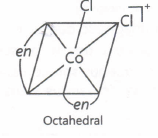
(il) Diamminechloridonitrito-N-platinum (II)
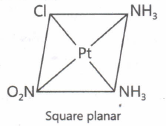
9.
The comp41ex [Cr(NH3)6 ]3+ is formed by d2sp3 hybridization therefore, it has octahedral geometry. Since it has three unpaired electrons, therefore, it is paramagnetic in nature.
[Cr(NH3)6]3+
Cr = 24 = 4s13d5
Cr3+ = 3d3
(ii) The IUPAC name of ionization isomer of is triamminechloridenickel (II) nitrate.
10.
(i) Tetraamminedichloridochrornium (III)chloride.
(ii) Optical isomerism,
(iii) In [NiCl4]2- ; cl- act as weak ligand therefore does not cause forced pairing, thus electrons will remain unpaired hence paramagnetic.
In [NiCO4]; CO act as strong ligand therefore causes forced pairing, thus electrons will become paired hence diamagnetic.
11.
i) [Pt(NH3)2CINO2]: Diamrninechloridonitrito-Nplatinum (II); pt2 = 5d8
x x : Electron pair from the NH3, Cl- and NO2 ,
Structure: Square planar;
Magnetic behaviour: Diamagnetic.
(ii) [Co (NH3)4CI2] CI : Tetraamminedichloro-cobalt (III) chloride; C03+ = 3d6
Structure : Octahedral;
Magnetic behaviour: Diamagnetic
(iii) Ni(CO)4 : Tetra carbonyl nickel (0); Ni = 3d84s2
x x : Electron pair from Ligand CO
Structure: Tetrahedral;
Magnetic behaviour: Diamagnetic.
12.
(i) In [Cr(NH3)6]3+
Cr(24): [Ar]4s13d5
Cr3+: [Ar]4s03d3
(ii)
s.png)
[CN- being strong field ligand, paired up the d-electrons of the metal].
s.png)
Shape Octahedral
Magnetic property Diamagnetic.
13.
(i)The chemical formula of the compound is shown. Its name is cis-diammine dichlorido platinum (II).
(ii) It behaves as an anti cancer agent by taking part in the chelate formation or chelation.
(iii) In the trans isomer the similar groups are on opposite sides and chelate formation does not take place.
(iv) Cis-platin saves many valueable lives by forming co-ordinate complex. So it is life saving.
14.
(i) \([CoF_6]^{3-}\)
\( [Co(H_2O)_6]^{2+}\)
\([Co(CN)_6]^{3-}\)
(ii) \([FeF_6]^{3-}\)
\(\ [Fe(H_2O)_6]^{2+}\)
\([Fe(CN)_6]^{4-}\)
It is diamagnetic due to the absence of unpaired electrons.
15.
There are coordinate bonds in the following complexes.
(a) [Fe(CN)6]4-
Fe(26) has electronic configuration [Ar] 4s23d6.
Fe2+ has electronic configuration 4s03d6
CN- ion causes pairing of electrons because it is a strong field ligand.
It has octahedral shape and is diamagnetic in nature due to the absence of unpaired electrons.
(b) [FeF6]3-
F- is weak field ligand, does not cause pairing of electrons.
(c) [Co(C2O4)3]3-
(d) [CoF6]3-
F- is weak field ligand, cannot cause pairing of electrons.
16.
(a)
\([Co(NH_3)_5(NO_2)]^{2+}\)
17.
(b)
\({ Cu }^{ 2+ }+4{ CN }^{ - }\rightleftharpoons \left[ Cu\left( CN \right) _{ 4 } \right] ^{ 2- },\quad log\quad K=27.3\)
18.
(c)
1, 2, 3 and 4
19.
(a)
[CoF6]3-
20.
(d)
linkage isomerism, ionization isomerism and geometrical isomerism
21.
(d)
1, 2
22.
(b)
Ferocyanide
23.
(c)
3,6
24.
(d)
4
25.
()
coordination number

12th Standard CBSE Syllabus & Materials
12th Standard CBSE
CBSE 12th Computer Science Python Revision Tour I - New Previous year Question Papers Study Material - QB365 Set A
NEW12th Standard CBSE
CBSE 12th Business Studies Planning Important Questions And Answers Study Material - QB365 Set A
NEW12th Standard CBSE
CBSE 12th Business Studies Business Environment Important Questions And Answers Study Material - QB365 Set A
NEW12th Standard CBSE
CBSE 12th Business Studies Principles of Management Important Questions And Answers Study Material - QB365 Set A



CBSE 12th Standard CBSE Subjects
CBSE Standards










