
 100% FREE ACCESS
12th Standard CBSE Syllabus & Materials
12th Standard CBSE
CBSE 12th Economics Government Budget and the Economy Previous year Question Papers Study Material - QB365 Set A
NEW12th Standard CBSE
CBSE 12th Computer Science Interface Python with MySQL - New Previous year Question Papers Study Material - QB365 Set A
NEW12th Standard CBSE
CBSE 12th Computer Science Database Concept - New Previous year Question Papers Study Material - QB365 Set A
NEW12th Standard CBSE
CBSE 12th Computer Science Data Communication - New Previous year Question Papers Study Material - QB365 Set A
NEW12th Standard CBSE
CBSE 12th Computer Science Data Structures - New Previous year Question Papers Study Material - QB365 Set A
NEW12th Standard CBSE
CBSE 12th Computer Science Functions - New Previous year Question Papers Study Material - QB365 Set A

Published on: 05/03/2019
Current Electricity Important Model Question Paper
Download CBSE Class 12th Standard CBSE Physics question papers, sample papers, important questions, and previous year solved papers in PDF format. Get free study materials, NCERT solutions, and exam preparation resources for Class 12th Standard CBSE Physics
Questions + Answers key
Take MCQ Physics Test
1.
In the figure, a long uniform potentiometer wire AB is having a constant potential gradient along its length. The null points for the two primary cells of emf E1 and E2 connected in the manner shown are obtained at a distance of 120 cm and 300 cm from the end A. Find
(i) E1/E2 and
(ii) position of null point for the cell E1 How is the sensitivity of a potentiometer increased?
.jpg)
2.
The sequence of coloured bands in two carbon resistors R1 and R2 is
(i) brown, green, blue and
(ii) orange, black, green.
Find the ratio of their resistances.
3.
Water boils in an electric kettle in 15 minutes after switching on. If the length of the heating wire is decreased to 2/3 of its initial value, then in how much time the same amount of water will boil with the same supply voltage.
4.
What is the colour of the third band of a coded resistor of resistance \(0.34 \ \Omega\)?
5.
A uniform copper wire of length 1 m and cross-sectional area 5 x 10⁻⁷ m2 carries a current of 1 A. Assuming that there are 8 x 1028 free electrons per m3 in copper, how long will an electron take to drift from one end of the wire to the other. Charge on an electron = 1.6 x 10⁻¹⁹ C.
6.
A letter 'A' consists of a uniform wire of resistance 1 ohm per cm. The sides of the letter are each 20 cm long and the cross piece in the middle is 10 cm long while the apex angle is \(60°\). Find the resistance of the letter between the two ends of the legs.
7.
The relaxation time \(\tau \) is nearly independent of applied E field whereas it changes significantly with temperature T. First fact is responsible for Ohm's law whereas the second fact lends to variation of \(\rho \) with temperature. Elaborate why?
8.
The number density of free electrons in a copper conductor estimated is \(8.5\times { 10 }^{ 28 }{ m }^{ -3 }\). How long does an electron take in drifting from one end of a wire 3.0m long to its other end? The area of cross-section of the wire is \(2.0\times { 10 }^{ -6 }{ m }^{ 2 }\) and it is carrying a current of 3.0 A.
9.
Two cells of e.m.f E1 and E2 (E1>E2) are connected as shown below.
When a potentiometer is connected between A and B the balancing length of the potentiometer is 300cm. On connecting the same potentiometer between A and C, the balancing length is 100cm. Calculate the ratio of E1 and E2.

10.
The e.m.f of a cell measured using a potentiometer is found to be 1.5V. An accurate voltmeter connected across the terminals of the cells reads 1.4V. Explain the discrepancy and calculate the ratio of the resistance of the cell.
11.
(i) State the principle of working of a potentiometer.
(ii) In the following potentiometer circuit AB is a uniform wire of length 1 m and resistance 10 \(\Omega \) .Calculate the potential gradient along the wire and balance length AO (= l).
12.
Father and a son returned home completely drenched due to heavy rain. Father advised his son not to touch any electrical units with wet hands for he may get a shock. In spite of this, on immediately entering the house, the son switches on the light (supply voltage is 220 V) and gets a severe shock. He was fortunate not to get electrocuted. Father, who is a Biologist, told that when the skin is dry, resistance of a human body is 105Ω and when the skin is wet the body resistance is 1500Ω.
(a) What is the lesson learnt by you?
(b) Calculate the current that flows through
(i) a wet body and
(ii) a dry body, and
(iii) dry skin or wet skin.
(c) When will we have serious consequences and why?
13.
(i) Calculate the value of R in the balance condition of the Wheatstone bridge, if the carbon resistor connected across the arm CD has the colour sequence red, red and orange as shown in the figure.
(ii) Use Kirchhoff's rules to obtain the balance condition in a Wheatstone bridge.
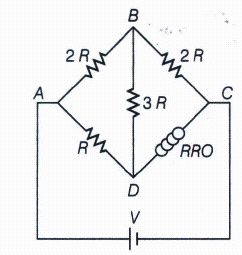
(ii) If now the resistance of the arms BC and CD are interchanged, to obtain the balance condition another carbon resistor is connected in place of R. What would now be sequence of colour bands of the carbon resistor? What is the current through the circuit?
14.
That night Vaikunth was preparing for his physics exam. Suddenly, the light in his room went off and he could not continue his studies. His cousin brother Vasu who had come to visit him was quick to react. Vasu using the torch (an android application) installed in his mobile phone found that the fuse had blown out. He checked the wiring and located a short circuit. He checked the wiring and located a short circuit. He rectified it and put a fuse wire. The light came to life again. Vaikunth had a sign of releif and continued his studies.
Read the above passage and answer the following question.
(i) What are the values projected by Vaikunth and Vasu?
(ii) Why did Vasu have to check the wiring?
(iii) What is an electric fuse? What characteristics you would prefer for a fuse wire?
15.
A wire of resistance \(5.0 \ \Omega\) is used to wind a coil of radius 5 cm. The wire has a diameter 2.0 mm and the specific resistance of its material is 2.0 x 10⁻⁷ \(\Omega m\). Find the number of turns in the coil.
16.
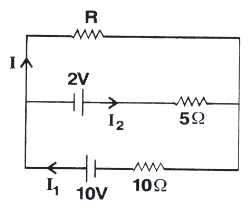
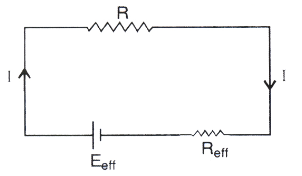
Two cells of voltages 10V and 2V and internal resistances \(10\Omega\ and\ 5\Omega \) respectively are connected in parallel with the positive end of 10V battery connected to negative pole of 2V battery. Find the effective voltage and effective resistance of the combination.
17.
You are given two sets of potentiometer circuit to measure the emf \({ E }_{ 1 }\) of a cell
Set A: consists of a potentiometer wire of a material of resistivity \({ \rho }_{ 1 }\) area of cross section \({ A }_{ 1 }\) and length l.
Set B : consists of a potentiometer of two composite wires of equal lengths \({ l }_{ 2 }\) each, of resistivity \({ \rho }_{ 1 }\), \({ \rho }_{ 2 }\) and area of cross-section \({ A }_{ 1 },{ A }_{ 2 }\) respectively.
(i) Find the relation between resistivity of the two wires with respect to their area of cross section, if the current flowing in the two sets is same.
(ii) Compare the balancing length obtained in the two sets.
.jpg)
18.
Why is potentiometer preferred over a voltmeter for determining the emf of a cell?
19.
Use Kirchhoff's rules to obtain the balance conditions in a Wheatstone bridge.
20.
Plot a graph showing the variation of resistivity of a conductor with temperature.
21.
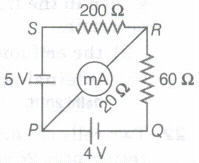
The network PQRS, shown in the circuit diagram, has the batteries of 4 V and 5 V and negligible internal resistance. A milliammeter of 20 Ω resistance is connected between P and R. Calculate the reading in the Millimetre.
22.
Two heating elements of resistance R1 and R2 when operated at a constant supply of voltage, V, consume powers P1 and P2 respectively. Deduce the expressions for the power of their combination when they are, in turn, connected in
(i) series and
(ii) parallel across the same voltage supply.
23.
In the given circuit, assuming point A to be at zero potential, use Kirchhoff,s rules to determine the potential at point B.

24.
I-V graph for a metallic wire at two different temperature T1 and T2 is as shown in the figure below.
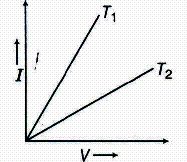
Which of the two temperatures is lower and why?
25.
In an electric kettle, water boils in 10 minutes after the kettle is switched on. With the same supply voltage if the water is to be boiled in 8 minutes, should the length of the heating elements be increased or decreased? Explain.
26.
What is the unit of potential gradient? If the potential gradient along the potentiometer wire be decreased, will the zero-deflection position be obtained at longer length or shorter length?
27.
What should be the properties of the material for the selection of potentiometer wire?
28.
Two students A and B were asked to pick a resistor of \(15 \ k\Omega\) from a collection of carbon resistors. A picked a resistor with bands of colours: brown, green, orange while B choose a resistor with bands black, green, red. Who picked the correct resistor? Explain.
29.
Write the mathematical relation between mobility and drift velocity between mobility and drift velocity of charge carriers in a conductor. Name the mobile charge carriers responsible for conduction of electric current in (a) an electrolyte (b) an ionised gas.
30.
A parallel combination of two cells of EMFs \(\epsilon_1\) and \(\epsilon_2\), and internal resistances r 1 and r2 is used to supply current to a load of resistance R. Write the expression for the current through the load in terms of \(\epsilon_1\), \(\epsilon_2\), r1 and r2.
31.
What is the internal resistance of a cell due to?
32.
Define the term mobility of charge carriers in a conductor. Write its SI unit.
33.
The connecting wires are of copper. Why?
34.
Two different wires X and Y of the same diameter but different materials are joined in series across a battery. If the number density of electrons in X is twice that in Y, find the ratio of drift velocity of electrons in the two wires.
35.
If the temperature of a good conductor increases, how does the relaxing time of electrons in the conductor change?
1.
(i) E1 + E2 = 300k
k is potential gradient in volt/cm
E1 - E2 = 120k
⇒ \(\frac { { E }_{ 1 } }{ { E }_{ 2 } } =7/3\)
(ii) E1 + E2 = 300k
∴ E1 + 3/7 = 300k
E1 = 210k
Therefore, balancing length for cell is E1 = 210 cm (Award this mark even if the student writes E1 = 240k)
(Award full marks for any other correct method)
(iii) By decreasing potential gradient.
[Or through increasing length, reducing potential drop across wire, increasing resistance put in series with the main cell etc.]
2.
According to the colour codes, resistances of two wires are as given below:
(i) Code of brown = 1, Code of green = 5
Code of blue = 6, R1 = \(15\times 10^{ 6 }\Omega \pm 20%\)%
(ii) Code of orange = 3, Code of black = 0
Code of green = 5, R2 = \(30\times 10^{ 5 }\Omega \pm 20%\)%
\(\therefore Ratio \ of \ resistance,\frac { { R }_{ 1 } }{ { R }_{ 2 } } =\frac { 15\times { 10 }^{ 6 } }{ 30\times { 10 }^{ 5 } } =\ 5\)
\(\frac { { R }_{ 1 } }{ { R }_{ 2 } } =5\)
3.
H = \(\frac{V^2t_1}{R_1}=\frac{V^2t_2}{R_2}\)
or \(\frac{R_1}{R_2}=\frac{t_1}{t_2}\) .......(i)
But \(R \propto l\),
so \(\frac{R_1}{R_2}=\frac{l_1}{l_2}\) ...........(ii)
Now, l2 = (2/3)l1
From (i) and (ii);
\(\frac{l_1}{l_2}=\frac{t_1}{t_2}\)
or \(\frac{3}{2}=\frac{15}{t_2}\)
or t2 = 10 minutes
4.
Resistance of resistor = \(0.34 \ \Omega\) = 34 x 10-2 \(\Omega\)
The colour of the third band of a coded resistor is due to multiplier 10-2 which is for silver.
5.
t = \(\frac{l}{v_d}=\frac{l}{I/n Ae}=\frac{lnAe}{I}\)
= \(\frac{1 \times (8 \times 10^{28})\times(5\times10^{-7})\times(1.6\times10^{-19})}{1}\)
= 6.4 x 10³ s
6.
The arrangement of resistance is shown in fig and its equivalent circuit. Since the wire has a resistance 1 ohm per cm, the resistance of the cross-piece DE is 10 ohm. Since apex angle is \(60°\) and the cross-piece must also be the mid-points of the legs AB and AC so ADE becomes an equilateral triangle.
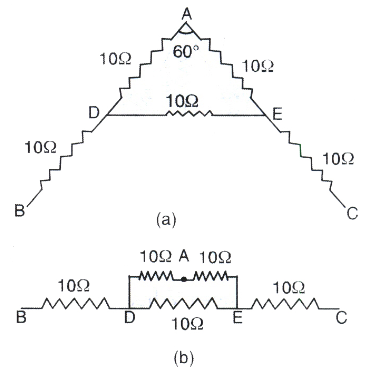
As is clear from fig DA and AE are in series and, therefore resistance of the combination of DA and AE = 10 + 10 = 20 ohm. This resistance of 20 ohm is in parallel to DE.
The effective resistance r of the portion DAED is given by
\(\frac { 1 }{ r } =\frac { 1 }{ 10 } +\frac { 1 }{ 20 } \)
\( =\frac { 2+1 }{ 20 } =\frac { 3 }{ 20 }\)
\(r=20/3 \ ohm\)
Now BD and EC are in series with the resistance of portion DAED
Resistance between B and C
\(=10+\frac { 20 }{ 3 } +10=26.67 \ ohm\)
7.
Relaxation time is inversely proportional to the velocities of electrons and ions. The applied electric field produces the insignificant change in velocities of electrons of the order of 1 mm/s, whereas the change in temperature T affects velocities at the order of 102 m/s
This decreases the relaxation time cinsiderably in metals and consequently resistivity of metal or conductor increases as, \(\rho=\frac{1}{\sigma}=\frac{m}{n e^2 \tau}\)
8.
Number density of free electrons in a copper conductor, n = 8.5 x 1028 m-3 Length of the copper wire, l = 3.0 m
Area of cross-section of the wire, A = 2.0 x 10⁻⁶ m2
Current carried by the wire, I = 3.0 A, which is given by the relation,
I = nAeVd
Where,
e = Electric charge = 1.6 x 10⁻¹⁹ C
Vd = Drift velocity = \(\frac{\text { Length of the wire (l) }}{\text { Time taken to cover l(t) }}\)
\(I=n A e \frac{l}{t}\)
\(t=n A e \frac{l}{I}\)
\(=\frac{3 \times 8.5 \times 10^{28} \times 2 \times 10^{-6} \times 1.6 \times 10^{-19}}{3.0}\)
\(=2.7 \times 10^{4} s\)
Therefore, the time taken by an electron to drift from one end of the wire to the other is 2.7 x 10⁴ s.
9.
When a potentiometer is connected between A and B,
\(E_{1}=k \times 300\) ...(i)
where k is potential gradient.
When the potentiometer is connected between A and C,
\(E_{1}-E_{2}=k \times 100 \ \left(\because E_{1}>E_{2}\right)\) ...(ii)
Dividing equations (i) and (ii), we get
\(\frac{E_{1}}{E_{1}-E_{2}}=\frac{300}{100} \Rightarrow \frac{E_{1}}{E_{2}}=\frac{3}{2}\)
10.
The discrepancy is due to (i) non-idealness of voltmeter, and (ii) an internal resistance of cell.
Now, \(\frac{V}{E}=\frac{1.4}{1.5} \Rightarrow \frac{I R}{I(R+r)}=\frac{1.4}{1.5}\)
\(\Rightarrow \ 1+\frac{r}{R}=\frac{15}{14} \Rightarrow \frac{r}{R}=\frac{1}{14} \Rightarrow \frac{R}{r}=14\)
Here, R is the resistance of the voltmeter and r is the internal resistance of the cell.
11.
(i) When constant current flows through a conductor of uniform area of cross-section ,the potential difference, across a length l of the wire, is directly proportional to that length of the wire.[\(V\propto l\)] (provided current and area are constant]
(ii) Current flowing in the potentiometer wire
\(i=\frac { E }{ { R }_{ total } } =\frac { 2.0 }{ 15+10 } =\frac { 2 }{ 25 } A\)
∴Potential difference across the two ends of the wire
\({ V }_{ AB }=\frac { 2 }{ 25 } \times 10V=\frac { 20 }{ 25 } =0.8volt\)
Hence potential gradient K = \(\frac { { V }_{ AB } }{ { l }_{ AB } } =\frac { 0.8 }{ 1.0 } =0.8\frac { V }{ m } \)
Current flowing in the circuit containing experimental cell, = \(\frac { 1.5 }{ 1.2+0.3 } =1A\)
Hence, potential difference across length AO of the wire \(=0.3\times 1V=0.3V\)
\(\Rightarrow \) \(0.3=K\times { l }_{ AO }\)
\(=0.8\times { l }_{ AO }\)
\(\Rightarrow \)\({ l }_{ AO }=\frac { 0.3 }{ 0.8 } m=0.375m\)
\(=\) 37.5cm
12.
(a) To obey elders.
(b) Using, I = V/R
(i) 147mA;
(ii) 2.2mA
(iii) Wet skin with 147mA,
(c) When the current flows, the result is fatal
13.
(i) Lat carbon resistor S is given to the bridge. Then,
\(\frac { 2R }{ R } =\frac { 2R }{ S } \Rightarrow \frac { R }{ S } =1\)
R = S = 22 x 103 \(\Omega =22k\Omega \)
(ii) After interchanging the resistance, the balanced bridge would be
\(\frac { 2R }{ X } =\frac { 22\times { 10 }^{ 3 } }{ 2\times 22\times { 10 }^{ 3 } } =\frac { 1 }{ 2 }\)
X = 4R = 4 x 22 x 103
= 88 x 103 \(\Omega \)
The colour sequence of X is grey, grey and orange. Thus, equivalent resistance of Wheatstone bridge,
\(\frac { 1 }{ { R }_{ eq } } =\frac { 1 }{ 3R } +\frac { 1 }{ 6R } =\frac { 3 }{ 6R } \)
\( { R }_{ eq }=2R\)
\(\therefore \ Current \ through \ the \ circuit,I=\frac { 1 }{ 3 } \times \frac { V }{ 2R } =\frac { V }{ 6R } A\)
14.
(i) Acknowledging the help from others with gratitude. Awareness of the technology, helping tendency, practical knowledge of the subject.
(ii) Vasu checked the wiring because he has practical knowledge and he can rectify the problem.
(iii) An electric fuse is a wire used as a safety device, which melts when current exceeds the limit. Fuse wire has low melting point, high resistivity
15.
Here,
R = \(5.0 \ \Omega\);
r1 = 5 x 10⁻² m;
D = 2.0 x 10⁻³ m;
\(\rho= 2.0 \times 10^{-7} \ \Omega m\).
R = \(\frac{\rho l}{\pi D^2/4}\)
or l = \(\frac{R \pi D^2}{4 \rho}\)
Let n be the number of turns in the coil. Then total length of the wire used, l = \(2 \pi r_1 n\)
or n = \(\frac{l}{2 \pi r_1}=\frac{R \pi D^2}{4 \rho \times 2 \pi r_1}=\frac{RD^2}{8 \rho r_1}\)
= \(\frac{5.0 \times (2.0 \times 10^{-3})^2}{8 \times (2.0 \times 10^{-7})\times (5 \times 10^{-2})^2}\)
= 250
16.
From Kirchhoff's junction rule, we have
\( { I }_{ 1 }={ I }+{ I }_{ 2 }\) ...........(i)
Applying Kirchhoff's loop rule to outer loop containing 10V cell, we get
\(10=IR+{ 10I }_{ 1 }\) ............(ii)
Applying Kirchhoff's loop rule to outer loop containing 2V cell, we get
\(2={ 5I }_{ 2 }-RI\)
\(2=5\left( { I }_{ 1 }-I \right) -RI\)
\(4={ 10I }_{ 1 }-10I-2RI\)
Subtracting eq (ii) from eq (i), we get
\(6=3RI+10I\)
\(2=I\left( R+\frac { 10 }{ 3 } \right) \)
From Ohm's law, we have
\(V=I\left( R+{ R }_{ off } \right) \)
Comparing eq (iii) and (iv), we get
\({ R }_{ ef }=\frac { 10 }{ 3 } \Omega \)
If \({ E }_{ eff }\) and \({ R }_{ eff }\) are the effective voltage and effective internal resistance of the combination, then the equivalent circuit is shown.
17.
\(I=\frac { \varepsilon }{ R+\frac { { \rho }_{ 1 }l }{ { A }_{ 1 } } } \)for set A
\(I=\frac { \varepsilon }{ R+\frac { { \rho }_{ 1 }l }{ 2{ A }_{ 1 } } +\frac { { \rho }_{ 2 }l }{ { 2A }_{ 2 } } } \)for set B
Equating the above two expressions and simplifying
\(\frac { { \rho }_{ 1 } }{ A_{ 1 } } =\frac { { \rho }_{ 2 } }{ { A }_{ 2 } } \)
(ii) Potential gradient of the potentiometer wire for Set A K = \(I\frac { { \rho }_{ 1 } }{ A_{ 1 } } \)
Potential drop across the potentiometer wire in Set B
\(V=I\left( \frac { { \rho }_{ 1 } }{ 2A_{ 1 } } +\frac { { \rho }_{ 2 }l }{ 2{ A }_{ 2 } } \right) \)
\(V=\frac { I }{ 2 } \left( \frac { { \rho }_{ 1 } }{ 2A_{ 1 } } +\frac { { \rho }_{ 2 } }{ { A }_{ 2 } } \right) l\)
\(K'=\frac { I }{ 2 } \left( \frac { { \rho }_{ 1 } }{ A_{ 1 } } +\frac { { \rho }_{ 2 } }{ { A }_{ 2 } } \right) \),using the condition obtained in part (i)
\(K'=I\frac { { \rho }_{ 1 } }{ { A }_{ 1 } } \),which is equal to K.Therefore, balancing length obtained in the two sets is same.
18.
Potentiometer does not draw any (net) current front-the cell. Voltmeter draws some current from cell, when connected across at, hence measures terminal voltage.
19.
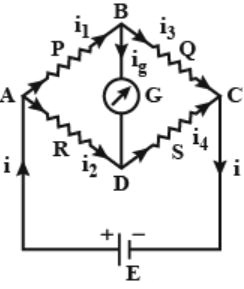
We apply Kirchoff's current law in the shown circuit.
At junction B,
i1=ig+i3
At junction D,
i2+ig=i4
If current through the galvanometer is zero,
ig = 0
thus i1 = i3
and i2 = i4
Applying Kirchoff's voltage law for loop ABDA,
i1P + igG = i2R
Applying Kirchoff's voltage law for loop BCDB,
i3Q + i4S + igG
When ig = 0,
i1P = i2R
and i3Q = i4S
But i1 = i3 and i2 = i4,
Therefore \(\frac{P}{Q}=\frac{R}{S}\)
20.
The resistivity of a metallic conductor is given by
ρ = ρ0[1 + ∝(T-T0)]
Where, ρ0 = Resistivity at reference temperature
T0 = Reference temperature
∝ = Coefficient of resistivity
From the above relation, we can say that the graph between resistivity of a conductor with temperature is straight line. But, at temperatures much lower than 273 K ( i.e. 0°C), the graph deviates considerably from a straight line as shown in the figure.

21.
Let us redraw circuit as shown.
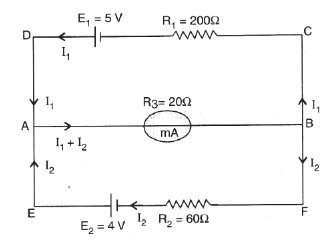
Using Kirchoff's voltage law in closed loop DABCD
\(\left( { I }_{ 1 }+{ I }_{ 2 } \right) { R }_{ 3 }+{ I }_{ 1 }{ R }_{ 1 }-{ E }_{ 1 }=0\) ..........(1)
In a closed loop ABFEA
\(\left( { I }_{ 1 }+{ I }_{ 2 } \right) { R }_{ 3 }+{ I }_{ 2 }{ R }_{ 2 }-{ E }_{ 2 }=0\) .........(2)
Multiplying (1) by (R2 + R3) and (2) by R3 and subtracting, we get
\({ I }_{ 1 }=\frac { { E }_{ 1 }{ R }_{ 2 }+{ E }_{ 1 }{ R }_{ 1 }-{ E }_{ 2 }{ R }_{ 3 } }{ { R }_{ 1 }{ R }_{ 2 }+{ R }_{ 2 }{ R }_{ 3 }+{ R }_{ 1 }{ R }_{ 3 } } \)
\(=\frac { 5\times 60+5\times 20-4\times 20 }{ 200\times 60+60\times 20+200\times 20 } \)
\(=\frac { 300+100-80 }{ 12000+1200+4000 } \)
\(=\frac { 320 }{ 17200 } A\)
Similarly,I2 =\(\frac { { E }_{ 2 }{ R }_{ 1 }+{ E }_{ 2 }{ R }_{ 3 }-{ E }_{ 1 }{ R }_{ 3 } }{ { R }_{ 1 }{ R }_{ 2 }+{ R }_{ 2 }{ R }_{ 3 }+{ R }_{ 1 }{ R }_{ 3 } } \)
= \(\frac { 4\times 200\times 4\times 20-5\times 20 }{ 200\times 60+60\times 20+200\times 20 } \)
= \(\frac { 800+80-100 }{ 17200 } =\frac { 780 }{ 17200 } A\)
\(\therefore\) Total current in mA
= \({ I }_{ 1 }+{ I }_{ 2 }\)
= \(\frac { 320 }{ 17200 } +\frac { 780 }{ 17200 } =\frac { 1100 }{ 17200 } \)
= \(\frac { 11 }{ 172 } A=0.06395A\)
= 63.95mA
= 64 mA (approx)
22.
\(P_1=\frac{V^2}{R^1}\)
\(R_2=\frac{V^2}{R_2}\)
In series
\(P=\frac{V^2}{R_1+R_2}\)
23.
By Kirchhoff's first law at D,
\({ I }_{ DC }=1A\) \([\because { I }_{ Dc }+1=2]\)
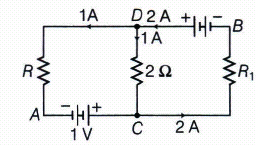
Along ACDBA,
\({ V }_{ A }+1+1\times 2-2={ V }_{ B }\) (VA = 0)
But, \({ V }_{ B }=1+2-2=1V\)
\({ V }_{ B }=1V\)
24.
Since, slope of 1 > slope of 2
\(\therefore\) R1 < R2
Also, we know that resistance is directly proportional to the temperature.
Therefore, T2 > T1.
25.
For a given supply voltage, heat produced in time t is
\(H =\frac{V^2}{R}t=\frac{V^2}{\rho l/A}=\frac{V^2At}{\rho l} \ \ i.e., \ \ H \propto \frac{t}{l}\)
\(\therefore \frac{H_1}{H_2}=\frac{t_1}{t_2}\times\frac{l_2}{l_1}\)
As H1 = H2,
so \(1 = \frac{t_1}{t_2}\times\frac{l_2}{l_1}\)
or \(\frac{l_2}{l_1}=\frac{t_2}{t_1}=\frac{8}{10}<1\)
or l2 < l1
It means the length of the heating wire should be decreased.
26.
Unit of potential gradient is V cm-1 or V m -1. Since fall of potential, V = K l where K is the potential gradient, therefore, for the given value of V, if K is decreased, l will increase.
27.
The material must have high resistivity and low temperature coefficient of resistance.
28.
For student A, the numbers attached to brown, green and orange are 1, 5 and 3. So the value of resistor is RA = 15 x 103 \(\Omega\) =\(15 \ k \Omega\).
For student B, the numbers attached to black, green and red are 0, 5 and 2 respectively. So the value of resistor is, RB = 05 x 102 \(\Omega\) =\(500 \ k \Omega\).
Thus, student A picked up the correct resistor of \(15 \ k \Omega\).
29.
Mobility, \(\mu = \frac{drift \ \ velocity}{electric \ \ field}=\frac{v_d}{E}\)
(a) The charge carriers in an electrolyte are positive and negative ions.
(b) The charge carriers in an ionised gas are electrons and positively charged ions.
30.
Equivalent resistance of two cells in parallel
\(r_{e q}=\frac{r_1 r_2}{r_1+r_2}\)
Equivalent emf of two cells in parallel
\(r_{e q}=\frac{\epsilon_1 r_2+\epsilon_2 r_1}{r_1+r_2}\)
Current in circuit,
\(I=\frac{\epsilon_{e q}}{R+r_{e q}}=\frac{\frac{\epsilon_1 r_2+\epsilon_2 r_1}{r_1+r_2}}{R+\frac{r_1 r_2}{\left(r_1+r_2\right)}}=\frac{\epsilon_1 r_2+\epsilon_2 r_1}{R\left(r_1+r_2\right)+r_1 r_2}\)
31.
The internal resistance of a cell depends upon:
(i) Nature, concentration and temperature of electrolyte,
(ii) the nature of electrodes,
(iii) the distance between the electrodes and
(iv) area of the electrodes immersed in the electrolyte.
32.
Mobility of charge carriers inside conductor is defined as the magnitude of drift velocity of charge per unit electric field applied.
SI unit of mobility is m2s-1V-1 or ms-1N-1C.
33.
The electrical conductivity of copper is next only to silver which is costly. Therefore, it conducts the current without offering much resistance. The copper being diamagnetic material does not get magnetised due to the current through it and hence does not disturb the current in the circuit.
34.
Drift velocity,
Since the wires are connected in series, current I through both is same. Therefore,
35.
With the increase in temperature, the free electrons collide more frequently with the ions/atoms of conductor, resulting decrease in relaxation time.

12th Standard CBSE Syllabus & Materials
12th Standard CBSE
CBSE 12th Computer Science Python Revision Tour I - New Previous year Question Papers Study Material - QB365 Set A
NEW12th Standard CBSE
CBSE 12th Business Studies Planning Important Questions And Answers Study Material - QB365 Set A
NEW12th Standard CBSE
CBSE 12th Business Studies Business Environment Important Questions And Answers Study Material - QB365 Set A
NEW12th Standard CBSE
CBSE 12th Business Studies Principles of Management Important Questions And Answers Study Material - QB365 Set A



CBSE 12th Standard CBSE Subjects
CBSE Standards










