
 100% FREE ACCESS
12th Standard CBSE Syllabus & Materials
12th Standard CBSE
CBSE 12th Economics Government Budget and the Economy Previous year Question Papers Study Material - QB365 Set A
NEW12th Standard CBSE
CBSE 12th Computer Science Interface Python with MySQL - New Previous year Question Papers Study Material - QB365 Set A
NEW12th Standard CBSE
CBSE 12th Computer Science Database Concept - New Previous year Question Papers Study Material - QB365 Set A
NEW12th Standard CBSE
CBSE 12th Computer Science Data Communication - New Previous year Question Papers Study Material - QB365 Set A
NEW12th Standard CBSE
CBSE 12th Computer Science Data Structures - New Previous year Question Papers Study Material - QB365 Set A
NEW12th Standard CBSE
CBSE 12th Computer Science Functions - New Previous year Question Papers Study Material - QB365 Set A

Published on: 27/07/2018
Based on the chapter Current Electricity, some of the important questions are prepared in this question paper. It covers one mark, two, three and five marks questions from the book back and PTA question.
Teachers can prepared question paper with answer key within five minutes. Please Click Here for subscribe.
Download CBSE Class 12th Standard CBSE Physics question papers, sample papers, important questions, and previous year solved papers in PDF format. Get free study materials, NCERT solutions, and exam preparation resources for Class 12th Standard CBSE Physics
Questions + Answers key
Take MCQ Physics Test
1.
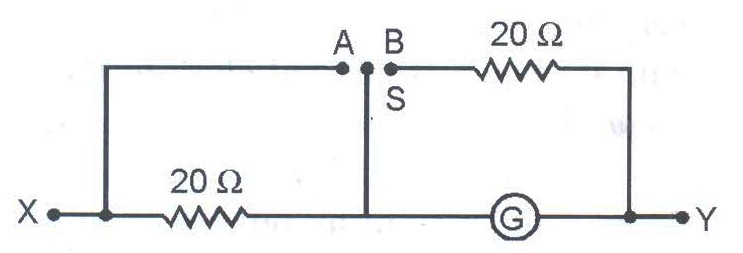
The galvanometer in the circuit shown here has a resistance of 20\(\Omega\)The terminals X and Y are connected to a cell of e.m.f. 1.5V and internal resistance 10\(\Omega\) Calculate the current flowing in the galvanometer:
(i) When the switch S is in position.
(ii) When the switch S is in position B.
2.
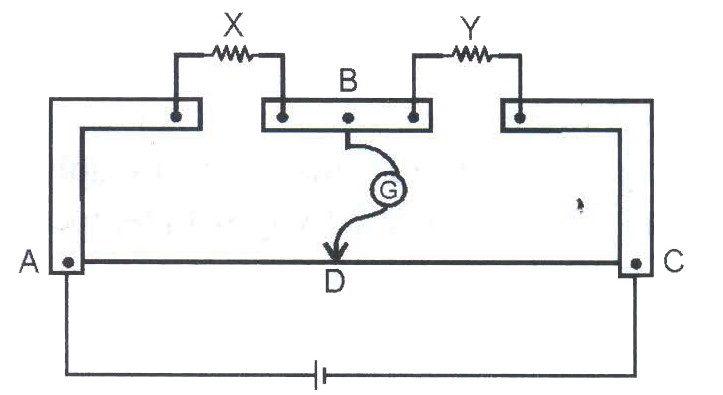
(a)In a meter bridge shown below the balance point is found to be at 39.5 cm from the end A, when the resistor Y is of 12.5\(\Omega\). Determine the resistance of X. Why are the connections between resistors in a wheatstone or meter bridge made of thick copper strips?
(b)Determine the balance point of the bridge above if X and Y are interchanged.
(c)What happens if the galvanometer and cell are interchanged at the balance point of the bridge? Would the galvanometer show any current?
3.
Two conducting wires X and Y of same diameter but different materials are joined in series across a battery. If the number density of electrons in X is twice that in Y, find the ratio of drift velocity of electrons in the two wires.
4.
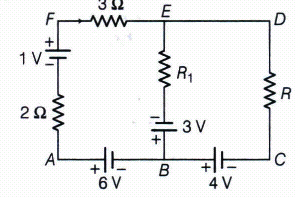
Use Kirchhoff's rules to determine the potential difference between the points A and D. When no current flows in the arm BE of the electric network shown in the figure below.
5.
A 10 V battery of negligible internal resistance is connected across a 200 V battery and a resistance of 38 \(\Omega \) as shown in the figure. Find the value of the current in the circuit.
6.
Graphing showing the variation of current versus voltage for material Gaas is shown in the figure. Identify the region of
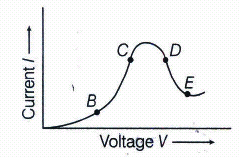
(i) negative resistance.
(ii) where Ohm's law is obeyed.
7.
If the current in the electric bulb changes by 1 %, then by what percentage will the power change?
8.
How many joules of energy is equivalent to 1k Wh?
9.
Write an expression for the heat produced when an electric current is passed through it.
10.
Distinguish between kilowatt and kilowatt hour.
11.
Of which material is a potentiometer wire normally made and why?
12.
Why should the potentiometer wire be of uniform cross-section and composition?
13.
At what position of the jockey on slide wire bridge, the results are most accurate?
14.
What happens to the balance point if the position of the cell and the galvanometer are interchanged in balanced Wheatstone bridge?
15.
State the fundamental concepts on which two Kirchhoff's rules are based.
16.
Define the units of conductance and conductivity. Give their dimensional formulae.
17.
If the resistance of our body is so large (\(\approx 10 \ k\Omega\) ) why does one experience a strong shock when one accidently touches the line wire, say a 240 volt supply?
18.
Of metals and alloys, which has a greater value of temperature coefficient of resistance?
19.
What will be the bands of colours in sequence on carbon resistor, if its resistance is \(0.1 \Omega \pm5\)%
20.
Name three materials whose resistivity decreases with rising in temperature.
21.
What are Non-ohmic devices? Give examples.
22.
The specific resistance of copper, silver and constantan are 1.78 x 10⁻⁶ Ω-cm, 10-6 Ω-cm and 48 x 10-6 Ω-cm, respectively. Which is the best conductor and why?
23.
If the electric current is passed through a nerve, the man is excited, why?
24.
Is electric current a vector or scalar quantity? Explain.
1.
(i) If S is in position A, the resistance 20 Ω short-circuited.
\(\therefore I_{g}=\frac{1.5}{20+10}=0.05 \mathrm{~A}\)
(ii) If S is in position B, circuit will be as shown in the
Now, \(
I=\frac{1.5}{20+10+20 \| 20}
\)
\(I=\frac{1.5}{20+10+10}=\frac{1.5}{40} \mathrm{~A}
\)
∴ Reading of galvanometer \(=\frac{I}{2}=0.01875 \mathrm{~A}\)
2.
(a) X = 8.2\(\Omega\)
(b) 60.5 cm from A
(c) No deflection
3.
\( I=n_e A v_x=n_y e A v_y \\ \Rightarrow \ \frac{v_X}{v_Y}=\frac{n_Y}{n_X}=\frac{n_Y}{2 n_Y}=\frac{1}{2} \)
4.
Applying Kirchhoff's loop rule for loop ABEFA
6 + 3 + R1 \(\times\) 0 - 3I1 + 1 - 2I1 = 0
or 10 - 5I1 = 0
or I1 = 2A
For loop BCDEB,
4 - I1 . R + R1 \(\times\) 0 - 3 = 0
or 1 - 2R = 0
\(\therefore \quad R=\frac{1}{2} \Omega\)
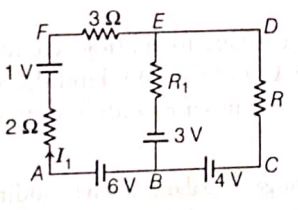
Potential difference between A and D through path
ABCD is 6 + 4 - I1 R = VAD \(\Rightarrow \quad 10-2 \times \frac{1}{2}=V_{A D}\)
\(\therefore\) VAD = 9 V
5.
Since, the positive terminal of the batteries are connected together, so the equivalent emf of the batteries is given by E = 200 - 10 = 190 V
Hence, the current in the circuit is given \(x = {-b \pm \sqrt{b^2-4ac} \over 2a}\)
6.
(i) DE is the region of negative resistance because the slope of curve in this part is negative.
(ii) BC is the region where Ohm's law is obeyed because in this part, the current varies linearly with the voltage.
7.
P = I2R or log P = 2 log I + log R;
Differentiating it, we get
\(\frac{\Delta P}{P}=\frac{2 \Delta I}{I}+0\)
% change in power
\(
=\frac{\Delta P}{P} \times 100=\frac{2 \Delta I}{I} \times 100 \\
=2 \frac{1}{100} \times 100=2 \%
\)
8.
Energy = 1 k Wh = 1000 W x (60 x 60) s
= 3.6 x 10⁶ J
9.
\(\mathrm{H}=\mathrm{VIt}=\mathrm{I}^2 \mathrm{Rt}=\frac{V^2}{R} t\) in energy units (joules).
\(\text { or } \mathrm{H}=\frac{V I t}{J}=\frac{I^2 R t}{J}=\frac{V^2 t}{J R}\) in heat units (cal.)
10.
Kilowatt is the unit of power. 1 kilowatt = 100 watt. Kilowatt hour is the unit of electric energy, where
1 kilowatt hour = 1000 watt x 1 hour
= 1000 watt x 60 x 60 second
= 3.6 x 10⁶ J
11.
Normally, the potentiometer wire is made of an alloy such as nichrome or manganin. Because those alloys have high resistivity and low-temperature coefficient of resistance.
12.
The potentiometer wire should be of uniform cross-section and composition so that there is same resistance per unit length throughout. Only then, potential difference will be proportional to length of the potentiometer wire, which is the requirement for the principle of potentiometer.
13.
The results are most accurate, when balance point is obtained at the mid point of bridge wire. In this case R = S. The end resistances of copper strips produce least effect and the bridge is most sensitive.
14.
There will be no depletion in the galvanometer as the condition of balanced bridge will still hold good.
15.
Kirchhoff's first rule is based on the fact that the charges are not accumulated at a junction, i.e., the law of conservation of charge.
Kirchhoff's second rule supports the law of conservation of energy.
16.
The units of conductance and conductivity are simen (denoted by S) and simen metre -1 (denoted by S m-1) respectively. We know that conductance = 1/resistance.
We know, electrical conductivity, \(\sigma = \frac{1}{\rho}=\frac{l}{RA}\)
If l = 1 m, R = 1 \(\Omega\), A = 1 m2 then \(\sigma\) = 1 S m-1
Thus 1 S m-1 is the electrical conductivity of a conductor of length 1 m, area of cross-section 1 m2 and resistance 1 \(\Omega\) or conductance 1S.
Dimensional formula of conductance,
\(G=\frac{1}{R}=\frac{1}{V}=\frac{[A]}{[ML^2T^{-3}A^{-1}]}=[M^{-1}L^{-2}T^{3}A^2]\)
Dimensional formula of conductivity,
\(\sigma=[M^{-1}L^{-3}T^3A^2]\)
17.
When a person accidently touches the line wire of a 240 V supply, a current I = 240/10000 = 0.024 A = 24 mA, flows through the body of the person. This current interferes with the nerve process related to our heart beating, which is basically electrical in nature, this, in turn, accounts for a strong shock.
18.
The value of temperature coefficient of resistance \((α)\) is more for metals than for alloys. For example, in case of copper, \(α= 4 x 10⁻³ oC-1 \) and for manganin, \(α= 1.5 x 10⁻⁶ oC-1.\)
19.
Resistance = \(0.1Ω±5% = 01×10−1±5%. \)
Thus, the colour of bands in the sequence is black, brown and gold. Tolerance of \(±5%\) is indicated by a gold ring.
20.
Silicon, germanium and carbon.
21.
Non-ohmic devices are those devices which do not obey Ohm's law. Examples are semiconductor diode, liquid electrolyte, etc.
22.
The best conductor is silver because electrical conductivity is inversely proportional to the resistivity and resistivity of silver is least.
23.
The man is excited due to the transfer of electric energy to his body.
24.
Electric current is a scalar quantity because it does not follow the laws of vectors addition, i.e., the angle between the wires carrying the current does not affect the total current in the circuit.

12th Standard CBSE Syllabus & Materials
12th Standard CBSE
CBSE 12th Computer Science Python Revision Tour I - New Previous year Question Papers Study Material - QB365 Set A
NEW12th Standard CBSE
CBSE 12th Business Studies Planning Important Questions And Answers Study Material - QB365 Set A
NEW12th Standard CBSE
CBSE 12th Business Studies Business Environment Important Questions And Answers Study Material - QB365 Set A
NEW12th Standard CBSE
CBSE 12th Business Studies Principles of Management Important Questions And Answers Study Material - QB365 Set A



CBSE 12th Standard CBSE Subjects
CBSE Standards










