
 100% FREE ACCESS
12th Standard CBSE Syllabus & Materials
12th Standard CBSE
CBSE 12th Economics Government Budget and the Economy Previous year Question Papers Study Material - QB365 Set A
NEW12th Standard CBSE
CBSE 12th Computer Science Interface Python with MySQL - New Previous year Question Papers Study Material - QB365 Set A
NEW12th Standard CBSE
CBSE 12th Computer Science Database Concept - New Previous year Question Papers Study Material - QB365 Set A
NEW12th Standard CBSE
CBSE 12th Computer Science Data Communication - New Previous year Question Papers Study Material - QB365 Set A
NEW12th Standard CBSE
CBSE 12th Computer Science Data Structures - New Previous year Question Papers Study Material - QB365 Set A
NEW12th Standard CBSE
CBSE 12th Computer Science Functions - New Previous year Question Papers Study Material - QB365 Set A

Published on: 31/07/2018
In this question paper, some of the important one mark, two and five marks questions from the chapter Dual Nature of Matter and Radiation are covered. The questions are prepared from the book back and previous year questions.
Students, subscribe and get plenty of question paper with answer key. For subscription please click here.
Download CBSE Class 12th Standard CBSE Physics question papers, sample papers, important questions, and previous year solved papers in PDF format. Get free study materials, NCERT solutions, and exam preparation resources for Class 12th Standard CBSE Physics
Questions + Answers key
Take MCQ Physics Test
1.
What is the de Broglie wavelength associated with
(a) an electron moving with a speed of 5.4 x 10⁶m/s
(b)a ball of mass 150g travelling at 30.0m/s?
2.
(i) For what kinetic energy of a neutron will associated de Broglie wavelength be 1.40 x 10⁻¹⁰m?
(ii) Also find the de-Broglie wavelength of a neutron in thermal equilibrium with matter,having an average kinetic energy of (3/2) kT and temperature is 300 K.
3.
Radiation has dual nature,i.e., it possesses the properties of both; wave and particle.This prompted de-Broglie to predict dual nature of moving material particles.Thus waves are associated with moving material particles which are called matter waves. The wavelength of matter wave is given by \(\lambda =\frac { h }{ mv } \), where m is the mass, v is the speed of the particle and h is Plank's constant. Read the above paragraph and answer the following questions;
(i) How was the wave nature of the electron established?
(ii) What are the de-Broglie wavelength associated with a particle (i) at rest (ii) moving with infinite speed?
(iii) What are the basic values displayed with this study?
4.
By how much would the stopping potential for a given photosensitive surface go up if the frequency of the incident radiations were to be increased from \(4\times { 10 }^{ 5 }Hz\) to \(8\times { 10 }^{ 15 }Hz\)? Given, \(h=6.6\times { 10 }^{ -34 }Js,e=1.6\times { 10 }^{ -19 }C \ and \ c=3\times { 10 }^{ 8 }{ ms }^{ -1 }\)
5.
Crystal diffraction experiments can be performed using X-rays, or electrons accelerated through appropriate voltage.Which probe has greater energy? (For quantitative comparison,take the wavelength of the probe equal to 1\(\overset { \circ }{ A } \), which is of the order of inter-atomic spacing in the lattice), (\({ m }_{ e }=9.11\times{ 10 }^{ -31 }kg.)\)
6.
Estimating the following two numbers should be interesting. The first number will tell you why radio engineers do not need to worry much about photons. The second number tells you why our eye can never count photons,even in barely detectable light.
(a) The number of photons emitted per second by an MW transmitter of 10 kW power emitting radio waves of wavelength 500 m.
(b) The number of photons entering the pupil of our eye per second corresponding to the minimum intensity of while light that we humans can perceive (\(\sim \)\({ (10 }^{ -10 }Wm^{ -2 })\). Take the area of the pupil to be white light to be about 0.4 cm2 and the average frequency of white light to be about 6 x 10¹⁴ Hz.
7.
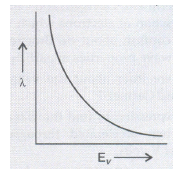
X-rays fall on a photosensitive surface to cause photoelectric emission. Assuming that the work function of the surface can be neglected, find the relation between the de-Broglie wavelength (\(\lambda \)) of the electrons emitted to the energy (Ev) of the incident photons. Draw the nature of the graph for Aas a function of Ev.
8.
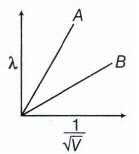
The two lines marked A and B in the given figure. Show a plot of de-Broglie wavelength \(\lambda \) versus \(\frac { 1 }{ \sqrt { V } } \), where V is the accelerating potential for two nuclei \(_{ 1 }^{ 2 }{ H }\) and \(_{ 1 }^{ 3 }{ H }\).
(i) What does the slope of the lines represent?
(ii) Identify, which of the lines corresponded to these nuclei.
9.
An electron and a proton have the same de-Broglie wavelength. Which one these have higher kinetic energy? Which one is moving faster?
10.
Name the device that converts changes in intensity illumination into changes in electric current. Give three applications of this device.
11.
If v is frequency, \(\lambda \) is the wavelength and \(\overline { v } \) is the wave number then the energy of a photon can be represented by
\(hv\)
\(hc\overline { v } \)
\(hc\ \lambda \)
\(hc/\lambda \)
12.
An electron of mass m and a photon have same energy E.The ratio of de-Broglie wavelengths associated with them is(c being velocity of light)
\(\frac { 1 }{ c } { \left( \frac { E }{ 2m } \right) }^{ 1/2 }\)
\({ \left( \frac { E }{ 2m } \right) }^{ 1/2 }\)
\(c{ \left( 2mE \right) }^{ 1/2 }\)
\(\frac { 1 }{ c } { \left( \frac { 2m }{ E } \right) }^{ 1/2 }\)
13.
What is the de-Broglie wavelength of the particle accelerated through a potential difference V? Given, \(h=6.63\times { 10 }^{ -34 }Js\)mass of a nucleon = \(1.66\times { 10 }^{ -27 }kg\)
\(\frac { 12.27 }{ \sqrt { V } } \overset { \circ }{ A } \)
\(\frac { 0.202 }{ \sqrt { V } } \overset { \circ }{ A } \)
\(\frac { 0.101 }{ \sqrt { V } } \overset { \circ }{ A } \)
\(\frac { 0.287 }{ \sqrt { V } } \overset { \circ }{ A } \)
14.
The de-Broglie wavelength of the tennis ball of mass 60g moving with a velocity of 10m/s is approximately: (Plank's constant h = \(h=6.63\times { 10 }^{ -34 }Js\)
\({ 10 }^{ -33 }m\)
\({ 10 }^{ -31 }m\)
\({ 10 }^{ -16 }m\)
\({ 10 }^{ -25 }m\)
15.
An X-ray tube operates at 10KV. The ratio of X-ray wavelength to the de-Broglie wavelength is
10 : 1
1 : 10
1 : 100
100 : 1
16.
What is de-Broglie wavelength associated with electron moving under a potential difference of 104 V.
12.27nm
1 nm
0.01227nm
0.1227nm
17.
Which of the following has minimum stopping potential?
Blue
Yellow
Violet
Red
18.
The momentum of a photon of energy E is...........and of wavelength \(\lambda \)is......
19.
The velocity of photon in different media is.......
20.
Photon is not a ......but it is a........
21.
The minimum frequency required to eject an electron from the surface of a metal is called.............
22.
An increase in the frequency of the incident light...........the velocity with which photoelectron is ejected.
1.
(a) For the electron:
Mass m = 9.11 x 10⁻³¹ kg, speed v = 5.4 x 10⁶ m/s. Then, momentum
p = m v = 9.11 x 10⁻³¹ (kg) x 5.4 x 10⁶ (m/s)
p = 4.92 x 10⁻²⁴ kg m/s
de Broglie wavelength,\(\lambda\) = h/p
\(=\frac{6.63 \times 10^{-34} \mathrm{Js}}{4.92 \times 10^{-24} \mathrm{~kg} \mathrm{~m} / \mathrm{s}}\)
\(\lambda=0.135 \mathrm{nm}\)
(b) For the ball:
Mass m’ = 0.150 kg, speed v’ = 30.0 m/s.
Then momentum p’ = m’ v ’ = 0.150 (kg) x 30.0 (m/s)
p ’= 4.50 kg m/s
de Broglie wavelength \(\lambda\)’ = h/p’.
\(=\frac{6.63 \times 10^{\pm 34} \mathrm{Js}}{4.50 \times \mathrm{kg} \mathrm{m} / \mathrm{s}}\)
\(\lambda^{\prime}=1.47 \times 10^{-34} \mathrm{~m}\)
The de Broglie wavelength of electron is comparable with X-ray wavelengths. However, for the ball it is about 10–19 times the size of the proton, quite beyond experimental measurement.
2.
(i)De Broglie wavelength of the neutron, λ = 1.40 x 10⁻¹⁰ m
Mass of a neutron, mn = 1.66 x 10⁻²⁷ kg
Planck’s constant, h = 6.6 x 10⁻³⁴ Js
Kinetic energy (K) and velocity (v) are related as:
\(K=\frac{1}{2} m_{n} v^{2} \ldots(1)\)
De Broglie wavelength (λ) and velocity (v) are related as:
\(\lambda=\frac{h}{m_{n}} v \ldots(2)\)
Using equation (2) in equation (1), we get:
\(K=\frac{1}{2} \frac{m_{n} h^{2}}{\lambda^{2} m_{n}^{2}}=\frac{h^{2}}{2 \lambda^{2} m_{n}}\)
\(=\frac{\left(6.63 \times 10^{-34}\right)^{2}}{2 \times\left(1.40 \times 10^{-10}\right)^{2} \times 1.66 \times 10^{-27}}=6.75 \times 10^{-21} J\)
Hence, the kinetic energy of the neutron is 6.75 x 10⁻²¹ J or 4.219 x 10⁻²¹ eV.
Hence, the kinetic energy of the neutron is 6.75 x 10⁻²¹ J or 4.219 x 10⁻² eV.
(ii) Temperature of the neutron, T = 300 K
Boltzmann constant, k = 1.38 x 10⁻²³ kg m2 s−2 K−1
Average kinetic energy of the neutron:
\(K \prime=\frac{3}{2} k T\)
\(=\frac{3}{2} \times 1.38 \times 10^{-23} \times 300=6.21 \times 10^{-21} J\)
The relation for the de Broglie wavelength is given as:
\(\lambda \prime=\frac{h}{\sqrt{2 K / m_{n}}}\)
Where
mn = 1.66 x 10⁻²⁷Kg
h = 6.6 x 10⁻³⁴Js
\(K \prime=6.75 \times 10^{-21} J\)
\(\therefore \lambda \prime=\frac{6.63 \times 10^{-34}}{\sqrt{2 \times 6.21 \times 10^{-21} \times 1.66 \times 10^{-27}}}=1.46 \times 10^{-10} \mathrm{~m}=0.146 \mathrm{nm}\)
Therefore, the de Broglie wavelength of the neutron is 0.146 nm.
3.
(i) Davisson and Germer observed diffraction patterns of slow moving electrons. And G.P. Thomson observed a diffraction pattern of fast moving electrons. As diffraction is essentially a wave phenomenon, therefore, it was concluded that wave must be associated with moving electrons.
(ii) (a) At rest, v = 0, \(=\frac { h }{ mv } =\frac { h }{ m\times 0 } =\infty \)
(b) Particle moving with infinite speed, v = \(\infty \)
\(\lambda =\frac { h }{ mv } =\frac { h }{ m\times \infty } \)
(iii) The dual nature of moving material particles reveals in a way the nature of Almighty God. He is in a visible form (i.e., Sakar) like a visible particle and also without any form (i.e., Nirakar) like a wave.It depends on us how we realize him.
4.
\(Here,{ v }_{ 1 }=4\times { 10 }^{ 15 }Hz,{ v }_{ 2 }=8\times { 10 }^{ 15 }Hz\)
From Einstein's photoelectric equation, we have
\(e{ V }_{ 0 }=hv-{ \phi }_{ 0 }\)
\(e{ V }_{ 01 }=h{ v }_{ 1 }-{ \phi }_{ 0 } \ and \ e{ V }_{ 02 }=h{ v }_{ 2 }-{ \phi }_{ 0 }\)
\( \therefore \ e\left( { V }_{ 02 }-{ V }_{ 01 } \right) =h\left( { v }_{ 2 }-{ v }_{ 1 } \right)\)
\(or \ { V }_{ 02 }-{ V }_{ 01 }=\frac { h }{ e } \left( { v }_{ 2 }-{ v }_{ 1 } \right) \)
\(=\frac { \left( 6.6\times { 10 }^{ -34 } \right) }{ 1.6\times { 10 }^{ -19 } } \left( 8-4 \right) { 10 }^{ 15 }\)
\( =16.5 \ V\)
5.
An X-ray probe has a greater energy than an electron probe for the same wavelength.
Wavelength of light emitted from the probe, λ = 1 Å = 10−10 m
Mass of an electron, me = 9.11 x 10⁻³¹ kg
Planck’s constant, h = 6.6 x 10⁻³⁴ Js
Charge on an electron, e = 1.6 x 10⁻¹⁹ C
The kinetic energy of the electron is given as:
\(E=\frac{1}{2} m_{e} v^{2}\)
\(m_{e} v=\sqrt{2 E m_{e}}\)
Where,
v = Velocity of the electron
mev = Momentum (p) of the electron
According to the de Broglie principle, the de Broglie wavelength is given as:
\(\lambda=\frac{h}{p}=\frac{h}{m_{e} v}=\frac{h}{\sqrt{2 E m_{e}}} \)
\(\therefore E=\frac{h^{2}}{2 \lambda^{2} m_{e}} \)
\(=\frac{\left(6.6 \times 10^{-34}\right)^{2}}{2 \times\left(10^{-10}\right)^{2} \times 9.11 \times 10^{-31}}=2.39 \times 10^{-17} J \)
\(=\frac{2.39 \times 10^{-17}}{1.6 \times 10^{-19}}=149.375 \mathrm{eV}\)
Energy of a photon, \(E \prime=\frac{\mathrm{hc}}{\lambda e} e V\)
\(=\frac{6.6 \times 10^{-34} \times 3 \times 10^{8}}{10^{-10} \times 1.6 \times 10^{-19}} \\ \)
\(=12.375 \times 10^{3} \mathrm{eV}=12.375 \mathrm{keV}\)
Hence, a photon has a greater energy than an electron for the same wavelength.
6.
(a) Power of the medium wave transmitter, P = 10 kW = 104 W = 104 J/s
Hence, energy emitted by the transmitter per second, E = 104
Wavelength of the radio wave, λ = 500 m
The energy of the wave is given as:
\(E_{1}=\frac{\mathrm{hc}}{\lambda}\)
Where,
h = Planck’s constant = 6.6 x 10⁻³⁴ Js
c = Speed of light = 3 x 10⁸ m/s
\(\therefore E_{1}=\frac{6.6 \times 10^{-34} \times 3 \times 10^{8}}{500}=3.96 \times 10^{-28} \mathrm{~J}\)
= 3 x 10 31
The energy (E1) of a radio photon is very less, but the number of photons (n) emitted per second in a radio wave is very large.
The existence of a minimum quantum of energy can be ignored and the total energy of a radio wave can be treated as being continuous.
(b)Intensity of light perceived by the human eye, I = 10−10 W m−2
Area of a pupil, A = 0.4 cm2 = 0.4 x 10⁻⁴ m2
Frequency of white light, ν= 6 x 10¹⁴ Hz
The energy emitted by a photon is given as:
E = hν
Where,
h = Planck’s constant = 6.6 x 10⁻³⁴ Js
∴ E = 6.6 x 10−34 x 6 x 1014
= 3.96 x 10⁻¹⁹ J
Let n be the total number of photons falling per second, per unit area of the pupil.
The total energy per unit for n falling photons is given as:
E = n x 3.96 x 10⁻¹⁹ J s−1 m−2
The energy per unit area per second is the intensity of light.
∴ E = I
n x 3.96 x 10−19 = 10−10
\(n=\frac{10^{-10}}{3.96 \times 10^{-19}}\)
= 2.52 x 10⁸ m2 s−1
The total number of photons entering the pupil per second is given as:
nA = n x A
= 2.52 x 108 x 0.4 x 10−4
= 1.008 x 10⁴ s−1
This number is not as large as the one found in problem (a), but it is large enough for the human eye to never see the individual photons.
7.
\( { E }_{ v }={ \phi }_{ 0 }+{ K }_{ max }\)
\( \Rightarrow { \phi }_{ 0 }=0\)
\( \Rightarrow \ { E }_{ v }={ K }_{ max }\)
\(\Rightarrow { K }_{ max }=\frac { { p }^{ 2 } }{ 2m } ={ E }_{ v }\)
\( \Rightarrow \ p=\sqrt { 2m{ E }_{ v } } \)
Wavelength \(\left( \lambda \right) \) of emitted electrons,
\(\lambda =\frac { h }{ p } =\frac { h }{ \sqrt { 2m{ E }_{ v } } } \)
8.
de-Broglie wavelength of accelerating charged particle is given by
\(\lambda =\frac { h }{ \sqrt { 2mqV } } \Rightarrow \lambda \sqrt { V } =\frac { h }{ \sqrt { 2mq } } =constant\)
(i) The slope of the lines represent \(\frac { h }{ \sqrt { 2mq } } .\)
where, h is Planck's constant, q is the charge and m is the mass of charged particle.
(ii) 1H2 and 1H3 carry same charge (as they have same atomic number).
\(\therefore \ \lambda \sqrt { V } \propto \frac { 1 }{ \sqrt { m } } \)
The lighter mass i.e 1H2 is represented by line of greater slope i.e A and similarly 1H3 by line B.
9.
Let m and K be the mass and kinetic energy of a particle. Its de-Broglie wavelength is
\(\lambda =\frac { h }{ \sqrt { 2mK } } or{ \lambda }^{ 2 }=\frac { { h }^{ 2 } }{ 2mK } or \ K=\frac { { h }^{ 2 } }{ 2m{ \lambda }^{ 2 } } \)
\( i.e.,K\alpha \frac { 1 }{ m } \)
\(\frac { { K }_{ e } }{ { K }_{ p } } =\frac { { m }_{ e } }{ { m }_{ p } } >1 or { K }_{ e }>{ K }_{ p }\)
10.
A photoelectric cell converts changes in intensity illumination into changes in electric current. The applications of photoelectric cells are
(i) in burglar alarm
(ii) in fire alarm
(iii) in the reproduction of sound from films in the cinema hall.
11.
(a)
\(hv\)
12.
(a)
\(\frac { 1 }{ c } { \left( \frac { E }{ 2m } \right) }^{ 1/2 }\)
13.
(c)
\(\frac { 0.101 }{ \sqrt { V } } \overset { \circ }{ A } \)
14.
(a)
\({ 10 }^{ -33 }m\)
15.
(a)
10 : 1
16.
(c)
0.01227nm
17.
(d)
Red
18.
()
\(E/c;h/\lambda \)
19.
()
different
20.
()
material body; packet of energy
21.
()
threshold frequency
22.
()
increases

12th Standard CBSE Syllabus & Materials
12th Standard CBSE
CBSE 12th Computer Science Python Revision Tour I - New Previous year Question Papers Study Material - QB365 Set A
NEW12th Standard CBSE
CBSE 12th Business Studies Planning Important Questions And Answers Study Material - QB365 Set A
NEW12th Standard CBSE
CBSE 12th Business Studies Business Environment Important Questions And Answers Study Material - QB365 Set A
NEW12th Standard CBSE
CBSE 12th Business Studies Principles of Management Important Questions And Answers Study Material - QB365 Set A



CBSE 12th Standard CBSE Subjects
CBSE Standards










