
 100% FREE ACCESS
12th Standard CBSE Syllabus & Materials
12th Standard CBSE
CBSE 12th Economics Government Budget and the Economy Previous year Question Papers Study Material - QB365 Set A
NEW12th Standard CBSE
CBSE 12th Computer Science Interface Python with MySQL - New Previous year Question Papers Study Material - QB365 Set A
NEW12th Standard CBSE
CBSE 12th Computer Science Database Concept - New Previous year Question Papers Study Material - QB365 Set A
NEW12th Standard CBSE
CBSE 12th Computer Science Data Communication - New Previous year Question Papers Study Material - QB365 Set A
NEW12th Standard CBSE
CBSE 12th Computer Science Data Structures - New Previous year Question Papers Study Material - QB365 Set A
NEW12th Standard CBSE
CBSE 12th Computer Science Functions - New Previous year Question Papers Study Material - QB365 Set A

Published on: 30/07/2018
Some of the important questions are prepared from this Electromagnetic Waves. In this question paper, questions are prepared from the book back and creative question.
Students, subscribe and get plenty of question paper with answer key. For subscription please click here.
Download CBSE Class 12th Standard CBSE Physics question papers, sample papers, important questions, and previous year solved papers in PDF format. Get free study materials, NCERT solutions, and exam preparation resources for Class 12th Standard CBSE Physics
Questions + Answers key
Take MCQ Physics Test
1.
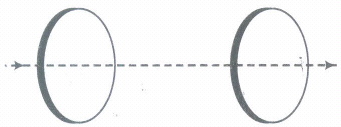
Figure shows a capacitor made of two circular plates each of radius 12 cm, and separated by 5.0 cm. The capacitor is being charged by an external source (not shown in the figure). The charging current is constant and equal to 0.15A.
(a) Calculate the capacitance and the rate of change of potential difference between the plates.
(b) Obtain the displacement current across the plates.
(c) Is Kirchhoff’s first rule (junction rule) valid at each plate of the capacitor? Explain.
2.
There are some famous numbers associated with electromagnetic radiations in different contexts in Physics given below. State the part of the electromnagnetic spectrum to which each belongs.
(i) 21 cm (wavelength emitted by atomic hydrogen in interstellar space).
(ii) 1057 MHz (frequency of radiation arising from two close energy levels in hydrogen, known as Lamb shift ).
(iii) 2.7 K (temperature associated with the isotropic radiation filling all space thought to be a relic of the big-bang origin of the universe).
(iv) 5890 \(\overset{\circ}{A}\) - 5896 \(\overset{\circ}{A}\) (double lines of sodium).
(v) 14.4 keV (energy of a particular transition in 57Fe nucleus associated with a famous high resolution spectroscopic method (Mössbauer spectroscopy).
3.
A parallel plate capacitor made of circular plates each of radius 10.0 cm has a capacitance 200 pF. The capacitor is connected to a 200 V a.c. supply with an angular frequency of 200 rad s-1.
(a) What is the r.m.s value of the conduction current?
(b) Is the conduction current equal to displacement current?
(c) Peak value of displacement current.
(d) Determine the amplitude of magnetic field at a point 2.0 cm from the axis between the plates.
4.
A plane EM wave travelling along \(z\) direction is described by \(\overset { \rightarrow }{ E } ={ E }_{ 0 } \ sin \ (kz-\omega t)i\) and \(\overset { \rightarrow }{ B } ={ B }_{ 0 } \ sin \ (kz-\omega t)\overset { \rightarrow }{ j } \). Show that
(i) The average energy density of the wave is given by \({ U }_{ av }=\frac { 1 }{ 4 } { \varepsilon }_{ 0 }{ E }_{ 0 }^{ 2 }+\frac { 1 }{ 4 } \frac { { B }_{ 0 }^{ 2 } }{ { \mu }_{ 0 } } \)
(ii) The time-averaged intensity of the wave is given by \({ I }_{ av }=\frac { 1 }{ 2 } c\varepsilon _{ 0 }{ E }_{ 0 }^{ 2 }\).
5.
Name the physical quantity which remains same for microwaves of wavelength 1 mm and UV radiations of 1600 \(\mathring { A } \) in vacuum.
6.
Arrange the following electromagnetic radiatios in ascending order to their frequencies:
(i) Microwaves
(ii) Radio waves
(iii) X-rays
(iv) Gamma rays
Write two uses of any one of these.
7.
Draw a sketch of a plane electromagnetic wave propagating along the z-direction. Depict clearly the directions of electric and magnetic fields varying sinusoidally with z.
8.
Calculate the displacement currecnt between the square plates of side 1 cm of a capcitor, if electric field between the plates is changing at the rate of 3 x 10⁶ V m-1 s-1.
9.
When an ideal capacitor is charged by a DC battery, no current flows. However, when an AC source is used, the current flows continously. How does one explain this, based on the concept of displacement current?
10.
A parallel capacitor is being charged by a time-varying current. Explain briefly how Ampere's circuital law is generalised to incorporate the effect due to the displacement current.
11.
Give the ratio of velocities of light rays of wavelength 4000 \(\dot { A } \) and 8000 \(\dot { A } \) in vacuum.
12.
If you find close loops of \(\overset { \rightarrow }{ B } \) in a region in space, does it necessarily mean that actual charges are flowing across the area bounded by the loops?
13.
The electromagnetic waves of frequency range from 5 x 10⁵ Hz to 109 Hz are called..........
14.
The radiation force on the roof is
\(2.67\times { 10 }^{ -4 }N\)
\(5.34\times { 10 }^{ -4 }N\)
\(2.33\times { 10 }^{ -4 }N\)
\(1.33\times { 10 }^{ -4 }N\)
15.
Sun also sends electromagnetic waves to earth. which one of the electromagnetic waves out of the visible portion, from the sun will be reaching the surface of earth earlier than others:
Violet waves
Green waves
Yellow waves
Red waves
16.
If \({ \mu }_{ 0 },{ \mu }_{ r },{ \epsilon }_{ 0 }and{ { \epsilon }_{ r } }\) as the absolute permeability relative permeability, absolute permittivity and relative permittivity of the medium, then the velocity of electromagnetic wave in a medium is
\(\frac { 1 }{ \sqrt { { \mu }_{ 0 }{ \epsilon }_{ 0 } } } \)
\(\frac { 1 }{ \sqrt { { \mu }_{ r }{ \epsilon }_{ r } } } \)
\(\frac { 1 }{ \sqrt { { \mu }_{ 0 }{ \epsilon }_{ 0 }{ \mu }_{ r }{ \epsilon }_{ r } } } \)
\(\sqrt { \frac { { \mu }_{ r }{ \epsilon }_{ r } }{ { \mu }_{ 0 }{ \epsilon }_{ 0 } } } \)
17.
If a source of power 4 KW produces \({ 10 }^{ 20 }\) Photon/second, the radiation belongs to part of the spectrum called
Ultraviolet rays
Microwaves
Gamma rays
x-rays
18.
The correct option if in vacuum the speed of gamma rays, x-rays and microwaves are \({ v }_{ g }, \ { v }_{ x }and \ { v }_{ m }\)
\({ v }_{ g }<{ v }_{ x }<{ v }_{ m }\)
\({ v }_{ g }<{ v }_{ x }>{ v }_{ m }\)
\({ v }_{ g }>{ v }_{ x }>{ v }_{ m }\)
\({ v }_{ g }={ v }_{ x }={ v }_{ m }\)
19.
The electric field associated with an e.m. wave in vacuum is given by \(\overset { \rightarrow }{ E } =\hat { i } 40 \ cos(kz-6\times { 10 }^{ 8 }t)\) where E,z, and t are in volt/m. metre and seconds respectively. The value of wave factor k is:
\(2 \ { m }^{ -1 }\)
\(0.5 \ { m }^{ -1 }\)
\(6 \ { m }^{ -1 }\)
\(3 \ { m }^{ -1 }\)
20.
The kinetic energy of a photon of frequency v, rest mass.\({ m }_{ 0 }\) having mass m while moving with velocity v is
\(\frac { 1 }{ 2 } { mv }^{ 2 }\)
hv
\({ mc }^{ 2 }={ m }_{ 0 }{ c }^{ 2 }\)
\(\frac { 1 }{ 2 } { mv }^{ 2 }-hv\)
21.
If \({ \mu }_{ 0 }\) be the permeability and \({ k }_{ 0 }\) the dielectric constant of a medium. its refractive index in given by
\(\frac { 1 }{ \sqrt { { \mu }_{ 0 }{ k }_{ 0 } } } \)
\(\frac { 1 }{ { \mu }_{ 0 }{ k }_{ 0 } } \)
\(\sqrt { { \mu }_{ 0 }{ k }_{ 0 } } \)
\({ \mu }_{ 0 }{ k }_{ 0 }\)
22.
The electric field intensity produced by the radiations coming from 100 W bulb at a 3m distance is E.What will be the electric field produced by the radiations coming from 50 W bulb at the same distance?
23.
Write the expression for the generalised form of Ampere's circuital law.
Discuss its significance and describe briefly how the concept of displacement current is explained through charging/discharging of a capacitor in an electric circuit.
1.
A) Step 1: Find capacitance between the two plates. Formula used: \(C=\frac{\varepsilon_0 A}{d}\)
Given, Distance between the plates, d=5 cm=0.05m
Radius of each circular plate,
r = 12cm = 0.12m
Now, area of each plate, A=πr2
A = 3.14 (0.12)2 = 0.045216 m2
Capacitance between two plates,
\(C=\frac{\varepsilon_0 A}{d}\)
Here, ϵ0 = permittivity of free space =8.85 × 10⁻¹²C2/Nm2
C=8.85×10−12× 0.045216/0.05
C = 8.0032×10⁻¹²
Step 2: Find change of potential difference between the two plates. Formula used: q = CV
Given, charging current, I=0.15A
Charge on each plate, q=CV
Where, V = Potential difference across the plates
Differentiating both sides with respect to time (t), we get,
\(\begin{array}{rlr} \Rightarrow \quad \frac{d q}{d t} & =C \cdot \frac{d V}{d t} \end{array}\)
\(\begin{array}{rlr} \Rightarrow \quad I & =C \cdot \frac{d V}{d t} \end{array}\) \(\left[\because \frac{d q}{d t}=I\right]\)
\(\begin{array}{rlr} \Rightarrow \quad \frac{d V}{d t} & =\frac{I}{C}=\frac{0.15}{8.0032
\times 10^{-12}} \end{array}\)
Step 2 : Find change of potential difference between teh two plates.
Formula used: q = CV
dV/dt= 1.87 × 10¹⁰V/s
The rate of change of potential difference between the plates is 1.87×10¹⁰V/s
Final answer : C=8.0032×10−12,1.87×1010V/s
B) Formula used: id=ϵ0(dϕEdt)
Given, charging current or conduction current, I=0.15 A
The displacement current across the plates, id=ϵ0(dϕE/dt)
Using Gauss's law, electric flux ϕE=qϵ0
id=ϵ0(1dq/ϵ0dt)=dq/dt
id=dqdt = conduction current =0.15A
Hence, the displacement current, id is 0.15 A.
Final answer : 0.15 A.
C) Kirchhoff’s first rule (junction rule):
It states that at a junction in an electrical circuit, the sum of currents flowing into the junction is equal to the sum of currents flowing out of the junction.
Kirchhoff’s first rule is valid at each plate of the capacitor provided that we consider the current to be the sum of both conduction and displacement currents.
2.
(i) This wavelength (21 cm) corresponds to the radio waves.
(ii) This frequency (1057 MHz) also corresponds to the radio waves (short wavelength).
(iii) As, T = 2.7 K
Using the formula,
\(\lambda\)m T = b = 0.29 cm-K
\(\lambda_m=\frac{0.29}{2.7}=0.11 \mathrm{~cm}\)
This wavelength corresponds to the microwaves region of the electromagnetic spectrum.
(iv) This wavelength lies in the visible region of the electromagnetic spectrum.
(v) Energy, E = 14.4 keV
= 14.4 \(\times\) 103 \(\times\) 1.6 \(\times\) 10-19 J
Frequency of wave,
\(\begin{aligned} v & =\frac{E}{h}=\frac{14.4 \times 1.6 \times 10^{-16}}{6.6 \times 10^{-34}} \end{aligned}\)
= 3.5 \(\times\) 1018 Hz
This frequency lies in the X-ray region of the electromagnetic spectrum.
3.
Here, R = 10 cm = 0.1 cm;
C = 200 pF = 200 x 10-12 F = 2 x 10⁻¹⁰ F;
Erms = 200 V; \(\omega\) = 200 rad s-1 ;
r = 2.0 x 10⁻² m.
(a) \({ I }_{ rms }=\frac { { E }_{ rms } }{ 1/\omega C } =\omega C{ E }_{ rms }\)
= 200 x (2 x 10-10) x 200
(b) Yes, because ID = 1
(c) \({ I }_{ 0 }=\sqrt { 2 } { I }_{ rms }=\sqrt { 2 } \times 8\times { 10 }^{ -6 }\)
= 11.312 x 10⁻⁶ A
(d) Consider a loop of radius r between two circular plates of parallel plate capacitor placed coaxially with them. The area of this loop \({ A }^{ \prime }=\pi { r }^{ 2 }\)
By symmetry, the magnetic field \(\overrightarrow { B } \) is equal in magnitude and is tangentially to the circle at every point. In this case, only a part of displacement current ID will cross the loop of area \({ A }^{ \prime }\) . Therefore, the current passing through the area \({ A }^{ \prime }\)
\({ I }^{ \prime }=\frac { { I }_{ D } }{ \pi { R }^{ 2 } } \times \pi { r }^{ 2 }=\frac { { I }_{ D } }{ { R }^{ 2 } } { r }^{ 2 }\)
Using Ampere's Maxwell law we have, \(\oint { \overrightarrow { B } .\overrightarrow { dl } } ={ \mu }_{ 0 }\times \)(total current through the area \({ A }^{ \prime }\)) or \(B=\frac { { \mu }_{ 0 }{ I }_{ 0 }r }{ 2\pi { R }^{ 2 } } =\frac { 4\pi \times { 10 }^{ -7 }\times 11.312\times { 10 }^{ -6 }\times 2\times { 10 }^{ -2 } }{ 2\pi \times { \left( 0.1 \right) }^{ 2 } } \)
or \(2\pi rB={ \mu }_{ 0 }\frac { { I }_{ 0 } }{ { R }^{ 2 } } { r }^{ 2 }\)
= 4.525 x 10⁻¹² T
4.
(i) We know that Electric energy density \({ U }_{ E }=\frac { 1 }{ 2 } \varepsilon _{ 0 }{ E }^{ 2 }\). and magnetic energy desity \({ U }_{ B }=\frac { 1 }{ 2 } \frac { { B }^{ 2 } }{ \mu _{ 0 } } \)
Total average energy density \({ U }_{ av }={ U }_{ E }+{ U }_{ B }=\frac { 1 }{ 2 } \varepsilon _{ 0 }{ E }^{ 2 }+\frac { 1 }{ 2 } \frac { { B }^{ 2 } }{ { \mu }_{ 0 } } \)
Given \(E={ E }_{ 0 } \ sin \ (kz-\omega t)\)
\(B={ B }_{ 0 } \ sin \ (kz-\omega t)\)
Time average value of \({ E }^{ 2 }\) over complete cycle \(=\frac { { E }_{ 0 }^{ 2 } }{ 2 } \) and time average value of \(=\frac { B_{ 0 }^{ 2 } }{ 2 } \)
\(\therefore \ { U }_{ av }=\frac { 1 }{ 2 } { \varepsilon }_{ 0 }\frac { { E }_{ 0 }^{ 2 } }{ 2 } +\frac { 1 }{ 2 } { \mu }_{ 0 }\frac { { B }_{ 0 }^{ 2 } }{ 2 } =\frac { 1 }{ 4 } { \varepsilon }_{ 0 }{ E }_{ 0 }^{ 2 }+\frac { { B }_{ 0 }^{ 2 } }{ 4{ \mu }_{ 0 } } \)
(ii) Average intensity \({ I }_{ av }={ U }_{ av }c=\left[ \frac { 1 }{ 4 } { \varepsilon }_{ 0 }{ E }_{ 0 }^{ 2 }+\frac { { B }_{ 0 }^{ 2 } }{ 4{ \mu }_{ 0 } } \right] c\)
\(=\left[ \frac { 1 }{ 4 } { \varepsilon }_{ 0 }{ E }_{ 0 }^{ 2 }+\frac { { E }_{ 0 }^{ 2 } }{ 4{ \mu }_{ 0 }^{ c2 } } \right] c\quad \left[ \therefore { B }_{ 0 }=\frac { E_{ c } }{ c } \right] \)
\(\frac { 1 }{ 4 } { \varepsilon }_{ 0 }{ E }_{ 0 }^{ 2 }\quad c\left[ 1+\frac { 1 }{ { \varepsilon }_{ 0 }{ \mu }_{ 0 }^{ c2 } } \right] \)
\(\frac { 1 }{ 4 } { \varepsilon }_{ 0 }{ E }_{ 0 }^{ 2 } \ c\left[ 1+1 \right] \ \left[ \therefore \frac { 1 }{ { \mu }_{ 0 }{ \varepsilon }_{ 0 } } =c^{ 2 } \right] \)
or \({ I }_{ av }=\frac { 1 }{ 2 } { \varepsilon }_{ 0 }c{ E }_{ 0 }^{ 2 }\)
5.
Speed (or Velocity).
6.
Radio waves < Microwaves < X-rays < Gamma rays
Uses of Microwaves :
(a) Aircraft navigation,
(b) Ovens
7.
The direction of propagation of the electromagnetic wave is perpendicular to both electric field vector E and magnetic field vector B, i.e. In the direction of E x B.
This can be seen by the diagram given below.
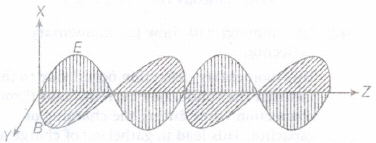
Here, electromagnetic wave is along the Z-direction which is given by the cross product of E and B
8.
We know that , I d = \(\varepsilon _{ 0 }A\frac { dE }{ dt } \)
Where, \(\varepsilon _{ 0 }\) = 8.85 x 10⁻¹² C2 N-1m-2
Area, A = 1 cm2 = 10-4 m-2
∴ \(\frac { dE }{ dt } \) = 3 x 10⁶ Vm-1 s-1
∵ I d = 8.85 x 10-12 x 10-4 x 3 x 106= 2.7 x 10⁻⁹A
9.
If an ideal capacitor is charged by DC battery, current flows momentarily till capacitor gets fully charged after that no current flows. however, when an AC source is connected, the conduction current, \(I_c=\frac{d q}{d t}\) starts flowing in the connecting wire. As charging polarity of AC current changes, the capacitor is alternatively charged and discharged with time. this causes change in electric field between plates of the capacitor which causes change in electric flux and gives rise to displacement current in the region between plates of cpacitor, as displacement current, \(I_d=\varepsilon_0 \frac{d {\phi}_E}{d t}\) and Id = Ie at all instants.
10.
While dealing with the charging of a parallel plate capacitor with varying current, it was found that Ampere's circuital law is not logically consistent, because \(\oint { \overset { \rightarrow }{ B } ,\overset { \rightarrow }{ dl } } \)has not same value on the two sides of a plate of charged capacitor. The inconsistency of Ampere's circuital law was removed by maxwell by predicting the presence of displacement current in the region between the plates of the capacitor. when the charge on the capacitor is changing with time. Maxwell also predicted that the sum of conduction current and displacement current has the property of continuity.
The generalised form of Ampere's circuital law, modified by Maxwell states that
\(\oint { \overset { \rightarrow }{ B } ,\overset { \rightarrow }{ dl } = } { \mu }_{ 0 }(I+{ I }_{ D })={ \mu }_{ 0 }\left( (I+{ \epsilon }_{ 0 }\frac { { d\phi }_{ E } }{ dt } ) \right) \)
11.
Ratio = 1; because of the velocity of both the wave. length in a vacuum is same \(\left(=3 \times 10^8 \mathrm{~ms}^{-1}\right)\)
12.
Not necessarily, A displacement current such as that between the plates of a charging capacitor) can also produce loops of \(\vec B\)
13.
()
radio waves
14.
(a)
\(2.67\times { 10 }^{ -4 }N\)
15.
(d)
Red waves
16.
(c)
\(\frac { 1 }{ \sqrt { { \mu }_{ 0 }{ \epsilon }_{ 0 }{ \mu }_{ r }{ \epsilon }_{ r } } } \)
17.
(a)
Ultraviolet rays
18.
(d)
\({ v }_{ g }={ v }_{ x }={ v }_{ m }\)
19.
(a)
\(2 \ { m }^{ -1 }\)
20.
(b)
hv
21.
(c)
\(\sqrt { { \mu }_{ 0 }{ k }_{ 0 } } \)
22.
As, we know that
Electric field intensity,
\( E= \ \sqrt { \frac { { Pc\mu }_{ 0 } }{ { 4\pi r }^{ 2 } } }\)
\( i.e.\ E\alpha \ \sqrt { \frac { P }{ { r }^{ 2 } } } \)
As, r is constant in this question.
So, \(E\alpha \sqrt { P } \)
For two different situations,
\({ \ E }_{ 1 }\alpha \sqrt { { P }_{ 1 } } and \ { E }_{ 2 } \ \alpha \sqrt { { P }_{ 2 } } \)
\(frac { { E }_{ 1 } }{ { E }_{ 2 } } =\left( \frac { { P }_{ 1 } }{ { P }_{ 2 } } \right) ^{ { 1 }/{ 2 } }\Rightarrow \frac { { E }_{ 1 } }{ { E }_{ 2 } } =\left( \frac { 100 }{ 50 } \right) ^{ { 1 }/{ 2 } }=\sqrt { 2 }\)
\(\Rightarrow \ { E }_{ 2 }=\frac { { E }_{ 1 } }{ \sqrt { 2 } }\)
\(As,d { E }_{ 1 }=E\Rightarrow { E }_{ 2 }=\frac { E }{ \sqrt { 2 } } \)
23.
The generalised form of Ampere's circuital law, modified by Maxwell, states that
\(\oint B.dI={ \mu }_{ 0 }(I+{ I }_{ d })={ \mu }_{ 0 }\left( I+{ \varepsilon }_{ 0 }\quad \frac { { d\phi }_{ E } }{ dt } \right) \)
While dealing with the charging of a parallel plate capacitor with varying current, it was found that Ampere's circuital law is not logically consistent, because \(\oint B.dI\) has not the same value on the two sides of a plate of charged capacitor. The inconsistency of Ampere's circuital law was removed by Maxwell by predicating the presence of displacement current in the region between the plates of capacitor, when the charge on the capacitor is changing with time. So, displacement current is the missing term (which is related with the changing electric field which passes through the surface between the plates of capacitor). In this way, Maxwell pointed out that for consistency of Ampere's circuital law, there must be displacement current Id along with the conduction current in the closed loop as (I+Id) has the property of continuity.

12th Standard CBSE Syllabus & Materials
12th Standard CBSE
CBSE 12th Computer Science Python Revision Tour I - New Previous year Question Papers Study Material - QB365 Set A
NEW12th Standard CBSE
CBSE 12th Business Studies Planning Important Questions And Answers Study Material - QB365 Set A
NEW12th Standard CBSE
CBSE 12th Business Studies Business Environment Important Questions And Answers Study Material - QB365 Set A
NEW12th Standard CBSE
CBSE 12th Business Studies Principles of Management Important Questions And Answers Study Material - QB365 Set A



CBSE 12th Standard CBSE Subjects
CBSE Standards










