
 100% FREE ACCESS
12th Standard CBSE Syllabus & Materials
12th Standard CBSE
CBSE 12th Economics Government Budget and the Economy Previous year Question Papers Study Material - QB365 Set A
NEW12th Standard CBSE
CBSE 12th Computer Science Interface Python with MySQL - New Previous year Question Papers Study Material - QB365 Set A
NEW12th Standard CBSE
CBSE 12th Computer Science Database Concept - New Previous year Question Papers Study Material - QB365 Set A
NEW12th Standard CBSE
CBSE 12th Computer Science Data Communication - New Previous year Question Papers Study Material - QB365 Set A
NEW12th Standard CBSE
CBSE 12th Computer Science Data Structures - New Previous year Question Papers Study Material - QB365 Set A
NEW12th Standard CBSE
CBSE 12th Computer Science Functions - New Previous year Question Papers Study Material - QB365 Set A

Published on: 02/03/2019
Electrostatics
Download CBSE Class 12th Standard CBSE Physics question papers, sample papers, important questions, and previous year solved papers in PDF format. Get free study materials, NCERT solutions, and exam preparation resources for Class 12th Standard CBSE Physics
Questions + Answers key
Take MCQ Physics Test
1.
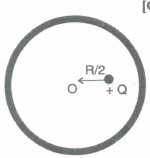
Figure shows a point charge + Q, located at a distance R/2 from the centre of a spherical metal shell. Draw the electric field lines for the given system.
2.
Why the potential inside a hollow spherical charged conductor is constant and has the same value as on its surface?
3.
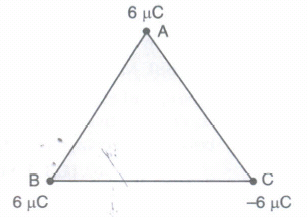
Find the amount of work done in arranging the three point charges, on the vertices of an equilateral triangle ABC, of side 10 cm, as shown in the figure.
4.
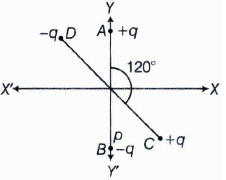
Two small identical dipoles AB and CD, each of dipole moment p are kept at an angle of 1200 as shown in the figure.
What is the resultant dipole moment of this combination? If this system is subjected to electric field (E) directed along positive X-direction of the torrque acting on this?
5.
A test charge q is moved without acceleration from A to C along the path from A to B and then from B to C in electric field E as shown in the figure.

(i) Calculate the potential difference between A and C.
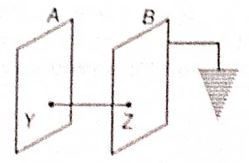
(ii) At which point (of the two) is the electric potential more and way?
6.
A positively charged particle is released from rest in a uniform electric field.What happens to its electrostatic potential energy?
7.
It is now believed that protons and neutrons (which constitute nuclei of ordinary matter) are themselves built out of more elementary units called quarks. A proton and a neutron consist of three quarks each. Two types of quarks, so-called 'up' quark (denoted by u) of charge + \(\left( \frac { 2 }{ 3 } \right) \)e and the 'down' quark (denoted by d) of charge \(\left( -\frac { 1 }{ 3 } \right) \) e, together with electrons build up ordinary matter. (Other types of quark have also been found which give rise to different unusual varieties of matter). Suggest a possible quark composition of a proton and a neutron.
8.
Two charges of -9C and +9C are palced at the points P(1, 0, 4) and Q(2,-1, 5) located in an electric field E = 0.20i V/cm. Calculate the torque acting on the dipole.
9.
Is it correct to write the unit of electric dipole moment as mC?
10.
A technician has only two capacitors. By using them in series or in parallel, he is able to obtain the capacitance of 4 \(\mu \) F, 5 \(\mu \) F, 20 \(\mu \) F. and 25 \(\mu \) F. What is the capacitance of both capacitors?
11.
Why should electrostatic field be zero inside a conductor?
12.
Given a battery, how would you connect two capacitors, in series or in parallel for them to store the greater
(a) total charge
(b) total energy?
13.
Write two applications of capacitors in electrical circuits?
14.
A charged Particle is free to move in an electric field. Will it always move along an electric line of force ?
15.
Four charges of same magnitude and same sign are placed at the corners of a square, of each side 0.1m. What is electric field intensity at the centre of the square?
16.
Two small balls having equal positive charge q coulomb are suspended by two insulating strings of equal length l metre from a hook fixed to a stand. The whole set up is taken in a satellite into space where there is no gravity. What is the angle between the two strings and the tension in each string?
17.
What do you mean by conservation of electric charge?
18.
In a Van de Graff type generator, a spherical metal shell is to be a \(15\times { 10 }^{ 6 }V\) electrode.The dielectric strength of the gas surrounding the electrode is \(5\times { 10 }^{ 7 }{ Vm }^{ -1 }\) .What is the minimum radius of the spherical shell required?
(You will learn from this exercise why one cannot build an electrostatic generator using a very small shell which requires a small charge to acquire a high potential)
19.
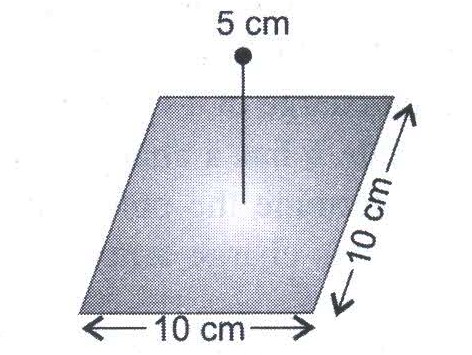
A point charge \(+10\mu \) is at a distance 5cm directly above the centre of square of side 10cm as shown in fig.What is the magnitude of the electric flux through the square?
20.
The equivalent capacitance of the combination between A and B in the given figure is 15 \(\mu F\). Calculate the capacitance of capacitor C.

21.
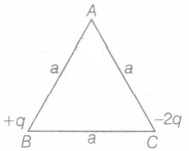
Two point charges + q and - 2q are placed at the vertices Band C of an equilateral
∆ABC of side a as given in the figure. Obtain the expression for
(i) the magnitude and
(ii) the direction of the resultant electric field at the vertex A due to these two charges.
22.
A spherical conducting shell of inner radius r1 and outer radius r2, has a charge 'Q'. A charge 'q' is placed at the centre of the shell.
(a) What is the surface charge density on the
(i) Winner surface,
(ii) outer surface of the shell ? .
(b) Write the expression for the electric field at a point x ( > r2) from the centre of the shell.
23.
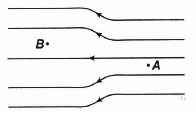
In the figure below the electric field lines on the left have twice the separation of those on the right.
(i) If the magnitude of the field of A is 40 N/C then what force acts on a proton at A?
(ii) What is the magnitude of the field at B?
24.
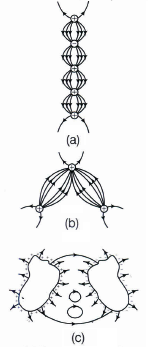
Explain why the following curves cannot possibly represent electrostatic field lines?
25.
What is potential gradient at a distance of 10-12m from the centre of the platinum nucleus? What is the potential gradient at the surface of the nucleus? Atomic number of platinum is 78 and radius of platinum nucleus is \(5\times 10^{-15}m\)
26.
The electrostatic force of repulsion between two positively charged ions carrying equal charges is \(3.7\times10^{-9}\)N, when they are separated by a distance of 5\(\mathring { A } \) . How many electrons are missing from each ion?
27.
Check that the ratio ke2/Gmemp is dimensionless. Look up a table of physical constants and determine the value of this ratio. What does the ratio signify?
28.
The surface integral of electrostatic field E produced by any source over any closed surface S enclosing a volume V in vacuum, i.e. total electric flux over the closed surface S in vacuum is \(1/{\epsilon}_{0}\) times the total charge Q contained inside S, i.e.
\({\phi}_{E}=\oint E.dS={{Q}\over{{\epsilon}_{0}}}\)
The charges inside S may be point charges or even continuous charge distributions. There is no contribution to "total electric flux from the charges outside S. Further, the location of Q inside S does not affect the value of surface integral.
Read the above passage and answer the following questions
What are the SI units and dimensions of electric flux?
A closed surface in vacuum encloses charges -q, + 3q and +5q. Another charge + 4q lies outside the surface. What is total electric flux over the surface?
A point charge a lies inside a spherical surface of radius r. How will the electric flux be affected, if, radius of the sphere is doubled?
What values of life do you learn from this theorem?
29.
(a) Obtain the expression for the potential due to an electric dipole of dipole moment p at a point 'x' on the axial line.
(b) Two identical capacitors of plate dimension l x b and plate separation d have dielectric slabs filled in between the space of the plates as shown in the figures.
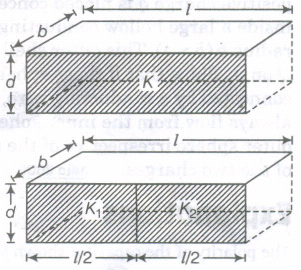
Obtain the relation between the dielectric constants K, K 1 and K2
30.
Mahesh was travelling in a bus. Suddenly the weather changed and it started raining. After sometime rain stopped and all the passengers opened their windows. But lightning started immediately. Then he suggested to shut the doors and windows of the bus, otherwise it may be dangerous.
(a) What values were shown by Mahesh?
(b) Two charges 5\(\mu\)C and -2\(\mu\)C are placed at points (5 cm, 0, 0) and (23 cm, 0, 0) in a region of space where there is no other external field. Calculate the electrostatic potential energy of this charge system.
31.
Three concentric metal shells A, B and C of radius a, b and c (a<b<c) have surface charge densities +\(\sigma\)
(i) Find the potential of three shells at A, B and C.
(ii) If the shells A and C are at the same potential, obtain the relation between the radii a, b and c.
32.
A physics teacher tells his students in the class that in paramagnetic materials, every atom has some permanent magnetic dipole moment. In the absence of an external magnetic field, the atomic dipoles are randomly oriented so that average magnetic moment per unit volume of the material behaves as a magnet. When an external magnetic field is applied, the torque developed tries to align the atomic magnetic dipoles in the direction of the field. That is why the specimen gets magnetized weekly in the direction of the field.
Read the above passage and answer the following questions:
(i) Name any three paramagnetic materials
(ii) Name any two ferromagnetic materials. How is their behavior different from that of paramagnetic materials?
(iii) The teacher asks the students how true is the famous saying: 'Spare the rod and spoil the child', comment.
33.
A charge of 8 mC is located at the origin. Calculate the work done in taking a small charge of -2\(\times\)10-9C from a point P (0, 0, 3 cm) to a point Q(0, 4 cm, 0) via a point R(0, 6 cm, 9 cm).
34.
A hemisphere is uniformly charged positively. The electric field at a point on a diameter away from the centre is directed
perpendicular to the diameter
parallel to the diameter
at an angle tilted towards the diameter
at an angle tilted away from the diameter
35.
A condenser is charged to double its initial potential. The energy stored in the condenser becomes x times, where x =
2
4
1
1/2
36.
The value of absolute electrical permittivity of free space is
\(9\times 10^9Nm^2C^{-2}\)
\(9\times 10^{-9}Nm^2C^{-2}\)
\(8.85\times 10^{-12}C^2N^{-1}m^{-2}\)
\(8.85\times 10^{-12}C^2Nm^{-2}\)
37.
When a plastic comb is passed through dry hair, the charge acquired by the comb is
always negative
always positive
sometimes negative
none of the above
38.
Electric potential V and electric flux \(\phi\) are
both vectors
both scalars
V is scalar, \(\phi\) is vector
V is vector, \(\phi \) is scalar
39.
The correct relation between electric intensity E and electric potential V is
\(E=-{dV\over dr}\)
\(E={dV\over dr}\)
\(V=-{dE\over dr}\)
\(V={dE\over dr}\)
40.
Potential energy of an electric dipole held at an angle \(\theta\) in a uniform electric field is zero when \(\theta=\)
\(0^o\)
90o
180o
360o
41.
Electric field intensity (E) due to an electric dipole varies with distance (r) of the point from the centre of dipole as:
\(E\alpha {1\over r}\)
\(E\alpha{1\over r^4}\)
\(E\alpha{1\over r^2}\)
\(E\alpha {1\over r^3}\)
42.
The maximum .............. that a dielectric medium can withstand breaking down of ........... is called its .............
43.
Dipole moment is a ............... quantity and its units are .............
1.
.png)
Inside
Outside
2.
Electric field inside the hollow spherical charged conductor is zero. So, no work is done in moving a charge inside the shell. Thus, potential is constant and therefore, equal to its value at the surface, i.e. \(V=\frac{1}{4 \pi \varepsilon_0} \cdot \frac{q}{R}\)
3.
P.E. of a pair of charges = work done to assemble the charges = \(\frac{1}{4\pi\epsilon_0r}.\frac{q_1q_2}{r}\)
qA = 6 x 10⁻⁶ C = qB, qC = -6 x 10⁻⁶ C and r = 0.1 m
then work done on the system
= WAB+ WBC + WAC
= \(\frac{1}{4\pi\epsilon_0r}\)[ qAqB + qBqC + qAqC ]
= 9 x 10⁻⁹ x \(\frac{1}{0.1}\)[36 - 36 - 36] x 10-12
= 9 x 10⁻⁹ x (-36) x 10-11
= -3.24 J
4.
Consider the figure, |PA| = PC = P
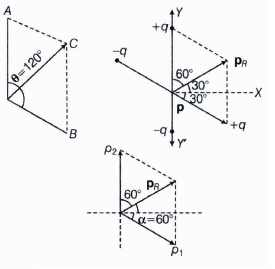
The magnitude of resultant PR ,
\({ P }_{ R }=\sqrt { { { p }_{ 1 } }^{ 2 }+{ { p }_{ 2 } }^{ 2 }+2{ p }_{ 1 }{ p }_{ 2 }\cos { \theta } } \)
\(=\sqrt { { p }_{ 2 }+{ p }_{ 2 }+2{ p }^{ 2 }\cos { \theta } } \)
\(=\sqrt { { 2p }^{ 2 }(1+\cos { \theta } } \)
\(=\sqrt { 2{ p }^{ 2 }\times 2{ cos }^{ 2 }\frac { \theta }{ 2 } } =2p \ cos\frac { \theta }{ 2 } \)
\(\tan\alpha =\frac { { p }_{ 2 }sin\theta }{ { p }_{ 1 }+{ p }_{ 2 }cos\theta } =\frac { psin{ 120 }^{ 0 } }{ p+pcos{ 120 }^{ 0 } } \)
\(=\frac { p\sqrt { 3/2 } }{ p } =\sqrt { 3 }\)
\(p-\frac { p }{ 2 } \)
\(|{ P }_{ R }|=2pcos\frac { \theta }{ 2 } =2pcos\frac { { 120 }^{ 0 } }{ 2 } =2p\times \frac { 1 }{ 2 } =p\)
\({ P }_{ R } \ will \ subtend \ an \ angle \ of \ { 30 }^{ 0 } \ with \ X \ axis.\)
Now torque acting on the system.
\(\tau ={ P }_{ R }\times E={ p }_{ R }Esin\theta =\frac { 1 }{ 2 } { p }E\)
The torque will work to align the dipole in the direction of electric field E.
5.
(i) \(\because \) Electric field intensity and potential difference are related as,
\(E=-\frac { \Delta V }{ \Delta r } \ \Rightarrow \ \Delta V \ = \ -E\Delta r\)
\(\\ { V }_{ A } \ - \ { V }_{ C } \ =-4E \ or \ { V }_{ C } \ - \ { V }_{ A } \ = \ 4E\)
[\(\because \) By Pythagoras law, AC2 = AB2+ BC2]
\(\Rightarrow \) 53-32 = AB2 \(\Rightarrow \) AB = \(\Delta \)r = 4
(ii) As, VC- VA = 4E, is positive.
\(\therefore \) VC > VA
Potential is greater at point C than at point A, as potential decreases along the direction of electric field.
6.
As, the positively charged particle experiences electrostatic force in the direction of electric field. Some work is done by the electric field on the positive charge, hence electrostatic potential energy decreases.
7.
For the protons, the charge on a proton is + e.
If the number of up quarks is a, then the number of down quarks are (3-a) as the total number of quarks are 3. So, \(a\times \)up quark charge + (3-a) down quark charge) = +e
\(a\times \left( \frac { 2 }{ 3 } e \right) +\left( 3-a \right) \left( -\frac { e }{ 3 } \right) =e\)
\(\Rightarrow \frac { 2ae }{ 3 } -\frac { \left( 3-a \right) e }{ 3 } =e\)
\(\Rightarrow 2a-3+a=3\\ \Rightarrow 3a=6\\ \Rightarrow a=2\)
Thus, in the proton, there are two up quarks and one down quark.
\(\therefore \) Possible quark composition for proton = uud
For the neutron, the charge on neutron is 0.
Let the number of up quarks is b and the number of down quarks be 3-b.
so, \(b\times \) up quark charge + (3-b) down quark charge = 0
\(b\times \left( \frac { 2e }{ 3 } \right) +\left( 3-b \right) \left( -\frac { e }{ 3 } \right) =0\)
\(\Rightarrow 2b-3+b=0\)
\(\Rightarrow 3b=3\\ \Rightarrow b=1\)
Thus, in neutron, there is one up quark and two down quarks.
\(\therefore \) Possible quark composition for neutron = udd.
8.
As, P(1, 0, 4) and (2,-1, 5)
\(\therefore \ 2l=PQ=[(2-1)\hat { i } +(-1-0)\hat { j } +(5-4)\hat { k] }\\
=(\hat { i } -\hat { j } +\hat { k } )\)
and \(\ q=\pm 9\times { 10 }^{ -6 }C,E=0.20\hat { i } V/cm.\tau =?\)
Since, \(\tau =\rho \times E=q(2l)\times E\)
\(\therefore \ \tau =9\times { 10 }^{ -6 }(\hat { i } -\hat { j } +\hat { k } )\times 0.20=18\times { 10 }^{ -7 }(\hat { k } -\hat { j) }
\)
Magnitude of torque,
\(\tau =18\times { 10 }^{ -7 }[\sqrt { { (1) }^{ 2 }+{ (1) }^{ 2 } } ]=25.45\times { 10 }^{ -7 }N-m\)
9.
No, it is not correct to write the unit of electric dipole moment as mC. The symbol mC represents milli-coulomb, i.e. unit of electric charges. IN SI system unit symbols are written in alphabetical order.
∴ Unit of dipole moment is C-m.
10.
Let the two capacitors be C1 and C2, capacitance will be maximum when connected in parallel.
i.e. C1 + C2 = 25
Capacitance will be minimum when connected in series.
i.e. \(\frac { { C }_{ 1 }{ C }_{ 2 } }{ { C }_{ 1 }+{ C }_{ 2 } } =4\)
Since, we are left with only two values 5 \(\mu \) F and 20\(\mu \) F.
So, the value of capacitances will be 5 \(\mu \) F and 20\(\mu \) F.
11.
Electric field lines do not pass through a conductor.Hence, the interior of the conductor is free from the influence of the electric field
12.
Total charge q = CV and total energy \(U={1\over 2}CV^2\)
Now, V is constant and \(C_p>C_s\)
therefore, parallel combination is required or storing greater charge and greater energy.
13.
(i) Capacitors are used in radio circuits for tuning purposes.
(ii) Capacitors are used in power supplies for smoothing the rectified current.
14.
If Changed particle was Initially at rest, it will move along the direction of electric field. If initial velocity of the charged particle makes a certain angle with electric field, then the charged particle will no move along the line of force.
15.
Electric field intensity at the centre of the square will be zero.
16.
In a satellite, there is a condition of weightlessness. Therefore, mg = 0. On account of electrostatic force of repulsion between the balls, the strings would become horizontal. Therefore, angle between the strings = 180o.
Also, tension in each string = force of repulsion
\(T={1\over 4\pi\epsilon_o}{q^2\over(2l)^2}N\)
17.
Conservation of electric charge means that the total charge on an isolated system remains unchanged with time.
18.
Potential difference, V = 15 x 106 V
Dielectric strength of the surrounding gas = 5 x 10⁷ V/m
Electric field intensity, E = Dielectric strength = 5 x 10⁷ V/m
Minimum radius of the spherical shell required for the purpose is given by,
\(r=\frac{V}{E}\)
\(=\frac{15 \times 10^{6}}{5 \times 10^{7}}=0.3 \mathrm{~m}=30 \mathrm{~cm}\)
Hence, the minimum radius of the spherical shell required is 30 cm.
19.
\(1.88\times {{10}^{5}}\)Nm2C-1
20.
\(60\mu F\)
21.
(i) The magnitude,
\(\left| { E }_{ AB } \right| =\frac { 1 }{ 4\pi { \varepsilon }_{ 0 } } \times \frac { q }{ { a }^{ 2 } } =E\)
\(\left| { E }_{ AC } \right| =\frac { 1 }{ 4\pi { \varepsilon }_{ 0 } } \times \frac { 2q }{ { a }^{ 2 } } =2E\)
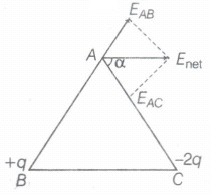
\({ E }_{ net }=\sqrt { { E }_{ AB }^{ 2 }+{ E }_{ AC }^{ 2 }+{ 2E }_{ AB }{ E }_{ AC }cos\theta } \)
\(=\sqrt { { (2E) }^{ 2 }+{ E }^{ 2 }+2\times 2E\times E\times \left( -\frac { 1 }{ 2 } \right) } \)
\(=\sqrt { { 4E }^{ 2 }+E^{ 2 }-{ 2E }^{ 2 } } =E\sqrt { 3 } ....(i)\)
\(We\quad know\quad that,\quad E=\frac { q }{ 4\pi { \varepsilon }_{ 0 }{ a }^{ 2 } } \)
\(So,{ E }_{ net }=\frac { q\sqrt { 3 } }{ 4\pi { \varepsilon }_{ 0 }{ a }^{ 2 } } \)
(ii) Direction of resultant electric field at vertex.
\(tan\alpha =\frac { { E }_{ AB }{ sin120 }^{ 0 } }{ { E }_{ AC }+{ E }_{ AB }{ cos120 }^{ 0 } } \)
\(=\frac { E\times \frac { \sqrt { 3 } }{ 2 } }{ 2E+E\times \left( -\frac { 1 }{ 2 } \right) } \)
\(tan\alpha =\frac { 1 }{ \sqrt { 3 } } \Rightarrow \alpha ={ tan }^{ -1 }\left( \frac { 1 }{ \sqrt { 3 } } \right) \)
α = 300
22.
(a) Charge placed at the centre of a shell is +q. Hence, a charge of magnitude - q will be induced to the inner surface of the shell. Therefore, total charge on the inner surface of the shell is - q.
Surface charge density at the inner surface of the shell is given by the relation,
\(\sigma_{1}=\frac{\text { Total charge }}{\text { Inner surface area }}=\frac{-q}{4 \pi r_{1}^{2}}\) .........(i)
A charge of +q is induced on the outer surface of the shell. A charge of magnitude Q is placed on the outer surface of the shell. Therefore, total charge on the outer surface of the shell is Q + q. Surface charge density at the outer surface of the shell
\(\sigma_{2}=\frac{\text { Total charge }}{\text { Outer surface area }}=\frac{Q+q}{4 \pi r_{2}^{2}}\) ..........(ii)
(b) Yes
The electric field intensity inside a cavity is zero, even if the shell is not spherical and has any irregular shape. Take a closed loop such that a part of it is inside the cavity along a field line while the rest is inside the conductor. Net work done by the field in carrying a test charge over a closed loop is zero because the field inside the conductor is zero. Hence, electric field is zero, whatever is the shape.
23.
(i) Charge of proton q = 1.6 x 10⁻¹⁹C
Force on proton at A is F = qEA
= (1.6 x 10⁻¹⁹C) (40 N / C)
= 6.4 x 10⁻¹⁸N
(ii) Since, electric field,
E\(\propto \) Number of electric field lines/Area
Hence, EB = 1/2 EA
= 1/2(40 N / c)
= 20 N / C.
24.
(a)Electrostatic field lines cannot start from a negative charge.
(b)Electrostatic field lines cannot end at positive charge
(c)Electrostatic field lines cannot form closed loops.
25.
Here, q = Ze = \(78\times1.6\times10^{-19}C\)
Potential gradient at a point is numerically equal to electric field at that point, i.e.,
\({dV\over dr}=E={q\over 4\pi\epsilon_or^2}\)
At \(r=10^{-12}m\)
\({dV\over dr}=E={9\times10^9\times78\times1.6\times 10^{-19}\over(10^{-12})^2}\)
\(=1.123\times 10^{17}Vm^{-1}\)
At r = \(5\times 10^{-15}m\)
\({dV\over dr}=E={q\over 4\pi\epsilon_or^2}={9\times 10^9\times78\times1.6\times10^{-19}\over(5\times10^{-15})^2}\)
\(=4.5\times 10^{21}Vm^{-1}\)
26.
Here q1 = q2 = q = ?
F = 3.7 x 10⁻⁹N, r = 5\(\mathring { A } \) = 5 x 10⁻¹⁰m
n = ?
As F=\({kq_1q_2\over r^2}={kq^2\over r^2}\)
\(q=\sqrt{r^2F/K}\)
\(=\sqrt{{1\over 9\times10^9}(5\times10^{-10})^2\times3.7\times10^{-9}}\)
\(={\sqrt{ 25\times3.7}\over 9}\)=3.2 x 10⁻¹⁹C
From q = ne
\(n={q\over e}={3.2\times 10^{-19}\over 1.6\times 10^{-19}}=2\)
27.
Since \({ F }_{ e }=-\frac { { ke }^{ 2 } }{ { r }^{ 2 } } \)
So \({ ke }^{ 2 }={ -F }_{ e }{ r }^{ 2 }\)
And \({ F }_{ G }=-G\frac { { m }_{ p }{ m }_{ e } }{ { r }^{ 2 } } \)
So \({ Gm }_{ p }{ m }_{ e }={ -F }_{ G }{ r }^{ 2 }\)
So dimensions of \(\frac { { ke }^{ 2 } }{ { Gm }_{ e }{ m }_{ p } } =\frac { { F }_{ e }{ r }^{ 2 } }{ { F }_{ G }{ r }^{ 2 } } =\frac { { F }_{ e } }{ { F }_{ G } } \)
\(=\frac { { [MLT }^{ -2 }] }{ { [MLT }^{ -2 }] } =[{ M }^{ 0 }{ L }^{ 0 }{ T }^{ 0 }]\)
= No dimensions
The value of \(\frac { { ke }^{ 2 } }{ { Gm }_{ e }{ m }_{ p } } \)
\(=\frac { 9\times { 10 }^{ 9 }\times (1.6\times { 10 }^{ -19 })^{ 2 } }{ 6.67\times { 10 }^{ -11 }(1.67\times { 10 }^{ -27 })(9.1\times { 10 }^{ -31 }) } \)
\(=2.9\times { 10 }^{ 39 }\)
From Eq. (1) and (2), we have
\(\left| \frac { { F }_{ e } }{ { F }_{ G } } \right| =\frac { { ke }^{ 2 } }{ { Gm }_{ p }{ m }_{ e } } =2.9\times { 10 }^{ 39 }\)
The ratio of the two forces shows that electrical forces are enormously stronger than the gravitational forces.
28.
SI units of electric flux is N-m2C-1.
Dimensional formula of electric flux is [ M1L1T-3A-1].
\(\phi={{\sum {q}_{inside}}\over{{\epsilon}_{0}}}={{-q+3q+5q}\over{{\epsilon}_{0}}}={{7q}\over{{\epsilon}_{0}}}\)
As \(\phi={{q}\over{{\epsilon}_{0}}},\) electric flux is not affected by area/shape of the surface. So, the electric flux remains unaffected.
This theorem emphasis that total normal flux from the surface depends only on algebraic sum of charges enclosed by the surface, irrespective of their location. The charges outside the surface do not affect the electric flux. In day-to-day life, the theorem implies that the knowledge you can import depends only on what you have stored within you. You
cannot emanate what you have not absorbed or what lies outside your reach?
In the examination, you can write what you have learnt by heart? Extraneous help from outside by unfair means will never serve your purpose.
29.
(a) Consider an electric dipole of charges +q and - q separated by 2x distance being placed in free space. Let P be the point at which the electric field is to be determined due to the electric dipole.
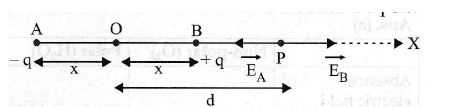
The electric field \(\overrightarrow{E}\) at P is given by
\(\overrightarrow{E}\) = \(\overrightarrow{E_A}\)+ \(\overrightarrow{E_B}\)
\(\left| \vec { { E }_{ A } } \right| \)= \(\frac { 1 }{ 4\pi { \varepsilon }_{ 0 } } \frac { q }{ { (d+x) }^{ 2 } } \)
\(\left| \vec { { E }_{ B } } \right| \)=\(\frac { 1 }{ 4\pi { \varepsilon }_{ 0 } } \frac { q }{ { (d-x) }^{ 2 } } \)
From diagram, it is clear that \(\overrightarrow{E_A}\)< \(\overrightarrow{E_B}\)and they are opposite in direction. Hence,
E = \(\left| \vec { E } \right| =\left| \vec { { E }_{ B } } -\vec { { E }_{ A } } \right| \)
\(\frac { 1 }{ 4\pi { \varepsilon }_{ 0 } } \left[ \frac { q }{ { (d-x) }^{ 2 } } -\frac { q }{ { (d+x) }^{ 2 } } \right] \)
\(\frac { 1 }{ 4\pi { \varepsilon }_{ 0 } } \frac { q\times 4dx }{ { { (d }^{ 2 }-{ x }^{ 2 }) }^{ 2 } } \)
\(\frac { 1 }{ 4\pi { \varepsilon }_{ 0 } } \)\(\frac { 2Pd }{ { { (d }^{ 2 } }-{ x }^{ 2 })^{ 2 } } \)
When x <
\(Potential(V)=\frac { { E }_{ axial } }{ d } .d\)
\(\frac { 1 }{ 4\pi { \varepsilon }_{ 0 } } \frac { 2P }{ { d }^{ 2 } } \)
(b) The capacitor can be considered as split into two capacitor connected in parallel.
Here \({ C }_{ 1 }=\frac { { K }_{ 1 }{ \varepsilon }_{ 0 }l }{ 2d } and{ C }_{ 2 }=\frac { { K }_{ 1 }{ \varepsilon }_{ 0 }l }{ 2d } \)
In parallel combination,
\({ C }_{ eq }={ C }_{ 1 }+{ C }_{ 2 }\)
\(\frac { { K }_{ 1 }{ \varepsilon }_{ 0 }l }{ 2d } +\frac { { K }_{ 2 }{ \varepsilon }_{ 0 }l }{ 2d } \)
\(\frac { { \varepsilon }_{ 0 }l }{ 2d } \left( { K }_{ 1 }+{ K }_{ 2 } \right) \)
From this figure
\({ C }_{ eq }=\frac { { K }_{ 2 }{ \varepsilon }_{ o }l }{ 2d } \)
From eqns. (i) & (ii)
\(\frac { { K }_{ 1 }{ \varepsilon }_{ 0 }l }{ 2d } =\frac { { \varepsilon }_{ o }l }{ 2d } \left( { K }_{ 1 }+{ K }_{ 2 } \right) \)
\(K={ K }_{ 1 }+{ K }_{ 2 }\)
30.
(a) (i) Presence of mind.
(ii) Ability to take prompt decisions.
(iii) Sense of responsibility
(b) Given, q1 = 5\(\mu\)C = 5 x 10⁻⁹C
q2 = -2\(\mu\)C = -2 x 10⁻⁹C.
The distance between the charges
= x = x2 - x1
= 23 cm - 5cm
= 18 cm
= 0.18 m
Thus, electrostatic potential energy of charges
\(U = \frac{1}{4\pi\epsilon_0}.\frac{q_1q_2}{x}\)
= \(\frac{9\times10^9\times5\times10^{-9}\times-2\times10^{-9}}{0.18}\)
= \(\frac{-9\times10^{-8}}{18\times10^{-2}}\)
= - 5 x 10⁻⁷ J
31.
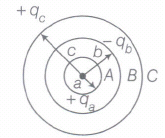
(i) Potential of three shells
At shell A
Potential,
VA = \(\frac { 1 }{ { 4\pi \varepsilon }_{ 0 } } \left[ \frac { { q }_{ a } }{ a } -\frac { { q }_{ b } }{ b } +\frac { { q }_{ c } }{ c } \right] \)
\(=\frac { 1 }{ { 4\pi \varepsilon }_{ 0 } } \left[ \frac { { 4\pi a }^{ 2 }\sigma }{ a } -\frac { { 4\pi b }^{ 2 }\sigma }{ b } +\frac { { 4\pi c }^{ 2 }\sigma }{ c } \right] \left( \because \sigma =\frac { q }{ { 4\pi r }^{ 2 } } \right) \\ \)
\(=\frac { \sigma }{ { \varepsilon }_{ 0 } } \left( a-b+c \right) \)
At shell B
Potential, VB = \(\frac { 1 }{ { 4\pi \varepsilon }_{ 0 } } \left[ \frac { { q }_{ a } }{ a } -\frac { { q }_{ b } }{ b } +\frac { { q }_{ c } }{ c } \right] \)
= \(\frac { 1 }{ { 4\pi \varepsilon }_{ 0 } } \left[ \frac { { 4\pi a }^{ 2 }\sigma }{ b } -\frac { { 4\pi b }^{ 2 }\sigma }{ b } +\frac { { 4\pi c }^{ 2 }\sigma }{ c } \right] \left[ \because \sigma =\frac { q }{ { 4\pi r }^{ 2 } } \right] \)
\( \\ =\frac { \sigma }{ { \varepsilon }_{ 0 } } \left[ \frac { { a }^{ 2 }-{ b }^{ 2 } }{ b } +c \right]\)
At shell C
Potential, Vc = \(\frac { 1 }{ { 4\pi \varepsilon }_{ 0 } } \left( \frac { { q }_{ a } }{ c } -\frac { { q }_{ b } }{ c } +\frac { { q }_{ c } }{ c } \right) \)
\(\\ =\frac { 1 }{ { 4\pi \varepsilon }_{ 0 } } \left( \frac { { 4\pi a }^{ 2 }\sigma }{ c } -\frac { { 4\pi b }^{ 2 }\sigma }{ c } +\frac { { 4\pi c }^{ 2 }\sigma }{ c } \right) \left[ \because \sigma \frac { q }{ { 4\pi r }^{ 2 } } \right] t)\)
\(=\frac{\sigma}{\varepsilon_{0}}\left(\frac{a^{2}-b^{2}+c^{2}}{c}\right)\)
(ii) Relation between the radii Now,
Now, VA = VC (given)
\(\frac{\sigma}{\varepsilon_{ }}(a-b+c)=\frac{\sigma}{\varepsilon} \frac{\left(a^{2}-b^{2}+c^{2}\right)}{c}\)
\(a-b+c=\frac{a^{2}-b^{2}+c^{2}}{c}=\frac{a^{2}-b^{2}}{c}+c\)
\(c(a-b)=a^{2}-b^{2}\)
\(\Rightarrow \ c=a+b\left[\because\left(a^{2}-b^{2}\right)=(a-b)(a+b)\right]\)
32.
(i) Examples of paramagnetic material are aluminum; chromium; oxygen.
(ii) Iron and cobalt are two ferromagnetic materials. The ferromagnetic substances, but to a much larger degree. For example, relative magnetic permeability of paramagnetic substances is slightly greater than 1
33.
Charge located at the origin, q = 8 mC = 8 x 10⁻³ C
The magnitude of the charge taken from the point P to R and then to Q, q1 = 2 x 10⁻⁹ C
Here OP= d1= 3 cm = 3 x 10⁻² m
OQ = d2= 4 cm = 4 x 10⁻² m
Potential at the point P, V1 \(=\frac{q}{4 \pi \epsilon_{0} d_{1}}\)
Potential at the point Q, V1 \(=\frac{q}{4 \pi \epsilon_{0} d_{1}}\)
The work done (W) is independent of the path
Therefore, W = q1[V1 – V2]
\(=V_{2}=q_{1}\left[\frac{q}{4 \pi \epsilon_{0} d_{2}}-\frac{q}{4 \pi \epsilon_{0} d_{1}}\right]\)
\(=V_{2}=\frac{q q_{1}}{4 \pi \epsilon_{0}}\left[\frac{1}{d_{2}}-\frac{1}{d_{1}}\right]\)
Where, \(\frac{1}{4 \pi \epsilon_{0}}=9 \times 10^{9} \mathrm{Nm}^{2} \mathrm{C}^{-2}\)
Therefore,
\(W=9 \times 10^{9} \times 8 \times 10^{-3} \times\left(-2 \times 10^{-9}\right)\left[\frac{1}{4 \times 10^{-2}}-\frac{1}{3 \times 10^{-2}}\right]\)
= -144 x 10-3 x (-100/12)
= 1.2 Joule
Therefore, the work done during the process is 1.2 J
34.
(a)
perpendicular to the diameter
35.
(b)
4
36.
(c)
\(8.85\times 10^{-12}C^2N^{-1}m^{-2}\)
37.
(a)
always negative
38.
(b)
both scalars
39.
(a)
\(E=-{dV\over dr}\)
40.
(b)
90o
41.
(d)
\(E\alpha {1\over r^3}\)
42.
()
electric field ; its insulating properties ; dielectric strength
43.
()
vector ; C-m

12th Standard CBSE Syllabus & Materials
12th Standard CBSE
CBSE 12th Computer Science Python Revision Tour I - New Previous year Question Papers Study Material - QB365 Set A
NEW12th Standard CBSE
CBSE 12th Business Studies Planning Important Questions And Answers Study Material - QB365 Set A
NEW12th Standard CBSE
CBSE 12th Business Studies Business Environment Important Questions And Answers Study Material - QB365 Set A
NEW12th Standard CBSE
CBSE 12th Business Studies Principles of Management Important Questions And Answers Study Material - QB365 Set A



CBSE 12th Standard CBSE Subjects
CBSE Standards










