
 100% FREE ACCESS
12th Standard CBSE Syllabus & Materials
12th Standard CBSE
CBSE 12th Economics Government Budget and the Economy Previous year Question Papers Study Material - QB365 Set A
NEW12th Standard CBSE
CBSE 12th Computer Science Interface Python with MySQL - New Previous year Question Papers Study Material - QB365 Set A
NEW12th Standard CBSE
CBSE 12th Computer Science Database Concept - New Previous year Question Papers Study Material - QB365 Set A
NEW12th Standard CBSE
CBSE 12th Computer Science Data Communication - New Previous year Question Papers Study Material - QB365 Set A
NEW12th Standard CBSE
CBSE 12th Computer Science Data Structures - New Previous year Question Papers Study Material - QB365 Set A
NEW12th Standard CBSE
CBSE 12th Computer Science Functions - New Previous year Question Papers Study Material - QB365 Set A

Published on: 30/07/2018
Based on the chapter General Principles and Processes of Isolation of Elements, some of the important questions are prepared in this question paper. It covers one mark, two and five marks questions from the book back and PTA question.
Download CBSE Class 12th Standard CBSE Chemistry question papers, sample papers, important questions, and previous year solved papers in PDF format. Get free study materials, NCERT solutions, and exam preparation resources for Class 12th Standard CBSE Chemistry
Questions + Answers key
Take MCQ Chemistry Test
1.
What is the principle of zone refinijng?
2.
what is the composition of copper matte?
3.
What is the role of a stabilizer in the froth floatation process?
4.
What do you mean by benefaction process?
5.
What is role of flux in metallurgical processes?
6.
Name one example each of
(i) acidic flux
(ii) basic flux.
7.
Give two requirements for vapour phase refining.
8.
Although carbon and hydrogen are better reducing agents but they are not used to reduce metallic oxides at high temperatures, why?
9.
Why is external emf of more than 2.2 volt required for the extraction of Cl2 from brine?
10.
Which of the ores of aluminium, iron, copper and zinc could be concentrated by magnetic method?
11.
Name one chief ore each of copper and aluminium. Name the method used for the concentration of these two ores.
12.
What are depressants? How would you separate Zinc sulphide (ZnS) and lead sulphide (PbS) ores?
13.
What is the role of silicain the extraction of copper?
14.
What chemical principle is involved in choosing a reducing agent for getting the metal from its oxide ore? Consider the metal oxides, \(Al_{ 2 }{ O }_{ 3 }\) and \(Fe_{ 2 }{ O }_{ 3 }\), and justify the choice of reducing agent in each case.
15.
Describe the role of the following:
(i) NaCN in the extraction of silver from a silver ore.
(ii) Iodine in the refining of titanium
(iii) Cryolite in the metallurgy of aluminium
16.
The method of zone refining of metals is based on the principle of
greater mobility of the pure metal than that of the impurity
higher melting point of the impurity than that of the pure metal
greater noble character of the solid metal than that of the impurity
greater solubility of the impurity in the molten state than the solid
17.
During smelting,an additional substance is added which combines with impurities to form a fusible mass.The additional substance is called
flux
slag
gangue
ore
18.
Consider the following reaction at 10000C.
A.Zn(s)+\(1\over2\)O2(g)\(\longrightarrow\)ZnO(g);\(\Delta\)G0=-360 kJ mol-1
B.C(gr)+\(1\over2\)O2(g)\(\longrightarrow\)CO(g);\(\Delta\)G0=-460 kJ mol-1
Choose the correct statement at 10000C
zinc can be oxidised by carbon monoxide
zinc oxide can be reduced by graphite
both statements (a) and (b) are true
both statements (a) and (b) are false
carbon monoxide can be reduced by zinc
19.
Which of the following benefaction processes is used for the mineral,Al2O3.2H2O?
Froth floatation
Leaching
Liquation
Magnetic separation
20.
The metal always found in free state is
Au
Ag
Cu
Na
21.
________________is added to Al2O3 in Hall-Heroult for extraction of aluminium to ____________the melting point and to ___________ the electrical conductivity of the melt
22.
Above 1073K, __________________ reduces FeO to Fe while below 1073K, ______________reduces FeO3 to Fe.
23.
_________________ involves reduction of metal oxide with coke or carbon monoxide.
24.
_______________ act as an acidic flux while _______________ act as a basic flux.
25.
Sodium cyanide solution is used to extract _____________or ________________from its ores.
26.
Metals are very useful in our daily life. Aluminium powder is used in white paints. It is also used as a reducing agent. Alloys containing aluminium being light, are very useful. Utensils of aluminium are more popular than utensils of brass. Metals like silver, gold, iron, copper, zinc are very useful in our daily life.
Why are aluminium vessels preferred over copper and bronze vessels?
27.
While washing a miner's overalls, a washerwoman noticed that sand and similar dirt fell to the bottom of the washtub. What was peculiar, the copper-bearing compounds that had come to the clothes from the mines were caught in the soaplids and so they came to the top. One of her clients was a chemist, Mrs. Malik. The washerwoman told her experience to Mrs. Malik. The latter thought that the idea could be used for separating copper compounds from rocky and earth materials on a large scale. After reading the above passage answer the following questions-
What type of ores are concentrated by this process?
28.
Explain :
(i) zone refining
(ii) column chromatography.
1.
()
When the melt of an impure metal is allowed to cool,the pure metal crystallize out while the impurities remains in the melt.
2.
()
Copper matte chiefly consists of Cu2S along with some unchanged FeS
3.
()
Chemical compounds like cresols and aniline which tend to stabilize the froth are called froth stabilizers.
4.
()
The process used to concentrate an ore is called the benefaction process.For example,froth floatation,electromagnetic separation,leaching,etc.
5.
()
Flux is used for making the molten mass more conducting and it reacts with gangue to form slag which can be easily removed.
6.
(i) Acidic flux: SiO2 is acidic flux.
(ii) Basic flux: CaO is basic flux.
7.
(i) The metal should form a volatile compound with a suitable reagents and impurities should not.
(ii) The volatile compound should be easily decomposable so that pure metal can be easily obtained.
8.
It is because at high temperature, metals react with 'C' to form metal carbide and with hydrogen, they form metal hydride.
9.
For the reaction
\(2Cl^{ - }(aq){ +2H }_{ 2 }O(l)\rightarrow 2OH^{ - }(aq)+H_{ 2 }(g)+Cl_{ 2 }(g),\)
the value of \(\Delta { G }^{ \circ }\) is +422 kJ. Using the equation \(\Delta { G }^{ \circ }\)
=-n\({ E }^{ \circ }F\), the value of \({ E }^{ \circ }\) comes out nearly to be -2.2 V.
\([+422\times{10}^{3} J=-2\times96500\times{E}^\circ\)
\(\Rightarrow \mathrm{E}^{\circ}=-\frac{422 \times 1000}{2 \times 96500}=-\frac{2110}{965}\)
= - 2.1865 V \(\simeq\) -2.2 V
Therefore, extraction of Cl2 from brine will require an external emf of greater than 2.2 volts.
10.
Fe3O4 (Magnetite), MnO2 (Pyrolusite) and FeCr2O4(Chromite) can be concentrated by magnetic separation as these are attracted by magnet but impurities do not.
11.
| Ores | Methods of concentration of ores |
| Copper: Copper pyrites | Froth Floatation process |
| Aluminium: Bauxite (Al2O3.2H2O) | Chemical separation (leaching) |
12.
Depressants are the chemicals which are used for preventing certain type of particles from forming the froth. Zinc sulphide are can be separated from lead sulphide are by froth floatation process using sodium cyanide (NaCN) as depressant. Sodium
cyanide act as depressants for ZnS but does not prevent PbS from the formation of froth. Thus, the two ores can be separated.
13.
In the extraction of copper, silica (SiO2)acts as 'flux'. It reacts with FeO and removes it as slag (feSiO3)
\(\underset { (Flux) }{ FeO } +\underset { slag }{ FeSi{ O }_{ 3 } } \)
14.
The choice of reducing agent and temperature
is decided with the help of Ellingham
diagram and sign of ΔrGo. AI can reduce
MgO at 2000 K because at this temperature
range, the line for ΔfGo (Mg, MgO)
lies above the line ΔfGo (AI, AI2P3). This
indicates that at this temperature, AI2P3 is
more stable than MgO and ΔrGo for the
reaction given below would be negative
above 1665 K. ΔrGo is standard free energy
of reaction and ΔfGo is standard free
energy of formation of a compound.
2AI + 3MgO ➝ ΔrGo + 3Mg
Below 1665 K, Mg can reduce AI2P3 i to AI, because ΔfGo will be negative for the reaction given below.
Since ΔrGo is negative at a particular temperature, therefore, co is suitable reducing agent for Fe2O3.The temperature at which reduction will take place can be calculated with the help of Ellingham diagram.
15.
(i) Dil. NaCN forms a complex with Ag2S which on reduction with zinc gives silver metal. Impurities remain unaffected and can be filtered off.
\(Ag_{ 2 }S+4NaC{ N }\rightarrow 2Na[Ag(CN)_{ 2 }]+{ Na }_{ 2 }S\)
\(Na[Ag(CN)_{ 2 }]+Zn\overset { Zn }{ \rightarrow } Na_{ 2 }[Zn(CN)_{ 4 }]+2Ag\)
(ii) Iodine reacts with Titanium to form Titanium iodide which on heating strongly gives pure titanium and iodine back.
\(Ti(impure)+{ 2I }_{ 2 }\rightarrow { TiI }_{ 4 }\)
\({ TiI }_{ 4 }\overset { heat }{ \rightarrow } Ti(pure)+{ 2I }_{ 2 }\)
(iii) Cryolite lowers the melting point of alumina and increases electrical conductivity.
In other words, fused \(Al_{ 2 }{ O }_{ 3 }\) is bad conductor of electricity. Therefore, cryolite (Na3AlF6) is added to purified \(Al_{ 2 }{ O }_{ 3 }\) which reduces the melting point of \(Al_{ 2 }{ O }_{ 3 }\) mixture around 1140 K and also increases electrical conductance.
16.
(d)
greater solubility of the impurity in the molten state than the solid
17.
(a)
flux
18.
(b)
zinc oxide can be reduced by graphite
19.
(b)
Leaching
20.
(a)
Au
21.
()
Cryolite Na3AlF6, lower, increase
22.
()
coke, CO
23.
()
Smelting
24.
()
SiO2, CaCO3 or CaO
25.
()
silver,gold
26.
Aluminium vessels are not affected either by acids or alkalies or by other chemicals, but copper and bronze vessels react with these forming poisonous chemical compounds.That's why, vessels are made up of aluminium are preferred.
27.
Only sulphide ores like ZnS, CuFeS2, etc. are concentrated by froth floatation process
28.
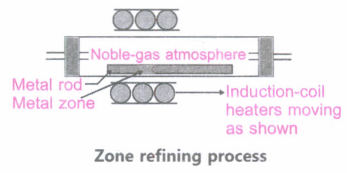
(i) Zone refining: It is based on the principle that impurities are more soluble in melt (molten state) than in the solid state of the metal. The. impure metal rod is heated with the help of circular heater from one end. The impurities move along with the heater and reach the other end which is discarded and pure metal is obtained.
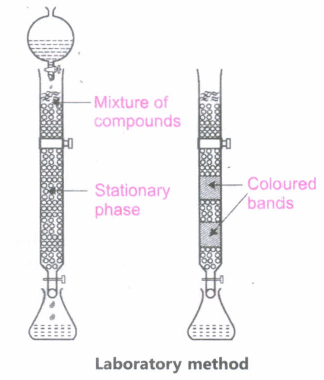
(ii) Column chromatography: In column chromatography, AI2O3 is taken as adsorbent which acts as stationary phase. The mixture of substances to be separated is dissolved in suitable solvent called eluent which acts as mobile phase. The components get separated due to different adsorbing power. The component which has maximum adsorbing power moves slowest. whereas substances which has least adsorbing power moves fastest, and thus, they get separated.

12th Standard CBSE Syllabus & Materials
12th Standard CBSE
CBSE 12th Computer Science Python Revision Tour I - New Previous year Question Papers Study Material - QB365 Set A
NEW12th Standard CBSE
CBSE 12th Business Studies Planning Important Questions And Answers Study Material - QB365 Set A
NEW12th Standard CBSE
CBSE 12th Business Studies Business Environment Important Questions And Answers Study Material - QB365 Set A
NEW12th Standard CBSE
CBSE 12th Business Studies Principles of Management Important Questions And Answers Study Material - QB365 Set A



CBSE 12th Standard CBSE Subjects
CBSE Standards










