
 100% FREE ACCESS
12th Standard CBSE Syllabus & Materials
12th Standard CBSE
CBSE 12th Economics Government Budget and the Economy Previous year Question Papers Study Material - QB365 Set A
NEW12th Standard CBSE
CBSE 12th Computer Science Interface Python with MySQL - New Previous year Question Papers Study Material - QB365 Set A
NEW12th Standard CBSE
CBSE 12th Computer Science Database Concept - New Previous year Question Papers Study Material - QB365 Set A
NEW12th Standard CBSE
CBSE 12th Computer Science Data Communication - New Previous year Question Papers Study Material - QB365 Set A
NEW12th Standard CBSE
CBSE 12th Computer Science Data Structures - New Previous year Question Papers Study Material - QB365 Set A
NEW12th Standard CBSE
CBSE 12th Computer Science Functions - New Previous year Question Papers Study Material - QB365 Set A

Published on: 03/08/2018
In this model question paper, it covers the important question from the term I syllabus. The syllabus that covers chapters are:
1. Reproduction in Organisms
2. Sexual Reproduction in Flowering Plants
3. Human Reproduction
Download CBSE Class 12th Standard CBSE Biology question papers, sample papers, important questions, and previous year solved papers in PDF format. Get free study materials, NCERT solutions, and exam preparation resources for Class 12th Standard CBSE Biology
Questions + Answers key
Take MCQ Biology Test
1.
Positive feedback loop signals from fully developed fetus and placenta ultimately lead to parturition which requires the release of
estrogen from the placenta
relaxing from placenta
oxytocin from fetal pituitary
oxytocin from maternal pituitary
2.
Which accessory genital gland occurs only in mammalian male?
prostate gland
perineal gland
cowper's gland
Bartholin gland
3.
Which one of the following events is correctly matched with the time period in a normal menstrual cycle?
Release of egg: 5-10 days
Endometrium regenerates: 5-10 days
Endometrium secretes nutrients for implantation: 11-18 days
Rise in progesterone level: 1-15 days
4.
Spermatids are transformed into spermatozoa by
spermiation
spermatogenesis
spermiogenesis
spermatosis
5.
Which of the following represents a condition where the motility of the of the sperms is highly reduced?
oligospermia
athenospermia
azoospermia
polyspermy
6.
Which one of the following is the most likely root cause why menstruation is not taking place in the regularly cycling human female?
retention of well-developed corpus luteum
fertilization of the ovum
maintenance of the hypertrophical endometrial lining
maintenance of high conc. of sex hormones in the blood stream
7.
1st polar body is formed at which state of oogenesis?
1st meiosis
2nd mitosis
1st mitosis
differentiation
8.
Which one of the following pairs of plant structures has a haploid number of chromosomes?
Nucellus and antipodal cells
Egg nucleus and secondary nucleus
Megaspore mother cell and antipodal cells
Egg cell and antipodal cells
9.
Through which cell of the embryo sac, does the pollen tube enter the embryo sac?
Egg cell
Persistent synergid
Degenerated synergid
Central Cell
10.
Chiropterophily means...
Pollination by insects
Pollination by the wind
Pollination by bats
Pollination by snails
11.
Which of the following birth control measures can be considered as the safest?
the rhythm method
the use of physical barriers
termination of unwanted pregnancy
sterilization techniques
12.
Which of the following statements is true of Bryophyllum?
Germinating bud appears from the eye of the stem tuber.
Germinating bud appears from the node of the rhizome.
Geminating bud appears from the notch at the leaf margin.
13.
Which of the following statements is true of yeast?
The cell divides by binary fission. One of them develops into a bud.
The cell divides unequally. The smaller cell develops into a bud.
The cell produces conidia, which develop into a bud.
14.
Give reasons why family planning techniques are not adopted by all in our country.
15.
What is mwant by LH-surge?When does it occur?
16.
How many are the cells of tapetum different from the cells of the other wall layers?
17.
What are hermaphrodites? Name two hermaphrodite animals
18.
Is Marchantia monoecious or dioecious? Why? where are the sex organs borne in this plant?
19.
In general, the male gametes are motile while the female gametes are stationary. Mention two types of exceptions to this, with an example for each.
20.
How do homogameters differ from heteroga-metes?
21.
What are
(a) continuous breeders and
(b) seasonal breeders?
22.
How does sexual reproduction enable organisms like algae and fungi to survive during unfavourable conditions?
23.
What is filiform apparatus? What is its function?
24.
Name the following structures:
(a) Single cotyledon of the monocotyledonous embryo of grass family.
(b) The portion of embryonal axis above the level of cotyledons in dicotyledonous embryo.
(c) Occurrence of more than one embryo in a seed
(d) Seedless fruits produced without fertilization.
25.
Each pollen grain produces two male gametes. How many pollen grains will be required to fertilise 4 ovules present in a particular carpel? Give reasons in support of your answer.
26.
Give a schematic view of spermatogenesis in human.
27.
Mention the target cells of lutenising hormone in human males and females.Explain the effect and the changes which the hormone induces in each case.
28.
(a) In plant breeding experiments, pistillate flowers are not emasculated, but are still bagged. Explain.
(b) Why are outbreeding devices developed by some flowering plants?
29.
(a) Explain triple fusion in angiosperms.
(b) Write the fate of the product of this fusion in the mature fruit of coconut.
30.
During a visit to Vaishno Devi, Rahul came across a young couple staying in the adjacent room in the hotel.
He learned that the couple had been visiting different temples and performing rituals to get a child. Rahul was astonished and explained to them about ART which he had recently studied in biology. The couple were happy and understood their wrong approach and thanked Rahul.
(i) What is ART? What is the various method included in ART?
(ii) What are the limitations for which ART is not commonly accepted?
(iii) Identify the values which Rahul showed.
31.
(a) Draw a labelled longisectional view of an albuminous seed.
(b) How are seeds advantages to flowering plants?
32.
Describe the Similarities between Spermatogenesis and Oogenesis.
33.
Write a notes population growth rate.
34.
Explain the development of the zygote into an embryo and of the primary endosperm nucleus into an endosperm in a fertilised embryo sac of a dicot plant.
35.
How can education help in building up a socially responsible and reproductively healthy society?
(Enumerate the aspects that should be emphasised).
36.
Jagan has two mango trees in the backyard of his house, which yielded fruits for the first time during this summer. The fruits were small, fibrous and not so sweet. In the next house, where his friend Ajay livers, there is a mango tree, which yields fruits that are fleshy/juicy, very sweet and bigger in size. Ajay, a student of B.sc. (Botany) comes out with an idea and takes some branches from the jagan's garden to his garden and explains the procedure.
(a) What method do you think Ajay has suggested for getting good quality fruits, on the trees of Jagan's house in a short period of time, i.e. during the next season?
(b) Describe how it is carried out to help japan.
(c) What are its advantages over growing a mango tree with the seeds obtained from Ajay's garden?
(d) Mention the values expressed by Ajay in this case.
37.
A farmer cultivates sugar cane and rose by usin stem cuttings. He found that some of the cuttings did not continue to grow into new plants. As a student of Agriculture; Shanu gives some points to be followed.
(a) Can you suggest a reason for this?
(b) Enlist the aspects that Shanu must have given for consideration, while preparing stem cuttings for propagation.
(c) Name two other plants which are also propagated by stem cuttings.
(d) What value (s) is/are shown by Shanu?
38.
You must have seen your mother adding 3-4 globules of yeast to the idli paste she has prepared. Similarly, brewing industry uses yeast in the manufacture of alcohol.
(a) How does such a small amount of yeast added help to produce thousands of litres of alcohol? Explain how yeast multiples so fast.
(b) Name the process carried out by yeast in these cases.
(c) What value is learnt from these?
1.
(d)
oxytocin from maternal pituitary
2.
(c)
cowper's gland
3.
(b)
Endometrium regenerates: 5-10 days
4.
(c)
spermiogenesis
5.
(b)
athenospermia
6.
(d)
maintenance of high conc. of sex hormones in the blood stream
7.
(a)
1st meiosis
8.
(d)
Egg cell and antipodal cells
9.
(c)
Degenerated synergid
10.
(c)
Pollination by bats
11.
(d)
sterilization techniques
12.
(c)
Geminating bud appears from the notch at the leaf margin.
13.
(b)
The cell divides unequally. The smaller cell develops into a bud.
14.
Family planning techniques are not adopted by all because of the following reasons:
(i) not fully aware of the methods.
(ii)fear of some of the possible ill-effects.
(iii)religious beliefs
(iv)emotional and social factors
15.
LH-surge refers to a very high (maximum) level of LH during the middle of menstrual cycle.
It occurs around the 14th day of mentrual cycle,just before ovulation.
16.
| Cells of tapetum | Cells of other wall layers |
|
They have a dense cytoplasm. They often have more than one nucleus. They do not develop thickenings on their walls. Their function is to nourish the developing pollen grains. |
They do not have dense cytoplasm. They have a single nucleus. They may develop wall thickenings. They help in the dehiscence of the anther and liberation of pollen grains. |
17.
Hermaphrodites are those bisexual organisms which posses both male and female reproductive organs in the same body, e.g. Tapeworm and earthworm.
18.
1. Marchantia is dioecious, because an individual plant of Marchantia bears exclusively either male or female sex organs.
2. The male sex organs are borne on the antheridiophores and female sex organs on archegoniophores.
19.
(i) Both male and female gametes are non-motile, eg. certain algae and few fungi.
(ii) In seed plants, the male gametes are non-motile and are carried in the pollen tube to the egg.
20.
| Homogametes | Heterogametes |
| When the two fusing gametes are similar in appearance and cannot be categorised into male and female gametes, they are called homogametes, eg. Cladophora. | When the two fusing gametes are dissimilar in morphology and/or physiology and can be categorised into male and female gametes, they are called heterogametes, e.g. human beings. |
21.
(a) Those mammals which are reproductively active throughout their reproductive phase, are called continuous breeders.
(b) Those mammals which are living in natural/wild conditions and exhibit the reproductive cycles only under favourable seasons during their reproductive phase, are called seasonal breeders.
22.
Sexual reproduction in organisms like algae and fungi occurs either towards the end of favorable season or at the onset of unfavourable seasons; the zygote formed as a result of sexual reproduction develops a thick wall that helps to survive under unfavourable conditions. Also, sexual reproduction brings in genetic variation, which helps in the better survival of some individuals under an unfavorable change in the environment
23.
The specialised cellular thickenings of the synergids at the micropylar tips are called filiform apparatus.
They guide the pollen tube into the synergid and to liberate the gametes.
24.
(a) Scutellum
(b) Epicotyl
(c) Polyembryony
(d) Patrhenocarpic fruits.
25.
Every pollen grain germinates to produce two male gametes. These are carried to the embryo sac through a pollen tube. The pollen tube enters into the embryosac through the filliform apparatus of one of the synergids and releases two male gametes. Out of two male gametes, one fuse with the egg and the other fuses with the secondary nucleus. Therefore, one pollen grain can fertilise only one ovule and four pollen grains will required to fertilise four ovules.
26.
Spermatogenesis. 1. The process of sperm formation from the sperm mother cells of testis (male gonad) is called spermatogenesis.
2. It starts at puberty (14-16 years).
A. Multiplicative phase
3. The epithelial cells present on the inner wall of seminiferous tubule multiply by mitotic division to form large number of spermatogonia (2N)
4. Some of the spermatogonia serve as stem cells for spermatogenic lineage
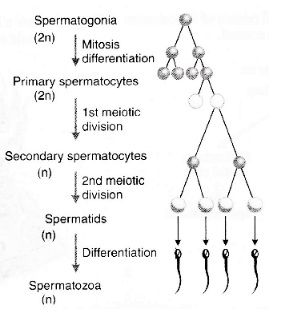
5. Other spermatogonia function as progenitor cells or the precursors of spermatozoa.
27.
The target cells for luteinising hormone in males are the Leydig cells and in females are the mature follicles.
LH in males stimulates the Leydig cells of testes to secrete androgens (testosterone) which controls spermatogenesis.
LH in females stimulates ovulation formation of corpus luteumfrom the reptured follicle and secretion of progesterone by corpus luteum.
28.
(a) In plant breeding experiments, pollen from the selected male parent only, are used for pollination.
To prevent contamination of the stigma by any other pollen grain, the pistillate flowers are bagged.
(b) Continued self-pollination leads to inbreeding depression; hence to discourage self-pollination, outbreeding devices have been developed by flowers.
29.
(a) (i) In the mature embryo sac of an angiosperm, two polar nuclei in the central cell fuse to form a diploid secondary nucleus.
(ii) During fertilisation, one of the male gametes fuses with the secondary nucleus to form a triploid primary endosperm nucleus (PEN); the central cell is now called primary endosperm cell (PEC).
(iii) Since, three nuclei triple fusion.
(b)(i) The primary endosperm nucleus of the primary endosperm cell undergoes repeated mitotic divisions, to give rise to a number of free nuclei; at this stage, the endosperm is called free nuclear endosperm.
(ii) Subsequently, cell wall formation starts from the periphery and the endosperm becomes cellular.
(iii) The water in the tender coconut represents the nuclear endosperm, while the white kernel represents the cellular endosperm.
30.
(i) Assisted reproductive technology. Various methods included in ART are:
(a) Test-tube baby programme which includes IVF and zygote or embryo transfer.
(b) Gamete Intra Fallopian Transfer
(c) Intra Cytoplasmic Sperm Injection
(d) Artificial Insemination Methods
(ii) Limitations of ARTs are as follows:
(a) these techniques require extremely high precision handling by specialized professionals and expensive instrumentation.
Therefore, these facilities are presently available only in a very few center in the country.
(b) Emotional, religious and social factors are also barriers in the adoptions of these methods.
(iii) Sympathetic attitude with alertness and practical approach.
31.
(a) 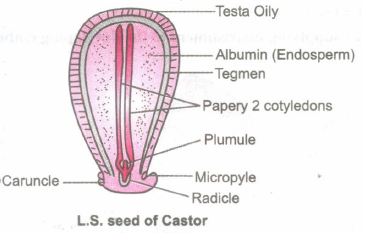
(b) Seeds contain food to nourish the embryo during germination and possess better adaptive strategies for dispersal to new habitats.These are formed by sexual reproduction with new variations and better genetic combinations.
32.
Similarities between Spermatogenesis and Oogenesis.
1. Both the process starts with primordial germ cells derived from inside the gonads.
2. They occur inside the gonads.
3. Both the processes are completed in three phases i.e. multiplication, growth and maturation.
4.Both the processes show meiosis in the maturation phase.
5.Both the processes produce haploid gametes.
33.
Population growth. Population growth is determined by number of individuals added to the population by births (natality) and immigration (entry of individuals of the same species into an area from outside). It increases the population size.The number of individuals lost from the population by deaths (mortality) and emigration (departure of individuals of same species from an area to outside). It decreases the size of local population but the species spreads to new areas.
If more individuals are added than lost, then the population will show positive growth.But if more individuals are lost than added, then the population shows negative growth. But if the two rates are equal, then the population will become stationary and is called zero growth.
Population growth = (Births + immigration) - (Deaths + emigration).
Migration involves the two-way movement of a whole population from one area to another area. Migration is not considered as a factor determining the population size.
Growth Rate. It is the increase in the number of individuals per unit time per unit number of individuals due to natality being higher than mortality.In other words, growth rate is the difference in the birth rate and death rate in a population. The growth rate of human population is 2%; 0.8% in developed countries and 2.5% in developing countries. It is 1.7% in India as per census of 2001.
34.
(a) A develops into the embryo.
B develops into the endosperm.
(b) - The endosperm development starts from the primary endosperm cell containing the primary endosperm nucleus.
- In the most common type of endosperm development, the primary endosperm nucleus undergoes successive free nuclear divisions to give rise to a number of free nuclei; at this stage, it is called free nuclear endosperm.
- Subsequently wall formation takes place from the periphery and proceeds towards the centre and the endosperm becomes cellular.
- This type of endosperm development is seen in coconut; the water of the tender coconut represents the free nuclear endosperm with thousands of nuclei in it and the white kernel around it represents the cellular endosperm.
- In albuminous seeds,some amount of endosperm persists in the mature seed, as the developing' embryo does not consume it fully, e.g. wheat/maize.
-In exalbuminous seeds, the endosperm is completely consumed by the developing embryo before seed maturation, e.g. groundnut and pea.
Development of primary endosperm nucleus:
- The PEN undergoes successive nuclear divisions to give rise to free nuclei, this stage of endosperm development is known as free-nuclear endosperm.
- Subsequently cell wall formation occurs and the endosperm becomes cellular .
35.
Counseling and creating awareness among people about the following aspects would help in building up a reproductively healthy society
(i) Reproductive organs
(ii) Adolescence and associated changes
(iii) Safe and hygienic sexual practices and
(iv) Sexually transmitted diseases
Educating people, especially fertile couples and those in marriageable age group about the following would help to raise a socially responsible society.
(i) Available birth control methods
(ii) Care of pregnant mothers
(iii) Importance of breast feeding and
(iv) Equal opportunities for a girl child.
36.
(a) Grafting a branch from the tree of Ajay's house on a tree of Jagan's garden can be done.
(b) The part of the graft that forms the upper part is called scion and the part of the graft that becomes the supporting portion (the root and base), is called stock.
(i) The scion is selected from a superior quality plant (juicy, larger mango fruits) while the stock belongs to the plant to be improved.
(ii) The scion and stock should be of same diameter and slant cuts are made on both the branches.
(iii) The scion is kept on the stock, covered with grafting clay and polythene; it is tied well and arrangement of water supply/ moisturising is made.
(iv) After a few weeks, you will see buds and leaves appearing on scion.
(c)The mango tree will start producing flowers and fruits very early, may be in the next season itself. - Many branches can be grafted on the tree with poor quality mangoes.
(i) When grown from a seed it takes many years for the tree to produce fruits. - Sometimes the plant produced from the seed may not be of the same quality, as sexual reproduction results in variation.
(d) Values for friendship and generosity.
37.
(a) (i) The polarity of the cutting would not have been correct.
(ii) It can be due to absence of buds.
(iii) The cutting may have been selected from a very old branch.
(b) (i) The cutting must be selected from a branch that is neither very old nor very young.
(ii) There should be enough number of buds.
(iii) The polarity of the cutting should be considered.
(iv) The season of growing must be properly selected.
(c) Bougainvillea, china rose, cotton, etc.(any two)
(d) Shanu's concern for fellow citizen and use of his knowledge for the benefit of the society
38.
(a) Yeast multiplies by budding very fast In yeast, the cell division is unequal and results in a large cell and a small cell, called bud which remains attached to the large cell; the bud gets separated and grows into an adult yeast.
The yeast cells secrete enzymes to produce alcohol.
(b) It carries out the process of fermentation.
(c) Mother shows how to make use of the natural processes and to live with nature and to appreciated how such microbes are useful to us; try to help others.

12th Standard CBSE Syllabus & Materials
12th Standard CBSE
CBSE 12th Computer Science Python Revision Tour I - New Previous year Question Papers Study Material - QB365 Set A
NEW12th Standard CBSE
CBSE 12th Business Studies Planning Important Questions And Answers Study Material - QB365 Set A
NEW12th Standard CBSE
CBSE 12th Business Studies Business Environment Important Questions And Answers Study Material - QB365 Set A
NEW12th Standard CBSE
CBSE 12th Business Studies Principles of Management Important Questions And Answers Study Material - QB365 Set A



CBSE 12th Standard CBSE Subjects
CBSE Standards










