
 100% FREE ACCESS
12th Standard CBSE Syllabus & Materials
12th Standard CBSE
CBSE 12th Economics Government Budget and the Economy Previous year Question Papers Study Material - QB365 Set A
NEW12th Standard CBSE
CBSE 12th Computer Science Interface Python with MySQL - New Previous year Question Papers Study Material - QB365 Set A
NEW12th Standard CBSE
CBSE 12th Computer Science Database Concept - New Previous year Question Papers Study Material - QB365 Set A
NEW12th Standard CBSE
CBSE 12th Computer Science Data Communication - New Previous year Question Papers Study Material - QB365 Set A
NEW12th Standard CBSE
CBSE 12th Computer Science Data Structures - New Previous year Question Papers Study Material - QB365 Set A
NEW12th Standard CBSE
CBSE 12th Computer Science Functions - New Previous year Question Papers Study Material - QB365 Set A

Published on: 31/07/2018
From the chapter Haloalkanes and Haloarenes, some of the important questions are covered in this question paper. The questions are covers from the book back and the previous year questions.
Download CBSE Class 12th Standard CBSE Chemistry question papers, sample papers, important questions, and previous year solved papers in PDF format. Get free study materials, NCERT solutions, and exam preparation resources for Class 12th Standard CBSE Chemistry
Questions + Answers key
Take MCQ Chemistry Test
1.
what happens when chlorobenzene is subjected to hydrolysis?
2.
Discuss the nature of C-X bond in the haloarenes.
3.
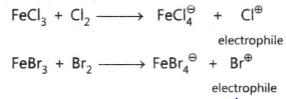
Discuss the role of Lewis acids in the preparation of aryl bromides and chlorides in the dark.
4.
Aryl chlorides and bromides can be easily prepared by electrophilic substitution of arenes with chlorine and bromine respectively in the presence of Lewis acid catalysts. But why does preparation of aryl iodides requires presence of an oxidising agent?
5.
Draw the structures of optically active unsaturated compound having molecular formula C5H9Br, that after addition of H2 becomes either optically inactive or shows optical activity.
6.
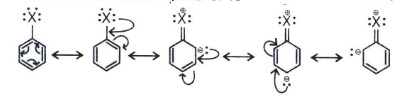
Why are haloarenes more stable than haloalkanes and undergo electrophilic substitution reaction at ortho and para positions?
7.
Trichloromethane or chloroform is a colorless oily liquid with a peculiar smell.It is sparingly soluble in water.The vapor when enhaled cause unconsciousness and therefore, it is used as an anesthetic.
Answer the following questions:
(i) What happens when chloroform is not protected from oxygen during its storage?
(ii) Why is the use of chloroform as an anesthetic has been reduced?
8.
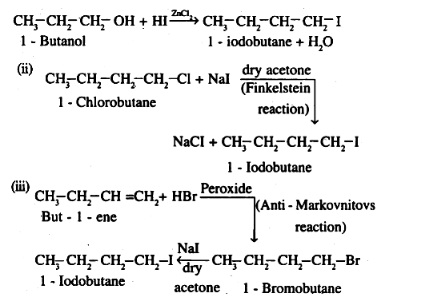
Write the equations for the preparation of 1-iodobutane from:
(a) 1-iodobutane from:
(b) 1-butanol
(c) but-1-ene.
9.
The reagents used in the preparation DDT from chlorobenzene are
Chloral (CCI3CHO)
Conc.II2SO4
CH3COCCI3
CH2CICOCH2CI
10.
Which of the following compound/s on halo-generation give a racemic mixture of products ?
(CH3)4C
CH3CH2CH2CH3
CH3CH2CH3
CH3CH3
11.
Which of the following methods cannot be used to prepare allyl fluride ?
CICH2CH = CH2 \(\xrightarrow { NaF,acetone } \)
CH3CH = CH2 + F2 \(\xrightarrow { hv } \)
HOCH2CH = CH2 \(\xrightarrow { HF } \)
CICH2CH = CH2+AgF \(\longrightarrow \)
12.
An alkyl bromide (X) reacts with sodium in ether to form 4,5-diethyloctane, the compound (X) is
CH3(CH2)3Br
CH3(CH2)5Br
CH3(CH2)3CH(Br)CH3
CH3__(CH2)2__CH(Br)__CH2CH3
13.
In the following reaction,
C6H5CH2Br \(\xrightarrow [ (ii){ H }_{ 3 }{ O }^{ + } ]{ (i)Mg,ether } \)
the product 'X' is
C6H5CH2OCH2C6H5
C6H5CH2OH
C6H5CH3
C6H5CH2CH2C6H5
14.
The order of rate of hydrolysis of alkyl halides 1o, 2o, 3o and CH3 X by the SN2 pathway is
1o > 2o > 3o > CH3X
CH3X > 3o > 2o > 1o
CH3X > 1o > 2o > 2o
3o > 2o > 1o > CH3X
15.
The intermidiate during the addition of HCI to propane in presence of peroxide is
CH3\(\overset { \bullet }{ C } \)HCH2 CI
CH3\(\overset {+ }{ C } \)CH3
CH3CH2\(\overset { \bullet }{ C } \)H2
CH3CH2\(\overset {+ }{ C } \)H2
16.
Which of the following events does not occur during SN2 reaction mechanism?
Back side attack of nucleophile
Formation of carbonium ion
One step continuous process
100% inversion of configuration
17.
Which of the following are arranged in the decreasing order of dipole moment?
CH3Cl, CH3Br, CH3F
CH3Cl, CH3F, CH3Br
CH3Br, CH3Cl, CH3F
CH3Br, CH3F, CH3Cl
18.
The reaction of hydrogen bromide with propene in absence of peroxide is an example of a/an
free radical addition
nucleophilic addition
electrophilic substitution
electrophilic addition
19.
Vinyl chloride on reaction with dimethyl copper gives.......
20.
Alkyl halides are insoluble in water because they do not form ......... with water.
21.
Carbon compounds containing more than one halogen atom are usually called polyhalogen compounds. Polyhalogen compounds are useful in industry and agriculture. One of the important polyhalogen compound is used as an insecticide.
(i) Name the polyhalogen compound for which Paul Muller won the Nobel Prize in medicine and physiology. Draw its structure also.
(ii) Why is the use of DDT banned in some countries?
(iii) What values do you derive from the answer of above question?
22.
Benzene on reaction with HOCI in presence of an acid produces organic compound (A), (A) on treatment with NaNH2/liq. NH3 furnishes another organic compound (B). (B) on treatment with HBF4 affords an organic compound (C) wich on heating with NaNO2 gives organic compound (D). Identify (A), (B), (C) and (D).
1.
Phenol is formed.
2.
In haloarenes, there is double bond character between C----X Bond due to resonance, therefore, it is less reactive and difficult to break.
3.
It helps in generation of electrophile.
4.
It is because iodination is reversible as HI formed is good reducing agent which needs to be removed with the help of oxidising agent.
5.

6.
Haloarenes are resonance stabilized. Due to resonance, C-X bond in haloarenes acquire a double bond character which makes them more stable than haloalkanes.
7.
(i) In the presence of air and light, chloroform is oxidized to poisonous gas phosgene.
\(CHC{ l }_{ 3 }+\frac { 1 }{ 2 } { O }_{ 2 }\overset { Air\quad or\quad light }{ \longrightarrow } \quad COC{ l }_{ 2 }+HCl\\ Phosgene\)
(ii) Continuous chloroform exposure may damage liver and kidneys because chloroform is metabolised to poisonous phosgene. Some people develop sores when the skin comes in contact with chloroform for a long time. Therefore, use of chloroform as an anesthetic has been replaced by less toxic and safer anesthetic such as ether.
8.
(i) 1-butanol
9.
(a)
Chloral (CCI3CHO)
10.
(b)
CH3CH2CH2CH3
11.
(a)
CICH2CH = CH2 \(\xrightarrow { NaF,acetone } \)
12.
(d)
CH3__(CH2)2__CH(Br)__CH2CH3
13.
(a)
C6H5CH2OCH2C6H5
14.
(c)
CH3X > 1o > 2o > 2o
15.
(a)
CH3\(\overset { \bullet }{ C } \)HCH2 CI
16.
(b)
Formation of carbonium ion
17.
(b)
CH3Cl, CH3F, CH3Br
18.
(d)
electrophilic addition
19.
()
propene, 2CH2=CHCl+(CH3)2Cu\(\rightarrow\) 2H2=CHCH3+CuCl2
20.
()
H-bonds
21.
(i) The polyhalogen compound for which Paul Muller was awarded the Nobel Prize is DDT. (Dichlorodiphenyltrichloroethane). The structure of DOT is given below:
(ii) The use of DOT is banned in some countries because:
(a) it is toxic to aquatic life.
(b) it is not degraded rapidly by soil microorganisms due to its complex structure.
(c) it is not metabolized rapidly by animals and deposited in the fatty tissues.
(d) Because of its stability, it accumulates in food chain leading to biomagnification.
(iii) Environmental protection and sensitivity towards life.
22.
(i) HOCI in presence of an acid generates the reactive electrophile, chloronium ion «r, which attacks benzene to give chlorobenzene (A).
(ii) Chlorobenzene (A) on treatment with NaNH2/liq. NH3 undergaes-dehydrohalogenation via benzyne to afford aniline (B).
(iii) Aniline (B) on treatment with HBF4 forms the corresponding salt anilinium tetrafluoroborate (C) which on heating with NaNO2 undergoes Balz-Schiemann reaction through the intermedium formation of benzenediazonium tetrafluoroborate to afford fluorobenzene (D).

12th Standard CBSE Syllabus & Materials
12th Standard CBSE
CBSE 12th Computer Science Python Revision Tour I - New Previous year Question Papers Study Material - QB365 Set A
NEW12th Standard CBSE
CBSE 12th Business Studies Planning Important Questions And Answers Study Material - QB365 Set A
NEW12th Standard CBSE
CBSE 12th Business Studies Business Environment Important Questions And Answers Study Material - QB365 Set A
NEW12th Standard CBSE
CBSE 12th Business Studies Principles of Management Important Questions And Answers Study Material - QB365 Set A



CBSE 12th Standard CBSE Subjects
CBSE Standards










