
 100% FREE ACCESS
12th Standard CBSE Syllabus & Materials
12th Standard CBSE
CBSE 12th Economics Government Budget and the Economy Previous year Question Papers Study Material - QB365 Set A
NEW12th Standard CBSE
CBSE 12th Computer Science Interface Python with MySQL - New Previous year Question Papers Study Material - QB365 Set A
NEW12th Standard CBSE
CBSE 12th Computer Science Database Concept - New Previous year Question Papers Study Material - QB365 Set A
NEW12th Standard CBSE
CBSE 12th Computer Science Data Communication - New Previous year Question Papers Study Material - QB365 Set A
NEW12th Standard CBSE
CBSE 12th Computer Science Data Structures - New Previous year Question Papers Study Material - QB365 Set A
NEW12th Standard CBSE
CBSE 12th Computer Science Functions - New Previous year Question Papers Study Material - QB365 Set A

Published on: 05/03/2019
Human Reproduction Important Questions
Download CBSE Class 12th Standard CBSE Biology question papers, sample papers, important questions, and previous year solved papers in PDF format. Get free study materials, NCERT solutions, and exam preparation resources for Class 12th Standard CBSE Biology
Questions + Answers key
Take MCQ Biology Test
1.
Write the function of each of the following:
(a)Luteinizing hormone in human males
(b) Middle piece of human sperm
2.
Name the pouch in which the human tests are present.
3.
When does a woman attain puberty?
4.
What is the special structural feature of the epithelial cells that line the fallopian tube?
5.
Which particular part of human sperm secretes enzymes to facilitate its penetration into the ovum?
6.
What is the function of the secretion of bulbourethral glands apart from nourising the spermatozoa?
7.
When do oogenesis and spermatogenesis initiate in human female and male,respectively?
8.
The diagram shows the side view of the female reproductive system (i) Label the parts A to D.
(ii) In which region are sperms released during intercourse?

9.
Match the items given in column I with appropriate items (one or more) of column II.
| Column I | Column II |
| (i) Acrosome | (a) Testes |
| (ii) Leydig's cells | (b) Monocystis |
| (iii) Clone | (c) Passage of urine |
| (iv) Isogamy | (d) Genetically identical offspring |
| (v) Male urethra | (e) Testosterone |
| (f) Passage of sperms | |
| (g) Spermatozoon |
10.
What is decidua? Explain its kinds.
11.
What is corpus luteum? Under what conditions does it undergo degeneration?
12.
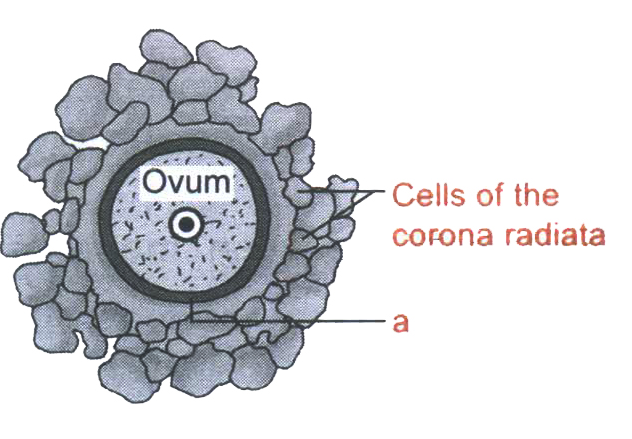
(i) Name the part labelled 'a' and its function.
(ii) Mention the site of fertilisation in the fallopian tube of human female where the ovum and sperm meet exactly.
13.
Name two hormones (other than gonadotropins,ovarian and placental hormones) that increase several fold in the maternal blood during pregnancy.What is the need for them?
14.
Name the organs where gametogenesis gets completed in human male and female,respectively.
15.
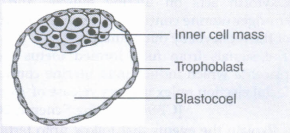
Draw a labelled diagram of the embryonic stage that gets implanted in the human uterus. State the functions of the two parts labelled
16.
Explain the events in a normal woman during her menstrual cycle on the following days:
(a) Pituitary hormone levels from 8 to 12 days
(b) Uterine events from 13 to 15 days
(c) Ovarian events from 16 to 23 days.
17.
Note the relationship between first two words and suggest suitable word/words for the fourth place.
(i) Testis: spermatogenesis :: ovary : ______.
(ii) Male: penis :: female : ______.
(iii) Ovary : mesovarium :: uterus : ______.
(iv) Man: Vasectomy :: Woman: ______.
(v) Interstitial cells: testosterone :: Graafian follicle cells :______.
(vi) Menstrual cycle: human female :: oestrous cycle :______.
18.
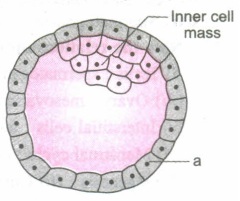
Study the figure given below and answer the questions that follows:
(a) Name the stage of human embryo the figure represents
(b) Identify 'a' in the figure and mention its function
(c) Mention the fate of the inner cell mass after implantation in the uterus.
(d) Where are the stem cells located in this embryo?
19.
(a) In which part of the humaa female reproductive system do the following events take place?
I - Release of 1st polar body.
II - Release of 2nd polar body.
III - Fertilisation
IV - Implantation
(b) From where do signals for partuirition originate and what does maternal pituitary release for stimulating uterine contractions for child birth?
20.
Describe the duct system of human male reproductive system.
21.
Describe how the changing levels of FSH,LH and progesterone during mentrual cycle induce changes in the ovary and the uterus in human female.
22.
Nisha's grandmother often blames her mother for giving birth to 3 daughters and no son and therefore wants another marriage of her son. Answer following questions on the basis of above information.
(i) Is it right to blame a female for determination of sex and giving birth to only girls? Justify.
(ii) What values are not exhibited by Nisha's grandmother.
23.
The graph given below shows the variation in the levels of ovarian hormones during various phases of menstrual cycle :
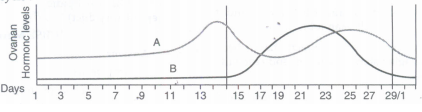
(a) Identify 'A' and 'B'.
(b) Specify the source of the hormone marked in the diagram.
(c) Reason: out why A peaks before B.
(d) Compare the role of A and B.
(e) Under which condition will the level of B continue to remain high on the 28th day?
24.
During the biology class, teacher was explaining the human reproductive system. Ankita was busy doing work of some other subject and so missed on the topic. When the teacher asked questions Ankita was unable to answer them. She, however, realised her mistake and requested the teacher to explain the topic once again. The teacher happily repeated.
(i) What is the primary sex organ in male?
(ii) What is tunica albuginea?
(iii) Name the three layers of tissue of uterus.
(iv) Identify the values shown by the teacher.
25.
Explain the events taking place at the time of fertilisation of an ovum in human female.
26.
Identify the human development stage shown as well as the related right place of its occurrence in a normal pregnant woman, and select the right option for the two together.
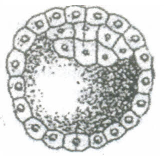
| Development stage | Site of occurrence |
| (a) Late morula | Middle part of Fallopian tube |
| Development stage | Site of occurrence |
| (b) Blastula | End part of Fallopian tube |
| Development stage | Site of occurrence |
| (c) Blastocyst | Uterine wall |
| Development stage | Site of occurrence |
| (d) 8-celled morula | Starting point of Fallopian tube |
27.
The given figure depicts a diagrammatic sectional view of the human female reproductive system.Which set of three parts out of I-IVI have been correctly identified?
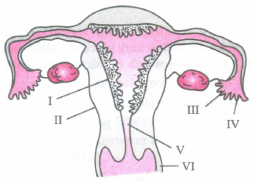
ii) endometrium, iii)infundibulum, iv)fimbrae
iii) infundibulum iv) fimbriae, v) cervix
iv) oviducal funnel, v) uterus, vi)cerix
i) perimetrium, ii)myometrium, iii)fallopian tube
28.
In the absence of acrosome, the sperm
Cannot get food
cannot swin
cannot penetrate the egg
cannot get energy
29.
What is present in the middle piece of sperm?
acrosome
mitochondria
nucleus
proximal centriole
30.
Which of the following statements about morula in humans is correct?
It has more cytoplasm and more DNA than an uncleaved zygote
It has almost equal quantity of cytoplasm as an uncleaved zygote but much more DNA
It has far less cytoplasm as well as less DNA than in an uncleaved zygote.
It has more or less equal quantity of cytoplasm and DNA as in uncleaved zygote.
31.
The main function of Trophectoderm in mammalian embryo is
Protection of the developing cells
Drawing food for the developing cells
Formation of future ectoderm
Formation of placenta
Formation of the body of developing embryo
32.
Which one of the following is the most likely root cause why menstruation is not taking place in the regularly cycling human female?
retention of well-developed corpus luteum
fertilization of the ovum
maintenance of the hypertrophical endometrial lining
maintenance of high conc. of sex hormones in the blood stream
33.
Some important events in the human female reproductive cycle are given below.Arrange the events in a proper sequence.A-secretion of FSH, B-growth of corpus luteum, C-growth of the follicle and oogenesis, D-ovulation, E-sudden increase in the levels of LH
A D C E B
B A C D E
C A D B E
A C E D B
34.
In human beings, the eggs are:
Skin lecithal
Macrolecithal
Mesolecithal
Alecithal
35.
Fertilization takes place in ________.
36.
Study the given figure
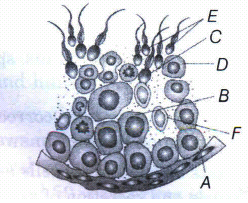
(i) Pick out and name the cells that undergo spermiogenesis.
(ii) Name 'A' and 'B' cells. What is the difference between them with reference to the number of chromosome?
(iii) Pick out and name the motile cells.
(v) What is 'F' cell? Mention its function?
(iv) Name the structure of which the given diagram is a part?
1.
()
(a) Luteinizing hormone (LH) stimulate leydig cell to secrete androgens which in turn stimulate spermatogenesis.
(b) There are numerous mitochondria in the middle piece of sperms which produce energy and required for the movement of sperms.
2.
()
Scrotum
3.
()
Women attain puberty about the age of 13.
4.
()
Epithelial cells that line the fallopian tubes are ciliated
5.
()
Acrosome
6.
()
It helps in the lubrication of the penis.
7.
()
Oogenesis starts during embryonic developmental stages of the female foetus.
Spermatogenesis starts at puberty.
8.
(i) A - Utreus B - Fallopian tube C - Ovary D - Vagina
(ii) The penis reaches into the vaginal area thus, the sperms are released in vagina.
9.
(i) g
(ii) a, e
(iii) d
(iv) b
(v) c, f
10.
If implantation occurs, a portion of the endometrium of the uterus becomes modified and is called the decidua. The decidua is shed when the foetus is delivered. There are three kinds of decidua.
(i) Decidua basalis. It is the portion of the endometrium between the chorion and the myometrium of the uterus. The decidua basalis becomes the maternal part of the placenta.
(ii) Decidua capsularis. It is the portion of the endometrium between the embryo and uterine cavity.
(iii) Decidua parietalis. It is the portion of the modified endometrium that lines the entire pregnant uterus, except for the area where the placenta is forming.
11.
The corpus luteum is formed in the mammalian ovary from a reputed Graaflan follicle after ovulation.It degenerates in the absence of fertilisation as the level of gonadotropins (FSH and LH) drops.
12.
(i) 'a' is zona pellucida.
The changes that occur in it when a sperm comes in contact with it, block the entry of other sperms.
(ii) Ampullary - isthmic junction of fallopian tube.
13.
Cortisol and thyroxine.
These hormones are essential for supporting the foetal growth,metabolic changes in the mother and maintenance of pregnancy.
14.
In males,gametogenesis is completed in the testes.
In females,it is completed in the ovary and fallopian tube.
15.
16.
(a) FSH and LH levels - low
(b) Endometrium is highly vascularised, proliferative phase of uterine lining.
(c) Formation of corpus luteum, secretion of progesterone.
17.
(i) Oogenesis
(ii) Clitoris
(iii) Mesometrium
(iv) Tubectomy
(v) Estrogens
(vi) Female rabbit
18.
(a) Blastula stage of human embryo (also called blastocyst).
(b) 'a' in the figure is trophoblast (trophoectoderm). The trophoblast gives rise to extraembryonic membranes for the protection and nourishment of the embryo.
(c) The inner cell mass (after implantation in the uterus) gives rise to three germ layers (ectoderm, mesoderm and endoderm) or simply embryo.
(d) Inner cell mass (embryonal knob) represents the stem cells.
19.
(a) I - Teritiary follicle
II - Ampullary-isthmic junction
III - Ampullary-isthmic junction
IV - Endometrium of uterus.
(b) The signals originate from the fully developed foetus and the placenta.
Pituitary releases oxytocin,that stimulates stronger contractions of the uterine muscles.
20.
Duct System of male Reproductive System.
The intratesticular duct system starts with tubuli recti,which are the short,straight end segments of the seminiferous tubules ;these tubules connect the seminiferous tubules to the cuboidal epithelium-lined channels,called rete testis.
Form the rete testis arise 10-20 fine tubules,called vasa efferentia that leave the testis and open into the epididymis.
Epididymis is a single convoluted tubule that is located along the posterior surface of the testis.
The epididymis continues as the vas-deferens,that ascends into the abdominal cavity through inguinal canal.
It loops over the urinary bladder and receives a duct from the seminal vesicle of its side to form ejaculatory duct that runs through the prostate and opens into the prostatic urethra,just after its emergence from the urinary bladder.
The urethra receives the ducts of prostate gland and bulbourethral glands,a little ahead and runs through the penis to its openning called urethral meatus,to the outside.
21.
The menstrual phase (menstruation) is followed by follicular or proliferative phase;it is under the influence of follicle stimulating hormone (FSH) from the anterior pituitary. The primary follicle matures into Graafian follicle;the follicular cells secrete estrogens,which control the growth and maintenence of the secondary sex organs like uterus,fallopian tube,ect. The FSH and lutenising hormone reach their peak level around the 14th day of menstrual cycle. The peak level of LH or LH surge causes the rupture of Graafian follicle and release of ovum;this process is called ovulation. It is followed by luteal phase,where LH influences the ruptured Graafian follicle to transform into corpus luteum. Corpus luteum secretes large quantity of progesterone in the luteal phase,which is necessary for the growth and maintenance of endometrium of uterus for implantation. If fertilisation does not occur,corpus luteum degenerates and progesterone is not secreted. The endometrium degenerates and menstruation occurs.
22.
(i) It is not correct to blame a females for giving birth to female child. The sex of the baby is determined by the male gamete, because the man is heterogametic and produces two types of sperms x and y. Female is homogametic and produce only one type of ova i.e., X. Now if the X sperm with X chromosome fuses with egg the zygote XX will develop into female baby and if sperm with Y chromosome fuses with egg the (XY) baby would be male.
(ii) Values: Following values are not exhibited by Nisha's grandmother:
(a) understanding and awareness
(b) Respect to females.
23.
(a) (A) Estrogen
(B) Progesterone
(b) (A) Maturing ovarian follicle/Graafian follicle
(B) Corpus luteum
(c) Formation of Graaffian follicle (releases estrogen) is followed by the formation of corpus luteum (releases progesterone)
(d) Role of A (Estrogen)-Leads to changes in the ovary and uterus/regeneration of endometrium through proliferation
Role of B (Progesterone)-Maintenance of endometrium for implantation of the fertilized ovum/maintenance of other events of pregnancy.
(e) In case of pregnancy.
24.
(i) Tests are the primary sex organs in males. It is the site where male gametes or sperms are made.
(ii) The outermost covering of the tests is formed of a dense fibrous membrane called tunica albuginea.
(iii) Uterus has a thick wall composed of three layers of tissues as follows:
(a) Outer perimetrium
(b) Middle myometrium
(c) Inner endometrium
(iv) The teacher is patient, understanding, has scientific knowledge and is dutiful.
25.
Fertilisation is the fusion of two gametic nuclei to form a diploid zygote.It involves a series of chemical and physical steps as follows:
The cortical cytoplasm of ovum shows the physicochemical reactions called the cortical reactions.
1.Sperm lysins dissolve the membranes around egg.centriole physically passes into ovum.
3.Normally these reactions result in the formation of fertilisation membrane outside the egg plasma membrane.
4.In man, cortical granules burst and release their contents between egg plasma membrane and zona pellucida i.e. perivitelline space (No fertilisation membrane formation).The plasma membrane shows increased permeability for water, phosphate and potassium.
5.Electrical potentiality of plasma membrane changes from positive to negative, NAD kinase enzyme becomes activated after fertilisation for the oxidation and reduction reaction of the cell.
6.Rate of DNA synthesis increases with great pace after fertilisation.Hence the ovum is now ready for mitosis(cleavage).
7.Cleavage results in multicellular in dividual.
26.
(c)
| Development stage | Site of occurrence |
| (c) Blastocyst | Uterine wall |
27.
(b)
iii) infundibulum iv) fimbriae, v) cervix
28.
(c)
cannot penetrate the egg
29.
(b)
mitochondria
30.
(b)
It has almost equal quantity of cytoplasm as an uncleaved zygote but much more DNA
31.
(d)
Formation of placenta
32.
(d)
maintenance of high conc. of sex hormones in the blood stream
33.
(d)
A C E D B
34.
(d)
Alecithal
35.
()
ampullary - isthmic function of fallopian tube
36.
(i) A-Spermatids, undergo spermiogenesis
(ii) A-Spermatids, B-Spermatogonium.
Spermatogonium (B) are diploid and have 46 chromosomes in humans, while spermatids (A) are haploid and have 23 chromosomes in case of human male.
(iii) E-spermatozoa, are motile cells
(iv) F-Sertoli cell, it provides nutrition to the germ cells
(v) Seminiferous tubule.

12th Standard CBSE Syllabus & Materials
12th Standard CBSE
CBSE 12th Computer Science Python Revision Tour I - New Previous year Question Papers Study Material - QB365 Set A
NEW12th Standard CBSE
CBSE 12th Business Studies Planning Important Questions And Answers Study Material - QB365 Set A
NEW12th Standard CBSE
CBSE 12th Business Studies Business Environment Important Questions And Answers Study Material - QB365 Set A
NEW12th Standard CBSE
CBSE 12th Business Studies Principles of Management Important Questions And Answers Study Material - QB365 Set A



CBSE 12th Standard CBSE Subjects
CBSE Standards










