
 100% FREE ACCESS
12th Standard CBSE Syllabus & Materials
12th Standard CBSE
CBSE 12th Economics Government Budget and the Economy Previous year Question Papers Study Material - QB365 Set A
NEW12th Standard CBSE
CBSE 12th Computer Science Interface Python with MySQL - New Previous year Question Papers Study Material - QB365 Set A
NEW12th Standard CBSE
CBSE 12th Computer Science Database Concept - New Previous year Question Papers Study Material - QB365 Set A
NEW12th Standard CBSE
CBSE 12th Computer Science Data Communication - New Previous year Question Papers Study Material - QB365 Set A
NEW12th Standard CBSE
CBSE 12th Computer Science Data Structures - New Previous year Question Papers Study Material - QB365 Set A
NEW12th Standard CBSE
CBSE 12th Computer Science Functions - New Previous year Question Papers Study Material - QB365 Set A

Published on: 30/07/2018
Human Reproduction - Important Question Paper
Download CBSE Class 12th Standard CBSE Biology question papers, sample papers, important questions, and previous year solved papers in PDF format. Get free study materials, NCERT solutions, and exam preparation resources for Class 12th Standard CBSE Biology
Questions + Answers key
Take MCQ Biology Test
1.
Luteal phase of the menstrual cycle is also called the secretory phase. Give reason.
2.
What is the other name for trophoblast cells lying over the embryonic disc.
3.
Which event marks the animal pole of the human ovum?
4.
How many sperms are present in a single ejaculation?
5.
What is the location of Sertoli cells?
6.
Name the part of blastocyst that forms the embryo proper.
7.
What is urethral meatus?
8.
Mention the importance of LH surde during menstrual cucle.
9.
How does the sperm penetrate through the zona pellucida in human ovum?
10.
Why scrotal sacs are present outside the body?
11.
(a) Name the human embryonic stage shown below. Identify 'a' and 'b' in it.
.png)
(b) Mention the part of the above embryonic stage that forms the foetus.
12.
Describe the events of changes that take place in the reproductive organs of a human female during follicular phase of menstrual cycle.
13.
Why is it considered that the presence or absence of hymen is not an indication of virginity?
14.
Explain the development of a secondary oocyte(ovum) in a human female from the embryonic stage upto its ovulation.Name the hormones involved in this process?
15.
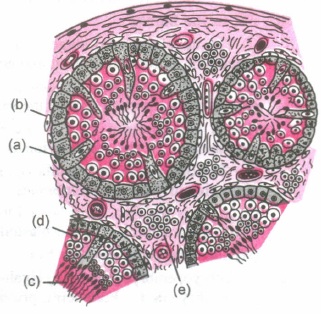
Study the given figure carefully and answer the following question:
(i) Label the parts marked as (a), (b), (c), (d) and (e).
(ii) Give one major function of each part.
16.
Describe the different parts of the fallopian tube of human female reproductive system.
17.
Describe the duct system of human male reproductive system.
18.
Mention the target cells of lutenising hormone in human males and females.Explain the effect and the changes which the hormone induces in each case.
19.
Pihu told her sister Pari that even after five years marriage she is not able to bear a child and have to hear sarcastic remarks of her in-laws make her depressed. Pari told Pihu that she and her husband should get examined by a doctor. After examination, doctor found no abnormalities in Pihu and her husband except low sperm count and some defects in the erection of penis of her husband.
(i) What are the possible causes of low sperm counts?
(ii) What is the use of erection of penis?
(iii) What are the possible treatments?
(iv) Mention the values shown by Pari.
20.
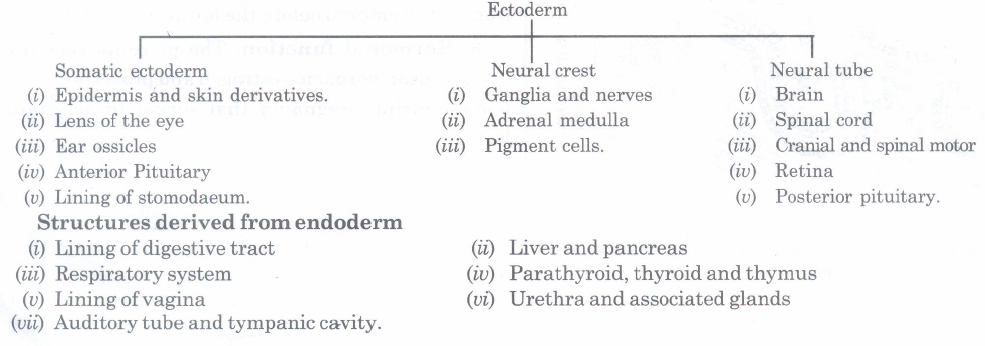
What are the main structures and organs which differentiate from the ectoderm and endoderm of an embryo?
21.
The Leydig cells found in the human body are the secretory source of
Progesterone
intestinal mucus
glucagon
androgens
22.
Which one of the following is the correct matching of the events occurring during menstrual cycle?
Menstruation: breakdown of myometrium and ovum not fertilized
Ovulation:LH and FSH attain peak level and sharp fall the in secretion of progesterone.
Proliferative phase: Rapid regeneration of myometrium and maturation of Graafian follicle
Development of corpus luteum: Secretary phase and increased secretion of progesterone
23.
Some important events in the human female reproductive cycle are given below.Arrange the events in a proper sequence.A-secretion of FSH, B-growth of corpus luteum, C-growth of the follicle and oogenesis, D-ovulation, E-sudden increase in the levels of LH
A D C E B
B A C D E
C A D B E
A C E D B
1.
()
In this phase, progesterone stimulates the endometrial glands of the uterus to secrete a nutrient fluid for the foetus hence also the secretory phase.
2.
()
Cells of Rauber
3.
()
Extrusion of polar bodies.
4.
()
About 400 million
5.
()
Sertoli cells. They are situated among the cells of germinal epithelium of the seminiferous tubules, stretching from the outer layer of the tubules to the lumen.
6.
()
Inner cell mass
7.
()
Urethral meatus refers to the external opening of urethra at the tip of the penis.
8.
()
LH surge (maximum level of luteinizing hormone) leads to ovulation,i.e. the rupture of mature Graafian follicle and the consequent release of ovum.
9.
()
The sperm penetrates through zona pellucida with the help of secretions from acrosome.
10.
It is a pouch of deeply pigmented skin divided into two separate sacs.Each sac contains one testis.The normal temperature of the testes in the scrotum is about \({ 2 }^{ \circ }C\)lower than the internal body temperature the ideal temperature for developing sperms.
11.
(a) It is a blastocyst.
'a' - Inner cell mass.
'b' -Trophoblast
(b) Inner cell mass
12.
Follicular phase.
The primary follicles in the ovary grow and become a fully mature Graafian follicle.
The endometrium of the uterus is regenerated by proliferation of the cells.
These changes are due to an increased level of pituitary hormones,FSH and LH and ovarian hormone,estrogen.
FSH controls the follicular phasa; it stimulates the growth of follicles and secretion of estrogen by the follicular cells.
Both FSH and LH reach their peak level in the middle of the cycle.
13.
1.Hymen is the membrane that partially covers the vaginal opening.
2.The hymen gets torn during the first coitus.
3. But it can also be torn by active participation in sports like horse-riding,cycling,or by a sudden fall or jolt and insertion of vaginal tampon;so its presence or absence cannot indicate virginity.
14.
The process of formation of a mature female ganete is called oogenesis. This process starts during embryonal stages where millions of gamete mother cells, oogonia are formed in foetal ovary.
Oogonia starts division and enters prophase-I and gets temporarily arrested at this stage to forn primary oocytes. Each primary oocyte gets surrounded by a layer of granulosa cells forming primary follicle. From birth to puberty, large number of follicles degenerate (follicular atresia) and at puberty 60,000-80,000 follicles are left in each ovary.
Primary follicles form secondary follicles, surrounded by more layers of granulosa cells.
Secondary follicle transforms into tertiary follicle with a fluid-filled cavity called antrum, having theca externa and theca interna. The primary oocyte completes Ist meiotic division (grows in size) forming two unequal haploid cells, large haploid secondary oocyte and a tiny first polar body.
Tertiary follicle transforms into mature Graafian follicle, which bursts to release ovum/secondary oocyte (ovulation). The hormones involved are FSH (Follicle Stimulating Hormone) and LH (Luteinizing Hormone) secreted by anterior pituitary in response to production of GnRH (Gonadotropin Releasing Hormone). FSH stimulates follicular growth and maturation of oocyte.Granulosa cells of follicles produce oestrogen. In the presence of both LH and oestrogen, ovulation Occurs.
15.
(i) (a) Sertoli cells
(b) Seminiferous tubule
(c) Spermatozoa
(d) Spermatogonia
(e) Interstitial cells.
(ii) Function of parts:
(a) Sertoli cells provide nutrition to developing spermatozoa.
(b) Spermatozoa are formed in the seminiferous tubules from spermatogonia that arise from germinal epithelial cells.
(c) These are male gametes which fertilize the ovum.
(d) The spermatogenic cells of germinal epithelium lining the seminiferous tubules by mitotic divisions produce spermatogonia. The latter undergo meiotic division to form spermatozoa.
(e) Interstitial cells secrete male sex hormones (Testosterone).
16.
Each fallopian tube extends from the periphery of each ovary to the uterus.
The part of the fallopian tube closer to the ovary is the funnel-shaped infundibulum.
The edges of the infundibulum possess finger like projections,called fimbriae.
The infundibulum leads to the wider part of the fallopian tube,called ampulla.
The last part of the oviduct with a narrow lumen;is called isthmus;it joins the uterus.
17.
Duct System of male Reproductive System.
The intratesticular duct system starts with tubuli recti,which are the short,straight end segments of the seminiferous tubules ;these tubules connect the seminiferous tubules to the cuboidal epithelium-lined channels,called rete testis.
Form the rete testis arise 10-20 fine tubules,called vasa efferentia that leave the testis and open into the epididymis.
Epididymis is a single convoluted tubule that is located along the posterior surface of the testis.
The epididymis continues as the vas-deferens,that ascends into the abdominal cavity through inguinal canal.
It loops over the urinary bladder and receives a duct from the seminal vesicle of its side to form ejaculatory duct that runs through the prostate and opens into the prostatic urethra,just after its emergence from the urinary bladder.
The urethra receives the ducts of prostate gland and bulbourethral glands,a little ahead and runs through the penis to its openning called urethral meatus,to the outside.
18.
The target cells for luteinising hormone in males are the Leydig cells and in females are the mature follicles.
LH in males stimulates the Leydig cells of testes to secrete androgens (testosterone) which controls spermatogenesis.
LH in females stimulates ovulation formation of corpus luteumfrom the reptured follicle and secretion of progesterone by corpus luteum.
19.
(i) Use of alcohol, drugs, smoking and stress may cause decrease in sperm counts.
(ii) If a man is unable to erect his penis properly, he is unable to perform intercouse and semen containing sperms cannot be introduced into the vagina in required amount.
(iii) Treatment depends on the cause, In this case cessation of alcohol, drugs, etc., may lead to significant improvement.
(iv) Pari is sensible, intelligent and has power of logical reasoning.
20.
Structures derived from ectoderm
21.
(d)
androgens
22.
(d)
Development of corpus luteum: Secretary phase and increased secretion of progesterone
23.
(d)
A C E D B

12th Standard CBSE Syllabus & Materials
12th Standard CBSE
CBSE 12th Computer Science Python Revision Tour I - New Previous year Question Papers Study Material - QB365 Set A
NEW12th Standard CBSE
CBSE 12th Business Studies Planning Important Questions And Answers Study Material - QB365 Set A
NEW12th Standard CBSE
CBSE 12th Business Studies Business Environment Important Questions And Answers Study Material - QB365 Set A
NEW12th Standard CBSE
CBSE 12th Business Studies Principles of Management Important Questions And Answers Study Material - QB365 Set A



CBSE 12th Standard CBSE Subjects
CBSE Standards










