
 100% FREE ACCESS
12th Standard CBSE Syllabus & Materials
12th Standard CBSE
CBSE 12th Economics Government Budget and the Economy Previous year Question Papers Study Material - QB365 Set A
NEW12th Standard CBSE
CBSE 12th Computer Science Interface Python with MySQL - New Previous year Question Papers Study Material - QB365 Set A
NEW12th Standard CBSE
CBSE 12th Computer Science Database Concept - New Previous year Question Papers Study Material - QB365 Set A
NEW12th Standard CBSE
CBSE 12th Computer Science Data Communication - New Previous year Question Papers Study Material - QB365 Set A
NEW12th Standard CBSE
CBSE 12th Computer Science Data Structures - New Previous year Question Papers Study Material - QB365 Set A
NEW12th Standard CBSE
CBSE 12th Computer Science Functions - New Previous year Question Papers Study Material - QB365 Set A

Published on: 01/08/2018
In this question paper, some of the important one mark, two and five marks questions from the chapter Linear Programming covered. The questions are prepared from the book back and previous year questions.
Students, subscribe and get plenty of question paper with answer key. For subscription please click here.
Download CBSE Class 12th Standard CBSE Maths question papers, sample papers, important questions, and previous year solved papers in PDF format. Get free study materials, NCERT solutions, and exam preparation resources for Class 12th Standard CBSE Maths
Questions + Answers key
Take MCQ Maths Test
1.
If a 20 year old girl drives her car at 25 km/h, she has to spend Rs. 4/km on petrol. If she drives her car at 40 km/h, the petrol cost increases to Rs. 5/km. She has Rs. 200 to spend on petrol and wishes to find the maximum distance she can travel within one hour. Express the above problem as a Linear Programming Problem. Write anyone value reflected in the problem.
2.
Solve the following Linear Programming Problem graphically:
Maximize Z = 3x + 4y subject to the constraints:
\(x+y\le 4,\)
\(x\ge 0 \ \text {and} \)
\(y\ge 0.\)
3.
A packet of plain biscuits costs Rs. 6 and that of chocolate biscuits costs Rs. 9. A house wife has Rs. 72 and wants to buy at least three packets of plain biscuits and at least 4 packets of Chocolate biscuits. How many of each type should she buy so that she can have maximum number of packets? Make it as an L.P.P and solve it graphically.
4.
Two tailors A and B earn Rs. 150 and Rs. 200 per day respectively. A can stitch 6 shirts and 4 pants while B can stitch 10 shirts and 4 pants per day. How many days shall each work if it is desired to produce (at least) 60 shits and 32 pants at a minimum labour cost? Make it an LLP and solve the problem graphically.
5.
Minimize and Maximize Z = 5x + 2y, subject to the following constraints:
\(x-2y\le 2,3x+2y\le 12,-3x+2y\le 3,x\ge 0,y\ge 0.\)
6.
Solve the following LLP graphically:
Maximise Z = 2x + 3y, subject to \(x+y\le 4,x\ge 0,y\ge 0.\)
7.
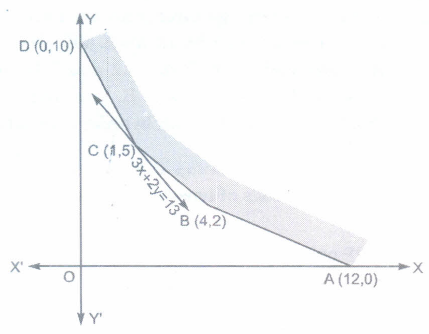
Determine the minimum value of Z = 3x + 2y (if any), if the feasible region for an LLP is shown in the figure:
8.
Solve the following problem graphically:
Minimise and Maximise : Z = 3x + 9y
subject to the constraints:
\(x+3y\le 60,\)
\(x+y\ge 10,\)
\(x\le y\)
\(x\ge 0,\)
\(y\ge 0.\)
9.
Solve the following linear programming problem graphically:
Maximise Z = 4x + y
subject to the constraints:
\(x+y\le 50,\)
\(3x+y\le 90,\)
\(x\ge 0,y\ge 0.\)
10.
(Manufacturing Problem) A small firm manufactures gold rings and chains. The total number of rings and chains manufactured per day is atmost 24. It takes 1 hour to make a ring and 30 minutes to make a chain. The maximum number of hours available per day is 16. If the profit on a ring is Rs. 300 and that on a chain is Rs. 190, find the number of rings and chains that should be manufactured per day, so as to earn the maximum profit. Make it as an LPP and solve it graphically.
11.
A housewife wishes to mix together two kinds of food X and Y, in such a way that the mixture contains at least 10 units of vitamin A, 12 units of vitamin Band 8 units of vitamin C. The vitamin contents of one kg of food is given below:
| Vitamin A | Vitamin B | Vitamin C | |
| Food X | 1 | 2 | 3 |
| Food Y | 2 | 2 | 1 |
One kg of food X costs Rs. 6 and one kg of food y costs Rs. 10. Formulate the above problem as a linear programming problem and find the least cost of the mixture which will produce the diet graphically. What value will you like to attach with this problem?
12.
A cottage industry manufactures pedestal lamps and wooden shades, each requiring the use of a grinding/cutting machine and a sprayer. It takes 2 hours on grinding/cutting machine and 3 hours on the sprayer to manufacture a pedestal lamp. It takes 1 hour on the grinding/cutting machine and 2 hours on the sprayer to manufacture a shade. On any day, the sprayer is available for at the most 20 hours and the grinding/cutting machine for at the most 12 hours. The profit from the sale of a lamp is Rs. 5 and that from a shade is Rs. 3. Assuming that the manufacturer can sell all the lamps and shades that he produces, how should he schedule his daily production in order to maximise his profit? Formulate the above as a LPP and solve it graphically.
13.
A cottage industry manufacturers pedestal lamps and wooden shades, each requiring the use of a grinding/cutting machine and a sprayer. It takes 2 hours on grinding/cutting machine and 3 hours on the sprayer to manufacture a pedestal lamp. It takes 1 hour on the grinding/cutting machine and 2 hours on the sprayer to manufacture a shade. On any day, the sprayer is available for at the most 20 hours and the grinding/cutting machine for at the most 12 hours. The profit from the sale of a lamp is Rs. 25 and that from a shade is Rs. 15.Assuming that the manufacturer can sell all the lamps and shades that he produces, how should he schedule his daily production in order to maximize his profit? Formulate an LPP and solve it graphically.
14.
Find graphically, the maximum value of Z = 2x + 5y, subject to constraints given below: 2x + 4y \(\le \) 8 \(\Rightarrow\) x + 2y \(\le \) 4
3x + y \(\le \) 6
x + y \(\le \) 4
x \(\\ \ge \) 0, y \(\\ \ge \) 0
15.
A manufacturing company makes two model A and B of a product. Each piece of mode} A requires 9 hours of labour for fabricating and 1 hour for finishing. Each piece of model B requires 12 hours of labour for fabricating and 3 hours for finishing. The maximum number of labour hours, available for fabricating and for finishing, are 180 and 30 respectively. The company makes a profit of Rs. 8,000 and Rs. 12,000 on each piece of model A and model B respectively. How many pieces of each model should be manufactured to get maximum profit? Also, find the maximum profit.
1.
Let the distance covered with speed of 25km/h = x hm
and the distance covered with speed of
40 km/h = y km
The.total distance covered = z km
The L.P.P. of the above problem, therefore, is
Maximize z = x + y
Subject to constraints
4x + 5y \(\le \)200
x/50 + y/40 \(\le\)1
x\(\ge \)0, y\(\ge\)0
Any one value
2.
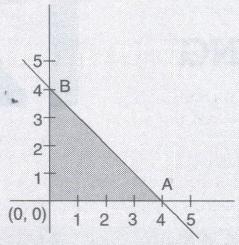
The feasible region determined by the constraints, x + y ≤ 4, x ≥ 0, y ≥ 0, is as follows.
The corner points of the feasible region are O (0, 0), A (4, 0), and B (0, 4). The values of Z at these points are as follows.
| Corner point | Z = 3x + 4y | |
| O(0, 0) | 0 | |
| A(4, 0) | 12 | |
| B(0, 4) |
16 |
→ Maximum |
Therefore, the maximum value of Z is 16 at the point B (0, 4).
3.
Let the house wife buy 'x' packets of plain biscuits and 'y' packets of Chocolate biscuits.
We have:
\(x\ge 3\)..(1)
\(y\ge 4\)..(2)
\(6x+9y\le 72\) ...(3)
i.e. \(2x+3y\le 24\)..(4)
The objective function, is given by:
Z = x + y
For the solution set, we draw the lines:
x = 3, y = 4, 2x + 3y = 24
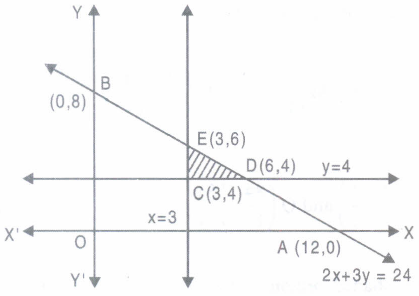
The feasible region (shaded) is bounded.
Let us evaluate Z at the corner points:
C(3, 4), D(6, 4) and E(3, 6).
Applying Corner Point Method, we have:
| Corner Point | Z = x + y |
| C : (3, 4) | 7 |
| D : (6, 4) | 10 (Maximum) |
| E : (3, 6) | 9 |
Hence, the maximum number of packets: 6 Packets: Plain Biscuits and 4 Packets: Chocolate Biscuits.
4.
Let the tailor A work for 'x' days and B for 'y' days.
We have: Shirts Pants
Tailor (A) 6 4
Tailor (B) 10 4
Thus we have the following constraints:
\(x\ge 0\)...(1)
\(y\ge 0\) ..(2)
\(6x+10y\ge 60\) ..(3)
i.e. \(3x+5y\ge 30\)
\(4x+4y\ge 32\)
i.e. \(x+y\ge 8\)
The objective function, or the cost, Z is:
Z = 150x + 200y
For the solution set, we draw the lines:
x = 0, y = 0, 3x + 5y = 30, x + y = 8.
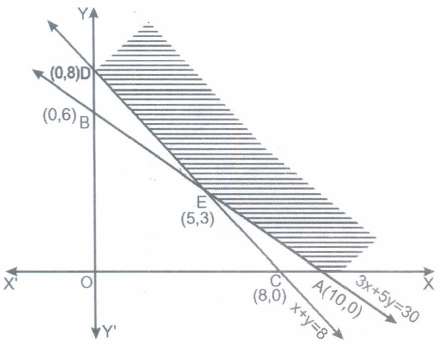
The feasible region (shaded) is unbounded.
Let us evaluate Z at the corner points:
A (10, 0), D (0, 8) and E (5, 3)
[Solving x + y = 8, 3x + 5y = 30; x = 5, y = 3]
Applying Corner Point Method, we have:
| Corner Point | Z = 150x + 200y |
| A : (10, 0) | \(\frac { 1400 }{ 3 } \) |
| E : (5, 3) | 1350 (Minimum) |
| D : (0, 8) | 1600 |
Hence, the tailor A should work for 5 days and B for 3 days for the minimum cost of Rs. 1,350.
5.
The system constraints is:
\(x-2y\le 2\)....(1)
\(3x+2y\le 12\) ..(2)
\(-3x+2y\le 3\) ..(3)
and \(x\ge 0,y\ge 0\) ..(4)
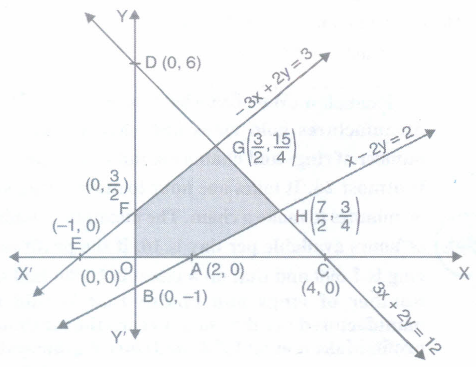
The line x - 2y and 3x + 2y = 12 meet at H \(\left( \frac { 7 }{ 2 } ,\frac { 3 }{ 4 } \right) \).
The lines -3x + 2y = 3 and 3x + 2y = 12 meet at G \(\left( \frac { 3 }{ 2 } ,\frac { 15 }{ 4 } \right) \)
The shaded portion in the above figure is the feasible region, which is bounded.
Applying Corner Point Method, we are to determine the maximum and minimum values of Z, where Z = 5x + 2y.
| Corner Point | Z = 5x + 2y |
| O : (0, 0) | 0 |
| A : (2, 0) | 10 |
| H : \(\left( \frac { 7 }{ 2 } ,\frac { 3 }{ 4 } \right) \) | 19 |
| G : \(\left( \frac { 3 }{ 2 } ,\frac { 15 }{ 4 } \right) \) | 15 |
| F : \(\left( 0,\frac { 3 }{ 2 } \right) \) | 3 |
Hence, Zmin = 0 at (0,0) and Zmax = 19 at \(\left( \frac { 7 }{ 2 } ,\frac { 3 }{ 4 } \right) \)
6.
The system of constraints is:
\(x+y\le 4\)..(1)
\(x\ge 0,y\ge 0\) ..(2)
It is observed that the feasible region OAB is bounded.
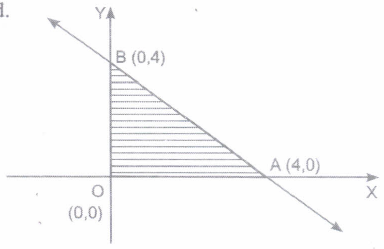
∴ By Corner Point Method, we have:
| Corner Point | Corresponding Value of Z |
| O : (0, 0) | 0 |
| A : (4, 0) | 8 |
| B : (0, 4) | 12 (Maximum) |
Hence, Zmax = 12 at (0, 4).
7.
The feasible region is unbounded.
∴ Minimum value of Z may or may not exist.
Applying Corner Point Method, we have:
| Corner Point | Value of Z |
| A : (12,0) | 36 |
| B : (4,2) | 16 |
| C : (1,5) | 13 (Minimum) |
| D : (0,10) | 20 |
We graph 3x + 2y < 13.
It is observed that the open half plane determined by 3x + 2y < 13 and R do not have a common point.
Hence, Minimum value of Z = 13.
8.
First of all, let us graph the feasible region of the system of linear inequalities (2) to (5). The feasible region ABCD. Note that the region is bounded. The coordinates of the corner points A, B, C and D are (0, 10), (5, 5), (15,15) and (0, 20) respectively
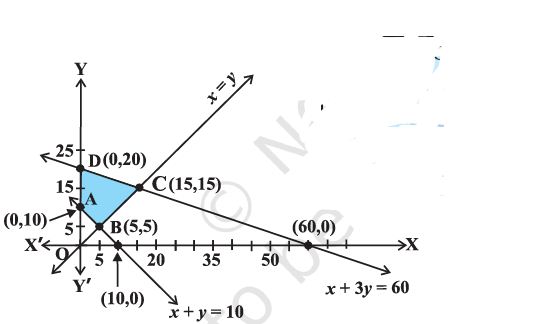
We now find the minimum and maximum value of Z. From the table, we find that the minimum value of Z is 60 at the point B (5, 5) of the feasible region.
The maximum value of Z on the feasible region occurs at the two corner points C (15, 15) and D (0, 20) and it is 180 in each case.
| Corner Point | Corresponding value of Z |
| D : (0,10) | 90 |
| E : (5,5) | 60 (Minimum) |
| F : (15,15) | 180} Maximum Values |
| B : (0,20) | 180} Maximum Values |
9.
The shaded region is the feasible region determined by the system of constraints (2) to (4). We observe that the feasible region OABC is bounded. So, we now use Corner Point Method to determine the maximum value of Z.
The coordinates of the corner points O, A, B and C are (0, 0), (30, 0), (20, 30) and (0, 50) respectively. Now we evaluate Z at each corner point.
\(x+y\le 50\)...(1)
\(3x+y\le 90\) ..(2)
and \(x\ge 0,y\ge 0\)..(3)
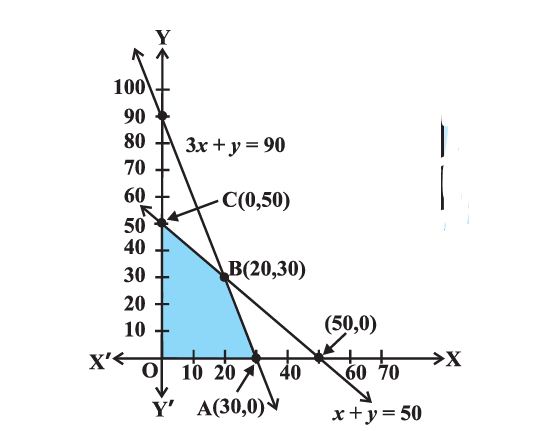
It is observed that the feasible region OCEB is bounded.
Thus we use Corner Method to determine the maximum value of Z, Where:
Z = 4x + y ..(4)
The co-ordinates of O,C,e and B are (0,0), (30,0), (20,30) [Solving x + y = 50, 3x + y = 90; x = 20, y = 3] and (0, 50) respectiely.
| Corner point | Corresponding Value of Z |
| O:(0,0) | 0 |
| C:(30,0) | 120 (Maximum) |
| E:(20,30) | 110 |
| B:(0,50) | 50 |
Hence, maximum value of Z is 120 at the point (30, 0).
10.
Let 'x' and 'y' be the number of gold rings and chains respectively.
We have:
\(x\ge 0\) ...(1)
\(y\ge 0\)...(2)
\(x+y\le 24\)...(3)
\(x+\frac { y }{ 2 } \le 16\) ...(4)
The objective function, or the profit, Z is:
Z = 300x + 190y ..(5)
We have to maximise Z subject to (1)-(4).
For solution set, we draw the lines:
x = 0, y = 0, x + y = 24, 2x + y = 32.
The lines x + y = 24 and 2x + y = 32 meet at E (8,16).
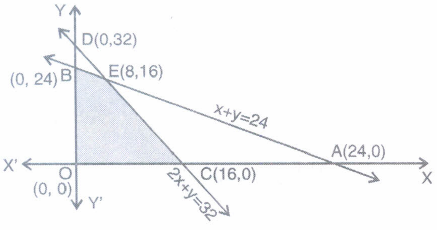
The shaded portion represents the feasible region, which is bounded.
Applying Corner Point Method, we have:
| Corner Point | Z = 300x + 190y |
| O : (0,0) | 0 |
| C : (16,0) | 4800 |
| E : (8,16) | 5440 (Maximum |
| B : (0,24) | 4560 |
Hence, the maximum profit is Rs. 5,440 and it is obtained when 8 gold rings and 16 chains are manufactured.
11.
Let x kg and y kg of food X and Y be mixed for the minimum cost of mixture, then LPP is
Minimise,
Z = 6x + 10 y
Subject to :
x + 2y \(\ge \) 10
2x + 2y \(\ge \) 12 \(\Rightarrow\) x + y \(\ge \) 6
3x + y \(\ge \) 8
x, y \(\ge \) 0
Correct graph
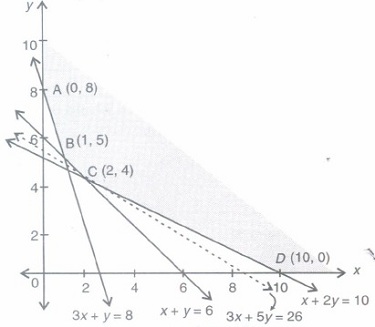
| Corner | Values of Z |
| (0, 8) | Rs. 80 |
| (1, 5) | Rs. 56 |
| (2, 4) | Rs. 52 (Minimum) |
| (10, 0) | Rs. 60 |
Region is unbounded
Rs. 52 i.e., 6x + 10y < 52 or 3x + 5y < 26 has no point common with feasible region.
\(\therefore\) The LPP has optimum solution at (2, 4) and least cost of the mixture = Rs. 52
Value: Balanced diet is essential for healthy body.
12.
Let number of pedestal lamps be x, and wooden shades by y.
LPP is Maximise P = 5x + 3y
Subject to 2x + y \(\le \) 12
3x + 2y \(\le \) 20
x \(\ge \)0, y\(\ge \) 0
Extreme points of feasible region are:A(0, 10), B(4, 4), C(6, 0)
P(A = 30, P(B) = 32, P(C) = 30
\(\therefore\) Max. Profit at B = 32
when pedestal lamps = 4, Wooden shades = 4
13.
Let the number of lamps and shades manufactured be x and y respectively.
\(\therefore\) LPP is maximise.
Z = 25x + 15y
Subject to 2x + y \(\le \) 12
3x + 2y \(\le \) 20
x \(\ge \) 0, y\(\ge \) 0
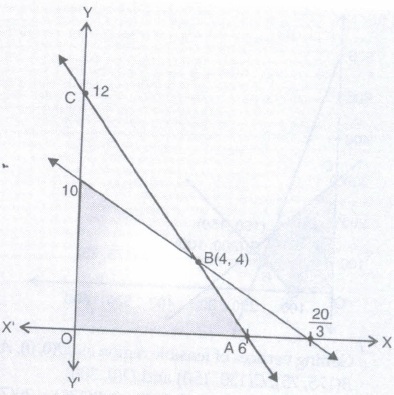
Vertices of feasible region are O(0, 0), A (6, 0), B(4, 4) and C (0, 10).
\(\begin{array}{|c|c|c|c|} \hline & \begin{array}{c} \text { Grinding/cutting } \\ \text { machine } \end{array} & \text { Sprayer } & \text { Profit } \\ \hline \text { Pedestal lamps } & 2 \mathrm{hr} & 3 \mathrm{hr} & \text { Rs 25 } \\ \hline \text { Wooden shades } & 1 \mathrm{hr} & 2 \mathrm{hr} & \text {Rs 15} \\ \hline \leq 12 \mathrm{hr} & \leq 20 \mathrm{hr} & \\ \hline \end{array}\)
P(A) = 150, P(B) = 160, P(C) = 150 and For max. profit no. of lamps = 4
no. of shades = 4
\(\begin{array}{|c|c|c|} \hline \text { Points } & Z=25 x+15 y & \text { Values } \\ \hline A(6,0) & 150+0 & 150 \\ \hline B(4,4) & 100+60 & 160 \\ \hline C(0,10) & 0+150 & 150 \\ \hline \end{array}\)
Maximum Profit = Rs. 160.
14.
Given inequations are
\(2 x+4 y \leq 8 \text { or } \ x+2 y \leq 4 \)
\(3 x+y \leq 6, x+y \leq 4, \ x \geq 0, \ y \geq 0
\)
Maximise Z = 2x + 5y on plotting the graph of the inequations we notice shaded portion as feasible solution
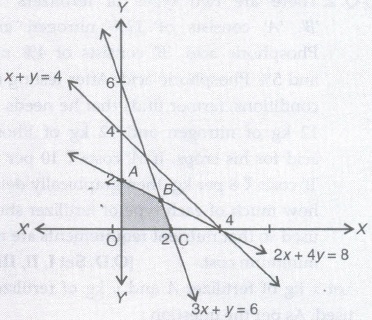
Possible points for maximum Z are A(2, 0),\(B\left(\frac{8}{5}, \frac{6}{5}\right)\) C (0,2)
| Points | Z= 2x + 5y | Values |
| A(2,0) | 4 + 0 | 4 |
| \(B\left(\frac{8}{5}, \frac{6}{5}\right)\) | \(\frac{16}{5}+\frac{30}{5}\) | \(\frac{46}{5}=9 \frac{1}{5}\) |
| C(0,2) | 0 + 10 | 10 \(\leftarrow\) Maximum |
Z is maximum at qo, 2), i.e. x = 0, y = 2, maximum value = 10
15.
Let the number of pieces of model A to be manufactured be x and the number of pieces of model B to be manufactured be y. Then LPP is maximize P = 8,000 x + 12,000 y
S.T. 9x + 12y \(\le \) 180
3x + 4y\(\le \) 60
x + 3y \(\le \) 30
x, y\(\ge \) 0
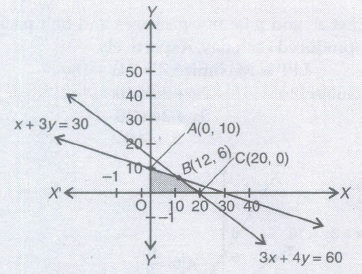
Vertices of feasible region are A(0, 10), B(12, 6) and C(20, 0).
P(A) = Rs. 1,20,000 at (0, 10)
P(B) = Rs. 1,68,000 at (12, 6)
P(C) = Rs. 1,68,000 at (20, 0)
Max. = Rs. 1,68,000 at (12, 6)
Hence, the number of pieces of model A = 12, the number of pieces of model B = 6 and the maximum profit = Rs. 1,68,000

12th Standard CBSE Syllabus & Materials
12th Standard CBSE
CBSE 12th Computer Science Python Revision Tour I - New Previous year Question Papers Study Material - QB365 Set A
NEW12th Standard CBSE
CBSE 12th Business Studies Planning Important Questions And Answers Study Material - QB365 Set A
NEW12th Standard CBSE
CBSE 12th Business Studies Business Environment Important Questions And Answers Study Material - QB365 Set A
NEW12th Standard CBSE
CBSE 12th Business Studies Principles of Management Important Questions And Answers Study Material - QB365 Set A



CBSE 12th Standard CBSE Subjects
CBSE Standards










