
 100% FREE ACCESS
12th Standard CBSE Syllabus & Materials
12th Standard CBSE
CBSE 12th Economics Government Budget and the Economy Previous year Question Papers Study Material - QB365 Set A
NEW12th Standard CBSE
CBSE 12th Computer Science Interface Python with MySQL - New Previous year Question Papers Study Material - QB365 Set A
NEW12th Standard CBSE
CBSE 12th Computer Science Database Concept - New Previous year Question Papers Study Material - QB365 Set A
NEW12th Standard CBSE
CBSE 12th Computer Science Data Communication - New Previous year Question Papers Study Material - QB365 Set A
NEW12th Standard CBSE
CBSE 12th Computer Science Data Structures - New Previous year Question Papers Study Material - QB365 Set A
NEW12th Standard CBSE
CBSE 12th Computer Science Functions - New Previous year Question Papers Study Material - QB365 Set A

Published on: 05/03/2019
Magnetic Effects of Current Important Mock Test
Download CBSE Class 12th Standard CBSE Physics question papers, sample papers, important questions, and previous year solved papers in PDF format. Get free study materials, NCERT solutions, and exam preparation resources for Class 12th Standard CBSE Physics
Questions + Answers key
Take MCQ Physics Test
1.
Two long straight parallel conductors carrying steady currents I1 and I2 are separated by a distance 'd', Explain brifely, with the help of a suitable diagram, how the magnetic field due to one conductor acts on the other. Hence deduce the expression for the force acting between the two conductors. Mention the nature of this force.
2.
(i) Name the machine which uses crossed electric and magnetic fields to accelerate the ions to high energies. With the help of a diagram, explain the resonance condition.
(ii) What will happen to the motion of charged particle if the frequency of the alternating voltage is doubled?
3.
(i) Write the expression for the force F acting on a particle of mass m and charge q moving with velocity v in a magnetic field B. Under what conditions will it move in
(a) a circular path and
(b) a helical path?
(ii) Show that the kinetic energy of the particle moving in magnetic field remains constant.
4.
(i) State Ampere's circuital law expressing it in the integral form.
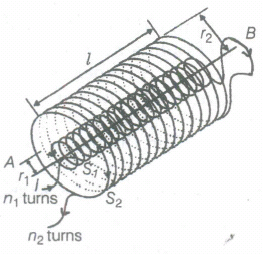
(ii) Two long co-axial insulated solenoids S1 and S2 of equal length are wound one over the other as shown in the figure. A steady current I flows through the inner solenoid S1 to the other end B which is connected to the outer solenoid S2 through which the some current I flows in the opposite direction so, as to come out at end A. If n1 and n2 are the number of turns per unit length, find the magnitude and direction of the net magnetic field at a point
(a) inside on the axis and
(b) outside the combined system.
5.
A bar magnet of magnetic moment m and moment of inertia I (about a center, perpendicular to the length) is cut into two equal pieces, perpendicular to the length. Let T be the period of oscillations of the original magnet about an axis through the midpoint, perpendicular to the length, in a magnetic field B, what would be the similar period T' for each piece?
6.
If \({ \theta }_{ 1 } \ and \ { \theta }_{ 2 }\) be the apparent angles of dip observed in two vertical planes at right angles to each other, then show that the true angle of dip, \({ \theta }\) is given by \({ cot }^{ 2 }\theta ={ cot }^{ 2 }{ \theta }_{ 1 }+{ cot }^{ 2 }{ \theta }_{ 2 }.\)
7.
A solenoid of length 1.0 m and 3.0 cm diameter has 5 layers of windings of 850 turns each and carries a current of 5 ampere. What is the magnetic field at the centre of the solenoid? Also calculate the magnetic flux for a cross-section of the solenoid at the centre of the solenoid.
8.
In a galvanometer there is a deflection of 10 divisions per mA. The internal resistance of the galvanometer is 78 \(\Omega\). If a shunt of 2 \(\Omega\) is connected to the galvanometer and there are 75 divisions in all on the maximum current which the galvanometer can read.
9.
(i) Draw a schematic sketch of a cyclotron. Explain clearly the role of crossed electric and magnetic field in accelerating the charge. Hence, derive the expression for the kinetic energy acquired by the particles.
10.
Dimpi's class was shown a video on effects of magnetic field on a current carrying straight conductor. She noticed that the force on the straight current carrying conductor becomes zero when it is oriented parallel to the magnetic field and this force becomes maximum when it is perpendicular to the field. She shared this interesting information with her grandfather in the evening. The grandfather could immediately relate it to something similar in real life situations. He explained it to Dimpi that similar things happen in real life too. When we align and orient our thinking and actions in an adaptive and accommodating way our lives become more peaceful and happy. However, when we adopt an unaccommodating and stubborn attitude, life becomes troubled and miserable. We should therefore always be careful in our response to different situations in life and avoid unnecessary conflicts.
Answer the following based on above information:
(a) Express the force acting on a straight current carrying conductor kept in a magnetic field in vector form. State the rule used to find the direction of this force.
(b) Which one value is displayed and conveyed by the grandfather as well as Dimpi?
(c) Mention one specific situation from your own life which reflects similar values shown by you towards your elders.
11.
Bala and rama (Class X students), were assigned a project based on magnetism.In their project work, they had calculated the value of the earth's magnetic field.When they submitted their project for verification.Mr.Santosh, their Physics techer, corrected the mistakes. He also suggested few books which could be useful for them.
i) What values did Mr.Santosh exhibit towards his students? Mention any two.
ii) Mention the three magnetic elements required to calculate the value of the earth's magnetic field.
iii) What is the strength of the earth's magnetic fields at the surface of the earth?
12.
When a galvanometer having 30 divisions scale and 100 \(\Omega \) resistance is connected in series with the battery of e.m.f. 3 volt through a resistance of 200 \(\Omega \) , it shows full scale deflection. Find the fogure of merit of the galvanometer in microampere.
13.
An electron beam passes through a magnetic field of 4 x 10⁻³ weber/m2 and an electric field of 2 x 10⁴ Vm-1, both acting simultaneously. The path of electron remaining undeviated, calculate the speed of the electrons. If the electric field is removed, what will be the radius of the electron path ?
14.
Assume the dipole model for earth's magnetic field B which by \({ B }_{ v }=\)vertical component of magnetic field = \(\frac { { \mu }_{ 0 } }{ 4\pi } \frac { 2M\cos { \theta } }{ { r }^{ 3 } } { B }_{ H }=\) Horizontal component of magnetic field = \(\frac { { \mu }_{ 0 } }{ 4\pi } \frac { 2M\sin { \theta M } }{ { r }^{ 3 } } ,\theta ={ 90 }^{ \circ }=\) lattitude as measured from magnetic equator. Find loci of points for which
(i) \(\left| B \right| \) is minimum
(ii) dip angle is zero and
(iii) dip angle is\(\pm { 45 }^{ \circ }\).
15.
A square shaped plane coil of area 100 cm2 of 200 turns carries a steady current of SA. It is placed in a uniform magnetic field of 0.2T acting perpendicular to the plane of the coil. Calculate the torque on the coil when its plane makes an angle of 60° with the direction of the field. In which orientation will the coil be in stable equilibrium?
16.
Where on the surface of Earth is the vertical component of earth's magnetic field zero?
17.
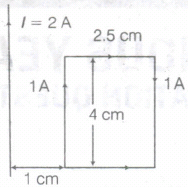
A rectangular loop of wire of size 2.5 cm x 4 cm carries steady current of 1 A. A straight wire carrying 2 A current is kept near the loop as shown. If the-loop and the wire are coplanar, find the (i) torque acting on the loop and (ii) the magnitude and direction of the force on the loop due to the current carrying wire.
18.
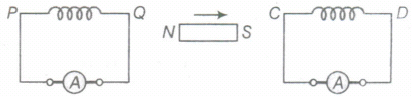
A bar magnet is moved in the direction indicated by the arrow between two coils PQ and CD. Predict the direction of the induced current in each coil.
19.
Out of the following, identify the materials which can be classified as
(i) paramagnetic
(ii) diamagnetic
(a) Aluminium
(b) Bismuth
(c) Copper
(d) Sodium
Write one property to distinguish between paramagnetic and diamagnetic materials.
20.
A long solenoid of length L having N turns carries a current I. Deduce the expression for the magnetic field in the interior of the solenoid.
21.
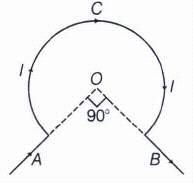
The wire shown in the figure, carries a current of 10 A. determine the magnitude of magnetic field induction at the centre O. Give the radius of bent coil is 3 cm.
22.
A permanent magnet in the shape of a thin Calculate of length 10 cm has M = 106 A/M. Calculate the magnetisation current Im .
23.
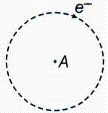
An electron is revolving around a circular loop as shown in the figure. What will be the direction of magnetic field at point A?
24.
A conductor of length 2 m carrying current of 2 A is held parallel to an infinitely long conductor carrying current of 10 A at a distance of 100 mm. Find the force on a small conductor?
25.
Using the concept of force between two infinitely long parallel current carrying conductors, define one ampere of current.
26.
Which of the following substances are paramagnetic?
Al, Bi, Cu, Ca, Pb, Ni.
27.
Can we have magnet with a single pole ?
28.
The coils in certain galvanometers, have a fixed core made of a non-magnetic metallic material. Why does the oscillating coil come to rest so quickly in such a core?
29.
A hydrogen ion of mass m and charge q travels with a speed v along a circle of radius r in a uniform magnetic field of flux density B. Obtain the expression for the magnetic force on the ion and determine its time period.
30.
If the distance between two parallel current carrying wires is doubled, what is the force between them?
31.
A current of one ampere is passed through a straight wire of length 2.0 metre. Find the magnetic field at a point in air at a distance 3 metre from one end of wire but lying on the axis of the wire.
32.
State the rule that is used to find the direction of magnetic field at a point near a current carrying straight conductor.
33.
A galvanometer having a coil resistance of \(100\Omega \) gives a full scale deflection, when a current of 1 mA is passed through it. The value of the resistance, which can convert this galvanometer into ammeter giving a full scale deflection for a current of 10 A is
\(0.01\Omega \)
\(2\Omega \)
\(0.1\Omega \)
\(3\Omega \)
34.
An electric charge + q moves with velocity \(\vec { \upsilon } =3\hat { i } +4\hat { j } +\hat { k } ,\) in an electromagnetic field give \(\vec { E } =3\hat { i } +\hat { j } +2\hat { k } ,\quad \vec { B } =\hat { i } +\hat { j } -3\hat { k } .\)They y-component of the force experienced by + q is
2 q
11 q
5 q
3 q
35.
Consider the two idealized systems: (i) a parallel plate capacitor with large and small separation and (ii) a long solenoid of length L>>R, radius of the cross-section. In (i) \(\overset { \rightarrow }{ E } \) is ideally treated as a constant between plates and zero outside. In (ii) magnetic field is constant inside the solenoid and zero outside. These idealized assumptions, however, contradict fundamental law as below:
case (i) contradicts Gauss's law for electrostatic fields.
case (ii) contradicts Gauss's law for magnetic fields.
case (i) agrees with \(\quad \oint { \overset { \rightarrow }{ E } .d\overset { \rightarrow }{ l } } =0\)
case (ii) contradicts \(\oint { \overset { \rightarrow }{ H } .d\overset { \rightarrow }{ l } } ={ l }_{ en }\)
36.
Two circular coils 1 and 2 are made from the same wire but the radius of the Ist coil twice that of the 2nd coil. What potential difference ratio should be applied across them so that the magnetic field at their centres is the same?
2
3
4
6
37.
A long solenoid has n turns per metre and current I A is flowing through it. The magnetic field induction at the ends of the solenoid is
zero
\({ \mu }_{ o }nI/2\)
\({ \mu }_{ o }nI\)
\(2{ \mu }_{ o }NI\)
38.
A positive charge is moving towards an observer. The direction of magnetic induction lines is
clockwise
anticlockwise
right
left
1.
The magnetic field, due to wire I, at any point on the wire 2, is directed normal to the direction of current flow in wire 2.
Magnetic field around wire 2, due to a current I1 in wire \({B}_{e}={{{\mu}_{0}{I}_{1}}\over{2\pi\ r}}\)
Force upon conductor carrying current due to magnetic field
\(\overrightarrow{F}=(\overrightarrow{l}\times\overrightarrow{B})\)
\(\therefore\) Force, F21 on a length 1 of wire 2 = \({I}_{2}l{{{\mu}_{0}{I}_{1}}\over{2\pi r}}\)
\(={{{\mu}_{0}{I}_{1}{I}_{2}}\over{2\pi r}}\)
Similarly, \({F}_{12}={{{\mu}_{0}{I}_{1}{I}_{2}}\over{2\pi r}}l\)
The nature of the force is repulsive for currents in opposite direction and attractive when currents flow in the same direction.
2.
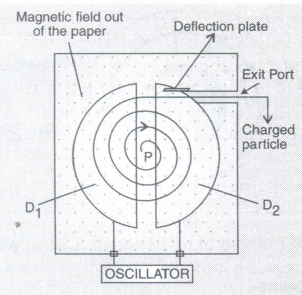
Construction: The cyclotron is made up of two hollow semi-circular disc like metal containers, \(D_1\) and \(D_2\) called dees.
It uses crossed electric and magnetic fields.The electric field is provided by an oscillator of adjustable frequency.
Working: In a cyclotron, the frequency of the applied alternating field is adjusted to be equal to the frequency of revolution of the charged particles in the magnetic field. This ensures that the particles get accelerated every time they cross the space between the two dees. The radius of their path increases with increase in energy and they are finally made to leave the system via an exit slit.
3.
(i) Force acting on the particle, F = Bqv
In vector form, F = q(v x B)
where, B is uniform magnetic field and v is velocity with particle which is moving.
From this equation, it is clear that direction of force is perpendicular to the plane containing both v and B. In other words, force acts perpendicular to both v and B. When velocity becomes perpendicular to force, the path of the object becomes circular.
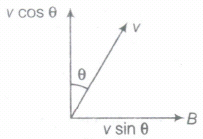
In this case, B is assumed to act perpendicular to v. In case, B is not perpendicular to v, a component of v remains perpendicular to v. It creates circular path. The component of v parallel to B will create linear path. Here, circular path is due to v cosθ and linear path is due to v sinθ. Both when combined gives helical path.
(ii) Since, force always adjusts itself in a direction which becomes perpendicular to velocity, so only direction of velocity is changes not the magnitude. Hence, the kinetic energy of the, particle always remains constant.
4.
(i) Ampere's circuital law states that the -line integral of magnetic field (B) around any closed path in vacuum is \(\mu_0\) times the pet current (1) threading the area enclosed by the curve. Mathematically, \(\oint B.dl=\mu_0 l\)
Ampere's law is applicable only for an Amperian loop as the Gauss's law is used for Gaussian surface in electrostatics.
(ii) According to Ampere's circuital .law, the net magnetic field is given by B = \(\mu_0\)ni
(a) The net magnetic field is given by
Bnet = B2 - B1
= \(\mu_0 n_2 I_2 - \mu_0 n_1 I_1\) [∵ I2 = I1 = I]
= \(\mu_0 I (n_2-n_1)\)
The direction is from B to A.
(b) As the magnetic field due to S1 is confined solely inside S1 as the solenoids are
assumed to be very long. So, there is no magnetic field outside S1 due to current in
S1 similarly there is no field outside S2.
∴ Bnet = 0
5.
Moment of inertia, I1 = I
Time period, T1 = T
Magnetic field = B, mass of magnet = x

As the magnet is cut into two pieces, mass of each piece
\(\frac { x }{ 2 } \)
Initial moment of inertia,
\(I=\frac { 1 }{ 12 } \times mass\times { \left( length \right) }^{ 2 }\)
\(I=\frac { 1 }{ 12 } \times \ x \ \times { \left( l \right) }^{ 2 }\)
where l = length of the magnet
Moment of inertia of half piece,
\({ I }^{ ' }=\frac { 1 }{ 12 } \times \frac { x }{ 2 } { \left( \frac { l }{ 2 } \right) }^{ 2 }=\frac { 1 }{ 12 } \times \frac { x{ l }^{ 2 } }{ 4 } \)
The magnetic moment of half piece, \({ m }^{ ' }=\frac { m }{ 2 } \)
Using the formula of time period,
\(T=2\pi \sqrt { \frac { I }{ mB } } \)
\( \frac { T }{ { T }^{ ' } } =\sqrt { \frac { I{ m }^{ ' }B }{ { I }^{ ' }mB } } =\sqrt { \frac { I }{ { I }^{ ' } } .\frac { { m }^{ ' } }{ m } }\)
\( \frac { T }{ { T }^{ ' } } =\sqrt { \frac { x{ l }^{ 2 }\times 12\times 4\times 2 }{ 12\times x{ l }^{ 2 } } \times \frac { m }{ 2m } } =\sqrt { 2\times 2 }\)
\({ T }^{ ' } \ =\frac { T }{ 2 } \)
The new time period of each piece is \(\frac { T }{ 2 } \)
6.
\({ tan\theta }_{ 1 }=\frac { V }{ { H }_{ 1 } } ,{ tan\theta }_{ 2 }=\frac { V }{ { H }_{ 2 } } ,{ tan\theta }=\frac { V }{ { H } } \)
As H1 & H2 are horizontal components in two planes at 90o to each other,
H2 = H12 + H22
\({ \left( Vcot\theta \right) }^{ 2 } \ ={ \left( Vcot{ \theta }_{ 1 } \right) }^{ 2 }+{ \left( Vcot{ \theta }_{ 2 } \right) }^{ 2 }\)
\(or \ { cot }^{ 2 }\theta ={ cot }^{ 2 }{ \theta }_{ 1 }+{ cot }^{ 2 }{ \theta }_{ 2 }.\)
7.
No. of turns, N = 850 x 5;
Area of cross section,
\(A=\pi { r }^{ 2 }=\frac { 22 }{ 7 } { \left( 3\times { 10 }^{ -2 } \right) }^{ 2 }{ m }^{ 2 };\)
l = 1 m; i = 5A.
Magnetic field induction at the centre of solenoid is
\(B={ \mu }_{ o }Ni/l=4\pi \times { 10 }^{ -7 }\times \left( 850\times 5 \right) \times 5/1\)
Magnetic flux = BA
\(=2.671\times { 10 }^{ -2 }\times \frac { 22 }{ 7 } \times { \left( \frac { 3 }{ 2 } \times { 10 }^{ -2 } \right) }^{ 2 }\)
= 1.89 x 10⁻⁵ Wb
8.
I = 0.3 A
9.
(ii) (a) Let the mass of proton = m; charge of proton = q, mass of a-particle = 4m
Charge of α-particle = 2q
Cyclotron frequency,
\(v=\frac{Bq}{2\pi m} \Rightarrow v \propto \frac{q}{m}\)
For proton frequency, vp\(\propto \frac{q}{m}\)
For α-particle,
Frequency, va \(\propto \frac{2q}{4m}\)
or va \(\propto \frac{q}{2m}\)
Thus, particles will not accelerate with same cyclotron frequency. The frequency of proton is twice than the frequency of α-particle.
(b) Velocity, \(v=\frac{Bqr}{m} \Rightarrow v \propto \frac{q}{m}\)
For proton velocity, \(v_p \propto \frac{q}{m}\)
For α-particle,
Velocity, v a \(\propto \frac{2q}{4m}\) or v a \(\propto \frac{q}{2m}\)
Thus, particles will not exit the dees with same velocity. The velocity of proton is twice than the velocity of α-particles.
10.
(a) \(\overrightarrow{F}=I(\overrightarrow{l} \times \overrightarrow{B})\), where \(\overrightarrow{l}\) is a vector of magnitude l, the length of the rod, and with a direction identical to the current I. Note that the current I is not a vector. According to Fleming's left hand rule,\(\overrightarrow{B}\) must act horizontally in a direction perpendicular to the wire carrying current.
(b) Adaptation to different situations and flexible and adjustable attitude.
(c) Avoiding unnecessary arguments in conflicting situations in everyday life.
11.
i) Mr.Santosh is helping in nature, honest and has concern for the students to create interest in the subject.
ii) Magnetic declination, magnetic inclination and horizontal component of the earth's magnetic field.
iii) It is of the order of 10-5 T.
12.
Here, n = 30, G = 100 \(\Omega \) , \(\varepsilon \) = 3 V,
R = 200, K = ?
Total resistance of the circuit
= G + R = 100 + 200 = 300 \(\Omega \)
Current in the circuit which produces full scale deflection in the galvanometer,
\({ I }_{ g }=\frac { \varepsilon }{ G+R } =\frac { 3 }{ 300 } =\frac { 1 }{ 100 } A\)
\(K=\frac { { I }_{ g } }{ n } =\frac { 1/100 }{ 30 } =\frac { 1 }{ 3 } \times { 10 }^{ -3 }A/division\)
\(=\frac { 1 }{ 3 } \times { 10 }^{ -3 }\times { 10 }^{ 6 }\mu \quad A/division\)
\(=333.3\mu \ A/division\)
13.
Here, B = 4 x 10⁻³ weber/m2;
E = 2 x 10⁴ V/m.
As the path of moving electron is undeviated, so force on moving electron due to electric field is equal and opposite to the force on moving electron due to magnetic field, i.e., eE = evB
\(or \ v=\frac { E }{ B } =\frac { 2\times { 10 }^{ 4 } }{ 4\times { 10 }^{ -3 } } =5\times { 10 }^{ 6 } \ m/s\)
When electron moves perpendicular to magnetic field, the radius r of circular path traced by electron is
\(or \ r=\frac { mv }{ eB } =\frac { \left( 9.1\times { 10 }^{ -31 } \right) \times \left( 5\times { 10 }^{ 6 } \right) }{ \left( 1.6\times { 10 }^{ -19 } \right) \times 4\times { 10 }^{ -3 } } \)
\(=7.11\times { 10 }^{ -3 } \ m=7.11 \ mm\)
14.
\({ B }_{ v }=\frac { { \mu }_{ 0 } }{ 4\pi } \frac { 2M\cos { \theta } }{ { r }^{ 3 } } \)
\({ \ B }_{ H }=\frac { { \mu }_{ 0 } }{ 4\pi } \frac { M\sin { \theta } }{ { r }^{ 3 } } \)
\(B=\sqrt { \begin{matrix} { { B }_{ v } }^{ 2 } & + & { { B }_{ H } }^{ 2 } \end{matrix} } =\frac { { \mu }_{ 0 }M }{ 4\pi { r }^{ 3 } } \left[ 4\cos ^{ 2 }{ \theta } +\sin ^{ 2 }{ \theta } \right] \)
\(B=\frac { { \mu }_{ 0 }M }{ 4\pi { r }^{ 3 } } \left[ 3\cos ^{ 2 }{ \theta } +1 \right] \)
Now B will be minimum if \(\cos { \theta } =0 \ or \ \theta ={ 90 }^{ \circ }\)
i.e. B will be minimum at magnetic equator.
(ii) Angle of dip is given by
\(\tan { \delta =\frac { { B }_{ V } }{ { B }_{ H } } } =\frac { 2\cos { \theta } }{ \sin { \theta } } =2\cot { \theta } \)
\(\delta =0,if \ \cot { \theta =0 \ or \ \theta =\frac { \pi }{ 2 } } \)
i.e. angle of dip is zero at magnetic equator(iii) \(\delta ={ 45 }^{ \circ },\cot { \theta =\frac { 1 }{ 2 } } or \ \tan { \theta =2 } \)
\( \theta =\tan ^{ -1 }{ 2is \ the \ locus. } \)
15.
Torque = \({\overrightarrow{\mu}}_{m}\times\overrightarrow{B}\)
\(|\overrightarrow{\mu}_{m}|=nI\times A = 200 \times5\times 100 \times{10}^{-4}A-{m}^{2
}\)
= 10 A - m2
Angle between \({\overrightarrow{\mu}}_{m}\) and \(\overrightarrow{B}=90°-60°=30°\)
|Torque| = 10 x 0.2 x sin 30°
= 1 N - m
16.
On the equator S, the vertical component of earth's magnetic field is zero.
17.
There will be force of attraction between the straight wire and 4 cm long arm of loop nearer to the straight conductor.
\(F_1=\frac{\mu_0}{4\pi} \frac{2\times2\times1}{(2\times10^{-2})}\times(4\times10^{-2})\)
[towards straight conductor]
\(F_1=8\times10^{-7}N\) --- (i)
Similarly, force on other 4 cm arm of loop, away from the straight conductor
\(F_2=\frac{\mu_0}{4\pi} \frac{2\times2\times1}{(4.5\times10^{-2})}\times(4\times10^{-2})\)
\(F_2=3.55 \times 10^{-7} N\) --- (ii)
(i) Since, F1 and F2 are of different magnitudes, therefore, do not form couple and hence Torque, t = 0
(ii) Net force on loop,
\(F=F_1-F_2\)
[towards straight conductor]
\(F=8\times10^{-7}-3.55\times10^{-7}\)
F =\(4.45\times10^{-7}N\)
The forces on two branches of loop are equal in magnitude and opposite in the directions, hence they balance each other.
18.
By applying Lenz's law, we can find out direction of current in the coil. On the right hand side coil, South pole is approaching towards the coil, so at end C, South pole will be produced and on the left hand side, North pole is moving away, so at end Q coil, South pole will be produced.
20.
Figure shows the longitudinal sectional view of long current carrying solenoid. The current comes out of the plane of paper at points marked.
The B is the magnetic field at any point inside the solenoid.
Considering the rectangular closed path abcda. Applying Ampere's circuital law over loop abcda.
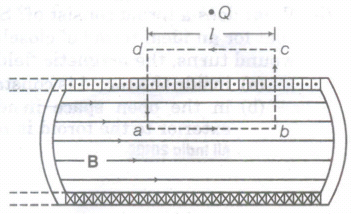
\(\oint {B.dI}=\mu_0 \) x(Total current passing through loop abcda)
\(\int_{a}^{b} B. dI+\int_{b}^{c} B. dI+\int_{c}^{d} B. dI+\int_{d}^{a} B. dI=\mu_0(\frac{N}{L}li)\)
where, \(\frac{N}{L}\) = number of turns per unit length
ab = cd = l = length of triangle.
\(\int_{a}^{b} B dI cos 0^{o}\int_{b}^{c} B dI cos 90^{0}+0+\int_{d}^{a} B dI cos 90{0}=\mu_0(\frac{N}{L}li)\)
\(B \int_{a}^{b} dI=\mu_0(\frac{N}{L}li) \Rightarrow Bl=\mu_0(\frac{N}{L})li\)
\(\Rightarrow B=\mu_0 (\frac{N}{L})i\)
or \(B=\mu_0 ni\)
where, n = number of turns per unit length. This is required expression for magnetic field inside the long current carrying solenoid.
21.
Here, I = 10 A, r = 3 cm, r = 3 x 10⁻² m
Angle subtended by coil at the centre,
\(\theta =360^{ \circ }-90^{ \circ }=270^{ \circ }=\frac { 3\pi }{ 2 } rad\)
Magnetic field induction at O due to current through circular path ACB is
\(B=\frac { \mu _{ 0 } }{ 4\pi } \times\frac { I }{ r } \emptyset ={ 10 }^{ -7 }\times\frac { 10 }{ (3\times{ 10 }^{ -2 }) } \times\frac { 3\pi }{ 2 } \)
\(\\ B=1.57\times{ 10 }^{ -4 }T\)
22.
Here, L = 10 cm = 0.1 m
Intensity of magnetisation, M = 106 A/m
Magnetisation current, Im = ?
Since, M = \(\frac { { I }_{ m } }{ I } \)
\(\therefore \ { I }_{ m }=M\times l\)
\(={ 10 }^{ 6 } \ A/m\times 0.1 \ m={ 10 }^{ 5 } \ A\)
23.
As, electron is revolving clockwise, therefore conventional current due to the motion of electron will be in anti-clockwise direction.
So, according to right hand rule,magnetic field at point A will be in outward direction to the plane of circular loop.
24.
8 x 10⁻⁵ N
25.
One ampere of current can be defined as the amount of current which when flows through two infinitely long parellel wires seperated by one metere produces an attractive foce 2 x 10⁻⁷N/m.
26.
Aluminium and calcium are paramagnetic.
27.
No, because unlike poles of equal strength exist together.
28.
In a galvanometer the coil having a fixed core made of non-magnetic metallic material, when oscillates, the eddy currents are set up in the metallic material which opposes the motion of the coil in the magnetic field. Due to it, the coil comes to rest at once.
29.
As hydrogen ion is describing a circular path in a uniform magnetic field, hence force on hydrogen ion due to perpendicular magnetic field is providing the centripetal force. So
\(Bqvsin{ 90 }^{ o }=\frac { m{ v }^{ 2 } }{ r } \ or\ r=\frac { mv }{ qB } \)
Time period of revolution of hydrogen ion
\(T=\frac { 2\pi r }{ v } =\frac { 2\pi }{ v } \times \frac { mv }{ qB } =\frac { 2\pi m }{ qB } \)
30.
The force acting on one wire due to currents through two wires is inversely proportional to the distance between them. Thus the force becomes 1/2 times if the distance between the wires is doubled.
31.
When a point P lies on the axis of wire conductor in air, then \(I\overrightarrow { dl } \ and \ \overrightarrow { r } \) for each element of the straight wire conductor are parallel. Therefore, \(I\overrightarrow { dl } \times \overrightarrow { r } =0,\) so the magnetic field induction at given point is zero.
32.
Right hand thumb rule states that, if we imagine a linear wire conductor to be need in the grip of the right hand such that the thumb points in the direction of current, then the curvature of the fingers around the conductor will give the direction of magnetic field lines.
33.
(a)
\(0.01\Omega \)
34.
(b)
11 q
35.
(d)
case (ii) contradicts \(\oint { \overset { \rightarrow }{ H } .d\overset { \rightarrow }{ l } } ={ l }_{ en }\)
36.
(c)
4
37.
(b)
\({ \mu }_{ o }nI/2\)
38.
(b)
anticlockwise

12th Standard CBSE Syllabus & Materials
12th Standard CBSE
CBSE 12th Computer Science Python Revision Tour I - New Previous year Question Papers Study Material - QB365 Set A
NEW12th Standard CBSE
CBSE 12th Business Studies Planning Important Questions And Answers Study Material - QB365 Set A
NEW12th Standard CBSE
CBSE 12th Business Studies Business Environment Important Questions And Answers Study Material - QB365 Set A
NEW12th Standard CBSE
CBSE 12th Business Studies Principles of Management Important Questions And Answers Study Material - QB365 Set A



CBSE 12th Standard CBSE Subjects
CBSE Standards










